
Soil Stabilization Methods: Guide for Foundations


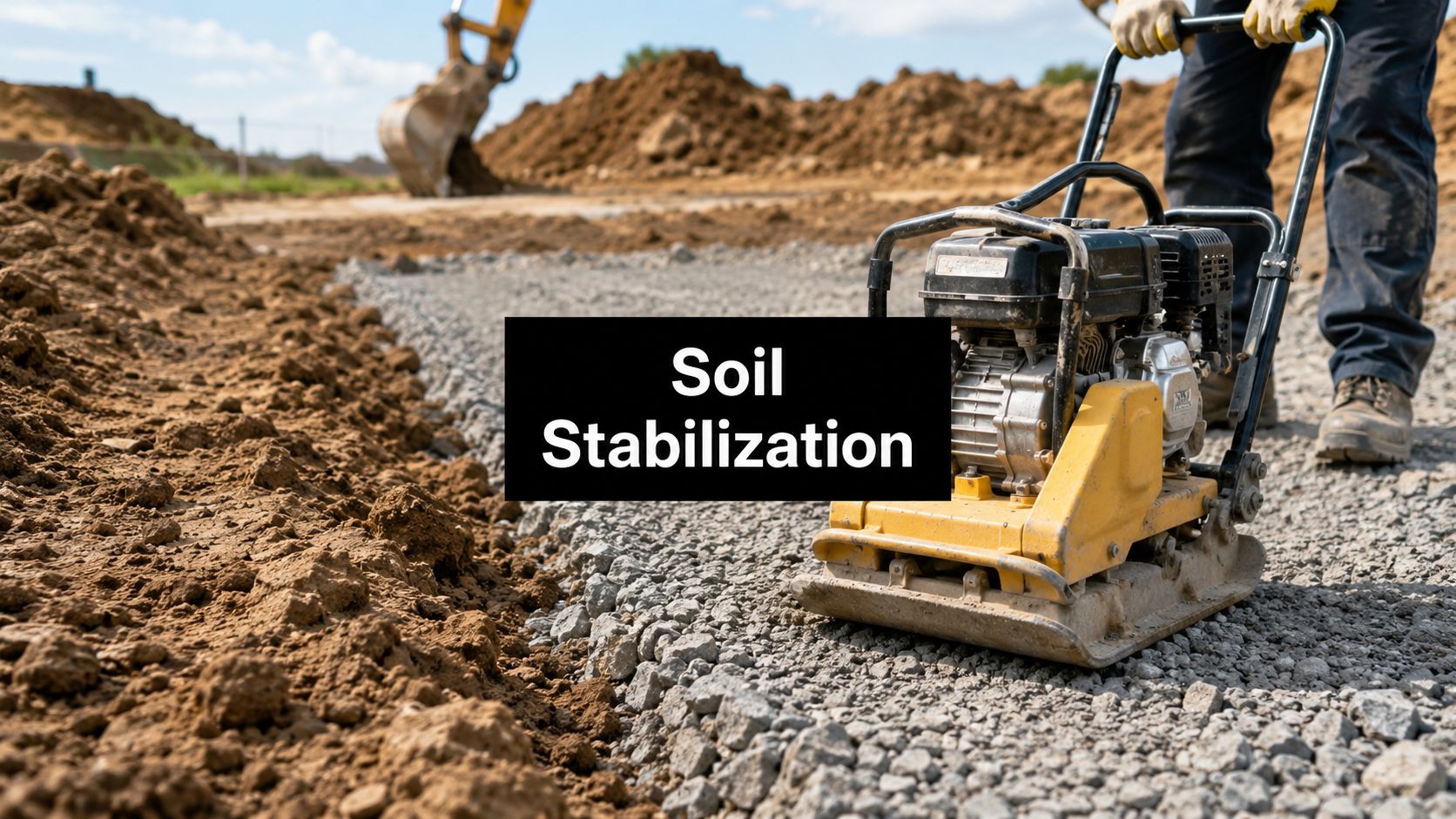
You’re usually not thinking about soil until the first test hole fills with water, the auger starts bringing up sticky clay, or a driveway base keeps pumping mud after a rain. That’s the moment soil stabilization methods stop being a technical phrase and start being the difference between a shed pad that stays level and one that settles, cracks, or ruts out under load. In Pennsylvania, Maryland, Delaware, and New Jersey, the ground can change fast from one lot to the next, so the right fix depends on what’s under the surface, not just what the project looks like from the street.
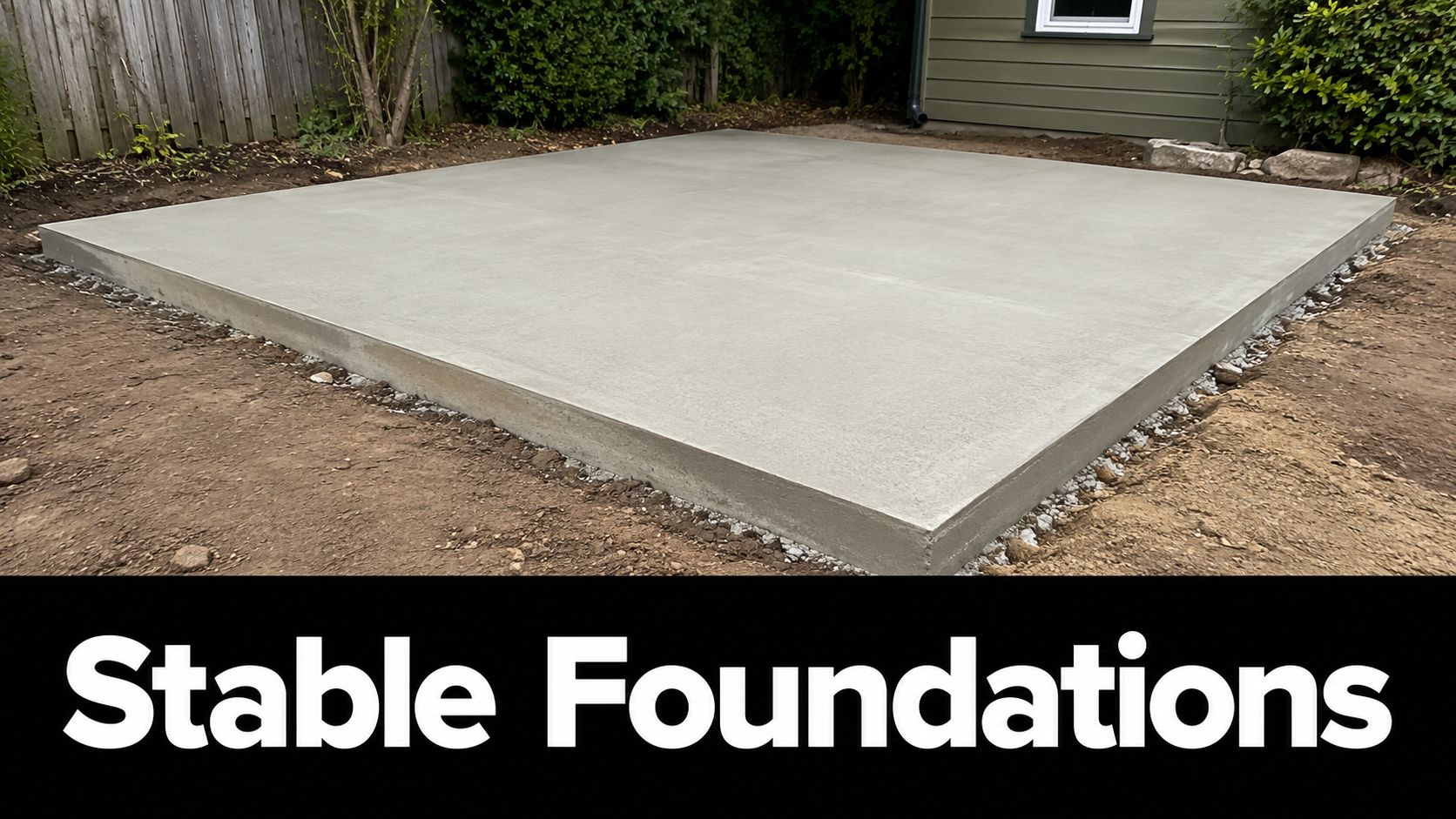
A lot of homeowners notice the warning signs before anyone ever talks about engineering. Water stands where it shouldn’t, the back corner of a shed leans, a previous fill area feels spongy, or frost keeps lifting the same section of a path every winter. Poor drainage is often part of the problem, and if you’re also dealing with runoff around the yard, preventing water damage with grading is a smart place to start thinking about the bigger picture.
For small projects, the question is simple. Can the soil support the load as it is, can it be improved in place, or does it need to be removed and rebuilt? That’s the same decision pathway used on shed foundations, garage slabs, gazebo pads, and driveway work. If you want a quick primer on how load-bearing ground gets evaluated, this guide on soil bearing capacity is a useful companion.
Why Your Shed Pad or Garage Foundation Might Need Soil Stabilization
The most common call starts with a familiar story. A homeowner wants a shed foundation, a base for storage shed, or a small concrete foundation for garage, and the hole reveals soft clay, wet fill, or a layer that just won’t compact cleanly. On the surface, the plan may still look straightforward, but the ground underneath is telling a different story.
What the ground is trying to tell you
In practice, bad drainage and weak subgrade usually show up in the same places. A shed foundation gravel base that sinks after rain, a garage footing that keeps cracking at the edge, or a gazebo foundation that feels uneven after a thaw all point to soil that needs more than a little extra stone on top. If a lot has been filled over time, the upper layer may look firm while the deeper material stays soft and unpredictable.
Practical rule: if the soil pumps water, ruts under equipment, or turns to paste during excavation, it needs to be evaluated before you pour concrete or set blocks.
That’s why soil stabilization methods matter so much for small residential work. The goal is not just to make the surface look solid. It’s to create a reliable platform that won’t move when the weather changes, especially on sites that need a shed foundation near the back line, a garage foundation contractor to prep a slab, or a gravel driveway that has to carry regular traffic.
For homeowners across the Mid-Atlantic, professional judgment saves money later. A pad that looks fine on day one can still fail if the underlying soil is wet, compressible, or frost-sensitive. Good stabilization turns a problem lot into a buildable site before the structure ever goes up.
Understanding the Main Soil Stabilization Methods
A backyard pad that looks fine on paper can still turn into a problem once the excavator opens it up. In PA, MD, DE, and NJ, the practical question is usually not whether the soil is perfect, it is which stabilization method will make the site buildable without overdoing the work.
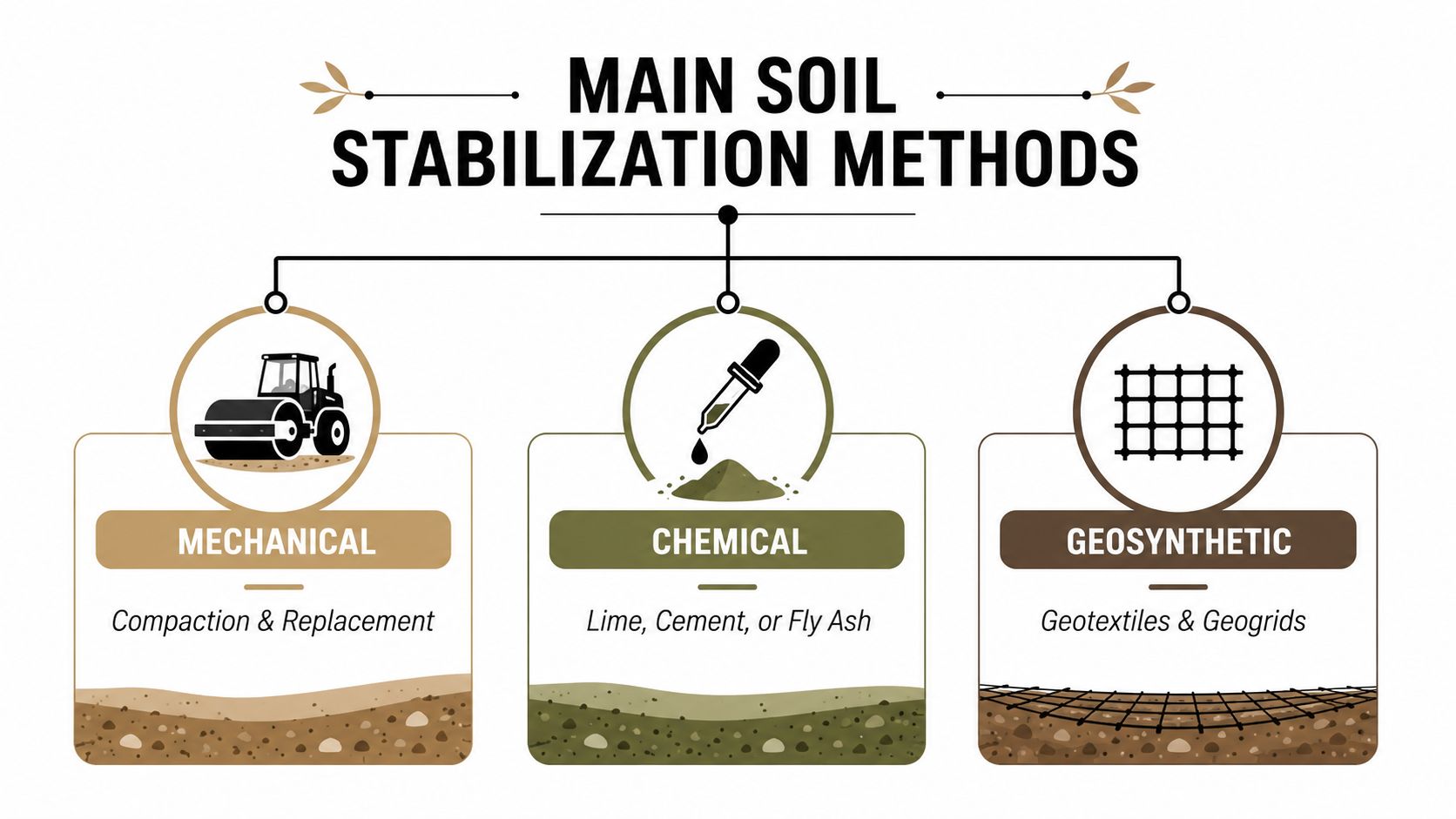
Mechanical, chemical, and geosynthetic options
Mechanical stabilization is the first option I look at on many small residential projects. It means building a better working layer with compacted stone or granular fill, then using the right lift thickness and compaction so the base carries load instead of sinking into soft subgrade. On sites with surface softness, this often solves the issue cleanly, especially for shed pads, driveway bases, and lighter slab work. The U.S. FHWA describes this approach for soft, wet subgrades and also ties chemical treatment to field targets, with lime for clay soils at 3 to 8 percent of dry soil weight and cement for granular or nonplastic soils at 3 to 10 percent, along with strength and density targets for each treated layer (FHWA guidance).
Chemical stabilization changes the soil itself instead of just building above it. Lime and cement react with the soil’s fines, so the soil type has to drive the mix, not the other way around. A clay-heavy backyard in Maryland does not behave like a sandy lot in southern New Jersey, and the wrong additive can leave you with a base that still moves when it gets wet or freezes. That is why a contractor should test or at least read the soil carefully before recommending treatment.
Geosynthetic reinforcement is the method I use when separation and load spreading matter more than brute force. Geotextile fabric and geogrid do not turn weak soil into stone. They keep the base from punching into the subgrade, hold the layers apart, and help the stone act like a single system under load. If you want a closer look at the setup, learn about geotextile fabric installation before choosing the fabric details. For some projects, builders also look at ground screws for decks when they need a different way to transfer load on difficult ground.
Deep mixing is the heavier intervention. Nordic geotechnical practice uses binder injected and blended in place, with a typical binder dosage of 150 to 250 kg/m³ and a target shear strength of 50 kPa (Nordic deep mixing reference). That level of treatment is well beyond what most homeowners need for a shed or garage pad, but it shows how far ground improvement can go when the soil is too weak for ordinary base work alone.
Choosing the Right Method for Your Residential Project
The right method for a 4×8 shed with foundation, 10×10 storage shed, garage footings and foundations, or driveway base comes down to four things, soil behavior, access, timeline, and what the finished structure needs to carry. For a lot of backyard projects, a gravel base plus fabric is enough. For a garage slab or a heavier concrete foundation for garage, the ground often needs a more deliberate fix.
A homeowner’s decision framework
If the site is only soft near the surface, mechanical stabilization is often the cleanest answer. If the soil is reactive clay, chemically treated layers may be the better path. If the issue is a weak transition zone or the base keeps blending into the subgrade, geotextile or geogrid reinforcement can help keep the system together. When the fill is inconsistent or the poor material runs deep, over-excavation and replacement may be the more honest solution.
Practical rule: the cheapest option on paper isn’t always the cheapest option after settlement, patching, and rework.
| Soil Stabilization Methods Compared for Residential Projects | ||||
|---|---|---|---|---|
| Method | Best For | Typical Projects | Relative Cost | Timeline |
| Mechanical stabilization | Soft or wet subgrades that need a stronger base | Shed pad, gravel driveway, gazebo foundation | Lower | Faster |
| Chemical stabilization | Clay or moisture-sensitive soils that need a stronger treated layer | Garage slab, thicker foundation builds, some driveway bases | Moderate | Longer |
| Geosynthetic reinforcement | Weak subgrades that need load separation and support | Shed foundation gravel base, driveway approaches, pad edges | Moderate | Faster |
| Over-excavation and replacement | Bad fill or very inconsistent soils | Small foundation builds, problem spots, new construction prep | Higher | Longer |
For homeowners comparing shed foundations contractors near me or garage foundation contractors, this is usually the point where a site visit matters more than any online estimate. The right answer depends on whether the soil is merely soft, structurally unreliable, or excessively wet to compact well.
Soil Conditions Common in PA MD DE and NJ
The Mid-Atlantic gives you a lot of different ground in a relatively small area. Parts of Pennsylvania and Maryland often bring heavier clay, which holds water and reacts strongly to moisture changes. Delaware and southern New Jersey can bring sandier ground, but that doesn’t automatically mean easy construction, because loose or poorly drained soils can still shift under load.
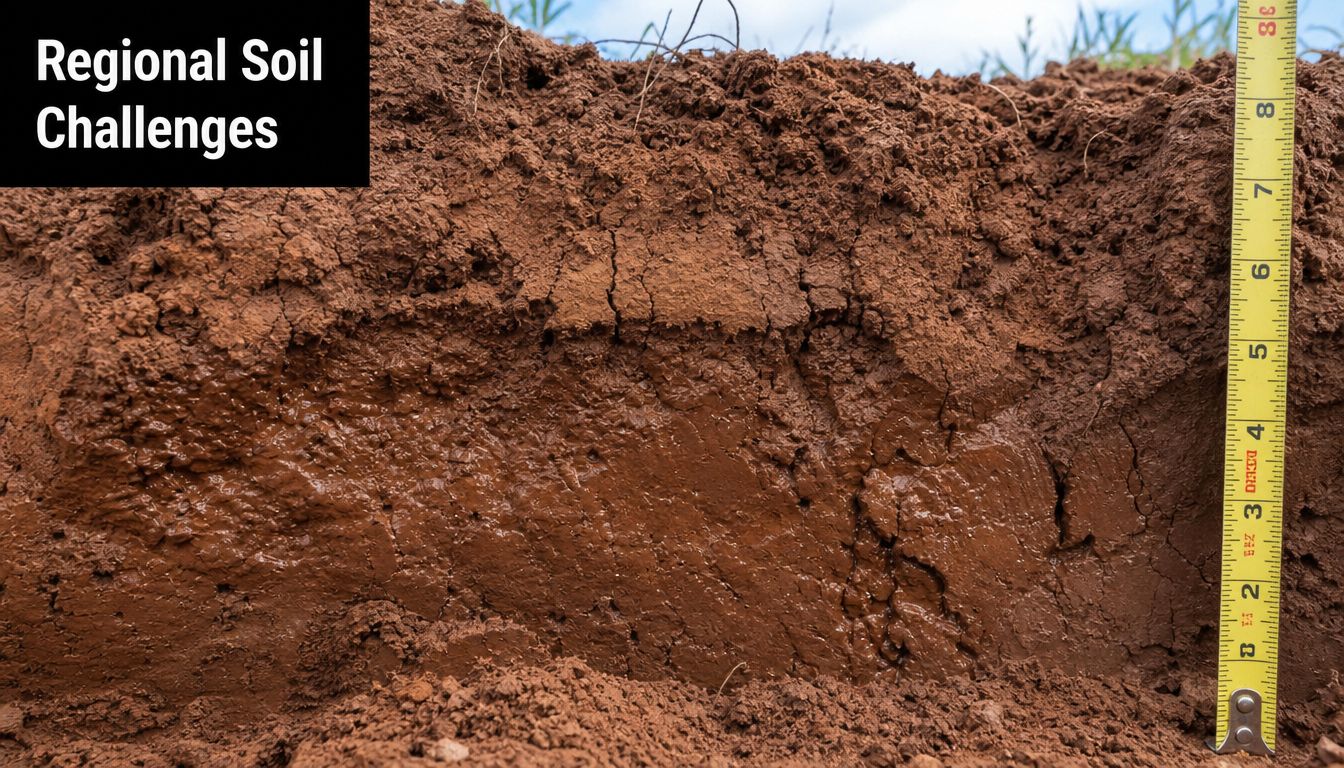
Why the same project behaves differently by county
A shed pad in Lancaster County can need a completely different approach than one in coastal Delaware. Clay wants the right treatment recipe and controlled moisture, while looser soils often need separation and compaction so the base doesn’t disappear into the subgrade. Government guidance also notes that, for successful treatment, the soil should be well graded and contain at least 12 percent material finer than 0.075 mm, with particle sizes ranging from sub-0.002 mm clay up to about 50 mm gravel, and clay particles are important for sulphonated products to react properly (UK government review).
The moisture side matters just as much. Chemical treatment works best when the recipe matches the soil classification and moisture state, and the recommended practice is to treat layers typically 150 to 200 mm deep and compact them immediately after mixing so the moisture doesn’t drift and the strength doesn’t vary (Texas and UK guidance). That’s one reason wet spring weather can complicate a job even when the soil itself seems workable.
For frost-sensitive sites, the issue is movement through the seasons. A driveway or shed pad that looks stable in July can behave very differently after freeze-thaw cycles. That’s why the same shed foundation gravel base can perform well on one lot and fail on another. The soil, drainage, and treatment method all need to fit together.
How Firm Foundations Implements Your Stabilization Plan
A good stabilization job starts before the first bucket of stone goes in. The site gets evaluated, the soil conditions get checked, and the crew decides whether the project calls for gravel, geotextile, chemical treatment, or a deeper rebuild. Mechanical methods can include placing solid materials on the soil surface or embedding them at depth, and the older field guidance also includes options like rock mulch, geotextile surface reinforcement, and altering the slope on more difficult sites (OSTI soil-stabilization report).
What the work looks like on site
The sequence is usually straightforward. First comes excavation and cleanup, then grading so water has somewhere to go. After that, the team installs the chosen stabilization layer, compacts it, and checks that the finished surface is ready for the next step, whether that’s concrete forms, shed blocks, or a gravel finish.
A stable base is built in layers, not guessed into place.
For a homeowner, the important part is not the machinery itself. It’s the discipline behind it. If the base is too wet, compacting early can trap problems in the pad. If it’s too dry or too loose, the structure can settle later. That’s why drainage, compaction, and clean transitions at the edges matter just as much as the visible top layer.
A professional crew also keeps the disruption manageable. You should expect excavation equipment, some noise, and a site that looks rough before it looks good. What you want to see is a clear process, consistent workmanship, and a finished grade that supports the structure instead of fighting it.
Cost Timeline and Environmental Considerations
Most homeowners want the same three things. They want the job done right, they want a fair price, and they don’t want surprises halfway through. For small residential work, mechanical gravel stabilization is usually the most economical path when the soil cooperates. Chemical treatment and full excavation are more involved, so they tend to suit bigger loads or problem sites where the extra work is justified.
What affects the price and schedule
The method drives the timeline. A straightforward gravel pad can move quickly once the site is ready, while treated soils need more coordination because mixing, placement, and compaction all have to line up. If the project also needs drainage correction or a larger dig, that adds time because the site has to be prepared before the base can be stabilized.
Modern options are broader than many homeowners realize. Recent summaries note that stabilization now includes soil polymers, recycled asphalt pavement, tire-derived aggregate, and bioengineering methods, but they also stress that design still depends on soil exploration, sampling, and mix design, which is a strong reminder that one-size-fits-all claims don’t hold up well in the field (ScienceDirect topic overview).
If you’re comparing quotes, a solid guide to yard grading pricing can help you understand where site prep ends and foundation work begins. That matters on driveway projects, shed pads, and garage prep because grading and stabilization often overlap.
Environmental concerns are mostly about using the right method for the right soil and keeping drainage under control. The better the match between soil, moisture, and treatment, the less likely you are to fight runoff, soft spots, or repeat repairs later.
Request Your Free Quote from Firm Foundations Today
The best soil stabilization methods are the ones matched to your site, not the ones that sound strongest in a brochure. A gravel shed base, a reinforced garage slab, a gazebo foundation, and a driveway rebuild can all need different solutions across PA, MD, DE, and NJ because the soil and drainage are never exactly the same from one property to the next. That’s why the smartest next step is a site-specific recommendation, not a guess.
Since 2011, Firm Foundations has focused on durable gravel pads and long-lasting concrete foundations for sheds, garages, houses, gazebos, horse barns, playsets, hot tubs, shipping containers, driveways, and patios. The team is licensed and insured, trusted by leading shed builders such as Stoltzfus Structures and Sheds Unlimited, and known for responsive communication, competitive pricing, and a build process that puts structural integrity and drainage first.
If you’re planning a shed foundation, garage foundation, gravel driveway, or a residential excavation job, don’t wait until settlement becomes a bigger repair. Reach out for a free quote and get a clear plan for the ground conditions on your property. You’ll know what it takes, what it costs, and what method makes sense before the work starts.
If you’re ready to stop guessing about soft spots, drainage, or the right base for your shed or garage, visit Firm Foundations to request your free quote. You’ll get straightforward guidance on the right stabilization approach for your site, plus a plan built for long-term performance across Pennsylvania, Maryland, Delaware, and New Jersey.