
Gravel Driveway Grading: Build a Drainage-Ready Surface


You've just had a new load of gravel spread across the driveway, and it looks smooth enough to park on. Then the next hard rain leaves water along the tire tracks, the entrance washes toward the road, or a soft spot opens beside the garage. That result is common when grading is treated as leveling instead of drainage design.
Gravel driveway grading should move water away from the travel surface, nearby foundations, and neighboring property while leaving a stable, comfortable route for vehicles. The right solution may involve crown shaping, excavation, a ditch crossing, aggregate replacement, or drainage work before the final stone is placed. That's why homeowners searching for driveway contractors near me, excavation near me, or a contractor who can prepare a base for a storage shed should start with the site, not just the surface.
Why Gravel Driveway Grading Is Really About Drainage
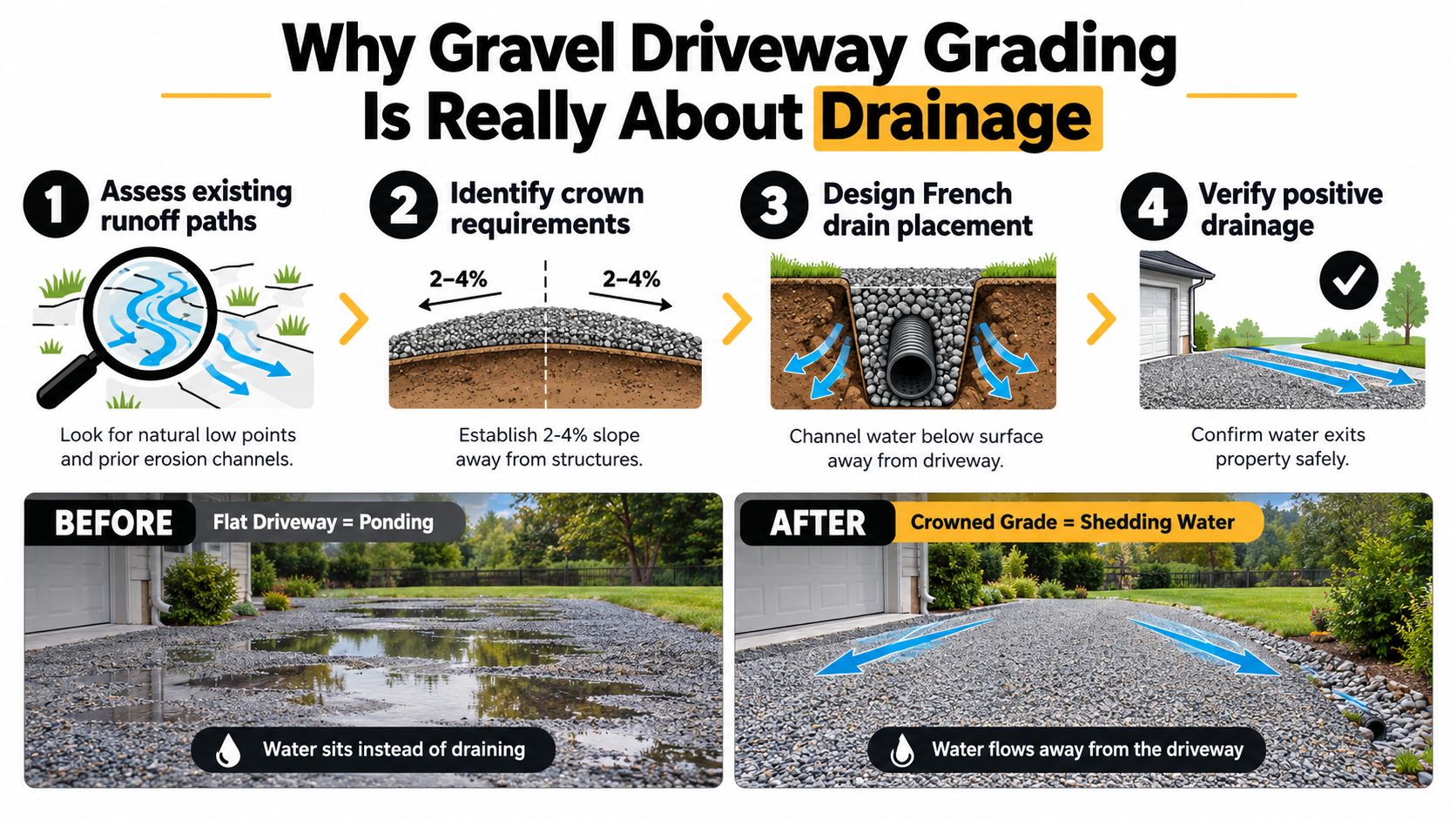
A gravel driveway can look smooth on the day it is finished and still fail under the first hard rain. Grading works only when it gives runoff a clear path off the surface, away from the subgrade, nearby structures, and the edges where fines wash out first. If water has nowhere to go, it settles, softens the base, and turns traffic into a rutting problem.
The Federal Highway Administration's guidance on unpaved-road surface shaping recommends a target crown of 5%, with an allowable range of approximately plus or minus 1%. On a 20-foot-wide driveway, that means the center should sit about 6 inches higher than the edges. FHWA also warns that a crown below 4% can let water pond, which creates soft spots that quickly become potholes.
Shape the surface before placing stone
The first job is to read where the water comes from and where it should leave. An uphill lawn, roof runoff, or a higher shoulder can send more water onto the drive than the crown can handle. In those cases, the fix may be a swale, ditch, culvert, or another outlet that keeps runoff moving without sending it toward a garage, shed foundation, or roadway.
A good gravel driveway grading job also has to work for vehicles. Too little cross-slope leaves standing water and ice. Too much slope makes the drive uncomfortable and can push runoff too hard to one side. The point is a controlled grade that sheds rain and holds shape under traffic, not a ridge that looks dramatic but performs poorly.
If the water path is not solved first, the stone only hides the problem for a short time.
FHWA treats surface shaping as ongoing maintenance because traffic and weather flatten the crown over time. For a broader trade reference, the driveway grading guide is a useful companion when comparing surface-shaping methods.
Site Assessment and Drainage Design Decisions
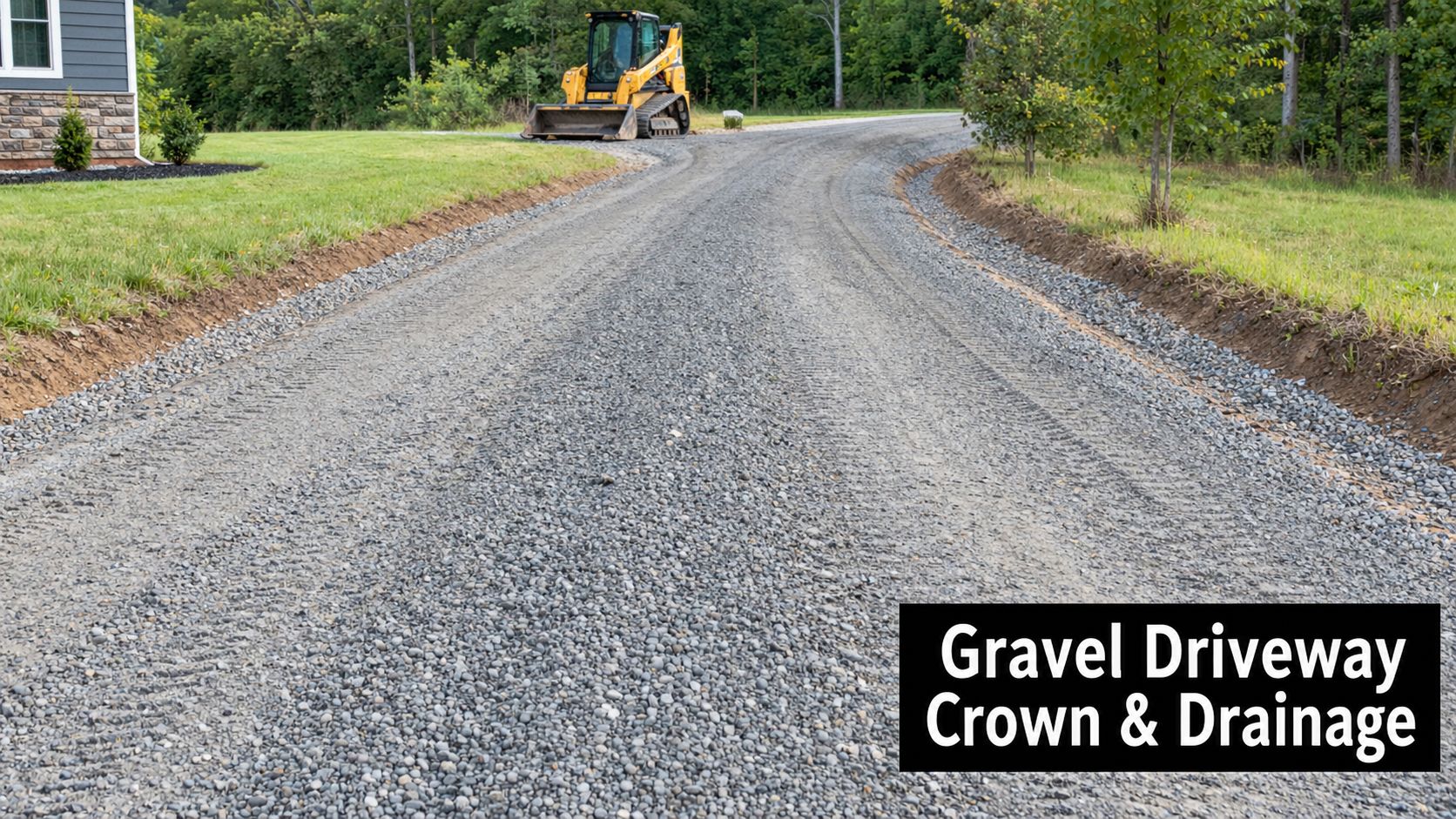
A gravel drive can look fine on dry ground and still fail the first time a storm hits. Walk it during or right after rainfall, and read where the water moves. Look for runoff coming from higher ground, shallow ponding, erosion along the edges, and tire tracks that have turned into drainage paths. Those signs tell you whether the fix belongs in the surface, the shoulder, or a drainage outlet.
Four questions to answer on the property
Where does uphill water arrive? A sloping lawn, roof discharge, or roadside ditch can push more water onto the drive than the crown can shed. A swale or properly placed drain may solve that better than another layer of stone.
Where should the water leave? The drive should discharge to a safe outlet, not toward a neighbor's lot, a foundation excavation, or the public road. If the outlet is blocked or poorly placed, grading alone will not hold up.
Does the driveway have enough cross-slope? Measure the existing crown with a level and tape before adding material. If the center is too flat, water will hang in the wheel paths and the surface will break down faster. As noted earlier, a weak crown encourages ponding and pothole development.
Is the approach too steep? Penn State's lot-preparation guidance treats drainage and slope as linked decisions, not separate ones. A driveway still needs enough grade to move water, but steep approaches can create handling problems and may call for a swale, a different profile, or a lower connection point. See the Penn State driveway and lot-preparation guidance before setting elevations.
Pennsylvania driveways also have to fit the road and the drainage around it. The state regulation requires driveway work to avoid impairing drainage in the highway right-of-way, changing drainage on adjacent property, or weakening the improved area. Where a roadside ditch or swale exists, the rule calls for an adequate pipe beneath the driveway, and the pipe under driveways is specified at a minimum of 15 inches in diameter. The Pennsylvania driveway regulation should be checked with local municipal requirements before any cut is made.
That matters most where a drive meets a public road or crosses a ditch. A layout that works on a level rural lot can fail fast on a site with stronger runoff, tighter grades, or a driveway that climbs toward a garage.
A short video can help homeowners see how grade, crown, and runoff interact before they request an estimate.
Pennsylvania, Maryland, Delaware, and New Jersey properties can have different soil, frost, slope, and permitting conditions.
Excavation, Subgrade Prep, and Base Layer Placement
A gravel drive fails fast when stone is spread over soft topsoil. Organic soil shifts, wet subgrade loses bearing, and tires load the same wheel paths again and again. Excavation and compaction build the platform that lets the aggregate do its job.
Start by stripping out unstable material and shaping the exposed subgrade to the planned crown and longitudinal grade. Water needs a path off the drive and away from the centerline. If the site stays wet, the fix may be deeper excavation, underdrainage, or replacing soil that will not hold shape under load.
Separate the surface layer from the base
The FHWA guidance on gravel-road layers states that the wearing course should typically be more than 4 inches, or 100 millimeters, thick. That layer takes traffic and can be renewed later. The base course carries the load and lifts the roadway above the surrounding ground so the subgrade is less likely to soften and rut.
| Layer | Minimum Thickness | Primary Function |
|---|---|---|
| Wearing course | More than 4 inches, or 100 millimeters | Provides durable traffic support and a maintainable driving surface |
| Base course | Thick enough to lift the roadway above surrounding ground | Distributes loads and protects the subgrade from rutting |
Excavation depth should match the soil, drainage, traffic, and final elevation on the site. A driveway for a small garden shed does not face the same demand as one serving a garage, barn shed, construction access route, or commercial property. The base plan should reflect that difference before the gravel goes down. For a compact example of how a drainage-ready pad is built for light structures, see the gravel shed pad installation guide.
Control moisture and lift thickness
Compaction works best when the material is at workable moisture. Grading saturated material can smear the subgrade and leave a weak layer underneath. Material that is too dry can refuse to knit together. Place, shape, and compact in controlled lifts. Dumping the full depth and relying on traffic to sort it out usually leaves a rough, loose surface.
PennDOT's benchmark for Driving Surface Aggregate allows an uncompacted depth from 6 to 8 inches in one lift, as described in its Driving Surface Aggregate technical sheet. That range gives a practical target for placement and compaction. Site conditions still decide whether the job needs more excavation, better separation, or a different base build before the top layer is finished.
Choosing the Right Aggregate and Material Strategy
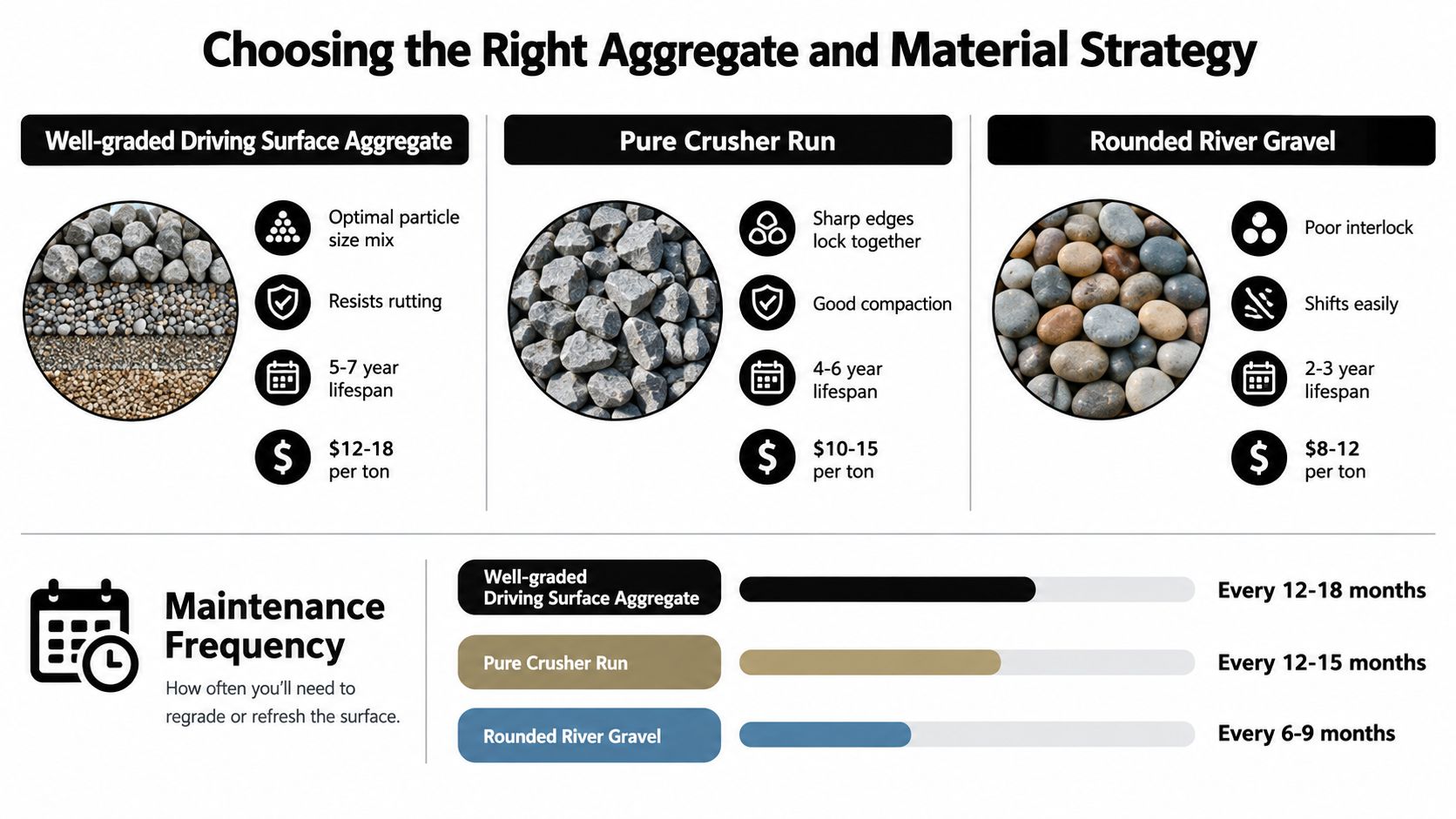
Aggregate selection affects how a driveway locks together, sheds water, and withstands traffic. Clean stone with one uniform size can look sharp after spreading, yet it leaves large voids and shifts under tires because it has little binding material. A mix loaded with clay-like fines creates the opposite problem. It holds moisture, becomes slippery when wet, and can deform under traffic.
Why gradation matters
Pennsylvania's Driving Surface Aggregate standard combines large particles, intermediate sizes, and fines. The blend fills voids, improves particle binding, limits stone loss under traffic, and compacts into a more stable driving surface. As noted in the previous section, the DSA specification calls for a 4% to 6% cross-slope, equal to approximately one-half to three-quarters of an inch of fall per foot. That slope supports drainage without relying on repeated surface reshaping.
| Material strategy | Main advantage | Main trade-off |
|---|---|---|
| Well-graded aggregate | Particles interlock and compact into a stable surface | Requires proper blending and moisture-aware placement |
| Clean, uniformly sized stone | Drains readily and can provide a decorative appearance | Usually shifts more easily because it lacks binding fines |
| Clay-heavy material | Can bind when dry | Holds water and may become slippery or deformable |
Aggregate quality also matters beyond particle size. PennDOT considers pH and soundness. The material's pH must fall between 6 and 12.45, while soundness testing measures resistance to weathering and freeze-thaw disintegration. These checks matter across the Mid-Atlantic, where wet seasons and repeated freezing can expose weak or easily degraded stone.
Rehabilitating an existing driveway
A worn driveway often needs more than a fresh top dressing. Scarify the existing surface, add roughly 2 to 3 inches where defects require correction, blend the new stone with the old material, reshape from the outside edge toward the center, and compact immediately after grading. Loose material left at the edges can wash away during the next storm, so sequence the work before rain reaches the surface.
Properly graded Driving Surface Aggregate remained more stable than the other tested aggregates in a Pennsylvania three-year study, while a USGS field evaluation found substantially lower sediment runoff than with traditional aggregates. Those findings provide useful performance benchmarks, not guarantees for every driveway. Soil conditions, traffic, drainage, installation quality, and climate still determine whether the selected material performs well on a specific property.
When Grading Alone Won't Fix Driveway Problems
Repeatedly dragging a blade over potholes can make a driveway look repaired while leaving the cause untouched. Surface reshaping won't correct a saturated subgrade, an undersized ditch crossing, or concentrated runoff flowing down from a steep hillside.
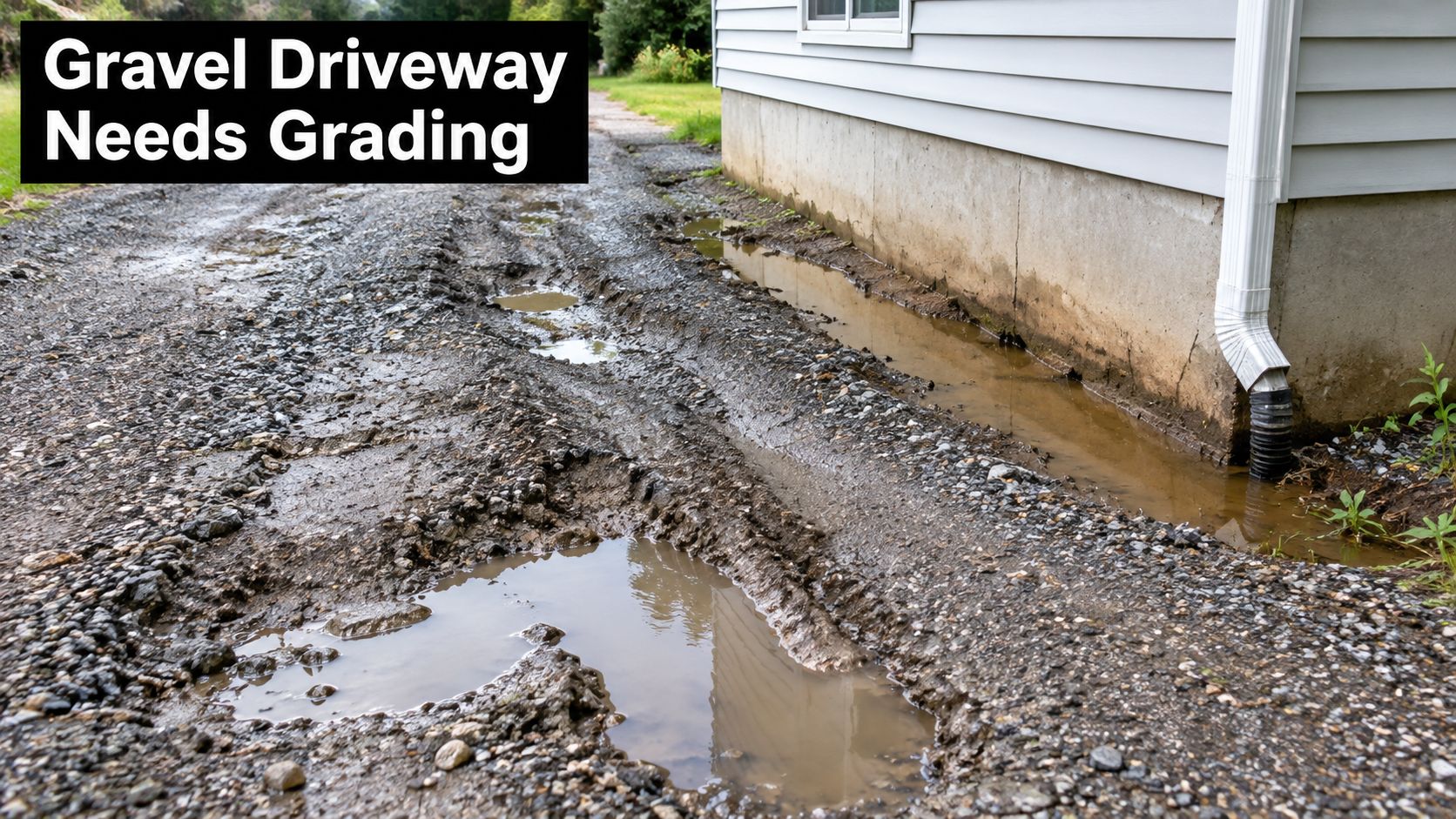
Trace the water before choosing the repair
Start at the damage and follow the water backward. A pothole at the bottom of a slope may be an outlet problem rather than a grading problem. Ruts that stay wet after the rest of the driveway dries can point to a high-water-table subgrade. Washboarding may reflect traffic and material movement, but it becomes harder to control when runoff is flowing along the tire paths.
A useful diagnosis separates four conditions:
- Uphill entry: Water arrives from a lawn, bank, roof discharge, or neighboring elevation.
- Insufficient crown: Rain falls directly on the driveway and ponds because the cross-section is too flat.
- Tire-path flow: Water follows the lowest compacted tracks and erodes fines.
- Subgrade emergence: Groundwater or saturated soil pushes moisture upward beneath the aggregate.
Each condition calls for a different response. Possible corrections include ditching, a culvert, edge restoration, underdrainage, aggregate replacement, or final grading after the water route is controlled. A drainage pipe installation guide can help homeowners understand why pipe placement and outlet protection are separate decisions from surface reshaping.
Drainage improvements can outperform repeated grading. Field investigations reported service-life increases of 50% to 100% or more from improved drainage alone, as summarized in the provided research reference.
That doesn't mean grading has no value. It means grading should follow diagnosis. If the base is sound and the issue is a flattened crown, reshaping may be the correct repair. If water keeps entering from uphill or rising through the soil, a new crown may only shift the damage a few feet.
Maintenance Practices and Local Compliance Considerations
A gravel driveway needs occasional correction because traffic, storms, and seasonal ground movement alter the surface. Maintenance should focus on preserving drainage, not chasing a perfectly flat appearance. Check the crown, shoulders, ditch, culvert inlet, and outlet together.
Use the right maintenance timing
Work when the surface is workable but not saturated. A box blade can loosen compacted areas and pull material back from the edges, while a land plane can help finish a longer, flatter drive after heavier repairs. Neither attachment can replace a functioning ditch or repair a failed subgrade.
A practical inspection routine includes:
- Watch the first heavy rain: Confirm that runoff leaves the driving surface and doesn't collect beside the garage, house foundation, shed foundation, or patio.
- Inspect the edges: Restore gravel that has migrated into grass or a ditch before the shoulder becomes a low channel.
- Check crossings: Keep culvert inlets and outlets clear of sediment, leaves, and displaced stone.
- Look after winter: Identify frost-related movement, new ruts, and soft areas before adding surface material.
- Compact repairs promptly: Blend added aggregate into the existing surface and compact after reshaping.
The driveway's vertical profile matters as much as the cross-slope. Penn State identifies a 2% minimum grade, a 15% maximum driveway grade, and a 10% maximum for the portion below street grade, with a drainage swale potentially required. Those thresholds should be reviewed with the applicable municipality because local ordinances may be stricter.
Treat the entrance as regulated infrastructure
In Pennsylvania, a driveway that crosses a roadside ditch isn't just a private gravel surface. The entrance must preserve highway-right-of-way drainage and use an adequate pipe where required. Maryland, Delaware, and New Jersey properties may have their own permit, setback, stormwater, or road-entrance requirements.
That's especially important when a driveway is part of a larger project. A new garage may need garage footings and foundations, a concrete foundation for a garage, or a properly excavated approach. A barn, gazebo, hot tub, shipping container, or storage shed can also require a stable pad and a route that doesn't send water toward the structure.
Homeowners searching for shed foundations near me, garage foundation contractors near me, or driveway companies near me should ask whether the estimate includes subgrade preparation, drainage review, aggregate placement, and compaction. Firm Foundations provides site preparation, excavation, gravel driveway installation, shed foundation work, and concrete foundations across Pennsylvania, Maryland, Delaware, and New Jersey, with projects planned around drainage and the intended structure.
Firm Foundations can assess your driveway site, prepare the subgrade, place and compact the aggregate, and coordinate drainage work for driveways serving homes, garages, sheds, barns, and other outbuildings. Visit Firm Foundations to request a quote and discuss the right foundation or excavation plan for your property.