
Soil Compaction for Concrete Slab: A PA & NJ Guide
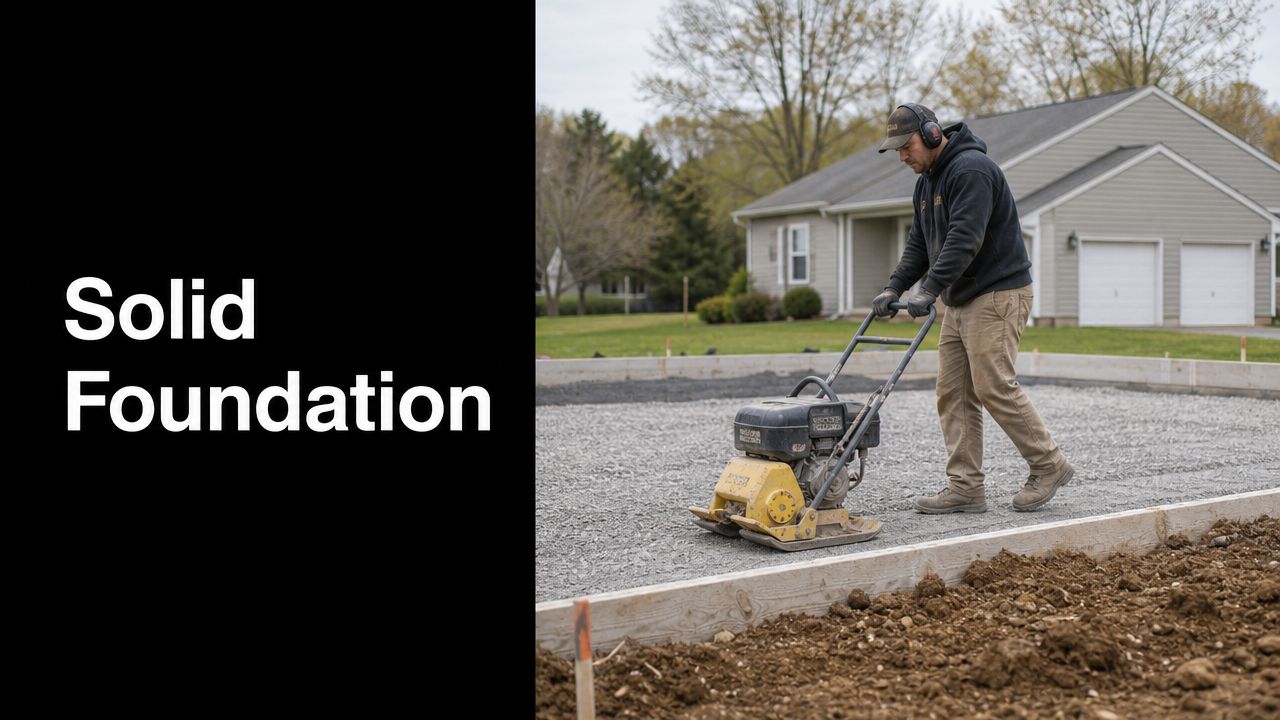
You’re probably looking at a project that seems straightforward on the surface. A shed pad, a garage slab, maybe a gazebo foundation or a base for a storage shed. The forms look simple, the concrete seems like the main event, and the ground underneath can feel like a detail.
It isn’t.
In Pennsylvania, Maryland, Delaware, and New Jersey, most slab problems start before the truck ever arrives. A cracked garage floor, a shed that goes out of level after winter, or a patio that starts holding water usually traces back to weak site prep, bad drainage, wet subgrade, or gravel that was dumped and never compacted properly. That’s why homeowners searching for shed foundations near me, garage foundation contractors near me, or concrete foundations should pay close attention to what happens under the slab, not just on top of it.
Much online advice falls short. Engineering documents can be hard to apply in a backyard. DIY articles often oversimplify the work. What truly helps is practical field knowledge. You need to know what soil should feel like, what gravel can and can’t do, what signs point to future settlement, and where cutting corners usually shows up later in the Mid-Atlantic climate.
Why Proper Soil Compaction Is Non-Negotiable
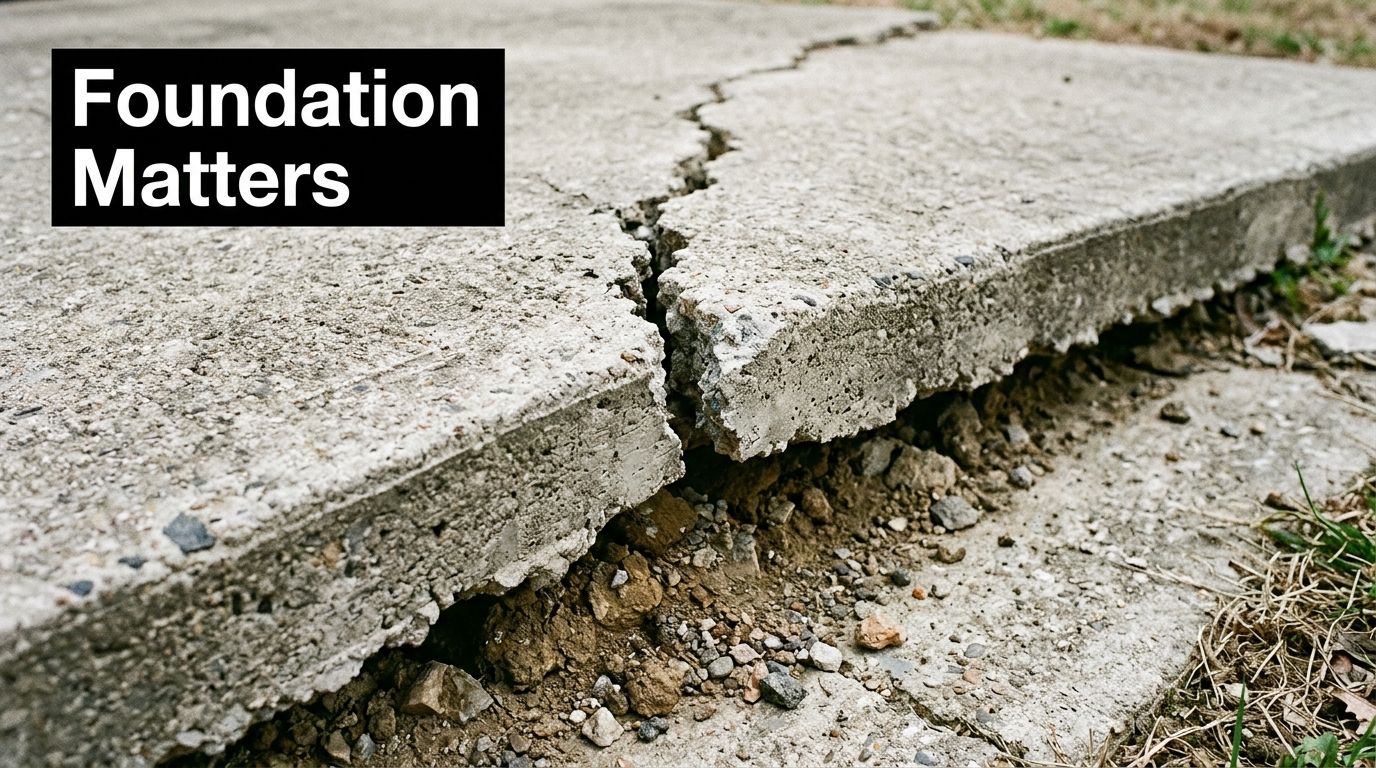
A concrete slab doesn’t forgive movement underneath it. Once the subgrade shifts, the slab usually tells on it fast. You see a crack through the middle of a garage, one corner of a shed foundation settles, or a patio edge drops enough to catch water.
That’s why soil compaction for concrete slab work is not a box to check. It’s the part that determines whether the rest of the project has a chance to last.
What the slab is really sitting on
Homeowners usually focus on slab thickness, finish, and reinforcement. Those matter. But the slab only performs as well as the support under it. If the native soil is soft, if fill was placed carelessly, or if water gets trapped below the pad, even a well-finished pour can fail early.
Proper compaction delivers four critical results for concrete placement: increased load-bearing capacity, stability to prevent frost damage, reduced water seepage and swelling, and minimized soil settling according to Bartell Global’s explanation of soil compression properties. Those are the exact outcomes that matter for a house foundation, cement foundations for garage projects, and smaller slabs like a gazebo foundation or barn shed pad.
Practical rule: If the base can move, the concrete will eventually show it.
In the Mid-Atlantic, freeze-thaw cycles make this even less forgiving. Water gets into weak spots, temperatures swing, and small inconsistencies turn into visible damage. That’s why a slab that looks fine on pour day can start showing trouble after one hard season.
What goes wrong when prep is rushed
The most common failures aren’t mysterious. They usually come from a few avoidable mistakes:
- Organic material left in place means roots and topsoil break down over time, leaving voids.
- Uneven compaction creates hard areas and soft areas under the same slab.
- Wet, unstable ground pumps under load and never gives the slab consistent support.
- Skipped verification leaves everyone guessing whether the site is ready.
If you’re comparing quotes for concrete foundations or searching for local excavation near me, experience is what distinguishes a durable install from a cosmetic one. The best crews don’t just flatten the ground. They build a stable bearing surface.
For homeowners who want a better sense of what the ground can support before building, this guide to soil bearing capacity is a useful companion to compaction planning.
Why this matters for every structure, not just big ones
People often think compaction only matters on large commercial work or a full house foundation. In practice, smaller projects can be even less forgiving because they’re often built on disturbed backyard ground, old fill, or marginal drainage areas.
A 4×8 shed with foundation, a hot tub slab, and garage footings and foundations all rely on the same basic truth. The ground has to be stable, drained, and uniformly compacted. If it isn’t, the finished concrete only hides the problem for a while.
Site Prep 101 Grading Drainage and Soil Assessment
A slab can look perfect on pour day and still start showing trouble later because the ground underneath was never ready. I see that more often on backyard projects than homeowners expect, especially where an area looks flat and dry on the surface but has soft fill, old roots, or trapped water a few inches down.
In PA, MD, DE, and NJ, site prep is rarely just a matter of scraping off grass and calling for concrete. Freeze-thaw cycles, spring moisture, and mixed native soils punish shortcuts. Good prep starts with stripping the site to firm mineral soil, shaping the grade so water leaves the area, and checking whether the subgrade is fit to compact.
Start with grade and water movement
Water decides a lot about slab performance. If runoff heads toward the pad, or if the finished grade lets water sit along the perimeter, the base stays wetter than it should and the slab edges lose support first.
The accepted benchmark for flatwork drainage is a minimum slope of 1/8 inch drop per foot of run to move water away from nearby structures, as outlined in this concrete slab grading reference. That standard is practical, not theoretical. It helps keep water from soaking the base, softening the subgrade, and creating the kind of seasonal movement that shows up as cracks, corner settlement, or heaving.
A reliable prep sequence usually includes these steps:
- Remove sod, topsoil, roots, and other organic material until firm mineral soil is exposed.
- Establish grade so surface water drains away from the slab area.
- Cut down high areas instead of hiding them under loose fill.
- Proof the footprint for soft pockets before stone is placed.
- Keep the subgrade uniform across the entire pad.
For homeowners who want to see that process laid out in order, this guide to site preparation for concrete slab work is a useful reference.
One practical note on imported fill and aggregate. Delivery matters. Wet material, segregated stone, or loads dumped in the wrong spot can slow the job and make grading harder than it needs to be. On larger residential and rural jobs, even transportation methods can affect how efficiently fill is placed, which is one reason some contractors pay attention to equipment options covered in the ANTS Trailers live bottom guide.
Use simple field checks before you compact
Homeowners do not need a lab report to spot obvious moisture problems. A few simple checks can tell you whether the ground is close to workable condition or whether a contractor should stop and address it first.
One of the best low-tech checks is the hand test. The USDA Natural Resources Conservation Service describes field texture and feel methods that help identify whether soil is loose, cohesive, dry, or overly wet based on how it forms in your hand and breaks apart under light pressure, as shown in its soil texture by feel guidance. For slab prep, the practical takeaway is simple. If the soil will not hold together at all, it is usually too dry to compact well. If it smears, shines, or leaves your hand damp, it is too wet.
The drop test is useful too. Squeeze a handful into a ball and drop it from about waist to shoulder height. Soil near workable moisture will usually hold shape briefly, then break into several pieces. Soil that splats is too wet. Soil that explodes into dust is too dry.
Watch your boots as well. If the ground pumps, ruts, or squeezes water to the surface under your weight or under machine passes, compaction should stop until conditions change. That is a field problem, not something to bury under stone and hope for the best.
Read the site before equipment hits it
The same slab detail can perform very differently from one yard to the next because the soil under it is different.
| Soil condition | What it usually means on site |
|---|---|
| Clay-heavy ground | Holds water longer and needs tighter moisture control |
| Sandy or granular ground | Drains better but still needs mechanical compaction |
| Topsoil or loam | Must be removed, not used as bearing soil |
| Wet subgrade | Needs drying, undercutting, or replacement before continuing |
In this context, experience matters most. A level-looking area can still hide an old stump hole, buried construction debris, utility trench backfill, or soft zones from years of runoff. Those are common on residential lots across the Mid-Atlantic, especially in newer developments and older properties with pieced-together yard grading.
If you are getting estimates for excavation near me or planning a base for storage shed, ask one direct question: how will you verify the ground after stripping and before the base goes in? A good answer should include checking for soft spots, evaluating moisture, and correcting weak areas before they disappear under the finished surface.
The Right Foundation Base Gravel Lifts and Compaction Myths
A homeowner sees a truck dump stone, watches it get raked flat, and assumes the base is ready for concrete. A few seasons later, the slab has a low corner, a crack at the garage door, or a section that always seems damp. In a lot of Mid-Atlantic jobs, that failure starts under the slab, not in the concrete itself.
The myth about self-compacting stone
“Self-compacting” gravel is one of the most expensive shortcuts in residential slab work. Clean stone does settle into place better than loose soil, but that is not the same as being uniformly compacted for slab support.
Green Building Advisor’s discussion of slab base compaction makes the point clearly. Clean crushed stone can drain well and still leave voids. Crusher run can lock together well and still fail if it is dumped too thick or left with uneven moisture and density. Under a slab in Pennsylvania, Maryland, Delaware, or New Jersey, those voids matter. Water finds them. Freeze-thaw cycles work on them. Settlement usually follows.
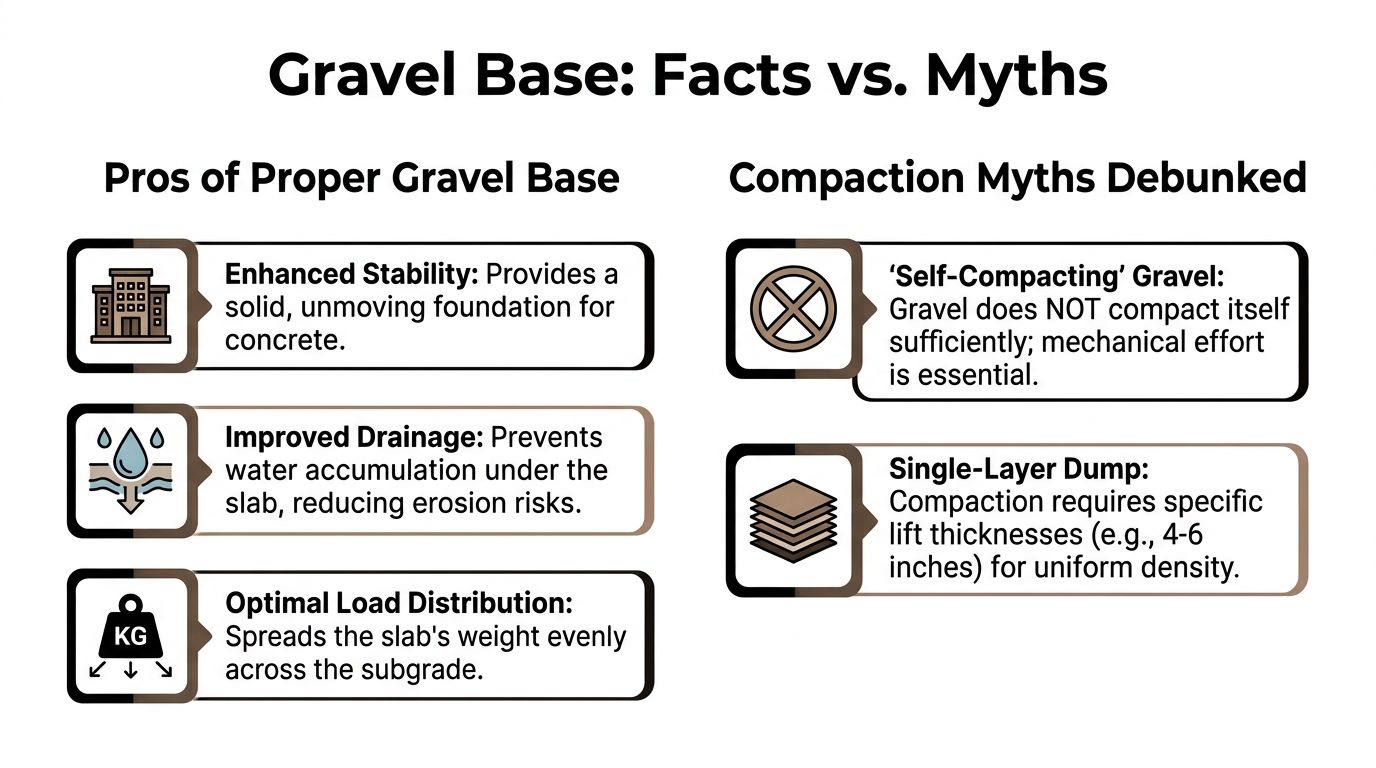
Drainage is not proof of compaction. A base can shed water and still be too loose to support a slab well.
Base materials behave differently
Homeowners comparing a shed foundation, gazebo foundation, or cement foundations for garage project usually hear material names tossed around as if they all do the same job. They do not.
- Clean crushed stone drains well and is useful where water needs a path out, but it still needs to be placed evenly and mechanically seated.
- Crusher run with fines can produce a tighter surface because the fines fill gaps, but it has to be installed carefully in controlled lifts.
- Rounded stone or decorative gravel shifts too easily and is a poor choice under a structural slab.
Placement matters more than many people realize. If the truck leaves a few big piles and the crew spreads them after the fact, it is harder to keep the layer uniform. On larger pads and driveways, controlled stone placement helps crews keep thickness consistent before compaction. Homeowners who want to see how that works on active jobs can review the ANTS Trailers live bottom guide.
Why lifts matter more than extra stone
The machine can only densify so much depth at one time. If the base goes in too thick, the top can look tight while the lower portion stays loose. That is one of the most common reasons a pad looks good on pour day and settles later.
A better practice is simple. Place the base in thin, consistent lifts and compact each one before adding the next. Minnesota Pollution Control Agency guidance for construction stormwater work also describes backfill and fill placement in layers, which aligns with what good slab crews already do in the field.
For residential slab prep, more base is not automatically better. Uniform support is better.
| Approach | What usually happens |
|---|---|
| Dump full depth at once | Surface firms up, lower material can stay loose |
| Install in lifts | Density stays more consistent through the layer |
| Skip mechanical compaction | Settlement risk rises, especially at edges and utility cuts |
| Compact each lift fully | Slab support is more predictable |
One more point gets missed in DIY advice. Stone does not fix a bad subgrade. If the soil underneath is soft, wet, or disturbed, adding thicker gravel often just hides the problem for a while.
For homeowners searching gravel shed foundation contractors near me or shed foundation gravel base solutions, this is one of the clearest signs of careful work. The crew should be thinking in measured lifts, checking thickness, and correcting weak spots before they disappear under the next layer.
Achieving Perfect Compaction Techniques and Testing
A slab can look clean, flat, and ready for concrete, then still fail because the compaction work was uneven. I’ve seen pads pass a quick visual check and still settle at the garage door, crack at a control joint, or drop along one edge after the first wet season. In PA, MD, DE, and NJ, that risk goes up fast when crews rush compaction on mixed fill, damp clay, or utility trench backfill.
Match the machine to the material
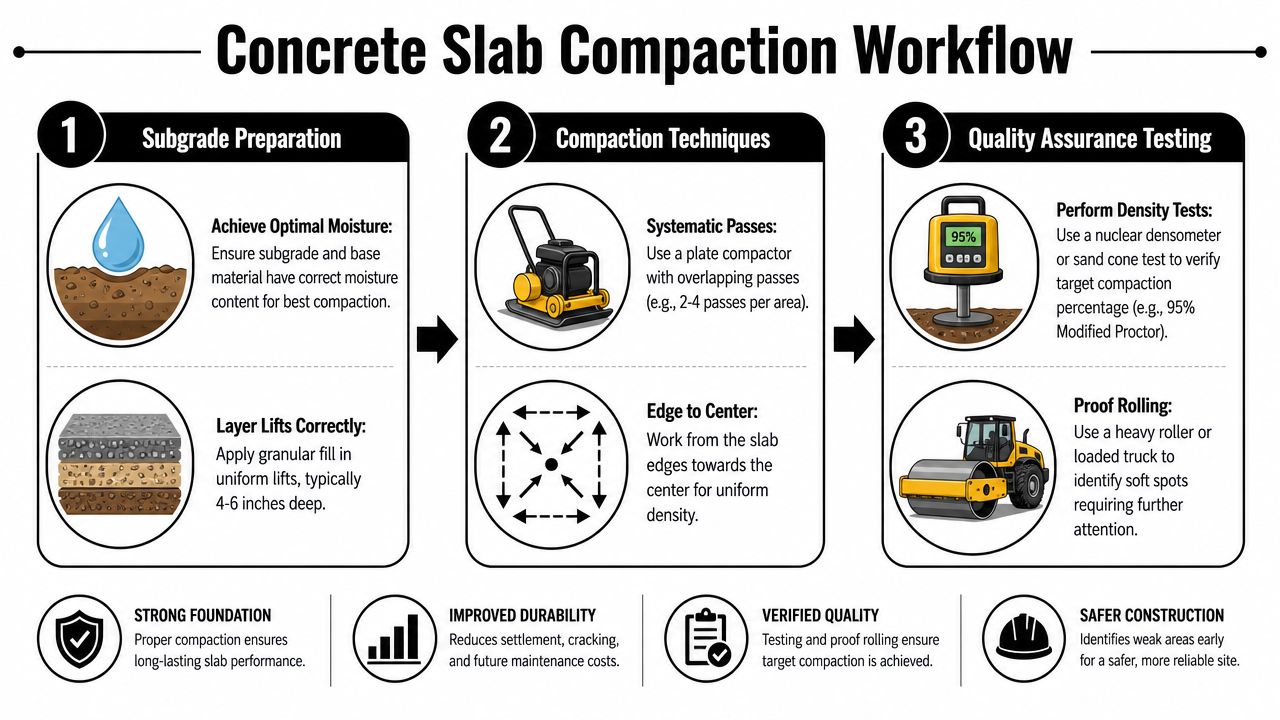
The right machine depends on what is under the slab. Granular base responds well to vibration. Clay and other cohesive soils usually need a kneading action from heavier equipment, such as a padfoot roller, to compact thoroughly. The Federal Highway Administration’s soil compaction reference explains that equipment choice should be based on soil type and lift conditions, not just what happens to be on the trailer that day: FHWA soil and foundation compaction reference.
On a typical residential slab, access often limits the options. A plate compactor is common and can do good work on stone and granular fill, but it has limits. It will not fix a wet subgrade, and it will not reliably densify a lift that is too thick. Hand tampers have their place around forms and tight corners, but they are for touch-up, not full production compaction.
That matters most at the perimeter, near utility cuts, and anywhere fill was brought in to correct grade.
Good technique is repetitive on purpose
Compaction is a coverage job. Missed strips, short passes, and random operator patterns leave weak pockets that do not show up until the slab is carrying weight.
A better routine is simple:
- Run overlapping passes so the whole area gets worked.
- Change direction between rounds.
- Slow down enough for the machine to do its job.
- Watch for pumping, rutting, or areas that keep moving under the machine.
- Spend extra time at edges, corners, and around penetrations.
On residential work, crews often hear that gravel is “self-compacting.” That is one of the more expensive myths in slab prep. Clean stone can settle into place better than wet clay, but it still needs proper placement and mechanical compaction if it is being used as part of the slab support system. If a crew dumps it, skins the surface smooth, and moves on, the top may feel firm while the lower portion stays loose.
This video gives a helpful visual sense of the workflow in action.
Testing separates a firm-looking pad from a proven one
A loaded truck or skid steer can help expose obvious soft spots, but proof rolling is only a screening step. It is useful, not conclusive. The U.S. Army Corps of Engineers notes in its field density guidance that actual compaction acceptance is typically confirmed with field testing, not visual appearance alone: USACE field density and compaction testing guidance.
For homeowners, that does not mean you need lab gear on site. It means you should ask better questions. Was the pad checked for weak zones after compaction? Were utility trenches reworked separately? If the project is large enough to justify it, was a testing company brought in for density checks or DCP testing?
There are also practical field checks that good crews use before a formal test ever happens. If the surface shoves ahead of the plate compactor, moisture is usually too high. If it powders and will not knit together, it is often too dry. If one area keeps flexing while the rest firms up, treat it as a problem area and fix it before concrete day. Those simple observations catch a lot of trouble that generic DIY articles skip.
Homeowners also tend to focus only on the concrete contractor. That misses part of the risk. If weather delays, runoff, or site damage affect the prepared pad before the pour, the financial side matters too. Larger projects benefit from understanding builders risk coverage before work starts.
For anyone comparing concrete contractors, garage foundation contractors near me, or local foundation builders, one question tells you a lot: “How do you know the pad is compacted, not just flat?” A solid contractor should have a clear answer.
Your Project Foundation DIY Checklist or Hire Firm Foundations
If you’re planning a slab for a 10×10 storage shed, a new concrete foundation for garage use, or a simple backyard pad, you don’t need to memorize every technical standard. You do need a way to judge whether the job is being prepared correctly.
That starts with a short checklist.
A simple quality check before concrete day
-
Ground is stripped properly
No sod, roots, or topsoil remain under the footprint. -
Drainage is intentional
Water has a clear path away from the slab area, not toward the house or into low corners. -
Moisture feels right
The soil holds shape without being dusty or overly wet. -
Base was installed in layers
Gravel wasn’t just dumped all at once and skimmed flat. -
Compaction was mechanical
The crew used a plate compactor or the right roller, not just tires and wishful thinking. -
Soft spots were addressed
No pumping, rutting, or spongy areas remain. -
The surface is consistent
Finished grade is level where it should be level, and pitched where it should shed water.

When DIY stops making sense
Small projects can tempt homeowners into doing everything themselves. Sometimes that works. Sometimes the hard part isn’t pouring the slab. It’s knowing whether the ground is ready for one.
If you’re coordinating a shed delivery, garage build, or backyard structure, there’s also the bigger project picture to consider. Homeowners planning larger installs may want to review this guide on understanding builders risk coverage so they know what may be protected while foundation and structure work are underway.
The decision usually comes down to risk tolerance. If you’ve got ideal soil, good drainage, room for equipment, and experience with grading, a DIY pad may be manageable. If the site is sloped, wet, tight, previously filled, or supporting something heavier than a small shed, the margin for error gets much thinner.
Homeowners searching shed foundations contractors near me in Honey Brook, garage foundation contractors in Pennsylvania, driveway contractors near me, or concrete foundations near the PA, MD, DE, and NJ line are usually trying to solve one thing. They want the project done once, done level, and done to last.
Frequently Asked Questions About Soil Compaction
Can you compact soil when it’s raining
Usually no.
In our part of PA, MD, DE, and NJ, a site can look workable from the driveway and still be too wet once you step onto the cut. If the soil is pumping under your boots, sticking to the plate, or smearing instead of breaking cleanly, stop and wait. That moisture traps trouble under the slab. A homeowner may see a smooth surface. I see a base that can rut, settle, and crack later.
What’s the difference between a hand tamper and a plate compactor
A hand tamper has its place. It works for small repairs, tight corners, and spots a machine cannot reach.
For slab prep, a plate compactor is the baseline tool because it delivers repeated, even impact across the whole lift. That matters on garage pads, shed slabs, and any base that needs to stay level under load. If someone is building a larger slab with only a hand tamper, they are either working on too small a budget or guessing their way through prep.
Can you overcompact soil
Yes, but the bigger problem on residential work is usually the wrong method, not too much effort.
Repeated passes on wet clay can seal the surface and trap moisture below. Running heavy equipment over the same path over and over can also break down some aggregate or create a hard crust on top while softer material remains underneath. The National Ready Mixed Concrete Association notes that overworking subgrade and base materials can damage uniform support, which is the primary goal under a slab. See NRMCA’s guidance on subgrades and subbases for concrete slabs at https://www.nrmca.org/wp-content/uploads/2021/01/06pr.pdf.
A good compacted surface feels firm and consistent. It should not bounce, shove, or turn dusty on top while staying soft below.
How do you know if gravel really needs compaction
If the gravel is going under a concrete slab, compact it.
That “self-compacting gravel” line causes a lot of expensive callbacks. Clean stone can lock together well, but that does not mean it is ready to support concrete without being placed in controlled lifts and compacted properly. A simple field check helps. Walk it. Turn on it. If the surface shifts under your feet, kicks loose at the top, or shows wheel rutting from a loaded buggy or skid steer, it still needs work.
How long should you wait after compaction before pouring concrete
Go by condition, not the clock.
The base should hold grade, stay dry enough for placement, and remain stable under foot traffic and equipment. If a rain hits after compaction, reassess before the pour. One of the most common mistakes I see is treating compaction like a box to check the day before, then assuming the base is still fine after weather changes overnight.
Is proof rolling enough
Proof rolling helps find obvious weak spots, but it is not the whole answer.
For a small residential project, it can be a useful screening step alongside common-sense field checks. For higher-load slabs, filled sites, or questionable native soil, it should not be the only basis for confidence. A contractor who understands compaction should be able to explain what they are looking for, what concerns them, and why the site is ready.
If you’re comparing bids for a shed foundation kit, concrete forms, a slab for a barn shed, or a full garage base, pay attention to how each contractor talks about the ground under the concrete. The ones who take time to explain moisture, lift thickness, and base stability usually do better work.
If you want a slab or pad built on solid ground without guessing through drainage, gravel selection, lift thickness, and compaction quality, Firm Foundations can help. The team serves Pennsylvania, Maryland, Delaware, and New Jersey with gravel pads, concrete foundations, excavation, and site prep for sheds, garages, gazebos, patios, shipping containers, and more. Request a free quote and get a foundation that’s built for the way Mid-Atlantic soil behaves.