
Garage & Shed Foundations in Pennsylvania: A Guide to Site Preparation
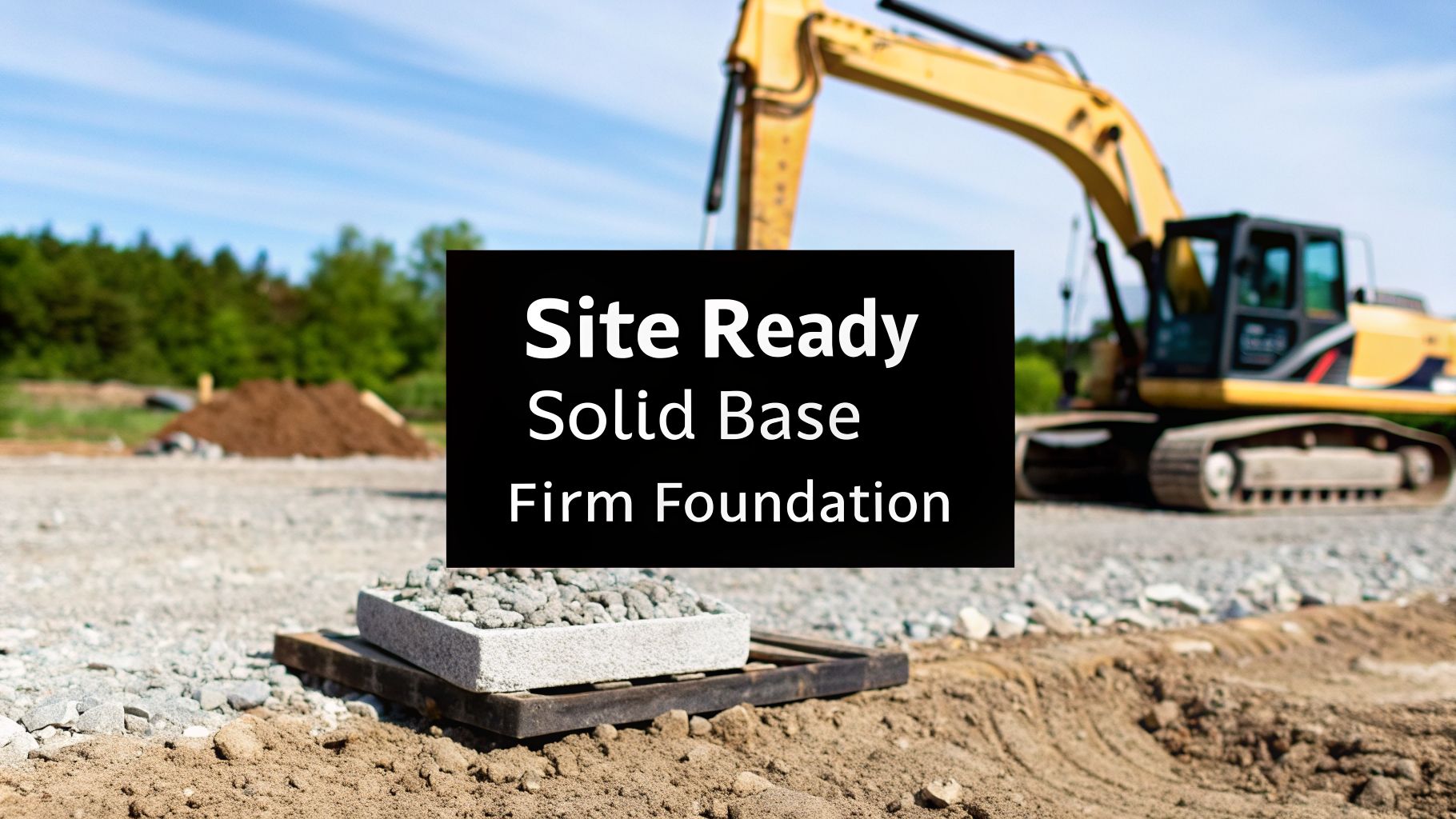
Before a single drop of concrete is poured for your new shed, garage, or gazebo in Pennsylvania, the project's entire future rests on the work done underneath. Proper site preparation for a concrete slab isn't just a preliminary step—it's the single most critical factor for a stable, crack-free foundation that will last for decades.
Why Your Project's Success Starts from the Ground Up
So many costly homeowner mistakes begin right here, often by rushing the job or simply underestimating the importance of a solid base. As your trusted local experts serving Pennsylvania and nearby communities in Maryland, Delaware, and New Jersey, we at Firm Foundations have seen firsthand how meticulous prep work prevents a world of future headaches.
Problems like sinking slabs, damaging frost heave, and persistent water issues can almost always be traced back to a poorly prepared site. Are you looking for "shed foundation contractors near me" who will get the job done right the first time? You've come to the right place.
This guide will walk you through the professional process we follow, showing you exactly how we protect your investment. Whether you need a simple base for a storage shed or a heavy-duty garage foundation, the principles for building a truly unshakeable base are non-negotiable.
The Goals of Meticulous Concrete Site Preparation
Every part of our site preparation process has a distinct purpose. It's not just about clearing dirt; it's about engineering a platform that can support tons of weight and resist the powerful forces of nature for years to come. Think of it as creating a stable, durable, and protected base, with each step building on the last.

The scale of the modern concrete industry is massive. With 9.42 billion cubic meters produced globally in 2021 and over 80 million tons of cement made in the U.S. alone each year, the standards for performance are incredibly high. This sheer volume is exactly why professional site prep is so essential—it ensures every slab can meet modern structural demands and provide lasting value for your Pennsylvania home or business.
A concrete slab is only as strong as the ground it sits on. Cutting corners during site prep is the fastest way to guarantee cracks, settling, and expensive repairs down the road.
Getting the prep work right isn't just a best practice; it's a fundamental requirement for a long-lasting slab. The table below outlines the core goals of professional site preparation and highlights the serious risks you take by cutting corners.
Goals of Professional Site Prep for a Rock-Solid Slab
| Preparation Goal | Why It Is Absolutely Critical | The Cost of Cutting This Corner |
|---|---|---|
| Establish a Stable, Compacted Base | Prevents the ground from shifting, settling, or sinking under the immense weight of the concrete slab and the structure it supports. | A sinking or uneven slab, which leads to major structural cracks, trip hazards, and potentially the need for a complete tear-out and replacement. |
| Ensure Proper Water Drainage | Directs rainwater and snowmelt away from the foundation, preventing soil erosion, water damage, and the destructive freeze-thaw cycles that cause frost heave. | Water pooling around and under the slab, leading to frost heave that can lift and crack the concrete. This is a major issue in our PA/MD/DE/NJ climate. |
| Achieve Perfect Level and Square | Guarantees the final slab is precisely dimensioned. This is vital for the structure being built on top, ensuring doors hang correctly and walls are plumb. | An out-of-square or unlevel foundation, making shed or garage construction a nightmare. It can also lead to uneven load distribution and premature wear. |
As you can see, each goal directly counters a specific, costly problem. Investing in professional preparation from the start is the most effective way to protect your property and your wallet.
Conducting Your Site Assessment and Navigating Local Permits
Before any ground is broken, the most critical phase of your project is a professional site assessment. This isn't a quick glance over your property; it is a meticulous evaluation that ensures the concrete foundation we build is engineered for long-term stability and performance from day one.
At Firm Foundations, our evaluation process across Pennsylvania, Maryland, Delaware, and New Jersey is exhaustive. We analyze soil composition to confirm its load-bearing capacity, map the site's topography to engineer proper drainage, and contract utility locating services to identify all underground lines. This diligence is essential for preventing costly and hazardous issues during excavation.
Understanding Your Site's Unique Needs
Every property in Pennsylvania presents a unique set of challenges and opportunities. One site may have expansive clay soil that retains water, while another might have sandy loam that requires different stabilization techniques. Our assessment of the site's grade—its natural slope—is what informs the plan for a perfectly level foundation that works with the land, not against it.
- Soil Analysis: We test the soil's stability to guarantee it can support the immense weight of your structure without shifting or settling. This is especially vital for a heavy garage foundation or a full house foundation.
- Drainage Mapping: By identifying how water moves across your land, we can design and implement drainage solutions that prevent water from pooling around or undermining your new slab.
- Utility Location: Safety is non-negotiable. Before any digging starts, we verify the exact location of all underground gas, water, and electrical lines to ensure a safe and compliant work site.
This in-depth evaluation is the difference between a foundation that simply gets the job done and one that performs flawlessly for decades to come. It’s the expert groundwork that makes a durable base for a storage shed or a robust gazebo foundation a reality.
Demystifying the Local Permitting Process
Navigating municipal codes and paperwork can feel like the most intimidating part of any construction project. The requirements for a shed foundation or garage footings and foundations vary significantly between townships in PA, MD, DE, and NJ. An accessory structure that is exempt in one jurisdiction may require a full permit in another.
An essential step in your site assessment and planning involves thoroughly navigating local requirements and understanding the specifics of obtaining relevant council permits. Ignoring this step can lead to fines, project delays, and orders to remove your new structure.
Knowing whether a permit is required is the first hurdle. While a small 4×8 shed with foundation may not need one, larger projects like a concrete foundation for a garage almost invariably demand official approval. As your professional concrete contractor in the community, Firm Foundations manages this entire process for you.
We are proficient in the specific documentation local authorities require, from detailed site plans to structural drawings. We handle the submissions, communications, and scheduling of all necessary inspections, ensuring your project proceeds on schedule and without bureaucratic headaches. This allows you to focus on the project itself, confident that the administrative details are in expert hands. When you partner with us, you can rest assured that your new cement foundation for a garage is not only built right but built legally.
Precision Excavation and Smart Drainage Solutions

Once the site assessment gives us a solid plan, it’s time to break ground. This is where the boots-on-the-ground work begins, and you start to see your project take shape. Our expert excavation near me services start by stripping away all the organic topsoil and any vegetation. We get rid of it because that material will just decompose over time, creating voids and an unstable base for your foundation.
With a clean slate, we start digging. The depth isn't just a random number; it's dictated by your project's engineering specs and, more importantly, the local frost line. Here in Pennsylvania, Maryland, Delaware, and New Jersey, this is a step we never skip. We have to dig below that line to prevent frost heave—that powerful upward force from frozen soil moisture that can crack and destroy even a well-poured slab.
Mastering the Grade for Water Management
After we hit the right depth, we focus on establishing the perfect grade. This is so much more than just making the ground flat. It's about strategically sculpting the earth to guarantee water always flows away from your new foundation. A subtle, almost invisible slope is often all it takes to prevent major water headaches down the road.
As your local garage foundation contractors near me, we know every property in our area has its own unique challenges with water. Proper grading is always our first line of defense.
- For a gazebo foundation on a sloped yard, we'll often do a "cut and fill," creating a level pad while making sure the uphill side is benched correctly to stop erosion and push water around the new structure.
- For a large barn shed in an open field, the goal is to create a high point where the pad will sit, ensuring a consistent grade that directs water away on all four sides.
This is where true craftsmanship comes in. The long-term health of your concrete foundations really does begin with smart, meticulous grading.
Implementing Advanced Drainage Solutions
On many job sites, especially those with heavy clay soil or a high water table, just grading the surface won't be enough. When that’s the case, we bring in more advanced systems to actively capture and move water away from the foundation area, protecting your slab from damaging hydrostatic pressure.
A French drain, for example, is a go-to solution we install for many clients. It’s a simple but incredibly effective system: a trench with a perforated pipe, backfilled with clean gravel. It intercepts groundwater before it ever gets a chance to saturate the subbase of your slab. Learning how to improve soil drainage can give you a better understanding of how these systems protect your entire property.
At Firm Foundations, we see smart drainage as an insurance policy for your foundation. It’s a proactive measure that prevents the most common cause of slab failure in our region—water.
Whether a project calls for a simple graded slope or a full French drain system for a complex house foundation, our approach is always customized. We don't just move dirt; we sculpt the land to create a dry, stable, and permanent base for your build. It's this careful site work that gives us the confidence to build a foundation that will last a lifetime.
Building and Compacting Your Subbase for Lasting Stability
The subbase is the unsung hero of every durable concrete slab. Think of it as the bedrock for your entire project. This critical layer of crushed stone provides the stable, load-bearing platform that supports the concrete, whether it’s for a simple shed foundation or a heavy-duty garage foundation.

After we’ve excavated and graded the site, we're left with the perfect "bowl" for your new foundation. Now comes the crucial part: filling it with the right material to create a rock-solid base that won't shift. This is where expert site preparation for a concrete slab moves from simple digging to a science of material selection and methodical compaction.
Choosing the Right Material for Your Foundation
Not all gravel is the same, and the right choice makes all the difference. For our work across Pennsylvania, Maryland, Delaware, and New Jersey, we rely almost exclusively on a specific type of crushed stone known as #57 stone, or "clean stone." This material is made of angular, machine-crushed stones, each roughly ¾ inch in size.
The angular edges are key. Unlike smooth river rocks that can roll and shift like marbles, these sharp edges interlock tightly when compacted. This creates an incredibly stable matrix that resists movement and provides fantastic drainage—a must-have feature for handling our region's freeze-thaw cycles. It's the ideal choice for a robust gravel shed foundation or a cement foundation for a garage.
Once we have the right stone, we spread it to a consistent depth, usually between 4 and 6 inches. Keeping this thickness uniform is vital for ensuring the slab gets even support everywhere. You can learn more about getting that perfectly flat surface in our guide on how to level ground for a concrete slab.
The Art and Science of Professional Compaction
Spreading the gravel is just the beginning; the real magic happens when we compact it. This is hands-down the most important step for creating a base for a storage shed that won't settle down the road. We use professional-grade plate compactors—heavy, vibrating machines that force the gravel into a dense, unyielding layer.
A poorly compacted subbase is a guarantee for future problems. The goal is to eliminate nearly 100% of the air pockets within the gravel, creating a solid mass that will not shift or sink under the immense weight of the concrete.
Our process is methodical and precise. We work in a tight grid pattern, making multiple overlapping passes over the entire area until the subbase is completely consolidated. You can actually feel the difference under your feet as the base becomes firm and unmoving.
Why This Step Matters for Every Project
This intense focus on building and compacting the subbase is what separates a professional job from a weekend DIY attempt. It’s the secret ingredient behind a foundation that performs flawlessly for decades.
- For a 10×10 storage shed: Proper compaction prevents the corners from sinking, which can twist the shed's frame and cause the doors to stick.
- For heavy garage footings and foundations: A dense subbase distributes the concentrated load from vehicles, preventing the cracks and failures that plague poorly prepared sites.
By the time we’re done, the subbase for your gazebo foundation or barn shed is a precisely engineered platform. It’s stable, it drains water effectively, and it’s ready to provide unwavering support for the concrete to come. This careful work gives us—and you—the confidence that the foundation we build is truly built to last.
Setting Forms and Reinforcement Before the Pour
With a solid, compacted subbase in place, our focus shifts to precision. This is where we build the framework—the concrete forms—that will give your finished slab its exact shape and dimensions. It’s a critical step that demands careful carpentry to make sure your new foundation is perfectly square, level, and strong.

Think of the forms as a temporary, custom-built mold. We use sturdy lumber to construct the perimeter, meticulously measuring and staking it to create the precise footprint for your shed foundation or gazebo foundation. Every corner has to be a perfect 90-degree angle, and the top edge must be completely level. There's no room for error here; the quality of the slab depends on it.
These forms do more than just shape the concrete; they have to withstand tremendous pressure. A single cubic yard of wet concrete weighs about 4,000 pounds. Without proper bracing, a form can easily bow or burst during the pour, leading to a huge mess and a costly failure. As experienced garage foundation contractors, we reinforce our forms with heavy-duty stakes and bracing to ensure they hold strong.
Adding Strength From Within With Steel Reinforcement
Concrete has incredible compressive strength (it can handle being squeezed), but it’s weak when it comes to tension (being pulled or bent). That's why we add a skeleton of steel reinforcement inside the forms before any concrete arrives. This internal grid is what keeps the slab from cracking under heavy loads or from the ground shifting over time.
For a serious cement foundation for a garage or a pad supporting heavy machinery, steel rebar is the only way to go. We lay out a grid of these steel rods, tie them together at the intersections, and lift them off the subbase using supports called "chairs." This ensures the rebar is embedded in the middle of the slab's thickness, where it can do the most good. For lighter-duty projects like a small shed pad or patio, a welded wire mesh might be enough.
Reinforcement is the key to turning a simple slab into a true structural foundation. It’s the hidden component that provides the tensile strength needed to resist cracking and ensure long-term durability for decades to come.
This level of on-site preparation is more important than ever. The precast concrete market, valued at $160.53 billion in 2025 and expected to hit $278 billion by 2034, is growing because pre-made products save time. This trend reinforces why our methodical site work—from excavation to reinforcement—is so vital. It creates the perfect base that allows for the efficient, high-quality construction people expect. You can see more on these industry shifts in the precast concrete trends from Fortune Business Insights.
Planning for Utilities and Final Touches
Will your new garage need power? Does your workshop shed need plumbing? Now is the time to plan for it. Trying to cut into a cured concrete slab to add utilities later is destructive, expensive, and often just not feasible.
As part of our thorough prep process, we coordinate with you or your other contractors to embed any necessary features right into the slab.
- Electrical Conduits: We'll place and secure PVC conduits within the forms, giving you a clean path for running wires to outlets and lights later on.
- Plumbing Pipes: If you need water or drainage, we ensure all pipes are correctly positioned and stubbed up exactly where they need to be.
- Anchor Bolts: For steel buildings, car lifts, or heavy machinery, we embed industrial-grade anchor bolts into the concrete according to the manufacturer's precise layout.
This proactive approach guarantees a clean, functional, and fully integrated result. Once the forms are built, the steel is tied, and the utilities are in place, we’re finally ready to bring in the concrete.
Your Final Check Before the Concrete Arrives
Before any concrete is poured, we always walk the site one last time. This is the moment to verify that the site preparation for a concrete slab has been done to a professional standard. It’s your final opportunity to see the quality of the work that supports your entire project.
We want our clients in Pennsylvania to know what to look for. The forms for your new shed foundation or gazebo foundation must be perfectly level and braced securely. Remember, they have to hold back thousands of pounds of wet concrete, so there's no room for error. Check for straight lines and square corners—this is where precision really shows.
Confirming the Critical Details
Next, take a look at the base itself. A properly compacted gravel subbase will feel completely solid underfoot. You shouldn't feel any give. We grade this layer with a slight, consistent slope to ensure water is channeled away from your foundation, which is an absolute must in our PA and MD climate.
Finally, inspect the reinforcement. For a cement foundation for a garage, this is usually steel rebar or wire mesh. It must be elevated on supports, often called "chairs," so it sits in the middle of the slab's thickness. This placement is what gives the concrete its tensile strength and prevents cracks from forming down the road.
The difference between a professional job and an amateur one comes down to these details. Getting it "close enough" isn't an option for us. Our team ensures every aspect is perfect before we proceed.
These steps are what create a foundation that lasts versus one that fails. You can learn more about what makes a quality final product in our guide to the shed concrete pad.
For property owners in PA, MD, DE, and NJ, the best way to safeguard your new structure is to work with a team that gets these details right every time. From the depth of the excavation to the placement of each rebar tie, every step contributes to the final durability. We encourage you to ask questions and see the quality for yourself before the pour begins.
Your Site Prep Questions, Answered
We get a lot of the same questions from homeowners across PA, MD, DE, and NJ when they're getting ready for a new concrete slab. It makes sense—getting the prep work right is everything. Here are the answers to the questions we hear most often.
How Deep Do I Really Need to Dig for a Concrete Slab?
This is a great question, and the answer depends entirely on what the slab is for.
For a structural foundation that will support a house or a heavy addition, we absolutely have to dig below the local frost line. In our region, that means going down 30 to 48 inches to prevent frost heave from shifting and cracking your foundation.
But for a floating slab, like the kind we build for sheds, garages, or patios, it’s a different story. We just need to excavate enough to get rid of all the black, organic topsoil and then make room for at least 4 to 6 inches of compacted gravel. This creates a stable pad that isn't connected to the main house foundation.
Can I Just Pour a Concrete Slab Directly on the Dirt?
Please don't. Pouring concrete straight onto dirt or topsoil is one of the biggest mistakes you can make. That soil is full of organic matter that will break down and settle over time, which creates empty pockets under your slab. Before you know it, you’ll have sinking, cracking, and a huge headache.
Proper site preparation for a concrete slab always starts by removing that unstable topsoil and replacing it with a solid, compacted gravel subbase. It’s the only way to guarantee a level, crack-free surface that lasts.
What’s the Best Base Material for Under a Slab?
The absolute best base is a layer of compacted, crushed angular stone. We exclusively use #57 clean stone, which is basically ¾-inch crushed rock with sharp, angular edges.
Unlike smooth, rounded river stones that just roll around, these sharp edges lock together tightly when we compact them. This creates an incredibly stable base that’s also fantastic for letting water drain away from your slab.
Using the right subbase material isn't just a recommendation; it's essential for preventing the settling and water damage that leads to premature slab failure. It's the core of a lasting foundation.
Will I Need a Permit for a Shed Foundation?
It really depends on your local town or township and how big your shed is. For a tiny 4×8 shed with foundation, you might not need one. But once you get into larger structures, most municipalities will require a permit.
This is part of the value of hiring a pro. As your trusted local shed foundation contractors, we deal with the permit offices all the time. We handle that whole process for you to make sure your project is 100% compliant with local codes, whether you're in Pennsylvania, Maryland, Delaware, or New Jersey.
Ready to get your project started on the right foot? The team at Firm Foundations provides expert excavation and foundation services across PA, MD, DE, and NJ. Contact us today for a free, transparent quote and let us lay the groundwork for your success.