
Your Expert Guide to a Perfect Shed Concrete Pad in Pennsylvania

Are you planning to add a new shed to your property? Before you pick out the style and color, let's talk about the most critical part of the entire project: the foundation it will sit on.
Many homeowners in Pennsylvania wonder if they can get by with a simple gravel base or a few shed foundation blocks. While those options might seem easier upfront, a professionally installed shed concrete pad is the single best investment you can make to protect your new building. It’s the only way to ensure your shed will last for decades without frustrating problems. At Firm Foundations, we are the shed foundation contractors you can trust to get the job done right.
Give Your Investment the Solid Start It Deserves
A new shed is more than just a place for your lawnmower. It’s a workshop, a secure home for your valuable tools, or even a backyard office. But without the right foundation, that entire investment is at risk from the moment it's built.
As local contractors serving homeowners across Pennsylvania, Maryland, Delaware, and New Jersey, we see the same avoidable problems time and time again.
What Goes Wrong With a Bad Shed Foundation?
It's easy to underestimate what our local soil and fluctuating weather can do to a structure. A flimsy or poorly prepared base almost always leads to major issues down the road.
- Sinking and Settling: Much of the soil here in PA is softer than you'd think. Placing a heavy shed on simple blocks or an unprepared base is a recipe for uneven sinking. This gradual shift puts immense stress on the shed's frame, warping the walls and throwing everything off-kilter.
- Doors and Windows That Stick: When a shed starts to settle, the first thing you'll notice is a door that just won't open or close properly. The frame twists just enough to make getting in and out a daily struggle.
- Moisture, Mold, and Rot: A shed sitting directly on the ground or on a basic gravel base acts like a sponge for ground moisture. Water wicks up into the floor joists, inviting rot, mold, and pests. A proper concrete foundation elevates the structure, keeping it high, dry, and secure.
- Voided Warranties: Read the fine print from most shed manufacturers. You'll likely find they require a solid, level foundation to keep your warranty valid. An improper base could mean you’re on your own when structural problems appear.
A shed is only as strong as the foundation it rests on. Investing in a proper concrete pad isn't just about building a base; it's about guaranteeing the stability, security, and longevity of the entire structure for years to come.
At Firm Foundations, we specialize in creating the perfect base for any storage shed, from a small 4×8 shed to a large barn shed. A concrete pad provides a permanent, perfectly level surface that distributes the shed's weight evenly, eliminating the risk of sinking. It’s also an impenetrable barrier against moisture, protecting your floor and everything inside.
Think of it this way: would you rather park your car on a paved driveway or in a muddy field? For homeowners searching for "shed foundations contractors near me," starting with a durable concrete solution is the best first step. We build foundations that prevent these common headaches before they ever start, ensuring your shed stands tall for decades.
Planning Your Shed Foundation From Start to Finish
A rock-solid shed pad is born from good planning, long before our concrete trucks arrive. Getting these initial steps right is what ensures your project goes smoothly and your foundation serves you well for decades. It’s how you prevent future problems before they start.
The first, and perhaps most important, decision is picking the perfect spot. Walk your property and look for a location that is already fairly level with good natural drainage. You definitely want to avoid low spots where water pools after it rains—that's a surefire way to undermine your foundation over time.
Zoning and Local Regulations
Before you get your heart set on that perfect spot, you need to do your homework on local rules. Every municipality, from Honey Brook Township to the surrounding towns in Pennsylvania, has its own specific zoning laws. These often dictate setbacks, which are the minimum distances your shed must be from property lines, fences, and your house.
Checking in with your local building or zoning office is non-negotiable. For a smaller 4×8 shed, you might not need a permit. But for larger structures, like a 10×10 storage shed or a full garage foundation, you will almost certainly need official approval. At Firm Foundations, we've navigated this process countless times and can help you make sense of it all.
Sizing and Staking Out Your Pad
Once you have an approved location, it’s time to mark out the exact footprint. Precision here is critical; it’s what guarantees your shed sits perfectly on its new base.
We almost always recommend making the concrete pad the exact same size as your shed's base. For a 10×12 shed, we'd pour a 10×12 concrete pad. This simple practice prevents a concrete "lip" from extending past the shed walls, which can catch rainwater and channel it right under your shed, creating moisture problems.
Pro Tip: When staking out the area, use the classic 3-4-5 triangle method to get perfectly square corners. Measure 3 feet down one side and 4 feet down the other—the diagonal line connecting those two points should be exactly 5 feet. A square base is absolutely critical for a stable shed that assembles correctly.
The image below shows exactly what can happen when planning is rushed or the foundation isn't up to the task.
Every one of these headaches—sinking, doors that stick, and a damaged base—usually traces back to poor site prep or choosing the wrong type of foundation from the start.
Thinking Ahead to Avoid Problems
As you're planning, don't forget about access for our crew and equipment. We need a clear path for machinery to handle the excavation and for the concrete truck to reach the site for the pour.
Also, give some thought to the final grade of the land surrounding the pad. We will ensure the soil slopes away from the foundation, directing water away from your shed and protecting your investment for years to come.
This planning stage can feel meticulous, but it’s what separates a professional job from a DIY headache. By sorting these details out upfront, you’re paving the way for a smooth, successful installation. You can get into more of the nitty-gritty by reading our guide on 2024 shed foundation costs, as the site complexity and plan directly impact the budget. Whether it’s a simple storage shed or a more involved gazebo foundation, a solid plan is always the first step.
Professional Site Prep and Excavation in Pennsylvania
The real strength and longevity of your shed's concrete pad isn't determined on pour day. It’s forged in the days before, during the critical work of site prep and excavation. This is the groundwork that separates a professional-grade slab that lasts a lifetime from a DIY job that cracks and settles in just a few years.
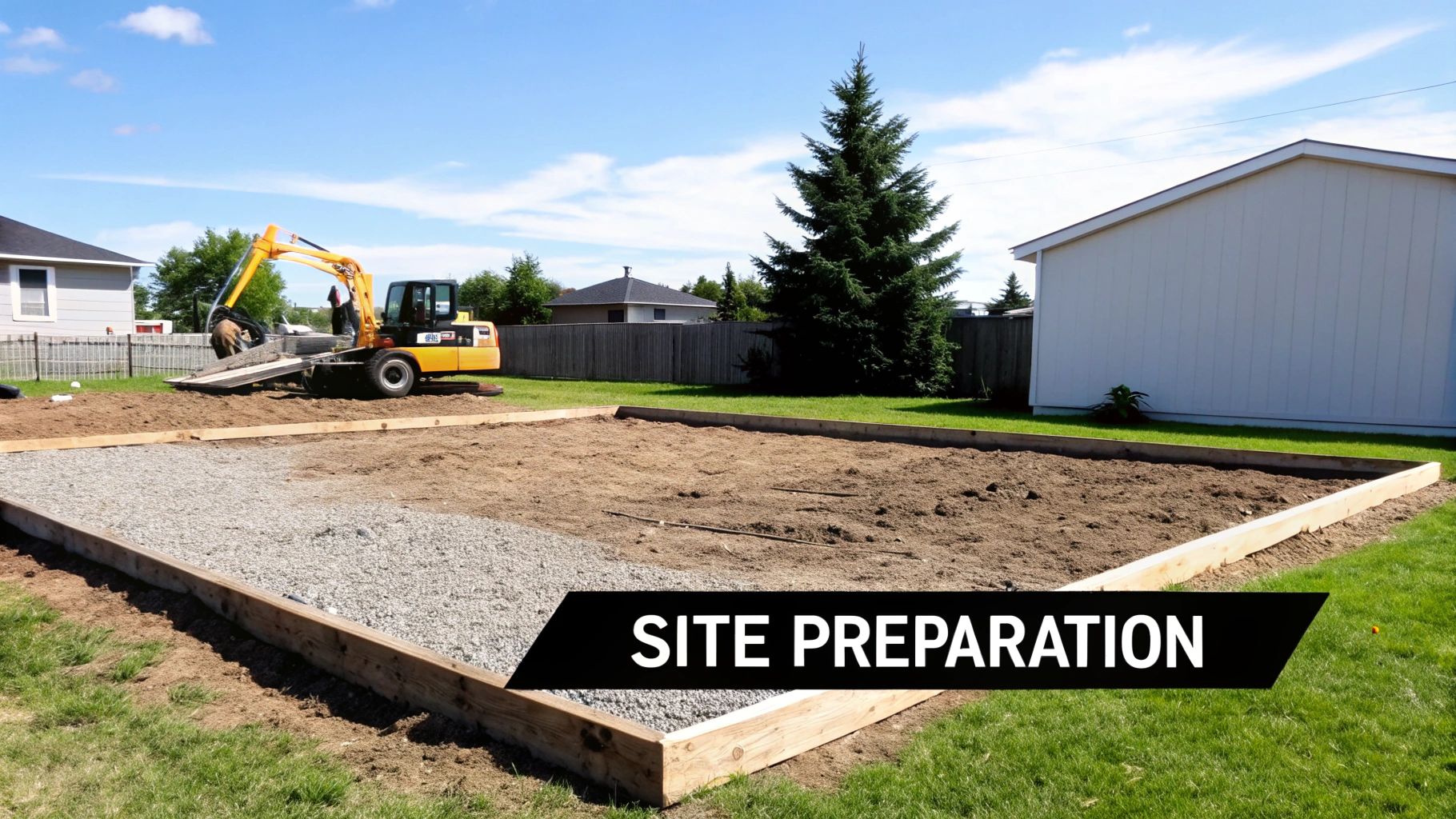
Here in Pennsylvania, we encounter all types of ground conditions—soft topsoil, heavy clay, and rocky terrain. Simply scraping the grass off and calling it level is asking for trouble. That ground will inevitably shift and settle, and that movement will transfer directly into your concrete and, eventually, your shed.
That's why our process at Firm Foundations begins by digging down. We excavate past all the unstable organic layers until we reach solid, undisturbed subsoil. It’s the only way to guarantee we’re building on ground that won’t compress or sink later on.
Creating a Stable Sub-Base
Once we've excavated to the proper depth, the real foundation work begins. We're not just creating a flat spot for concrete. We're engineering a stable base that can support thousands of pounds and withstand our region's notorious freeze-thaw cycles.
Our crews—some of the most trusted excavation contractors near me in PA—carefully install and compact a sub-base of crushed stone. This isn't just filler; this layer of angular gravel is a workhorse.
- It distributes the load. The weight of the slab and shed gets spread evenly across the subsoil, preventing any single spot from sinking under pressure.
- It handles drainage. The gaps between the stones create a path for water to drain, channeling it away from the bottom of your slab. This is your number one defense against frost heave.
- It provides stability. A tightly compacted gravel base creates a rock-solid platform that won't shift. Your concrete stays perfectly level for decades.
This compacted stone is what creates a truly durable shed foundation gravel base. It’s a non-negotiable step for us, whether we're pouring a small pad for a gazebo or laying large-scale garage footings and foundations.
For us, 'good enough' is never good enough. A proper excavation and a compacted stone sub-base are the non-negotiable first steps to building a concrete foundation that lasts a lifetime. Rushing this stage is the number one cause of premature foundation failure.
The Importance of Proper Grading
A perfectly level pad is only half the battle. The land immediately surrounding it is just as crucial. A classic mistake we see is leaving the surrounding soil flat or, even worse, sloped toward the new pad. Every time it rains, water is funneled directly under your foundation, where it can cause serious erosion.
As part of our standard site preparation, we expertly grade the soil to create a gentle, positive slope away from the concrete on all sides. This simple step ensures water sheds away from your investment, protecting both the shed concrete pad and the building itself.
It’s a subtle but critical detail that shows the difference between a quick concrete pour and a complete foundation solution. This is the kind of meticulous work that leads homeowners who were just looking for "driveway contractors near me" to trust us with their more complex foundation projects. They see the care we put into every single step.
How We Form, Pour, and Finish Your Concrete Pad
With the site perfectly graded and prepared, it's time for the foundation to take shape. This is where our team’s craftsmanship truly shines. A flawless pour day is the direct result of meticulous work in forming, reinforcing, and finishing the concrete.
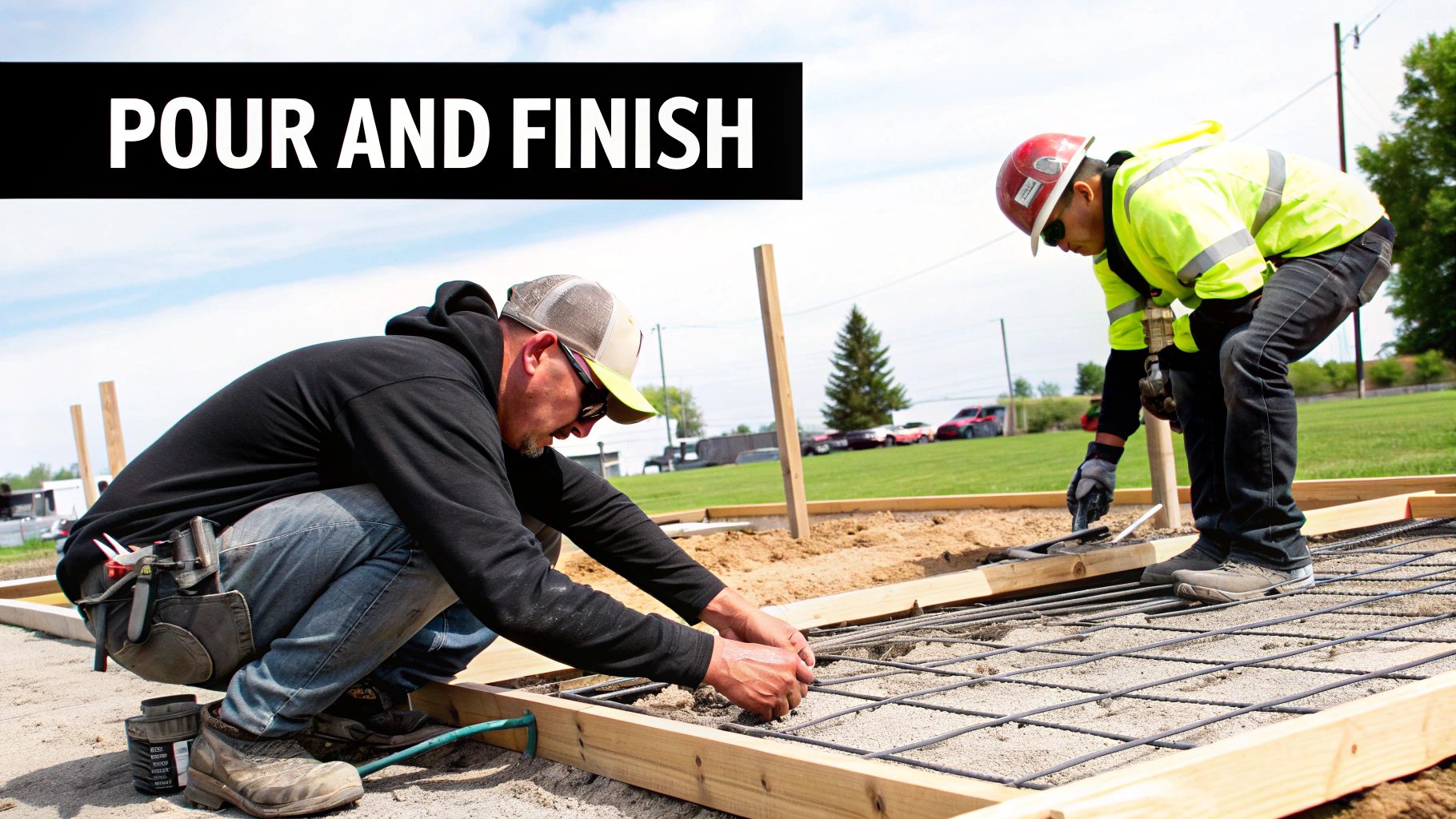
The first step is building the skeleton—the concrete forms. These aren't just simple wooden boxes; they are a critical temporary structure built to hold back the immense pressure of wet concrete. Our crews construct these forms with sturdy lumber, ensuring they are perfectly level, square, and securely braced.
Any bulge or dip in the forms will be permanently mirrored in the finished slab, so we take our time to get this step exactly right.
Building Strength From Within With Steel Reinforcement
Concrete is incredibly strong under compression (pushing down), but it needs help when it comes to tension (pulling or bending forces). Without reinforcement, a slab is prone to cracking under the stress of ground movement or heavy loads. That’s why adding steel is a non-negotiable part of our process at Firm Foundations.
For most standard shed pads, we embed a grid of steel wire mesh into the concrete. For heavier structures, like a garage foundation or a base for a large barn, we upgrade to a more robust grid of steel rebar.
This internal steel skeleton performs several critical jobs:
- Increases Tensile Strength: It actively resists the pulling forces that lead to cracks, essentially holding the slab together.
- Controls Cracking: If a tiny hairline crack does form, the steel prevents it from widening and becoming a structural problem.
- Manages Temperature Stress: Steel helps the slab expand and contract with temperature changes without breaking apart.
Skipping this step is a shortcut that always leads to a weaker, less durable foundation. For us, it’s a fundamental part of building a pad that is truly meant to last.
The Pour: The Art and Science of Concrete Work
With the forms built and steel in place, it’s time for the pour. This is where experience really makes a difference. We don't just order a generic mix; we specify the correct concrete strength, measured in Pounds per Square Inch (PSI), for your specific project. A pad for a small 10×10 storage shed has very different requirements than the concrete footings for a house foundation.
As the concrete is carefully placed into the forms, our crew gets to work immediately. This stage involves several key finishing techniques to create a smooth, dense, and incredibly durable surface.
The quality of a concrete slab is determined by the hands that finish it. The techniques used in the first few hours after the pour dictate the strength, appearance, and longevity of the foundation for the next 30 years.
We start by screeding the concrete, using a long, straight board to strike off the excess and bring the surface to a uniform level. This is immediately followed by floating, which uses a special tool to push down larger aggregate stones and bring a rich layer of cement paste to the surface. This step smooths any marks left by screeding and begins to densify the slab.
Finally, as the concrete begins to set, we use steel trowels to create that smooth, hard, and sealed surface. This trowel finish doesn't just look professional; it makes the pad more resistant to water and wear over time. This meticulous finishing is what separates a basic slab from a high-quality foundation built for longevity. You can learn more by exploring our resources on everything you should know about concrete footings. It's this deep understanding that informs every pad we pour.
Ensuring Longevity With Proper Curing and Drainage
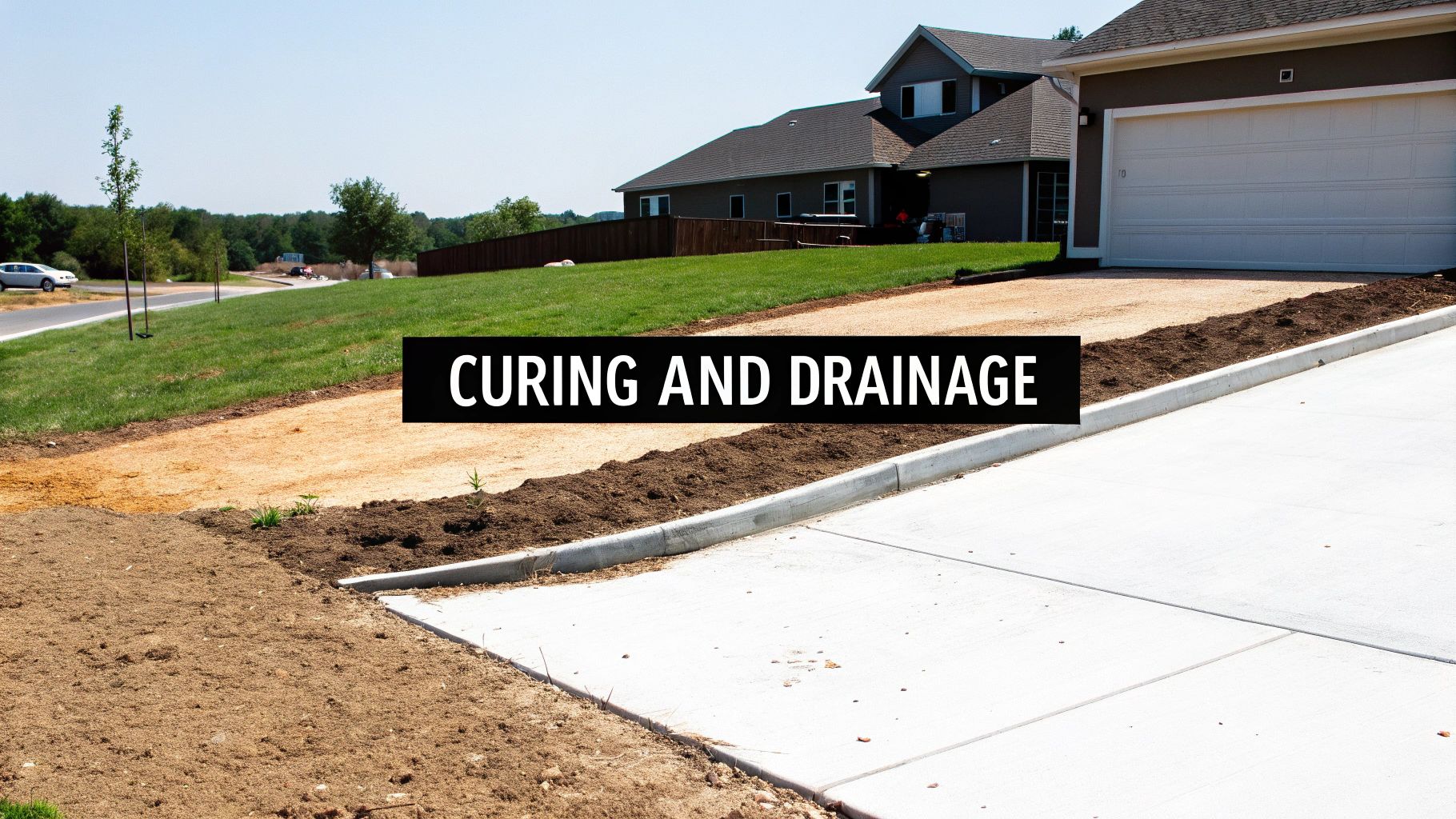
A freshly finished concrete pad might look like the job is done, but the most critical part is just beginning. What happens next—the curing process and long-term drainage—is what truly guarantees your foundation will last for decades.
This isn’t about just letting the concrete “dry.” Curing is a chemical reaction called hydration. As water in the mix combines with cement, it forms interlocking crystals that give concrete its incredible strength. If the surface dries out too quickly, especially on a hot or windy Pennsylvania day, that reaction stops. The result is a weaker, porous surface that is prone to cracks and flaking.
At Firm Foundations, we manage this crucial phase with patience and expertise. It’s what separates a professional job built to last from a rushed one that will cause headaches down the road.
The Science of a Strong Cure
Proper curing is all about controlling how quickly the concrete loses moisture. Think of it like baking bread—if you pull it out of the oven too soon, you end up with a doughy, weak middle. If a concrete slab dries too fast, you starve the chemical reaction it needs to harden completely.
Our team uses proven methods to get this right:
- Wet Curing: We may keep the surface damp with a fine mist of water for several days, which is one of the best ways to ensure full hydration.
- Covering: Using plastic sheeting or special curing blankets traps the moisture already in the mix, creating a humid environment where the hydration process can continue without interruption.
- Curing Compounds: We can also apply a liquid compound that forms a membrane, sealing the surface to prevent water from evaporating too quickly.
A slab that cures too fast might only reach 50% of its intended design strength. Proper curing isn't an optional step; it’s the final piece of craftsmanship that ensures your concrete pad is as tough as it was designed to be.
This careful attention during the first week prevents future problems like surface dusting and scaling, keeping your shed concrete pad solid for years to come.
Smart Drainage: A Permanent Solution
A strong pad is only half the battle. How that new foundation interacts with your property is just as important, especially with our region’s heavy rains and snowy winters. Water is, and always will be, the number one enemy of any foundation.
For us, proper drainage is never an afterthought; it's built into the plan from day one. We start by grading the site so water naturally flows away from the shed. But for properties with tricky slopes or heavy clay soil, a more robust solution is often needed to offer complete protection.
In challenging Pennsylvania landscapes, we often recommend installing a French drain. This is a gravel-filled trench with a perforated pipe that collects both groundwater and surface runoff, channeling it safely away from your foundation. It’s an incredibly effective way to keep the area around your shed dry and stable, preventing the soil erosion and frost heave that can damage even the strongest concrete foundations.
This complete approach—from meticulous curing to smart water management—is how we deliver a total foundation solution, not just a slab of concrete. It’s the peace of mind you get from knowing every detail has been handled by experienced local concrete contractors.
Finding the Right Shed Foundation Contractors in Pennsylvania
Choosing the right partner for your project is just as crucial as the concrete itself. With the right team, the entire process feels seamless, and you’re left with a foundation that will last a lifetime. This simple checklist will help you confidently evaluate contractors in Pennsylvania and ensure you hire a true professional.
The Hiring Checklist Every Homeowner Needs
First, verify their licensing and insurance. Any legitimate contractor will have this ready and won't hesitate to provide it. This is non-negotiable—it protects you from liability and proves they meet state standards. A professional website and clear, consistent branding are also good signs of a stable, reliable business.
Next, ask to see a portfolio of their local work. You want to see what they’ve actually built in your community. When reviewing their past jobs, see if they have experience with related concrete projects, like sturdy concrete patios and decks. This demonstrates a versatile skillset and a deep understanding of concrete, not just basic pads. At Firm Foundations, we’re always happy to share examples of our projects right here in PA, MD, DE, and NJ.
A contractor's portfolio is their resume. Look for clean lines, smooth finishes, and projects that look as good today as the day they were poured. This is the clearest evidence of quality craftsmanship and attention to detail.
Finally, take a close look at the quote. A bid from a trustworthy contractor will be detailed and transparent, breaking down the costs for materials, labor, and site prep. Be very cautious of quotes that seem unusually low or are vague. Those are often red flags for shortcuts, like skipping steel reinforcement or skimping on the gravel base. A professional quote reflects the true cost of a job done right.
Why Choose Firm Foundations for Your Shed Pad
We have built our reputation by checking every box on this list, and then some. As a licensed and insured local business, our goal is to provide homeowners with a stress-free experience from the first phone call to the final cleanup.
Our quotes are always free, always detailed, and come with zero pressure. We believe in earning your trust by delivering exceptional work on every single shed concrete pad we pour.
Ready to get a solid foundation under your new shed? Contact Firm Foundations today for your free, no-obligation quote. Let us show you what a difference professional craftsmanship makes.
Your Shed Pad Questions, Answered
When you're planning a new shed, you've got questions. We get it. Getting clear, straightforward answers is the best way to start a project with confidence. Here are a few of the most common questions our neighbors in Pennsylvania ask us about building a solid concrete pad for their shed.
How Thick Should the Concrete Be?
For most backyard storage sheds, a 4-inch thick pad is the industry standard. It's more than enough to provide a stable, long-lasting base for everyday use.
However, if you're planning something more substantial, like a workshop for heavy equipment or a two-car garage, you'll need a thicker slab. We typically recommend a 5 to 6-inch thick slab reinforced with steel rebar for those heavier-duty projects. We will always assess your specific needs to recommend the right thickness, whether you're in PA, MD, DE, or NJ.
Do I Actually Need a Permit for a Shed Pad?
This is a common question, and the answer is… it depends. Permit rules can change from one township to the next. In many areas, sheds under a certain size—say, 200 square feet—may not require one. But you should never assume that's the case.
The best approach is always to check with your local zoning office before any work begins. We work with local regulations all the time and can help guide you through the process to ensure your project is 100% compliant.
How Long Does This Whole Installation Take?
For a typical shed pad, you can expect the full installation to take about 2-3 days. This can vary slightly based on weather conditions and the complexity of your site.
- Day 1 is dedicated to site prep—excavation, grading, and preparing the gravel base.
- Day 2 is when we set the forms and pour the concrete.
After that, the pad needs a few days to cure properly before you can begin building the shed on top of it. We will always provide a realistic timeline in your quote.
My Yard Isn't Flat. Can You Still Install a Concrete Pad?
Yes, absolutely. Building on sloped ground is one of our specialties as local excavation contractors. It simply requires professional grading to create a level and secure base for the concrete. Our team has the equipment and expertise to build up a stable foundation that won't erode, ensuring your shed stays perfectly level for years to come.
Ready to build a foundation that lasts a lifetime? The team at Firm Foundations is here to help our neighbors in Pennsylvania and surrounding states. Get your free, no-obligation quote today and let's get your project started on solid ground.