
Local Guide: How to Level Ground for a Concrete Slab in Pennsylvania


Getting ready to pour a concrete slab for a new shed, garage, or patio? The success of your project hinges on the work you do before a single drop of concrete arrives. A solid foundation isn’t just about the pour; it’s about excavating the area, compacting the native soil, and building a perfectly leveled 4-6 inch layer of gravel.
This crucial layer, what we call a compacted subbase, is everything. Here at Firm Foundations, serving our neighbors across Pennsylvania, we know it’s the key to preventing cracks and settling. It’s how we ensure you get a durable, long-lasting slab for your new shed, garage, or gazebo foundation.
Why a Flawless Base is the Bedrock of Your Concrete Slab
As your local concrete contractors, we’ve seen it time and again: the success or failure of a concrete slab is decided long before the pour. An improperly leveled or poorly compacted base is the number one reason concrete fails, whether it’s for a small gazebo foundation or a large two-car garage. Here in Pennsylvania and Maryland, the freeze-thaw cycle is relentless, and it will quickly find any weakness in your groundwork.
This constant soil movement causes common problems like ugly cracks, sinking corners that become trip hazards, and poor drainage that leaves water pooling right against your new building. Prepping the site isn’t just a step in the process; it’s the most critical thing you’ll do to make sure your investment lasts for years to come.
The True Cost of an Uneven Foundation
Trying to save a little time or money by skimping on ground prep? It almost always backfires, leading to much bigger repair bills later. An uneven slab is a direct cause of major issues with concrete foundations.
You don’t have to take our word for it. The market for self-leveling concrete products hit USD 5.0 billion in 2023, a staggering number driven by the need to fix bad subgrades after the fact. It’s a clear sign that homeowners and businesses are spending a fortune to correct mistakes that could have been avoided from the start.
At Firm Foundations, we’ve been building our reputation in the Honey Brook Township community on getting this first phase right since 2011. A properly prepared base is what separates a slab that lasts five years from one that lasts a lifetime.
Understanding the Groundwork
To understand why this is so important, it helps to know what is groundwork in construction. The term covers everything done to prepare the ground before you build, like excavation, drainage, and creating that stable subbase. It’s the unsung hero of every successful shed foundation, garage, or patio.
As the go-to shed foundations contractors near me for folks in Honey Brook Township and beyond, this is our guiding principle. The integrity of your new barn shed or garage depends completely on the stability we build into the ground first.
In this guide, we’ll walk you through the process, from site assessment to final compaction. We’re sharing the same professional techniques we use on jobs across Pennsylvania, Maryland, Delaware, and New Jersey to create concrete foundations that truly last. You’ll see what it takes to do it right and feel more confident deciding when to tackle it yourself versus when it’s smarter to call a trusted local pro.
Mapping Out Your Project and Preparing The Site
Before a single shovel hits the dirt, the real work on your concrete slab has already begun. The success of your entire project hinges on this initial planning phase. Taking the time now to properly assess your site and understand the requirements will save you from massive headaches and unexpected costs later on.
Proper planning is the line between a smooth, on-schedule project and one that’s a mess of delays. It doesn’t matter if it’s a simple gazebo foundation or a larger base for a storage shed—these first steps are non-negotiable if you want a result that lasts.
Your First Call: 811 Before You Dig
Here in Pennsylvania, Maryland, Delaware, and New Jersey, your first move is always to call 811. This free service gets all the local utility companies to come out and mark their underground lines—gas, water, electric, and more.
Hitting one of those lines is a nightmare. It’s incredibly dangerous and can stick you with hefty fines and repair bills. Any professional excavation near me contractor worth their salt never skips this, and neither should you. It can take a few business days for all markings to be completed, so be sure to build that time into your project schedule.
Choosing The Right Spot For Your Slab
Where you decide to put your new shed or garage foundation isn’t just about aesthetics; it’s a strategic decision that affects drainage and the slab’s long-term health. Stay away from low-lying areas where water naturally pools. That’s a recipe for soil erosion and will put your new concrete at risk.
Try to find a spot that’s already fairly level, as this will reduce the amount of digging required. Don’t forget to think about access, either. You’ll need a clear path for materials like gravel and concrete. If you hire driveway contractors near me for the pour, their trucks and equipment will need an easy way in and out.
Here’s a critical pro tip from our years of local experience: Always plan for a slight, consistent slope. We aim for about a quarter-inch per foot, directing water away from your house or other structures. This simple detail is one of the best ways to prevent future water damage.
Budgeting and Getting Your Tools Together
With your site picked and utility lines marked, it’s time to work out a realistic budget and gather your supplies. Getting accurate measurements is absolutely crucial. For larger jobs, specialized tools like Exayard construction takeoff software can help nail down your material needs without guesswork.
The scale of your project dictates your tool list. A small 4×8 shed with foundation has a much simpler list than a full concrete foundation for a garage. Still, here are the basics you’ll likely need:
- Marking Tools: You’ll want stakes, string lines, and marking paint or chalk to outline your slab’s perimeter.
- Measuring Tools: A good tape measure is a must, along with a line level or a laser level to set your grades accurately.
- Excavation Tools: A pointed shovel for breaking ground, a square-nosed shovel for moving loose dirt, and a heavy-duty wheelbarrow are essential.
- Safety Gear: Don’t skip this. At a minimum, you need gloves and steel-toed boots to protect yourself.
By thinking through these details upfront, you’re setting the stage for a successful build. This planning ensures that when it’s time to level the ground for your concrete slab, you’re working efficiently and safely—whether you do it yourself or bring in an expert from Firm Foundations.
Your Guide to Excavation and Precision Grading
With your site all planned out, we get to the exciting part—actually moving some dirt. This is where your vision starts to take shape, but it’s also where precision is absolutely critical. We’re going to walk you through the physical work of marking your perimeter, stripping away topsoil, and digging to the perfect depth.
Getting the excavation right sets the tone for the entire job. It doesn’t matter if you’re leveling a sloped yard in New Jersey for a new 10×10 storage shed or preparing for garage footings and foundations; the depth and grade must be spot-on. This isn’t just about digging a hole. It’s about creating a perfectly engineered base for a slab that’s going to last for decades.
Before you put a shovel in the ground, there are a few key steps. This diagram lays out the essential pre-work checks, from safety calls to getting your gear lined up.
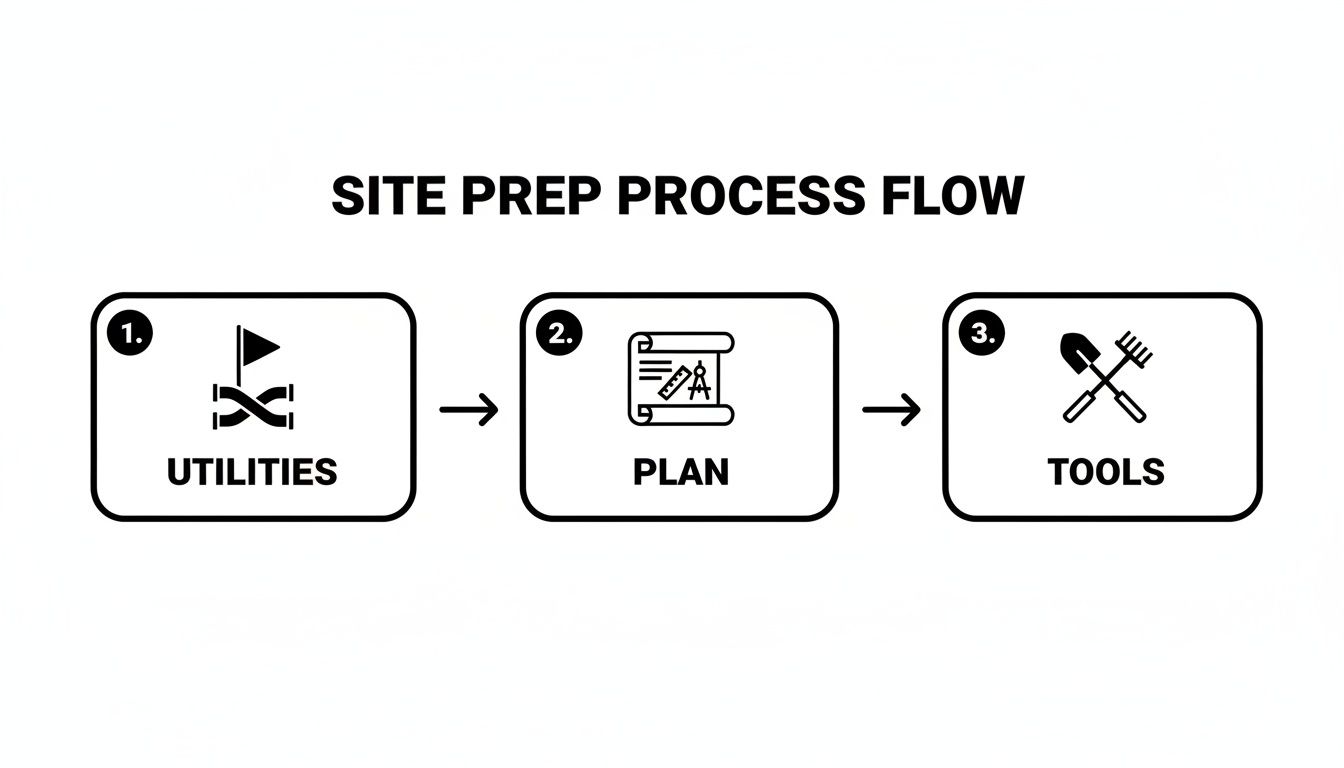
Think of this as your pre-flight checklist. Successful excavation starts with doing your homework: confirming utility line locations, double-checking your plan, and having the right tools ready to go.
Marking the Perimeter and Establishing Grade
First, you need to mark out the exact footprint of your slab. The professional way to do this is with batter boards and string lines. This technique gives you a perfectly level reference point that will guide every shovel of dirt you move. Simply drive stakes into the ground just outside your planned corners, stretch taut strings between them, and use a line level to get them perfectly horizontal.
These strings don’t just mark the ground—they represent the finished height of your concrete slab. Everything gets measured down from this line. It’s how you’ll know exactly how deep to dig for both your concrete and the all-important shed foundation gravel base.
For example, a standard 4-inch concrete slab on a 4-inch gravel base means you need to dig a total of 8 inches below your string line. This simple math ensures your shed foundation has the solid support it needs to avoid cracking.
A huge mistake we see homeowners make is trying to level the dirt itself. That’s not the goal. You need to establish a level reference with string lines above the ground, then dig a flat, consistently sloped plane below that line.
The Art of the Cut: Excavating to the Right Depth
Once your lines are set, it’s time to start digging. The first layer to go is all the topsoil, grass, and any roots within your marked-out area. This organic material is your enemy; it will decompose, creating voids under your slab that lead to settling and cracks. You must get down to the stable, compactable subsoil.
As you dig, keep checking your depth by measuring from your level string lines down to the bottom of the excavation. You’re aiming for a consistent depth across the entire area. If you’re on a slope, this will mean cutting into the high side and using that soil to build up the low side (a “cut and fill”). Be warned: any fill you add must be compacted in thin layers, or it will settle later.
Here’s a detail that separates the pros from the amateurs: your excavated base shouldn’t be perfectly level. You need to build in a slight, uniform slope of ¼ inch per foot to guide water away from the slab and any nearby buildings. This subtle grade is the single best way to prevent water from pooling underneath. For a closer look at how we handle this on-site, check out our in-depth guide on the excavation process at Firm Foundations.
To make sure you have everything you need before you start, here’s a quick checklist of essential tools and materials.
Essential Tools and Materials for Ground Leveling
Having the right gear on hand makes all the difference. This table breaks down what you’ll need for each stage of the process, from initial layout to final compaction.
| Tool/Material | Purpose | Pro Tip from Firm Foundations |
|---|---|---|
| Tape Measure & Marking Paint | For accurately measuring and marking the slab’s perimeter. | Use fluorescent paint. It’s much easier to see, especially in bright sun or low light. |
| Batter Boards & String Lines | To create a level reference for excavation depth and slope. | Always use a line level. Don’t eyeball it. Even a slight error here gets magnified across the slab. |
| Shovel & Mattock | For manual excavation and breaking up tough soil or roots. | A mattock is great for chopping through roots and clay that a shovel can’t handle. |
| Wheelbarrow | To move excavated soil and transport gravel subbase. | Don’t overfill it, especially on sloped ground. Multiple smaller loads are safer and easier. |
| Plate Compactor or Hand Tamper | For compacting the subgrade and each layer of the gravel subbase. | Rent a gas-powered plate compactor. The compaction quality is far superior to a hand tamper. |
| Level (4-foot or longer) | To check for level and ensure a consistent slope across the base. | A longer level gives you a more accurate reading over a larger area. |
| Landscape Rake | For spreading and grading the gravel subbase smoothly. | Use the back of the rake to knock down high spots and the tines to feather out the edges. |
Getting these items ready ahead of time will prevent frustrating delays and help your project run smoothly.
Why Professional Grading Matters
Cutting corners on ground leveling is a recipe for disaster. It’s not an exaggeration—historical data shows that poor site prep is behind nearly 25% of all concrete slab failures. This is one reason products like self-leveling concrete have become so popular, with the market growing to USD 5.70 billion in 2023. It highlights a hard truth: getting a perfectly graded surface by hand, especially in the clay-heavy soils common to Pennsylvania, is incredibly difficult.
At Firm Foundations, we don’t take chances. By using meticulously graded and compacted gravel bases, we can reduce the risk of a slab settling by over 50% compared to just pouring concrete on poorly leveled dirt. It’s the difference between a foundation that lasts a lifetime and one that fails in a few years.
Compacting The Ground and Building a Stable Subbase
Now for the part that really separates a rock-solid slab from one doomed to fail: compaction and the subbase. With your site dug out and grades set, this is where the true foundation gets built. It’s what prevents that awful sinking and cracking you see on poorly-done jobs.
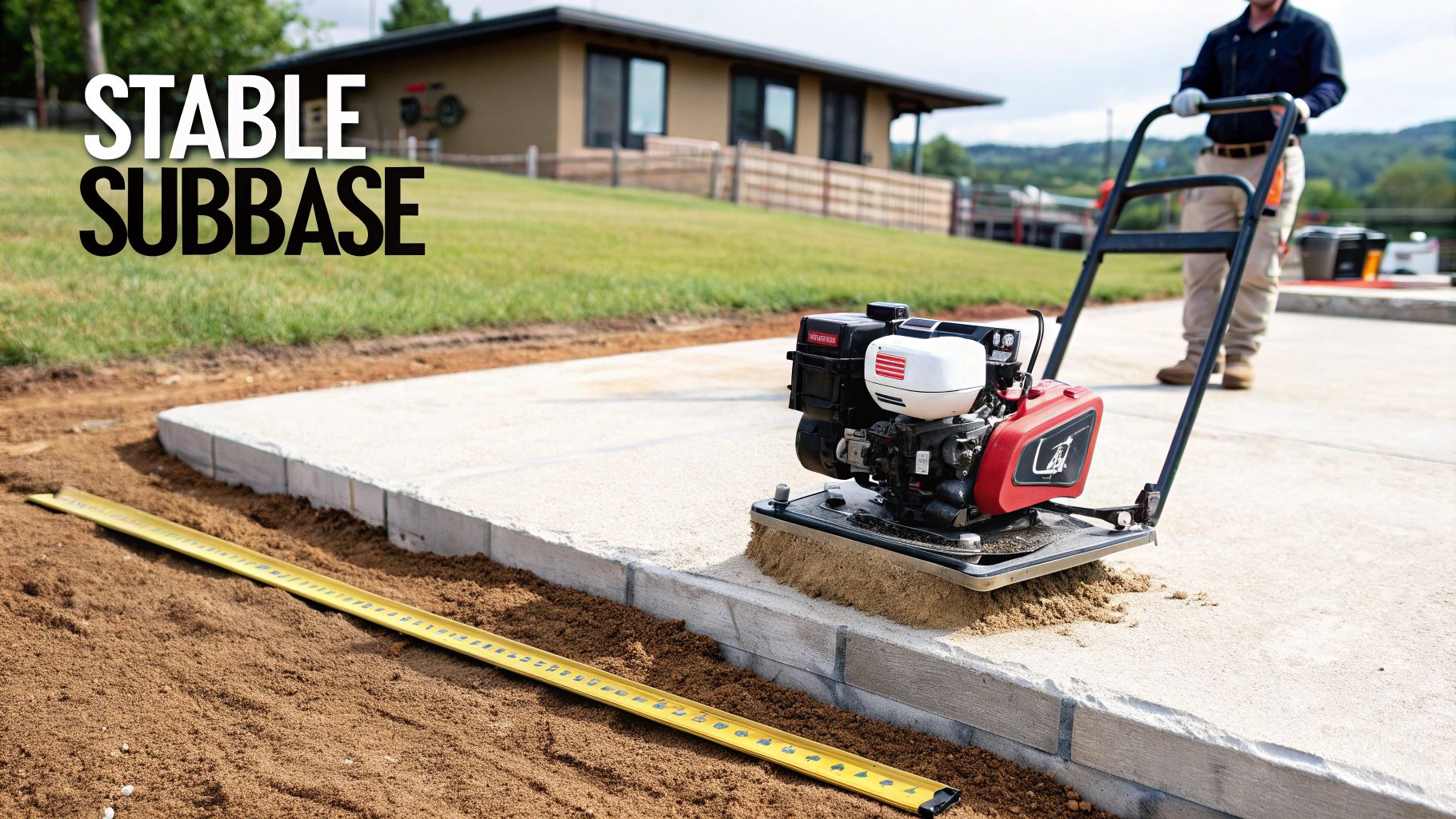
Think of it this way: the native soil is the mattress, but your gravel subbase is the box spring. You can’t have one without the other if you want proper support. Rushing this step is like building on a weak, lumpy bed—it’s just not going to last.
The First (and Most Important) Compaction
Before a single stone hits the ground, you have to compact the soil you just exposed. Digging loosens everything up, creating air pockets. If you build on that fluffy dirt, it will eventually settle under the massive weight of the concrete, and your slab will sink and crack.
We bring in a heavy-duty plate compactor and run it over every square inch. If you’re doing this yourself, you can rent one from almost any local equipment supplier. The goal is to get the soil as dense and tightly packed as possible, creating a stable platform for everything that comes next.
This is especially critical if you did any “cut and fill” work. That loose fill must be compacted in thin layers (we call them “lifts”) of no more than 4-6 inches at a time. Skip this, and settlement is a guarantee.
Choosing The Right Stone For The Subbase
With the subgrade locked in, it’s time to build the subbase. This gravel layer is your load-bearing MVP and your drainage system all in one. But not just any stone will do.
For nearly every project we handle, from shed foundation blocks to large foundation builds, we use ¾-inch clean crushed stone. The sharp, angular edges of this gravel are key—they interlock like a puzzle when compacted, creating an incredibly stable base. Never use rounded river rock; it just rolls around like marbles under pressure.
Another common mistake we see is using “crusher run,” which contains a lot of fine dust. It might pack down hard, but it kills your drainage. For a high-performance base, clean crushed stone is the only way to go. You can see exactly how we build these crucial layers in our guide to durable gravel pads.
We often see homeowners trying to save a few bucks by using sand or leftover topsoil as a base. Please, don’t do this. Sand can wash out and topsoil will decompose over time, leaving voids under your slab that will lead to certain failure.
Building and Leveling the Gravel Layer
How deep should your gravel be? For a typical shed or patio, a 4-inch compacted depth is the standard. For something heavier like a garage that needs to support vehicles, we always recommend a minimum of 6 inches of compacted gravel.
Here’s the pro technique for building it up:
- Work in Lifts: Never dump all the gravel at once. Spread it out in 2-3 inch layers.
- Compact Each Layer: After spreading each lift, run the plate compactor over the whole area until the stone is locked in tight. You’ll hear the sound change from a dull thud to a higher-pitched rattle when it’s fully compacted.
- Check Your Grade as You Go: Keep your string lines up and use a tape measure to constantly check your depth. This ensures you’re maintaining the proper slope and thickness as you build.
Once you hit your final height, use a sturdy landscape rake to screed the surface smooth, pulling stone from high spots into low ones. You should be left with a perfectly graded, unyielding plane that’s ready for your concrete forms.
Knowing When to Call In The Professionals
There’s a real sense of pride in a well-done DIY project, and we respect that. But one of the smartest things any homeowner can learn is knowing where the line is—the one between a satisfying weekend project and a total nightmare.
When it comes to leveling ground for a concrete slab, a small, flat patch for a simple shed is often a great DIY job. But when certain challenges arise, calling a professional isn’t admitting defeat. It’s the safest, smartest, and often most cost-effective move you can make.
At Firm Foundations, we’ve helped many folks in Pennsylvania, Maryland, Delaware, and New Jersey who started with the best intentions, only to hit a wall that turned their project into a major headache. Our goal is to ensure you get a perfect result that protects your property value, and sometimes, that means handing the shovel over to an experienced crew.
Red Flags That Signal It’s Time to Call a Pro
Some ground-leveling jobs are just too complex or risky to tackle without specialized knowledge and equipment. If you encounter any of these situations, it’s a good idea to get a professional opinion before you dig yourself any deeper.
- Heavily Sloped Yards: A slight grade is one thing; a significant slope is another beast entirely. This kind of job often requires major excavation, retaining walls, and expert water management. Cutting into a hill incorrectly can create serious soil instability and drainage problems.
- Poor Soil Quality: Is your ground a minefield of large rocks? Or is it full of heavy clay that holds water like a sponge? Excessively sandy and loose soil is also a problem. Standard compaction techniques won’t cut it. A professional excavation near me contractor knows how to amend and properly stabilize these challenging soil types.
- Large-Scale Projects: The bigger the slab, the higher the stakes. A two-car garage foundation or a full-blown house foundation is not a DIY job. These projects require deep garage footings and foundations, precision grading, and heavy machinery that only licensed pros can operate safely.
- Accessibility Issues: Is your site on a steep hill, tucked behind a fence, or squeezed into a tight spot? We have specialized equipment designed to navigate tricky sites without tearing up your yard—something a standard rental machine often can’t do.
The Firm Foundations Advantage
This is exactly where our team at Firm Foundations steps in. When you search for “garage foundation contractors near me” and find us, you’re not just hiring muscle; you’re investing in genuine peace of mind. We bring professional-grade equipment, licensed and insured expertise, and over a decade of hands-on experience to every job in our community.
We understand the unique soil conditions and weather patterns across Pennsylvania and our neighboring states. That local knowledge is critical—it allows us to build a base specifically engineered to withstand the freeze-thaw cycles that can destroy an improperly prepared slab.
Instead of spending your weekends fighting with rented equipment and stressing over complex grades, you get a guaranteed, perfectly prepared site. We handle it all, from the first scoop of dirt to the final pour, making sure every detail is spot-on.
A professionally built cement foundation for a garage or a sturdy gravel shed foundation is a long-term asset to your home, not a potential liability.
We want to empower you, whether that means giving you the knowledge to tackle a small project with confidence or being the trusted local expert you call for a free, no-pressure quote. If your project feels too big, give Firm Foundations a call. Let us show you how a professional touch ensures your new foundation stands strong for decades.
Your Ground Leveling Questions, Answered
Got questions about getting the ground ready for your new concrete slab? You’re not alone. We hear these all the time from homeowners across Pennsylvania, so we’ve put together straightforward answers to help you plan your project, whether it’s for a shed, garage, or new patio.
How Level Does The Ground Actually Need To Be For A Concrete Slab?
This is a great question, because “perfectly level” isn’t the real goal. While you want a smooth, flat base, what you really need is a slight, consistent slope for drainage.
We build in a grade of about ¼ inch per foot, sloping away from your home or other buildings. This is the secret to doing it right. That gentle slope prevents water from pooling on top of or underneath your slab, which is your best defense against erosion and frost heave damage.
What’s The Best Material To Put Underneath Concrete?
The method we trust—and the one that’s the industry standard for a reason—is a layered system. It starts with your existing soil, properly compacted (the “subgrade”). But the most important part is next: a layer of compacted crushed stone, known as the “subbase.”
For the subbase, we stick with ¾-inch clean gravel. A 4- to 6-inch layer of this, properly compacted, creates a rock-solid platform that drains beautifully. This is what keeps the cement foundations for your garage from shifting, settling, or cracking.
Can I Just Pour A Concrete Slab Directly On The Dirt?
Honestly, we’d strongly advise against it. Pouring concrete straight onto unprepared dirt or topsoil is the single biggest reason slabs fail prematurely.
Topsoil is full of organic matter that rots away, leaving empty pockets. Plus, all soil swells and shrinks with changes in moisture and temperature. Without a stable gravel shed foundation to act as a buffer, your slab is practically guaranteed to crack and sink. That gravel subbase isn’t just a suggestion; it’s essential for a slab that lasts.
A stable gravel subbase isn’t just a recommendation; it’s the core component of a durable foundation. It isolates the concrete from ground movement, provides a drainage path for water, and evenly distributes the load of the structure above.
What’s The Cost To Get Ground Leveled For A Slab?
The cost for a professional to level your ground can vary. The final price depends on the site’s current condition, the total square footage, and how easy it is for us to get our equipment into the area.
For a small, mostly flat spot, preparation might only run a few hundred dollars. On the other hand, a large, steep site that needs major excavation could be several thousand. There’s no one-size-fits-all price.
That’s why we always offer a free, no-pressure quote at Firm Foundations. We’ll visit your property in Pennsylvania, Maryland, Delaware, or New Jersey, assess what’s needed, and give you a clear, precise price for your specific project.
Ready to ensure the groundwork for your new project is done right the first time? The team at Firm Foundations has the expertise and equipment to create a perfectly graded and compacted base for any structure, from a simple shed foundation to a robust garage foundation.