
Recycled Concrete Aggregate: Benefits & Uses by Firm
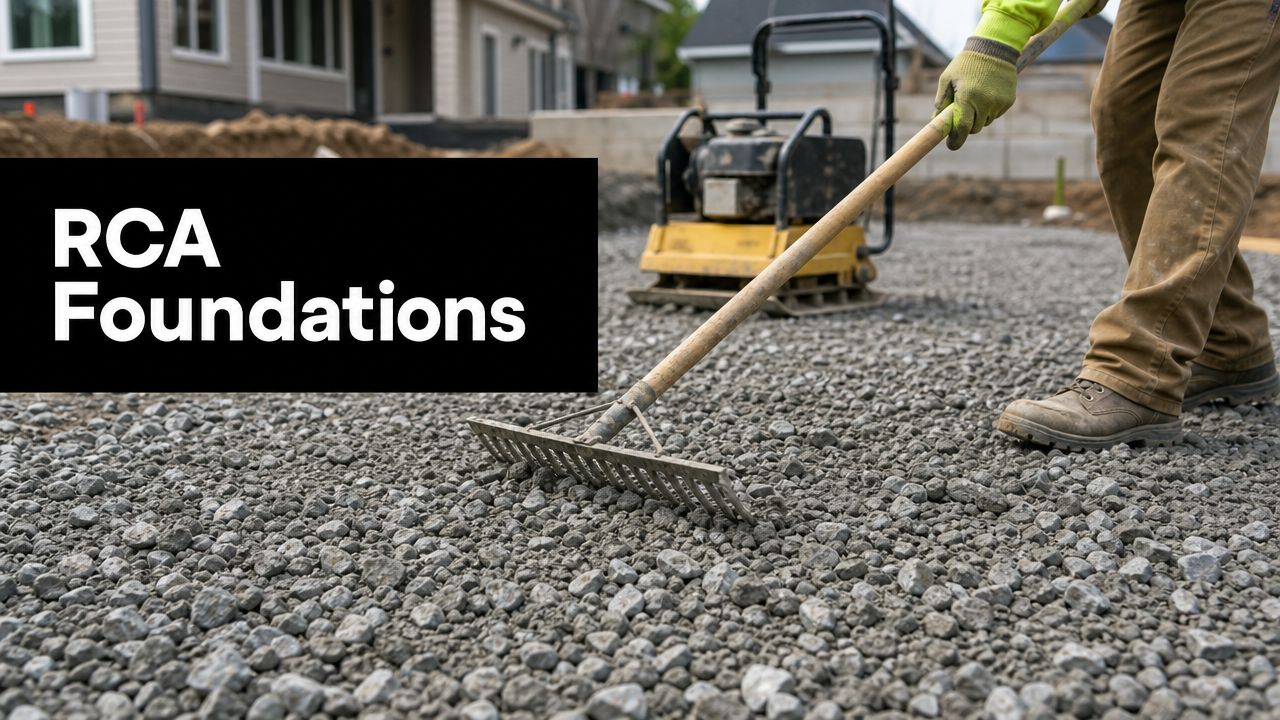
You've finally picked the shed, mapped out the garage, or decided it's time to fix that driveway that turns soft every winter. Then a crucial question arises. What should the base or foundation be made of?
That's where a lot of homeowners in Pennsylvania, Maryland, Delaware, and New Jersey get stuck. You search for shed foundations near me, garage foundation contractors near me, or gravel shed foundation contractors near me, and you start seeing the term recycled concrete aggregate everywhere. It sounds practical. It sounds cost-conscious. It sounds like the responsible choice. Sometimes it is.
But not every project should use it the same way. In our climate, the difference between a foundation that stays solid and one that shifts, traps water, or settles early usually comes down to matching the material to the job. A base for storage shed isn't the same as a concrete foundation for garage. A gazebo foundation doesn't carry the same load or risk as garage footings and foundations. The smartest decision isn't choosing the cheapest option or the newest trend. It's choosing the right base for the structure you're building.
Planning Your Foundation A Smart Start for Your Project
A homeowner in southeastern Pennsylvania might start with a simple goal. They want a clean, level pad for a new 10×10 storage shed. Someone in South Jersey may be planning a larger barn shed or a detached garage. In northern Maryland, the need might be a driveway extension, a house foundation prep area, or a slab for a workshop.
The pattern is usually the same. The structure gets most of the attention first, then the foundation becomes an afterthought. That's backwards. The pad, base, drainage, and compaction work decide whether the building stays square and usable.
What homeowners usually ask first
Customers typically don't call asking for recycled concrete aggregate by name. They ask practical questions:
- Will this save money without causing problems later
- Is gravel enough, or do I need concrete foundations
- Can I use recycled material under a shed foundation
- What works best in freeze-thaw weather across PA, MD, DE, and NJ
- Who handles excavation near me and the base in one job
Those are the right questions. Material choice should follow the use of the structure, the soil conditions, the drainage pattern on the lot, and how long you expect the project to last.
Practical rule: The foundation should fit the building, not the other way around.
For homeowners comparing options, good planning also means getting the quantities right before any stone or concrete shows up. A practical tool like Exayard concrete estimating software can help property owners and contractors think through material needs early, especially when comparing a gravel base, a slab, or a larger garage foundation.
Why the early decision matters
A shed foundation gravel base can be a strong, economical solution when it's designed correctly. A cement foundation for garage may be the better route when you need a finished floor, anchor points, or support for vehicles and heavier wall loads. The mistake is assuming one material works best for every job.
That's why homeowners in places like Honey Brook Township, Lancaster County, Wilmington, and nearby service areas benefit from looking at the whole system first. Drainage, grading, excavation, edge restraint, and compaction matter just as much as the aggregate itself.
What Is Recycled Concrete Aggregate
Recycled concrete aggregate, often shortened to RCA, is crushed and processed concrete from older structures that gets turned into usable base material for new projects. Instead of sending demolished concrete to a landfill, crews break it down, remove unwanted material, screen it, and sort it by size so it can go back into service.
That matters because concrete demolition creates a lot of usable stone-like material. The market has grown well beyond a niche product. The global RCA market is projected to grow from USD 8.6 billion in 2024 to USD 13.9 billion by 2030, according to Strategic Market Research's recycled concrete aggregates market analysis.
Here's the basic process homeowners should picture:
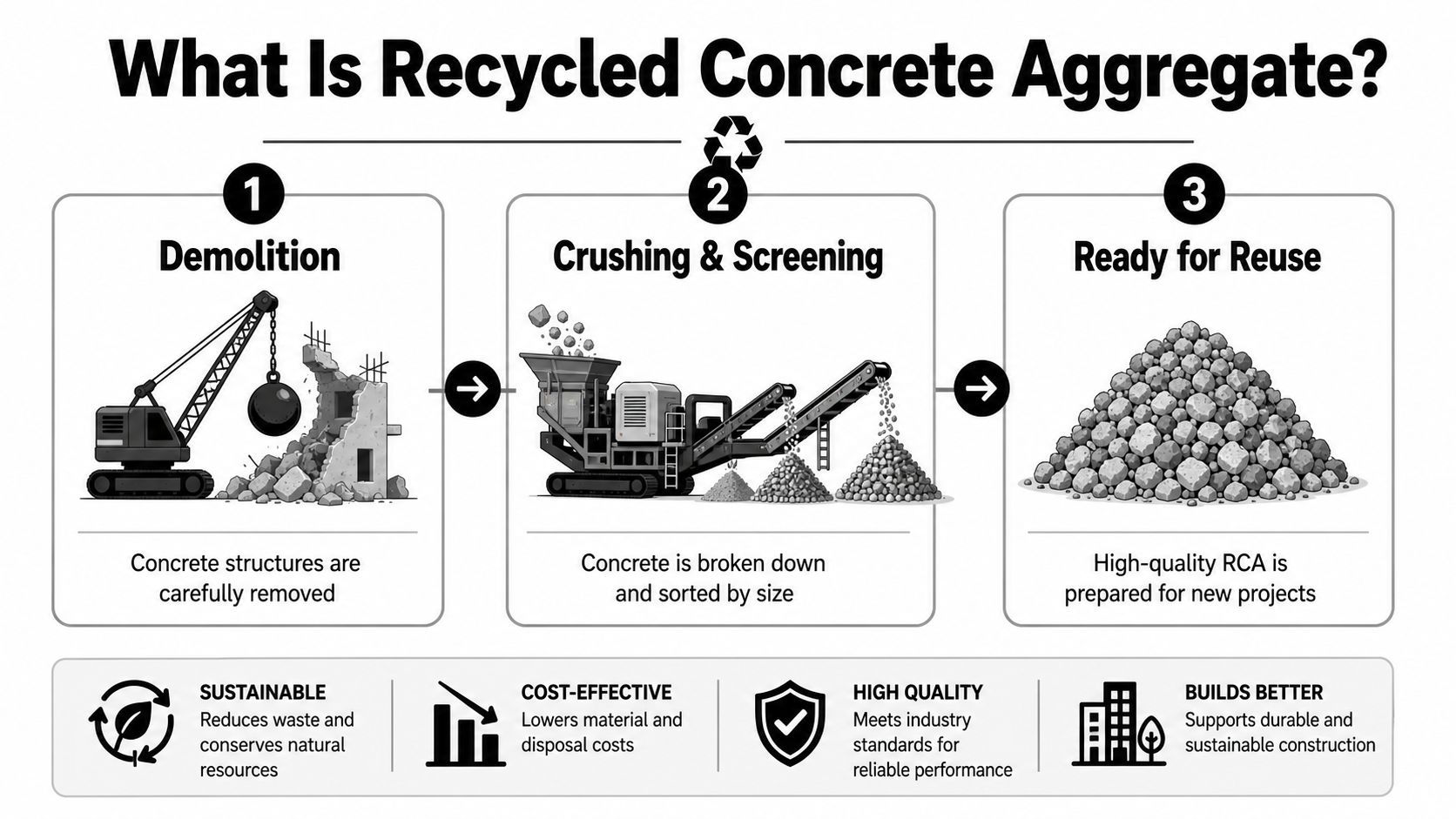
How old concrete becomes a new base material
A sidewalk, slab, curb, or driveway gets removed during demolition. That concrete is hauled to a processing yard and run through crushing equipment. From there, the material is screened and graded into usable sizes for base applications.
Consider reclaimed lumber. It's still wood, but it won't behave exactly like boards cut fresh from the mill. RCA is still aggregate, but it doesn't act exactly like newly quarried stone.
Why RCA behaves differently
The key difference is that RCA usually carries some of the old cement paste and mortar on it. That leftover material changes how it absorbs water and how it compacts. It can still be an excellent product, but it has to be sourced well and used in the right application.
That's why not all RCA is equal. One load may be clean, consistent, and ideal for a shed foundation, gazebo foundation, or subbase under flatwork. Another load may have too many fines, too much variability, or contaminants that make it a poor choice for a precision job.
Good RCA starts with good processing. Crushing concrete is easy. Producing a clean, predictable base material takes much more care.
For homeowners searching for driveway contractors near me, concrete contractors, or shed foundation contractors near me, that distinction matters. The material itself isn't the whole answer. Sourcing, screening, and installation determine whether recycled concrete aggregate performs like a smart value or becomes a shortcut that causes trouble later.
RCA vs Virgin Aggregate A Contractor's Guide
If you're comparing recycled concrete aggregate with virgin aggregate, you're really comparing two different tools. Both can work well. The right one depends on what the project needs to do.
Virgin aggregate is freshly quarried stone. It's more uniform and typically the safer choice where concrete performance, strength consistency, and long-term structural behavior matter most. RCA often shines where you need a stable base, good compaction, and a more budget-friendly option.
The practical difference on the job
One of the main reasons RCA performs differently is the adhered mortar left on the recycled material. That mortar is more porous and can reduce the concrete's modulus of elasticity by up to 25%, while also increasing water absorption and slightly lowering compressive strength, as explained in this technical discussion of adhered mortar on RCA.
For a homeowner, that doesn't mean RCA is bad. It means the job has to match the material.
A base for storage shed, shed foundation blocks, patio base, or driveway subbase usually has very different demands from a structural slab that needs tighter performance. If the project is a garage with vehicle loading and finish-floor expectations, a contractor has to be more selective.
Side by side comparison
| Feature | Recycled Concrete Aggregate (RCA) | Virgin Aggregate (Quarried Stone) |
|---|---|---|
| Source | Processed from demolished concrete | Newly quarried stone |
| Cost approach | Often chosen for budget savings on base work | Usually higher material cost |
| Best fit | Shed pads, driveway subbase, patio base, non-structural fill | Structural concrete, high-spec mixes, precision applications |
| Water behavior | More variable because of attached mortar | More predictable |
| Consistency | Depends heavily on source and screening | Typically more uniform |
| Sustainability | Reuses demolition material and reduces disposal | Requires new extraction |
| Contractor concern | Quality control and compaction | Material cost and hauling |
Where each one makes sense
For many residential projects in PA, MD, DE, and NJ, RCA is the better value below the finished structure, not always inside the finished structural concrete itself. That's a big distinction.
If you're also pricing a driveway project, this guide on how to build a gravel driveway helps show why base preparation and drainage usually matter more than the stone choice alone.
A homeowner planning a 4×8 shed with foundation or a small gazebo foundation can often use RCA wisely and save money. A property owner planning a concrete foundation for garage should expect a more cautious recommendation. That's not upselling. It's good judgment.
Best Uses for RCA on Your Property
The best use of recycled concrete aggregate is usually simple. Put it where it can do what it does well. Don't force it into applications where better materials give you a stronger margin of safety.
For most homeowners, RCA earns its keep under the project, not as the final visible surface and not as a default substitute in every structural mix.
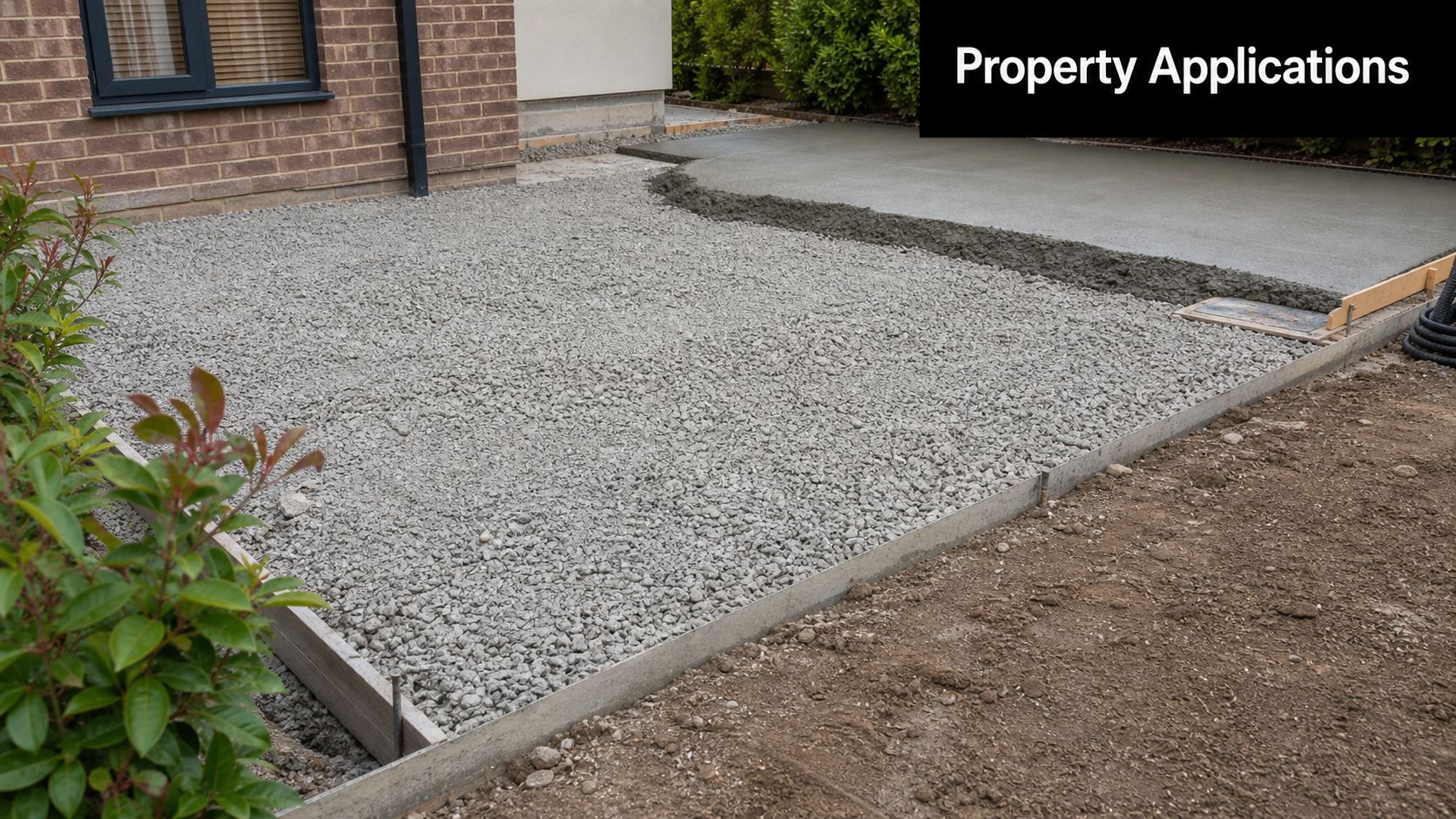
Where RCA is usually a smart buy
RCA is standard for non-structural base courses, where it performs comparably to virgin aggregate at a 30 to 50% lower cost, but it's often restricted for new structural concrete mixes because of higher creep and lower strength limits without specific mix adjustments, according to Komplet America's overview of crushed concrete uses.
That lines up with what makes sense on real jobs:
- Shed pads and gravel bases for backyard storage buildings
- Driveway subbase under a finished stone, asphalt, or concrete surface
- Gazebo foundation and patio support layers
- Shipping container bases where grading and compaction matter most
- Horse barn and outbuilding pads where drainage and stability are the priorities
A solid base for a shed in Lancaster County doesn't need the same material strategy as a reinforced slab for a garage in Delaware County. A cost-conscious driveway subbase in Wilmington, Delaware can be an excellent place to use RCA without compromising the finished project.
Where I'd stay conservative
If the project calls for structural concrete that must meet tighter performance expectations over time, virgin aggregate is often the safer call unless the mix has been specifically engineered around RCA.
That includes cases like:
- Garage footings and foundations carrying vehicle loads and framed walls
- Concrete foundation for garage work where finish quality and long-term durability both matter
- Certain house foundation or heavily loaded slab applications
- Projects in wet or variable soils where any added uncertainty can show up later as movement or cracking
The cheapest material is only a good value when it fits the job. If it creates risk in the wrong application, it's no bargain.
Best local fit in PA MD DE and NJ
In our regional climate, freeze-thaw cycles and drainage are always part of the conversation. That's why RCA often works best as a compacted, shaped, well-draining layer beneath the structure. For a shed foundation gravel base or base for storage shed, that's often exactly what you want.
For homeowners searching gravel shed foundation contractors near me, the most practical answer is this. RCA can be a very smart way to save money on the base system. It just shouldn't be treated as a universal replacement for every aggregate need on the property.
Proper Installation for Long Lasting Results
Good material can still fail when the installation is rushed. Most settling problems don't start because the aggregate name was wrong. They start because the site wasn't prepared, the base depth was inconsistent, or the crew tried to compact too much material at once.
That matters even more with recycled material. RCA mixtures typically have unit weights that are 10 to 15 percent lower than conventional concrete, and that lower weight has to be considered during compaction to reach the needed density for a stable foundation, according to the Federal Highway Administration concrete pavement guidance.
What proper installation looks like
A strong pad or subbase usually follows the same sequence, whether it's for a shed foundation, gazebo foundation, driveway, or larger pad:
- Excavate to the right footprint. Remove topsoil, roots, soft pockets, and organic material that will decay or compress.
- Set grade and drainage. Water has to move away from the foundation area, not sit under it.
- Install the aggregate in lifts. Crews place and compact it in layers rather than dumping the whole depth at once.
- Compact with the right equipment. Plate compactors, rollers, and moisture control all matter.
- Check final elevation and flatness. The structure has to sit on a level, dense base.
Here's a visual example of the kind of gravel pad installation homeowners often ask about:
Why lifts matter so much
Trying to compact a deep pile all at once is one of the fastest ways to get future settlement. The top may look tight while the lower layer stays loose. That's how a pad looks good on install day but starts moving after rain, frost, or the first season under load.
For homeowners who want a better sense of how compaction affects slab performance, this article on soil compaction for concrete slab projects is worth reviewing.
A pad doesn't fail all at once. It usually fails one soft layer at a time.
What this means for budget-minded projects
If you're building a shed, hot tub pad, or storage base, proper installation often matters more than chasing a premium material. For a garage slab or larger foundation builds project, both matter. The base has to be dense, dry where possible, and shaped to manage water before any concrete forms go in.
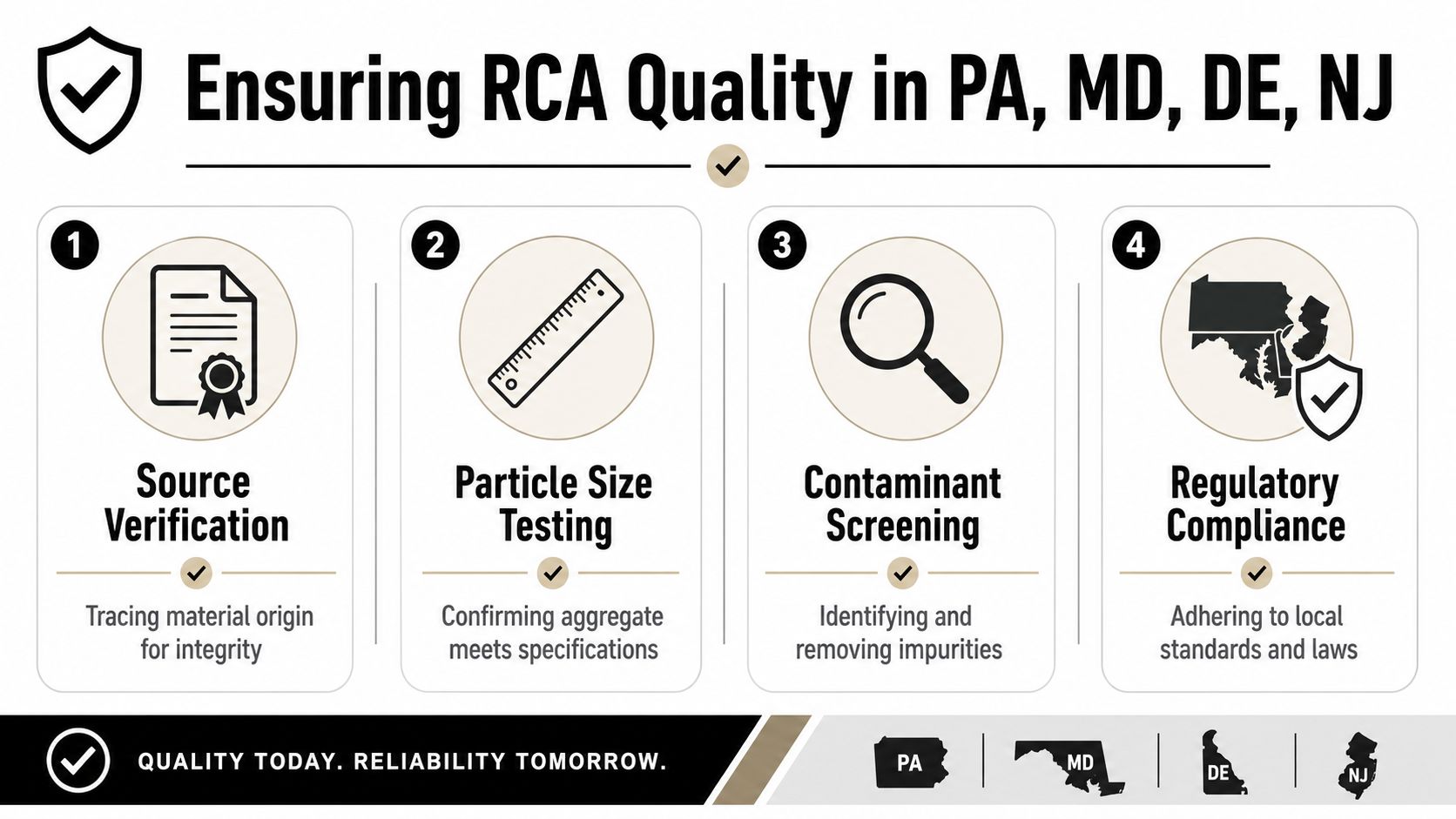
Ensuring RCA Quality in PA MD DE and NJ
RCA only works when the quality is controlled. Homeowners usually don't see that part, but it's where a lot of project success is decided. A clean, well-graded recycled product is a very different material from a random pile of broken concrete with mixed debris in it.
State agencies have looked closely at this. The Pennsylvania Department of Transportation has verified that RCA can produce strong, durable concrete suitable for many uses, and research cited by PennDOT shows it can even improve freeze-thaw resistance, which matters in our regional climate. You can review that in PennDOT's recycled concrete aggregate fact sheet.
What quality control should include
When RCA is being used for a residential or commercial base in Pennsylvania, Maryland, Delaware, or New Jersey, a contractor should care about a few things right away:
- Material source. Reputable suppliers screen and process consistently.
- Gradation. The blend of particle sizes affects compaction and drainage.
- Contaminants. Wood, metal, asphalt, trash, and excess fines shouldn't be mixed through the load.
- Job match. The material has to fit the application, whether that's a shed foundation gravel base or a larger subbase under flatwork.
Why local climate changes the conversation
In PA, MD, DE, and NJ, the material has to deal with wet seasons, freezing temperatures, and repeated thaw cycles. That's why quality and drainage belong in the same conversation.
A base under a concrete foundation for garage can't just be hard. It has to stay stable when the seasons change. A pad for a barn shed or playset has to resist rutting and edge washout. A driveway base has to hold shape under traffic and stormwater.
What homeowners should ask before saying yes
If you're hiring concrete contractors, driveway companies near me, or crews advertising shed foundations contractors near me, ask direct questions:
- Where is the RCA sourced from
- Is it screened and graded for this use
- How do you handle drainage on this lot
- Will the base be compacted in lifts
- Is RCA being used as subbase, finished base, or inside the structural concrete
Those questions tell you quickly whether the contractor understands the difference between hauling stone and building a foundation that lasts.
Clean source material, proper grading, and careful compaction matter more than marketing language.
Your Recycled Concrete Aggregate Questions Answered
Is recycled concrete aggregate good for a shed foundation
Yes, often. RCA is commonly a good fit for a shed foundation, especially for a properly prepared gravel pad. If the goal is a firm, level, draining base for a shed, gazebo, or similar structure, RCA can be a practical and cost-conscious option when the site is excavated and compacted correctly.
Is RCA a good choice for a garage slab
Sometimes as subbase, not always as the aggregate choice for the slab itself. A cement foundation for garage or finished slab usually calls for a more conservative approach because garage projects carry heavier loads and tighter performance expectations than a backyard shed.
Does recycled concrete aggregate hold up in PA, MD, DE, and NJ weather
It can. In this region, success depends on drainage, compaction, and material quality. Freeze-thaw weather doesn't forgive shortcuts. A well-built base performs very differently from a rushed one.
Is RCA cheaper than virgin stone
In many non-structural base applications, yes. That's one reason it's popular for shed foundation gravel base work, driveway subbase layers, and similar projects where homeowners want value without sacrificing stability.
What projects are best for RCA
Good candidates include:
- Base for storage shed
- Gazebo foundation
- Driveway subbase
- Pads for hot tubs, playsets, and containers
- Outbuilding and barn shed bases
For heavily loaded or structural concrete applications, the right answer may be a different material or a different design.
Can RCA be used everywhere on my property
No, and that's the honest answer. It's a useful material, not a universal one. The job, soil, drainage, and structure all need to be considered before picking the foundation system.
What matters most besides the material
Three things decide a lot of outcomes:
- Excavation quality so the base starts on firm ground
- Drainage planning so water moves away from the structure
- Compaction discipline so the pad doesn't settle later
If you're comparing options for concrete foundations, garage footings and foundations, or shed foundations near me, the right contractor should be able to explain the “why” behind the recommendation in plain language.
When should I request a quote
As soon as you know the size of the structure and roughly where it's going. Early planning helps avoid rework, delivery issues, and surprise site costs. It also makes it easier to decide whether you need a gravel pad, slab, footings, excavation, or a combination of services.
If you're planning a shed pad, garage slab, driveway base, or excavation project in Pennsylvania, Maryland, Delaware, or New Jersey, Firm Foundations can help you choose the right foundation for the job and build it the right way. Reach out for a free quote if you want straight answers, clear pricing, and a foundation that's designed for long-term performance.