
How to Build a Gravel Driveway in PA, MD, DE & NJ
A lot of homeowners start looking up how to build a gravel driveway after the same frustrating moment. It rains hard, the car tires sink at the edge of the yard, and the path to the garage, shed, or barn turns into a muddy track. Others run into it when they’re planning a new outbuilding and realize the structure is only part of the project. You also need a reliable surface that can handle vehicles, drain properly, and still look clean from the road.
That’s where gravel makes sense. It’s a practical option for rural and suburban properties across Pennsylvania, Maryland, Delaware, and New Jersey, especially when you need access to a garage, barn shed, storage area, or backyard building site. It also stays far more budget-friendly than many paved options. Typical installation costs range from $1 to $10 per square foot according to Angi’s gravel driveway cost guide.
What trips people up is that a lasting gravel driveway is not just stone dumped on bare ground. The difference between a driveway that stays firm and one that starts rutting, washing out, or growing soft spots usually comes down to preparation, drainage, and compaction. In the Mid-Atlantic, those details matter even more because the weather and soil work against you.
Your Guide to a Lasting Gravel Driveway
A homeowner usually sees the problem after the first hard rain. The stone still looks fine from the road, but tires start pushing into soft spots, water sits in the tracks, and the edges begin to unravel. In our part of the country, that failure often starts underneath, not on top.
A lasting gravel driveway is built as a system. Excavation, base preparation, compaction, and drainage determine whether the surface stays firm through wet springs, summer storms, and winter freeze-thaw. The most important work happens below the finished stone.
That matters across Pennsylvania, Maryland, Delaware, and New Jersey, where driveways often cross clay-heavy soils, shaded wooded areas, and lots with runoff coming off roofs, slopes, or both. A method that holds up on sandy, dry ground can fail fast here. Mid-Atlantic driveways need to shed water, resist pumping in wet weather, and stay tight after repeated freezing and thawing.
What gravel does well
Gravel works well for many properties because it drains, adapts to long rural and semi-rural driveways, and is easier to repair than hard pavement. It also fits the way many detached garages, barns, sheds, and backyard buildings are used. If a section needs attention later, you can regrade and add material without tearing out the whole driveway.
It also gives homeowners flexibility. A simple access lane, a wider parking area, and a heavier-duty route for delivery trucks do not all need the same build. The trade-off is that gravel is less forgiving of poor prep. If the subgrade is soft or water is trapped, fresh stone only hides the problem for a while.
Practical rule: If the ground underneath is weak, the gravel on top will reflect that weakness.
What usually goes wrong
Failed gravel driveways tend to break down in predictable ways, especially in the Mid-Atlantic:
- Topsoil or soft organic material was left in place. That layer compresses, holds water, and creates weak spots.
- Runoff was ignored. Water starts at the high side, crosses the drive, and washes fines out of the stone.
- The base was dumped too thick and not compacted in lifts. The driveway looks finished early, then starts rutting under traffic.
- The surface stone was chosen for appearance instead of performance. Rounded gravel moves, scatters, and never locks together the way a proper topping stone should.
Those are construction problems, not cosmetic ones.
If the driveway serves a new shed foundation, garage, gazebo foundation, or storage shed access route, it should be treated like part of the sitework, not an afterthought. Built properly, it carries daily traffic, handles weather better, and protects the surrounding investment instead of becoming another repair project.
Planning Your Driveway Project for the Mid-Atlantic
The best driveway jobs are usually the ones that looked uneventful from the outside. No surprise puddles. No last-minute route changes. No excavation into a wet area that should’ve been avoided from the start. That kind of result comes from planning the layout before equipment ever arrives.

Start with the path, not the stone
On paper, the shortest route from the road to the garage or shed looks like the obvious choice. On the ground, it often isn’t. The right path depends on slope, low spots, existing drainage patterns, tree roots, property lines, and how vehicles will turn and back up.
A driveway should feel easy to use in bad weather, not just on a dry summer afternoon. If a truck has to swing wide to reach a garage foundation or a shed delivery spot, the layout needs to account for that early. Tight approaches and awkward turns create edge breakdown and tire rutting even when the gravel itself is decent.
Drainage is the first real design decision
In this region, drainage can’t be treated as an afterthought. Homeowners in the Mid-Atlantic often deal with 30 to 40 annual freeze-thaw cycles, and regional rainfall averages 42 to 48 inches annually, which is why standard gravel specs often fail within 2 to 3 years if they aren’t adapted for local soils and moisture conditions, according to this Mid-Atlantic gravel driveway planning guide.
That’s the core reason a driveway needs either a crown or a consistent cross-slope that moves water off the surface. If water sits in the wheel tracks, it weakens the upper layers, softens the subgrade, and makes winter heaving worse.
Water is never neutral on a driveway. It either leaves quickly, or it starts taking the driveway apart.
What to check before excavation
Before a driveway route is finalized, a few site checks save a lot of trouble later:
- Utility locations: Buried lines need to be identified before any digging starts.
- Setbacks and easements: The driveway may be clear physically but still conflict with local rules.
- Runoff direction: Water should move away from structures, not toward a house foundation, garage slab, or outbuilding pad.
- Finished elevation: The driveway should meet existing surfaces cleanly instead of creating abrupt lips or low pockets.
Local approval matters more than many owners expect
Municipal requirements vary, and some townships care a lot about driveway entrances, stormwater, and excavation near the road. That’s especially true when the project affects a ditch line, culvert, or public right-of-way. If you’re in Honey Brook Township or nearby communities, it’s worth checking local rules early instead of assuming a gravel surface means no permit questions apply.
A short planning checklist helps:
| Item | Why it matters |
|---|---|
| Driveway route | Prevents awkward turns and soft low areas |
| Drainage plan | Reduces washouts and standing water |
| Utility marking | Avoids dangerous and expensive strikes |
| Township review | Prevents delays and rework |
| Access width | Makes room for real vehicle use, not just passenger cars |
For homeowners searching for driveway contractors near me, excavation near me, or even gravel shed foundation contractors near me, this planning stage is often where professional experience shows up first. The visible work comes later. The right decisions start here.
Excavation and Building a Stable Sub-Base
Once the layout is set, the driveway stops being a landscaping idea and becomes an earthwork job. Here, long-term performance is won or lost. A driveway can have attractive stone on top and still fail quickly if the excavation is shallow, the soil is left contaminated with organics, or the base is dumped in all at once and never compacted correctly.
Excavate until the bad material is gone
Topsoil has no place under a driveway. Neither do roots, soft organic pockets, or loose fill that’s been sitting there for years. The point of excavation is to remove unstable material and create room for a proper stone structure.
The depth depends on conditions and load, but the key is that the finished driveway needs enough stone below it to carry traffic and shed water. In many Mid-Atlantic properties, clay-heavy areas need deeper preparation because the soil holds moisture and moves more through wet and cold cycles.
Build the shape before the stone goes in
The subgrade should already reflect the drainage plan. If the grade underneath is flat in the wrong places, the gravel above tends to mirror those mistakes. Good crews shape the bed so runoff leaves the driveway instead of sitting beneath it.
This is also the stage where weak spots show themselves. A driveway route may look uniform from the surface, but the excavator operator often finds one section that pumps, smears, or stays damp. That area usually needs extra attention before the first base load goes down.
A gravel driveway should never rely on the top layer to fix a soft bottom.
Geotextile fabric is one of the smartest upgrades
On many jobs, a geotextile fabric goes over the prepared soil before base stone is placed. It doesn’t replace excavation or compaction, but it does help separate the stone from the earth below. That keeps mud from migrating upward and helps preserve the strength of the base over time.
It also helps with weed suppression and subgrade stability, especially on sites that stay damp or have mixed soil conditions. Homeowners often don’t notice it because it disappears under the gravel, but it’s one of those details that provides subtle benefits.
For properties that also need broader site prep, this kind of work overlaps with residential excavation services much more than people realize. Driveways, shed foundations, garage footings and foundations, and pad prep all depend on the same basic principle. Remove unstable material and build back in controlled layers.
The sub-base does the heavy lifting
The load-bearing layer is typically made from angular crushed stone such as #3 or similar base material. Angular stone locks together better than rounded rock, which is why it performs well below driveways. This isn’t decorative gravel. It’s structural.
The base should be spread in lifts rather than dumped to full depth in one pass. Compaction is what turns loose aggregate into a stable working surface.
According to this step-by-step driveway compaction guide, poor compaction causes 70-80% of driveway failures, and a sub-base of at least 6 inches, or up to 12 inches in clay soils, should be compacted in 4-inch lifts to reach 95-98% Proctor density. The same source notes that inadequate slope is linked to 60% of DIY failures because of water pooling.
What proper compaction looks like
A plate compactor is not just a formality. It’s the tool that densifies each lift so the particles interlock and the layer stops behaving like a loose pile. On larger areas, crews may use heavier compaction equipment, but the principle stays the same. Spread, level, compact, and then repeat.
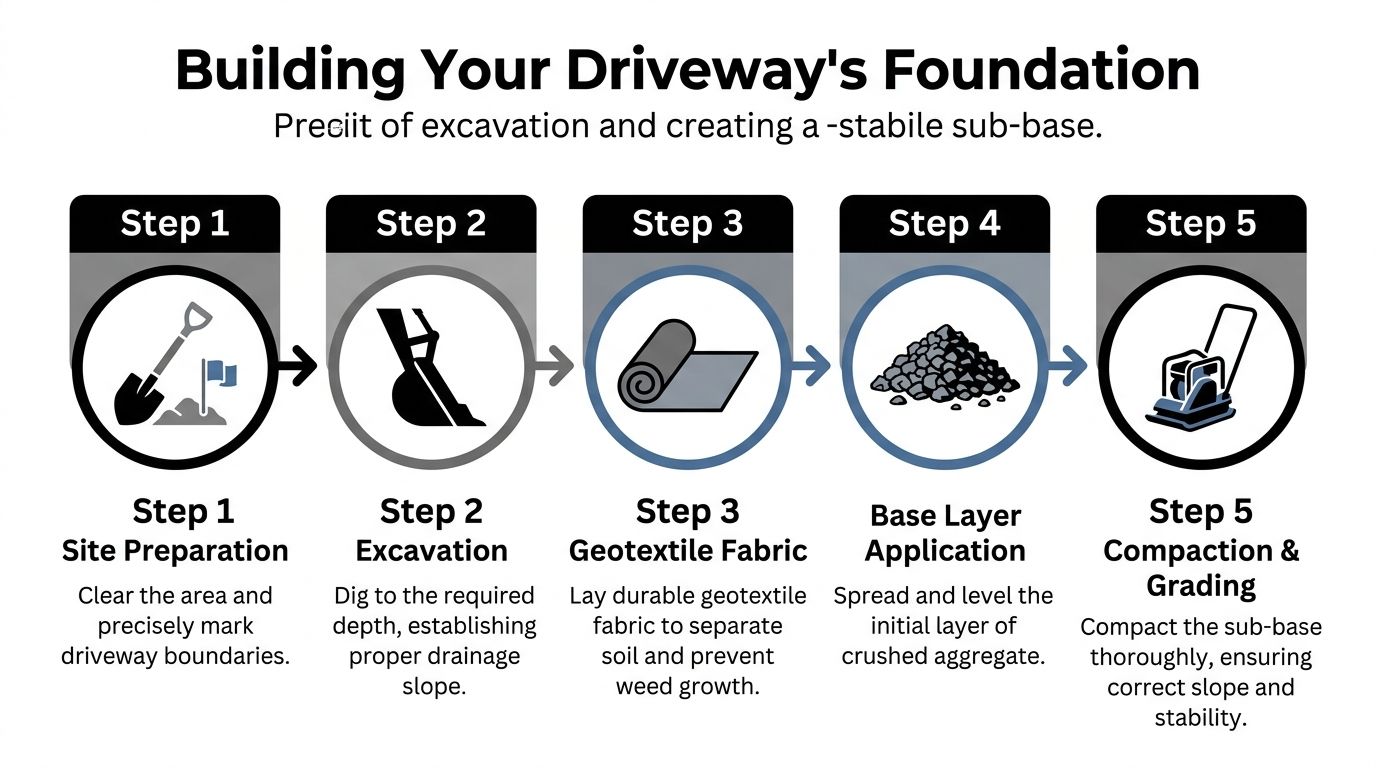
Here’s the sequence that holds up best:
- Mark the boundaries clearly. Stakes and string lines keep width and grade consistent.
- Excavate to suitable depth. Remove organics and weak soil, not just grass.
- Install fabric where needed. Especially helpful on unstable or wet sites.
- Place base stone in lifts. Don’t rush to full thickness.
- Compact each lift thoroughly. No shortcuts here.
- Check grade as you go. A driveway that compacts flat in the wrong direction will still drain poorly.
A lot of DIY jobs look acceptable right after installation. The failures show up later, when repeated traffic and weather expose what was skipped underneath. That’s why this stage deserves the most care.
Choosing and Applying Your Gravel Layers
With the sub-base finished, the driveway starts to look like a driveway. Many people might think the main part of the project begins here, but the smarter way to view it is that these layers are the finishing structure sitting on top of the underlying foundation. Their job is to lock together, drain well, ride smoothly, and stay put under turning tires.
Why one stone type isn’t enough
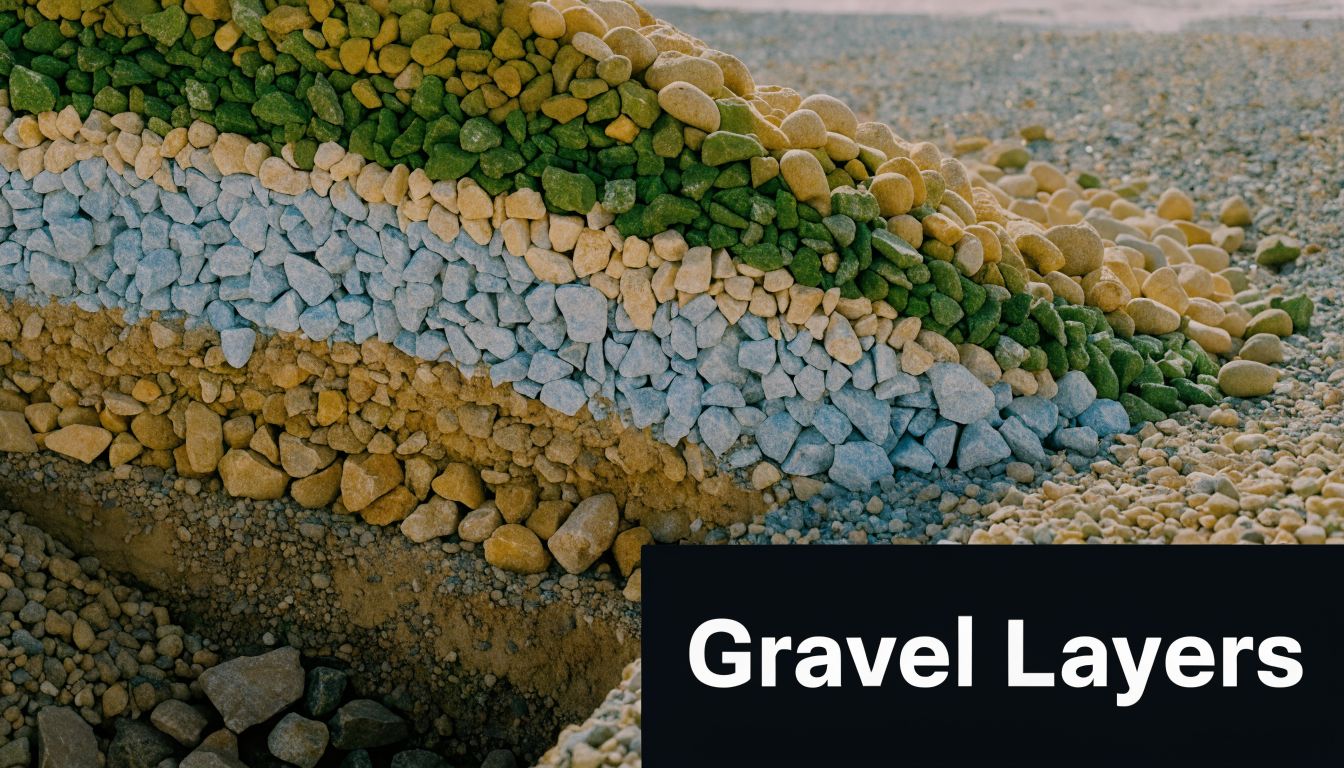
A durable gravel driveway isn’t usually made from one uniform aggregate all the way through. The layer above the sub-base needs smaller angular stone that fills voids and creates a denser matrix. That’s why many installers use #57 or #411 crushed stone for the middle course.
This layer acts like the bridge between the larger base stone and the surface material. It improves interlock and gives the driveway a tighter, more stable body under traffic. If the middle layer is skipped, the top stone has less support and tends to migrate faster.
The middle layer needs the same discipline as the base
The driveway may already look solid by this point, but the middle layer still needs to be spread evenly and compacted properly. It’s easy to lose discipline once the area looks built out, especially on a homeowner-led project. That’s usually when uneven thickness and soft spots get introduced.
A useful way to think about it is that each layer should solve a specific problem:
- Sub-base: Carries load and stabilizes the structure
- Middle layer: Fills voids and tightens the system
- Top layer: Provides finish, traction, and appearance
Choosing the top stone
The top layer is where function and curb appeal meet. Homeowners often ask about pea gravel because they like the softer look, but for driveways, rounded material tends to move under tires more than angular products. In wet conditions and on sloped approaches, that difference becomes obvious fast.
Angular gravel, crushed limestone, or firm chippings usually perform better because they knit together instead of acting like marbles. The surface still needs to be comfortable to drive on, but appearance alone shouldn’t make the decision.
If a gravel surface looks great on day one but keeps rolling out from under the tires, it’s the wrong finish for a driveway.
A short comparison helps:
| Top layer option | General behavior |
|---|---|
| Pea gravel | Decorative look, but tends to shift more |
| Angular chippings | Better traction and better hold |
| Crushed limestone | Clean finish and stable under use |
A visual walkthrough can help if you want to see layering in practice:
Gravel grids are worth considering on problem sites
Some driveways perform well with standard layered installation alone. Others benefit from added stabilization, especially where braking, turning, wet conditions, or softer soils create repeated movement at the surface. That’s where honeycomb gravel grids come in.
According to this multi-layer driveway installation guide, a multi-layer system with gravel grids can achieve 95% rut-free performance after 5 years, compared to 60% for un-gridded driveways. The same source notes that fine top gravel can displace 2-3 times faster under braking, while grids improve stabilization against that displacement by 90%, especially in wet conditions.
That doesn’t mean every driveway needs grids. It does mean they’re a strong option when the site has one or more of these conditions:
- Turning movements near a garage or parking pad
- Wet ground that tends to loosen the top course
- Frequent deliveries or heavier vehicles
- A steeper section where loose gravel drifts downhill
Finish the surface with restraint
The top layer should be placed evenly and compacted enough to settle in, but not crushed into dust. Too much loose surface gravel feels sloppy. Too much fine material can reduce drainage and make the driveway muddy.
The best finished surface usually looks deliberate rather than deep. You should be driving on a contained, interlocked surface, not floating over loose stone. That’s the difference between a gravel driveway that feels professional and one that always seems halfway finished.
Finishing Touches and Long-Term Driveway Care
A driveway can have a strong base and still start looking tired early if the edges are weak and the transitions are rough. The details at the perimeter matter more than people expect. They help keep the surface contained, preserve the shape, and make routine maintenance much easier.
Edging keeps the driveway from unraveling
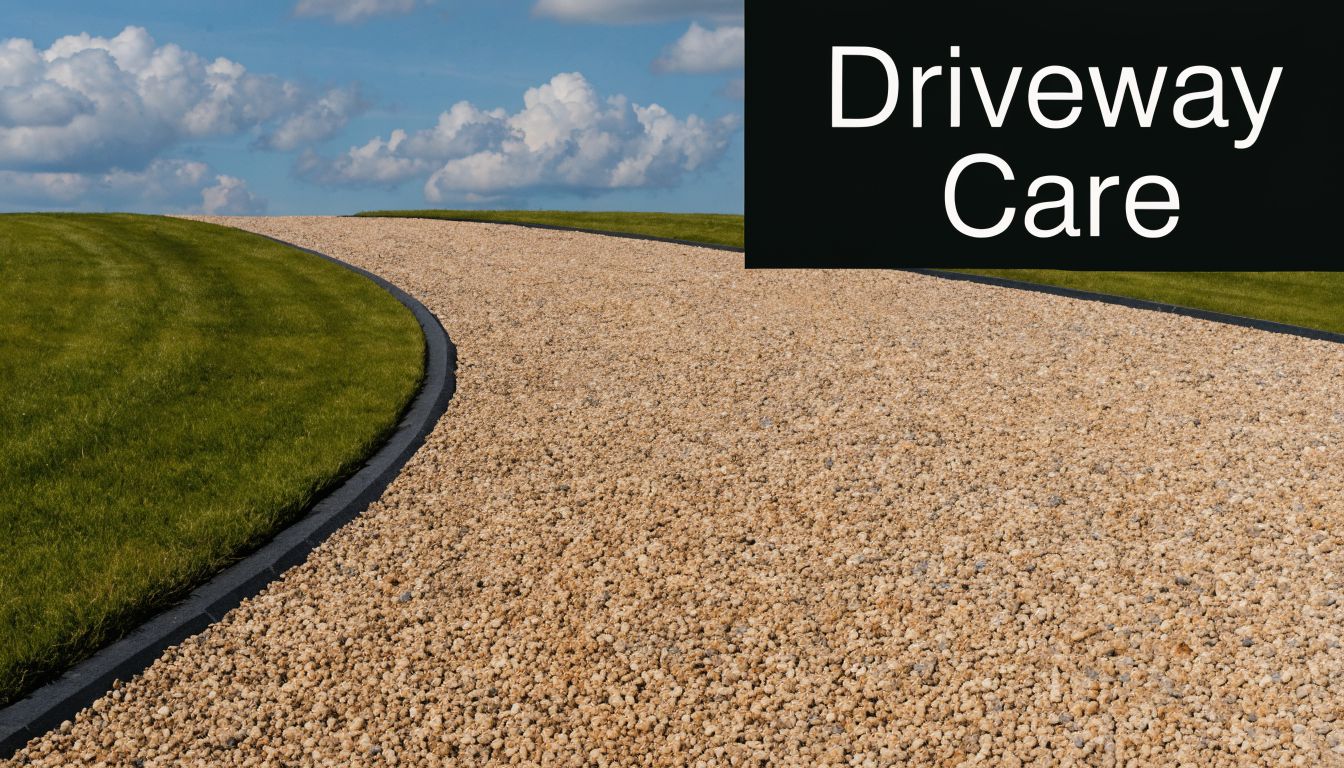
Without some kind of edge control, gravel slowly migrates. Tires push it outward, rain carries it off, and lawn equipment nibbles away at the shoulder. The driveway gets wider in some spots, thinner in others, and less defined overall.
Depending on the property, edging can be done with timber, natural stone, or steel. The best choice usually depends on style, grade changes, and whether you want the border to stand out or disappear visually. What matters most is that the edge supports the shape of the driveway rather than merely decorating it.
The transition areas deserve special attention
Two spots often wear first. One is where the driveway meets the road. The other is where it meets a garage slab, shed pad, concrete foundation, or other hard surface. If those transitions are abrupt or weak, tires grind them down quickly.
A clean transition makes the whole driveway feel better built. It also reduces the tendency for stone to wash or kick into adjoining surfaces. That’s especially important when the driveway serves a garage, house foundation area, or high-use outbuilding entrance.
A driveway usually starts failing at the edges and connection points before the middle gives out.
Simple maintenance protects the work
Gravel is low maintenance, but it isn’t no-maintenance. The good news is that upkeep is straightforward when the driveway was built correctly to begin with.
A practical maintenance routine looks like this:
- Rake displaced stone back into place after heavy use or snow removal.
- Regrade shallow low spots before they turn into established ruts.
- Remove weeds early so roots don’t spread through the edges.
- Add fresh surface gravel when needed to restore appearance and coverage.
Material supply isn’t the limiting factor. The aggregate industry is built to support large-scale infrastructure and local construction alike. For example, Pennsylvania produced 13,500 thousand metric tons of construction sand and gravel, helping supply projects tied to the region’s 98,632 miles of public roads, according to state aggregate data from NSSGA.
That availability helps homeowners maintain driveways over time, but maintenance only works well when the original structure was sound. Fresh gravel on top of a badly built driveway doesn’t fix the cause. It just hides it for a while.
Driveway Costs, Safety, and When to Call a Pro
A gravel driveway often looks affordable on paper until the site work enters the conversation. Homeowners usually price the stone first. The actual cost sits in excavation, hauling, grading, drainage control, compaction, and the time it takes to build each layer correctly, especially on Mid-Atlantic properties with clay soil and wet seasons.
Material price is only one piece of the budget. A gravel driveway cost overview helps set expectations, but the final number changes with driveway length, soil conditions, access for trucks, required base depth, and whether water has a clear place to go. In Pennsylvania, Maryland, Delaware, and New Jersey, that last point matters more than many homeowners expect. I have seen plenty of driveways that had enough stone, but still failed because runoff was never handled properly.
DIY costs rise fast once equipment and rework enter the job
Some homeowners can handle touch-up grading or adding fresh top stone. Full installation is a different class of work.
A proper build usually includes layout, utility marking, stripping topsoil, cutting out soft ground, hauling spoils, importing several stone sizes, compacting in lifts, and checking grade over and over so water leaves the driveway instead of sitting in it. On clay-heavy sites, mistakes do not stay small. A weak spot pumps water, traffic pushes ruts deeper, and freeze-thaw cycling starts breaking the surface apart.
The surprises usually fall into three areas:
| Cost area | What drives the price |
|---|---|
| Equipment | Excavation, grading, and compaction take machines sized for the job |
| Material handling | Stone is ordered by the ton and has to be placed accurately, not just dumped |
| Rework | Fixing poor drainage or a soft sub-base costs more after the driveway is finished |
That is where many DIY budgets go off track. Renting machines, making multiple material deliveries work, and correcting a grade that was off by even a little can erase the savings quickly.
Safety starts before the first bucket hits the ground
Utility locating is required before excavation. A driveway route can cross electric, gas, water, septic components, or communications lines, and older Mid-Atlantic properties often have undocumented changes from past additions and repairs.
Heavy equipment brings its own risks. Skid steers and excavators can break the edge of an existing slab, sink into saturated ground, or damage a lawn and drainage swale in a single pass if the site is not planned well. Wet weather makes that worse. So do narrow approaches, retaining walls, and working near garages or foundation corners.
On larger or more complex sites, pre-construction imaging helps with planning. Tools such as aerial mapping and drone use in construction can help visualize grades, access routes, and drainage patterns before excavation begins. That added view is useful for long rural driveways, shared entrances, and lots with outbuildings spread across uneven ground.
Call a pro when the site has consequences
Some gravel driveways are simple. Others affect drainage around a house, garage, pole barn, or future building pad, and that changes the risk.
Professional installation makes sense when the site includes clay soil, standing water, repeated washouts, steep grades, tight truck access, or a driveway that needs to tie cleanly into a garage slab, road edge, or foundation approach. It also makes sense when the driveway needs to support heavier loads than daily car traffic. Delivery trucks, dumpsters, shed installs, and concrete trucks expose weak base work fast.
I tell homeowners to pay close attention to one question. If this driveway fails, what else does it affect? If the answer includes drainage near the house, access to a building project, or expensive rework to surrounding hardscape, bringing in an experienced excavation crew is usually the cheaper decision.
What professional work changes on the ground
Good contractors do more than move stone faster. They read soil conditions, adjust excavation depth, set elevations with drainage in mind, and compact each lift so the driveway acts like a system instead of a pile of aggregate.
That matters a lot in this region. Mid-Atlantic freeze-thaw cycles expose shallow base work. Heavy summer storms expose poor water management. Clay subgrades expose shortcuts in compaction. A crew that has built driveways across Pennsylvania, Maryland, Delaware, and New Jersey knows where those failures start and how to head them off before the first truck unloads.
Professional work usually improves these parts of the project:
- Site evaluation that catches soft spots and drainage conflicts early
- Base design matched to local soil and expected vehicle weight
- Grade control that moves water off the drive without creating edge erosion
- Compaction done in measured lifts, not guessed at from the seat of a machine
- Transitions built cleanly where the driveway meets roads, pads, slabs, and garage entries
That overlap is why excavation, driveway, and foundation crews often handle the same properties. Stable ground supports everything else built on top of it.
If you want a gravel driveway, shed pad, garage foundation, or excavation project built for Mid-Atlantic conditions, Firm Foundations is a strong place to start. Their team serves Pennsylvania, Maryland, Delaware, and New Jersey with licensed, insured foundation and excavation work focused on drainage, structural integrity, and long-term performance. Reach out for a free quote and get a driveway or pad built to exact specifications, without guesswork.