
Firm Foundations: Quality Assurance Processes Explained
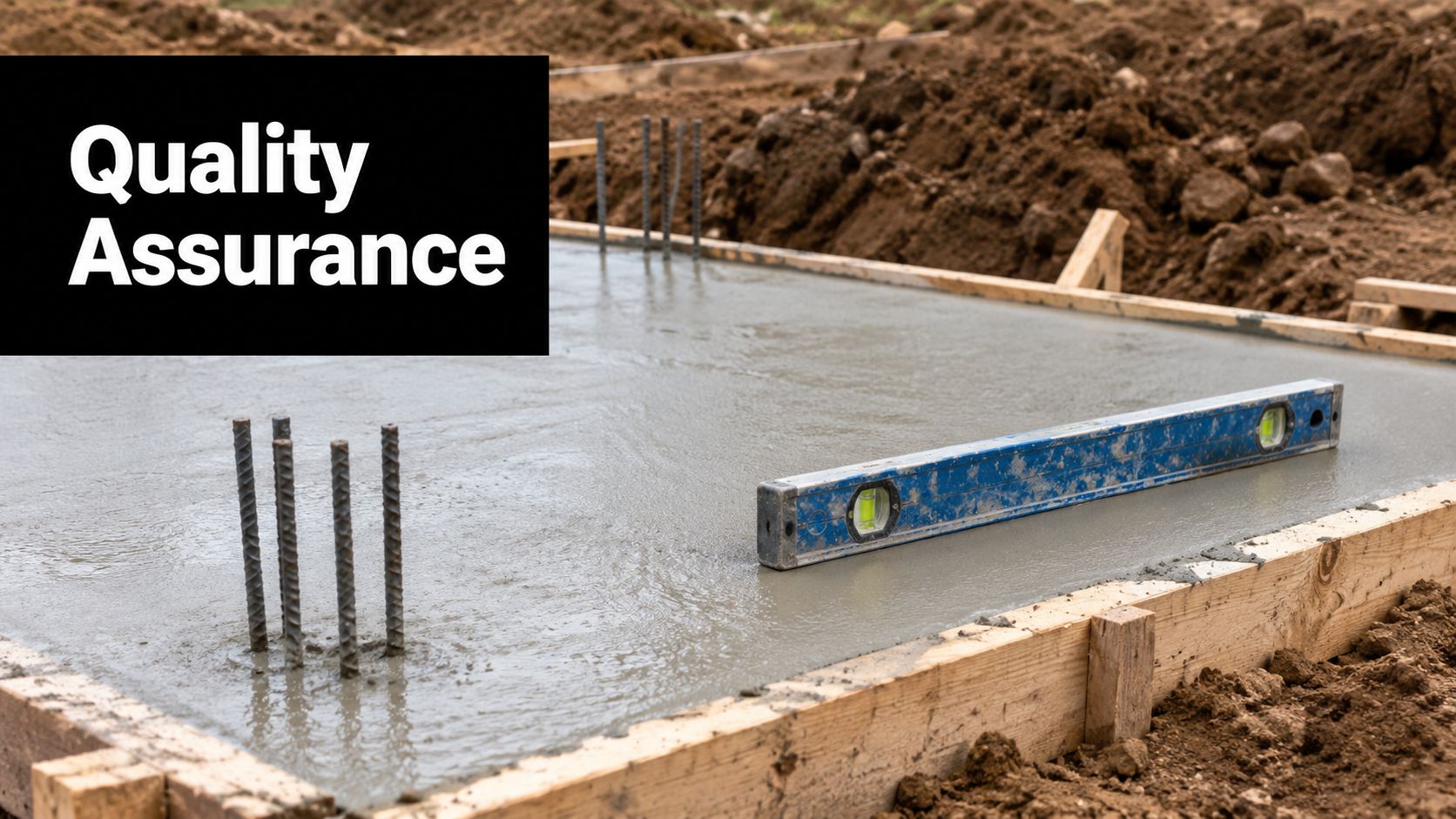
A lot of homeowners start in the same place. You've picked the shed, garage, gazebo, or new slab location. You can already picture how the space will function. Then the practical question shows up fast: what is this going to sit on, and will that foundation still be solid years from now?
That concern is justified. A structure can look great on delivery day and still develop trouble later if the base underneath it wasn't prepared correctly. Cracking, settling, standing water, and doors that stop closing properly usually don't begin with the building. They begin with what happened, or didn't happen, before the first load of gravel or the first truck of concrete arrived.
For homeowners in Pennsylvania, Maryland, Delaware, and New Jersey, that matters even more. Soil conditions change from property to property. Drainage can be obvious in a hard rain and invisible on a dry afternoon. A pad for a barn shed, a gazebo foundation, or a base for storage shed has to be built for the site it's on, not treated like a one-size-fits-all install.
Your Guide to a Flawless Foundation in Pennsylvania
In Pennsylvania, homeowners often search for shed foundations near me, garage foundation contractors near me, or concrete foundations when they're close to making a decision. At that point, the question usually isn't whether a project is worth doing. It's whether the contractor's process is strong enough to protect the investment.
That's where rigorous quality assurance processes matter. Not as a buzzword, and not as paperwork. In foundation work, quality assurance is the discipline that keeps avoidable problems from getting buried under stone or locked into cured concrete. If the process is weak, the finished project can still look fine at first. That's what makes poor foundation work so frustrating for homeowners.
Why homeowners worry, and why they should
The worry isn't about the color of the slab. It's about the consequences of mistakes:
- Cracking later on because the base moved
- Water collecting around the edges because grading was rushed
- A shed foundation gravel base sinking out of level after a wet season
- Garage footings and foundations that weren't set up correctly for the load above
Those are reasonable concerns, especially if you're planning a concrete foundation for garage use, a house foundation, or a heavy-duty slab for a hot tub, shipping container, or horse barn.
Practical rule: A foundation project rarely fails because of one dramatic mistake. It usually fails because several small checks were skipped.
What a dependable process gives you
A strong process gives you more than a finished pad. It gives you confidence that each step was handled in the right order, with the right checks, for the right reason.
That matters in Honey Brook Township and across the wider region because local properties vary. Some lots need more excavation. Some need drainage corrections. Some are ideal for a gravel shed foundation, while others call for reinforced concrete forms and a more involved build. The contractor's job is to make those decisions carefully, not guess and hope the finish hides the shortcuts.
When homeowners understand the process behind a shed foundation, gazebo foundation, or cement foundations for garage projects, they can judge quality before the job starts. That brings peace of mind. You're not just buying a slab. You're buying the system that keeps the slab from becoming a problem.
What Quality Assurance Means for Your Foundation Project
Most homeowners hear “quality assurance” and think of a final walkthrough. In foundation work, that's too late. By the time someone is only inspecting the finished surface, the important decisions are already buried underneath it.
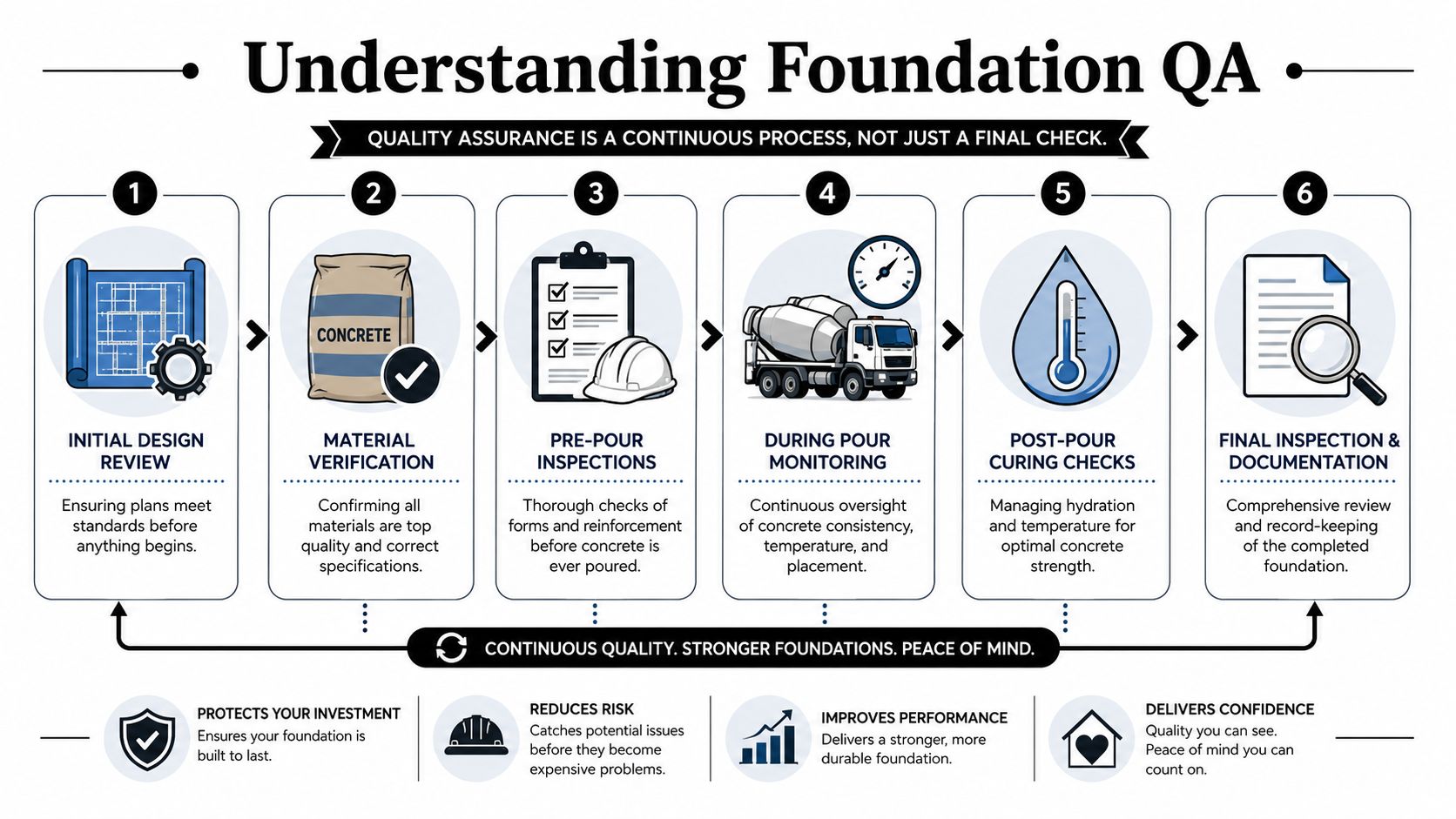
Quality assurance means building the job so problems are less likely to happen in the first place. It starts before excavation. It continues through material selection, layout, base prep, forming, pouring, curing, and final review. The point is prevention.
Quality assurance versus quality control
A simple way to think about it is this. Quality control looks for mistakes. Quality assurance is the system that reduces the chance of making them.
If you bake a cake and only check it after it comes out of the oven, you might catch that something went wrong. But you won't undo the wrong ingredient, the wrong pan, or the wrong oven temperature. Foundation work is similar. You can't fix poor compaction with a smooth finish.
What that looks like on a real project
On a real shed foundation or garage slab, a quality assurance process includes checks like these:
| Stage | What gets verified | Why it matters to you |
|---|---|---|
| Planning | Size, use, load, site conditions | The foundation matches the structure |
| Materials | Gravel, concrete, reinforcement, form materials | The right products are on site before work begins |
| Layout | Elevation, square, slope, footing locations | The slab fits and drains correctly |
| Pre-pour review | Forms, base, reinforcement, anchor points | Problems are caught before concrete locks them in |
| Pour day oversight | Placement, finish, surface slope | The slab performs well and looks right |
| Completion | Cure protection, cleanup, final checks | The foundation is ready for long-term service |
Why “good enough” usually isn't
A rushed crew can still produce something that looks straight from the driveway. That's why homeowners sometimes get surprised later. The visible part of a foundation is only a small part of its quality.
Good foundation work is quiet work. You don't always notice it on day one, but you notice the absence of problems over time.
For projects like gravel shed foundation contractors near me, gazebo foundation, or garage footings and foundations, the best results come from teams that treat every phase as part of one connected system. That's how you get it right the first time, instead of fixing what should've been prevented.
The Groundwork Our QA Process for Site Prep and Excavation
The first physical work on site often determines whether the rest of the project will hold up. That's true for a simple base for storage shed, and it's even more true for larger foundation builds like a garage slab or house foundation. If the soil below the project is unstable, wet, soft, or poorly graded, the surface above it won't stay reliable for long.
A solid quality assurance process starts with understanding the site as it exists, not as the plans assume it exists.
Reading the site before moving dirt
Good excavation isn't just digging to a target depth. It begins with observing how the property behaves. Crews look at slope, drainage paths, soft areas, access, and how water moves around nearby structures. On some properties, the right answer is limited excavation and a compacted gravel build-up. On others, unsuitable material needs to come out before a proper base goes in.
For homeowners searching for excavation near me or gravel shed foundation contractors, this is the difference between a contractor who installs pads and a contractor who evaluates sites.
A careful process also includes knowing when the subgrade deserves closer attention. For homeowners who want a better sense of what soil conditions can mean for long-term performance, this overview of local soil testing considerations is useful background.
The checks that matter under a gravel or concrete foundation
Before stone or concrete goes down, crews should be verifying several things:
- Correct excavation depth so the finished pad reaches the intended elevation without leaving weak material underneath
- Separation of topsoil from structural base areas because organic material doesn't belong under a load-bearing foundation
- Drainage planning so water sheds away from the slab or pad instead of pooling around it
- Subgrade firmness to identify soft spots before they become settlement points
- Layered compaction so the base tightens up evenly instead of leaving loose pockets below the surface
These checks are especially important for a shed foundation gravel base. Gravel performs well when it is properly installed, shaped, and compacted. It performs poorly when it is dumped, raked, and called finished.
A gravel pad isn't a pile of stone. It's a built system. The edges, lift thickness, compaction, and drainage all matter.
Why proper compaction beats shortcuts
Compaction is one of the least visible but most important parts of site prep. If the base isn't compacted in controlled layers, the weight of the structure will do that compaction later. That's when you start seeing settlement, tilt, and uneven support.
DIY installs and rushed jobs often fall short. A homeowner can build a 4×8 shed with foundation blocks and get acceptable results for a very light structure in the right conditions. But once you move into a 10×10 storage shed, a barn shed, a garage, or anything with repeated traffic or heavier loads, the margin for error shrinks.
Matching the base to the project
Not every project needs the same foundation type. That's another key part of quality assurance.
A well-built gravel pad can be an excellent choice for sheds, playsets, gazebos, and some utility structures. Reinforced concrete often makes more sense for cement foundations for garage, hot tubs, patios, and slabs that need a hard finished surface. The process works when the contractor chooses the base for the use, the site, and the expected load, not just for speed.
That's the groundwork homeowners don't always see, but it's what keeps the project level, dry, and dependable.
Building the Bones Quality Checks for Forms and Reinforcement
By the time a foundation reaches the formwork stage, the margin for correction gets smaller. At this point, shape, elevation, slab edge, and structural support get locked in. If the setup is off here, the concrete will faithfully preserve the mistake.
That's why good crews slow down before the pour. In practice, this stage is less about speed and more about precision.
What crews verify before concrete arrives
Concrete forms have one job on the surface. Hold wet concrete in place. In reality, they do much more. They establish the exact footprint, control thickness, maintain slope, and define whether the slab ends up square and level.
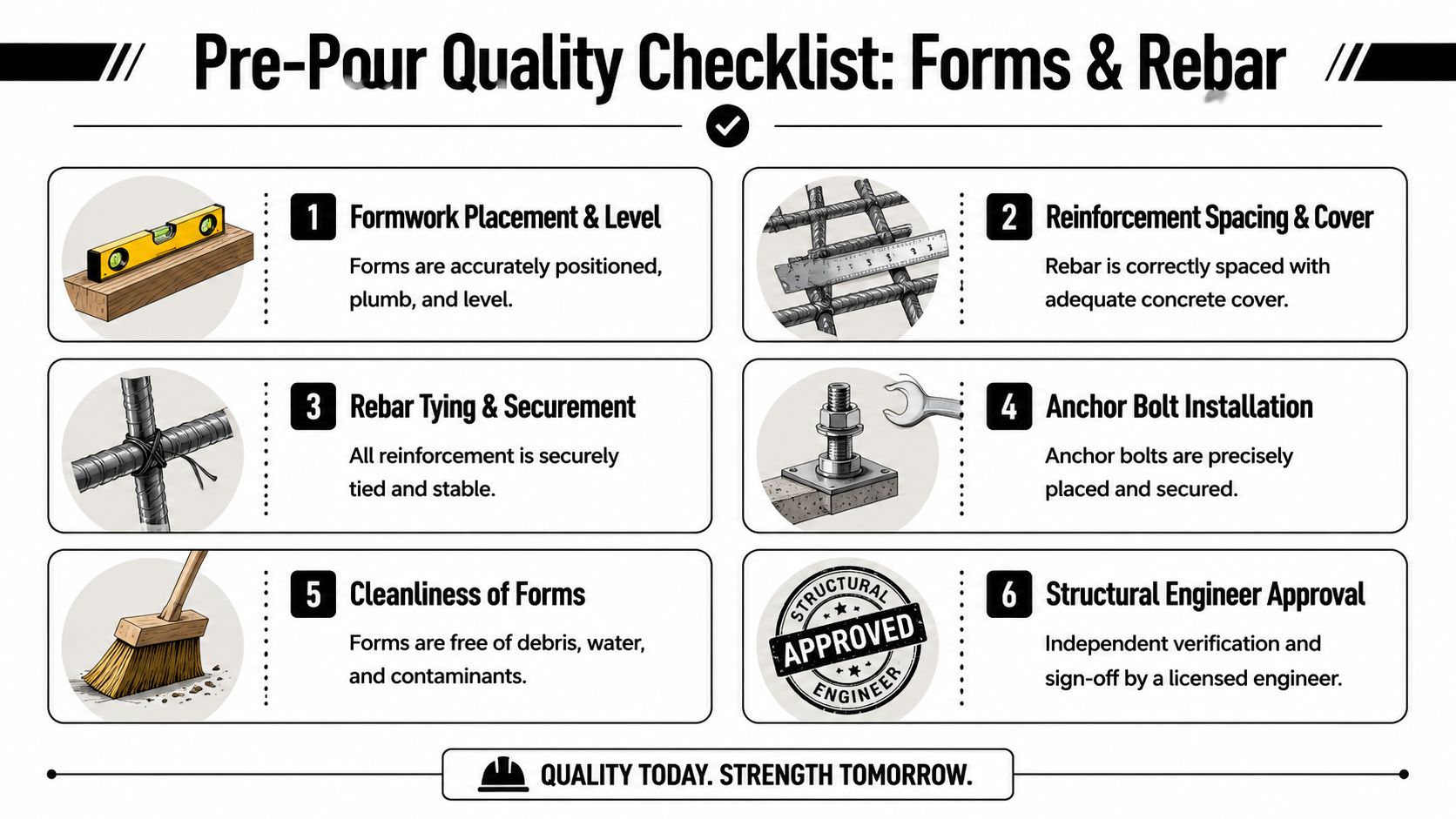
Before a pour, careful crews inspect items like these:
- Form alignment so corners are square and dimensions match the intended build
- Bracing and fastening so forms don't shift or blow out under pressure
- Height and grade so the slab finishes at the right elevation
- Clean interior surfaces so debris doesn't get trapped in the pour
For projects like a concrete foundation for garage, these checks are critical because the slab often has to work with framing, door openings, and vehicle loads. Small layout errors at this stage can create large headaches later.
Reinforcement is only useful when it's placed correctly
Rebar and wire mesh don't add value just because they're on site. They need to be located where they can do their job. That means proper spacing, secure tying, and enough concrete cover to protect the steel and let the slab perform as intended.
A pre-pour review often focuses on these questions:
| Check | Why it matters |
|---|---|
| Is the reinforcement in the right pattern? | Strength depends on layout, not just material presence |
| Is it supported at the correct height? | Steel buried too low or left on the base won't perform the same way |
| Are anchor points in the right locations? | Framing and attachments depend on this being accurate |
| Are openings and edges prepared correctly? | Stress tends to show up where details were rushed |
Field note: The concrete pour doesn't create precision. The setup creates precision. The pour preserves it.
For homeowners comparing garage foundation contractors near me or local concrete contractors, this is one of the clearest signs of professionalism. Strong crews don't treat forms and reinforcement as a quick setup before the “real work.” They treat it as structural work, because that's exactly what it is.
The Perfect Pour Our Process for Concrete Placement and Finishing
Pour day moves fast, but it shouldn't feel uncontrolled. On a well-run project, each person has a role, the site is ready before the truck arrives, and the crew works through placement and finishing in a sequence that protects both strength and appearance.
Homeowners often focus on this part because it's the most visible moment in the build. They should. A lot can go right here, and a lot can go wrong if the prep behind it was sloppy.
Before the first concrete hits the forms
A controlled pour starts before placement. Crews verify access, weather conditions, form stability, reinforcement readiness, and finishing tools. They also confirm that the concrete being delivered matches the needs of the project.
That matters for a gazebo foundation, a driveway, or a cement foundation for garage because different uses call for different performance priorities. The slab has to be placed and finished for the way it will be used, not just made to look smooth from a distance.
Homeowners who want a closer look at surface outcomes can review concrete finishing techniques for long-term performance.
During placement, crews are watching more than the surface
Concrete doesn't forgive poor handling. If it's placed carelessly, worked too much, or finished at the wrong time, the slab may cure with weak spots, scaling, or an uneven surface.
A disciplined pour process usually includes attention to:
- Consistent placement so one area isn't overloaded while another is starved
- Consolidation where needed to reduce trapped air and voids
- Edge integrity so slab boundaries stay clean and durable
- Surface slope to help water move off instead of sit on top
- Timing of finishing passes so the crew works with the concrete, not against it
The best pours look coordinated because they are coordinated. One person can't fix poor placement with a steel trowel at the end.
Finishing is about performance, not just appearance
A smooth slab isn't always a good slab. The finish has to suit the use. Some projects need a broom finish for traction. Others need a cleaner troweled look. Exterior slabs also need finishing practices that support drainage and weather exposure.
A slab should look good, but it also has to shed water, resist surface damage, and serve the structure sitting on it.
Here's a short look at what homeowners should expect:
| Finish concern | What a good process addresses |
|---|---|
| Flatness | Helps the structure sit properly |
| Drainage slope | Moves water away from the slab |
| Surface texture | Matches the use of the area |
| Edge finish | Reduces chipping and rough appearance |
Later in the process, good crews also protect the slab while it cures. That's not a minor detail. Early curing conditions affect how the concrete performs after the crew leaves.
A video view helps show how methodical this work needs to be in the field.
Common Foundation Failures and Our Preventive Controls
Most homeowners don't call about quality assurance because they love process. They care because they want to avoid expensive, frustrating failures later. That's the right instinct. Foundation problems usually trace back to steps that were skipped early.
When you connect common failures to the process that prevents them, the value of a rigorous build becomes obvious.
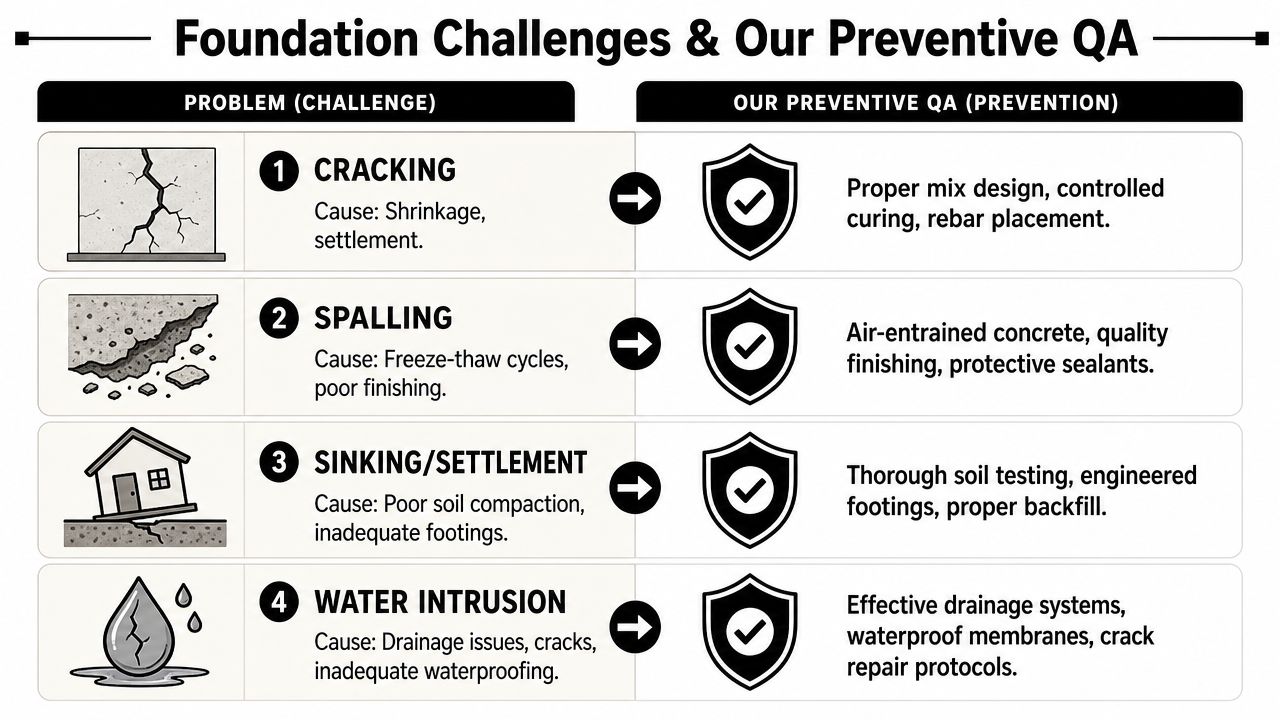
Cracking, sinking, and water trouble usually have a backstory
Here are the failures homeowners worry about most, and what usually causes them:
- Cracking often starts with movement below the slab, weak support, rushed finishing, or curing issues
- Spalling or surface flaking can come from poor finishing practices and exposure conditions that weren't accounted for
- Sinking or settlement usually points back to poor excavation decisions, soft spots, or inadequate compaction
- Water intrusion or standing water often comes from incorrect grade, weak drainage planning, or cracks that opened later
The reason this matters is simple. These aren't random problems. They're process problems.
Prevention is built in before the project looks finished
A careful contractor prevents settlement during site prep. That's where subgrade evaluation, excavation decisions, and layered compaction do their work. Cracking risk is reduced before and during the pour through reinforcement placement, controlled finishing, and curing protection. Water issues are addressed even earlier through grading and slope planning.
That's why a polished surface alone doesn't mean much. The slab can look clean and still be vulnerable if the hidden decisions were poor.
Homeowners usually see the finish. Failures usually reveal the steps underneath it.
What this means for different project types
A shed foundation can fail by going out of level and stressing the structure above it. A garage footing and foundation problem can show up as cracks, door issues, or water tracking inward. A gazebo foundation might hold visually but develop edge erosion and frost-related movement if drainage wasn't handled properly.
Each type of project has its own risks, but the preventive controls follow the same principle. Build from the bottom up, verify before moving forward, and don't rely on last-minute fixes.
That's the strongest argument for quality assurance processes. They don't just improve the odds of a good-looking result. They reduce the chance that you'll be dealing with rework, repairs, or regrets after the structure is already in place.
Get a Foundation Built Right With Firm Foundations
A lasting foundation doesn't happen because a contractor poured concrete on schedule. It happens because every stage before, during, and after the pour was handled with discipline. That's what gives homeowners real confidence in a project.
If you're comparing shed foundations contractors near me, garage foundation contractors near me, or local crews for concrete foundations, it helps to look past the surface. Ask how site prep is handled. Ask how grading is checked. Ask what happens before concrete is poured, not just after. The answers will tell you a lot about the final result you can expect.
What a careful process delivers
When the process is strong, the customer benefits are straightforward:
- A pad or slab that stays level because the base was prepared correctly
- Better drainage performance because slope and grading were intentional
- Fewer surprises during the project because the work follows a clear sequence
- A finished foundation that matches the structure whether it's a shed, garage, patio, barn shed, or house foundation
For homeowners across Pennsylvania, Maryland, Delaware, and New Jersey, that consistency matters. The same commitment to preparation, verification, and workmanship should apply whether the job is a simple shed foundation blocks setup, a gravel shed foundation, or a reinforced slab for a larger structure.
Choose process, not promises
Anyone can say they build quality work. The better question is how they make quality repeatable.
That's what separates a dependable foundation contractor from a crew that hopes experience alone will carry the job. Experience matters. A repeatable process matters just as much. Together, they're what produce durable slabs, stable gravel pads, clean finishes, and fewer callbacks.
If you want a project built with clear communication, careful site evaluation, and workmanship that respects the investment you're making, the next step is simple. Get the site looked at, get the options explained clearly, and get a quote that reflects the work required to do it right.
If you need a shed pad, garage slab, gazebo foundation, driveway base, or excavation work in Pennsylvania, Maryland, Delaware, or New Jersey, Firm Foundations is ready to help. Reach out for a free, transparent quote and get a foundation built with no surprises, solid drainage, and long-term performance in mind.