
Moving Portable Building in Honey Brook Township PA
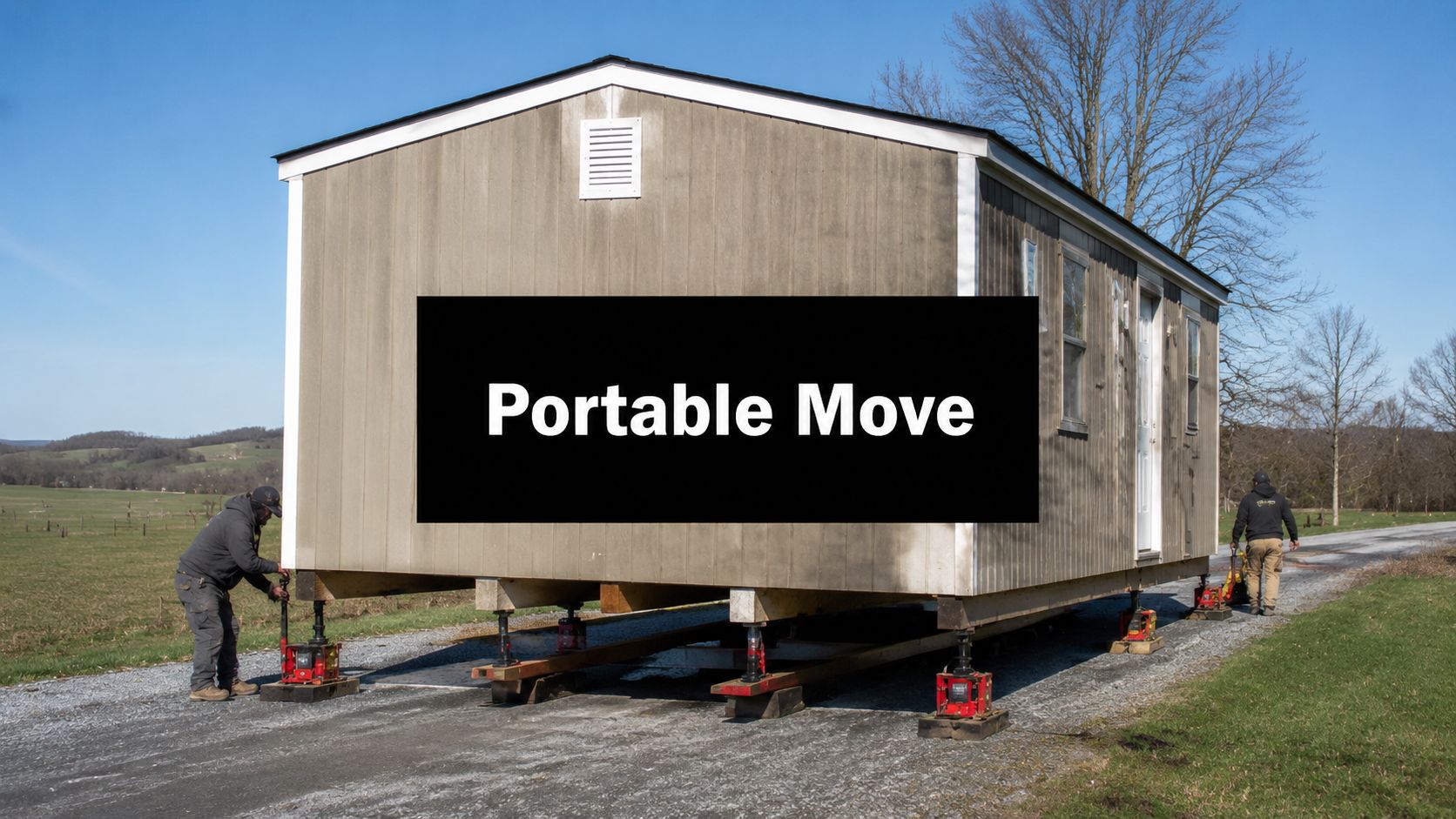
A portable building move in Honey Brook Township usually starts with a practical problem, a shed that sits in the wrong spot, a workshop that needs to be closer to a driveway, or a storage building that has to come off a soft yard before winter settles in. The hard part is not only getting it from point A to point B. The move also has to avoid settling, drainage trouble, and an unexpected repair bill after the building lands.
That is why foundation work has to be part of the plan from the start. A moving portable building project goes well only when the structure, the route, the permits, and the new pad all line up, and that is what separates a clean relocation from a long cleanup. In this area, homeowners who want a shed foundation, a gravel shed foundation, or concrete foundations for a garage, gazebo, or storage building need to treat the destination site as seriously as the lift itself.
Portable and relocatable buildings were designed to be moved and reused, and that makes transport distance, permits, and site prep part of the cost from the beginning. For a 10×12 shed, moves under 50 miles are commonly priced around $1,200 to $3,000 including permits and site prep, while longer hauls can reach $2,000 to $4,500 from the Modular Building Institute guidance. For homeowners comparing that work against a replacement build, the move plan matters long before the truck rolls out. If you want a local estimate that includes the haul, setup, and pad work, this shed moving cost guide is a useful place to start.
At the same time, the destination site often decides whether the move holds up over time. A building can arrive in good shape and still perform poorly if the pad is uneven, the drainage is wrong, or the support blocks do not match the structure. I see that problem most often when the move is treated like a transport job only, instead of a transport job plus foundation prep. A licensed contractor who understands excavation, drainage, and shed foundations can keep the relocation on schedule and reduce the kind of follow-up work that shows up after the building is already set.
Moving a Portable Building Overview
A Honey Brook Township homeowner usually reaches this point after a practical problem shows up, the shed is too far from the house, the old pad has started to sink, or a workshop needs a better layout before the next season. In that moment, the move feels straightforward, but the actual work starts before any trailer arrives.
What makes the job more than a simple haul
Portable and relocatable buildings are valuable because they're meant to be reused, but that only works when the move is planned around the structure and the receiving site. The moving industry behind one-off relocations is large, with about $23.2 billion in annual revenue, 110,000+ workers, and roughly 21,892 businesses supporting specialized trucking, permits, and labor in the moving industry statistics. That scale tells you something important, even a small building can require a real logistics chain.
For homeowners, the main risk is assuming the move is all about lifting. If the destination pad isn't ready, the building can settle, trap water, or end up out of square after it lands. That's why a local contractor who understands excavation, drainage, and shed foundations can save time and avoid the typical chain of delays.
Practical rule: treat the new site as part of the move itself, not a separate cleanup task afterward.
At Firm Foundations, the work is built around the ground first, then the building. That means site prep, grading, and a pad that fits the structure instead of forcing the structure to adapt later. For many owners in Chester County, that's the difference between a short interruption and a long list of corrections.
Assess Building Condition and Site Requirements
Before a portable building gets lifted, the structure itself needs a close look. I always tell homeowners to think in two directions at once, what the building can safely handle, and what the new site can safely support.
Start with the building, then check the landing spot
Inspect the framing for signs of rot, sagging, or twisted members. Check the roof load path, because transport stress travels differently than normal use, especially if the building has added shingles, heavy trim, or a roofed porch. Every semi-permanent attachment should come off before the move, including skirting, ramps, extra decking, and custom fixtures, because attached items can be damaged or can tear the main structure during transport.
At the destination, clear access matters as much as floor strength. Measure the route for gates, overhead lines, and driveway width, then confirm that the building can reach the final pad without tight turns that force the movers to twist the frame. The ground itself should be checked for levelness, compaction, and drainage so water doesn't pool under the base later.
Skipping leveling, compaction, drainage, or support preparation can jeopardize stability and longevity even after a professional move.
That point matters in Honey Brook Township because soil and seasonal moisture can change how a site behaves after the building is set. A pad that looks fine on a dry day may still be wrong if it isn't compacted and drained properly.
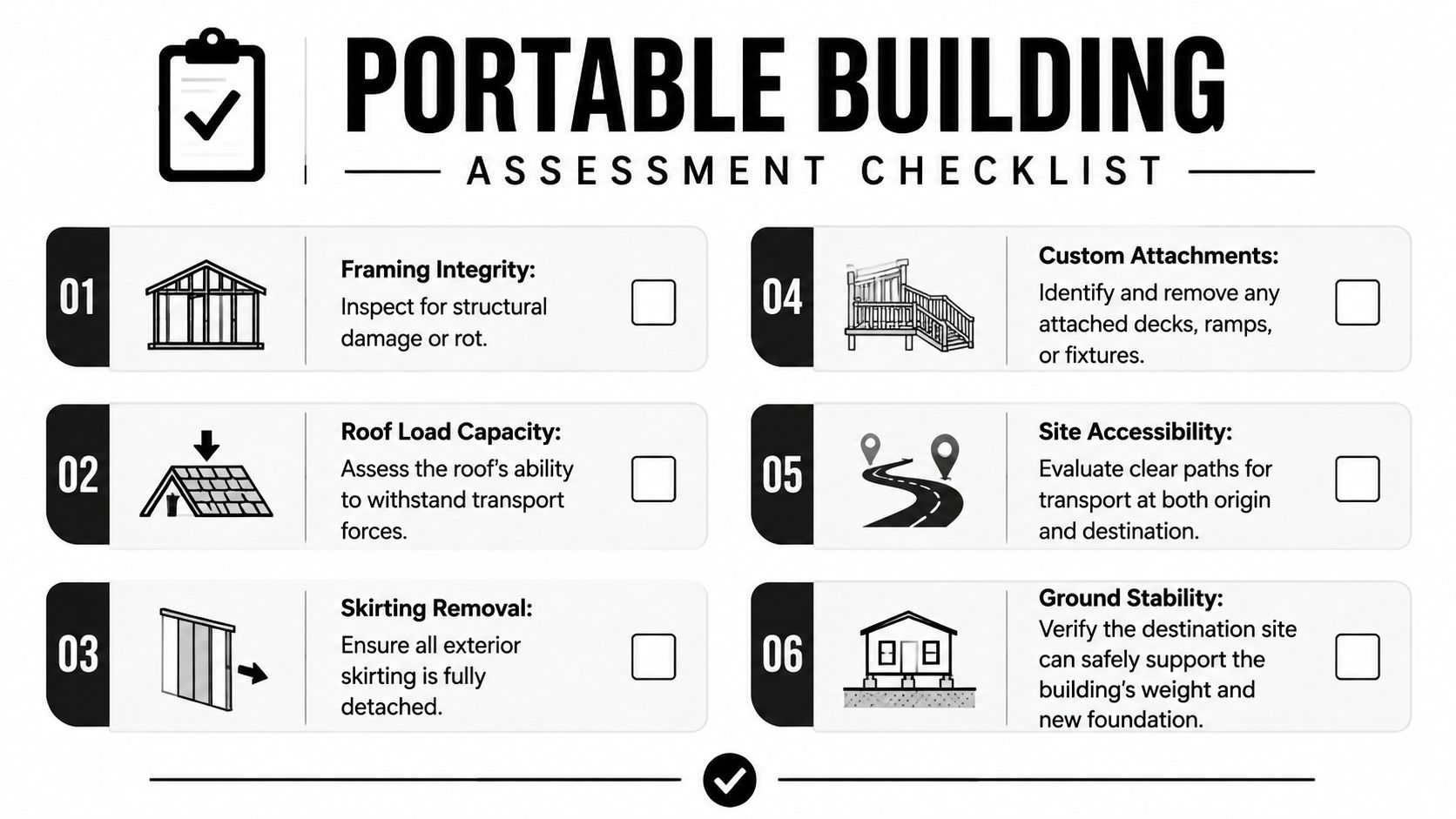
A simple pre-move checklist homeowners can use
- Framing integrity: Look for cracked members, soft spots, and visible distortion.
- Roof condition: Confirm the roof won't shed loose material or shift under transport vibration.
- Attachment removal: Take off skirting, ramps, porches, and any add-ons tied into the shell.
- Access path: Make sure the route is clear enough for the mover's equipment.
- Ground readiness: Check that the destination is level, compacted, and ready for support.
A properly prepared site cuts down on surprises and helps the crew place the building once instead of repositioning it repeatedly.
Secure Permits and Disconnect Utilities
Permitting and utility shutoffs are where a lot of otherwise simple moves get delayed. The move itself may look physical, but the paperwork and disconnections have to be timed just as carefully as the lift.
Why paperwork needs to be ahead of the truck
Portable-building transport is regulated by exact size limits in some states, and Texas DMV portable-building rules show how strict those thresholds can be. Under a single-trip permit, the vehicle and load must stay within 14 ft high and 80 ft long according to Texas DMV permit rules. Even though Pennsylvania has its own process, the lesson is the same, load dimensions affect whether the building can be moved as one piece and what kind of transport setup is allowed.
On the utility side, every semi-permanent service needs to be disconnected before transport. That includes electrical panels, plumbing hookups, HVAC lines, and any site-built additions tied into the structure. The older ERIC classroom relocation example shows the same logic, disconnect utilities, clear the passage, remove steps and shelters, and secure the structure before moving in the relocation sequence document.
A practical schedule helps here. Permit applications should be handled before the mover is booked, and utility shutoffs should be timed so the building isn't left waiting with open lines or exposed service points. If there's any overlap between the mover and the utility crew, the job becomes slower and more exposed to damage.
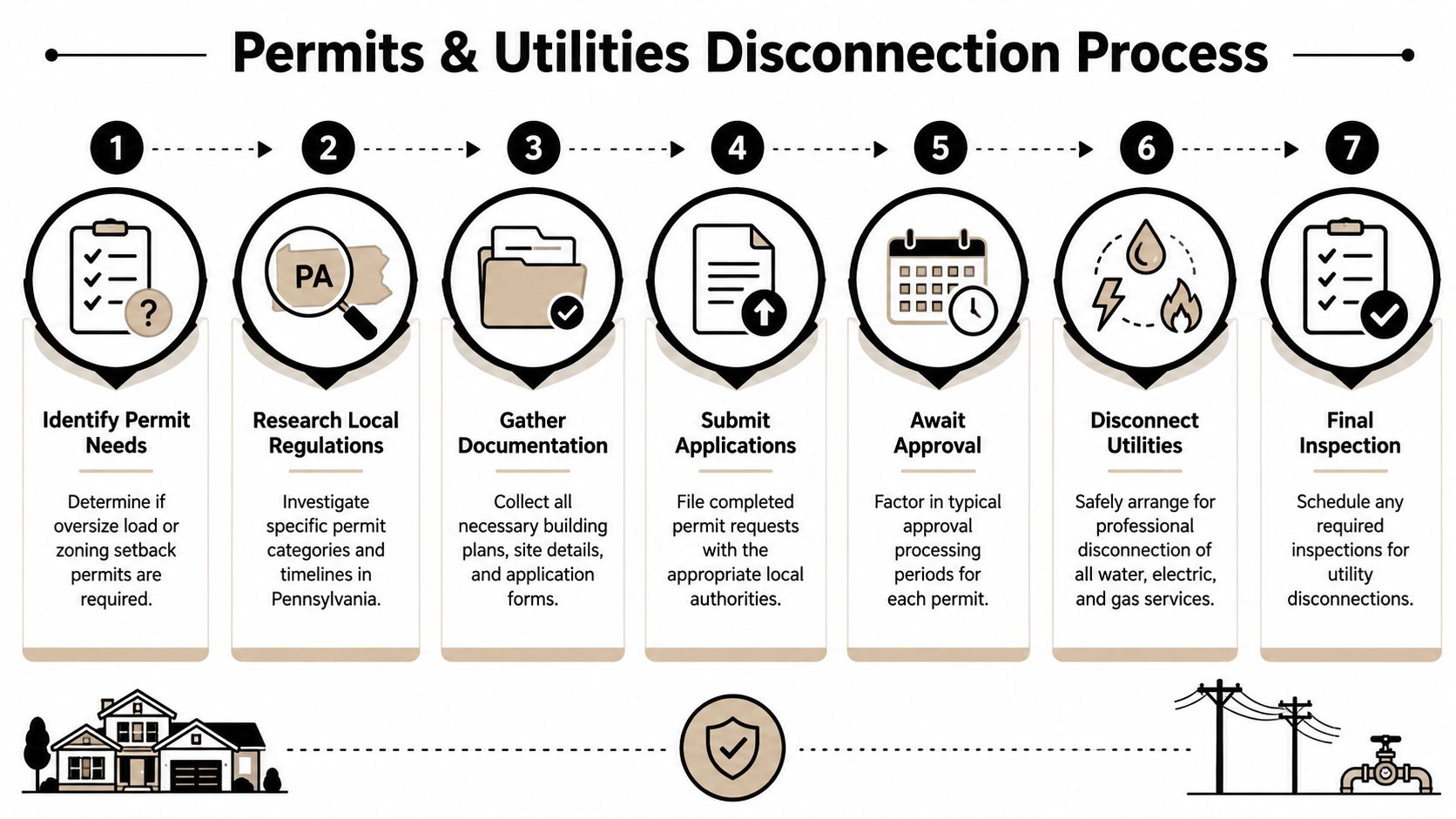
The disconnect sequence that keeps the job clean
- Confirm permit needs: Check transport and destination requirements before scheduling.
- Gather site documents: Have measurements, access notes, and placement details ready.
- File applications early: Don't wait until the week of the move.
- Line up shutdowns: Schedule electrical, plumbing, and gas disconnects with the movers.
- Protect the opening: Cap or secure service ends so nothing is damaged in transit.
If the building still has active utility tie-ins on move day, the crew has to stop and wait, and that's where small planning mistakes turn into expensive time losses.
Choose Transport Method and Hire Pros
The first decision is whether the portable building should move as one unit or come apart for transport and reassembly. Size, route access, roof overhangs, utility tie-ins, and the condition of the frame all push that choice one way or the other.
Whole-structure move or sectional teardown
A whole-structure move usually relies on 6×6 skids or a trailer deck with jacks at several corners. That setup keeps the building level during lift and loading, and it works best when the shell is sound and the access path gives the crew enough room to steer, clear obstacles, and keep the load stable. If the structure is oversized, has awkward add-ons, or cannot clear the route without risk, sectional teardown is the safer call.
The labor and trucking side of the job drives much of the price, as noted in relocation guidance, and those pieces often control whether a move stays practical or becomes too costly for the building's value as noted in relocation guidance. That is why even a modest shed can climb in cost once the work calls for specialized equipment and road transport. For a typical local move, the range is usually lower than a longer haul, where extra miles, permits, and staging add more time on the clock based on moving industry benchmarks.
A good crew reduces avoidable rework. If the mover understands the route, the permit limits, and what the new site will accept, the job usually stays cleaner from lift to landing. The same route discipline that matters in optimizing haulage operations applies here, because load control and trip planning affect how long the building stays exposed and how many chances there are for damage.
If the mover cannot explain how the building will be lifted, blocked, loaded, and set, keep looking.
The equipment choice also needs to match the structure, not just the truck. The right trailer or shed-moving setup depends on wheelbase, access width, and how stable the shell stays once it leaves the ground. If you are comparing setup options, this trailer guide for moving sheds is a useful way to frame the discussion before bids come in.
What to ask before you hire
Ask about insurance and licensing first. Both the transport crew and any crew handling site work should be covered for the work they are performing, and the contractor should be able to explain how they handle local access issues, soft ground, and tight turn paths.
Then ask for recent references from similar jobs. A crew that has moved buildings through similar soil conditions and driveway access points is usually better prepared than one that only handles easy, open sites. Ask what equipment they plan to use, whether they will rely on skids, a trailer, or sectional removal, and who is responsible for leveling and landing the building at the new address.
Timeline coordination matters as much as equipment. The mover, the utility shutdown crew, and the site prep team need to work in sequence, or the building can sit exposed while everyone waits on the next step. If the scope includes reassembly, confirm that in writing before the first truck arrives.
For homeowners who want one contractor to handle the pad side of the work, Firm Foundations is one option for site preparation and foundations for sheds, garages, gazebos, and other moved structures.
Prepare and Pour New Foundation Pad
The pad is where the move either holds up long term or starts failing without immediate notice. A building that's well transported can still perform poorly if it lands on the wrong base, so the foundation choice has to match the structure, the soil, and the way water moves across the property.
Gravel pad or concrete slab
| Criteria | Gravel Pad | Concrete Slab |
|---|---|---|
| Drainage | Drains well when graded correctly | Needs drainage detail to avoid trapping water |
| Installation | Faster and less rigid | More permanent and structurally fixed |
| Best use | Sheds, portable storage, light accessory buildings | Garages, heavier structures, and longer-term foundations |
| Maintenance | Easier to adjust and re-level | Less forgiving, but stable when formed correctly |
| Anchorage | Works with proper tie-downs and substructure | Works well with embedded anchors and engineered restraints |
The transportable-building standard from New South Wales makes the long-term point clearly, foundations and tie-downs should be designed for a 50-year life, installed below topsoil where shrink-swell is an issue, and secured with steel or reinforced-concrete substructures using M20 structural bolts or equivalent restraints as set out in the standard. That's a strong reminder that a portable building isn't “light” just because it moves.
What a good pad actually needs
A useful pad starts with grading and compaction, then drainage that moves water away from the footprint. For a gravel shed base, the material has to be spread evenly and compacted so it doesn't shift after the building lands. For a poured slab, the formwork, reinforcement, and finish need to match the intended load so the edges don't break down at the first freeze-thaw cycle.
Anchor points matter too. The building should be tied into the substructure, not just sitting on top of loose material. If the site has uneven soils or a history of moisture movement, the foundation design should account for that instead of assuming a standard block setup will hold.
A strong move ends with a pad that matches the building, not with a building forced to adapt to a weak pad.
The practical result is simple, a well-built shed foundation or garage foundation protects the structure, reduces maintenance, and gives the owner a base that stays square after the move.
Post-Move Setup and Final Inspection
Once the building is set, the work isn't done. The final phase is about making sure the structure is secure, level, and ready to use without hidden problems showing up later.
Reconnect, reset, and inspect
Start by reconnecting electrical, plumbing, and HVAC only after the building is fully seated and stable. Then reinstall skirting, ramps, and trim so the underside is protected from wind, debris, and moisture intrusion. If the building needs fine adjustment, use shims or blocks to correct alignment before final anchoring, not after finish work has been completed.
A final walkthrough should focus on the details that cause later calls for repair. Check that water drains away from the pad, not toward it. Confirm the anchors are tight and properly seated, and look for gaps that could let moisture collect under the structure.
- Drainage slope: Water should move away from the foundation.
- Anchor tension: Straps, bolts, or restraints should be snug and secure.
- Seal points: Close openings where wind or water could enter.
- Alignment: Doors and trim should operate without binding.
- Underside clearance: Make sure skirting isn't trapping damp air.
Loose anchors and poor grading are the two problems I see cause the most avoidable callbacks. They're easy to miss when the structure looks finished, but they're exactly what shorten the life of a moved building.
Conclusion and Next Steps
A good portable building move follows a clear path, inspect the structure, confirm the site, secure permits, disconnect utilities, choose the right transport method, and land the building on a foundation that's built for the soil and the load. When those pieces are handled in order, the owner gets a cleaner move, less rework, and a building that performs the way it should after it's relocated.
That's where professional site prep pays off. Whether you need a shed foundation, concrete foundations, a gravel shed base, or garage footings and foundations, the pad has to be set up for drainage, anchorage, and long-term stability. If you're moving a portable building in Honey Brook Township or nearby communities in PA, the smart next step is to have the site evaluated before the move date gets locked in.
Firm Foundations builds gravel pads and concrete foundations for moved sheds, garages, gazebos, and other portable structures, with site prep, excavation, and leveling handled as part of the foundation plan. If you're ready to move a building and want the landing pad done right, visit Firm Foundations to request a transparent quote and schedule a site visit.