
Shed Moving Cost 2026 Guide for PA, MD, DE & NJ
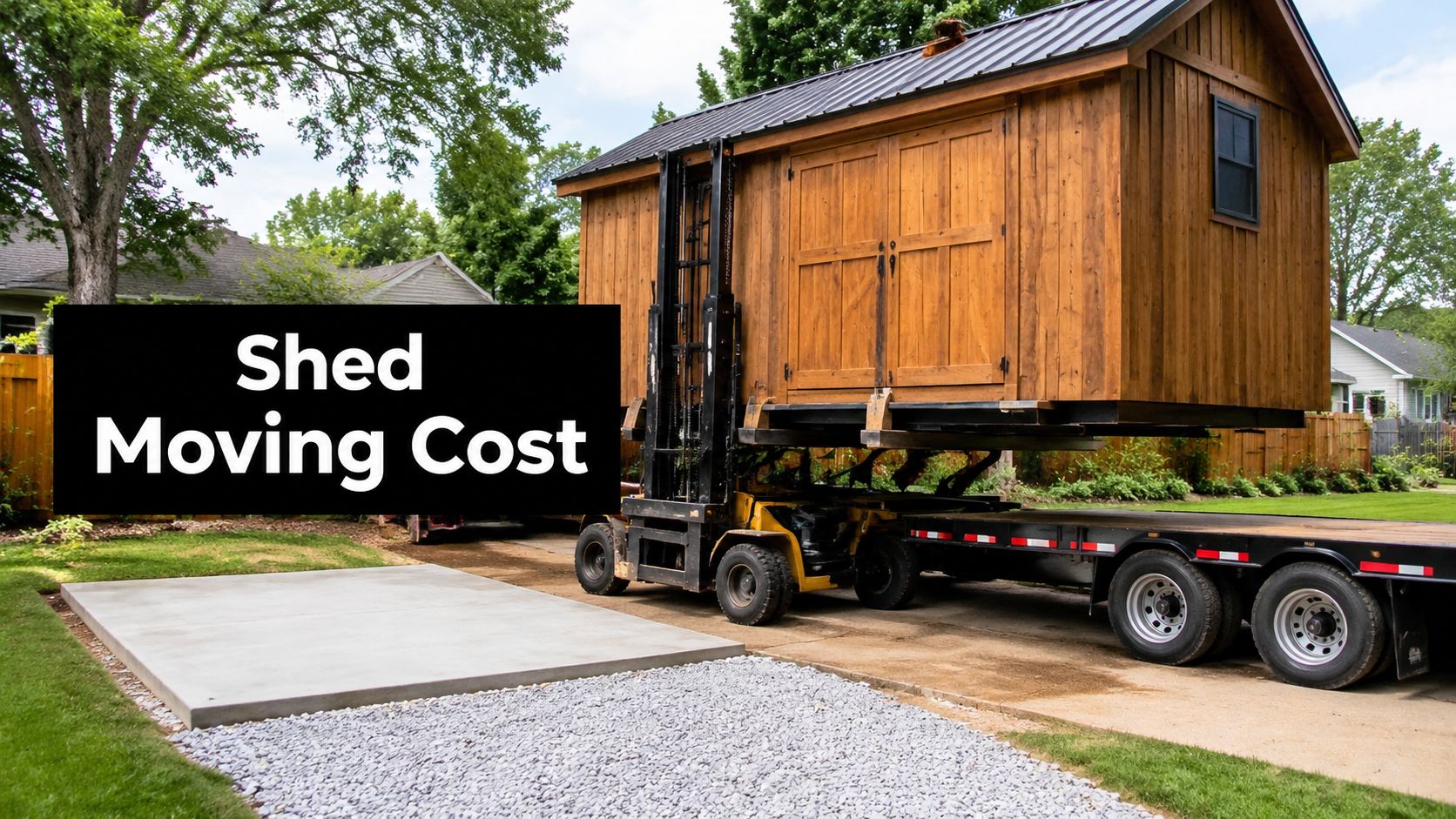
Most local shed moves land between $200 and $1,000, and the national average is $500 for a standard relocation on the same property or nearby city move, according to HomeAdvisor's shed moving cost guide. If you're in Pennsylvania, Maryland, Delaware, or New Jersey, that number is only the starting point, because the actual budget usually includes access, site prep, and the new base your shed will sit on.
A lot of homeowners end up here for the same reason. The shed seemed fine where it was when it went in, and now it's in the way of a patio, driveway, fence line, pool plan, drainage fix, or backyard redesign. Others are moving to a new property and want to take a solid barn shed or 10×10 storage shed with them instead of starting over.
The biggest mistake I see is treating the move like the whole project. It isn't. The shed can be lifted, transported, and set down in a day, but if the new location isn't excavated correctly and built with a proper shed foundation, you can create new problems fast. Uneven settling, door issues, soft corners, trapped moisture, and runoff under the floor all start there.
Homeowners searching for shed foundations near me, gravel shed foundation contractors near me, garage foundation contractors near me, or concrete foundations are usually asking the right question without realizing it. They're not just asking what it costs to move a shed. They're asking what it costs to move it correctly.
Your Guide to Shed Moving Costs in the Mid-Atlantic
A common Mid-Atlantic shed move starts like this. The old location worked for years, then a patio goes in, drainage becomes a problem, or the shed ends up blocking a fence, driveway, or pool plan. The first number people focus on is the cost to lift and transport the building. In practice, that is only one part of the budget.
In Pennsylvania, Maryland, Delaware, and New Jersey, the actual price usually depends on what has to happen before the shed is set down again. If access is tight, the yard is soft, the grade falls off, or the new spot needs excavation and a proper base, the total changes fast. I tell property owners the same thing on foundation jobs all the time. A clean move can be undone by a bad landing spot.
What property owners usually run into
Most shed relocations happen because the current location stopped making sense.
Common reasons include:
- Backyard changes: Patios, fences, driveway extensions, drainage corrections, or a new gazebo foundation can force the shed to move.
- Building plans: A house addition, garage project, or utility installation may take over the original shed location.
- Access problems: The shed may sit too far from the house, stay in a wet area, or waste usable yard space.
That part is straightforward. The part that catches people off guard is the ground.
Across PA, MD, DE, and NJ, freeze-thaw cycles, clay-heavy soils, runoff, and low backyard areas can turn a simple relocation into a site-prep and foundation project. If the new spot holds water or settles unevenly, the shed starts showing it at the doors, the floor, and the corners.
Practical rule: The job is not finished when the shed is moved. It is finished when the shed is level, supported correctly, and set on a base that sheds water.
Why the base matters as much as the move
Moving the shed solves placement. The base determines whether the move was worth paying for.
A proper setup for a storage shed, whether that means a gravel shed foundation, a new pad, or another engineered support system, has to do three things well. It has to carry the load evenly, stay stable through wet and cold seasons, and move water away from the structure. Those are the same fundamentals we apply on larger foundation work too, even though the scale and materials change.
That is why Firm Foundations looks at the whole project in this region, not just the transport portion. For many shed moves in the Mid-Atlantic, the overlooked costs are excavation, grading, stone, leveling, and building the new base correctly the first time. That approach costs more upfront than dropping a shed on bare ground or an underbuilt pad. It also helps prevent the expensive problems that show up later.
Key Factors That Determine Your Shed Moving Cost
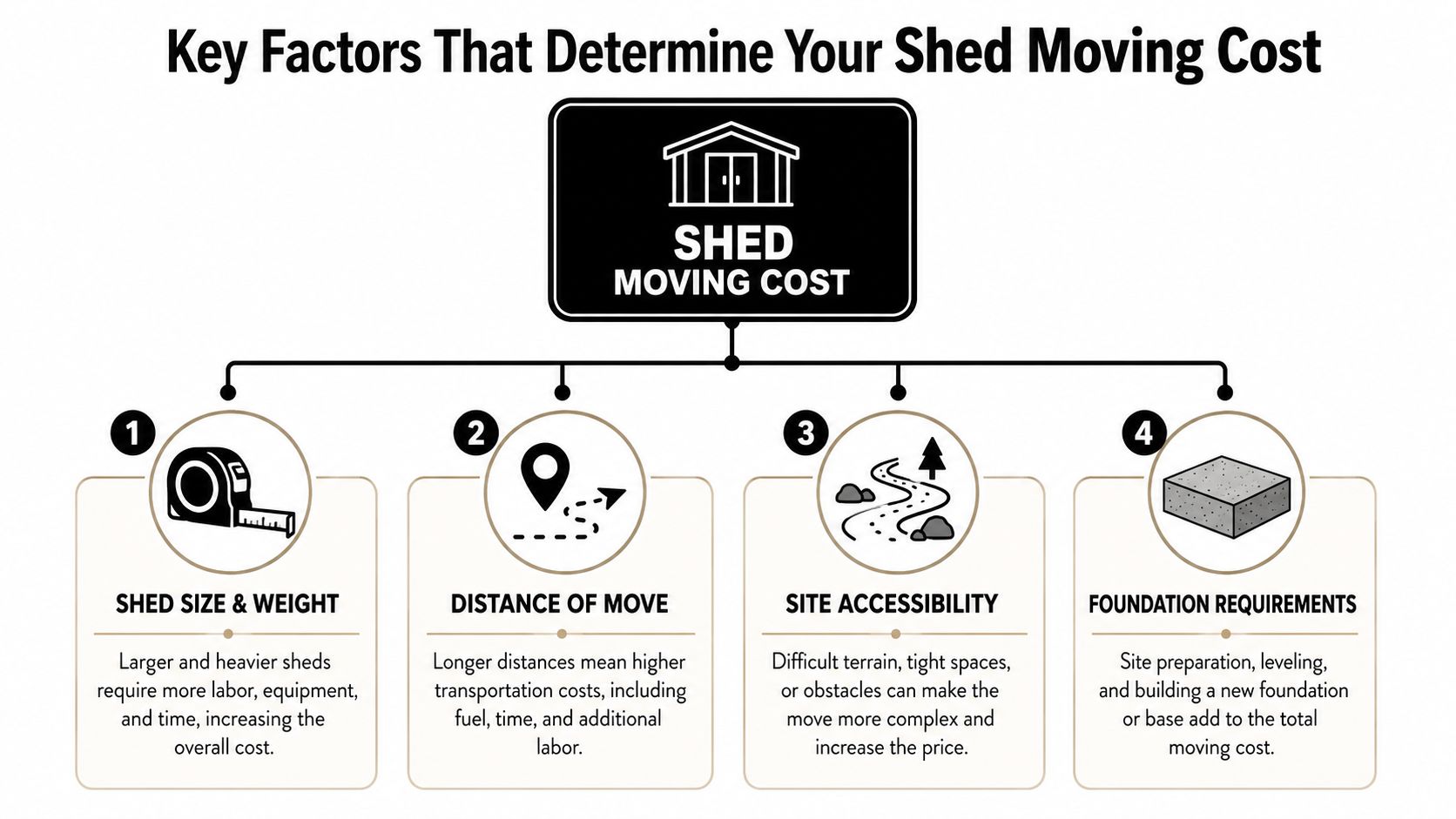
Two shed moves can look similar from the street and price out very differently once a crew sees the job in person. In PA, MD, DE, and NJ, the final number usually comes down to four things: the shed itself, the travel involved, access on both ends, and what the new site needs before the shed can be set down and stay level.
Size and weight change the equipment
A small prefab shed with solid skids is one kind of job. A larger shed with a wider footprint, heavier roof load, or a weakened floor system is another.
As noted earlier, shed movers usually price from a base service charge and then add costs for distance, permits, and site conditions. The practical issue is equipment. Some sheds can be shifted with specialized shed-moving gear and a straightforward lift. Others need more lifting capacity, more cribbing, more setup time, or a crane.
That is also why condition matters. A shed with rotten rim boards, split skids, or a sagging floor cannot be handled the same way as a rigid, well-built structure. If we have to slow the lift, reinforce parts of the frame, or change the moving method to keep it from racking out of square, the labor cost goes up.
Distance changes the scope
An on-property move is usually a placement job. A road move is a transport job with a longer checklist.
Once the shed leaves the yard, cost is shaped by trailer choice, loading method, road width limits, route clearance, and travel time. Homeowners who look at trailers used for moving sheds can see why. Trailer deck height, axle setup, and loading angle affect whether the shed can be moved safely without stressing the frame.
Here's the section visual that captures the main cost drivers at a glance.
Longer moves also create more chances for delays. Traffic, permit timing, utility clearance, and weather all matter more on a road job than they do in a backyard relocation.
Access at both ends can raise the price
Access is one of the biggest cost drivers because it affects time, equipment, and risk.
Common problems include:
- Tight entry points: Gates, fences, retaining walls, and narrow side yards
- Overhead conflicts: Tree limbs, service drops, roof lines, and other obstructions
- Ground conditions: Soft lawns, mud, slope, washout areas, or uneven grade
- Set location issues: A destination that still needs excavation, grading, or compaction before the shed can be placed
A clear, level path saves money. A blocked or unstable path forces the crew to protect the structure more carefully, stage equipment differently, and spend more time getting the shed in without damage to the building or the property.
Permits and foundation needs finish the picture
Permit requirements depend on the shed size and whether the move involves public roads. In some cases, the permit cost is minor. In others, route restrictions and escort requirements can change the job significantly.
The bigger surprise for many homeowners is the destination cost. If the new location needs grading, stone, drainage correction, or a new base, that work can equal or exceed the transport charge. That is common in the Mid-Atlantic, where freeze-thaw movement, wet soils, and low backyard areas cause settling problems if the base is underbuilt.
Homeowners often focus on the move first and the support system second. In practice, both numbers need to be evaluated together. A shed that arrives on a poor base can end up with sticking doors, floor sag, corner drop, and water problems, which is exactly the kind of expensive mistake a professional plan is meant to prevent.
Professional Movers vs DIY A Cost and Risk Comparison
A shed move can look manageable until the building is off the ground. Then problems emerge. The lift points may be weak, the trailer deck may sit too high, the shed may twist during loading, or the floor system may not tolerate the stress at all.
In Pennsylvania, Maryland, Delaware, and New Jersey, I'd treat the decision as a risk question first and a price question second. A short move across a flat, dry yard with a small shed is one thing. A larger shed, soft ground, a slope, or tight access changes the job fast.
What a professional crew is actually charging for
A professional move includes more than labor on moving day. You are paying for the right trailer, lifting equipment, cribbing, load control, route planning, and insurance if the shed or property is damaged.
You are also paying for judgment.
A good crew can tell the difference between a shed that can be moved safely and one that is likely to rack, split, or drop a corner during the lift. That call matters. For an older shed with weak skids or a soft floor, stopping before the move starts is cheaper than forcing it and paying for wall repairs, door reframing, or a full replacement later.
If you want to see the kind of equipment setup that affects whether a move goes smoothly, this guide on trailers used for moving sheds gives a useful overview.
Where DIY saves money, and where it often gets expensive
DIY usually lowers the upfront cash outlay. If the shed is small, access is open, and you already have the right vehicle and lifting help, that can work.
The problem is that rented equipment does not create a safe moving plan by itself. Homeowners still have to match trailer height to the shed, support the load correctly, secure it for transport, and keep it stable over uneven ground. I've seen plenty of jobs where the first mistake was small. A skid catches. One corner drops. A wall moves out of square by less than an inch. By the time the shed is set down, the doors no longer shut right and the floor framing has taken a hit.
That is the cost many DIY estimates leave out.
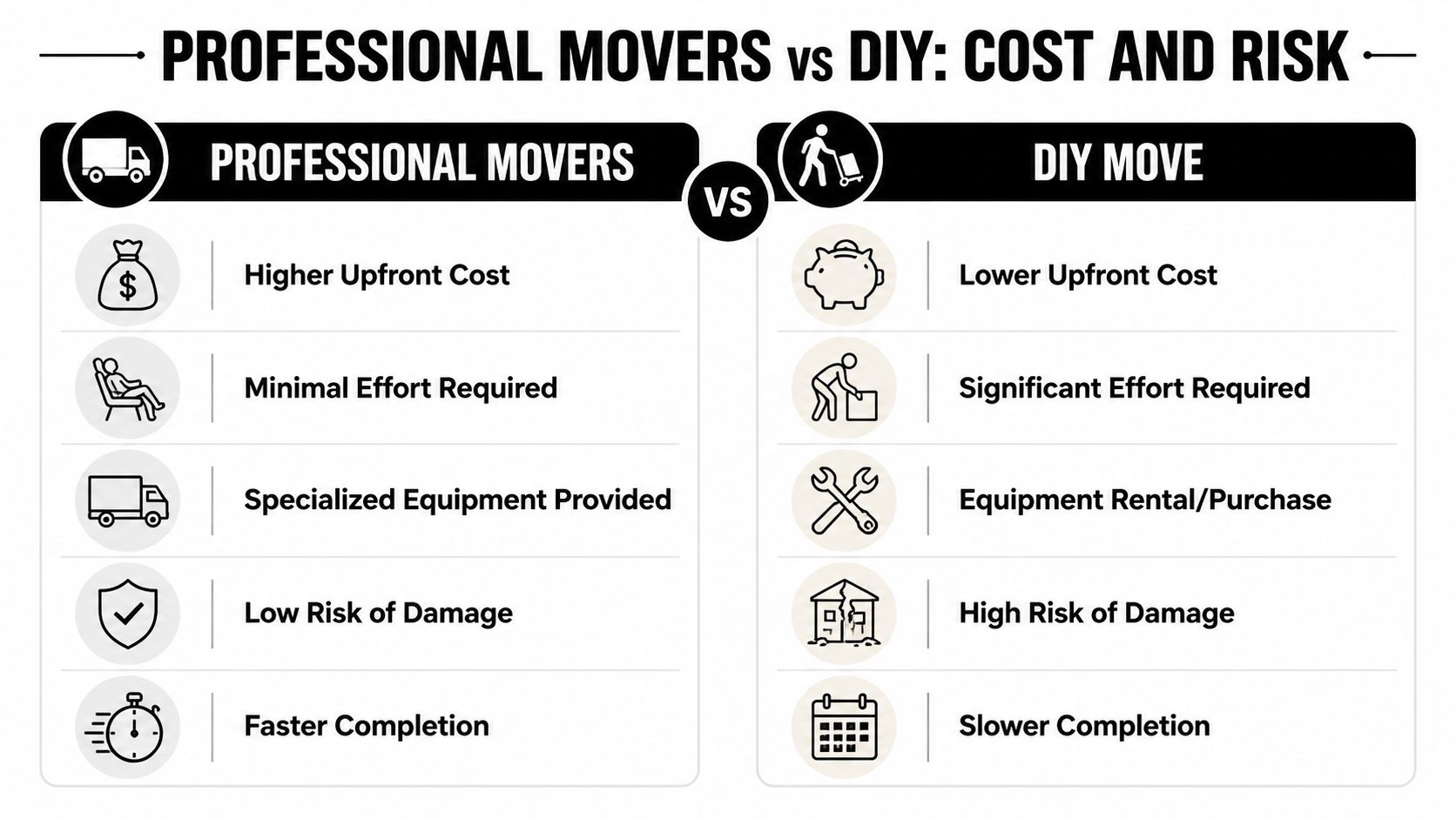
Side-by-side comparison
| Factor | Professional Mover | DIY Approach |
|---|---|---|
| Cost structure | Usually includes equipment, labor, transport planning, and insurance | Usually starts with rentals, tools, fuel, and your own labor |
| Upfront spend | Higher in many cases | Lower at first glance |
| Equipment | Purpose-built movers, trailers, lifting systems, blocking | Rented, borrowed, or improvised equipment |
| Risk to shed | Lower if the structure is sound and the move is planned correctly | Higher if the shed twists, drops, or shifts |
| Risk to property | Lower because access and ground pressure are planned in advance | Higher if tires rut the yard or the load tracks poorly |
| Time and effort | Limited homeowner involvement | Significant coordination, labor, and problem-solving |
| Best fit | Medium and large sheds, tight sites, difficult terrain, older structures | Small sheds with simple access and very light weight |
A cheap move is not automatically a low-cost project. If the shed is damaged during loading or lands out of level, the savings disappear quickly.
For most medium and large sheds in the Mid-Atlantic, the key comparison is not the professional cost versus the DIY cost. It is the professional cost versus the DIY risk. A professional approach usually costs more at the start, but it helps prevent the kind of structural and site damage that makes the full project cost much higher.
The Hidden Costs Site Prep and New Foundations
The part homeowners overlook most often is the destination. A shed can be moved successfully and still end up on a bad installation if the new location wasn't prepared correctly.
That's why shed moving cost and shed foundation cost belong in the same conversation. Once the structure leaves its old spot, it needs a level, stable, drained surface that fits the building and the soil conditions.

A moved shed still needs a proper landing spot
If the shed goes back onto bare ground, low spots, or loose fill, several things can happen. The floor can sag. Doors can bind. Moisture can collect under the structure. The corners may settle unevenly and put stress back into the framing.
For projects that include a new concrete base, costs rise fast. Design Transition Studio reports that moving a 10×12 shed typically costs $1,500 to $3,500 when the job requires a new concrete foundation, such as piers or a slab. A straightforward move without a new foundation tends toward the lower end of that range.
That's not bad news. It's the actual number homeowners need if they want the project done once and done right.
Gravel pad or concrete slab
The right base depends on the structure, the site, and how you'll use it.
A gravel shed foundation works well when drainage is the priority and the shed is designed to sit on skids or a prepared aggregate base. It's a common choice for storage sheds, playhouses, and some prefab outbuildings. A good gravel base needs excavation, leveling, edge control, and compacted stone. It can't just be a few loads dumped on grass.
A concrete foundation is often the better fit for heavier structures, garages, long-term use, or projects where you want a more permanent finished surface. Homeowners searching cement foundations for garage, garage footings and foundations, and concrete foundation for garage are usually in this category.
If you're comparing base options for sheds and similar backyard structures, this page on shed and playhouse foundations is a practical reference for the differences in support and site prep.
Why site prep is not the place to cut corners
Excavation controls elevation. Elevation controls drainage. Drainage controls how long the structure lasts.
That's why the foundation line item matters whether you're planning a base for storage shed, a gazebo foundation, or one of the larger foundation builds tied to garage or barn use. The same mindset applies to related exterior work too. Homeowners who look for driveway companies near me, driveway contractors near me, or concrete contractors often discover the same truth. Base work determines performance.
A shed can survive a rough move better than it can survive years on a poor foundation.
When to Replace Your Shed Instead of Moving It
Not every shed is worth relocating. Some are too far gone structurally, and some only make sense until you add up the move, the new base, and the repair work waiting on the other side.
Homeowners need a blunt answer. If the shed is weak now, moving it won't fix it. It may expose every problem the structure already has.
A practical replacement checklist
Walk around the shed and look at the parts that carry the building.
- Floor system: Soft spots, sagging corners, broken skids, or floor framing that's already failing
- Wall condition: Leaning walls, racked door openings, rot at the bottom plates, or separated siding seams
- Roof condition: Ongoing leaks, widespread sheathing damage, or visible framing movement
- Pest or water damage: Rot, insect damage, or repeated moisture problems
- Use case: You may need a different size, layout, or door arrangement than the current shed offers
If the answer to several of those items is “yes,” replacement may be the better use of your money.
Compare the total project, not just the move
A lot of old sheds look salvageable until removal and reinstallation details show up. If your current shed sits on an old slab and you're thinking about starting over, demolition can become a real cost driver.
This shed removal cost guide notes that removing a shed with an existing concrete slab foundation can cost $1,200 to $3,500, compared with $200 to $2,000 for simpler structures without a concrete base, because the slab has to be demolished and disposed of as well.
That number matters if you're deciding between moving the existing shed, replacing it, or clearing the site for a new structure.
Good candidates for moving
A shed is usually a strong move candidate when it checks most of these boxes:
- The frame is solid: It can be lifted without coming apart.
- The size still works: You don't need a larger footprint or a new design.
- The structure is worth preserving: The build quality is better than what you'd want to discard.
- The new site improves the setup: Better drainage, better access, and a better shed foundation than the current location.
If the structure is still sound, moving it can preserve a good building. If the structure is already failing, relocation just moves the problem.
Getting Accurate Quotes in PA MD DE and NJ
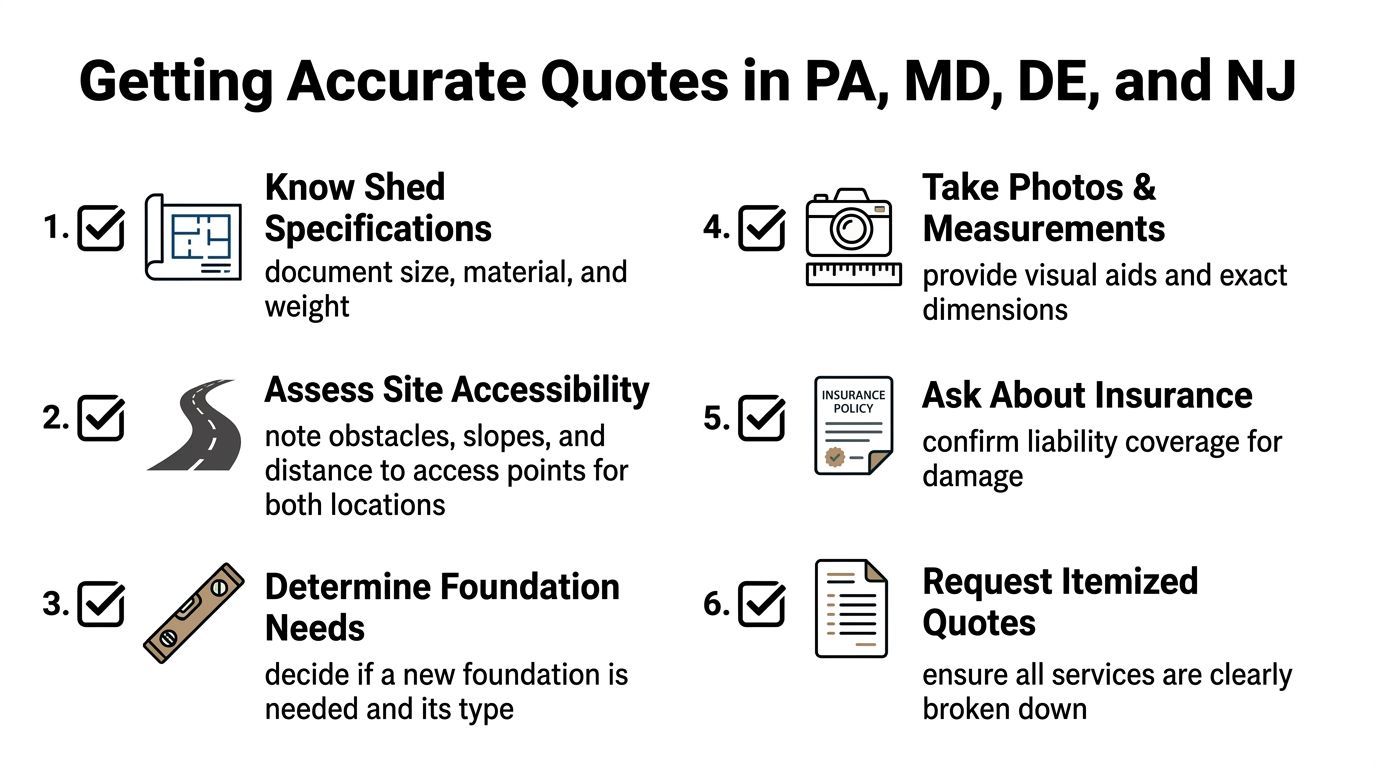
The best quote is the one that accounts for the whole job before a truck shows up. In Pennsylvania, Maryland, Delaware, and New Jersey, that means giving contractors enough detail to price transport, access, and foundation work accurately.
What to have ready before you call
Bring real job information, not a rough guess.
Shed dimensions and material
Know the length, width, approximate height, and whether it's wood, vinyl, or metal.Photos of both locations
Include the current shed location, gate openings, slopes, fences, trees, overhead lines, and the new destination.Foundation expectations
Say whether you want a gravel base, concrete pad, or another prepared landing area. If you're searching terms like shed foundations contractors near me, garage foundation contractors near me, or concrete forms, this is the part you're really pricing.Access notes
Mention soft ground, retaining walls, tight turns, septic areas, or any reason equipment may have trouble getting in or out.An itemized estimate request
Ask for the move, site prep, and base work to be broken out clearly.
Why local quoting matters
A local contractor can judge site conditions faster because they know the region's drainage patterns, soil behavior, municipal expectations, and property layouts. That matters in older neighborhoods, rural properties, and sites where a shed pad, garage slab, or excavation near me request overlaps with other work.
For homeowners who like to understand how contractors build pricing from the ground up, this article on pricing plumbing jobs for profit is a useful trade-service example. It's about plumbing, but the lesson carries over. Good pricing comes from labor, materials, travel, overhead, and risk being accounted for accurately instead of guessed at.
When you're comparing quotes, look for the company that asks the best questions. That's usually the crew least likely to surprise you later.
If you need a complete quote for shed relocation prep, gravel shed pads, concrete foundations, garage footings and foundations, or excavation work in Pennsylvania, Maryland, Delaware, or New Jersey, contact Firm Foundations. You'll get a clear, itemized estimate built around the actual site conditions, so you can move forward with confidence and avoid the expensive mistakes that happen when the base is treated like an afterthought.