
Residential Excavation Services Near Me: Costs & Permits
If you’re searching for residential excavation services near me, you’re probably at the stage where the shed is picked, the garage is planned, or the patio layout is finally making sense on paper. Then the practical questions start. Is the ground level enough? Will water run toward the building? Do you need a gravel pad, footings, or a full concrete slab?
That uncertainty is normal. Most problems with small buildings and larger residential structures don’t start after construction. They start before it, when the site prep gets rushed, the soil isn’t handled properly, or drainage is treated like an afterthought.
For homeowners across Pennsylvania, Maryland, Delaware, and New Jersey, excavation isn’t just dirt work. It’s the part that determines whether your shed doors still shut cleanly, your garage slab stays stable, and your new structure holds up through wet seasons and freeze-thaw cycles. The industry itself reflects how important that work has become. The U.S. excavation contractors industry is projected to reach $203.1 billion in revenue by the end of 2025, with a 7.1% compound annual growth rate over the prior five years, driven in part by residential construction and home improvement projects where professional site preparation matters most (IBISWorld excavation contractors industry data).
Planning a New Shed or Garage Your Project Starts Here
A lot of homeowners start with the building and only later think about the ground underneath it.
A common example is the family that orders a prefab shed for the backyard, then realizes the lot has a soft corner, a slight slope, and water standing near the fence after a hard rain. On paper, it looks like a simple install. On site, it isn’t.
What usually goes wrong at the start
The first mistake is assuming flat-looking ground is build-ready. It often isn’t.
Topsoil can be too soft to support a base for storage shed, gazebo foundation, or cement foundations for garage work. A site can also look level but still send runoff toward the building. In parts of PA and NJ, that creates long-term headaches fast.
Another mistake is choosing a foundation type before anyone evaluates the site. A shed foundation gravel base can be the right answer for one yard and the wrong answer for another. The same goes for concrete foundations, garage footings and foundations, and larger house foundation prep.
Why the ground work matters so much
Excavation sets the elevation, drainage path, bearing surface, and footprint accuracy.
If those are off, the structure above it has to compensate. That usually shows up later as settling, standing water, cracking, racking doors, or edge erosion around the pad or slab.
Practical rule: The more permanent the structure, the less room there is for guesswork in the site prep.
Homeowners searching for shed foundations contractors near me, garage foundation contractors near me, or gravel shed foundation contractors near me usually want the same thing. They want the building to sit right the first time and stay that way.
Local conditions change the answer
A level suburban lot in Maryland isn’t the same as a sloped property in Pennsylvania or a wetter area in Delaware.
Access matters. Drainage matters. Soil behavior matters. So does how the structure will be used. A 10×10 storage shed for lawn tools doesn’t place the same demands on the ground as a detached garage, a hot tub pad, or a shipping container base.
That’s why the project really starts before any machine arrives. It starts with site evaluation, layout, and a foundation plan that matches the structure and the property.
Beyond Digging a Hole What Our Excavation Services Cover
When people search for excavation near me, they often picture one machine and one task. Real residential excavation is broader than that. Good work solves support, drainage, utility access, and finished elevation together.
Site clearing and preparation
Before a foundation crew can build anything, the site has to be made workable.
That may include removing brush, stripping unsuitable surface material, cutting high spots, and identifying where spoil can go without creating a new drainage problem elsewhere on the lot. On some properties, access is half the challenge. Tight gates, fences, tree lines, and septic locations affect equipment choice and staging.
A rushed clearing phase causes problems later. Buried organics, soft topsoil, and poorly planned machine access can compromise compaction and leave a rough finished grade.
Foundation excavation for sheds garages and additions
The work becomes specific to the structure.
A shed foundation may need excavation for a compacted gravel pad with clean edges and correct elevation. A garage foundation contractors near me search usually points to a deeper, more exact process that can include footing excavation, slab prep, and subgrade correction. A gazebo foundation or patio base may require less depth but more careful grade control so water moves away instead of collecting under the finished surface.
Common residential excavation work includes:
- Gravel pad prep: Used for many sheds, barns, playsets, and some outbuildings where a compacted aggregate base is the right fit.
- Concrete slab prep: Used for garages, patios, and other projects where a formed and poured slab needs stable support.
- Footing excavation: Required where structural loads call for garage footings and foundations or similar support.
- Home and addition prep: Involves larger layout control, stricter tolerances, and coordination with other trades.
Grading for water control
Drainage is where good excavation separates itself from cheap excavation.
The site has to shed water without undermining the pad, flooding adjacent areas, or creating muddy edges around the new structure. Proper grading considers where water comes from, where it exits, and how the finished ground ties into the rest of the property.
What doesn’t work is building a perfect-looking pad in the wrong place on the grade. It may look clean on install day and still become a drainage trap after the first heavy rain.
Water problems are rarely caused by one dramatic mistake. More often, they come from several small grading misses that add up.
Utility trenching and service lines
Many residential projects need trenches for electric, water, drainage, or other site services.
That work has to be planned around the structure location, existing utilities, and backfill requirements. Trenching also changes how the surrounding foundation area should be compacted. If utility work is sloppy, settlement often shows up around the trench line first.
Why full-scope excavation matters
A homeowner might call for a concrete foundation for garage, a base for storage shed, or driveway-related work after searching driveway contractors near me or driveway companies near me. Those projects overlap more than people think.
The same crew planning the pad or slab often has to think through grade transitions, trench routes, access paths, and spoil handling. When those pieces are coordinated from the beginning, the finished project performs better and the install tends to move more smoothly.
Our Step-by-Step Excavation and Foundation Process
Homeowners feel more comfortable when they know what happens before, during, and after the dig. A clear process also makes it easier to spot the difference between careful work and rushed work.
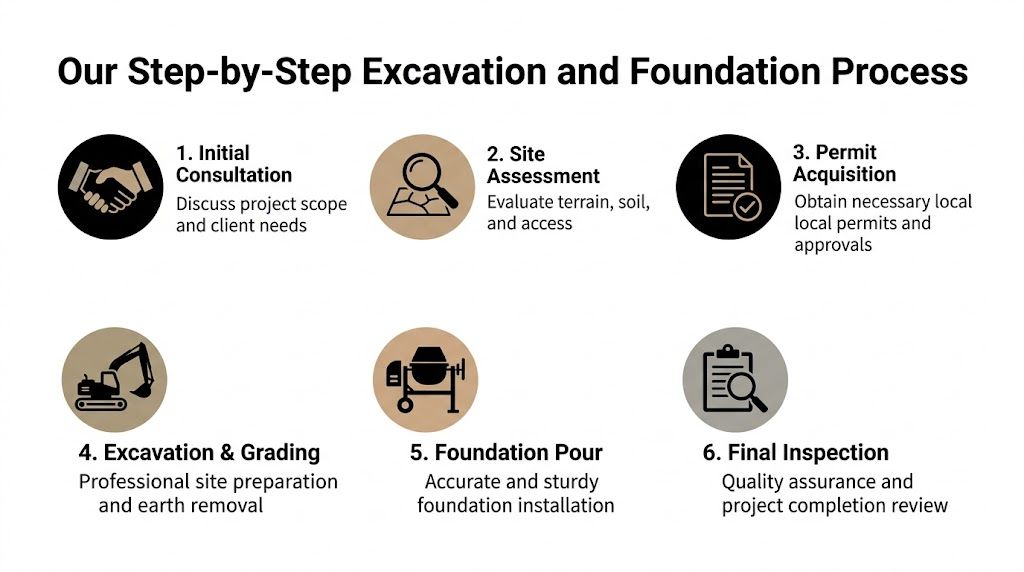
Step one starts with the site not the machine
The first visit should answer practical questions.
Can equipment access the area without damaging other parts of the property? Does the site hold water? Is the proposed building size realistic for setbacks and usable grade? Is the best option a gravel pad or a concrete slab?
A contractor should also look at elevation, drainage direction, and how the pad or slab will tie into nearby driveways, walkways, or yard space. If you’re comparing options, a page on site preparation for concrete slab helps clarify how slab prep differs from simpler pad work.
Layout and marking have to be exact
Once the plan is set, the footprint gets marked.
This phase sounds simple, but small layout errors become big problems later. A pad that’s out of square can complicate a prefab shed install. A garage slab that’s slightly off elevation can create apron and drainage issues that are expensive to correct later.
The crew should mark the work area, identify known utilities, and confirm finished dimensions before excavation begins.
Excavation removes the wrong material
Good excavation isn’t about digging more. It’s about digging to the right depth and stopping there.
On one site, that might mean stripping topsoil and organic material until the crew reaches competent subgrade. On another, it may involve cutting one side of a slope, balancing fill carefully, and shaping the base so the structure sits level while surrounding grades still drain well.
What doesn’t work is leaving soft material in place because it looks close enough. That shortcut is one of the main reasons pads settle unevenly.
Base prep and compaction determine long-term performance
This is the stage many homeowners never see clearly, even though it matters more than the final appearance.
For trench work around utilities and drainage lines, the initial backfill layers matter a lot. The first backfill layers must be hand-packed around pipes and utilities, which reduces settlement by 40% compared to mechanical compaction alone according to the trench backfilling guidance cited here (Section 02 Excavation guidance). That detail is easy to skip and expensive to ignore.
Field note: If a trench is backfilled carelessly, the surface may look fine at first. The real problem shows up later when the trench line settles and the slab edge, pad, or drainage path starts moving differently from the surrounding ground.
For gravel foundations, compaction has to be consistent across the entire footprint. For slabs, the subgrade and stone base need to support the concrete evenly, especially along edges and entrance areas.
Foundation installation comes after the groundwork is right
At this point, the project shifts from excavation into foundation construction.
That can mean placing and compacting a shed foundation gravel base, forming a slab for a garage, or preparing for other foundation builds tied to the structure. This is the one place where it makes sense to mention a specific regional contractor. Firm Foundations handles excavation, gravel pads, and concrete foundation work across PA, MD, DE, and NJ, including pads for sheds, garages, patios, barns, and similar residential projects.
Final cleanup and review
The job isn’t done when the digging stops.
The site should be cleaned, the work area checked for grade consistency, and the homeowner should understand what’s ready for the next phase. A clean finish doesn’t just look better. It shows the crew paid attention all the way through the process.
Budgeting for Your Foundation Project Costs and Drivers
Cost is one of the first questions homeowners ask, and it should be.
The useful answer isn’t a one-size-fits-all number. It’s understanding what moves the quote up or down, and why two projects that seem similar on paper can price very differently once the site is inspected.
What the typical range actually tells you
Based on 2025 data from a similar U.S. market, typical residential excavation projects range from $1,500 to $6,300, with final cost driven by size, soil, and dig depth (Angi excavation cost data). That gives homeowners a starting point, not a guaranteed local price.
A small 4×8 shed with foundation area on a flat, accessible lot may land near the lower end of that kind of range. A garage project with deeper excavation, utility coordination, and more demanding drainage work can move much higher within it.
The main cost drivers on residential sites
Some factors are obvious. Others surprise people.
- Project size: A compact base for storage shed takes less excavation and material than a full concrete foundation for garage.
- Soil conditions: Soft, wet, rocky, or unstable ground often requires more correction before the foundation can go in.
- Depth of excavation: Deeper cuts usually mean more labor, more spoil handling, and more compaction work.
- Access to the site: Narrow gates, backyard access, and protected landscaping slow production and can require smaller equipment.
- Foundation type: A compacted gravel base, footings, and a reinforced slab are different scopes of work.
- Drainage needs: If the site needs reshaping to move water properly, that adds time and detail work.
Sample Project Cost Ranges in PA MD DE and NJ
The table below is for planning only. Actual pricing depends on the site and scope.
| Project Type | Foundation Type | Typical Size | Estimated Cost Range |
|---|---|---|---|
| Small storage shed pad | Gravel pad | Small shed footprint | Within typical residential excavation range |
| Standard shed foundation | Gravel pad or compacted base | Mid-size shed footprint | Within typical residential excavation range |
| Gazebo or patio base | Excavated and graded base | Small to moderate footprint | Within typical residential excavation range |
| Detached garage site prep | Slab prep or footing excavation | Larger footprint | Often influenced heavily by depth, drainage, and access |
| Home addition prep | Excavation for foundation area | Varies by addition | Typically requires a custom site-specific quote |
If you want another market-based cost reference to compare how excavation variables are explained, this overview of Cost of Excavation in Marietta, GA is useful for understanding how site conditions affect pricing.
For early planning, a concrete foundation cost calculator can also help you think through slab-related budget questions before requesting a formal quote.
What a good quote should include
A useful quote should explain scope, not just price.
It should clarify the foundation type, what excavation is included, whether grading or trenching is part of the work, and what assumptions are being made about the site. The cheapest number on the page isn’t always the lowest final cost if key items were left vague at the start.
Permit and Inspection Rules for PA MD DE and NJ
Permits are one of the biggest reasons residential projects stall.
That doesn’t happen because homeowners aren’t willing to move forward. It usually happens because local requirements are scattered across zoning, erosion control, utility coordination, and inspection timing.
Why permit confusion delays projects
A 2025 report found that 68% of homeowners experience project delays because of permit confusion, and in Maryland, sediment control permits can take 30 to 60 days to process (regional permit guidance and delay data). If you’re planning excavation in MD, that timeline matters before you schedule equipment, building delivery, or concrete work.
What homeowners in each state should expect
Pennsylvania
Projects often involve local permit review plus erosion and soil-related requirements. Sloped lots and runoff-sensitive areas usually need closer attention. Homeowners should expect questions about grading, drainage, and where disturbed soil will be controlled during the job.
Maryland
Maryland review can be stricter when sediment control applies. If your site disturbance is large enough to trigger that process, the paperwork and review path can add time before excavation starts.
Delaware
Drainage and stormwater considerations are a recurring issue, especially on sites with limited fall or wetter ground conditions. Trenching and grading plans need to support the permit path, not just the build itself.
New Jersey
Local requirements vary widely, and coastal or environmentally sensitive areas can bring additional oversight. For some properties, site location matters almost as much as the structure you plan to build.
Bring permit questions up before you order the structure, not after. That one decision can save weeks of rescheduling.
The practical permit checklist
Before excavation starts, homeowners should confirm:
- Property details: The exact location of the structure, lot lines, and any obvious setback concerns.
- Utility coordination: Existing lines should be identified before digging begins.
- Drainage plan: The site should show how water will move away from the foundation area.
- Inspection timing: Some approvals affect when excavation can start and when the next phase can proceed.
The smoothest jobs usually have one thing in common. Someone handled the paperwork early and tied the permit plan to the actual site conditions.
How to Choose Your Excavation and Foundation Contractor
A bad foundation contractor can make a clean-looking mess.
The site may look neat on day one, but the test comes later when the ground gets wet, a trench line settles, or the slab edge starts showing the consequences of poor prep. If you’re comparing companies for shed foundations near me, garage footings and foundations, or residential excavation services near me, start with the basics that protect the job and your property.

Start with credentials and scope clarity
Ask whether the contractor is licensed and insured for the work they’re proposing.
Then look at the quote. A serious contractor should be able to describe what they’re building, what prep is included, and what assumptions they’re making about the site. If the proposal is vague, the job usually is too.
A written scope matters for shed foundation blocks, gravel pads, slab prep, trenching, and any concrete forms tied to the project. It reduces misunderstandings and gives you a basis for comparison.
Safety tells you a lot about workmanship
Safety isn’t separate from quality. It usually predicts it.
OSHA requires protective systems in trenches deeper than four feet, and compliant sloping or shoring reduces the risk of fatal accidents by 85% under the cited excavation safety guidance (OSHA trench safety requirements). A contractor who respects trench safety is more likely to take layout, compaction, and utility protection seriously too.
A crew that cuts corners on safety often cuts corners where you can’t see them yet.
Here’s a short video that gives additional context on evaluating contractors and jobsite standards.
Check local reputation the right way
Reviews don’t replace due diligence, but they do help you spot patterns.
Look for comments about communication, scheduling, cleanup, drainage results, and whether the finished foundation matched the quoted scope. If you’re curious how review visibility affects local contractor discovery online, this explanation of the impact of Google reviews gives useful background.
Ask practical questions not sales questions
The best questions are specific.
- How will you handle drainage on my lot: You want a direct answer, not a generic promise.
- What foundation type fits this structure and site: The answer should reflect your actual ground conditions.
- How do you compact and backfill around trenches or utilities: This tells you whether they understand the part that prevents later settlement.
- What happens if the subgrade is softer than expected: Experienced contractors plan for that possibility.
A strong contractor doesn’t need fancy language. They need a clear process, sound site judgment, and work that stays stable after the truck leaves.
Get Your Project Started on a Firm Foundation
A shed, garage, patio, or addition is only as good as the ground underneath it.
The visible part of the project gets the attention, but the long-term value comes from the excavation, grading, compaction, and foundation work that happens first. That’s what keeps water moving away, prevents settlement problems, and gives the structure a stable base year after year.
For homeowners in Pennsylvania, Maryland, Delaware, and New Jersey, the right contractor should make the process easier to understand, not harder. You should know what type of foundation fits your project, what the site requires, and what to expect before work begins.
If you’re ready to move forward with residential excavation services near me, the next step is simple. Get a site-specific quote and make decisions based on your actual property, not guesswork.
If you need excavation, grading, a shed pad, or a concrete foundation in PA, MD, DE, or NJ, contact Firm Foundations to discuss your project and request a free, no-obligation quote.