
How Much Does a Gravel Driveway Cost?


A gravel driveway typically costs $1 to $3 per square foot, while asphalt usually runs $5 to $12 per square foot and concrete $6 to $12 per square foot. For a standard 24×24-foot two-car driveway, most projects fall between $600 and $1,800.
If you're dealing with a driveway that turns muddy after every rain, sheds water toward the garage, or has old asphalt breaking apart at the edges, gravel is often the most practical reset. In Pennsylvania, Maryland, Delaware, and New Jersey, that matters. Freeze-thaw cycles punish weak driveways, and rushed installation usually shows up fast in the form of ruts, puddles, and stone that migrates into the yard.
Homeowners usually start with one question: how much does a gravel driveway cost. The honest answer is that the square-foot price is only the starting point. The actual cost depends on what the site needs to hold up through weather, traffic, drainage, and daily use. A driveway for a compact car is one thing. A driveway feeding a detached garage, barn shed, or workshop is another.
Planning Your New Driveway in Pennsylvania or Maryland
A common call starts with a familiar problem. A homeowner in southeastern Pennsylvania has an aging driveway that used to be “good enough.” Then the low spots deepen, water sits near the house, tires track mud into the garage, and every storm leaves a mess. By the time they're searching for driveway contractors near me or excavation near me, they usually want two things at once: a price they can live with and a driveway that won't need constant patching.
That’s where gravel makes sense for a lot of properties in PA, MD, DE, and NJ. Based on 2026 gravel driveway pricing data from LawnStarter, installation generally ranges from $1 to $3 per square foot, and a standard 24×24-foot driveway typically lands between $600 and $1,800. That same pricing overview compares gravel with asphalt at $5 to $12 per square foot and concrete at $6 to $12 per square foot, which is why gravel stays popular for homes, long lanes, garage approaches, and access to a new shed foundation or gazebo foundation.
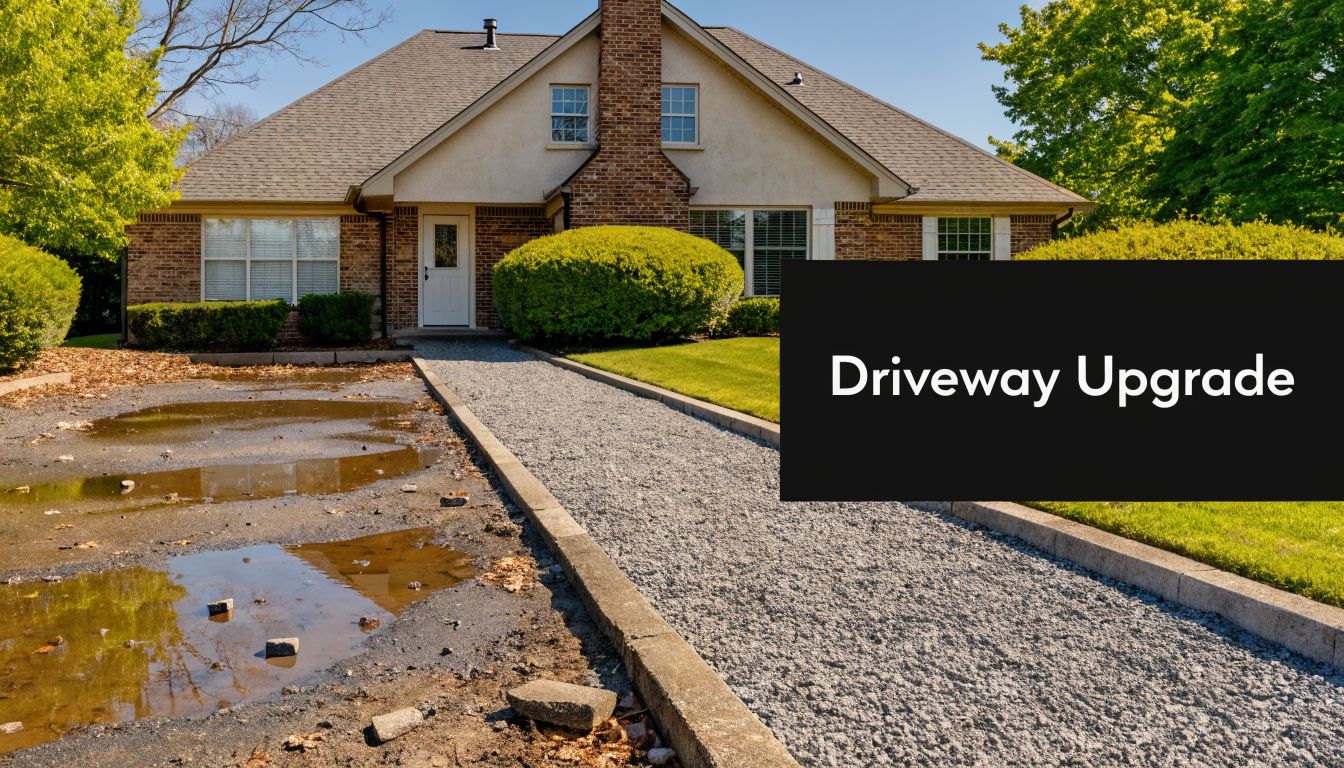
A well-built gravel driveway also fits the way many Mid-Atlantic properties are used. Some need a simple drive to the house. Others need a solid route to a garage slab, a base for storage shed access, or room for trailers, deliveries, and farm equipment. The surface has to drain, stay shaped, and resist washout.
What homeowners usually worry about first
Homeowners aren't typically worried about the stone itself. They're worried about what happens after the first winter.
- Drainage problems: Water is what ruins driveways first. If the grade is wrong, even good gravel won't stay put.
- Soft subgrade: A weak base under the stone leads to rutting, especially near parking areas and turnarounds.
- Tracking and spread: Rounded surface stone can move around more than homeowners expect.
- Budget creep: An inexpensive surface can become an expensive mistake if the prep work is skipped.
Practical rule: The cheapest quote is often the one with the least excavation, the least grading, and the least compaction.
If you're still evaluating the site itself, it helps to understand what local excavation work may be involved before stone ever arrives. This overview of residential excavation services near me gives useful context for what happens under the driveway, not just on top of it.
Where gravel makes the most sense
Gravel is often the right fit when you need function first. It works well for a new house approach, a detached garage entrance, access to a barn shed, or a practical lane to outbuildings. It also pairs naturally with projects homeowners search for under terms like shed foundations near me, gravel shed foundation contractors near me, garage foundation contractors near me, and concrete foundations.
A Detailed Gravel Driveway Cost Breakdown
A gravel driveway price only makes sense when you know what is included. In PA, MD, DE, and NJ, two quotes can look close on paper and produce very different results after a wet spring or a hard freeze.
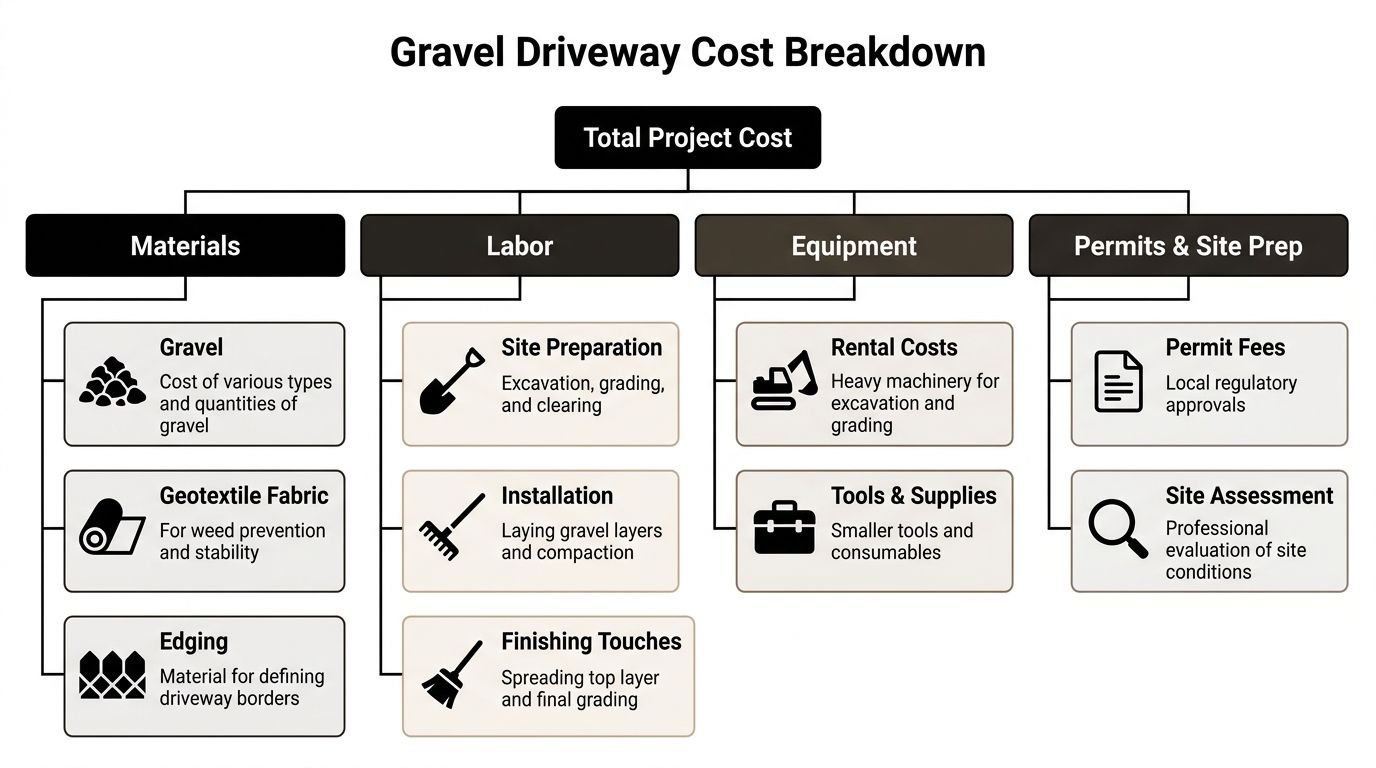
The total usually falls into four parts: materials, labor, equipment and site preparation, and optional upgrades. Homeowners often compare the finish stone first. I look at the base, grade, and drainage first, because those are the items that decide whether the driveway holds up or starts rutting in year one.
Materials
Material cost depends on the stone you choose, how far it has to be hauled, and whether the driveway is being built as a single layer or a true base-plus-top system. The base stone does the structural work. The top layer affects appearance, traction, and how much stone migrates into the lawn or roadway.
A few numbers help frame the budget:
| Cost item | Verified range |
|---|---|
| Gravel driveway installation | $1 to $3 per sq ft |
| DIY gravel material cost | $0.50 to $1.50 per sq ft |
| Professional gravel by ton | $10 to $50 per ton |
| Gravel needed for 100 sq ft at 6-inch depth | About 2.5 tons |
| Pea gravel installed average | $2.18 to $2.99 per sq ft |
Those figures come from the earlier LawnStarter data source already cited above.
For a lasting driveway, the stone choice needs to match the job. Crushed base stone locks together and compacts into a firmer surface. Rounded stone may look cleaner at first, but it shifts more under tires and usually needs more maintenance, especially on slopes, curves, and parking areas where vehicles turn in place.
Labor
Labor covers much more than dumping and spreading gravel. It includes layout, cutting the driveway to the right elevation, shaping the subgrade, compacting each layer, setting the crown, and tying the new surface into the garage, road, or existing parking area.
That work changes from property to property. A straight, open lane with easy truck access is faster to build than a driveway tucked between trees, fences, retaining walls, or tight garage corners. The square footage may match, but the labor does not.
This is also where experience shows. Good crews know when the existing ground can stay, when soft spots need to come out, and when a customer will be better served by spending more on base work now instead of paying for regrading every spring.
Equipment and site prep
Many low quotes leave out site preparation.
If the old driveway has failed edges, buried topsoil, mud pockets, or poor drainage, the crew may need to strip material, reshape the lane, compact the sub-base, and rebuild the stone section in lifts. That takes machine time, trucking, and more stone, but it is usually the difference between a driveway that settles evenly and one that develops potholes and washboarding.
In the Mid-Atlantic, prep work carries more weight because the climate is hard on shallow installs. Freeze-thaw cycles in Pennsylvania and New Jersey can heave weak sections. Clay-heavy soils in parts of Maryland and Delaware hold water longer than homeowners expect. Long rural driveways often need shoulder support and careful shaping so runoff leaves the surface instead of cutting channels through it.
A gravel driveway lasts because of grade and compaction. The stone itself is only one part of the system.
Base prep and stabilization
A properly built gravel driveway is installed in layers and compacted as it goes. On stronger ground, standard base preparation may be enough. On weaker soils, wet areas, or steep sections, stabilization can save money over the life of the driveway by reducing rutting, stone loss, and repeat grading.
As noted earlier, LawnStarter describes layered installations that may include geotextile fabric to help separate the stone from the soil below and improve drainage performance. The same source also notes typical layered bases of 4 to 6 inches deep, while upgraded stabilized systems can push costs higher.
That added cost is not for every property. I usually recommend it where the subgrade is soft, where delivery trucks or trailers will use the driveway regularly, or where the driveway includes turns, slopes, or a parking area that gets repeated tire scrub.
What a transparent quote should include
A good quote should show what is being built.
- Driveway size: Length and width affect stone quantity, trucking, and machine hours.
- Stone specification: The base stone and finish stone should be listed clearly.
- Excavation scope: The quote should state whether removal of soft material, topsoil stripping, or regrading is included.
- Compaction and shaping: Crown, slope control, and final grading should be part of the base price, not vague allowances.
- Optional add-ons: Fabric, edging, extra depth, culvert work, and stabilization should be priced separately.
A lump-sum number without detail usually hides risk for the homeowner. The cheapest driveway is not always the lowest-cost driveway to own. In this region, the better value usually comes from a contractor who builds for drainage, frost, and traffic from the start.
Sample Project Quotes for Common Driveway Sizes
Square-foot pricing is helpful, but most homeowners want examples that resemble their own property. The easiest way to budget is to compare your driveway to a few common layouts.
Small one-car driveway
A 12×25-foot one-car driveway typically falls between $300 and $900, based on the LawnStarter pricing figures cited earlier in the article. This is often a good fit for a compact parking pad, a short side drive, or access to a small outbuilding such as a 10×10 storage shed.
This kind of project can still become more involved if the area holds water or if the existing ground is soft. A short driveway doesn't automatically mean a simple driveway. Small jobs sometimes need just as much precision near the garage door, walkway, or property edge.
Standard two-car driveway
A 24×24-foot two-car driveway usually runs $600 to $1,800, again based on the previously cited LawnStarter figures. This is the layout many homeowners picture when they ask how much does a gravel driveway cost. It gives enough room for two vehicles and usually works well in front of a detached garage or beside a house with a moderate setback.
If the site is fairly level and already drains reasonably well, this is often the sweet spot for gravel. The cost stays manageable, and the installation can create a clean, durable surface without moving into the much higher price range of asphalt or concrete.
Longer driveway for rural or outbuilding access
For a 100-foot by 10-foot driveway, professional installation typically totals $4,000 to $6,000, including 13 tons of gravel and $1,500 to $3,000 in labor, according to Houzz gravel driveway cost data. That same source notes that low-end projects start at $300 to $600 nationally.
This type of driveway is common on rural or semi-rural properties in Pennsylvania and New Jersey where the drive has to reach a garage, barn shed, workshop, or new house foundation area. It’s also where gravel shows one of its biggest strengths. A long lane is where paved surfaces get expensive quickly.
On a long driveway, hauling, grading, and drainage control usually matter more than the finish stone color.
Comparing the three examples
| Driveway size | Typical cost |
|---|---|
| 12×25 one-car | $300 to $900 |
| 24×24 two-car | $600 to $1,800 |
| 100×10 long driveway | $4,000 to $6,000 |
These examples also overlap with other site work homeowners plan at the same time. A family may install the driveway first, then add a concrete foundation for garage construction later. Another property owner may need access to a gravel shed foundation, gazebo foundation, or barn shed pad before the building arrives. Bundling the work often makes the project easier to coordinate because the same grading plan can serve more than one structure.
What changes the number inside those ranges
The lower end of a quote usually assumes simpler access, less excavation, and local material availability. The higher end often reflects more grading, more imported stone, longer hauling, or a site that needs better drainage control before gravel can perform the way it should.
That’s why sample pricing is useful, but it’s still only a benchmark. The final quote comes from the ground conditions, not just the tape measure.
Key Factors That Influence Your Final Price
A driveway can measure the same on two properties and still come in thousands of dollars apart. I see that every week across PA, MD, DE, and NJ. The difference is usually below the surface. Base preparation, drainage, truck access, and soil behavior decide whether a gravel driveway stays firm for years or starts rutting after one wet season.
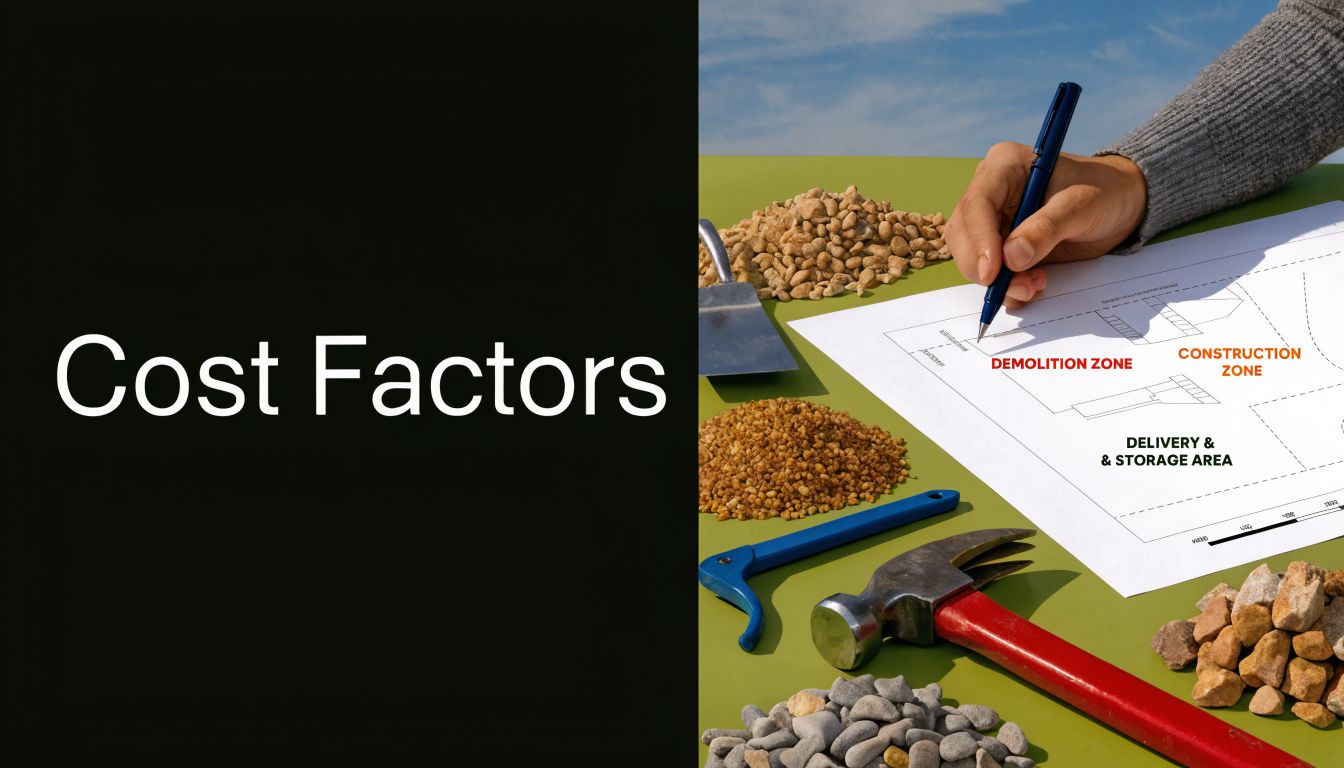
Gravel type affects both upfront cost and long-term upkeep
Stone choice changes more than the look of the finished driveway. It affects how the surface packs, how it handles tire traffic, and how often you will need touch-up gravel later.
Rounded stone tends to shift and migrate, especially on slopes or in turning areas. Crushed angular stone locks together better and usually holds grade longer. For many Mid-Atlantic driveways, that means a lower maintenance bill over time, even if the initial material cost is a little higher. Homeowners focused only on the cheapest delivered stone often end up paying again sooner for regrading, top-offs, or edge cleanup.
Site access and layout
Access problems raise labor costs fast. A straight, open approach lets trucks dump efficiently and lets equipment shape the driveway in fewer passes. A tight entrance, tree-lined lane, fence pinch point, or limited turnaround slows every part of the job.
Common layout issues that increase the quote include:
- Tight entrances: Dump trucks and skid steers need room to enter and work safely.
- Long carry distances: If stone cannot be placed near the work area, machines spend more time moving material around the site.
- Limited turnaround space: Extra maneuvering adds crew time and fuel.
- Finished landscaping nearby: Protecting lawns, curbs, beds, or sidewalks takes care and usually slows production.
A homeowner looking at bids should ask whether the contractor accounted for access or just priced the square footage. That one detail explains a lot of low quotes that climb later.
Slope, drainage, and soil conditions
Water is the main cost driver on many gravel projects in this region. Freeze-thaw cycles in Pennsylvania, wet springs in Maryland, and heavy summer storms across New Jersey and Delaware all put pressure on a driveway base. If water sits in the subgrade, the gravel above it will pump, rut, and wash out.
A gravel driveway lasts because water leaves it quickly.
That is why a proper site visit looks beyond the lane itself. Runoff from rooflines, hillsides, roadside ditches, and neighboring grades all matters. Some driveways need a simple crown and ditch cleanup. Others need undercutting, geotextile fabric, added base stone, or a pipe at the entrance. Those items raise the upfront price, but they usually cost less than rebuilding a failed driveway two years later.
Here’s a useful visual overview of the planning and installation process:
Base depth and intended use
Usage changes the build. A driveway serving two daily cars is different from one that handles delivery trucks, a camper, a trailer, or equipment headed to a barn or workshop. The surface may look similar when the job is finished, but the base under it should not be the same.
| Property use | What it usually means for construction |
|---|---|
| Daily household parking | Standard grading and compacted aggregate layers may be enough |
| Detached garage access | Parking pads and transitions need tighter shaping and compaction |
| Barn shed or equipment access | Wheel paths and turning areas often need more stone and a stronger base |
| Mixed residential and work use | Drainage control and deeper support layers usually matter more |
This is one place where cheap pricing can hide future expense. A thin base may look fine at handoff, then fail once repeated loads start pushing moisture and fines upward.
Upgrades, permits, and bundling work
Some properties need more than gravel and grading. Weak soils may call for fabric separation. Sloped edges may benefit from stabilization. Municipal entrance rules can require culvert work or apron changes where the driveway meets the road. Those are real costs, and they should be discussed before the first truck arrives.
Bundling related site work can also change the math in a good way. If you are planning a garage pad, shed base, or access lane at the same time, one grading plan often saves money compared with doing each piece separately. Homeowners comparing bids should also read up on how to hire contractors for smarter home projects, because the quality of the quote matters almost as much as the number at the bottom.
The best price is not the lowest line item. It is the one that gives you a driveway that drains properly, carries the loads you have, and does not need major correction after the first hard winter.
DIY vs Hiring Driveway Contractors Near Me
A gravel driveway looks simple from the road. That’s why DIY is tempting. Homeowners see stone, a few machines, and a surface that seems straightforward. The hard part is hidden. The project only stays simple if the site is already dry, level, accessible, and easy to compact. A lot of driveways in the Mid-Atlantic aren't.
Where DIY makes sense
If you're topping off a small existing area that already has a stable base, DIY can be reasonable. Light reshaping, spreading a small amount of fresh gravel, or cleaning up a short path to a shed can be manageable if the drainage is already right.
DIY gets riskier when the project involves:
- Excavation: Removing soft soil and cutting grade correctly takes equipment and judgment.
- Compaction: Loose stone spread over loose ground won't stay smooth for long.
- Water management: Many failures start because runoff wasn't redirected.
- Layer selection: Using the wrong stone in the wrong layer creates a driveway that looks finished but drives poorly.
What usually goes wrong on homeowner-built driveways
Most bad gravel driveways don't fail because the owner didn't work hard enough. They fail because one of the structural steps was skipped. A driveway may be too flat, too shallow, too rounded on the surface, or built directly over weak material that should have been removed.
The maintenance side is where the cost difference shows up. The Hello Gravel cost analysis notes that while gravel offers clear upfront savings at $1 to $4 per square foot compared with $7 to $18 for asphalt or concrete, DIY installations or poorly built driveways can need $200 to $500 in annual upkeep for a 500-square-foot area, adding $2,500 to $6,000 over a decade. That same source says professional installation with proper base and drainage can cut long-term maintenance by over 50%.
That lines up with what contractors see in the field. The problem isn't usually the first month. It's the second winter, the wet spring, and the repeated tire traffic in the same spots.
Field advice: If the driveway needs excavation, grade correction, or drainage work, professional installation usually costs less than rebuilding a failed DIY job later.
What a professional crew brings to the project
Hiring driveway contractors near me isn't only about labor. It's about sequence. An experienced crew knows when to excavate deeper, when to use fabric, how to compact in lifts, and how to shape a crown that drains. Those decisions affect how often you rake, regrade, or order more stone in the years ahead.
If you're comparing bids, it also helps to understand how to evaluate the contractor, not just the price. This guide on how to hire contractors for smarter home projects is a useful reference for vetting communication, scope, and professionalism before you sign anything.
Checklist for an accurate quote
Before you call for pricing, gather a few details. It speeds up the estimate and helps you get apples-to-apples comparisons.
Approximate size
Measure the length and width of the driveway or the area you want to build.Current surface condition
Note whether the site is grass, mud, old gravel, or broken asphalt.Water issues
Mention puddling, washout, runoff from a hill, or soft spots near parking areas.Intended use
Say whether it's for cars, pickups, trailers, garage access, a barn shed, or equipment.Access constraints
Tell the contractor about narrow gates, overhead lines, retaining walls, or limited truck access.
The better value question
The cheapest install price isn't always the lowest cost ownership. For homeowners also planning a shed foundation, concrete forms for a garage slab, or a concrete foundation for garage construction, it often makes sense to think in systems. One crew can evaluate driveway access, finished elevation, drainage, and foundation prep together. That usually produces a cleaner result than treating each part as a separate fix.
Maintaining Your Gravel Driveway for a 20+ Year Lifespan
A gravel driveway can last a long time if it starts with proper grade, a stable base, and drainage that works. Maintenance is still part of ownership, but it should be routine upkeep, not constant repair.
What regular maintenance looks like
Most gravel driveways need occasional touch-up work. That usually means redistributing stone that has moved out of the wheel tracks, smoothing minor washboarding, and keeping edges from creeping into grass or beds. The goal is to correct small movement before it becomes a rut or pothole.
A few habits make a big difference:
- Rake or reshape early: Fixing shallow low spots early is easier than rebuilding deep ones later.
- Watch water after storms: The first heavy rain tells you a lot about whether the crown and edges are doing their job.
- Keep entrances clean: Roadside areas take extra abuse from turning and braking.
- Control vegetation: Weeds are easier to stop when they first appear than after roots spread through the stone.
Replenishing stone over time
Even a good driveway loses some surface stone over the years. Tires push it outward, snow removal can scrape some away, and heavy rain can move loose material if the edges aren't stable. The earlier Houzz data cited above notes that gravel may need replenishment every 2 to 4 years at $120 to $240. That kind of maintenance is normal. What isn't normal is needing major reshaping every season.
A driveway that needs constant fresh stone is usually telling you something about the base, the drainage, or both.
Why installation quality changes maintenance
The driveway's lifespan starts long before the top layer is spread. If the contractor installs a proper crown, compacts the base well, and separates weak soil where needed, routine upkeep stays manageable. If those basics are skipped, the driveway consumes time and money.
That’s why long-term care and installation quality go together. If you want a practical overview of upkeep after the project is done, these tips for maintaining your gravel driveway for longevity are worth reviewing. Homeowners who follow a simple maintenance routine usually avoid the big failures that make gravel seem harder to own than it really is.
A realistic lifespan mindset
A driveway doesn't need to look decorative to perform well. It needs to stay shaped, drain consistently, and support traffic without rutting. When those three things are in place, gravel becomes a durable, cost-conscious surface for homes, garages, sheds, gazebos, and work areas across the region.
Frequently Asked Questions About Gravel Driveways
What is the best gravel for a driveway in Pennsylvania or New Jersey
For a working driveway in PA or NJ, angular crushed stone is usually the right choice, not rounded decorative gravel. Angi’s gravel guide identifies Item #4 crushed stone as a solid base material because the stone locks together better under traffic. That matters in the Mid-Atlantic, where freeze-thaw cycles, spring rain, and turning tires will expose a weak stone choice fast.
A good-looking top layer is not enough. If the stone shifts every time a vehicle brakes, the driveway costs more to maintain over time.
How long does a gravel driveway installation take
Most gravel driveway jobs take anywhere from a day to several days, depending on length, width, access, weather, and how much excavation the site needs first.
A straightforward replacement over a stable base goes much faster than a new driveway cut through soft ground or a lane that needs drainage correction. On rural properties in PA, MD, DE, and NJ, I also look at truck access and where materials can be staged. Tight access can slow a job more than driveway size.
Do I need a permit for a new driveway
Sometimes. The answer usually depends on whether you are adding a new entrance, widening an existing one, or changing drainage near a public road or roadside ditch.
Permit rules vary by township, borough, county, and state agency. In this region, it is smart to confirm requirements before work starts, especially if the driveway connects to a state road or crosses a drainage swale.
Is gravel cheaper than asphalt or concrete
Yes, in upfront cost.
The LawnStarter pricing cited earlier puts gravel below asphalt and concrete on a per-square-foot basis. That lower entry price is why gravel makes sense for long rural driveways, secondary lanes, parking pads, and properties with sheds, garages, or barns. The bigger cost question is whether the driveway is built well enough to avoid frequent regrading, added stone, and water damage.
Can a gravel driveway work for a garage or shed project
Yes, and I often recommend planning those together.
If a driveway, shed pad, or garage area is graded as one project, the site usually drains better and heavy delivery trucks have a cleaner path in and out. That can prevent ruts in the yard and save money compared with fixing access problems later.
Will a gravel driveway get muddy
A properly installed gravel driveway should not turn muddy under normal use.
Mud usually points to an underlying problem. The base may be too thin, the soil may be pumping up through the stone, or runoff may be crossing the drive instead of shedding off it. In the Mid-Atlantic, wet winters and freeze-thaw conditions make those base and drainage mistakes show up quickly.
Can you use gravel for more than just a driveway
Yes. Gravel is also a practical surface for parking pads, equipment areas, shed bases, barn access lanes, gazebo pads, and work space beside garages or shops.
On many properties, the driveway is only one part of the site work. The grading has to make the whole area function together.
What should I ask for when getting estimates
Ask what stone is included, how deep the base will be, whether excavation and grading are part of the price, and how water will be directed away from the driveway.
Also ask how the contractor plans to compact the stone and whether fabric, edge support, or additional base repair may be needed. A low number can look good at first, but if the quote skips base preparation, drainage, or compaction, it often becomes the expensive option within a few seasons.
If you're planning a gravel driveway, shed pad, garage slab, or excavation project in Pennsylvania, Maryland, Delaware, or New Jersey, Firm Foundations can help you get a clear, no-surprises quote based on your actual site conditions. Reach out to discuss your driveway, foundation, or site prep project and get practical guidance on what will hold up best on your property.