
How Thick Should A Patio Concrete Slab Be?


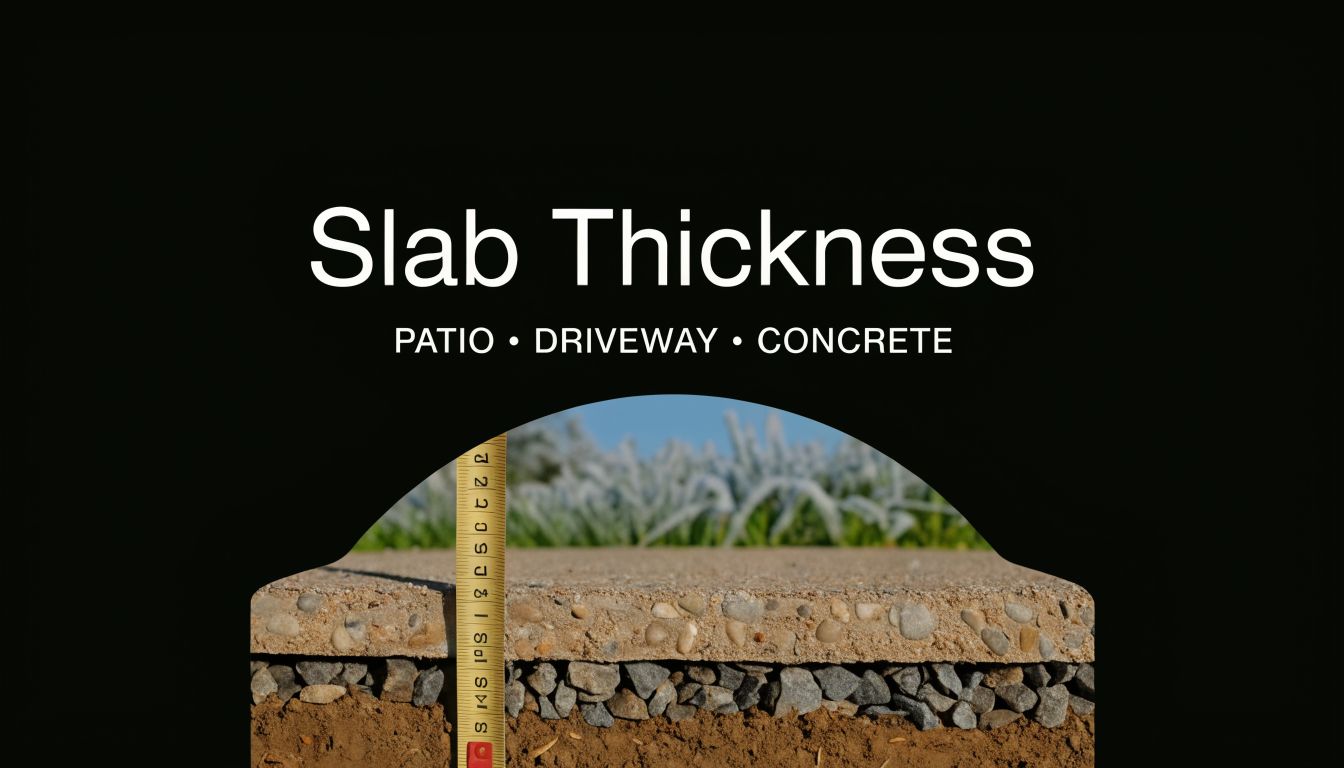
A 4-inch concrete patio slab is the standard for most residential patios, and in many backyards that’s the right answer. But it’s only the starting point, because in Pennsylvania, Maryland, Delaware, and New Jersey, soil movement, freeze-thaw weather, drainage, and what you plan to put on the slab all matter.
A lot of homeowners start with the same question: how thick should a patio concrete slab be if they want it to last, not just look good on pour day. That’s the right question. A patio can look perfect the first week and still fail early if the base is weak, the slab is too thin for the load, or the ground underneath shifts through the seasons.
That matters whether you’re planning a simple backyard sitting area, a gazebo foundation, a base for storage shed, or a slab that ties into larger concrete foundations work around the property. The slab thickness is never just about concrete. It’s about the entire system under and inside it.
Planning Your Perfect Patio The First Questions to Ask
Most patio problems start before the truck arrives. Homeowners often focus on finish color, shape, border detail, or where the grill will go. The smarter place to start is with use, site conditions, and what the slab has to carry for years.
If you’re planning a patio in PA, MD, DE, or NJ, ask the practical questions first. Is this space only for chairs and a table, or will it support a fire feature, outdoor kitchen, playset nearby, or a future structure? Is the yard dry and stable, or does it stay soft after rain? Has that area ever held water, settled, or heaved in winter?
Start with use, not appearance
The thickness decision gets easier when you think in terms of real use.
- Everyday patio use means foot traffic, patio furniture, and a grill.
- Structure support changes the conversation if the slab will serve as a shed foundation, gazebo foundation, or support area near other foundation builds.
- Heavy concentrated weight matters if you’re planning stone features, built-ins, or equipment storage.
A lot of homeowners also compare surface options before they decide on the slab itself. If you’re thinking beyond plain broom-finished concrete, this guide to the Original Mission Tile outdoor collection is a useful design reference because it shows how surface materials affect the finished look, while the slab underneath still has to do the structural work.
A patio surface is the part you see. The slab system is the part that decides whether you enjoy it or repair it.
Know what your site is asking for
A patio in the Mid-Atlantic has to deal with more than summer use. Ground conditions can change from season to season. Clay-heavy soil, poor drainage, and frost action create stress that generic online advice often ignores.
Before any concrete contractor gives a thickness recommendation, they should be looking at:
- The intended load on the slab now and later.
- The soil condition after excavation.
- Drainage across the site and away from the house.
- Whether the patio will support anything permanent besides people and furniture.
That same mindset applies if you’re searching for shed foundations contractors near me, garage foundation contractors near me, or excavation near me. Good slab work starts with the site, not the finish trowel.
The 4-Inch Rule Why It's the Standard for Most Concrete Patios
A homeowner in Pennsylvania or New Jersey might hear “4 inches” from three different contractors and assume it’s just a stock answer. In practice, it became the standard because it fits how most residential patios are used and priced. For everyday backyard use, 4 inches gives a patio enough body to hold up under foot traffic, furniture, grills, and regular entertaining without adding concrete you do not need.
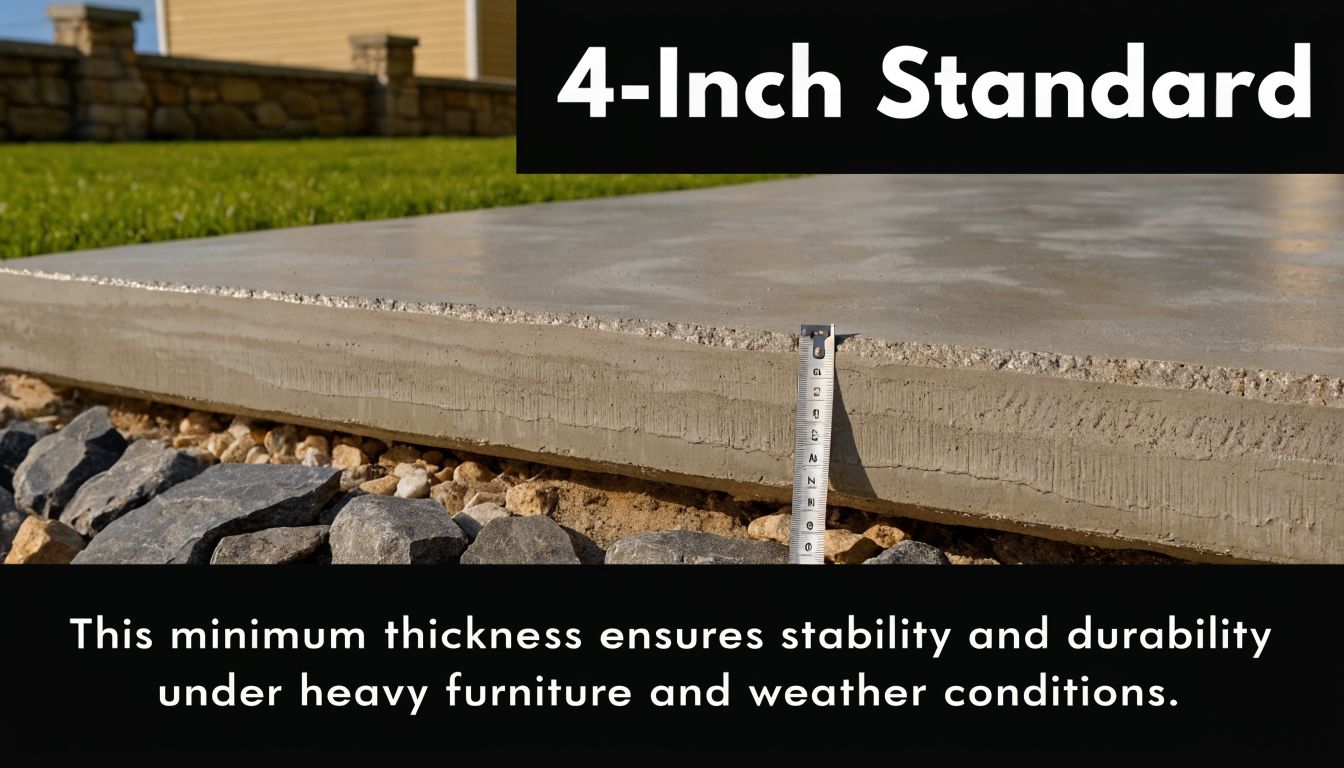
That matters in the Mid-Atlantic, where homeowners are often balancing performance against budget. In PA, MD, DE, and NJ, a patio has to live through humid summers, freeze-thaw cycles, and soils that are not always consistent from one side of the yard to the other. A 4-inch slab is usually enough for normal residential use, but only when the rest of the installation is done to match.
What a 4-inch patio slab is meant to support
A standard patio slab is built for spread-out household loads, not concentrated structural weight.
That usually means:
- Daily foot traffic
- Outdoor tables, chairs, and loungers
- Grills and common backyard equipment
- Family gatherings and normal entertaining
For that kind of use, 4 inches is a practical target because it gives the slab enough thickness to resist typical surface stress while keeping the project cost in line. Homeowners who want a straightforward overview of the build sequence can review this guide on how to build a concrete patio, but the short version is simple. Standard patio use calls for a standard patio slab, provided the site conditions support it.
Why 4 inches works, and why some 4-inch patios still fail
Thickness is only one part of the job.
I have seen 4-inch patios last for decades, and I have seen 4-inch patios crack early because the ground underneath was soft, wet, or poorly compacted. The slab dimension was not the actual problem. The installation was.
That distinction matters a lot in this region. A backyard in Delaware with sandy, better-draining soil behaves differently than a patio area in southeastern Pennsylvania or parts of Maryland where clay holds water longer. In New Jersey, one property can drain well while the next one stays wet after every storm. The same 4-inch recommendation can be right in all of those places, but the prep work and support underneath it cannot be treated as identical.
Practical rule: Four inches is the standard for a residential patio. It is not permission to cut corners on excavation, compaction, or drainage.
Where the standard makes good sense
For a basic outdoor living space, 4 inches is usually the right call. It gives homeowners a slab that is thick enough for normal use, easier to budget, and less likely to be overbuilt for the job.
It also keeps concrete volume reasonable. That has a direct effect on material cost, labor, and scheduling, especially on smaller backyard projects where the goal is a durable patio, not a structural pad for heavy features. In many Mid-Atlantic homes, that is the sweet spot. Strong enough for intended use. Sensible enough not to spend money where it does not add value.
The real takeaway for homeowners
If a contractor recommends a 4-inch patio slab, that recommendation is usually sound. The question to ask next is whether the site supports that standard.
That is where experience shows. A good contractor looks at drainage, subgrade condition, and the way the patio will be used before treating 4 inches as the final answer. In PA, MD, DE, and NJ, that extra judgment is what separates a patio that stays level from one that starts showing movement after a few winters.
What Lies Beneath The Critical Role of Base and Reinforcement
A patio usually fails from the bottom first.
In PA, MD, DE, and NJ, I see the same pattern over and over. The finish may look clean on pour day, but if the soil stays wet, the base is thin, or the reinforcement is sitting in the dirt instead of the slab, cracks and movement show up after a few hard seasons. Homeowners often blame the concrete. The actual problem started underneath it.
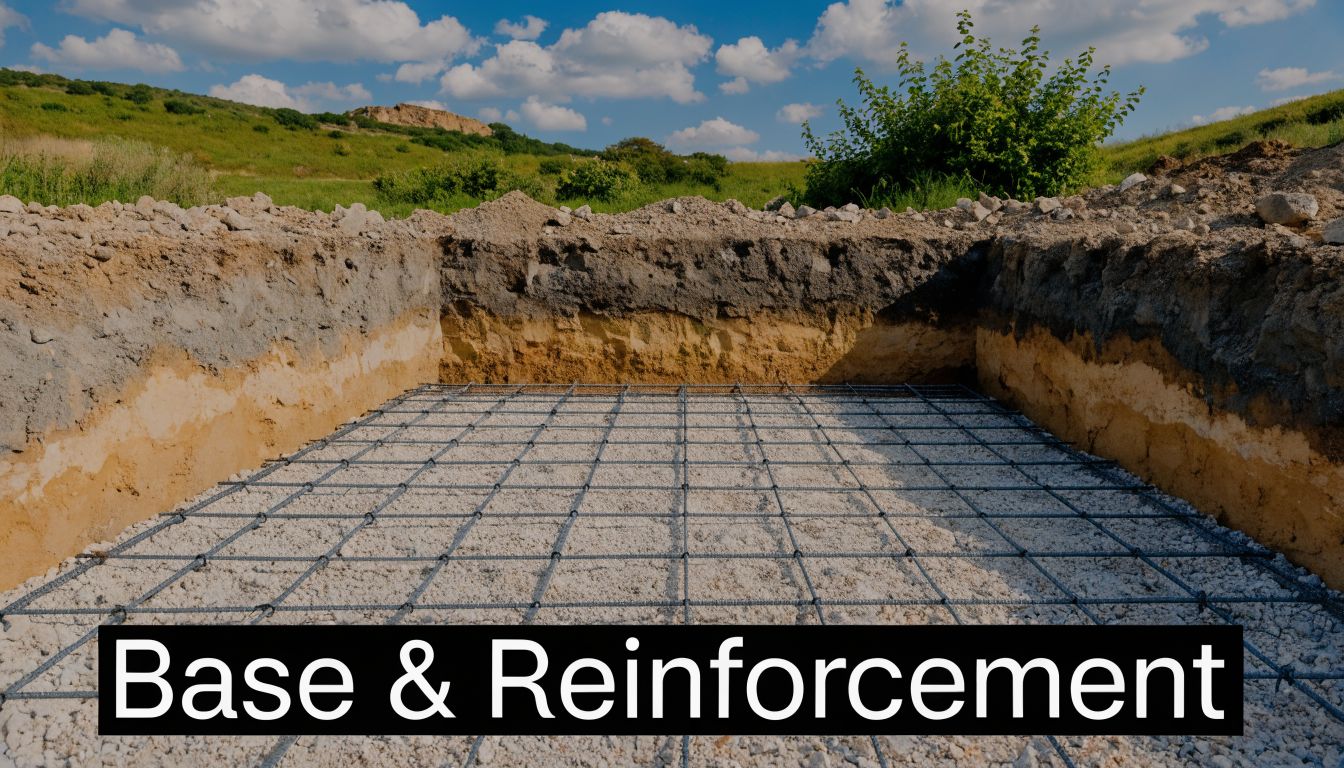
The base supports the slab and manages water
A patio slab needs a compacted, drainable layer under it so the concrete has uniform support. In the Mid-Atlantic, that matters even more because many yards have clay-heavy soil, mixed fill near newer construction, or spots that stay soft after rain. A good gravel base helps the slab hold its plane instead of settling in sections.
That base does four jobs at once:
- Spreads weight evenly across the subgrade
- Helps water move out instead of staying trapped under the slab
- Reduces settlement over softer pockets
- Keeps slab thickness more consistent during the pour
If those conditions are ignored, the slab starts carrying stress unevenly. That is when corners break down, edges crack, and one panel sits higher than the next after winter.
Reinforcement controls cracks. It does not fix weak prep.
Concrete will crack. The goal is to control where and how that happens, and to keep small cracks from turning into wider movement. Reinforcement helps with that job, especially in a region where the slab sees wet springs, summer heat, and freeze-thaw cycles in the same year.
For a standard residential patio, contractors typically use welded wire mesh or rebar based on the size of the slab, joint layout, site conditions, and expected use. The material matters, but placement matters just as much. If mesh is left at the bottom, it does very little. If rebar is poorly spaced or not supported at the right height, the slab loses much of the benefit you paid for.
I tell homeowners to focus on three questions:
- Was the soil excavated to stable material
- Was the stone compacted in lifts
- Will the reinforcement sit in the slab where it can work
Those answers usually tell you more about long-term performance than the finish texture on top.
Mesh or rebar depends on the patio and the site
Wire mesh is common on basic patio pours because it helps limit shrinkage cracking across a broad area. Rebar gives a contractor more control when the slab shape is irregular, the panels are larger, or the ground conditions are less predictable. On Mid-Atlantic jobs with questionable subgrade, wet areas, or added features near the slab edge, many contractors prefer rebar because it holds its position better and gives more reliable support.
That does not mean every backyard patio needs heavy steel. It means the reinforcement choice should match the site instead of being picked from habit.
If you want a practical overview of the full build sequence, this guide on how to build a concrete patio shows how excavation, base prep, reinforcement, forms, and finishing fit together. Homeowners comparing surface options may also benefit from understanding porcelain pavers, especially if they are weighing a slab against a different patio system.
Why Mid-Atlantic prep standards need closer attention
The generic advice online usually stops at slab thickness. It rarely accounts for what happens in a Yardley clay lot, a South Jersey property with changing moisture, or a Maryland backyard where runoff from a slope keeps one side of the patio wet. Those local conditions change how much support the slab needs and how carefully the base has to be built.
A patio is a layered system. Excavation sets the depth. The base handles support and drainage. Reinforcement helps control cracking. The concrete only performs as well as those layers allow.
For homeowners looking at patios, shed pads, garage slabs, or other flatwork, the lesson is simple. The hidden work below grade decides whether the surface above stays level and serviceable.
A short visual can make that easier to understand:
When to Pour a Thicker Concrete Slab for Patios and Sheds
A 4-inch slab is standard for everyday patio use, but some projects need more depth from the beginning. If the slab will carry concentrated weight or support a structure, thicker concrete isn’t overkill. It’s the correct specification.
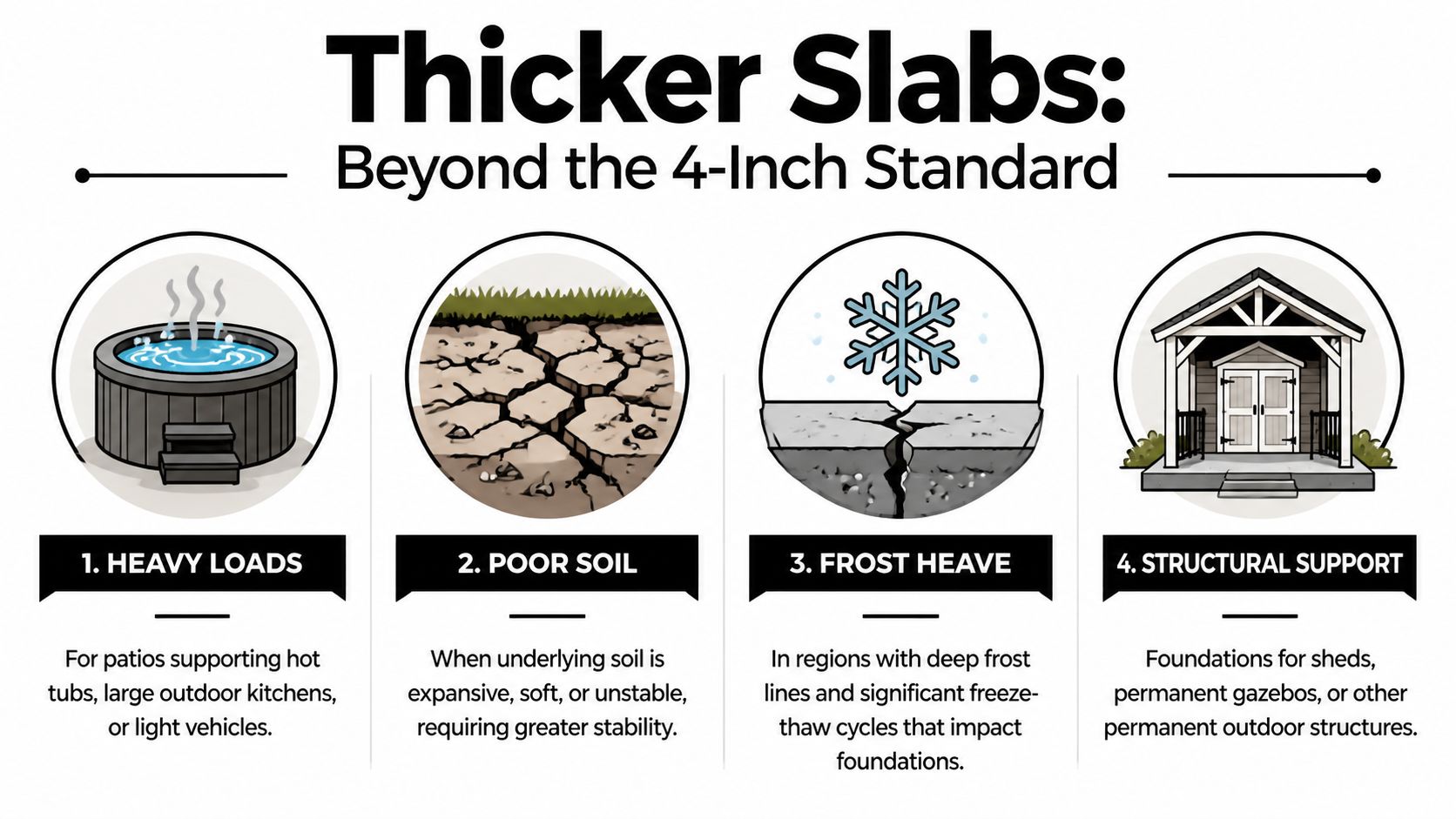
A 6-inch thick slab is recommended for patios supporting moderate to heavy loads like outdoor kitchens or hot tubs with up to 5,000 to 10,000 pound point loads, and that thicker slab delivers 50 to 75 percent higher flexural capacity with better resistance to punching shear under concentrated weight, according to Lapis Patios’ slab thickness article. That same guidance notes that #4 rebar is essential in those heavier-duty applications.
If your patio use changes, the thickness should change too
Many homeowners make a common mistake. They think “patio” means one category. It doesn’t.
A patio used for chairs and a grill is one thing. A slab supporting an outdoor kitchen, a large fire feature, or a hot tub is doing a very different job. The same goes for a shed foundation, a base for storage shed, or a slab under a permanent gazebo.
A slab should be sized for the heaviest realistic use, not the lightest current use.
Common thickness decisions by intended use
| Intended Use | Recommended Thickness | Base Requirement | Reinforcement |
|---|---|---|---|
| Standard residential patio | 4 inches | Compacted gravel base | Wire mesh or #3 rebar depending on design |
| Patio with heavier built-in features | 6 inches | Stable, well-prepared base suited to site conditions | #4 rebar |
| Hot tub or outdoor kitchen area | 6 inches | Heavier-duty base preparation | #4 rebar |
| Shed or permanent gazebo support slab | Often thicker than a basic patio, depending on structure and site | Site-specific base prep | Reinforcement matched to load |
That table is a field guide, not a substitute for site review. The intended use and the ground conditions still need to agree with each other.
Four situations where thicker is the safer choice
- Heavy concentrated loads matter most with hot tubs, outdoor kitchens, masonry islands, or equipment.
- Permanent structures such as a barn shed, gazebo, or larger prefab building can require more than a simple patio slab.
- Poor or active soil can justify a stronger slab section because the ground is less predictable.
- Future use changes should be considered now. A plain patio today can become a support area later.
Homeowners comparing hardscape finishes sometimes also look at alternatives like pavers. If that’s part of your planning, this guide on understanding porcelain pavers is helpful for comparing surface options, though the support requirements underneath still need to match the load and site conditions.
If cracking is one of your biggest concerns, this practical article on how to prevent concrete slab from cracking is worth reviewing before finalizing your slab design.
The Mid-Atlantic Difference Why Soil and Frost Matter in PA MD DE and NJ
National patio advice often gives a standard thickness and stops there. That’s where Mid-Atlantic homeowners can get bad guidance. A patio in this region has to deal with seasonal moisture swings, soil variability, and winter ground movement that can punish shortcuts.

A key gap in generic advice is that it offers minimal practical guidance on regional soil conditions and freeze-thaw cycles, and it often doesn’t address how local soil composition or specific frost depth in Pennsylvania, Maryland, Delaware, and New Jersey should inform slab design, as noted in this discussion of the Mid-Atlantic guidance gap.
Why generic slab advice misses the real problem
The slab thickness number gets all the attention, but in this region, movement under the slab is often the actual issue.
A backyard in Pennsylvania may deal with more winter stress than a sheltered southern Maryland site. A Delaware property with drainage issues behaves differently than a compact, well-drained New Jersey lot. Clay-heavy ground can swell and shrink. Wet subgrades can soften. Frost can lift one section more than another.
That means the question isn’t only “how thick should a patio concrete slab be.” It’s also:
- What kind of soil is under it
- How water moves through the site
- Whether frost action is likely to affect the area
- Whether the slab will tie into other structures or stand alone
What local homeowners should watch for
When a slab fails in the Mid-Atlantic, the warning signs usually show up in familiar ways. Corners lift. Sections settle. Cracks open where drainage was poor or support was uneven. Edges break down first.
These conditions deserve extra attention if your property has:
- Clay-heavy or slow-draining soil
- Low spots that stay wet
- Evidence of past movement
- Planned structures such as a shed, garage slab, or playset support pad
That’s why local knowledge matters for homeowners searching for shed foundations near me, cement foundations for garage, or house foundation prep work. A slab spec copied from a national blog won’t tell you how your specific lot behaves through winter and spring.
Good patio work in PA, MD, DE, and NJ starts with reading the ground correctly, not just ordering concrete.
The Smart Investment Why a Proper Foundation Saves You Money
A patio usually looks expensive on pour day. The expensive part often comes two or three winters later, after settling, heaving, or cracking forces a partial replacement.
In PA, MD, DE, and NJ, I see the same pattern. Homeowners try to save money by trimming base work, skipping reinforcement, or treating slab thickness like the only decision that matters. Then spring moisture, freeze and thaw cycles, and soft pockets under the slab expose every shortcut.
Reinforcement is a good example. It is not a decorative upgrade. It is part of the system that helps concrete handle shrinkage, movement, and day-to-day use. Angi’s overview of patio slab thickness also points out that reinforcement can make a major difference in how a slab performs under load.
The main cost problem is replacement work.
Once a slab fails, the bill usually reaches far beyond the concrete itself. Demolition, hauling debris out, correcting the base, repouring, and repairing disturbed grass, edging, or walkways add up fast. On tight Mid-Atlantic lots, access can make that even more expensive because crews may need smaller equipment or extra labor to get in and out without tearing up the yard.
That is why good prep usually saves more than it costs. A slab built for the actual use of the space holds up better and asks for fewer repairs over time. That matters whether the project is a patio, a concrete foundation for garage, a 4×8 shed with foundation, or a pad for a heavier prefab structure.
The value usually comes from a few plain decisions made early:
- Use the slab thickness that fits the job
- Excavate to stable material
- Install and compact the right base
- Add reinforcement where the application calls for it
- Control water so the slab is not sitting on a wet, unstable subgrade
For homeowners in this region, that last point is often where money is won or lost. A well-finished patio on weak prep can still move. A plain-looking slab with solid support underneath usually lasts longer.
Building it right the first time costs less than tearing it out and doing it over after a few Mid-Atlantic winters.
The smart investment is not oversizing every patio. It is matching the slab and foundation work to the site, the load, and the local conditions before the concrete truck arrives.
From Quote to Completion The Firm Foundations Process
Choosing a contractor for a patio or foundation job often feels harder than choosing the slab itself. Homeowners want clear answers, a realistic scope, and no surprises once excavation starts.
At Firm Foundations, the process starts with the intended use of the slab and the actual conditions on the site. A patio, shed foundation, garage foundation, or gravel shed foundation may look similar from a distance, but each one asks something different from excavation, base prep, and concrete design.
What the process looks like
The work typically follows a straightforward path:
Quote and site discussion
The first step is understanding the project goals, access, grade, drainage, and what the slab will support.Excavation and preparation
The crew removes the necessary material, establishes grade, and prepares the site for a stable base.Base and forms
The base is built for support and drainage, then concrete forms are set to create clean layout lines and proper dimensions.Reinforcement and pour
Reinforcement is placed according to the job requirements, then the slab is poured and finished to spec.Final review and curing guidance
Homeowners know what to expect after the pour and how to protect the new slab while it cures.
Why builders rely on specialist foundation crews
This kind of work matters for more than patios. The same process discipline is what homeowners and builders look for when they need garage footings and foundations, concrete foundations, or a base for storage shed that won’t shift out of level.
Firm Foundations has built its reputation in that space since 2011, and the company is also trusted by shed builders including Stoltzfus Structures and Sheds Unlimited, based on the publisher information provided for this article. That kind of partnership usually comes from consistency. Builders need slabs and pads installed to spec, on grade, and ready for the structure that follows.
For homeowners, the benefit is simple. You want a crew that understands the difference between a decorative concrete job and a structural support system.
Frequently Asked Questions About Concrete Foundations
Is 4 inches enough for every patio?
No. 4 inches is the standard for many residential patios used for foot traffic, furniture, and grills, but it isn’t the right answer for every site or every load. If you’re planning permanent structures, heavier built-ins, or concentrated weight, the slab may need to be thicker.
Does a patio need gravel underneath?
Yes, in practical construction terms, a patio slab needs a properly prepared base. Concrete performs better when it sits on compacted, stable support rather than loose or inconsistent ground. That’s especially important in areas with drainage issues, soft spots, or seasonal ground movement.
Is wire mesh enough, or do I need rebar?
It depends on the slab design and intended use. Standard patio pours may use wire mesh or rebar, while heavier-duty slabs often call for stronger reinforcement. The right question isn’t which material sounds stronger. It’s which one fits the slab thickness, load, and site conditions.
Should a shed sit on the same kind of slab as a patio?
Not always. A shed foundation may need different design choices than a simple sitting patio, especially if the structure is larger, enclosed, or storing heavy items. Some projects are better served by gravel pads, while others call for concrete.
What if I may add a hot tub or outdoor kitchen later?
Plan for that now if it’s a real possibility. It’s much easier to pour the right slab the first time than to wish the patio had been thicker after the build-out starts.
Can a contractor just pour over existing ground if it looks firm?
That’s a risky shortcut. Ground can look stable at the surface and still move, trap moisture, or settle unevenly later. Proper excavation and compaction are part of what makes the slab reliable.
Do local conditions really make that much difference?
Yes. In PA, MD, DE, and NJ, local soil and weather can change how a slab performs over time. The same patio design won’t behave the same way on every property.
Is a patio slab the same thing as a garage slab?
No. A patio is generally designed for lighter use. A concrete foundation for garage or other structural slab has different support demands and should be designed accordingly.
If you’re planning a patio, shed pad, gazebo foundation, garage slab, or excavation project in Pennsylvania, Maryland, Delaware, or New Jersey, Firm Foundations can help you choose the right approach for your property. From compacted gravel pads to reinforced concrete foundations, the team builds for drainage, stability, and long-term performance so you can get a clear quote and a slab that matches the way you’ll use it.