
Concrete Foundation Contractors in Honey Brook, PA
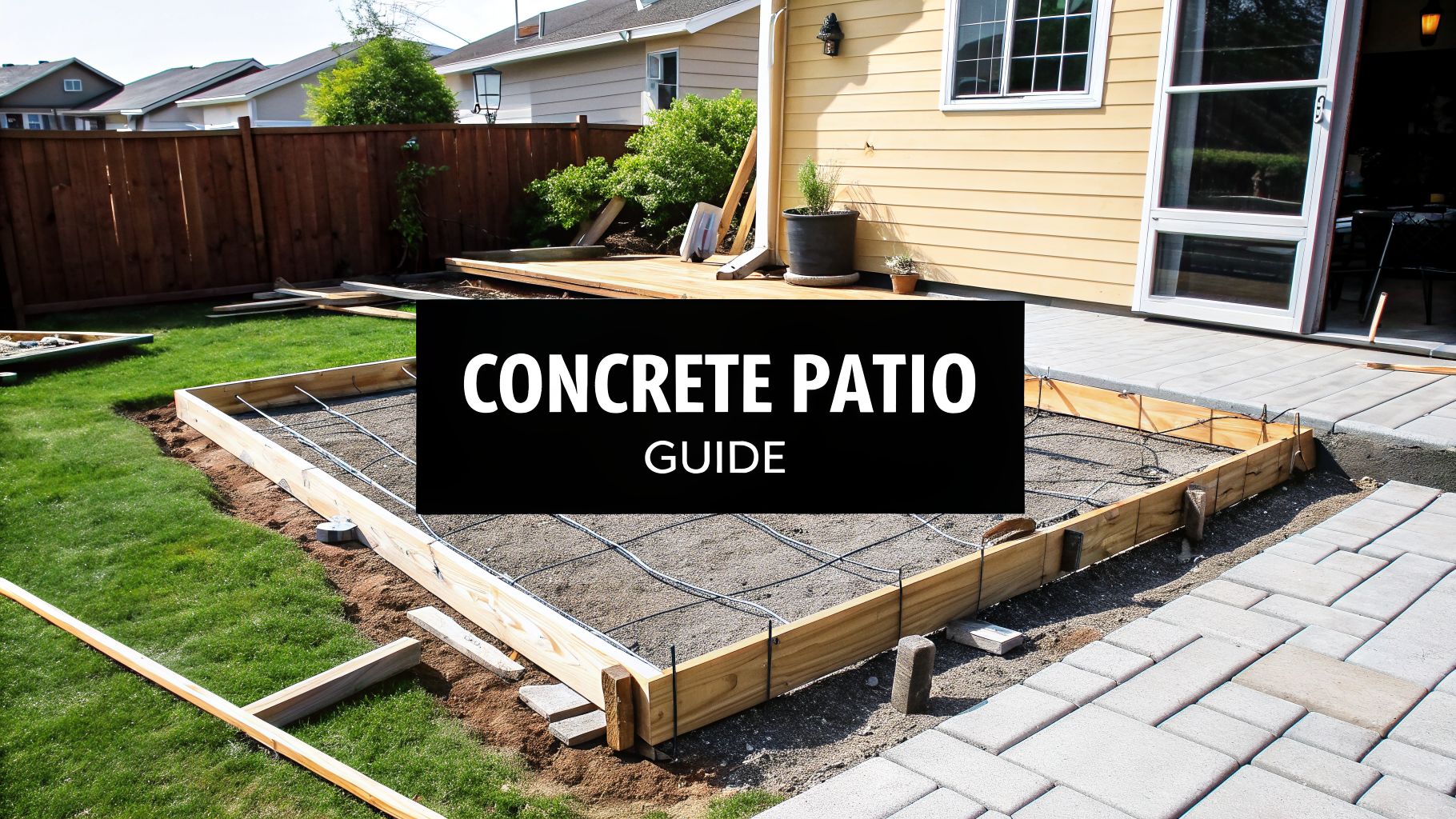
Thinking about a new concrete patio for your home in Honey Brook? It’s a fantastic way to create a durable, stylish space for everything from summer cookouts to quiet evenings outdoors. But turning that vision into a reality that lasts for decades takes more than just a bag of cement. As your local concrete and foundation experts, Firm Foundations is here to guide you through the process, ensuring your project is built right from the start.
Your Local Guide to a Perfect Concrete Patio
For homeowners in the demanding climates of Pennsylvania, Maryland, Delaware, and New Jersey, a concrete patio is a sound decision. It holds up far better than a wood deck that needs constant staining or pavers that shift and sprout weeds. A properly poured concrete slab provides a clean, solid foundation for your grill, patio furniture, and years of family memories.
The demand for quality outdoor living spaces is on the rise, and as your trusted local construction company, we've seen firsthand why concrete is a popular choice. It’s a serious upgrade to a property's value and daily usability, whether it's for a home, a commercial business, or a base for a storage shed.
The US Concrete Contractors market has seen a 4.3% CAGR from 2021 to 2026. This growth isn't surprising—it reflects how many homeowners are investing in concrete for its long-term performance and reliability. You can see more data on the concrete industry's growth on IBISWorld.com.
Why a Concrete Patio is a Smart Choice for Your Property
A well-constructed concrete patio, gazebo foundation, or barn shed base is a core feature of your landscape. Here are the key reasons so many homeowners in our Honey Brook community opt for concrete foundations:
- Durability and Longevity: Concrete is tough. It can handle the hot, humid Maryland summers and the freeze-thaw cycles of a Pennsylvania winter. A professionally installed slab from Firm Foundations will serve you well for decades.
- Low Maintenance: Say goodbye to annual sealing and replacing warped boards. Keeping your concrete patio looking sharp usually just requires a good sweeping and an occasional power wash.
- Design Flexibility: Forget plain, gray slabs. Modern concrete can be stamped, stained, or colored to mimic the appearance of high-end materials like natural stone, brick, or even wood.
- Cost-Effectiveness: When you compare it to other premium materials like flagstone or imported pavers, concrete delivers a similar high-end look at a much more accessible price point.
While a small, simple slab might seem like a manageable DIY project, it involves serious physical labor, exacting measurements, and a solid understanding of drainage, sub-base preparation, and how concrete behaves. Getting any of these steps wrong can lead to ugly cracks, a pooling surface, or even water issues around your home's foundation. For some great design concepts, check out these 3 Patio Ideas that can transform your outdoor space.
This guide will walk you through the critical steps. However, to ensure your investment is built with true craftsmanship and longevity, partnering with an experienced local professional like Firm Foundations is always the safest bet. We are the shed foundations contractors near you who make sure the job is done right, avoiding common pitfalls and delivering a patio you'll be proud of for years to come.
Planning Your Patio for Long-Term Success
A beautiful, long-lasting concrete patio doesn't just happen. The real work begins long before our team mixes a single bag of cement. In our experience serving the Honey Brook community, success is built on careful planning—this is the phase where we help you make the decisions that prevent headaches and ensure your new outdoor space will be a family favorite for years to come.
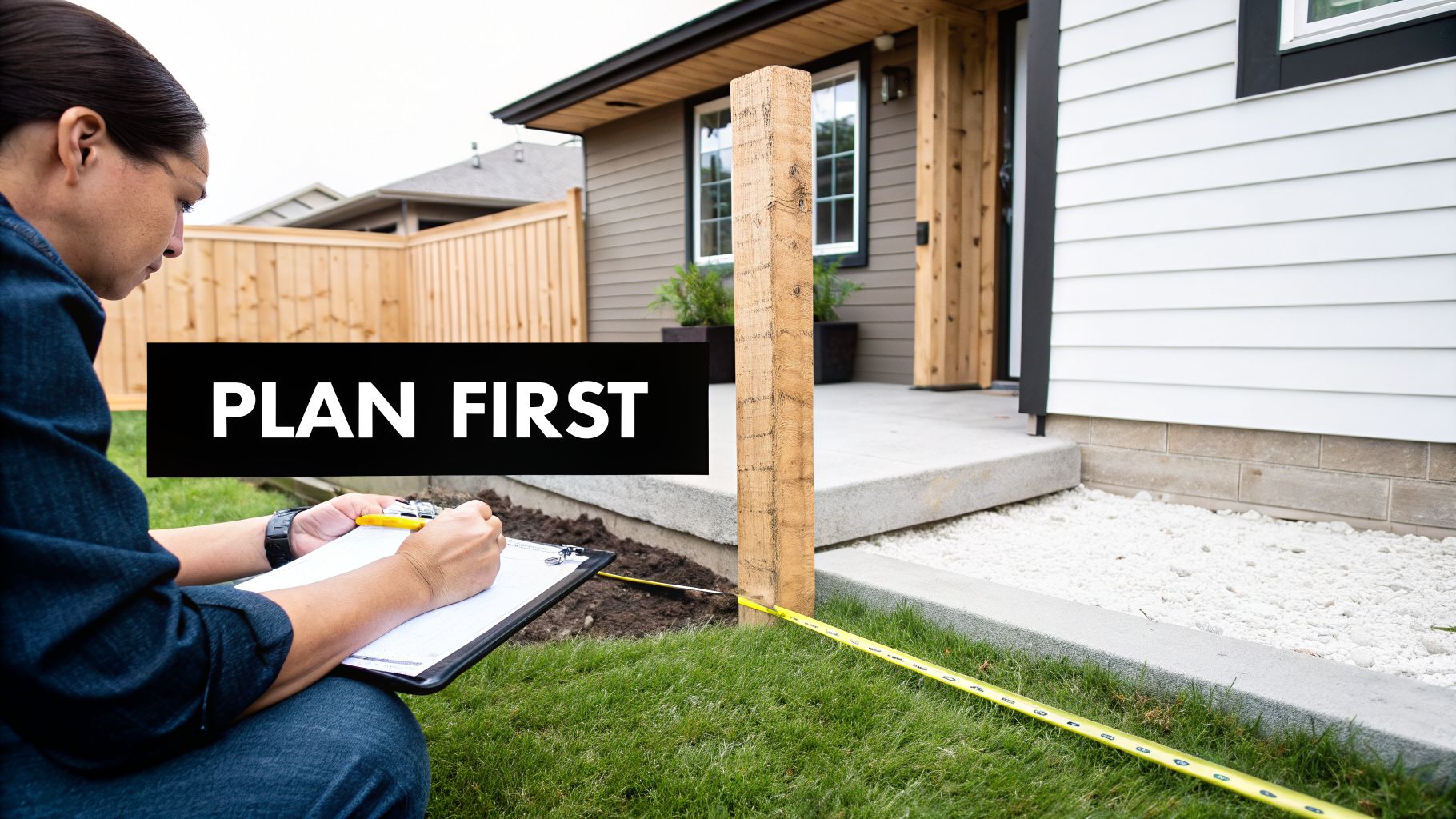
First thing's first: where should it go? We'll help you think about how you’ll actually use the space. Are you picturing a sunny spot for lounging or a shaded area for summer dinners? We also consider privacy from the neighbors and how the patio connects to your house. A patio that flows right off the kitchen or living room door will get a lot more use than one tucked away in a far corner of the yard.
Checking Local Codes and Preparing the Site
Before we grab a shovel, we do our homework. Most towns and townships in our service areas—from Honey Brook, PA, across Maryland and into New Jersey—have specific rules for projects like this, and we're familiar with them.
We'll handle the key details:
- Setback requirements: We ensure your patio is the proper distance from your property lines.
- Permit needs: Larger patios, or those you plan to add a roof to later, often require a building permit, which we can help manage.
- Utility lines: We absolutely call 811 before we dig. It’s a free service that marks all underground utility lines, a non-negotiable safety step for any foundation builds.
Once we’re clear on the local rules, our team marks out your patio's footprint using professional tools to create a tight, accurate perimeter. We ensure every corner is perfectly square, setting the stage for a flawless installation.
The Importance of Proper Excavation
Digging out the area for your patio is more than just clearing space; we're building the very foundation for your new concrete foundation. For a typical patio, we plan on digging down about 8 inches from the final surface height. This gives us room for a solid 4-inch compacted gravel base and the 4-inch concrete slab itself.
As professionals, we understand the logistics of excavation. A small 200 sq. ft. patio excavated 8 inches deep creates nearly 5 cubic yards of soil. Firm Foundations handles all the digging and removal, so you don't have to worry about what to do with all that dirt.
As the go-to experts for excavation near me, we know the ground under the patio is just as important as the part you see. If you have soft, loamy topsoil, we may need to dig even deeper to hit solid, stable subsoil, ensuring your investment is secure.
This is also our one chance to get the drainage right. Your patio must have a slight, consistent slope away from your house. The standard is a 1/4 inch of drop for every foot of length. It's an angle you'll barely notice, but it's essential for guiding rainwater away from your home’s foundation and preventing serious water damage. Getting this wrong can lead to puddles on your patio or, much worse, water flowing straight into your basement. We guarantee it’s done right.
Planning your budget is just as vital as planning the build itself. For a detailed breakdown, check out our guide on concrete patio slab costs.
Laying a Solid Foundation and Setting the Forms
Once we've finished the initial excavation, our team moves into what is arguably the most critical phase of the entire project. The long-term durability of your concrete patio hinges entirely on the quality of the base we build for it. As your local garage foundation contractors, we know a poorly prepared base is the number one reason for slabs cracking, heaving, or sinking over time.
The secret to a patio that stands the test of time is a stable, unmoving base. This layer serves as a crucial buffer between the concrete and the native soil, which naturally expands and contracts. This is especially true with the freeze-thaw cycles we constantly deal with in Pennsylvania, Maryland, Delaware, and New Jersey.
Creating the Perfect Sub-Base
Our first task is to lay down a sub-base of gravel. We always recommend using 3/4-inch clean stone. Unlike other materials that can trap moisture, clean stone allows water to drain freely away from the underside of your slab—a crucial detail for any shed foundation gravel base.
We begin by spreading the gravel to achieve a uniform depth of at least 4 inches throughout the excavated area. We build this up in 2-inch lifts, or layers, rather than dumping it all in at once.
A common DIY mistake is simply raking the gravel level. To prevent settling down the road, our crews use a professional-grade plate compactor to achieve proper density. This is a non-negotiable step for us.
For each 2-inch layer, we make several passes with the compactor over the entire area. You can physically see the gravel lock together and settle. A correctly compacted base feels solid underfoot, with no stones shifting as you walk on it. This is the quality you get when you hire trusted gravel shed foundation contractors near me.
Essential Materials and Tools for Your Concrete Patio Project
| Category | Item | Pro Tip |
|---|---|---|
| Base Material | 3/4-Inch Clean Stone | We avoid "crusher run" as the fine particles hold moisture, which can lead to frost heave. |
| Equipment | Plate Compactor | Our team uses this on every job. Compacting in 2-inch lifts is essential for a stable base. |
| Forming | 2×4 Lumber | For a standard 4-inch slab. We use 2x6s for thicker slabs like a concrete foundation for garage or heavy structures. |
| Fasteners | 3-Inch Deck Screws | Screws hold better than nails and allow for precise adjustments to the forms. |
| Bracing | Wooden Stakes | We place stakes every 2-3 feet along the outside of the forms to prevent bowing from the weight of the concrete. |
| Measurement | 4-Foot Level & Tape Measure | Critical for ensuring your forms are level, square, and sloped correctly for drainage. |
Having every tool and material ready before we start is how our process remains efficient, preventing costly errors and delays for our clients.
Building and Bracing Your Concrete Forms
With a solid base in place, it’s time to construct the concrete forms. This wooden frame contains the wet concrete and dictates the final shape of your patio. For a typical 4-inch thick patio, we use standard 2×4 lumber.
We assemble the frame directly on the compacted gravel, with the primary goal of creating a perfectly square and level box.
- Measure and Cut: Our team precisely cuts the lumber to the patio's exact outside dimensions.
- Assemble the Frame: We screw the corners together to build the frame.
- Square the Corners: We use the professional diagonal measurement method. By measuring corner to corner, we ensure the two measurements are identical, guaranteeing the form is perfectly square.
- Level the Form: Using a 4-foot level, we make sure the top edges are level all the way around, making minor adjustments for a perfect setup.
Now, we build in that crucial slope for drainage. After leveling the form, we simply lower the side that's furthest from your home by 1/4 inch for every foot of width. This slight, almost imperceptible pitch is all you need to ensure water runs off properly.
Securing the Forms for the Pour
Wet concrete is incredibly heavy and exerts tremendous pressure on the forms. Without proper bracing, the forms will bow outward, resulting in a wavy, unprofessional edge.
We drive wooden stakes into the ground every 2-3 feet along the exterior of the frame and securely screw them into the 2x4s. This reinforcement is what ensures your cement foundation for garage or patio will hold its shape when the concrete is poured.
This stage is all about precision. A form that is out-of-square, improperly leveled, or poorly braced can undermine all the hard work. It's one of the main reasons so many homeowners in Honey Brook trust a professional concrete contractor like Firm Foundations. For a more detailed look at the groundwork involved, feel free to review our guide on site preparation for a concrete slab.
Pouring and Finishing Your Concrete Slab
This is where all our prep work pays off. Once your forms are secure and your base is solid, it's time for the concrete. Make no mistake, our team works like a well-oiled machine. From the moment that concrete truck rumbles up your driveway, the clock is ticking, and we are ready to move.
Before we even schedule the delivery, we ensure everything is prepared. For a patio of any real size, a ready-mix truck is the only way to go. It guarantees our clients get a consistent, strong mix without the inconsistencies of on-site mixing.
Reinforcement Is Not Optional
At Firm Foundations, we can't stress this enough: reinforcement is what separates a patio that lasts for decades from one that cracks in a few years. Concrete is incredibly strong under compression, but it’s weak when pulled or bent. Reinforcement gives it that missing tensile strength.
You’ve got a couple of choices here, and we help you pick the right one:
- Wire Mesh: This is a steel grid that works well for standard residential patios and a base for storage shed projects. We lay it out across the entire area before we pour.
- Steel Rebar: If you’re planning for a thicker slab or something heavy like a hot tub, we build a grid of steel rebar. We tie the steel bars together and prop it up on "chairs" so it sits right in the middle of the concrete's thickness, where it does the most good. This is essential for robust garage footings and foundations.
This is your single best defense against the ugly shrinkage cracks that often ruin DIY projects, especially with the freeze-thaw cycles we get here in Pennsylvania.
The Pour Itself
When the ready-mix truck from a local driveway company near me shows up, our crew and tools are staged and ready. Wheelbarrows, shovels, concrete rakes, and screed boards are all within arm's reach.
There’s a natural flow to the work, and we don't pause. We have the truck chute start placing concrete in the farthest corner of the forms. The immediate goal is to get it spread out, using shovels and rakes to push it into every corner, slightly overfilling the forms.
While one person is spreading, another is right behind them with the screed board. Resting it on the edges of the forms, we use a back-and-forth sawing motion to scrape off the excess and create a flat surface. If we see any low spots, we add more concrete and screed over it again.
The professional work we do on the base and forms is what makes this part possible.
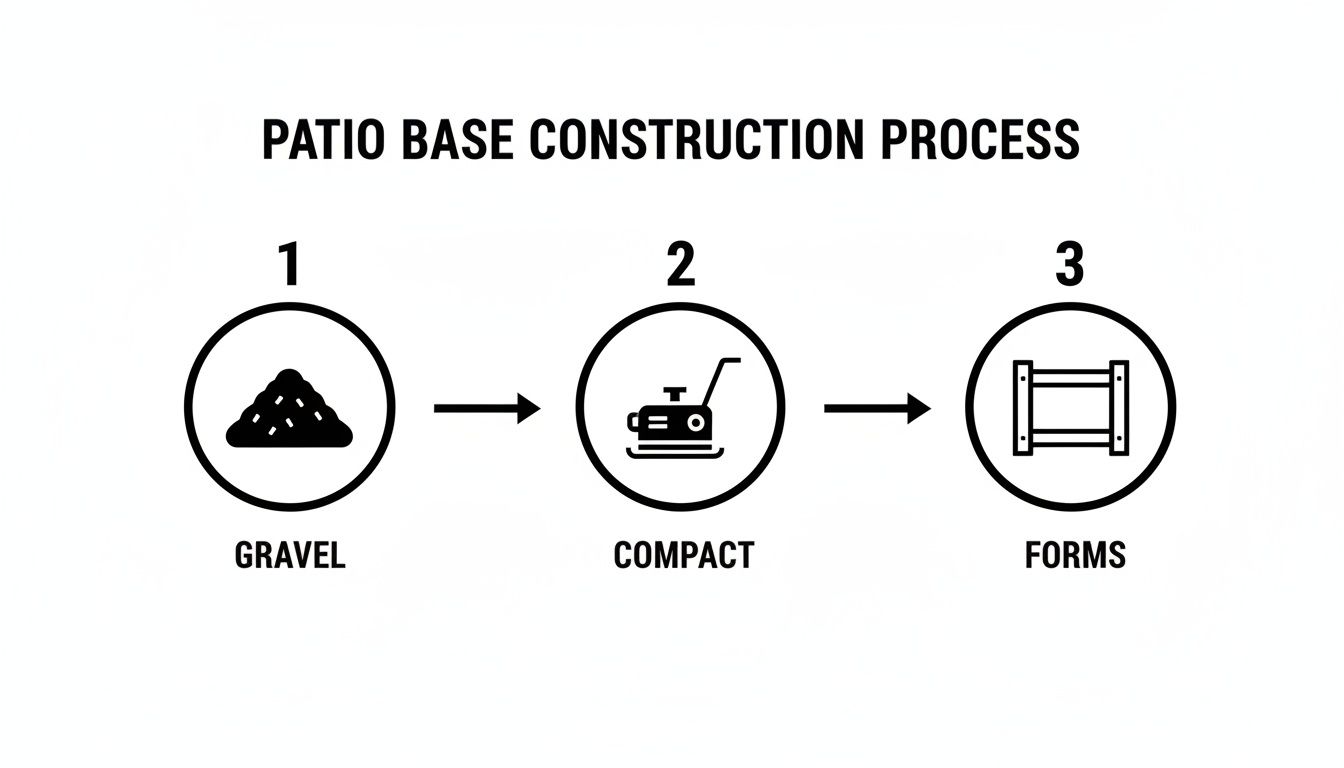
Getting this sequence of gravel, compaction, and form-setting perfect is the foundation for a successful pour.
How We Get a Professional Finish
After the slab is screeded, the real craft of finishing begins. This is what determines the final look and durability. The key is timing. We wait for the surface water—we call it "bleed water"—to completely evaporate before we touch it.
The first tool we grab is a bull float. It’s on a long handle, and we push and pull it across the slab to flatten any ridges from the screed board. It also helps push the heavy stones down just a bit, leaving a smoother, creamier surface to work with.
We let the concrete set up a bit more after that, checking until it's ready for the next step.
- Edging: We run an edging tool around the entire inside perimeter of the forms. This gives you a clean, rounded edge that’s far less likely to chip off down the road.
- Control Joints: Concrete shrinks as it cures, and it will crack. We cut control joints—shallow grooves—into the surface to tell the concrete where to crack in a nice, straight line. We typically place these every 8-10 feet.
- Broom Finish: For a patio, you don't want a slick, garage-floor finish. We take a clean push broom and gently drag it across the surface. This creates a fine-lined texture that provides excellent slip resistance, which is a must for any outdoor surface that gets wet.
These are the details we, as experienced concrete contractors, never skip. Proper base compaction can prevent a 30% failure rate within 5 years, and a simple reinforcement grid prevents the shrinkage cracks we see in many DIY jobs. In rainy states like Pennsylvania, managing water runoff with the right slope is just as critical. You can always learn more about industry tools and standards by reviewing market research like the analysis of the concrete paving equipment market at gminsights.com.
Curing and Protecting Your New Patio Investment
Many homeowners think the job is over once the concrete is smooth. However, the next week is arguably the most critical phase for ensuring your new patio has the strength and durability to last for decades. At Firm Foundations, we guide our clients through this final, crucial step.
Letting a new slab simply air dry is a common mistake that leads to a weak surface and eventual cracks.
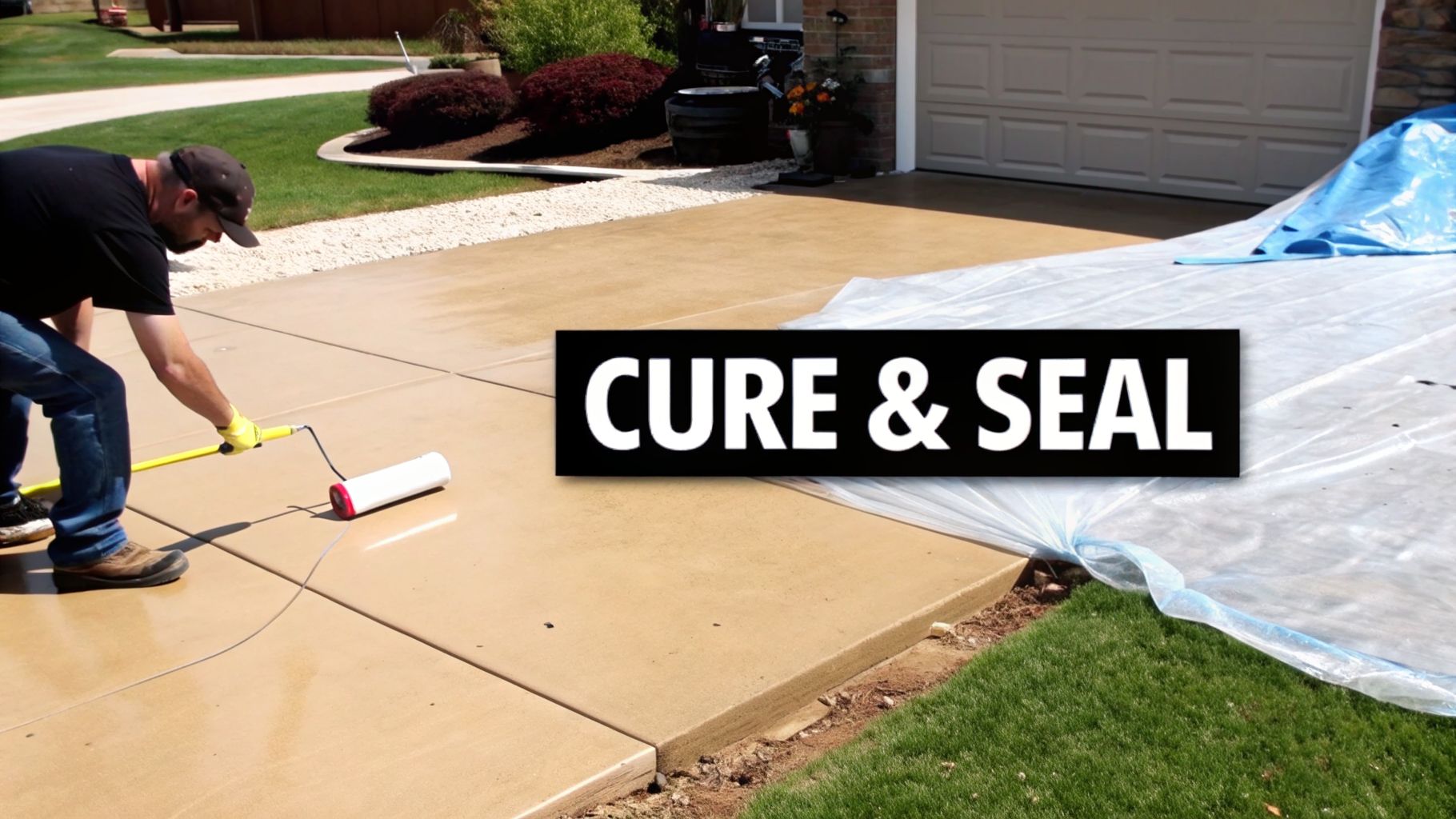
Concrete does not “dry”; it hardens through a chemical process known as hydration. For this reaction to complete successfully, consistent moisture is required. If surface water evaporates too quickly, the process is inhibited, resulting in a weaker slab prone to dusting and cracking.
The Curing Process: A Non-Negotiable Step
Proper curing involves maintaining a moist environment for the concrete for a minimum of seven days. During this period, the slab gains the majority of its compressive strength. This simple procedure offers a significant return on investment in the longevity of your house foundation or patio.
Several effective methods can be employed, and we'll advise on the best one for your project:
- Plastic Sheeting: After the surface is hard enough to walk on, cover the slab with 6-mil plastic.
- Water Misting: For the first week, lightly mist the surface with water multiple times per day.
- Curing Compounds: These are spray-applied liquids that form a membrane over the concrete, locking in moisture. Due to its efficiency, this is a popular method among professional concrete contractors.
The objective is to slow the rate of evaporation. A slab that is properly cured can be up to 50% stronger than one left to air dry. This is the single most effective action you can take to protect your investment.
Sealing Your Patio for All-Weather Protection
After the concrete has cured for at least 28 days, it is time to apply a protective sealant. In the demanding climate of Pennsylvania, Maryland, Delaware, and New Jersey, this is an essential step, not an optional one, to protect your investment.
A high-quality sealer shields your patio from multiple environmental threats. It prevents moisture intrusion, which is the primary cause of damage from freeze-thaw cycles. It also provides a protective barrier against stains from spills, grill grease, and organic matter.
We recommend reapplying a quality penetrating sealer every 3-5 years. This routine maintenance preserves the appearance of your patio and ensures the hard work invested in building your concrete patio yields lasting value.
When to Call a Professional Patio Contractor in Honey Brook
While a DIY concrete patio project can be a fulfilling endeavor, it is a significant undertaking that demands considerable labor, time, and precision. The work is physically demanding, and even minor errors can compromise the final result. Knowing when to engage a professional is a critical component of project planning.
One of the most common oversights is underestimating the sheer volume of work involved. A project can present unforeseen challenges like unstable soil or unexpected drainage problems that require an expert's eye.
When Professional Help Is the Right Call
Engaging a professional contractor like Firm Foundations is not merely about saving time and labor; it is about ensuring a high-quality, durable, and properly executed installation. We recommend consulting an expert if your project involves any of the following:
- You Need a Large or Complex Design: Projects with curves, multiple tiers, or integrated features like fire pits require a high degree of complexity.
- Your Site Has Drainage Issues: If your property has existing issues with standing water, improper grading can lead to significant water damage. As experts, we create the correct slope for proper runoff.
- You Want a Decorative Finish: Achieving a professional look with stamped concrete or custom colors requires specialized tools and techniques.
- You Lack the Time or Physical Ability: A successful concrete pour is a race against the clock that involves strenuous work. Our team handles it all efficiently.
The peace of mind that accompanies a professional installation is invaluable. A poorly executed DIY project can ultimately be more costly to repair than hiring qualified shed foundations contractors near me from the outset. We ensure every shed foundation is built to last, from sub-base to final sealing.
When providing estimates, we use advanced tools like concrete estimating software to ensure our bids and timelines are accurate and transparent. At Firm Foundations, we manage every aspect of the project across Pennsylvania, Maryland, Delaware, and New Jersey, from securing permits to the final site cleanup. We are committed to transforming your vision into a stress-free reality.
Your Top Concrete Patio Questions, Answered
Thinking about adding a concrete patio is exciting, but it’s a big project. You’ve probably got a lot of questions. As a local contractor with crews working across Honey Brook and our neighboring communities every day, we’ve heard just about all of them.
We're here to give you straightforward answers, building trust and helping you feel confident in your decision.
How Thick Should My Concrete Patio Be?
For a typical backyard patio that just needs to handle foot traffic and your average patio furniture, 4 inches is the magic number. That thickness gives you plenty of strength and durability for years of cookouts and relaxing outdoors.
But what if you're dreaming bigger? If you’re planning on adding a heavy feature like a hot tub or a full outdoor kitchen, you need more support. In those cases, we'll recommend a slab that is 5 or 6 inches thick and add a grid of steel rebar for extra muscle. That's why one of the first things our team will ask is, "What are you going to use it for?" It ensures the cement foundation for your garage or patio is built for its specific purpose.
Can I Just Pour a Concrete Patio on the Dirt?
We have to be direct with our neighbors: absolutely not. Pouring concrete directly onto bare soil is one of the fastest ways to guarantee your new patio will fail. The ground beneath your yard is constantly shifting with moisture and temperature changes.
A patio poured on dirt will inevitably crack, heave, and settle into an uneven mess. Without a proper base, there’s nothing to absorb that ground movement or give water a place to go.
This is exactly why a compacted gravel base of at least 4 inches is non-negotiable for any quality job we do. This sub-base creates the stable, level platform your patio needs. More importantly, it allows water to drain away, which is critical for surviving the freeze-thaw cycles in our region. A solid shed foundation gravel base is the real foundation of a patio that lasts.
What's a Concrete Patio Going to Cost Me Around Here?
The final price tag for a professionally installed concrete patio in the Honey Brook area really depends on a few key things: the total size, how tricky it is to get equipment to your backyard, and any decorative touches you want.
Right now, in 2026, most homeowners in the PA, MD, DE, and NJ areas can expect to pay somewhere between $15 and $25 per square foot. That price usually covers everything from start to finish—the excavation, the gravel base, all the materials and reinforcement, and a standard broom finish.
Going the DIY route can definitely save you money on labor, but be sure to tally up the cost of materials and tool rentals. The best way to get a firm number for your project is to have a local concrete contractor like us come out and give you a detailed, written estimate.
How Long Do I Have to Wait to Use My New Patio?
This is where a little patience really pays off. Even though the surface will feel hard to the touch pretty quickly, the concrete is still curing. Rushing it is a bad idea, and we'll give you clear instructions.
Here's a good timeline to follow:
- Light Foot Traffic: You can generally walk on the new slab after 24 to 48 hours.
- Placing Furniture: Hold off on setting up tables, chairs, and your grill for at least 7 full days.
- Heavy Items: For anything really heavy like a filled hot tub or large planters, you need to wait the full 28-day cure period. This gives the concrete time to reach its maximum design strength.
Ready to turn that backyard vision into a durable, professionally built reality? The expert crews at Firm Foundations specialize in building concrete patios, driveways, and the shed foundations near me that are made to last. We are your trusted, local construction company serving Honey Brook, PA, and the surrounding areas. Request your free, no-obligation quote today!