
How to Prevent Concrete Slab From Cracking A Local Guide
A new shed, garage, patio, or driveway should feel like progress. Then the worry creeps in. You’ve seen slabs with spiderweb cracks, sunken corners, or broken edges, and you don’t want your project in Pennsylvania or Maryland to head that way a few months after the pour.
That concern is reasonable. Concrete is durable, but it isn’t forgiving when crews rush the prep, add too much water, miss the joint layout, or leave the slab exposed after finishing. Cracking usually starts long before a homeowner notices it. The decisions under the slab and during the first week after the pour are what separate a clean, durable surface from one that becomes a constant repair question.
Since 2011, crews working across PA, MD, DE, and NJ have had to build for variable soils, wet seasons, and freeze-thaw weather. That matters whether you need a base for storage shed use in Honey Brook Township, a gazebo foundation, a concrete foundation for garage construction, or a reinforced slab for a barn shed. If you want to know how to prevent concrete slab from cracking, the answer is a process, not a product.
Your Investment Deserves a Flawless Foundation
Most homeowners don’t call about concrete because they’re interested in mix design. They call because they’re making a real investment. A 10×10 storage shed, a larger barn shed, a garage addition, or a new patio all depend on the same thing. The slab has to stay stable, level, and clean-looking.
The frustrating part is that cracks often get treated like bad luck. They aren’t. Random cracking usually points back to a shortcut somewhere in the chain, from excavation to curing. If topsoil stayed in place, if the base wasn’t compacted correctly, if the concrete arrived too wet, or if joints were cut late, the slab was being set up to fail before the homeowner ever parked on it or placed a shed on it.
Practical rule: Concrete performance starts below the surface. If the ground moves, the slab follows.
That’s especially true in the Mid-Atlantic. In Pennsylvania, Maryland, Delaware, and New Jersey, a slab has to deal with moisture swings, soft spots, and winter weather that punishes weak installation work. A pad for a small shed foundation and a slab for garage footings and foundations aren’t identical jobs, but they do share one requirement. The process has to be deliberate from day one.
Homeowners searching for shed foundations contractors near me, garage foundation contractors near me, or concrete contractors usually want one simple answer. Will this hold up? It can, if the crew respects the basics that too many installers skip.
A flawless slab isn’t magic. It comes from proper excavation, a stable base, the right concrete, correctly placed reinforcement, smart jointing, and patient curing. Skip one of those and the slab may still look fine on pour day. That doesn’t mean it was built right.
The Groundwork Your Concrete Foundation Depends On
Concrete doesn’t fail only because of what happens on top. It often fails because of what was left underneath. For homeowners planning a shed foundation gravel base, a cement foundation for garage use, or a new driveway in Pennsylvania or Maryland, the foundational work starts before the truck arrives.
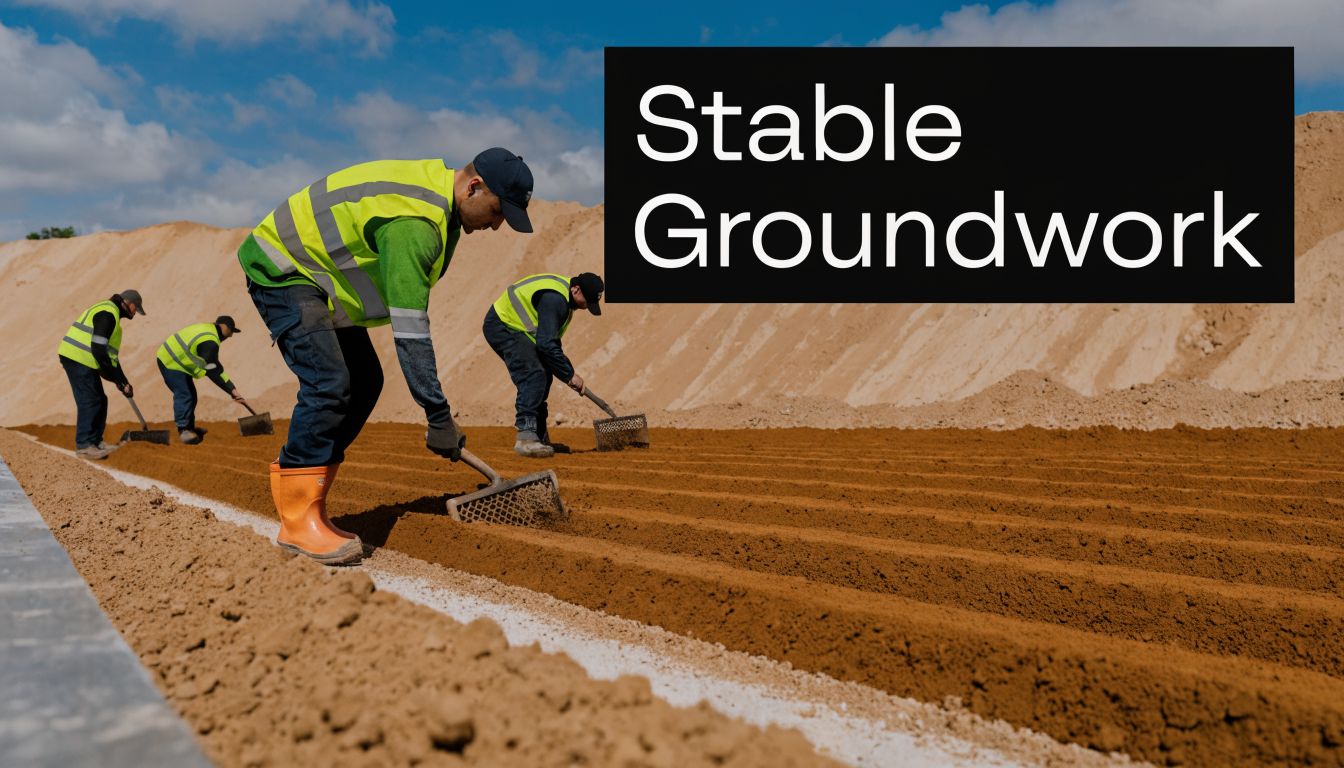
Remove what doesn’t belong
A slab should never go over topsoil, roots, buried debris, or soft organic material. Those materials break down, hold water, and create uneven support. Once one area settles more than another, the slab starts carrying stress it wasn’t meant to carry.
That’s why professional site prep starts with excavation and cleanup. The site gets stripped to a suitable subgrade, shaped for drainage, and checked for soft areas. If you’re comparing bids for excavation near me, this is one of the first places where low-price work can become expensive later.
For homeowners who want a closer look at what proper prep involves, site preparation for a concrete slab lays out the sequence in practical terms.
Compact the soil like the slab depends on it
It does.
Poor soil compaction is a leading cause of slab failure, contributing to 30-50% of settlement cracks. Professional contractors compact soil to at least 95% Proctor density and install a 4-6 inch compacted gravel base. In regions like Pennsylvania with freeze-thaw cycles, this preparation is critical, as it can reduce the risk of random cracking by up to 90% when combined with proper jointing, according to Powerblanket’s concrete cracking guidance.
That’s a technical sentence, but the homeowner version is simple. Loose soil keeps moving after the job is done. Well-compacted soil gives the slab uniform support.
Here’s what that means in practice:
- Organic material gets removed: Leaves, roots, topsoil, and buried scraps don’t belong under a slab.
- The exposed subgrade gets shaped and checked: Low pockets and wet spots need attention before gravel goes in.
- Compaction happens in a controlled way: Soil and stone should be compacted thoroughly, not just driven over and called done.
- Drainage is part of the prep: Water should move away from the pad, not sit against it.
Build a gravel base that drains and supports
The gravel layer does two jobs at once. It creates a uniform platform, and it helps water move away from the slab. In the Mid-Atlantic, that matters because trapped water and winter freezing are a bad combination.
A 4-6 inch gravel base gives the slab a more reliable footing when installed and compacted properly. For a shed foundation, gazebo foundation, or concrete foundation for garage use, this step helps the slab resist settlement and edge stress. For driveways and heavier slabs, it becomes even more important because wheel loads punish weak subgrade quickly.
If the base is uneven, the slab becomes a bridge over soft spots. Concrete can carry compression well, but it won’t tolerate unsupported areas for long.
Not every site needs the same answer
One mistake homeowners make is assuming every foundation build is a standard box. It isn’t. A 4×8 shed with foundation needs a different conversation than a reinforced garage slab or a pad for a shipping container. Soil type, drainage pattern, access, and intended load all matter.
A practical way to look at it is this:
| Project type | What the base must do |
|---|---|
| Shed foundation | Stay level, drain well, resist minor settlement |
| Garage slab | Support heavier loads and repeated traffic |
| Patio or gazebo foundation | Limit surface movement and hold finish quality |
| Barn shed or farm pad | Handle broader loads and wetter site conditions |
When crews rush groundwork, every later step gets harder. Forms don’t sit right. Reinforcement placement gets inconsistent. Water collects where it shouldn’t. The slab may still be poured, but it’s already carrying hidden risk.
For homeowners searching shed foundations near me, gravel shed foundation contractors near me, or garage footings and foundations, this is the first thing to ask about. Not the finish. Not the color. Ask how the contractor prepares the ground.
Choosing the Right Concrete Mix and Reinforcement
A slab can sit on a well-prepared base and still crack if the concrete itself is wrong for the job. Mix design and reinforcement are where a lot of homeowners hear half-true advice. “Just make it wetter so it’s easier to place.” “Wire mesh solves everything.” “A slab is a slab.” None of that holds up on an actual jobsite.
Water is helpful until it isn’t
The most common internal cause of cracking is shrinkage. According to SpecChem’s overview of concrete cracking, up to 70% of all concrete cracks are caused by shrinkage. That’s largely controlled by the water-cement ratio, which should be kept below 0.45. The same source notes that using low-shrinkage aggregates and water-reducing admixtures can cut shrinkage by 20-30%.
That matters because extra water makes finishing feel easier in the moment. It also weakens the slab and increases volume reduction as the concrete cures. Homeowners usually see only the short-term convenience. Contractors see the long-term cost.
A good mix for a garage slab or other load-bearing pad should be workable without being soupy. If a crew is solving every placement problem by adding water, they’re trading easy finishing for future cracking.
What PSI means to a homeowner
PSI is compressive strength. In plain language, it’s a way of describing how much load the hardened concrete can take. A homeowner doesn’t need to become an engineer, but they should understand this much: a simple walkway mix and a slab that will carry vehicles or a heavy outbuilding aren’t interchangeable.
For a lot of residential slab work, the target mix should match the use of the structure. A base for storage shed use has different demands than a concrete foundation for garage parking. The right contractor should talk about the load first, then choose the mix and reinforcement around it.
A slab that looks smooth on top can still be underbuilt for what you plan to place on it.
Rebar, wire mesh, and fibers don’t do the same job
Homeowners often hear these terms as if they are substitutes. They’re not.
Wire mesh helps distribute cracking and hold the slab together after cracking starts, but only if it’s positioned correctly in the slab. If it ends up lying on the base, it isn’t doing much.
Rebar provides stronger reinforcement and is often the right choice for garage footings and foundations, heavier slabs, and applications that need better tensile support. For a 4-inch slab, one accepted reinforcement approach is #4 rebar at 18-inch centers or wire mesh, paired with correctly placed control joints.
Micro synthetic polypropylene fibers solve a different problem. They are dispersed through the mix and help control very early surface cracking. They don’t replace steel reinforcement where structural support is needed, but they are useful when the risk of early moisture loss is high.
A simple comparison helps:
| Material | What it helps with | Where it fits |
|---|---|---|
| Wire mesh | Crack distribution after hardening | Lighter slab applications if properly positioned |
| Rebar | Tensile support and load handling | Garage slabs, footings, heavier pads |
| Micro fibers | Early surface crack control | Flatwork and pours exposed to fast evaporation |
Match the slab to the project, not the shortcut
A patio, driveway, playset pad, shed base, and garage slab may all use concrete forms, but they shouldn’t all be built exactly the same way. The right design depends on weight, weather exposure, and the risk of movement.
That’s why homeowners looking for concrete foundations, cement foundations for garage, or a reliable house foundation contractor should ask specific questions. What mix is being used? What reinforcement is being installed? Is the water-cement ratio being controlled? Those answers tell you much more than a smooth sales pitch.
Strategic Pouring and Finishing Techniques
The day of the pour is where careful planning either pays off or gets undone. Good materials and proper groundwork still need a disciplined crew. Hot sun, wind, rushed finishing, and bad joint timing can turn a promising slab into one with visible cracks before the structure is even installed.
Pour with control, not speed
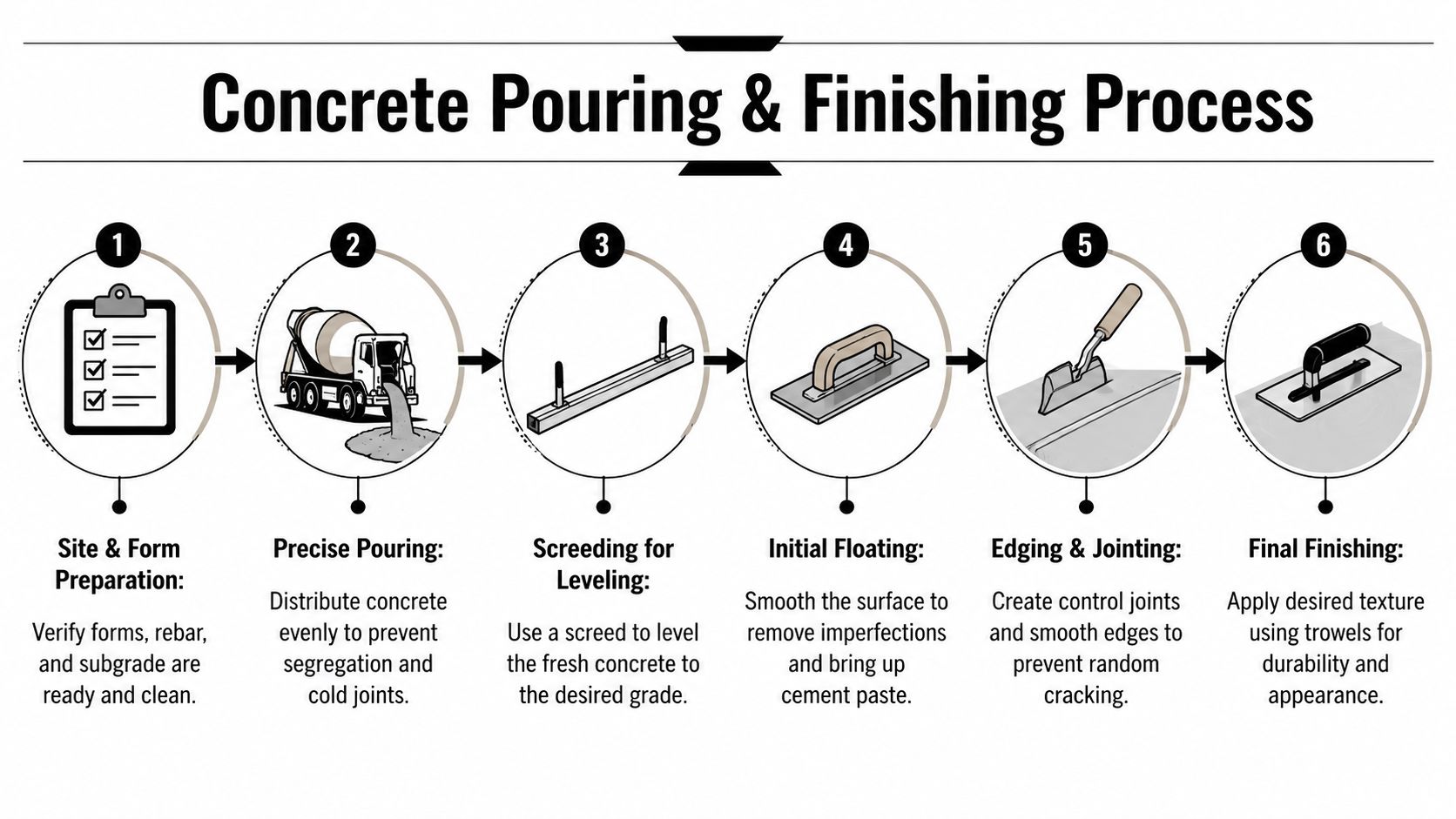
Concrete placement should be even and deliberate. Crews need forms verified, reinforcement in place, and the subgrade clean before discharge starts. If the pour is scattered, delayed, or handled roughly, the slab can develop weak transitions and inconsistent surface quality.
Screeding is one of the most important steps because it establishes grade and flatness. Then comes floating, which smooths the surface and consolidates the top layer without overworking it. Homeowners often focus on the troweled appearance, but the slab’s finish quality starts with level placement and timing.
Weather changes the whole approach. A windy summer afternoon in Delaware or Maryland can dry the surface too fast. When that happens, crews need to respond with methods that reduce evaporation pressure instead of trying to “finish through it.”
Fibers help, but they don’t replace joints
One of the most useful upgrades for early-age crack control is micro synthetic polypropylene fiber. According to Pioneer Fibre’s explanation of plastic shrinkage cracking, these fibers can reduce plastic shrinkage cracking by up to 80% by controlling micro-cracks before they spread, especially when surface evaporation is high. The same source makes an equally important point. Fibers do not replace control joints, which ACI 302.1R requires to be placed every 10-12 feet for a 4-inch slab to manage long-term drying shrinkage.
That trade-off matters. Fibers are a smart addition. They are not permission to skip layout discipline.
A homeowner can think of it this way:
- Fibers help inside the fresh mix: They limit tiny cracks that form early.
- Control joints guide future movement: They tell the slab where to crack neatly instead of randomly.
- Both matter for different reasons: One handles early-age surface stress, the other handles long-term shrinkage.
Planned joints are not a flaw. They are the contractor telling the slab where to relieve stress.
Control joints are part of the design
Many ugly slabs share the same problem. The joints were too far apart, too shallow, or cut too late. Concrete is going to move as it cures. The question isn’t whether it will relieve stress. The question is whether the crew gave it a proper place to do that.
For a typical 4-inch residential slab, control joints are generally laid out so panel sizes stay manageable and crack lines remain predictable. For some post-frame and outbuilding applications, panel layout becomes even more important near edges and corners, where stress tends to concentrate.
This short video shows the sequence homeowners often hear about but rarely get to see explained clearly:
Finishing mistakes that cause trouble later
The slab can still be damaged after the pour if the finish work is rushed. A few common examples come up again and again:
- Adding water at the surface: This weakens the top layer and can contribute to surface defects.
- Over-finishing bleed water back into the slab: That can trap weakness right at the top.
- Closing the surface too soon: Timing matters, especially on warm or windy days.
- Ignoring edge detail: Corners and slab edges are vulnerable if they aren’t finished cleanly.
For homeowners comparing driveway contractors near me or concrete contractors for a pad or slab, this is where craftsmanship shows. Good pouring and finishing isn’t flashy. It’s measured, calm, and consistent.
Curing and Long-Term Protection for Lasting Durability
A slab isn’t finished when the crew leaves. It’s still developing strength, and the next few days matter more than most homeowners realize. During this critical time, many concrete problems begin, especially when a new slab is left to dry out too quickly or absorb water year after year without protection.
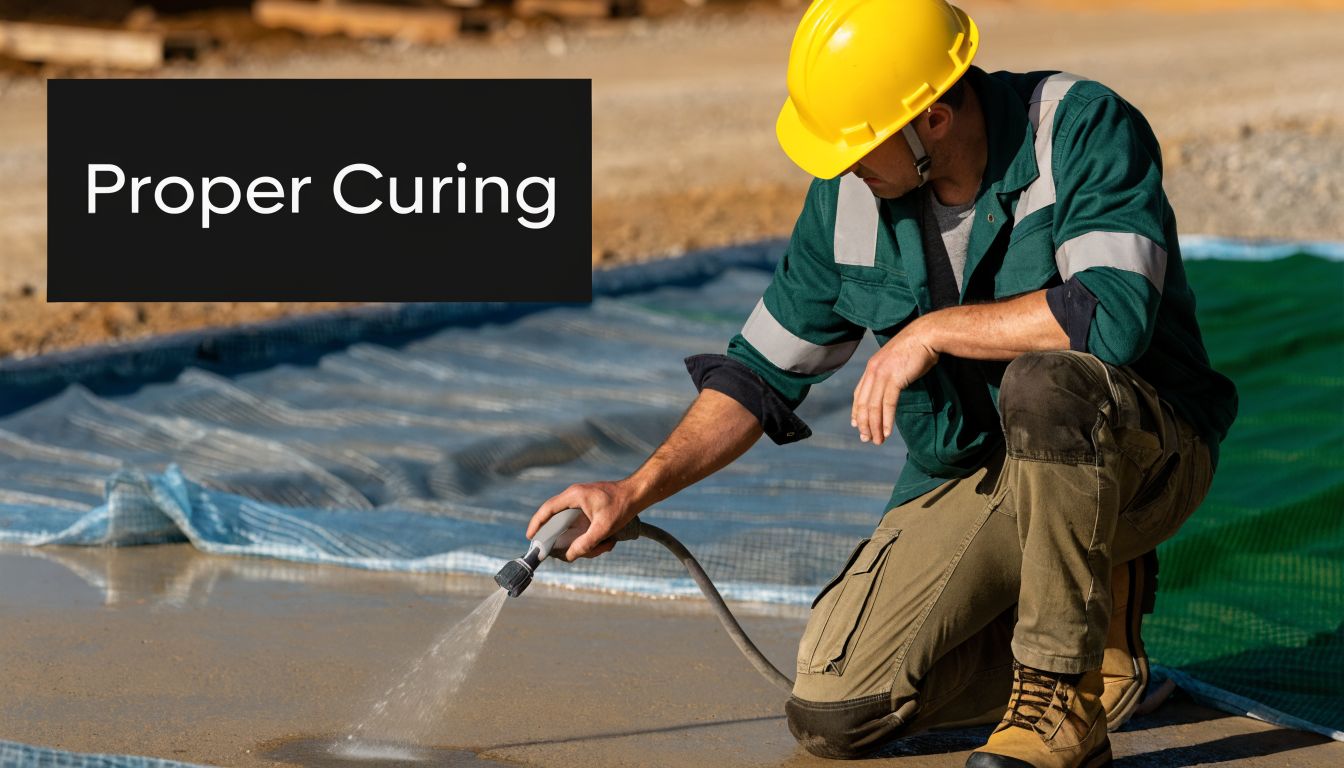
Curing is not the same as drying
Concrete needs moisture to hydrate properly. A slab that dries too fast is more vulnerable to surface cracking and reduced long-term durability. One standard practice is curing for a minimum of 7 days by methods such as misting or covering with wet burlap. According to this explanation of concrete cracking and curing, that moisture retention supports proper strength development and helps reduce surface cracking.
That’s why experienced crews protect the slab after finishing instead of treating the pour day as the end of the job. For garages, patios, and shed pads, the early curing window has a direct effect on how the slab looks and performs later.
Water management doesn’t stop after cure
Once the slab is in service, drainage becomes the next line of defense. The ground around the pad should shed water away from the concrete. Downspouts shouldn’t empty against slab edges. Low spots that hold water beside a garage slab or shed foundation should be corrected before they start softening the support below.
This is especially important in Pennsylvania, Maryland, and Delaware, where wet periods can be followed by freezing weather. Water that gets into small openings has a way of becoming a bigger issue when winter arrives.
A slab lasts longer when the surrounding grade helps it stay dry.
Sealing and joint maintenance matter
Long-term crack prevention isn’t just about the original pour. According to Sawmill Creek’s discussion of concrete crack prevention and maintenance, unsealed slabs can absorb 5-10% more moisture, which can cause up to 70% of new cracks over 5 years in freeze-thaw climates. The same source notes that annual sealing can boost durability 2-3x, and sealing joints with polyurethane can prevent 80% of water-related undermining and sinking.
That gives homeowners a straightforward maintenance plan:
- Seal the slab on a routine basis: This helps limit water entry into the concrete.
- Inspect joints regularly: Open joints let water reach the base and slab edges.
- Use polyurethane joint sealant where appropriate: It helps block water intrusion at the slab’s most vulnerable lines.
- Keep drainage working: Soil should slope away, and runoff should stay controlled.
Practical long-term habits
The best slab still benefits from attention. A few habits make a real difference for driveways, patios, garage floors, and outbuilding pads:
| Maintenance item | Why it matters |
|---|---|
| Check joint condition | Damaged joints invite water below the slab |
| Watch runoff after storms | Standing water often points to a grading issue |
| Reseal as needed | Surface protection helps in freeze-thaw weather |
| Address small cracks early | Early repair limits water entry and erosion |
Homeowners often ask whether crack prevention is mostly about the pour or mostly about maintenance. It’s both. The install creates the slab’s potential. Long-term care protects it.
Why a Perfect Foundation Is Not a DIY Job
Concrete videos make slab work look simple. Build forms. Order a truck. Rake it around. Smooth it off. In reality, each stage has decisions that affect whether the slab stays sound or starts failing in ways that are hard to reverse.
The challenge isn’t only labor. It’s judgment. You need to know when a site is too wet to prep correctly, when a soft spot needs to be removed, how to hold grade, how to position reinforcement, when the surface is ready for finishing, and when joints need to be cut. None of those calls are obvious to a first-time installer.
Small errors stack up fast
A DIY slab usually doesn’t fail because of one dramatic mistake. It fails because several smaller mistakes line up.
One person under-compacts the base. Another adds water because the mix feels stiff. The mesh settles to the bottom. Joints are cut late. The slab gets left alone through hot sun or a windy evening. Each choice seems manageable. Together, they create the random crack pattern homeowners hoped to avoid in the first place.
That’s why the primary value of an experienced crew is risk control. The job has many moving parts, but each one is managed in sequence.
A professional process protects the homeowner
For homeowners searching shed foundations near me, garage foundation contractors near me, or concrete foundations in Pennsylvania, Maryland, Delaware, or New Jersey, the safer route is a contractor who handles the entire chain. That includes excavation, grading, gravel base preparation, forms, reinforcement, pouring, finishing, and post-pour guidance.
The practical advantage is consistency. The same team that prepares the site understands the slab requirements. That matters for a base for storage shed placement, a house foundation area, a reinforced garage pad, or a large driveway where one bad area can telegraph trouble later.
One option homeowners and builders in the region consider is Firm Foundations, which handles site preparation, gravel pads, and concrete slab installation for sheds, garages, driveways, patios, barns, and similar projects across PA, MD, DE, and NJ.
Good estimating is part of good construction
Homeowners also benefit when the contractor’s planning is organized before work begins. Accurate takeoffs, base material calculations, and slab planning reduce the chance of rushed decisions on install day. For builders or property owners comparing project planning tools, concrete estimating software can be a useful resource for understanding how professionals scope material needs and job quantities before the first machine arrives onsite.
What to ask before you hire anyone
If you’re evaluating concrete contractors, ask questions that reveal process, not sales polish:
- How do you prepare the subgrade: Listen for excavation, removal of organics, compaction, and drainage.
- What base do you install under the slab: You want a real answer, not “whatever is there now.”
- How do you reinforce the slab: The answer should fit the intended load.
- How do you handle joints and curing: Those details affect crack control as much as the pour itself.
- What kind of projects do you build most often: A crew that regularly handles shed foundation, garage slab, and driveway work will usually speak more clearly about practical site conditions.
Homeowners don’t need to memorize concrete standards. They do need a contractor who works like those standards matter.
A perfect slab can’t be promised in the sense that concrete is a natural material and movement has to be managed, not wished away. But random cracking, settlement, edge failure, and premature deterioration are often preventable when the job is handled professionally from excavation through maintenance advice. That’s the difference between a slab that just got poured and one that was genuinely built.
If you’re planning a shed pad, garage slab, patio, driveway, or other concrete foundation in Pennsylvania, Maryland, Delaware, or New Jersey, Firm Foundations can help you get the site evaluated, the right foundation type selected, and a clear quote for work built to specification. Contact the team to discuss your project and get a no-surprises estimate.