
Gravel Driveway How Deep: Expert Base Guide
You're probably looking at a driveway that has started to rut, shed stone into the yard, or collect water after a Mid-Atlantic storm. The natural question is simple: gravel driveway how deep should it be? The dependable answer isn't one number dumped over soil. It's a compacted, layered section matched to your vehicles, subgrade, and drainage.
For homeowners searching for driveway contractors near me, excavation near me, or dependable foundation work, that distinction matters. Firm Foundations serves Pennsylvania, Maryland, Delaware, and New Jersey with site preparation, gravel pads, concrete foundations, garage footings and foundations, and driveway excavation designed around long-term stability.
Understanding Gravel Driveway Depth Layers
A durable gravel driveway has more in common with a shallow road section than with a pile of decorative stone. The visible surface is only the finish. Below it, the subgrade and compacted stone carry the vehicle load, limit movement, and help water pass through the section without turning the soil into mud.
A common modern recommendation for a residential driveway is 6 to 8 inches total installed depth, usually made from 4 to 5 inches of compacted dense-grade base gravel and 2 to 3 inches of angular surface stone. Driveways used by trucks, RVs, or farm vehicles are often specified at 8 to 12 inches total, while colder, wetter, or weaker soils may need an additional 2 to 4 inches for durability. See the gravel driveway depth guidance for the layered rationale.
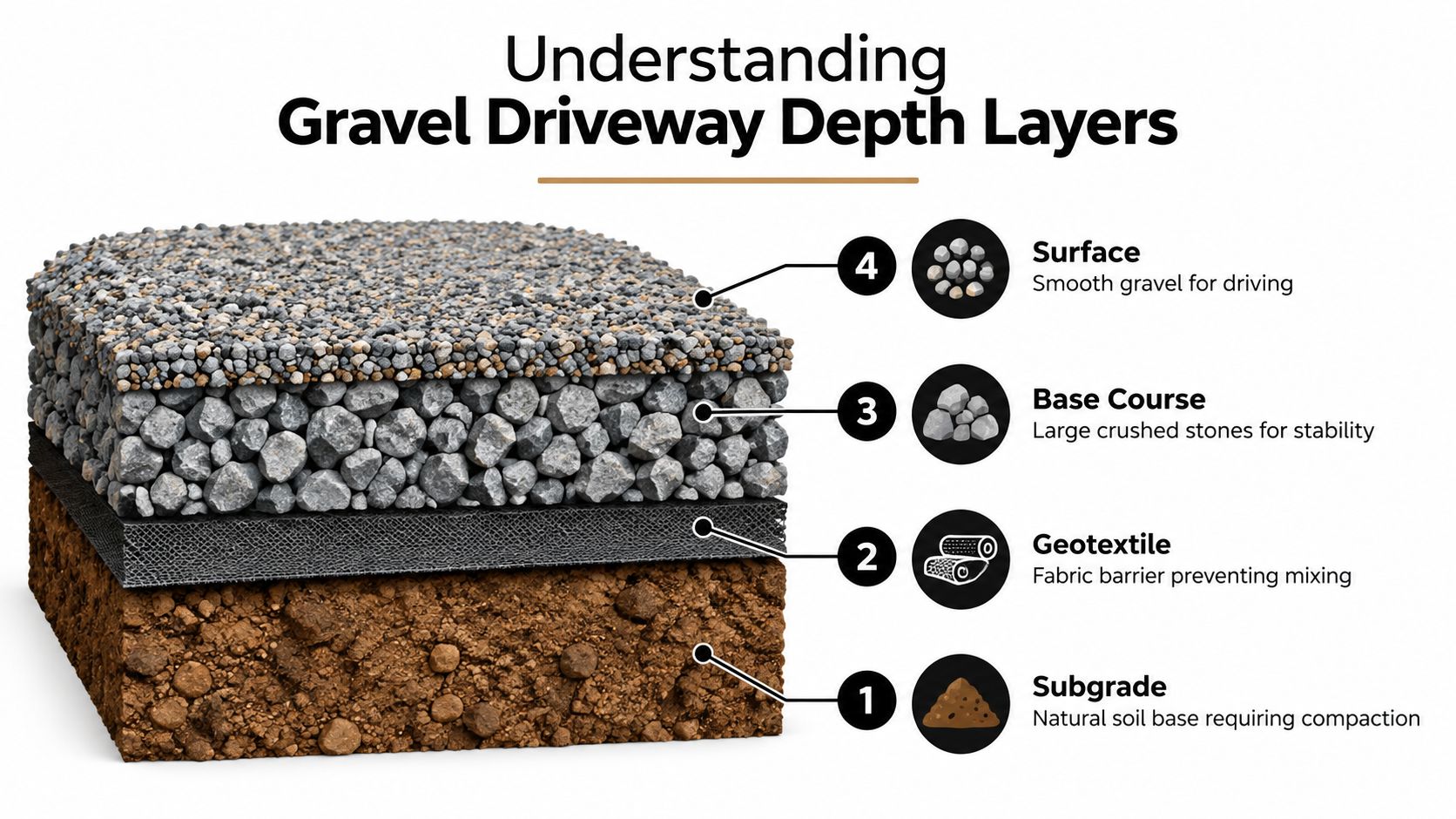
The layers that do the real work
- Subgrade: Native soil must be shaped and compacted. Organic topsoil, roots, and soft pockets don't provide a reliable structural platform.
- Geotextile fabric: On weak or wet ground, fabric can help keep stone from mixing into the soil. It separates materials rather than replacing proper excavation.
- Base course: Larger angular crushed stone forms the load-bearing foundation. Its interlocking edges resist shifting better than rounded decorative rock.
- Surface course: Smaller angular gravel creates the drivable finish, fills surface voids, and provides a smoother appearance.
One UK installation guide describes a different but useful rule of thumb. For vehicle traffic, the gravel layer should be no deeper than roughly twice the stone size, such as 20 mm for 10 mm gravel or 40 mm for 20 mm gravel, over a compacted 150 mm sub-base. That comparison reinforces the same principle: the structural layer below the finish is substantially thicker than the stone you see. The gravel driveway installation guide gives that historical-style relationship.
A driveway proposal that lists only “several inches of gravel” leaves important questions unanswered. Ask what material forms the base, how deep the excavation will be, whether fabric is needed, and how each lift will be compacted. Homeowners comparing a shed foundation gravel base, a driveway, or a base for storage shed can also review this gravel driveway construction guide to see how preparation affects performance. If you're also comparing finish materials for a garden project, a guide to decorative rock for Peoria homes can help distinguish appearance-driven stone from structural driveway aggregate.
Matching Depth to Vehicle Traffic and Soil Conditions
A passenger car and a loaded dump truck don't impose the same demands on a driveway. Turning wheels, repeated deliveries, RV parking, farm equipment, and snowplow activity all increase the need for a deeper, better-compacted base.
For many residential installations, contractors use a total compacted section in the 8 to 12 inch range, built in layers rather than placed in one loose dump. One common layout uses a 4 to 6 inch compacted subbase, a 3 to 4 inch base course, and approximately a 2 inch surface layer. Loose lifts should generally remain around 4 to 6 inches maximum before compaction so the material can lock together properly. These specifications are outlined in crushed stone base and subbase guidance.
Recommended driveway depth by use and soil
| Traffic Type | Standard Soil Depth | Weak/Clay Soil Depth |
|---|---|---|
| Passenger cars and light residential use | 6 to 8 inches total | 8 to 10 inches total |
| Regular deliveries or frequent vehicle traffic | 8 to 10 inches total | 10 to 12 inches total |
| Trucks, RVs, or farm vehicles | 8 to 12 inches total | 10 to 12 inches total, subject to site review |
The table reflects a planning range, not a substitute for inspecting the ground. The source guidance identifies light residential use in the 4 to 6 inch range in some coverage, while truck or RV traffic is more often associated with 8 to 12 inches. It also emphasizes that a driveway has “two depths,” a coarse load-bearing base and a finer surface layer. The soil and traffic depth discussion explains why generic single-number answers can mislead homeowners.
Mid-Atlantic properties can present heavy clay, seasonal saturation, or high water tables. On those sites, adding surface stone without strengthening the lower section usually produces a driveway that looks improved briefly but still moves under traffic. A contractor should inspect soft spots, existing grades, nearby drainage paths, and the soil exposed after excavation before finalizing the depth.
For large heavy trucks, one guideline specifically recommends 8 inches of base stone, while other guidance places heavier-use driveways around 6 to 10 inches or 8 to 12 inches total compacted depth, depending on loading and subgrade. Those ranges are documented in heavy-duty gravel driveway recommendations.
Professional Excavation and Compaction Standards
Dumping stone over grass or loose topsoil is the shortcut that causes many driveway failures. A professional installation starts by removing organic material and unstable soil, then shaping the exposed subgrade so water has a controlled route away from the driving surface.
What proper site preparation includes
- Excavation: The crew removes topsoil, roots, organic debris, and visibly unstable pockets. The required cut depends on the selected total section and the final elevation.
- Subgrade shaping: The driveway receives a planned crown or cross-slope rather than a flat bowl. Edges, entrances, and transitions to roads or garages need special attention.
- Fabric placement: Where soil is soft or likely to pump upward, geotextile fabric can separate the native ground from the aggregate.
- Controlled placement: Larger crushed stone goes down first. Each lift is spread evenly instead of being dumped into deep piles and left loose.
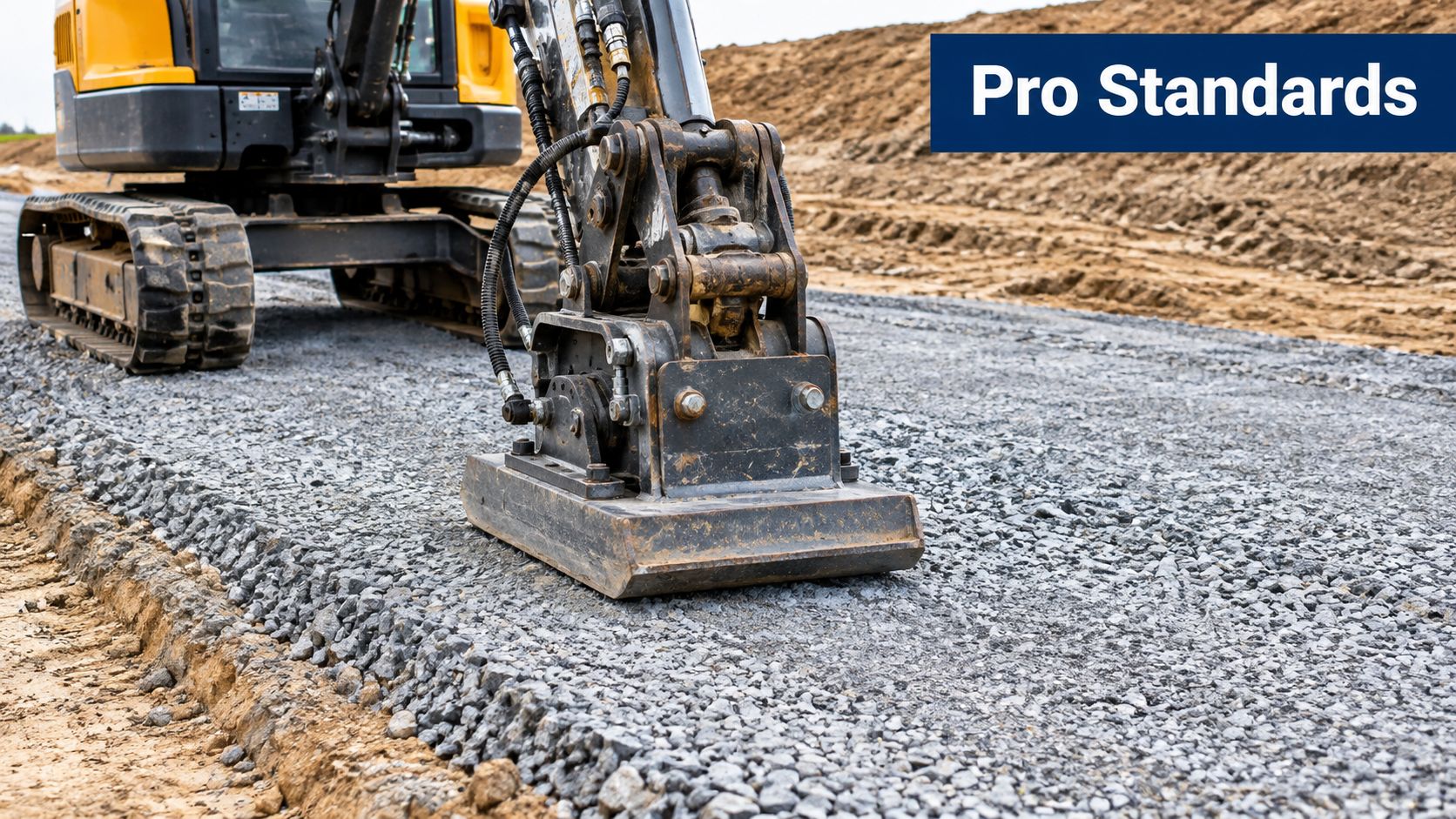
- Mechanical compaction: A plate compactor, vibratory roller, or suitable excavator attachment consolidates each lift before the next material is placed.
- Finish grading: The final surface is shaped for comfortable driving while preserving the drainage pattern established below.
Compaction targets provide a useful way to judge whether a proposal is specific enough. One set of residential requirements places the subgrade at 90 to 95 percent of Proctor maximum dry density, the subbase at at least 95 percent, and the base course at 95 to 98 percent. Those figures come from driveway compaction requirements, and they show why walking a hand tamper over the surface isn't equivalent to controlled mechanical compaction.
Practical rule: A driveway should be compacted in layers, not after all the stone has been dumped. The compactor needs access to the lift it's consolidating.
The same preparation standards matter around structures. A gravel driveway leading to a garage foundation, shed foundation, or concrete patio must meet finished elevations carefully so water doesn't drain toward the slab. Experience with concrete forms, shed foundation blocks, and excavation transitions becomes valuable here. A driveway may be gravel, but it still needs the same attention to grade and bearing that supports a house foundation or garage slab.
For a visual example of equipment and placement methods, this driveway excavation and compaction video shows the type of mechanical work involved.
Solving Drainage and Permeability Challenges
Adding loose gravel to a wet or rutted driveway often treats the symptom, not the cause. If water remains trapped in the section, the stone can migrate, fines can clog voids, and tires can push the softened material into channels.
Shape controls where water goes
A driveway needs a deliberate crown or cross-slope that sheds rainfall toward a safe outlet. Edge containment also matters, particularly where tires turn, where gravel meets pavement, or where runoff could carry stone into a ditch. If a low area collects water, the solution may involve correcting grade, improving an outlet, or addressing an uphill drainage source rather than increasing surface depth.
Layering affects permeability as well. Clean, angular stone can leave useful voids, but excessive fines may fill those spaces. A stable driveway therefore needs a balance between interlocking material and controlled infiltration. More gravel isn't automatically more permeable, especially when the base is poorly compacted or the surface becomes clogged with sediment.
A useful way to think about the problem is to separate load support from water management. The base supports vehicles. The crown, edge details, subgrade preparation, and outlet manage water. Neither function can reliably replace the other.
Homeowners considering permeable systems or gravel-grid products should ask how the product handles vehicle loads, what base it requires, and how maintenance preserves infiltration. Recent guidance also connects permeable driveway design with SUDS compliance, so local approval and drainage requirements may influence the system selection. For broader context on grading and water control, this discussion of the cost of grading and drainage in MA explains why drainage work needs to be evaluated as its own scope.
Before installation, walk the site during or shortly after rain if possible. Look for water entering from neighboring grades, downspouts discharging across the proposed route, and low points near a garage or shed. The gravel driveway drainage solutions guide offers another reference for connecting surface shape, material selection, and runoff control.
Common Installation Mistakes to Avoid
The cheapest-looking driveway proposal can become the most expensive option if it leaves out excavation, separation, or compaction. A thin layer of attractive stone may hide soft soil for a season, but traffic eventually exposes the weak structure underneath.
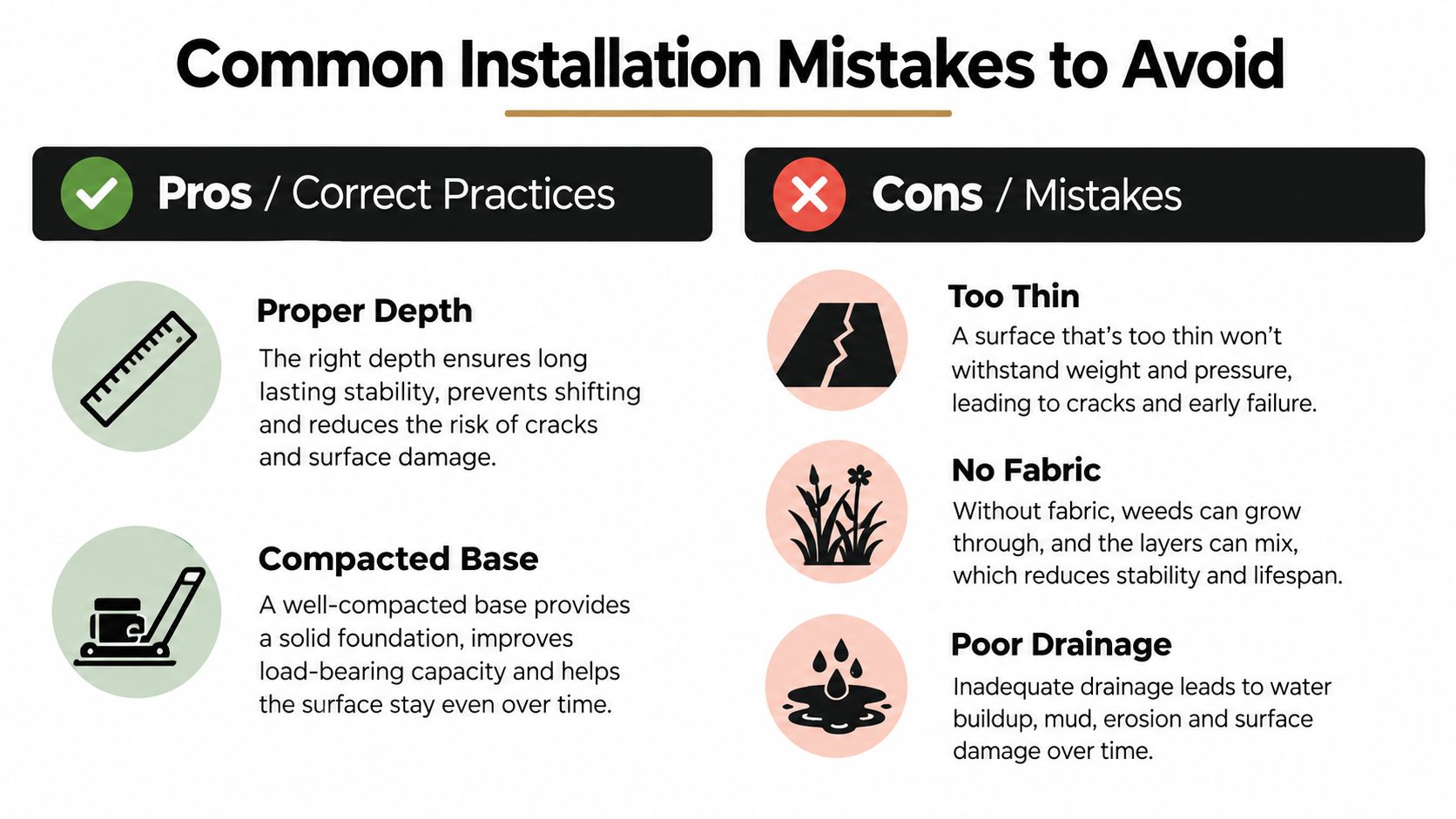
Red flags during planning
- A single depth with no layer breakdown: The proposal should identify the subbase, base course, and surface material separately.
- No answer about soft soil: If the site has clay, standing water, or visible pumping, ask whether geotextile fabric and additional base are appropriate.
- One large loose placement: Material placed too deep for the compactor won't consolidate evenly. The finished surface may appear firm while the lower section remains loose.
- Rounded stone used as structural aggregate: Decorative or pea gravel may move under turning tires. Angular crushed stone generally offers better interlock for vehicle areas.
- No finished-grade plan: A contractor who doesn't discuss runoff, edges, and transitions may leave water moving toward a garage, shed, or public roadway.
A common mistake is treating a 4×8 shed with foundation, 10×10 storage shed, or gazebo foundation as a simple stone placement job. Small structures still need a level, stable bearing surface. The same applies to a barn shed, shipping container, or hot tub pad. If the ground settles unevenly, doors bind, frames rack, and connected drainage problems become harder to correct.
A surface repair can hide a structural problem, but it can't compact soil that was never prepared.
Correcting a failed driveway often means removing contaminated aggregate, reworking the subgrade, rebuilding the base, and restoring the surface. That work disrupts access and can cost more than establishing the correct section during the initial excavation. Ask driveway companies near me to explain not only what stone they'll deliver, but also what happens beneath it.
A reliable contractor should be comfortable discussing equipment, lift thickness, compaction, fabric, drainage, and final elevations. If the answers stay vague, the risk remains on the homeowner.
Planning Your Driveway Project with Firm Foundations
Start with the site, not the stone order. Note the driveway's length, width, intended vehicles, connection to the road, relationship to the garage or house, and any areas that stay wet. A contractor can then evaluate the soil, determine whether excavation or fabric is needed, and separate the base and surface quantities.
Your consultation should also address nearby projects. The same crew may be preparing a gravel shed foundation, garage slab, gazebo foundation, patio, or concrete pad, and each one needs finished grades that work together. Homeowners comparing aggregate appearance can use the SouthRay Kitchen & Bath granite manual as a material reference, but decorative material shouldn't be selected as a substitute for structural driveway stone.
Firm Foundations is a licensed and insured foundation and excavation contractor serving Pennsylvania, Maryland, Delaware, and New Jersey. Since 2011, the company has handled gravel pads, concrete foundations, garage footings and foundations, excavation, driveways, patios, sheds, houses, gazebos, barns, playsets, hot tubs, and shipping-container bases. The process includes selecting the foundation type, preparing a transparent free quote, and completing the site work to the specified grade and section.
If you're searching for shed foundations near me, gravel shed foundation contractors near me, garage foundation contractors near me, or concrete foundations, ask for a site-specific recommendation rather than a generic depth. The right answer depends on load, soil, water, and how the driveway connects to the rest of your property.
Firm Foundations can evaluate your driveway site, excavate and compact the base, manage drainage, and coordinate related shed, garage, or concrete foundation work. Visit Firm Foundations to request a transparent quote and discuss the depth and construction approach your Pennsylvania, Maryland, Delaware, or New Jersey property needs.