
Garage Floor Sealer: A PA Contractor’s Guide for 2026
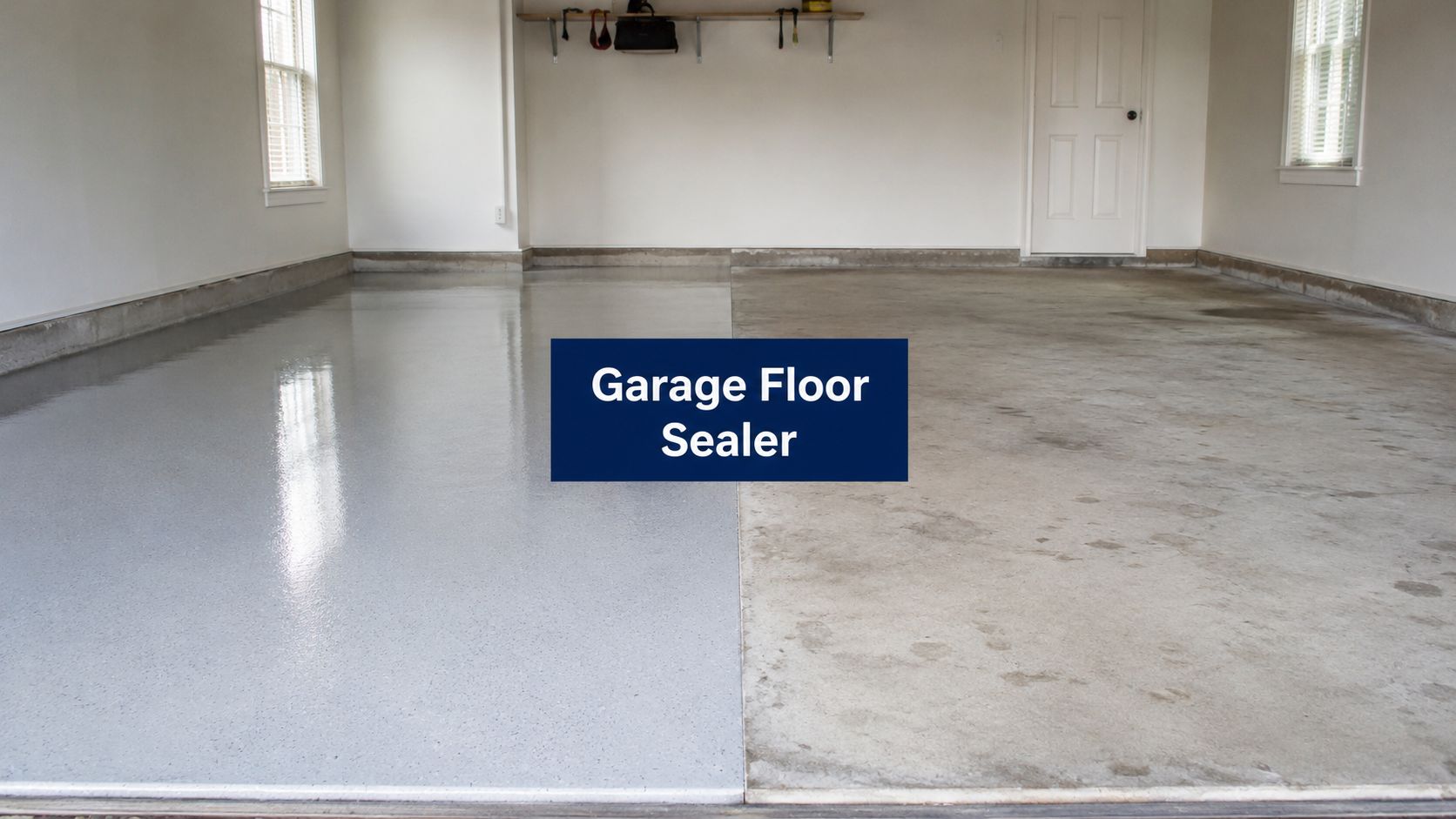
By late winter in Pennsylvania, a lot of garage floors look the same. The concrete is dusty, there are dark spots from oil or fertilizer, and the area near the garage door has that chalky, worn look from road salt and slush getting tracked in every day. Homeowners often start by asking for a cleaner-looking floor, but protection is the underlying issue.
That matters whether you're maintaining an older slab or planning a better concrete foundation for a garage from the start. A garage floor that's poured well but left unprotected will still absorb moisture, collect stains, and wear faster than it should. That's why people searching for garage foundation contractors near me, concrete contractors, or even help with related outdoor flatwork are often dealing with the same long-term question. How do I make this concrete last?
In Pennsylvania, Maryland, Delaware, and New Jersey, garages work hard. They see wet tires, deicing salts, freeze-thaw swings, lawn equipment, shelving, and regular foot traffic. A good garage floor sealer can help a lot. The wrong product, or the right product on the wrong slab, can be a waste of money.
Protecting Your Garage Floor in Pennsylvania and Beyond
A Pennsylvania garage floor usually starts asking for help at the front edge. That is where road salt, meltwater, and tire traffic hit first. I often see the same sequence. The surface turns chalky, dark spots stop cleaning up, and shallow pitting shows up near the door long before homeowners notice wear in the rest of the slab.
That pattern is common across the Mid-Atlantic, even if the weather shifts from one state to the next. Southeastern Pennsylvania garages take a steady beating from freeze-thaw cycles, salt, and wet vehicles. Delaware and New Jersey may bring milder winters in some areas, but concrete still deals with moisture, vehicle traffic, fertilizer, oil, and everyday storage loads. Given enough time, unprotected concrete responds the same way. It absorbs contamination, wears at the surface, and gets harder to maintain.
Practical rule: If water darkens the slab instead of beading, or the concrete is dusting and flaking near the garage door, protection is overdue.
The part homeowners need clear guidance on is the difference between sealing and coating. Those are not interchangeable terms. A basic sealer can be the right answer for a sound slab that mainly needs moisture and salt resistance. A coating system makes more sense when the goal is a cleaner finish, better stain resistance, and a floor that looks more finished. If the slab has widespread scaling, active moisture issues, or failing concrete, neither option fixes the root problem. At that point, repair, resurfacing, or replacement may be the better investment.
Local climate is what pushes this decision from cosmetic to practical. In Pennsylvania, a garage floor has to handle wet tires in January, muddy runoff in March, and hot-tire pickup risk in summer. The product has to match the slab condition and the way the space is used. A homeowner who parks daily, stores salt bags and lawn chemicals, or works on equipment in the garage needs a different level of protection than someone using the space for light storage.
Start with the concrete itself. Sound concrete gives sealers and coatings a fair chance to perform. Weak, contaminated, or damp concrete does not. The same principle applies whether you are maintaining an older garage slab or evaluating garage footings and foundations, cement foundations for garage work, or related flatwork from driveway contractors near me.
The goal is not just a better-looking floor. The goal is a garage that stays serviceable longer, cleans up easier, and does not force you into bigger concrete repairs sooner than necessary.
What Is a Garage Floor Sealer and Why Do You Need One
Pull a car into a Pennsylvania garage after a snowstorm, and the floor gets a hard test. Melted snow carries road salt onto the slab. Mud and grit settle in. If the concrete is bare, that moisture and contamination start working into the surface right away.
A garage floor sealer is the first level of protection for that slab. It reduces how much water, salt, oil, and dirt can get into the concrete. Some sealers soak into the pores and protect from within. Others stay closer to the surface and create a light protective film. The point is simple. Slow down wear, make cleanup easier, and help the floor last longer.
That matters because concrete is durable, but it is not immune to abuse. In garages, I see the same problems over and over. Salt exposure, surface dusting, oil stains, and gradual surface breakdown from repeated wet-dry and freeze-thaw cycles. A good sealer helps limit those problems before they turn into repairs.
A sealer also fills a different role than paint. Paint mainly changes the look. A true sealer is chosen for how it bonds with concrete and how well it protects the slab under real garage use. If you are weighing a sealer against a heavier-duty system, it helps to understand the difference between basic protection and a full coating. Homeowners comparing those options can also review this guide to the best garage floor coating systems.
The problems a sealer actually solves
On a sound garage slab, a sealer usually helps with:
- Moisture resistance: It reduces surface absorption, which matters in wet winters and during spring thaw.
- Salt protection: It gives deicing residue less opportunity to soak in and attack the surface.
- Less dusting: Many sealed floors shed less fine concrete dust.
- Easier cleanup: Oil drips, fertilizer residue, and muddy tire tracks do not cling as aggressively.
- Longer service life: By limiting everyday exposure, a sealer can help delay surface wear and small maintenance issues.
That last point is the part homeowners often overlook. A sealer is not just about appearance. It is a maintenance tool. On the right slab, it buys time and helps you avoid pushing a manageable floor into early patching, resurfacing, or replacement.
What a sealer does not do
A sealer will not fix structural cracks, settling, poor drainage, or concrete that is already failing. If the slab is scaling badly, staying damp from below, or breaking apart at the surface, sealing over it is usually a short-term patch.
Some products do a solid job against water and staining but still will not bridge moving cracks or stop hydrostatic moisture. That is where homeowners need honest guidance. If the concrete is in decent shape and the goal is protection, a sealer is often enough. If you want a cleaner finish, stronger stain resistance, and a tougher wear layer, a coating system is usually the better investment. If the slab itself is weak, neither one is the appropriate fix.
That is the contractor view on sealing versus coating. Start with the condition of the concrete, then match the product to the job.
Comparing the Four Main Types of Garage Floor Sealers
A good recommendation starts with the slab, not the label on the bucket. In Pennsylvania, I look at four things first. How much road salt the floor sees, whether moisture is coming through the concrete, how hard the garage is used, and whether the homeowner wants simple protection or a finished surface.
A sealer and a coating are not the same purchase. Some products soak in and help the concrete resist water and salt. Others build a wear layer on top and change how the garage looks and performs. That distinction matters because plenty of homeowners really need basic slab protection, while others are better served by a full system. If the concrete is weak, scaling badly, or moving, neither option fixes the underlying problem.
Penetrating sealers
Penetrating sealers soak into the pores of the concrete and leave little or no film on the surface. For a sound garage slab that sees wet cars, snow melt, and winter salt, this is often the most sensible starting point.
Their biggest advantage is low drama over time. They do not usually peel like film-forming products because there is not much sitting on top to fail. They also keep the floor looking natural, which many homeowners prefer in a working garage.
The trade-off is appearance. You get protection more than transformation. If your goal is a brighter, cleaner-looking floor with decorative value, a penetrating sealer will feel underwhelming.
Best use case: solid concrete where moisture resistance and salt protection matter more than looks.
Main trade-off: dependable protection, minimal visual change.
Acrylic sealers
Acrylic sealers sit closer to the surface and give the floor a light sheen or gloss. They are often chosen for a quick visual improvement at a lower price than a true coating system.
I use caution with acrylics in active garages. They can be a reasonable fit for lighter-duty spaces, but they wear faster under hot tires, winter grit, jack stands, and repeated traffic. On the right floor, they freshen the look. On the wrong floor, they become a maintenance item.
Best use case: budget-conscious homeowners who want a modest cosmetic upgrade on a lower-demand slab.
Main trade-off: lower upfront cost, shorter service life.
Epoxy systems
Epoxy is where the conversation shifts from sealing concrete to coating it. It creates a thicker surface layer, improves stain resistance, and gives the garage a more finished feel. For workshops, home gyms, and garages that double as storage space, epoxy is often the point where utility turns into a planned, durable room.
Epoxy also hides minor cosmetic flaws better than a clear sealer. Flake systems can make an older slab look cleaner and more uniform. That said, epoxy is only as good as the prep under it. If the slab has moisture issues or poor surface prep, epoxy can fail in ways a penetrating sealer usually does not.
Best use case: homeowners who want both protection and a cleaner, more polished surface.
Main trade-off: stronger finish and better looks, with more demanding prep and a higher installed cost than basic sealers.
Polyaspartic systems
Polyaspartic is usually the premium option. It is commonly used in professional coating systems because it cures fast, handles abrasion well, and returns the garage to service sooner than many traditional systems.
That speed cuts both ways. It leaves less room for application mistakes, which is one reason I do not put it in the same category as a simple weekend sealer project. Homeowners usually compare polyaspartic to epoxy because both are coatings, not because they solve the same problem as a penetrating sealer.
Best use case: homeowners who want a high-end floor, quick turnaround, and professional installation.
Main trade-off: strong performance and fast cure, with less forgiveness during installation and a higher price.
Quick comparison table
| Garage Floor Sealer Comparison | ||||
|---|---|---|---|---|
| Sealer Type | Finish | Durability | Avg. Cost (Pro Install) | Best For |
| Penetrating | Natural to low-sheen | Good moisture and salt protection | Lower than full coating systems | Practical protection on sound concrete |
| Acrylic | Light sheen to gloss | Light-duty | Lower than epoxy and polyaspartic systems | Budget-friendly cosmetic refresh |
| Epoxy | Decorative, often glossy | High when installed over proper prep | Mid-range among professional garage floor options | Finished garages and multi-use spaces |
| Polyaspartic | Clean, professional finish | High | Usually the premium-priced option | Homeowners who want a faster return to service |
If you are comparing true coating systems, this guide to the best garage floor coating options gives a useful side-by-side look at finish and performance.
Moisture behavior matters in garages and basements alike, so homeowners dealing with slab-related flooring decisions may also find this expert advice for concrete slab basements helpful.
The Critical Importance of Surface Preparation
Most garage floor failures don't start with the topcoat. They start before the first product ever hits the slab. If the concrete is dirty, sealed already, too smooth, or holding moisture, even a good material can let go.
Professional-grade systems rely on bond strength. That bond comes from two things. The surface must be clean, and it must have enough texture for the coating to grab onto.
What proper prep includes
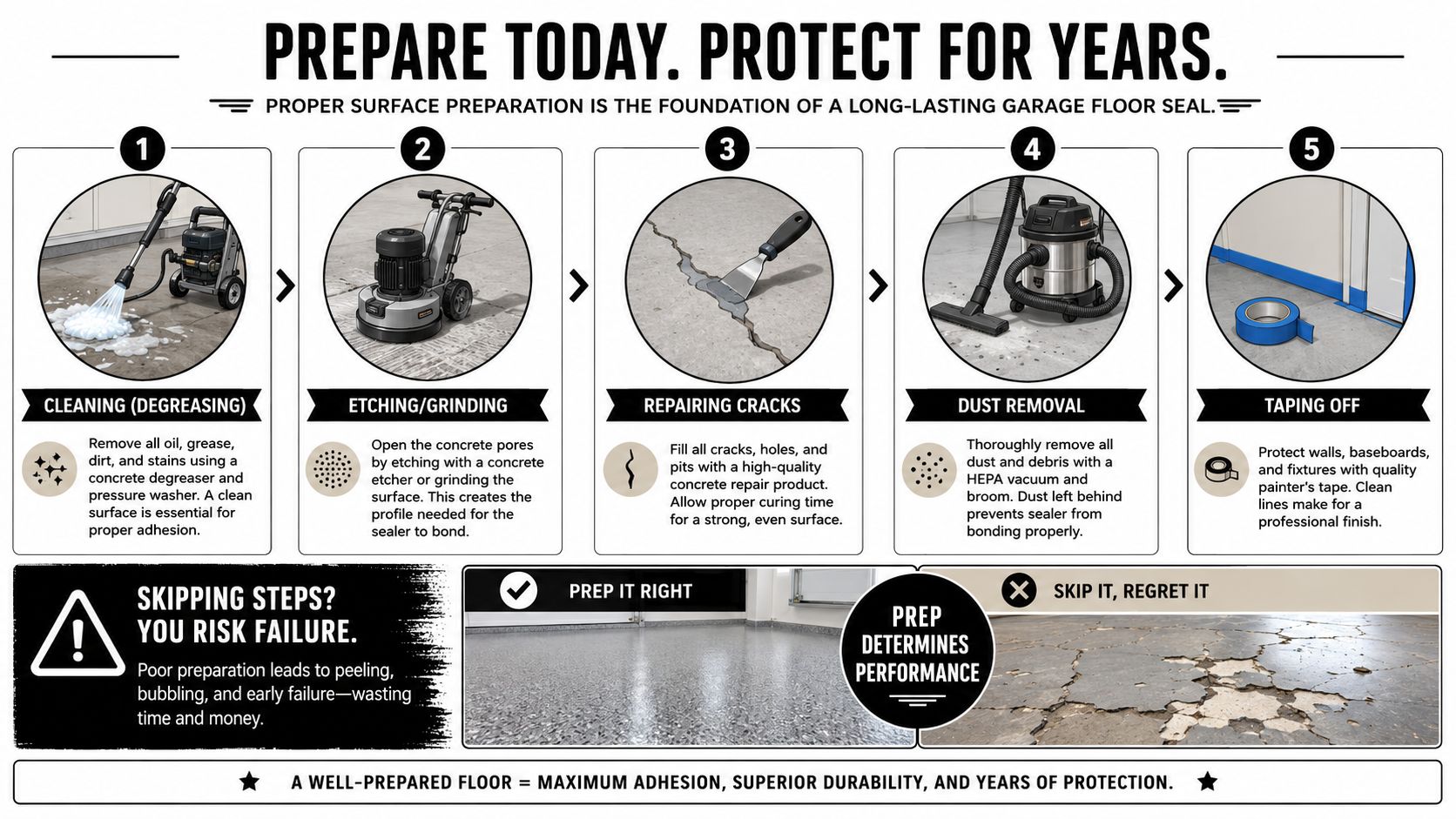
Industry guidance for epoxy, urethane, and polyurea-type systems emphasizes removing oil, grease, efflorescence, laitance, and other contaminants, then creating a roughened profile by abrading, scarifying, or acid etching before application. It also notes that the concrete must be dry at application because trapped moisture can impair adhesion and lead to blistering or failure, as explained in this concrete floor sealer preparation guide.
In the field, that usually means several separate tasks, not one quick cleaning pass.
- Deep cleaning and degreasing: Oil spots, tire residue, and old household spills have to come off.
- Mechanical profiling: Diamond grinding is the standard for serious coating work because it opens the surface and creates texture.
- Crack and surface repair: Chips, pitting, and spalled areas should be addressed before coating.
- Dust removal: Fine grinding dust left behind can ruin adhesion.
- Edge protection: Taping, masking, and controlled application keep the system neat and consistent.
For homeowners trying to understand the equipment side, this overview of a garage floor grinder shows why prep tools matter so much more than people expect.
Why clean concrete still may not be ready
A floor can look clean and still be a bad candidate for coating. That happens when old sealers remain in the slab, when the surface is too smooth, or when moisture vapor is working upward through the concrete.
The coating doesn't bond to what you can see. It bonds to the actual condition of the concrete.
That same logic shows up in other slab environments too. If you're comparing moisture-prone concrete surfaces beyond the garage, this piece on expert advice for concrete slab basements is a useful read because it helps homeowners think through how slab condition affects finish choices.
Here's a visual look at the prep process before any coating work begins:
Where DIY prep usually goes wrong
The most common mistakes are underestimating contamination, skipping mechanical prep, and coating over damp concrete. A floor may hold a coating for a while, then start peeling where the tires sit, where salt collects, or where old stains were never fully removed.
That's why prep isn't the boring part of the project. It is the project.
DIY Sealing vs Hiring a Professional Concrete Contractor
A lot of garage floor projects look simple on the shelf and turn expensive on the slab. I have seen homeowners in Pennsylvania buy a weekend DIY kit, put it on a floor that seemed clean, and then call a contractor months later because hot tire pickup, peeling, or moisture haze started showing up. The product was not always the main problem. The slab condition was.
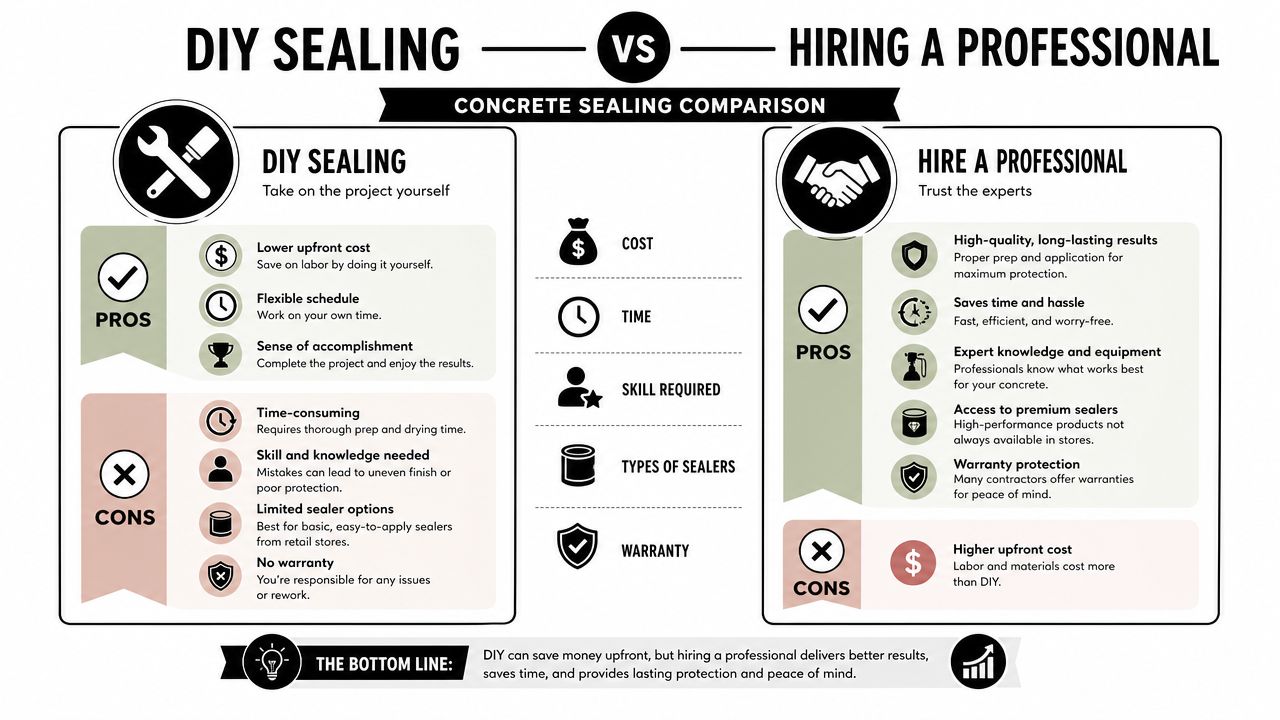
DIY can still be the right choice. A basic sealer makes sense when the concrete is sound, the floor has no active moisture issues, and the goal is practical protection rather than a showroom finish. On a garage like that, a homeowner can often get a good result with careful cleaning, realistic expectations, and a product that is suited to the slab.
DIY usually fits best when:
- The slab is structurally sound: Minor wear is one thing. Widespread cracking, flaking, or failed old coatings are another.
- You are using a simple sealer: Penetrating sealers and some acrylics are more forgiving than multi-step coating systems.
- Appearance is secondary: A natural or lightly enhanced look is acceptable.
- You are prepared to recoat sooner: Lower-cost sealers often need more upkeep than a professionally installed coating system.
The line gets sharper once the project moves from sealing into coating. Epoxy and polyaspartic systems ask for much tighter control over repair work, mixing, timing, temperature, and surface condition. That is where many DIY jobs fail. The floor may look fine on day one and still lose bond later where road salt sits, tires heat up, or moisture pushes from below.
Professional installation earns its cost on the jobs where failure is expensive to fix. A contractor brings grinders, industrial vacuums, repair materials, moisture testing, and enough experience to spot issues that are easy to miss. Hidden curing compounds, old silicone contamination, soft surface paste, and damp concrete can all change the recommendation from "use a sealer" to "install a full coating system" or even "hold off and address the slab first."
That last point matters more than many homeowners expect. Sometimes the honest answer is that sealing is only a short-term improvement because the concrete itself is too far gone. In those cases, patching over the symptoms is not the best investment. The same judgment call comes up in other surface-restoration projects. This article on is headlight restoration a smart investment gets at the same idea. The right answer depends on the condition of what you are trying to save.
A local concrete contractor adds value because regional conditions matter. Pennsylvania garages deal with freeze-thaw cycles, deicing salts, snow melt, and moisture movement that all affect how a sealer or coating performs over time. Homeowners who need driveway contractors near me or garage floor help are usually better served by a crew that understands how local slabs age, what prep methods hold up here, and when a basic sealer is enough versus when a coating system is the better long-term move.
If the floor is clean, stable, and your expectations are modest, DIY sealing can be reasonable. If you want strong appearance, longer service life, or reliable performance on a problem slab, hiring a professional is often the lower-risk decision.
Understanding Cost Longevity and Maintenance
A garage floor is one of those projects where the cheapest option can become the expensive option if it has to be redone too soon. Homeowners usually want three straight answers. What does it cost, how long will it hold up, and how much work will it take to maintain?
The answer depends on whether you are sealing sound concrete or trying to get coating-level performance from a product that was never meant to do that job. A basic sealer is often the right call for a solid slab that mainly needs protection from moisture, salt, and staining. If you want a more finished look, better wear resistance, and a longer service life, a full coating system usually gives better long-term value.
What the installed cost range looks like
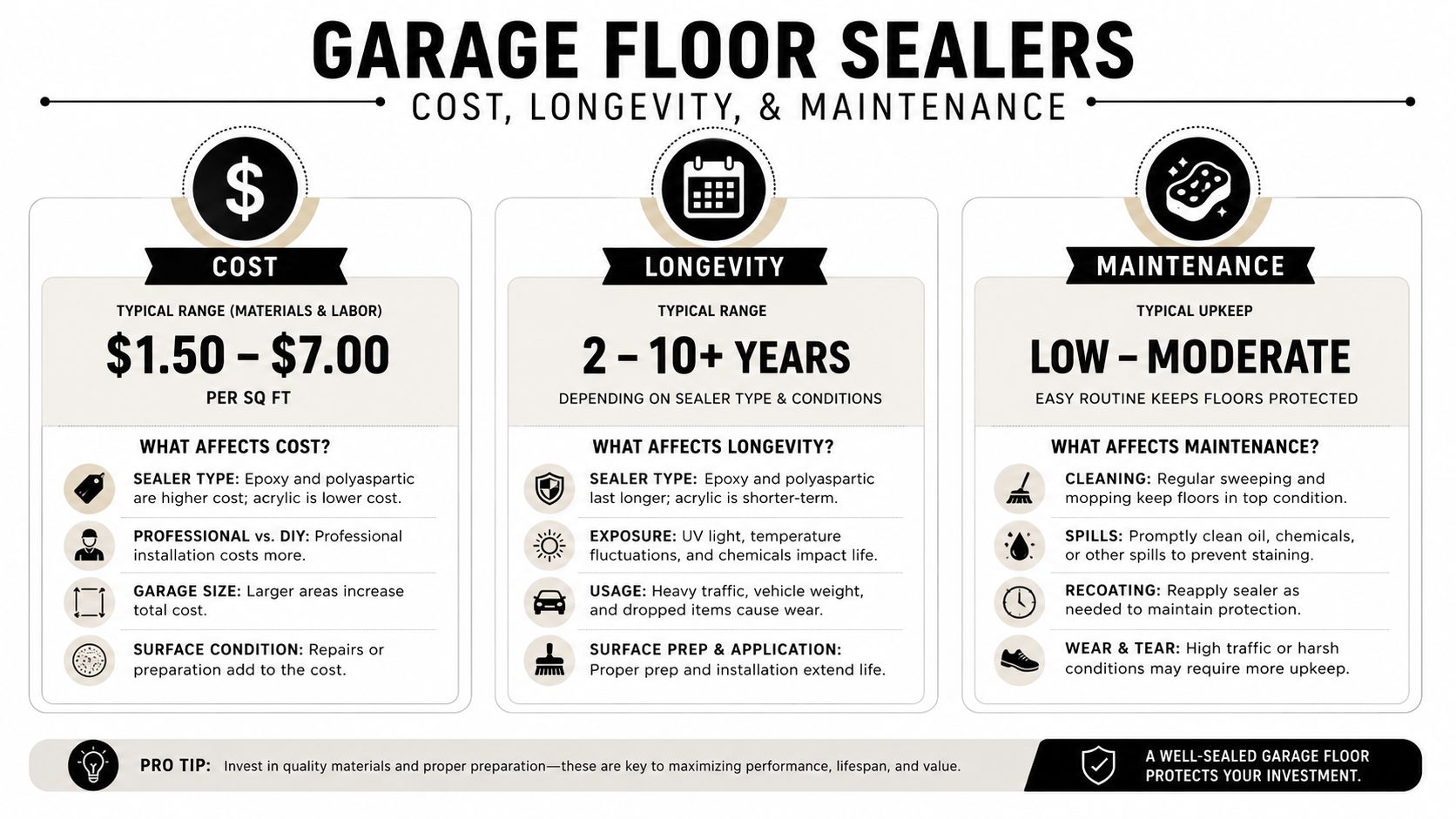
In practical terms, penetrating sealers and acrylic sealers usually sit at the lower end of the budget because the material cost is lower and the installation process is simpler. Coating systems such as epoxy or polyaspartic cost more because the prep is heavier, the materials are more expensive, and the installer is building a thicker protective layer on top of the concrete.
For professionally installed coating systems, homeowners often see pricing discussed by the square foot, with final cost driven by slab condition, crack repair, grinding requirements, moisture issues, and the finish selected. A clean, newer floor costs less to handle than an older slab with oil contamination, pitting, or previous failed products that have to be removed first.
That is why I usually caution homeowners against comparing price by product name alone. A proper comparison is system plus prep plus expected lifespan.
Long-term value versus upfront cost
A lower initial price can still make sense. If the slab is in good shape and the goal is basic protection, a sealer can be money well spent. That is especially true for homeowners who do not care much about decorative finish and want to slow down salt damage and make the floor easier to clean.
The trade-off is service life. Sealers wear away faster, especially in garages that see snow melt, road salt, hot tires, tool drops, and frequent vehicle traffic. Coatings cost more at the start, but they often hold appearance and surface protection longer if they are installed on a slab that is dry, stable, and properly prepared.
That last part matters. If the concrete is failing, a premium coating may still be the wrong investment. In some garages, the smartest long-term decision is a concrete repair program first, or in severe cases, replacement instead of another surface treatment.
Bottom line: The best return comes from matching the system to the slab condition, the way the garage is used, and how long you plan to stay in the home.
Keeping the floor in good shape
Maintenance is usually straightforward, but neglect shortens the life of both sealers and coatings.
- Remove salt and slush regularly: Pennsylvania winters are hard on concrete. Letting salty water sit on the floor adds wear and can leave the surface looking rough sooner.
- Wipe up oil, brake fluid, and other spills: Some products resist staining better than others, but none benefit from prolonged exposure.
- Use mats in high-wear areas: Parking mats or workbench mats can reduce abrasion where tires, jacks, and foot traffic hit the same spots every day.
- Clean with mild products: Routine sweeping and occasional washing with a gentle cleaner is usually enough. Aggressive degreasers and stiff scrubbing can shorten the life of some finishes.
- Address cracks early: A sealer helps protect the surface. It does not stop slab movement, and small cracks are easier to repair before they spread.
For homeowners deciding between sealing and coating, this is the practical way to look at it. If you want affordable protection for a sound slab, a sealer is often enough. If you want appearance, heavier-duty wear resistance, and longer intervals before redoing the floor, a coating system is usually the better investment.
Frequently Asked Questions About Garage Floor Sealing
Can you apply a sealer over an existing coating
Sometimes yes, sometimes no. It depends on what's already on the floor and whether the new product is compatible with it. A garage floor with old paint, a failing coating, or unknown residue usually needs testing and prep before anything new goes down. Coating over a weak layer just transfers the problem upward.
Will a garage floor sealer make the floor slippery
Some can, especially smoother film-forming products when they're wet. That doesn't mean every sealed floor is dangerous. It means product choice and finish texture matter. If slip resistance is a concern, ask about additives or systems that leave more texture underfoot.
What works best in Pennsylvania winters
For many homeowners, a penetrating sealer is a smart answer when the slab is in good shape and the main problem is moisture, road salt, and freeze-thaw wear. If the goal is a cleaner, more finished-looking garage, a professionally installed coating system may be the better fit. The key is matching the system to both climate and expectations.
Should you seal new concrete now if you might want epoxy later
This is one of the most important questions, and a lot of general advice online misses it. A common mistake is applying a penetrating sealer to new concrete with plans to add an epoxy coating later. Most sealers must be mechanically removed before epoxy can be applied because they block the pores of the concrete and prevent the epoxy from bonding, which can lead to system failure, according to ArmorGarage's FAQ on sealer and epoxy compatibility.
That means if you know you want epoxy or another bonded coating later, don't assume a sealer now is harmless. It may create extra prep costs or shut down that option until the slab is mechanically opened back up.
How can you tell if a garage floor is already sealed
A simple field clue is how water behaves. If water beads on the surface instead of darkening the concrete, there may already be a sealer present. That's not a full technical test, but it's a practical first check before planning any new coating work.
When is a new slab the better investment
If the concrete is badly deteriorated, settled, improperly sloped, or structurally compromised, surface products may be treating the symptom instead of the cause. In that situation, money may be better spent on repair or replacement. A beautiful coating on weak concrete won't stay beautiful for long.
If you're weighing a basic garage floor sealer against a full coating system, or you need help deciding whether your slab should be repaired or replaced first, Firm Foundations can help. We build durable concrete foundations and garage slabs across Pennsylvania, Maryland, Delaware, and New Jersey, and we'll give you straight advice based on the condition of your concrete, your budget, and how you use the space. Request a quote to get a garage floor built for long-term performance, not just a quick cosmetic fix.