
Best Garage Floor Coating for PA, MD, DE & NJ Homes


A new garage slab looks clean for about five minutes. Then the first tire marks show up, somebody drips oil near the overhead door, and fine concrete dust starts working its way onto tools, boxes, and anything stored along the walls.
That's usually when homeowners in Pennsylvania, Maryland, Delaware, and New Jersey start searching for the best garage floor coating. They want something that looks sharp, cleans easily, and holds up through wet winters, road salt, hot tires, and day-to-day use.
The part most online guides miss is simple. A coating is only the top layer. The actual job starts much lower, at the slab itself. If the concrete was poured well, drained properly, and allowed to cure under the right conditions, you have a strong foundation for a coating system. If the slab has moisture issues, weak surface paste, poor finishing, or drainage problems around the building, even a premium coating can fail early.
That's why garage coatings make the most sense when you look at them the same way you'd look at concrete foundations, garage footings and foundations, or a concrete foundation for garage build. The surface matters, but the base matters more.
Protecting Your Investment from the Ground Up
A lot of homeowners call after building a new detached garage, adding a workshop, or finishing a slab for a barn shed or storage building. The garage is finally up, the doors are on, and now they want to keep the floor from turning into a stained, dusty mess.
That instinct is right.
Bare concrete works, but it takes abuse. In our PA, MD, DE, and NJ climate, garages see water, deicing residue, seasonal humidity swings, and freeze-thaw stress at the apron and entry. Even when the slab stays structurally sound, the surface can start looking worn long before the building itself does.
What homeowners usually want
Many homeowners aren't asking for chemistry. They're asking for practical results:
- Cleaner storage space that doesn't keep shedding concrete dust
- Better stain resistance against oil, gasoline, and routine household chemicals
- A tougher wear surface for daily parking, toolboxes, and general traffic
- An easier-to-maintain finish that doesn't trap every mark
Historically, epoxy has been the dominant garage floor coating because it balances durability, chemical resistance, and cost. A 2026 market overview says epoxy coatings are the leading segment in the garage flooring market, which is projected to reach USD 17.56 billion in 2026 and USD 25.54 billion by 2033, with a 5.5% CAGR, according to this garage flooring market overview.
That history matters because epoxy earned its reputation the hard way. It became popular by giving garages a hard, impact-resistant, easy-to-clean surface that stands up to oil, gasoline, and cleaning chemicals.
Field reality: The coating that performs well over time usually starts with a slab that was placed, finished, and drained correctly.
Homeowners searching for garage foundation contractors near me, concrete contractors, or cement foundations for garage projects are often thinking about the slab first and the finish later. That's the right order. A garage floor coating should be treated as the final protective layer on a properly built concrete surface, not as a fix for bad concrete.
Why slab quality changes everything
A coating can improve appearance and protect a good slab. It won't correct weak finishing, trapped moisture, settlement-related movement, or drainage failures outside the garage.
That's where experience with foundation builds, site prep, excavation, and slab construction changes the advice. If the garage floor was built on a solid base, with attention to grading and long-term water control, you have real options. If it wasn't, the conversation should start there.
Why Your Concrete Slab Health is the Real Key
Most articles frame the decision as epoxy versus polyaspartic versus polyurea. That's incomplete. The first question is whether the slab is dry, stable, and suitable for a coating at all.
Most “best garage floor coating” content ignores slab moisture, but moisture and hydrostatic pressure can cause peeling or blistering if the concrete isn't dry enough or the site lacks adequate drainage, which is especially relevant in wetter Mid-Atlantic conditions, as noted in this discussion of coating choice and slab moisture.
Moisture problems don't stay hidden
A garage slab can look fine on top and still be pushing moisture upward. That's what causes a lot of frustrating coating failures. The coating may bond at first, then start lifting, bubbling, or separating as vapor pressure works against it from below.
This is common in areas with:
- Poor exterior drainage where water runs back toward the garage
- High seasonal groundwater
- No effective vapor protection under the slab
- Humid conditions that slow drying and keep the concrete loaded with moisture
In this region, that combination isn't rare. It's one reason a simple damp spot near a wall or overhead door shouldn't be brushed off.
The slab and the site work together
Concrete performance starts before the truck arrives. Proper grading, excavation, base preparation, and water management around the structure all affect how the slab behaves later.
If you're comparing a new coating to the cost of correcting recurring moisture issues, the moisture issue wins every time. Solve that first. Homeowners who want to understand how under-slab protection fits into long-term slab performance can review this guide on a garage floor vapor barrier.
A coating should go onto concrete that's ready to receive it, not concrete that's still fighting water.
What a contractor should check before coating
Before anybody talks color flakes or gloss level, the basics should be reviewed:
- Surface condition. Weak, dusty, contaminated, or overly smooth concrete needs proper prep.
- Cracks and joints. Some movement is cosmetic. Some movement signals a deeper slab issue.
- Drainage outside the garage. Downspouts, apron slope, and yard grading all matter.
- Moisture condition. Testing isn't a sales trick. It's a diagnostic step.
Experience in excavation near me, garage footings and foundations, and slab construction matters more than marketing language. The coating only performs as well as the concrete underneath.
Comparing the Top Garage Floor Coating Systems
Homeowners usually ask for one product name. What they really need is a side-by-side view of how each system behaves in a real garage.
Here's the quick version first.
| Garage Floor Coating At-a-Glance Comparison | Durability | Avg. Pro Cost/sq. ft. | Cure Time | UV Stability |
|---|---|---|---|---|
| 100% solids epoxy | High | Varies by slab condition and system design | Slower than fast-cure systems | Fair to limited without UV-stable topcoat |
| Polyaspartic | Very high | Varies by slab condition and system design | Fast, often suitable for quick return to service | Strong |
| Polyurea | Very high | Varies by slab condition and system design | Very fast | Varies by formulation |
| Urethane or polyurethane topcoat system | High as part of a system | Varies by slab condition and system design | Moderate to fast depending on system | Strong |
| Acrylic sealer or concrete paint | Low for garage use | Lower initial cost | Fast to moderate | Limited |
Epoxy still matters
Epoxy has been the standard for years because it gives a hard, durable build layer with good chemical resistance. It's still the baseline against which most garage coatings get compared.
Where epoxy really helps is film build. Professional epoxy systems are commonly installed in the 20 to 250 mil range, while heavy-duty resinous flooring can reach 375 mils or more. By contrast, store-bought DIY epoxy kits may leave only about 1.5 mils per coat, according to this garage floor coating guide. That's not a small difference. It's a completely different performance class.
If you want a simple way to think about it, thicker professional systems give the slab a tougher sacrificial layer. That helps with hot tires, abrasion, and chemical exposure.
Where polyaspartic and polyurea stand out
Polyaspartic and polyurea systems are popular for good reason. They cure fast, handle demanding service well, and generally perform better than standard epoxy in sun-exposed or temperature-variable conditions.
A practical summary:
- Polyaspartic is attractive when UV stability, weather resistance, and faster return to use matter.
- Polyurea is known for fast installation and flexibility.
- Epoxy still does important work as a base or build coat.
The right question isn't “Which chemistry wins?” It's “Which system fits the slab, the use, and the exposure?”
What doesn't work well for serious garage use
Paint and light-duty acrylic sealers can improve appearance for a while, but they don't belong in the same category as a professional coating system. They may be acceptable for a low-use storage space. They're usually a poor fit for a working garage, a home shop, or a daily-driver bay.
For homeowners looking at long-term value, the main trade-offs are:
- Initial cost versus service life
- Fast cure versus installation sensitivity
- Appearance versus repair simplicity
- UV resistance versus raw build thickness
That's why the best garage floor coating usually isn't a single product sold as a magic answer.
The Professional's Choice Modern Hybrid Systems
The strongest systems today combine materials instead of forcing one product to do everything.
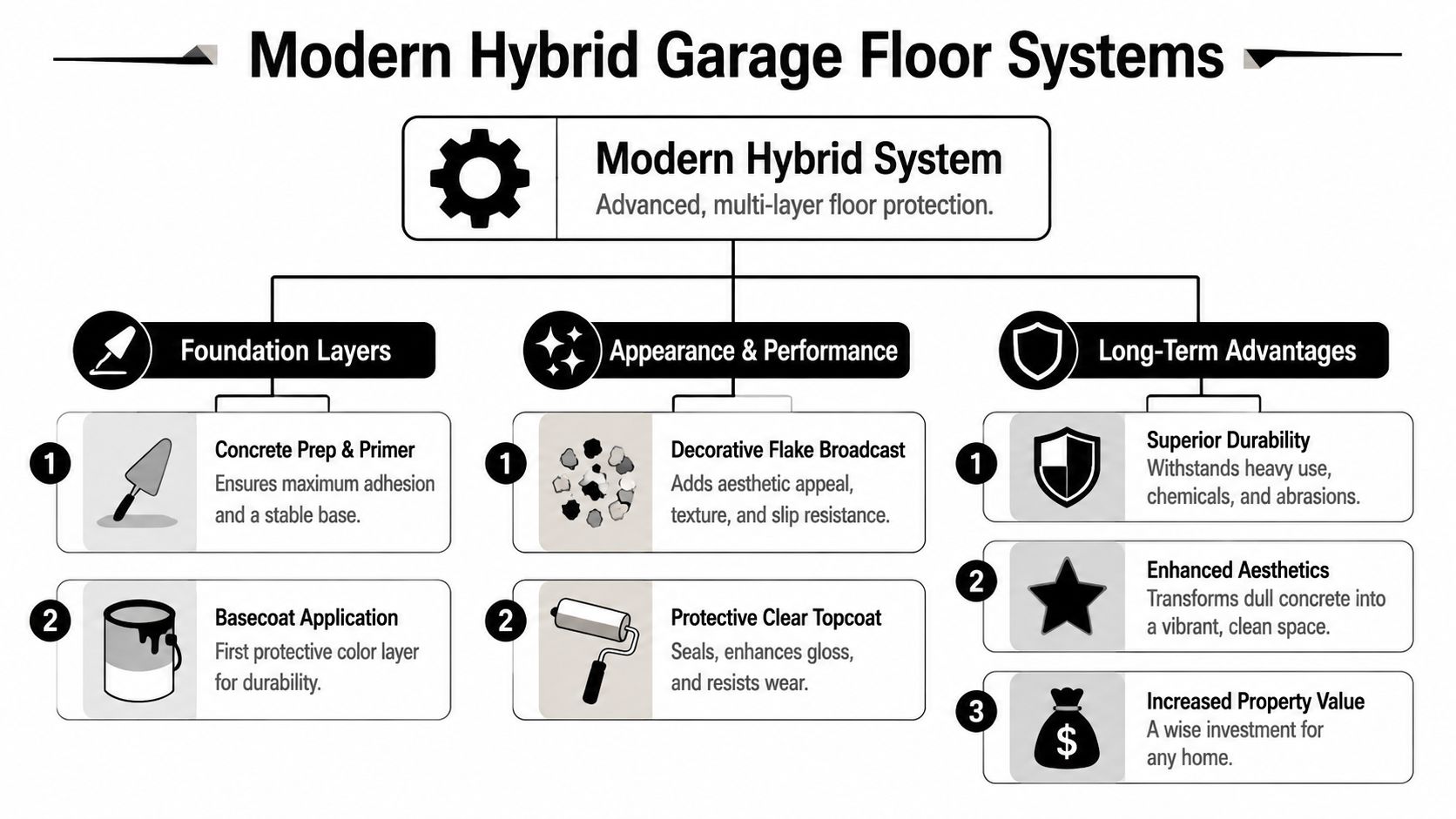
Industry guidance describes the “clear winner” for most homeowners as a professionally installed, multi-layer system using 100% solids epoxy as the base coat and polyaspartic as the topcoat, combining a durable foundation with a UV-stable, scratch-resistant finish. The same guidance says polyaspartic offers about 10x the durability of some traditional epoxy coatings and can allow one-day installation, according to this review of top garage floor options.
Why hybrid systems work better
A garage floor has several jobs at once. It needs to bond to concrete, absorb wear, resist chemicals, look good, and stay stable near the door where sunlight hits. One material rarely does all of that equally well.
A hybrid system solves that by assigning the job in layers:
- Epoxy base coat for adhesion and build
- Decorative flake or texture layer if desired
- Polyaspartic or urethane topcoat for UV resistance, scratch resistance, and easier cleaning
That's the same logic used in many high-performance resin flooring systems. Build thickness where you need it. Surface protection where you need it.
Why pros lean this direction
This approach gives a homeowner a better balance of performance than a single thin coating. It also gives the installer more control over how the finished system handles a real garage environment.
If you want a broader sense of how advanced protective systems are engineered in industrial settings, it's useful to learn about military-grade industrial coatings. The products used in residential garages aren't identical to every industrial application, but the design principle is similar. Match the system to the substrate, exposure, and service demands.
A thick base coat gives the floor substance. A UV-stable topcoat keeps that system looking and performing right at the surface.
Where a local slab contractor fits in
This is one place where Firm Foundations is relevant to the conversation. The company builds garage slabs, concrete pads, and related sitework across PA, MD, DE, and NJ, so the coating decision can be tied back to slab condition, drainage, and the quality of the original concrete work rather than treated as a cosmetic add-on.
That matters for homeowners searching for garage foundation contractors near me, shed foundations near me, or concrete foundation for garage solutions and trying to think through the whole project, not just the finish.
A Decision Guide for PA MD DE & NJ Homeowners
The best system depends on how you use the garage. A family parking bay in Delaware doesn't need the same floor as a tool-heavy workshop in Pennsylvania.
Match the coating to the garage
If your garage is mainly for daily parking, snow melt, and household storage, a professional hybrid system usually gives the best balance. You get strong chemical resistance, a surface that cleans easily, and better long-term appearance near the garage door.
If you use the space as a workshop, impact resistance and build thickness matter more. Dropped hand tools, rolling equipment, and repeated abrasion call for a system with a strong base layer and careful surface prep.
If your garage gets a lot of direct sun, especially near the threshold, prioritize UV stability. That's where polyaspartic or a UV-stable urethane topcoat makes more sense than relying on epoxy alone.
Simple local scenarios
- Lancaster County or Chester County workshop use. Go with a thicker professional system, not a paint product or light DIY kit.
- Southern New Jersey sun exposure. Favor a system with a UV-stable topcoat to reduce yellowing risk at the front edge.
- Maryland or Delaware garage with moisture concerns. Hold off on coating until the slab and drainage are evaluated.
- Detached garage used like a showroom. Decorative flake plus a quality topcoat usually gives the cleanest finished look.
Budget the right way
The cheapest option up front is often the most expensive one to redo. If a coating fails because the slab was damp, the floor wasn't ground properly, or the product was too light-duty for the use, you're paying for removal, prep, and reinstall.
A smarter budget asks three questions:
- Is the slab healthy enough to coat?
- How hard will this garage be used?
- Do I care more about lowest initial cost or fewer problems later?
That same thinking applies whether you're planning a garage slab, a base for storage shed, a gazebo foundation, or a larger concrete project. The long-term value starts with matching the system to the site and the structure.
The Risks of DIY vs The Value of a Professional
DIY garage floor kits are appealing because they look simple on the box. Clean the floor, roll on the coating, toss some flakes, and you're done. In practice, most failures happen long before the topcoat dries.
For performance-focused floors, polyaspartic systems are often superior to standard epoxy where UV stability, flexibility, and turnaround time matter. Guidance also recommends a hybrid system with an epoxy primer and polyaspartic topcoat to combine adhesion and thickness with UV protection and improved surface durability, as explained in this complete guide to garage floor coatings.
Where DIY jobs usually go wrong
The biggest issue is surface prep. A garage floor has to be mechanically prepared so the coating can bond. That means grinders, proper crack repair, dust control, and careful cleaning. Skipping or softening that step is one of the fastest ways to end up with peeling.
DIY work also runs into trouble with:
- Moisture misdiagnosis that isn't discovered until the coating starts failing
- Thin material application that doesn't perform like a professional system
- Fast-curing products that are hard to place correctly without experience
- Poor edge work and timing that leave visible roller lines or weak spots
A failed coating is also harder to undo than many homeowners expect. Once the floor needs grinding and removal, the “save money” part of the project usually disappears.
What you're paying a professional for
A pro isn't just selling product. They're controlling variables:
- slab evaluation
- moisture assessment
- mechanical prep
- repair of minor defects
- system selection based on use and exposure
- installation within the right recoat windows
That's similar to the logic behind hiring shed foundations contractors near me or gravel shed foundation contractors near me instead of trying to improvise a structural base. Specialized work tends to stay specialized for a reason.
Homeowners who are comparing kit options can also look at this overview of a garage floor kit to understand where off-the-shelf approaches differ from full professional systems.
Most bad coating jobs don't fail because the color was wrong. They fail because the prep, moisture judgment, or application method was wrong.
For contractors reading this, there's a separate lesson too. Companies that explain prep, drainage, and long-term ownership clearly tend to earn better-fit customers. If that topic interests you, this guide on how contractors can get more local leads in 2026 is a practical resource.
Long-Term Care for Your New Garage Floor
A quality garage floor coating should make ownership easier, not create a maintenance headache. Still, no floor is maintenance-free.
Long-term value depends not just on durability but also on how the floor handles hot tires, chemical spills, and spot repairs over time, as discussed in this overview of choosing a garage floor coating.
What to do after installation
Keep the routine simple:
- Sweep grit regularly so sand and debris don't act like sandpaper
- Clean spills promptly especially oil, gasoline, and harsh automotive fluids
- Use mild cleaners instead of aggressive acids or overly strong degreasers
- Rinse winter residue so salts and grime don't sit on the surface
What to expect over time
Hot-tire pickup is mostly a problem with weaker systems or poor prep. Better professional systems reduce that risk, but homeowners should still avoid assuming every coating is equal.
Minor scratches can happen, especially in working garages. The important question isn't whether a mark will ever appear. It's whether the system can be cleaned, maintained, and repaired without turning into a full replacement project.
A floor that looks great on install day but becomes difficult to patch later may not be the best long-term value. For many households, the better answer is a finish that balances appearance, serviceability, and realistic maintenance.
Frequently Asked Questions About Garage Floor Coatings
What is the best garage floor coating for most homes in PA, MD, DE, and NJ
For most homeowners, a professionally installed multi-layer system with an epoxy build layer and a UV-stable topcoat is the strongest all-around choice. The final recommendation still depends on slab condition, moisture, sun exposure, and how the garage is used.
Can you coat a brand-new garage slab right away
Usually, the slab needs to cure properly and be evaluated before coating. New concrete isn't automatically ready just because it looks dry on top.
What if my garage floor already has cracks or damp spots
Don't coat first and hope for the best. Cracks, moisture, and drainage issues should be diagnosed before any finish goes down. Some cracks are manageable. Ongoing moisture is a bigger warning sign.
Is a DIY kit good enough for a garage
For a light-use storage space, maybe. For a daily-use garage, workshop, or vehicle bay, DIY kits are usually in a lower performance class than professional systems.
Does a better slab lead to a better coating result
Yes. Strong concrete, proper base prep, and good drainage give any coating system a much better chance of lasting.
If you're planning a new garage slab or thinking about coating an existing one, start with the concrete first. Firm Foundations builds garage slabs, concrete pads, and foundation systems across Pennsylvania, Maryland, Delaware, and New Jersey, with attention to drainage, site prep, and long-term slab performance. If you want a quote for a new garage foundation, help evaluating slab conditions, or guidance on whether your floor is ready for a coating, reach out and start with the ground that everything else depends on.