
Concrete Patio With Pergola Ideas & Expert Guide
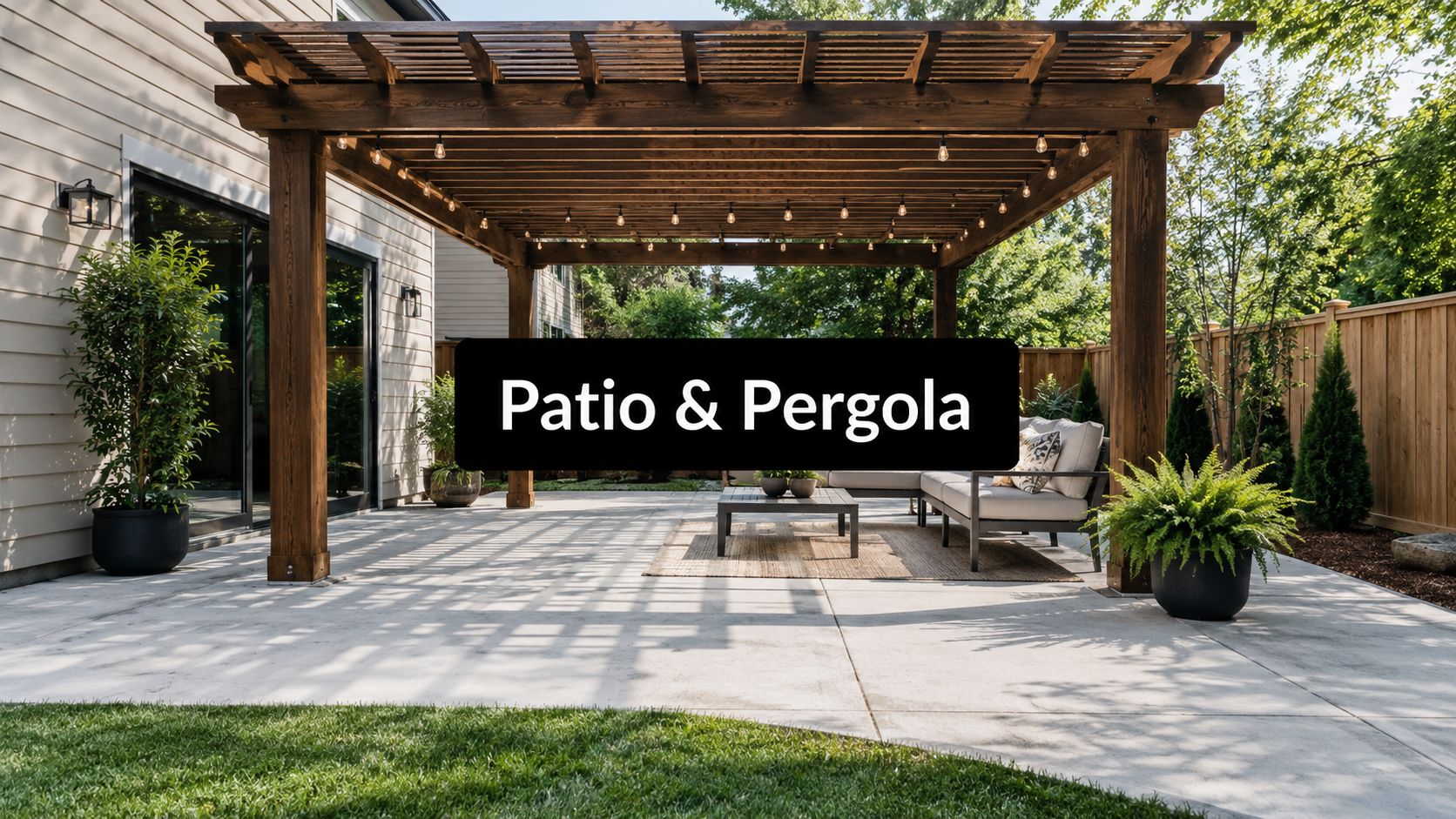
A lot of homeowners across Pennsylvania, Maryland, Delaware, and New Jersey start in the same place. They have an empty stretch of backyard, an aging patio, or a patch of lawn that feels underused, and they know exactly how they want it to feel when it's done. They want a clean concrete patio with pergola overhead, enough shade to make summer afternoons comfortable, and a space that works for dinners, quiet mornings, and family time.
What usually slows people down isn't the vision. It's the uncertainty around how to build it the right way. A pergola changes the job. Once posts, anchors, drainage, slab thickness, and local code come into the picture, this stops being just a patio and starts becoming a structural project that needs to be planned properly.
Your Vision for a Perfect Backyard Oasis
A well-built backyard living space feels simple when you're using it. The patio is level. The pergola lines are straight. Water moves away from the house. The posts feel solid when the wind picks up. That clean finished look only happens when the base is designed for the structure sitting on top of it.
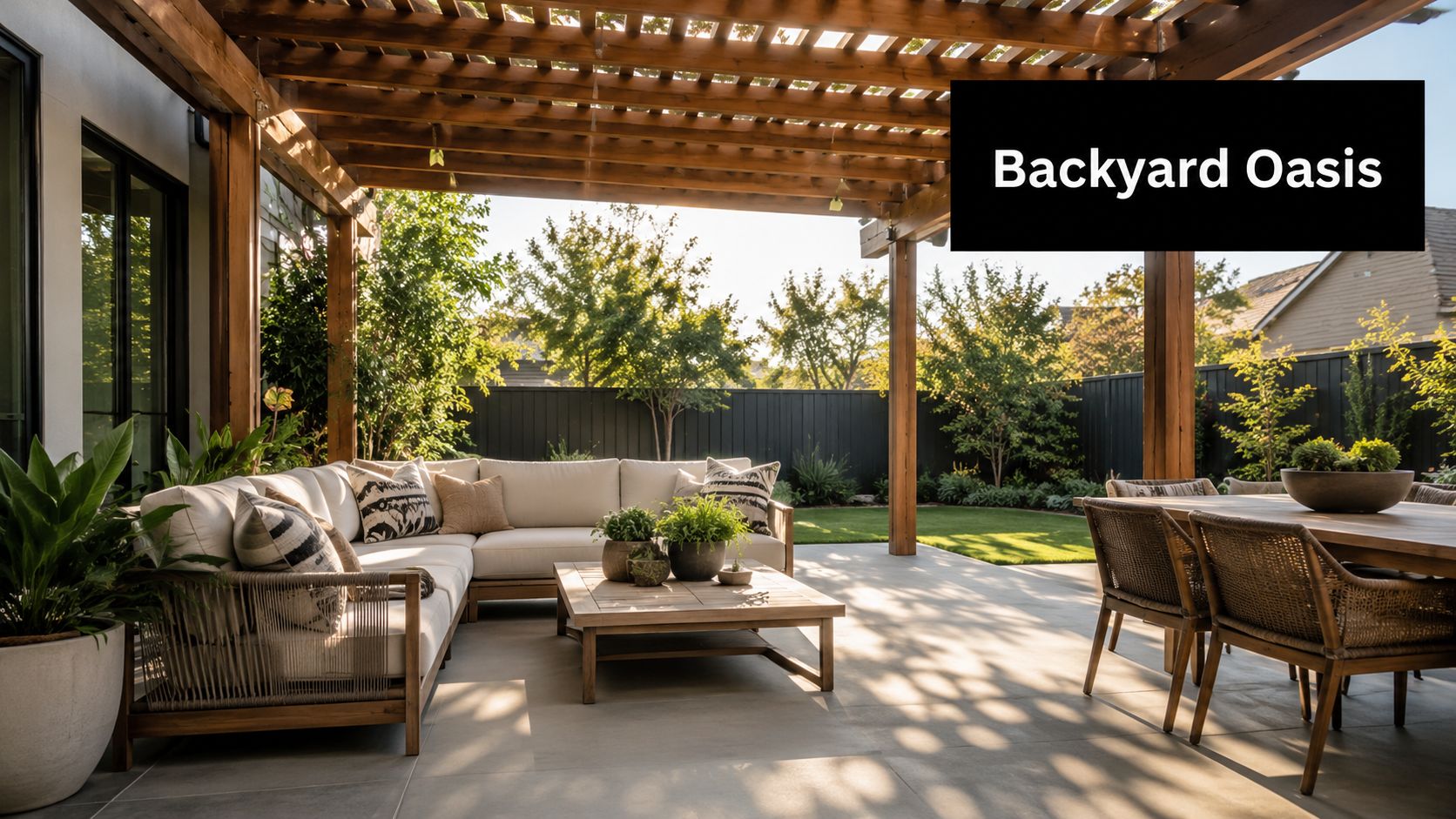
In this region, homeowners often call after seeing patio photos online and realizing most galleries skip the part that matters most. They show the furniture, string lights, and finished beams. They don't show the excavation, the subbase, the concrete forms, or the anchoring details that determine whether the project stays attractive and stable through changing weather.
What homeowners usually want
Some want a simple slab with a freestanding wood pergola near the back door. Others want a larger outdoor room tied into a pool area, outdoor kitchen, or fire feature. The style can change. The basic needs don't.
- Comfortable shade: Enough coverage to make the patio usable during hot afternoons.
- A clean layout: Room for furniture, walking space, grills, and traffic flow.
- Low maintenance: A surface that's easier to keep up than pavers with shifting joints or grass that turns muddy.
- Long-term stability: A patio and pergola system that won't loosen, settle, or crack around the posts.
Homeowners comparing surface choices often benefit from reviewing broader paving material options for homeowners before committing to a final plan. If you're still collecting ideas, these backyard concrete slab ideas can also help you sort out size, layout, and finish direction before the project gets priced.
A patio for seating and a patio that has to carry pergola post loads are not the same job.
Where the real decisions start
The first good question isn't “Can I put a pergola on concrete?” It's “Was this concrete designed for a pergola, or does it only look ready for one?” That's where many projects either stay on track or start creating problems.
A beautiful pergola set on the wrong slab can lead to loose anchors, chipped edges, standing water, or post movement over time. A properly planned slab gives you the opposite. It creates a backyard feature that feels finished, dependable, and worth the investment from the first day on.
The Foundation Plan, Design, Permits, and Site Prep
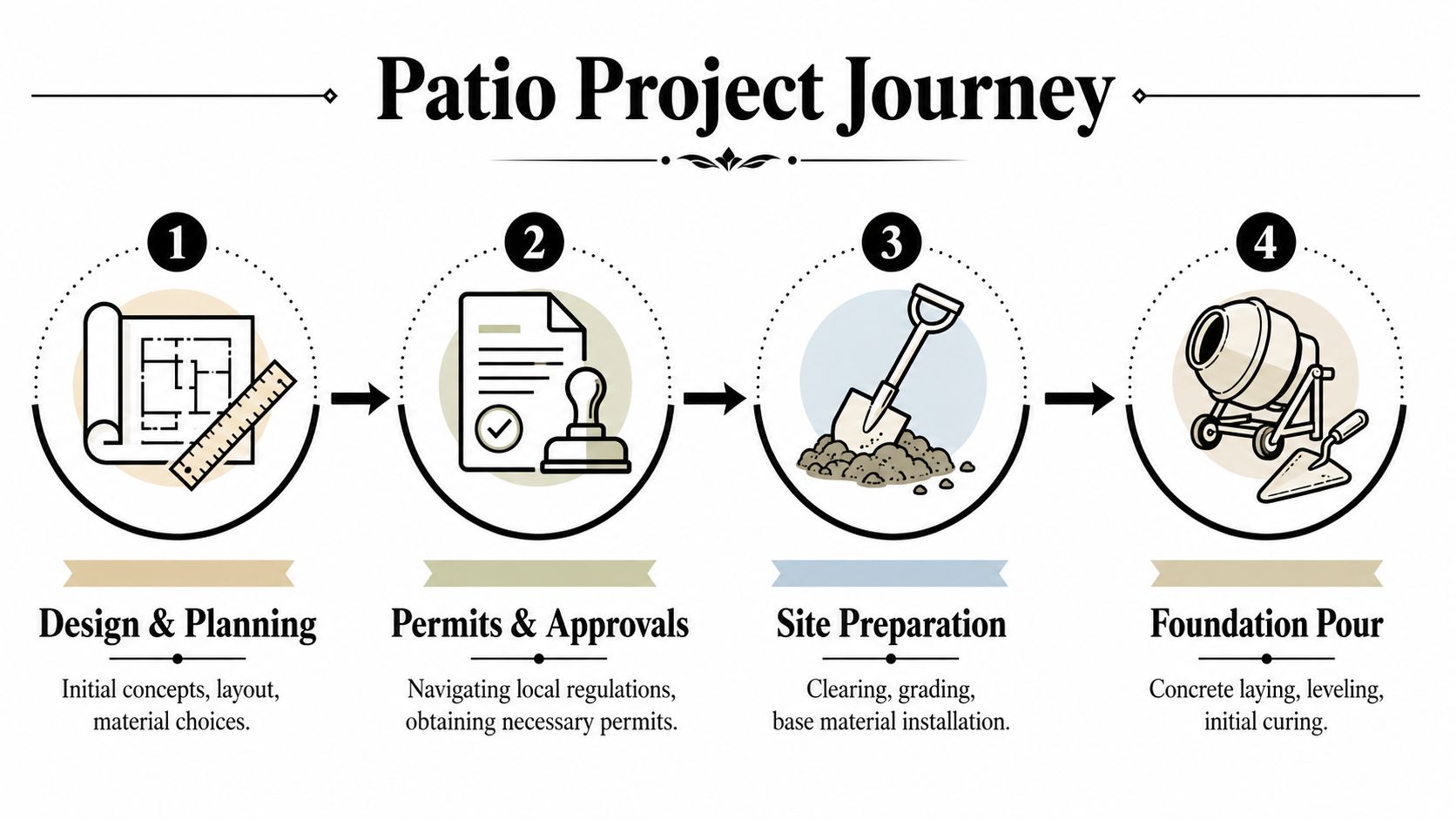
The strength of a concrete patio with pergola starts before any concrete truck shows up. The planning phase decides whether the slab drains correctly, whether the pergola layout works with your yard, and whether the finished project will pass inspection without expensive changes later.
Start with layout and drainage
The patio has to fit how you'll use it, but it also has to fit the property. That means checking setbacks, access paths, door clearances, and how water already moves across the lot. In southeastern Pennsylvania and surrounding areas, a flat-looking backyard can still hold water in ways that don't show up until after a heavy rain.
Good design work usually includes these checks:
- House relationship: The patio should sit comfortably off the home, not trap water against it.
- Pergola footprint: Post locations need to make sense with furniture, traffic flow, and roof overhangs.
- Surface drainage: Water needs a planned path away from structures and away from post bases.
- Edge conditions: Steps, retaining areas, and lawn transitions need to be intentional, not improvised at the end.
Permits matter more than people think
A pergola changes the permit conversation because it introduces structural loads and anchoring. Rules vary by township and municipality, but homeowners shouldn't assume a backyard shade structure is automatically exempt. In Pennsylvania, Maryland, Delaware, and New Jersey, local review can affect footing depth, placement, and attachment details.
That's one reason site planning should happen before materials are ordered. It's easier to move a layout line on paper than to relocate anchors after a pour.
Practical rule: The more permanent the pergola is, the more important it is to treat the patio and supports like a real structural system.
Site prep is where good slabs begin
Once the design is settled, actual work starts with excavation and base preparation. This is the part many people never see, but it's what separates a durable patio from one that shifts or cracks early.
The sequence is straightforward when it's done correctly:
- Excavate to proper depth: Remove organic material and soft spots so the slab isn't sitting on unstable ground.
- Build the base: Compact gravel in a controlled way so the concrete has uniform support.
- Set concrete forms: Forms establish the shape, elevation, and finished edges.
- Prepare for reinforcement: Reinforcement has to be placed correctly before the pour, not dropped in as an afterthought.
For homeowners who want a clearer picture of what that groundwork looks like, this overview of site preparation for concrete slab projects is useful because it shows why excavation and base work carry so much of the project's performance.
What a pergola-ready slab needs
A patio intended to support pergola loads should be built with those loads in mind. One commonly cited minimum is a 5-inch concrete slab reinforced with rebar on an 18-to-20-inch grid according to Western Timber Frame's pergola foundation guidance.
That doesn't mean every yard gets the exact same build. Soil conditions, pergola size, and local requirements still matter. It does mean that thin, lightly built patio slabs are often the wrong place to start if the goal is a permanent pergola installation.
Pouring a Durable Concrete Slab That Lasts
Once the excavation, base, and forms are right, the pour has to match the purpose of the patio. A slab under a pergola isn't just a place to set chairs. It needs to perform as part of the support system for the structure above it.
Thickness and reinforcement are doing the heavy lifting
Concrete is strong in compression, but that doesn't mean any patio slab will hold up under concentrated post loads and seasonal ground movement. Reinforcement is what helps the slab hold together when conditions aren't perfect. That includes shrinkage during curing, minor soil movement, and stress around anchor locations.
This is why contractors planning a concrete patio with pergola don't treat it like a basic walkway or a small base for storage shed use. The slab has to be built with more discipline because the consequences of movement show up fast once a rigid frame is bolted to it.
A reliable pour also depends on details that homeowners don't always hear about up front:
- Subbase consistency: Soft spots under one corner can lead to uneven support.
- Reinforcement placement: Steel has to stay where it was designed to work.
- Finishing timing: Overworking wet concrete often creates surface weakness.
- Curing protection: Fresh slabs need time and care to develop properly.
Exterior work has to deal with weather
In PA, MD, DE, and NJ, exterior concrete takes a beating. Freeze-thaw cycles, wet seasons, and temperature swings all push on the slab differently over time. A patio that looks good the day it's poured still needs enough structure to stay serviceable after years of exposure.
That's why the right concrete mix, proper finishing, and disciplined curing all matter. The goal isn't just a smooth patio on day one. The goal is a slab that still supports anchors, sheds water, and keeps its shape after seasons of use.
If the base was rushed, the concrete usually tells on the project later.
Homeowners trying to build a lasting outdoor space often focus on surface appearance first, but the slab's internal strength and reinforcement usually decide whether that appearance holds up.
What doesn't work
The common failures are predictable. A thin slab poured over weak prep. Reinforcement added inconsistently. Anchors planned after the concrete is already cured. Edges too close to post bases. These shortcuts may save time at the start, but they tend to cost more once cracking, chipping, or movement begins.
A properly poured slab gives the pergola installer a stable, predictable surface to work with. That makes every step above it cleaner and safer.
Choosing the Right Pergola Anchoring System
Anchoring is where the project becomes structural in a very obvious way. The pergola can look excellent and still be wrong if the posts aren't tied into the concrete properly. In this region, where frost, wind, and wet weather all matter, the anchor choice should never be treated like a hardware-store decision.
Two professional paths
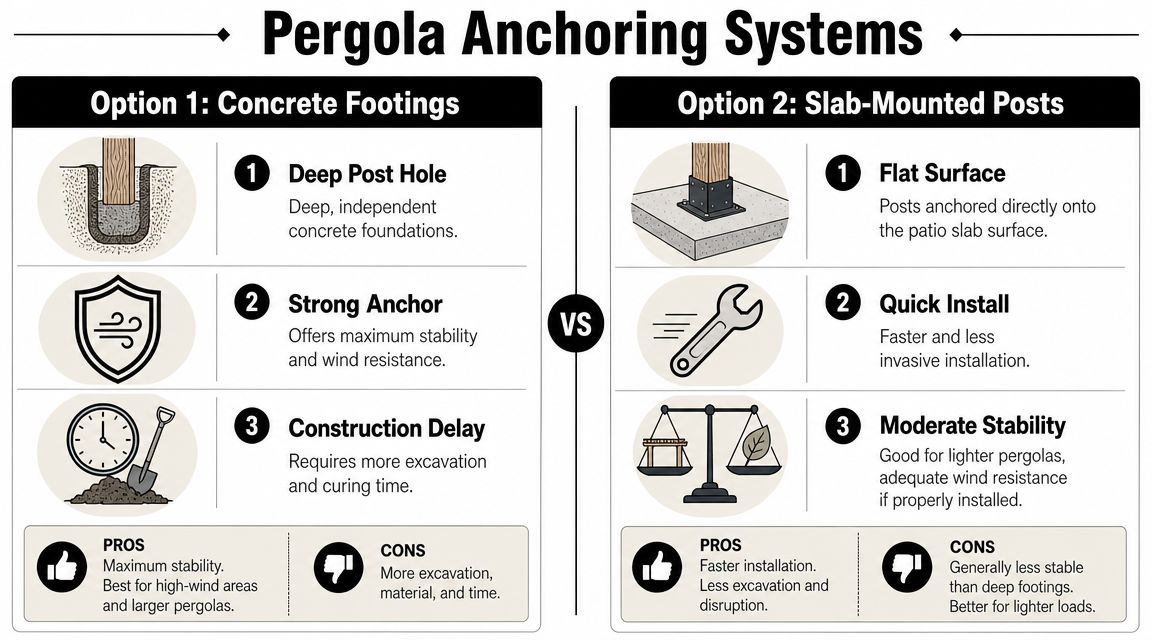
Most pergola installations over concrete come down to dedicated footings or slab-mounted anchors. Both can work in the right setting. They are not interchangeable.
Concrete footings are the stronger solution when the pergola is larger, heavier, or expected to handle more weather exposure. They transfer loads into the ground more directly and are often the safer route in places where frost movement is a concern.
Slab-mounted anchors can be appropriate when the slab was designed for the job and the pergola system fits that approach. This method is less invasive, but it puts much more importance on slab thickness, slab condition, edge distance, and anchor selection.
According to CHC Remodeling's pergola footing guidance, typical piers are 10 to 16 inches in diameter and can be 12 to 48 inches deep or more, depending on local code and frost depth. That range is a useful reminder that the correct answer depends on where the project is located and how the structure is being supported.
Pergola anchoring methods compared
| Factor | Concrete Footings | Slab-Mounted Anchors |
|---|---|---|
| Structural support | Independent support below the patio | Relies on slab quality and thickness |
| Frost performance | Better choice where frost heave is a concern | More limited if the slab wasn't built for structural loads |
| Installation effort | More excavation and coordination | Faster when conditions are right |
| Best use case | Larger or more permanent pergolas | Suitable for lighter pergolas on sound slabs |
| Risk if done poorly | Movement from improper depth or placement | Spalling, weak hold-down, or anchor failure |
The small details that matter
Anchor layout is not guesswork. One installation source recommends laying out carefully with a framing square and chalk lines, keeping post bases at least 2 inches from slab edges, and drilling anchor holes about 1/2 inch deeper than the anchor length so the fastener seats fully, as shown in this pergola-on-concrete installation walkthrough.
Those details matter because anchors fail at the edges first. A post base placed too close to the patio perimeter can chip the slab or weaken hold-down performance during load.
For homeowners who want to better understand the hardware side, this practical guide to installing concrete wedge anchors helps explain why anchor type and installation technique matter so much.
Don't decide the pergola first and ask whether the slab can handle it later. Check the load path from the top down and the ground up.
What the right choice usually looks like
If the slab is older, cracked, thin, or unknown, dedicated footings are often the cleaner answer. If the slab is newer, reinforced, properly located, and built for the pergola plan, slab-mounted anchors may be a workable option. The right answer comes from evaluation, not preference.
Finishing, Sealing, and Long-Term Maintenance
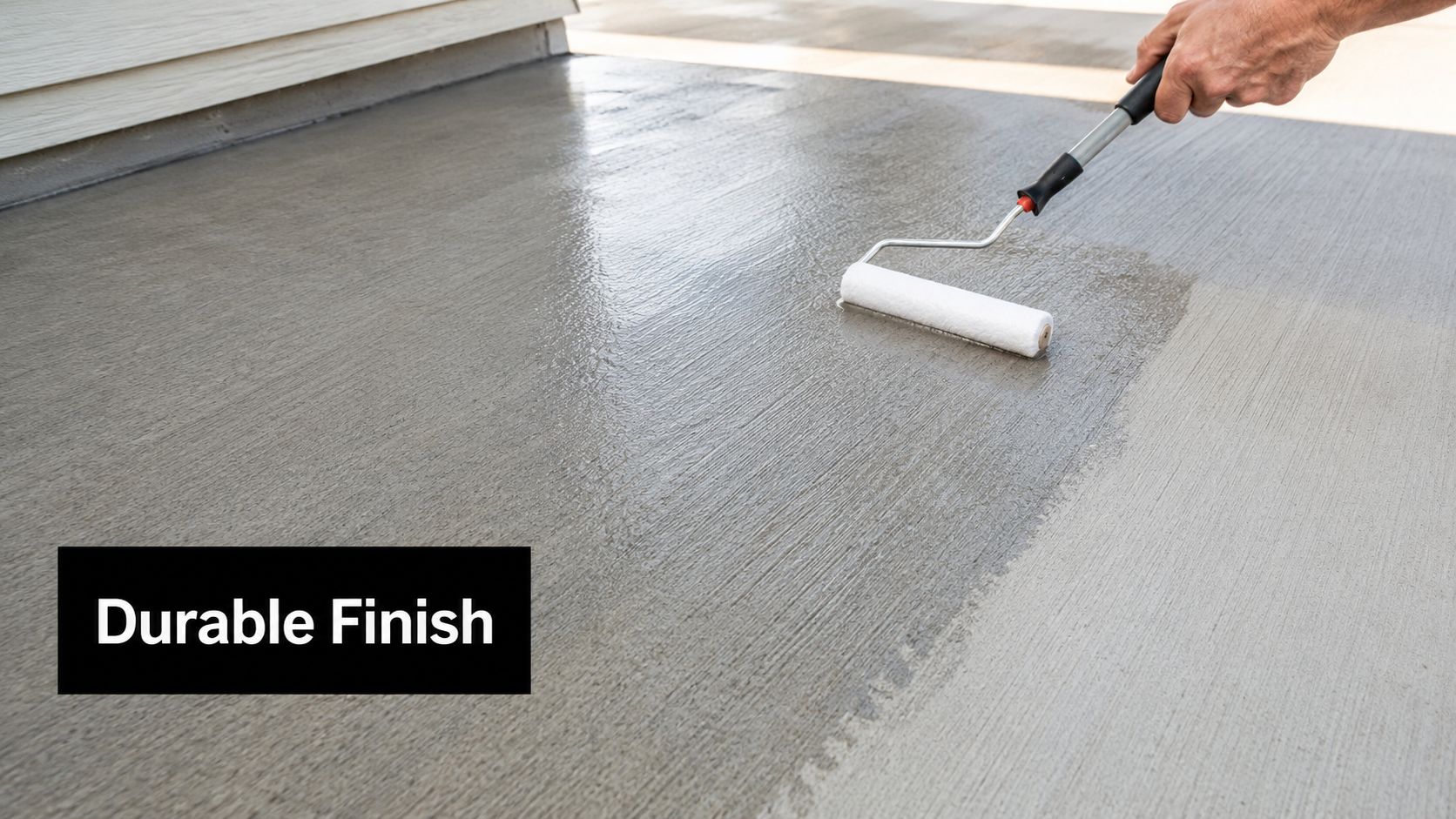
The final appearance of the patio matters, but the finishing stage is also where long-term usability gets protected. Here, texture, jointing, moisture control, and sealer choice all come together.
The finish affects everyday use
For most patios, a light broom finish is the practical choice. It gives the slab a cleaner walking surface than a slick steel-troweled finish and helps with traction when the patio gets wet. That matters even more under a pergola, where sections of the slab may dry unevenly.
Control joints are another part of professional finishing that homeowners should expect. Concrete can crack. The goal is to guide that movement into planned lines instead of letting it run randomly across the surface.
A good finishing plan usually includes:
- Slip resistance: A patio should feel secure underfoot after rain.
- Control joints: These help manage where natural cracking shows up.
- Clean edges and transitions: They improve both appearance and durability.
- Sealer selection: The right sealer adds protection against moisture and staining.
Pergolas change how patios dry
A pergola improves comfort, but it also changes the moisture pattern on the slab. Shaded concrete stays wet longer than concrete in full sun, especially in humid parts of Pennsylvania, Maryland, Delaware, and New Jersey. That can show up as darker areas, algae growth, staining, and a more slippery walking surface.
A practical benchmark for drainage is a 1/4-inch-per-foot slope, and a high-quality sealer is also important for moisture management, as noted in this concrete drainage and maintenance discussion.
That moisture issue is one of the most overlooked parts of a concrete patio with pergola design. Homeowners often think about shade first and drying time later. The patio has to handle both.
Here's a useful visual on sealing methods and surface protection in practice:
What maintenance actually looks like
This doesn't need to become a high-maintenance surface. It just needs periodic attention.
Keep organic debris off the slab, watch for slippery shaded areas, and reseal on a sensible schedule based on wear and exposure.
If a pergola creates a persistently damp corner, that area may need more frequent cleaning than the rest of the patio. That's normal. It's also easier to manage when the slab was pitched, jointed, and sealed correctly from the beginning.
Your Project Partner in PA, MD, DE, and NJ
A concrete patio with pergola can be one of the most rewarding improvements you make to a home. It adds usable outdoor space, improves how the yard functions, and gives the property a finished feel. But this kind of project only performs well when the slab, drainage, and anchoring were treated as one connected system.
That's why professional execution matters so much in this region. Weather changes quickly, soils vary from property to property, and local code requirements don't always line up neatly from one township to the next. In variable conditions, professional anchoring methods such as wedge anchors, epoxy-set bolts, and reinforced base plates are important for wind resistance and code compliance, according to Express Sunrooms' guidance on pergolas over concrete slabs.
What homeowners should expect from the process
A solid contractor should be able to explain the job in plain language. That includes whether the patio needs dedicated support under pergola posts, how water will drain, what finish is appropriate, and how the slab will be prepared before the pour.
Look for a process that includes:
- Clear site evaluation: Existing grade, access, and drainage should be reviewed before quoting.
- Honest structural advice: Not every existing patio is a candidate for anchoring a pergola.
- Thoughtful excavation and forming: This work's impact on finished quality is frequently underestimated.
- A complete plan: Patio dimensions, reinforcement approach, finish, joints, and anchor strategy should all be coordinated.
Why regional experience helps
Building in Pennsylvania isn't the same as building in southern Delaware, and neither is exactly the same as work in Maryland or New Jersey. Frost concerns, soil behavior, and municipal expectations can shift from one area to another. The contractor has to account for those differences without overcomplicating the job for the homeowner.
Firm Foundations provides concrete pad foundations, excavation, and site preparation work across PA, MD, DE, and NJ, including projects where a patio slab is being built to support structures such as gazebos, sheds, and pergola-style outdoor features. That kind of work benefits from crews who understand both the slab itself and the support requirements that go underneath it.
The value is in getting it right the first time
A patio can be replaced. A failed anchor pattern can be reworked. Drainage can be corrected after the fact. All of that is possible. None of it is the efficient path.
The better approach is to build the slab for the pergola from the start. Confirm the load path. Set the layout carefully. Prepare the ground correctly. Use an anchoring method that matches the slab and the structure. Finish and seal the surface so it stays usable, not just attractive.
If you're searching for concrete contractors near me, garage foundation contractors near me, a gazebo foundation, shed foundations near me, or help with broader concrete foundations and excavation in the Mid-Atlantic, the right conversation starts with the actual conditions on your property and the structure you want to build.
If you're ready to plan a concrete patio with pergola that's built for long-term performance in Pennsylvania, Maryland, Delaware, or New Jersey, contact Firm Foundations for a free quote. You'll get straightforward guidance on site prep, slab design, anchoring options, and the right foundation approach for your backyard project.