
Concrete Pads for Mobile Homes: A PA & MD Guide (2026)


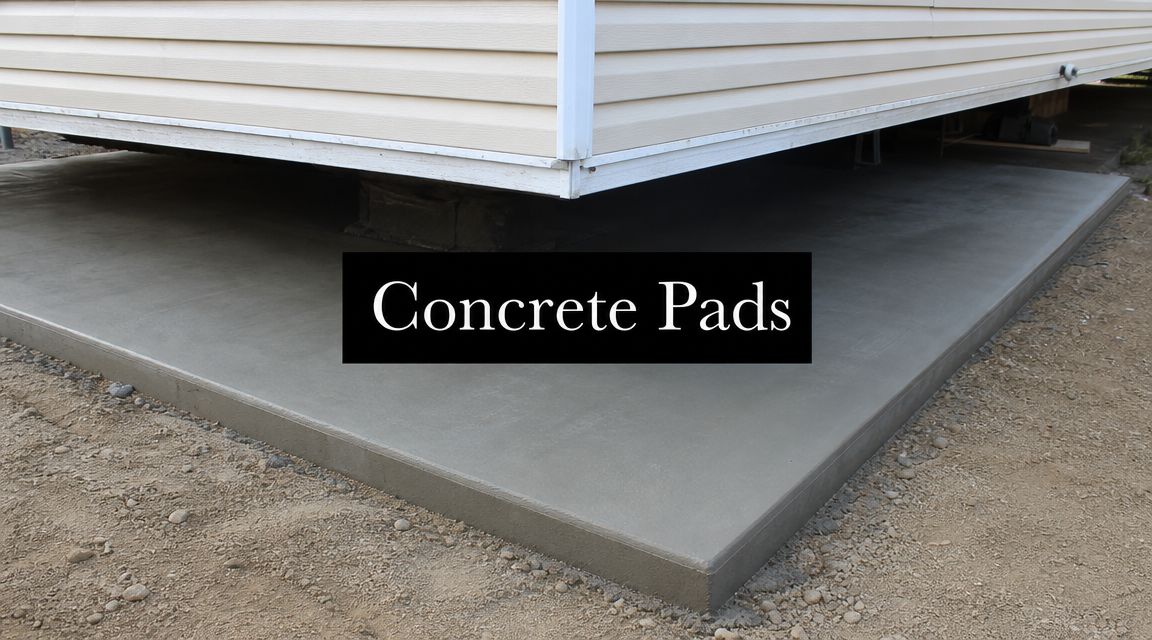
Buying a mobile home is exciting right up until the practical questions show up. Where will it sit, what kind of foundation does it need, and how do you make sure you don't end up paying twice because the first pad wasn't built for your site?
Homeowners across Pennsylvania and Maryland ask the same thing in different ways. Some search for concrete foundations, others type in excavation near me, garage foundation contractors near me, or even shed foundations near me because the basic issue is the same. You need stable ground, good drainage, and a foundation that matches local code and real site conditions.
That's especially true in PA, MD, DE, and NJ. National articles tend to treat concrete pads for mobile homes like a simple flat slab. On real jobs, the soil, slope, frost, access, and municipality all matter. A pad that works on one lot can be the wrong answer on another lot a few counties away.
Securing Your Investment An Introduction to Mobile Home Foundations
A lot of homeowners reach this stage after they've already made the big decision. The home is purchased or on order, the site is picked out, and now the pressure shifts to the foundation. That's where people often realize how much advice online is either too general or aimed at a different region.
A mobile home foundation isn't just another construction item on a checklist. It affects how the home handles water, how level it stays over time, whether setup goes smoothly, and whether you're dealing with avoidable repairs later. If the base is wrong, everything above it feels the effects.
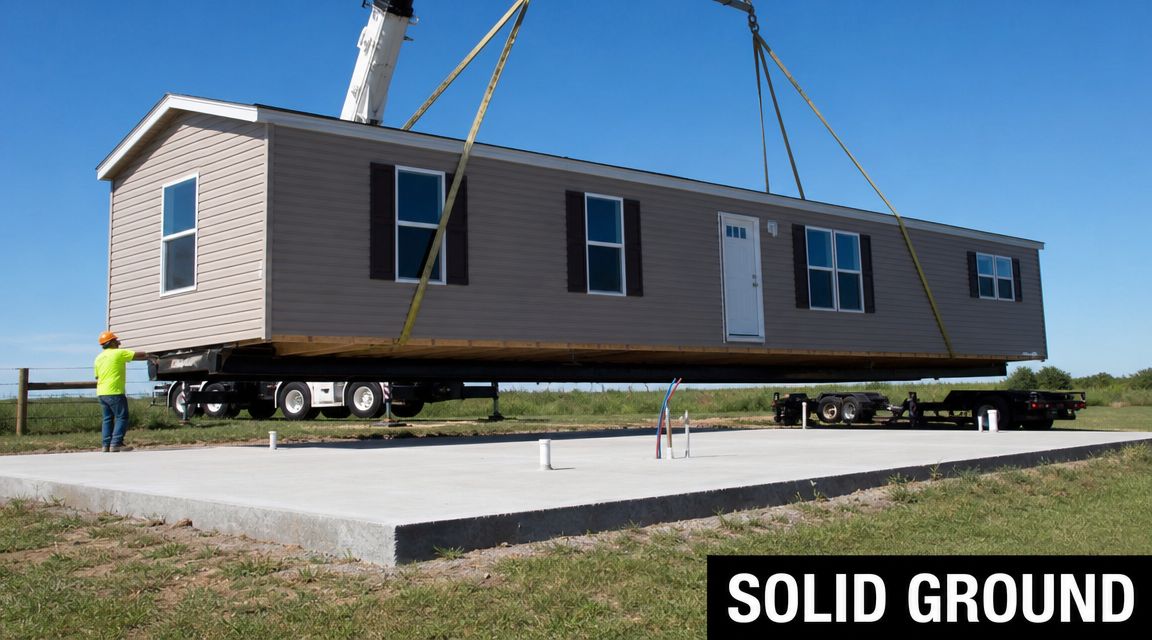
The same principles apply across foundation work
Homeowners are often surprised that the thinking behind a mobile home pad overlaps with other residential projects. The same crew that understands a base for storage shed, garage footings and foundations, a gazebo foundation, or a cement foundation for garage also understands what makes a mobile home base last. The loads are different, but the core rules stay the same.
Those rules are straightforward:
- Water has to move away from the foundation. If it doesn't, the soil softens and support becomes inconsistent.
- The subgrade has to be prepared correctly. Concrete can't fix bad ground underneath it.
- The finished pad has to match the structure and the site. Guesswork is what causes callbacks.
- Local requirements matter. Inspection problems usually start when someone assumes one standard fits every township or county.
A concrete pad only looks simple from the top. Most of the important work happens before the truck arrives.
For homeowners in Pennsylvania, Maryland, Delaware, and New Jersey, that's why local experience matters. The same company that handles foundation builds for garages, sheds, and outbuildings can spot drainage problems, soft areas, and grading issues before they turn into bigger costs. That's the difference between a quick pour and a foundation that protects your investment.
What Is an Engineered Concrete Pad Foundation
A lot of people hear “concrete pad” and picture a flat rectangle of concrete. That's only the visible part. A proper pad is an engineered support system that manages weight, moisture, and movement.
The easiest way to think about it is a vehicle chassis. You don't see most of what makes it stable, but every other part depends on it. A mobile home works the same way. The floor system, walls, doors, windows, and roof all rely on the foundation staying level and consistent.
What the pad is actually doing
A well-built concrete pad for a mobile home has several jobs at once:
- Carries load into the ground evenly
- Helps keep the home level
- Reduces moisture problems below the structure
- Provides a reliable base for the installation system
- Supports long-term durability instead of short-term setup
That's why there's a big difference between a true pad foundation and a temporary-looking setup with blocks on soil that was never properly prepared. The second option may get the home in place, but it doesn't solve the long-term issues that usually matter most to a homeowner.
What works and what doesn't
What works is a pad designed around the home, the lot, and the local code. That means the ground is evaluated first, drainage is planned before concrete is poured, and the base is built to stay stable through seasonal changes.
What doesn't work is treating the concrete as if it can hide every problem underneath. Concrete is strong, but it won't rescue a site with poor drainage, unprepared soil, or bad grading.
Practical rule: If a contractor talks only about the slab surface and not the soil, drainage, and elevation, you're not hearing the full story.
For homeowners comparing options, concrete pads for mobile homes earn their reputation. They aren't chosen just because they look clean. They're chosen because, when built properly, they create a more permanent, more predictable foundation than makeshift support systems.
That same thinking shows up on other jobs too. Whether someone is planning a shed foundation, a house foundation, or a slab for a detached garage, the best results come from treating the foundation as a system, not as a single pour.
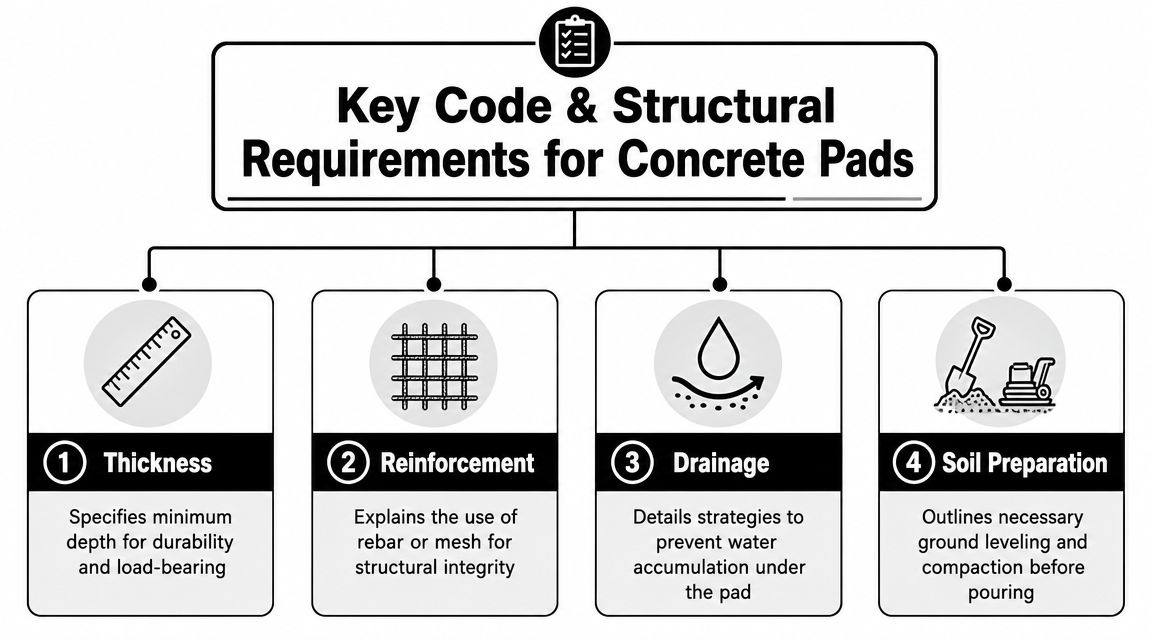
Code and Structural Requirements for a Lasting Concrete Pad
The strongest-looking slab can still fail if the structure underneath and around it was done carelessly. Lasting concrete pads for mobile homes depend on code compliance, soil preparation, drainage control, and the details that many homeowners never get shown.
Site prep and moisture control
Before concrete enters the picture, the site has to be stripped and shaped correctly. Manufactured-home site guidance says the area should be stripped of organic material and topsoil, graded, covered with an inorganic granular layer such as gravel, and protected with a 6-mil polyethylene ground cover that extends 6 inches past the prepared perimeter, with the granular fill sitting above surrounding finished grade to help shed runoff, as outlined in manufactured home pad preparation guidance.
That one point explains a lot of foundation problems. Topsoil holds moisture and organic material breaks down. If a contractor pours over ground that should have been removed, the foundation may look fine at first and then start showing movement, wet conditions, or soft spots later.
Here's what homeowners should expect during prep:
- Topsoil removal: Organic material has to come out because it doesn't make a reliable bearing surface.
- Grading: Water needs a route away from the structure, not toward it.
- Granular base: Gravel or similar inorganic material helps create a more stable working platform.
- Ground cover: A continuous vapor barrier helps control ground moisture under the home.
Footings and support details
Not every mobile home installation uses the exact same footing arrangement, but the principle stays the same. The load has to be transferred safely into the soil. One county permit document calls for an exterior footing at least 16 inches wide by 6 inches thick in continuous poured concrete around the perimeter, and also notes that non-reinforced concrete footings beneath piers should be at least 4 inches thick, with concrete block piers built from at least 8-inch masonry units with hollow cores set vertically, as described in this county mobile home permit document.
That doesn't mean every project in PA or MD should copy those exact dimensions. It means real code documents use specific structural benchmarks, not rough guesses. On a proper job, footing size and support layout are matched to the home, the soil, and local requirements.
Reinforcement and anchoring
A slab also has to work with the anchoring system. That's where experience matters. Reinforcement, anchor planning, and final installation all need to line up so the pad functions as part of the full support system instead of being treated like a separate task.
Common mistakes include:
- Pouring without a full plan for anchoring
- Ignoring how water will move around the slab
- Using a flat-looking site as proof that grading is finished
- Assuming any concrete contractor understands mobile home loads
A practical sign of a more organized contractor is how they handle communication and scheduling. Home service companies that invest in reliable customer follow-up often keep projects moving more smoothly. If you're comparing how contractors manage leads and callbacks, this overview of appointment generation for home services gives a useful look at that side of the business.
If the base stays dry, stable, and properly supported, the home above it has a far better chance of staying trouble-free.
Comparing Foundation Options Concrete Slab vs Piers vs Gravel
Not every site needs the same foundation, and not every budget points to the same starting choice. The right decision usually comes down to what you value most now versus what you want to avoid later.
For mobile homes, the three options homeowners ask about most are a concrete slab, a pier and beam system, and a gravel pad. Each has a place. Each also has limits.
The quick comparison
| Feature | Concrete Slab | Pier & Beam System | Gravel Pad |
|---|---|---|---|
| Long-term stability | Strong option when the site is prepared and drainage is handled correctly | Can work well, but performance depends heavily on footing layout, soil conditions, and maintenance | Better suited as a site-prep base than as a full long-term foundation approach by itself |
| Upfront cost | Mid-range among permanent foundation choices | Lower starting cost than a slab in many cases | Usually chosen when budget is the main concern |
| Maintenance | Lower ongoing maintenance when properly built | More likely to need periodic adjustment or attention over time | More vulnerable to drainage and settlement issues if used beyond its limits |
| Financing eligibility | Permanent foundation option | May or may not meet financing goals depending on configuration and permanence | Usually not the choice when permanent-foundation financing matters |
| Best fit | Homeowners prioritizing permanence, durability, and resale | Sites where access, terrain, or budget make pier support more practical | Temporary or limited-use situations, or as part of a broader prepared base |
Where slab foundations stand out
A slab is popular because it sits in the middle ground between bare-minimum support and the cost of a basement. A mobile-home financing guide notes that only permanent foundations such as slabs, crawl spaces, and basements generally qualify for FHA and VA loan programs under HUD requirements, while simple pier-and-beam systems can start around $1,000 and full basements can reach $25,000, putting slabs in a practical middle tier, according to this financing and foundation guide.
That matters for two reasons. First, financing can shape the whole project. Second, a foundation that supports permanence usually aligns better with resale and long-term ownership plans.
Where piers and gravel still make sense
Pier systems aren't automatically wrong. On some sites, they're a reasonable answer, especially where terrain, access, or project scope make a full slab less practical. The key is that the system still has to be designed and installed correctly. Cheap and adequate are not the same thing.
A gravel pad has value too, but homeowners need to be careful about what they expect from it. Gravel is often part of good site preparation. It is not always the same thing as a fully engineered permanent foundation.
If you're comparing support systems in more detail, this page on pier foundations for sheds helps explain how pier-style support works and where it fits.
Homeowners usually regret paying for a second foundation. They rarely regret building the right one first.
Local Foundation Requirements for PA MD DE and NJ
Generic advice usually breaks down in this specific context. Concrete pads for mobile homes in Pennsylvania, Maryland, Delaware, and New Jersey have to deal with conditions that national articles barely mention. Frost movement, wet seasons, mixed soil, sloped lots, and local inspection requirements all shape the right design.
Why regional conditions change the answer
In Pennsylvania and parts of New Jersey, freeze-thaw cycles can be hard on shallow or poorly drained foundation work. Water gets into the soil, temperatures drop, the ground moves, and weak areas show up fast. A pad that isn't planned with frost and drainage in mind can shift enough to create headaches with level, doors, skirting, and support points.
Maryland adds another layer because soil conditions can vary a lot from one area to another. Some lots drain well. Others hold moisture or become soft during wet periods. Delaware and coastal-adjacent parts of New Jersey bring their own concerns with drainage and site exposure.
That's why local work starts with questions like these:
- How does water move across the lot after a heavy rain?
- What kind of soil are we building on?
- Will frost affect the support system here?
- What does the township or county require?
- How will anchoring tie into the final setup?
Code is local, not generic
One municipal code example shows how specific local requirements can get. It requires immobilized mobile homes to sit on either a 14-by-60-foot concrete pad or two reinforced concrete runners, with the pad made of either 4 inches of reinforced concrete or 6 inches of concrete, as shown in this municipal code example.
The takeaway isn't that your town in PA or MD uses those exact numbers. The takeaway is that local codes can set exact dimensions, reinforcement expectations, and foundation choices. Home size alone doesn't decide the design.
Why local expertise matters
A contractor who builds in this region knows that inspection approval and long-term performance are tied together. If a pad ignores frost, drainage, or local anchoring requirements, the homeowner pays for it in one of two ways. Either the project stalls at inspection, or the home starts showing movement and moisture issues after the crew is gone.
That's the practical difference between reading a national article and hiring someone who works these states every day. In PA, MD, DE, and NJ, doing it right here means adapting the foundation to the site, not forcing the site to fit a generic sketch.
Our Foundation Installation Process and Cost Breakdown
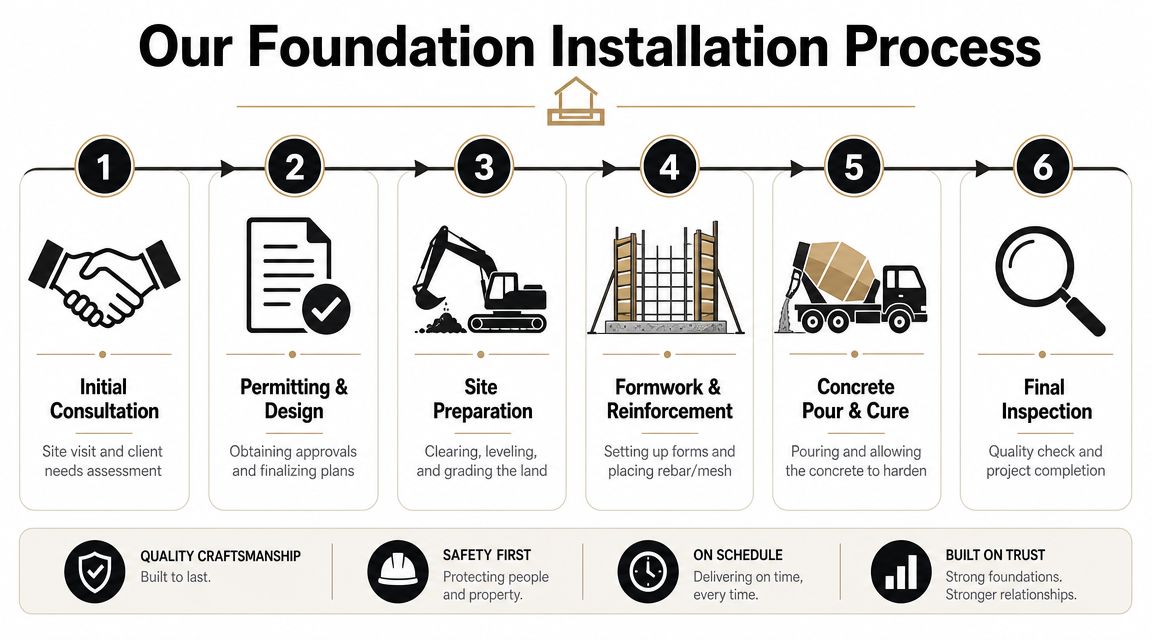
Most homeowners feel better once they know what the job will look like. A concrete pad project becomes much easier to judge when it's broken into clear steps instead of vague promises.
How the work usually unfolds
A clean installation follows a sequence. The exact details change by lot and municipality, but the basic path is consistent.
Initial consultation and quote
The first step is learning what structure is going on the site, what the access looks like, and what conditions may affect the job.Site assessment and planning
During this stage, slope, drainage, soil behavior, and local requirements start shaping the foundation plan.Excavation and preparation
The crew removes unsuitable material, establishes grade, and builds the base needed for a stable pour.Forming and reinforcement
Forms set the footprint. Reinforcement and support details are installed based on the project requirements.Pouring and finishing
Concrete placement and finishing have to be handled with care because surface quality and consistency matter.Inspection and handoff
Final checks make sure the pad is ready for the next stage of installation.
For homeowners who want to see a related service example, this page on concrete pad installation shows the kind of site preparation and slab work that goes into a proper pad project. One provider that performs this type of work in the region is Firm Foundations.
A short video can also help make the process easier to visualize.
What affects cost
Mobile home slab foundations typically cost $4,000 to $9,000, and can exceed $12,000 when site preparation is extensive, according to this mobile home base pad guide. The same guide notes that a properly designed pad should sit about 4 to 6 inches above natural grade and extend about 1 foot wider and longer on each side than the home.
That range makes sense in the field because pricing is rarely driven by concrete alone. Final cost usually moves based on:
- Site access: Tight access can slow excavation and forming.
- Drainage needs: Lots that hold water usually need more preparation.
- Pad size: Larger homes require larger pads.
- Grading and excavation: Uneven sites take more work before the pour.
- Soil conditions: Weak or inconsistent ground often requires additional effort.
The cheapest number on paper can become the most expensive job if the site prep was skipped.
Homeowners should expect a quote that reflects the lot, not just a standard template. That's how you avoid surprise change orders and disappointing results.
Build Your Home on a Firm Foundation Get Your Free Quote
A mobile home can only perform as well as the base under it. If the pad drains properly, supports the load correctly, and meets local requirements, the home has a much better chance of staying level, dry, and trouble-free. If those basics are skipped, the problems tend to show up in expensive ways.
That's why concrete pads for mobile homes shouldn't be treated like generic flatwork. In Pennsylvania, Maryland, Delaware, and New Jersey, frost, water, soil conditions, and municipal rules all matter. The right foundation is the one that fits your site and is built to last in your local conditions.
If you're planning a mobile home pad, a garage slab, or a shed base, the smartest next step is getting the site evaluated before the work begins. A clear quote and a realistic plan will tell you far more than a rough number over the phone ever will.
If you need a practical assessment for your project, request a quote from Firm Foundations. They handle excavation, grading, gravel pads, and concrete foundation work for homeowners across Pennsylvania, Maryland, Delaware, and New Jersey.