Pier Foundations for Sheds A PA & NJ Guide
You picked the shed. You may even have the delivery date circled on the calendar. Then the hard part shows up. The base under that shed matters more than the siding color, the loft layout, or the ramp.
That’s where many homeowners in Pennsylvania, Maryland, Delaware, and New Jersey get stuck. A yard that looked “flat enough” turns out to have a real slope. Soil that seems dry in summer stays soft after rain. Winter freeze and spring thaw start moving the ground in ways a simple block setup can’t handle.
A good shed foundation doesn’t just hold weight. It keeps doors working, floors level, and moisture from turning a new structure into an expensive repair project. In our region, that often means looking closely at pier foundations for sheds, especially on sloped sites and in frost-prone areas.
Your Guide to Shed Foundations in PA MD DE & NJ
A shed delivery often gets scheduled before the site is ready. We see it across southeastern Pennsylvania, rural Maryland, Delaware shore communities, and New Jersey suburbs. The shed is built, the path is clear, and then a key question arises. What foundation will keep it level through wet seasons, winter frost, and years of use?
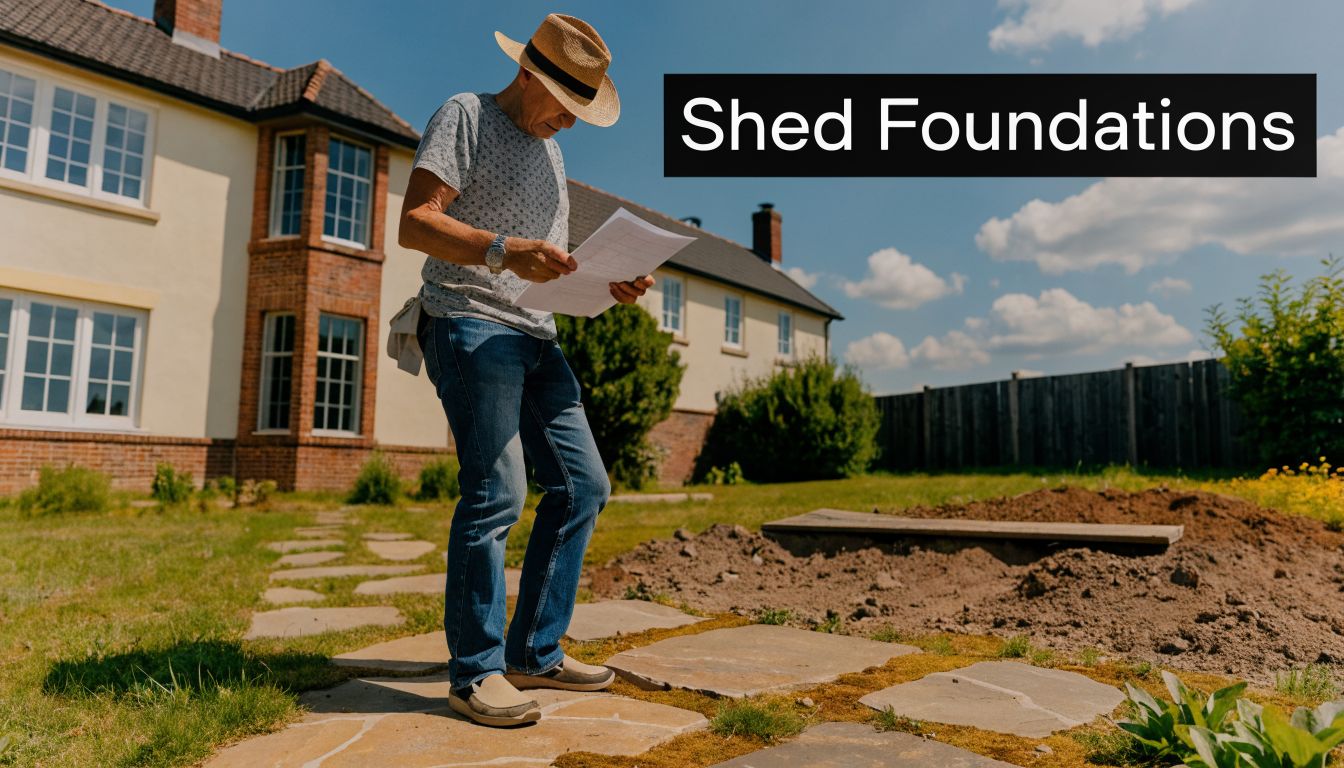
The wrong answer is picking a base only because it has the lowest upfront price. In PA, MD, DE, and NJ, shed foundations have to handle real site conditions. That includes drainage, frost depth, slope, access, and soils that can change from one side yard to the next. A foundation can look acceptable on install day and still create trouble later, with sticking doors, a sagging floor, and framing that slowly moves out of square.
We install plenty of gravel pads, and they remain a solid choice for many standard shed sites with good drainage and minimal grade change. But a gravel pad is not the default best option for every property in our region. On sloped terrain, frost-prone ground, or sites with soft upper soils, pier foundations often give better long-term support and require less site disruption than trying to force a flat-pad solution where it does not belong.
Homeowners usually run into problems on a few types of lots:
- Sloped backyards where a level shed base would require substantial cut and fill
- Freeze-thaw areas where shallow supports can lift and settle unevenly
- Wet or inconsistent soils that look firm in dry weather but soften after rain
- Tight-access locations where bringing in material for a slab or large pad is harder than expected
Our rule is simple. Match the foundation to the site first, then to the shed.
That matters more in this region than many generic shed guides admit. A wooded lot in Bucks County, a rolling yard in northern Maryland, a low-lying Delaware property, and a frost-exposed site in New Jersey may all need different support strategies, even for the same shed size. We help homeowners sort that out before the shed arrives, because the best foundation is not the one that sounds easiest. It is the one that fits the ground, the climate, and the load.
Understanding Pier Foundations and How They Work
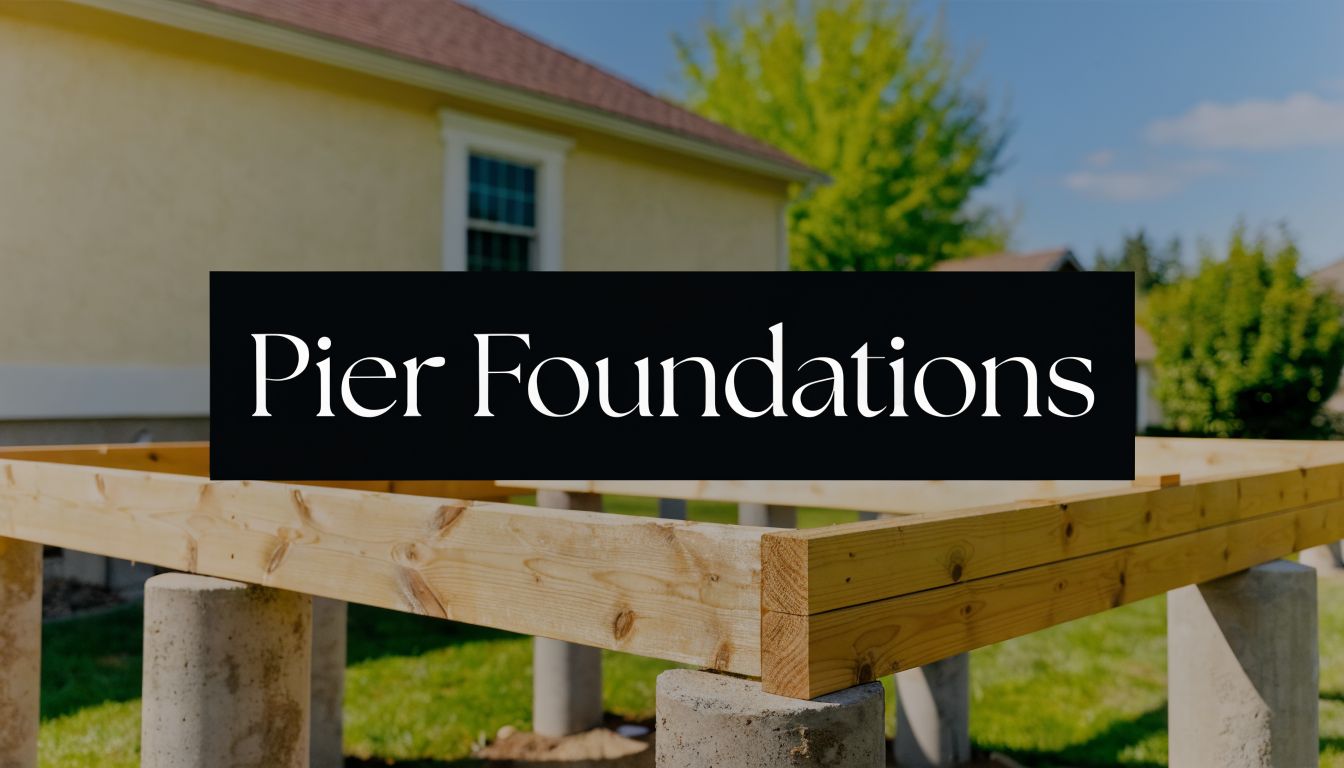
A pier foundation supports a shed at a series of planned load points instead of across the entire footprint. We use that approach when the ground should not be flattened into submission, especially on sloped yards, frost-prone sites, and properties where the topsoil looks stable until a wet season proves otherwise.
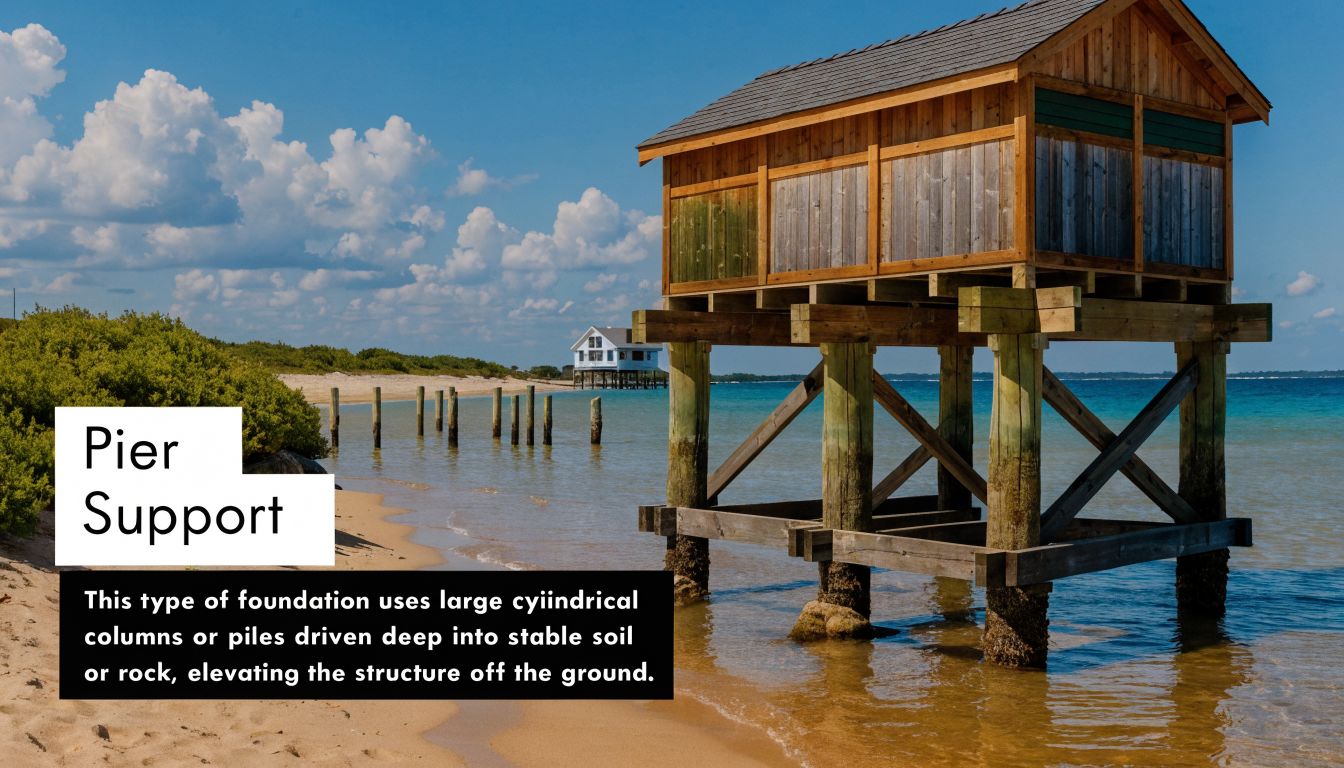
The basic idea is simple. The shed floor bears on beams or framed members, those members bear on the piers, and the piers carry the load into ground that can support it with less seasonal movement. On many properties in Pennsylvania, Maryland, Delaware, and New Jersey, that matters because the surface layer is often the least reliable part of the site.
A good pier system does two jobs at once. It supports the weight of the shed, and it keeps the structure level when the surrounding soil swells, softens, or shifts through freeze-thaw cycles. That is why pier foundations show up so often on hillside lots, wooded backyards, and sites where bringing in enough stone for a large pad would mean more excavation than the project really needs.
What a pier foundation is actually doing
A shed does not load the ground evenly on its own. The weight concentrates at the framing lines, especially under beams, wall lines, door openings, and any heavier storage zones. A pier foundation places support where the structure needs it, rather than relying on a full slab or pad to solve every site problem the same way.
For homeowners, the practical difference looks like this:
| Foundation type | Main support method | Best fit |
|---|---|---|
| Pier foundation | Load carried at specific support points | Slopes, frost-prone areas, variable soils |
| Gravel pad | Load spread across the entire base | Standard shed sites with good drainage |
| Concrete slab | Continuous concrete surface | Heavy-use structures on prepared, flat ground |
That point-load approach is often the reason a pier system makes sense on uneven ground. We can establish a level bearing plane above changing grade without overcutting the high side of the yard or building up the low side with fill that may settle later.
Why this matters in our region
In PA, MD, DE, and NJ, frost depth, drainage, and soil consistency can change a lot from one property to the next. A shed site in southeastern Pennsylvania may have shallow rock and a slope. A New Jersey yard may have frost exposure and clay movement. Parts of Delaware and Maryland can bring softer, wetter soils that stay workable in dry weather, then lose bearing strength after repeated rain.
Pier foundations help address those regional problems because the support system can be set deeper and adjusted to the terrain. On the right site, that gives the shed a better chance of staying square, keeping doors aligned, and avoiding the small seasonal movements that turn into floor bounce and framing stress over time.
The parts that matter most
Pier foundations work well only when the details are right.
- Accurate layout so beams, skids, or floor framing land exactly where they should
- Proper depth based on frost exposure and local conditions
- Sound bearing at the bottom of each pier location so the load is not resting on loose or disturbed material
- Drainage control to limit standing water around support points
- Correct brackets and hardware alignment so the shed can be fastened cleanly and set level
We see problems when one of those pieces gets skipped. A shed can sit on piers and still perform poorly if the spacing is wrong, the depth is too shallow, or the installer treats every yard in the Mid-Atlantic like it has the same soil.
For the right property, a pier foundation is a practical way to support a storage shed, gazebo, or small outbuilding without forcing a full slab or a large pad into a site that does not suit it. The key is matching the support method to the ground conditions first, then building the shed on top of that plan.
Choosing the Right Pier Type Concrete vs Helical Piles
Choosing a pier system gets more complicated in PA, MD, DE, and NJ than a lot of online guides suggest. A flat, dry yard in one county can support a shed with a straightforward concrete plan. A sloped backyard in another can deal with frost movement, wet clay, fill soil, or tight access that changes the right answer completely.
We look at four things first. Soil strength, slope, frost exposure, and access for equipment. Those factors usually tell us more than the shed size alone.
Poured concrete piers
Poured concrete piers are still a solid choice for many permanent shed foundations. We use them where the site is accessible, excavation is practical, and the soil conditions support a below-frost installation without constant water filling the holes.
They are a good fit for:
- Stable sites with room to dig and form each pier
- Sheds that need precise height adjustments on moderate slope
- Projects where local permitting favors a traditional concrete foundation
- Homeowners who want a familiar, permanent support system
What concrete does well is straightforward. It gives us custom pier heights, a clean way to support beams, and long service life when the depth, bearing, and drainage are handled correctly.
The trade-off is the site has to cooperate. On steep lots, muddy backyards, or properties with a high water table, excavation gets slower and messier. Concrete also needs curing time, which matters if your shed delivery date is close.
Precast concrete pier blocks
Precast pier blocks are common in DIY shed plans because they are fast and inexpensive. For a very light structure on level, well-drained ground, they can work.
In our region, they are often asked to do more than they should. Frost heave, soft soil, and cross-slope movement can shift blocks enough to throw a shed out of level. Doors start sticking. Floors pick up bounce. The structure may still stand, but it does not perform the way most homeowners expect from a long-term installation.
That is why we treat pier blocks as a limited-use option, not a default foundation.
Helical piles
Helical piles solve a different set of problems. They are steel piers that are screwed into the ground until they reach suitable bearing. That makes them especially useful on sites where digging deep concrete holes is the hard part of the job.
They tend to make more sense when we are dealing with:
- Weak or wet surface soils
- Previously disturbed or filled ground
- Steeper grades
- Backyards with limited access
- Projects that need immediate support without waiting for concrete to cure
A well-designed helical system can reduce site disturbance and speed up the schedule. That matters on finished lawns, narrow side yards, and sloped properties where hauling spoil and concrete back and forth creates extra cost. If you want a broader overview of site-driven foundation decisions, our guide on how to choose the right shed foundation covers the bigger picture.
Concrete vs helical piles. How we choose
We do not treat this as a material preference. We treat it as a site decision.
If the yard has decent access, manageable slope, and soils that stay stable at the required depth, poured concrete piers are often the practical answer. If the lot is steep, wet, tight, or built on questionable fill, helical piles often give better control with less disruption.
Here is the short version:
| Pier type | Best use | Main advantage | Main drawback |
|---|---|---|---|
| Poured concrete piers | Accessible sites with stable digging conditions | Custom height control and durable long-term support | Excavation, spoil removal, and curing time |
| Precast pier blocks | Very light-duty sheds on stable, level ground | Fast setup | Poor choice for frost, slope, and shifting soils |
| Helical piles | Wet soils, fill, tight access, or steeper slopes | Immediate support with less disturbance | Usually requires specialized equipment and installation |
For homeowners comparing pier systems to other foundation types, the right question is not which option sounds strongest on paper. The right question is which system fits your soil, your slope, and your local frost conditions without creating repair problems later. That is the standard we use at Firm Foundations.
Pier Foundations vs Gravel Pads and Concrete Slabs
A shed set on the wrong foundation can look fine on install day and still give you trouble after the first wet spring or hard winter. We see that often across PA, MD, DE, and NJ, especially on lots with slope, mixed soils, or freeze-thaw movement. The foundation choice has to match the site, not just the shed.
Where gravel pads win
Gravel pads are a strong option for many backyard sheds. On a level site with decent drainage and a shed that includes its own framed floor, gravel is often the cleanest and most cost-conscious solution. It drains well, installs quickly, and avoids the cost and curing time that come with poured concrete.
The limits show up fast on more difficult properties. If one side of the shed area drops off, if runoff crosses the footprint, or if the subsoil is soft in spots, a gravel pad may need more excavation, retaining work, or base preparation than a homeowner expects. In parts of Pennsylvania and New Jersey, that is often the point where a simple pad stops being the simple answer.
Where slabs make sense
Concrete slabs make sense when the slab is also the finished floor and the building use justifies the added cost. That can be a good fit for a workshop, a garage-style shed, or a space that will carry heavier point loads from equipment.
A slab asks more from the site. Grade has to be controlled, drainage has to be planned around the slab, and mistakes are harder to correct later. On sloped lots in our region, getting a slab right can involve far more site work than the shed itself.
Where piers pull ahead
Pier foundations solve a different problem. They support the shed at planned load points instead of requiring the entire footprint to be flattened and built up. That matters on properties where grade changes across a short distance or where keeping wood framing up off the ground helps with moisture control.
Piers are often the better choice when long-term stability matters more than having a full ground-contact base.
They also give us more flexibility on sites where a gravel pad or slab would force major excavation. On a backyard with side slope, tree-root constraints, or access issues, piers can reduce disturbance while still giving the shed solid support. For homeowners sorting through those trade-offs, our guide on how to choose the right shed foundation gives a broader framework.
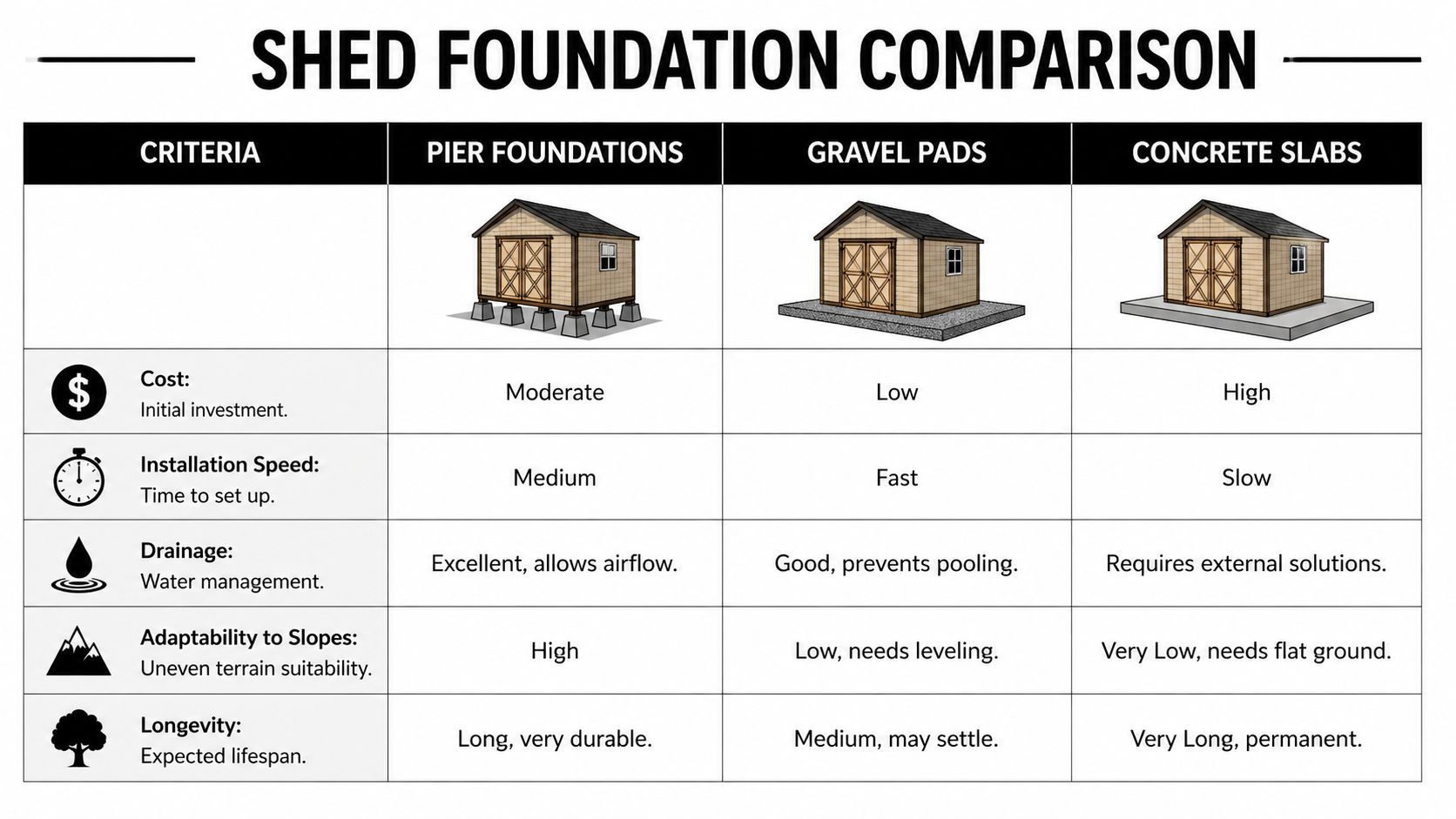
Shed Foundation Comparison Piers vs Gravel Pad vs Concrete Slab
| Factor | Pier Foundation | Gravel Pad | Concrete Slab |
|---|---|---|---|
| Cost | Moderate | Low to moderate | High |
| Installation speed | Medium | Fast | Slow |
| Drainage | Excellent, allows airflow | Good, depends on base prep | Requires careful grading and runoff control |
| Adaptability to slopes | High | Limited | Low |
| Best use case | Sloped lots, frost-prone sites, variable soils | Level sites with good drainage | Buildings needing a concrete floor |
| Future corrections | Easier to adjust in some cases | Base may need rework if settlement occurs | Repairs are more invasive and costly |
A practical way to choose
For a standard storage shed, start with the site conditions before you look at price.
- Choose gravel if the area is level, drains well, and the shed has a built-in floor system.
- Choose piers if the lot has slope, uneven bearing conditions, frost concerns, or you want the structure raised above damp ground.
- Choose a slab if you need a concrete floor and the site can be graded and drained properly.
If the shed location is questionable, an engineer’s input can prevent expensive guesswork. On fill ground, steep grade changes, or sites with signs of movement, it can make sense to get a structural engineer survey before the foundation is selected.
The hybrid answer many homeowners miss
Some of the best shed foundations in this region are hybrids. We may use piers for structural support and gravel for drainage, splash control, and cleaner access around the shed. That approach works well where frost depth, runoff, and slope all need to be handled together.
Generic shed guides often frame this as a simple three-way choice. In PA, MD, DE, and NJ, the better question is which system will stay level through wet seasons, freeze-thaw cycles, and uneven ground. That is the standard we use at Firm Foundations.
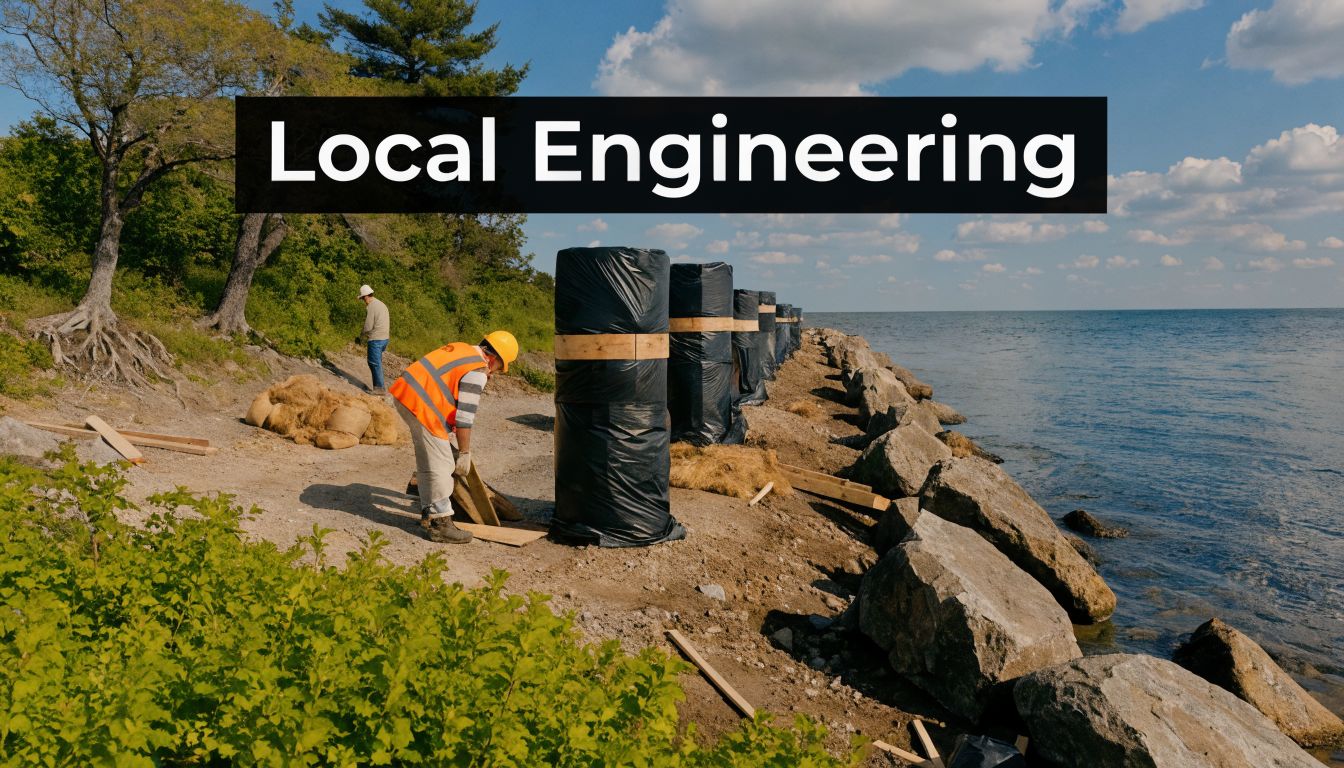
Engineering for Slopes Frost and Soil in PA and NJ
A shed site in this region can look straightforward in dry weather and still give you trouble after the first freeze. We see that often on lots in Pennsylvania and New Jersey where the shed pad sits on a side yard, near a tree line, or along a grade break that sheds water across the footprint.
Frost changes the design requirements
Frost heave is one of the main reasons shed foundations fail in the Mid-Atlantic. Wet soil freezes, expands, and pushes upward. When it thaws, one area may settle back while another stays high. That is how a shed goes out of level even when it looked perfectly fine on install day.
For homeowners in PA, MD, DE, and NJ, the practical takeaway is simple. Pier depth has to be set for local frost conditions, and the support system has to stay stable through repeated freeze thaw cycles. A shallow support may hold for a season, then start showing problems through sticking doors, cracked trim joints, and a floor that no longer feels square.
We do not treat frost as a minor detail. It drives the foundation plan.
Slope changes embedment, drainage, and support layout
A sloped site needs more than level pier tops. The buried portion has to be right too.
On a mild slope, one side of the shed may sit over firmer, drier soil while the downhill side carries more runoff and softer bearing conditions. That creates uneven movement if every pier is installed the same way without regard for grade change. On steeper sites, longer exposed pier heights and taller brackets can also introduce more movement if the framing and bracing are not matched to the actual conditions.
This is one of the clearest decision points between concrete piers and helical piles. Concrete piers work well where we can excavate cleanly, reach stable bearing, and manage drainage around the hole locations. Helicals often make more sense on tighter sites, on stronger slopes, or where excavation would disturb the hillside too much. They can also be a better fit where access is limited and we want less spoil and less disruption to the yard.
Soil decides whether a standard pier plan will hold up
Two sheds of the same size can need different foundations because the soil under them is different. We may find dense, well-drained material near the surface on one property, then soft fill, wet pockets, or loose upper layers a few streets over.
That is why we pay close attention to drainage paths, past grading work, and signs of fill placement before we recommend a foundation type. Loose or inconsistent ground can cause settlement even if the piers themselves are built correctly. If you want a clear explanation of why that matters, this guide on what soil compaction means for foundation performance is worth reading.
If the site raises bigger questions, especially on fill ground or a lot with visible movement, it makes sense to get a structural engineer survey before the final foundation plan is set.
What good regional engineering looks like
In our service area, good shed foundation engineering is not about picking the strongest-looking option. It is about matching the foundation to the site.
That usually means:
- Setting pier depth by frost exposure and grade change, not by using the same depth at every support point
- Checking runoff patterns before installation, especially where water crosses the shed footprint during heavy rain
- Matching the number and spacing of supports to the shed framing, so loads are carried where the structure is designed to bear
- Choosing concrete piers or helical piles based on soil behavior, access, and slope, not just material cost
- Planning for long-term serviceability, including future adjustments, drainage maintenance, and seasonal ground movement
Homeowners often start by looking for concrete work, excavation, or a simple shed pad. On sloped or frost-prone sites in PA and NJ, those are not separate decisions. The foundation has to be engineered as a system so the shed stays level through wet seasons, winter heave, and spring thaw.
Our Pier Foundation Installation Process from Start to Finish
A pier foundation should look uneventful when the shed is set. The floor lands where it should, the building sits level, and the doors work through wet springs and freeze-thaw winters. That result comes from a disciplined install process, especially on lots in PA, MD, DE, and NJ where slope, runoff, and frost depth can change across one backyard.
We start by confirming the exact shed size, beam layout, and access path before any equipment comes in. A 10×12 shed on a flat Chester County yard gets approached differently than the same shed on a sloped lot in northern New Jersey with soft topsoil and winter heave concerns. The foundation plan has to match the structure and the site at the same time.
We lay out the footprint before we break ground
Layout controls the whole job.
We stake the corners, pull string lines, and check diagonals so the footprint is square and the pier locations line up with the shed's actual load points. If the layout is off by even a small amount, the problem shows up later when beams, brackets, and floor framing do not land cleanly.
On sloped sites, we also establish finished elevation early. That tells us how much height difference the piers need to handle and whether the grade creates drainage concerns under the shed.
We build each support for the conditions on that part of the site
Pier installation is never just "dig holes and pour concrete." On many properties in our region, one side of the shed may sit on firmer ground while the downhill side has softer or wetter soil. We account for that before the first pier goes in.
For concrete piers, our sequence is straightforward:
- Excavate each pier location to the required depth based on local frost exposure and site conditions.
- Clean out loose material so the base is not bearing on disturbed soil.
- Add a gravel base where the design calls for it to improve drainage at the bottom of the hole.
- Set forms plumb and to the right height so the tops finish on a consistent plane.
- Install reinforcement and hardware in the correct position for the beam or post connection.
- Place concrete carefully and recheck alignment before it sets.
The details matter here. A pier can look fine above grade and still cause trouble later if the hole was overdug, the form was out of plumb, or the bracket was set a little off center.
Helical piers follow a different process
When helical piers are the better fit, we do not excavate and wait on cure time. We advance the steel piers into stable bearing soil, verify installation resistance, then set the brackets and support framing to the planned elevation.
That method earns its keep on tighter sites, steeper yards, and places where deep excavation would tear up the property or turn into a muddy mess after rain. It can also be the cleaner option when the upper soil is weak but stronger bearing is available deeper down.
We check drainage, height, and alignment before the shed goes on
Before the shed arrives, we inspect the finished pier system as a foundation, not as a group of individual holes or columns. We confirm that support points are at the right elevation, hardware matches the framing plan, and water has a path to move away from the foundation area.
Our final review usually includes:
- Top-of-pier height across the full footprint
- Bracket and anchor alignment
- Clear bearing at each support location
- Drainage around uphill and downhill sides of the shed
- Delivery or framing access without damaging the new work
Homeowners often focus on what they can see after the job is done. We focus on what keeps the shed level three winters from now. That is the difference between a pier foundation that holds the shed up today and one that keeps performing through frost, rain, and seasonal ground movement across PA, MD, DE, and NJ.
Get a Lasting Foundation and a Free Quote Today
Most homeowners don’t need the most expensive shed foundation. They need the one that fits the site and won’t create problems later. On level, well-drained ground, that may be gravel. On a sloped yard, a frost-prone lot, or weak soil, a pier system is often the better call.
Common questions homeowners still ask
Do I need a permit for a shed foundation
Sometimes yes, sometimes no. It depends on your municipality, shed size, and whether the foundation is considered permanent. Local code also matters more once frost-protected piers, larger structures, or utility clearances enter the picture. It’s smart to confirm permit requirements before excavation begins.
How long does a pier foundation take
That depends on the system and site conditions. Concrete piers involve excavation, setup, pour, and cure. Helical piers move faster because they don’t require cure time. Access, weather, and soil conditions all affect the schedule.
Are pier foundations better than gravel pads
Not across the board. They’re better in the right conditions. If the site has slope, frost exposure, or unreliable upper soil, piers often outperform a simple floating foundation. If the yard is flat and drains well, gravel may still be the more practical option.
Can pier foundations support more than sheds
Yes. The same site and support principles apply to many small structures, including some gazebo foundation projects, garages, and other outbuildings. The right design depends on load, footprint, and local conditions.
The long-term value is in the right decision early
Homeowners often search for shed foundations contractors near me, garage foundation contractors near me, driveway contractors near me, or driveway companies near me after they’ve already seen what poor site prep can do. The lesson is usually the same. Ground conditions don’t care how new the structure is.
A foundation should solve the actual problem the site presents. That means drainage where water is the issue. Frost depth where winter movement is the issue. Better support where the soil is the issue. The best projects get that call right before the shed is delivered, not after the doors stop closing square.
If you’re planning a shed, garage, barn, or other backyard structure in Pennsylvania, Maryland, Delaware, or New Jersey, start with the foundation decision. It’s the part you can’t afford to guess on.
If you want a foundation built for your site, not a generic template, contact Firm Foundations for a free quote. We install gravel pads, concrete foundations, shed pads, garage slabs, and excavation-based foundation systems across PA, MD, DE, and NJ, with a focus on drainage, frost protection, and long-term stability.