
Expert Shed Foundation Contractors in Pennsylvania, MD, DE & NJ

Are you planning to build a new garage, install a 10×10 storage shed, or create a beautiful spot for a gazebo? A new concrete structure is a significant investment in your home’s functionality and value. The real key to a project that endures for decades, rather than just a few seasons, is the expert concrete driveway preparation or shed foundation work that happens long before any concrete is poured.
At Firm Foundations, we're your local, trusted construction company, and our community-oriented approach means we're here to help you get the job done right. If you're looking for "shed foundation contractors near me," you've come to the right place.
Why a Proper Foundation Is Your Best Home Investment
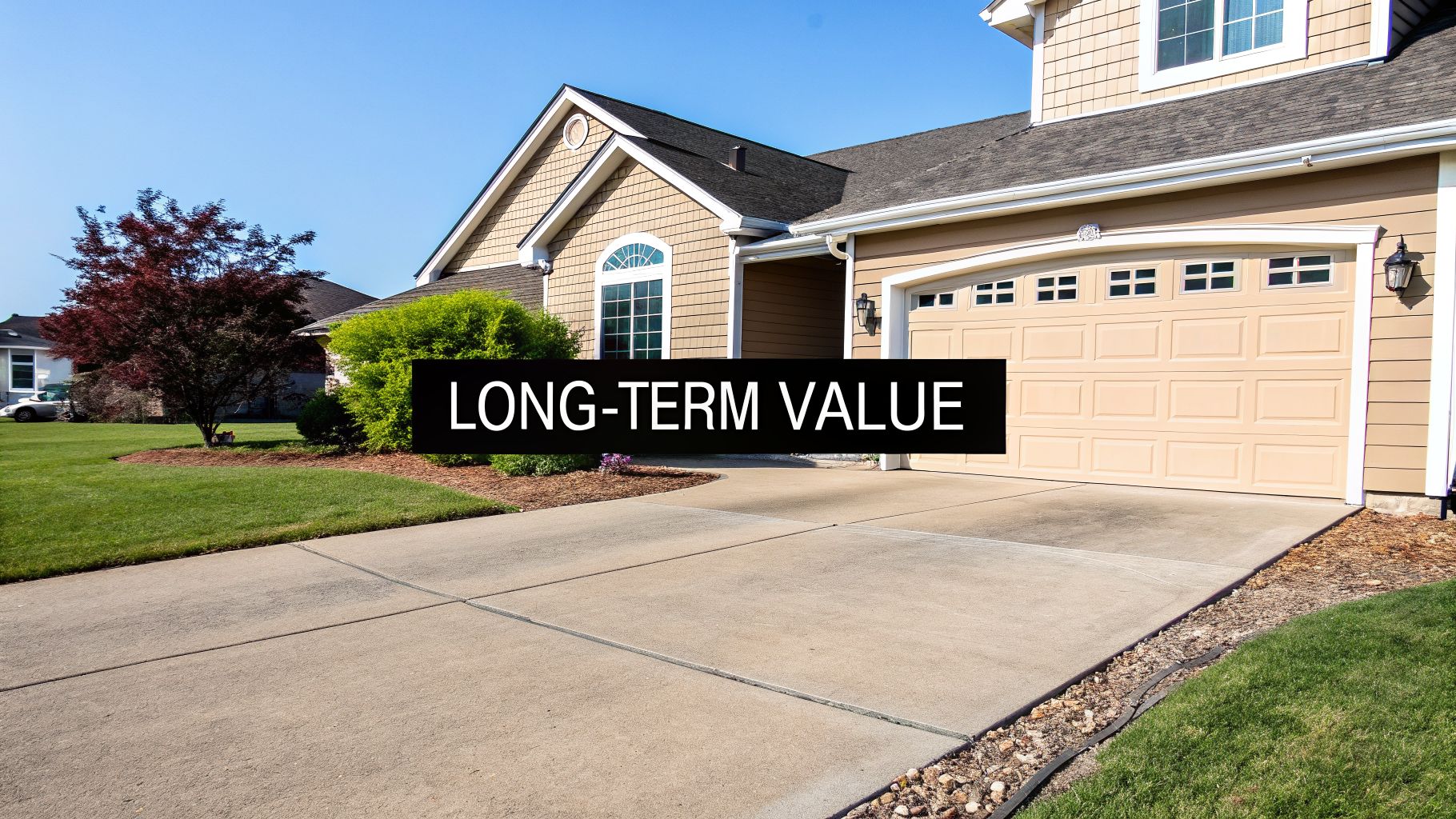
It’s natural to focus on the final look of your new project, but its longevity is determined by what you can't see. Much like a house, a driveway or a base for a storage shed is only as strong as the foundation it's built upon. The unseen, engineered layers of soil and stone beneath the concrete surface are what provide true durability.
As your neighbors and local garage foundation contractors, we’ve seen countless times how skipping proper site preparation leads to premature failure. A slab can look perfect for the first year, only to develop major cracks, sink, or crumble. This is a common issue for homeowners in Pennsylvania, Maryland, Delaware, and New Jersey, where relentless freeze-thaw cycles put constant stress on outdoor surfaces. We're here to make sure that doesn't happen to you.
The True Cost of Poor Preparation
A driveway or shed foundation installed on an improperly prepared base is destined to fail. When water seeps beneath the concrete and freezes, it expands with enough force to lift the slab, causing heaving and cracking. Once it thaws, the supporting ground can settle unevenly, creating voids. The weight of a vehicle or a heavy structure is often all it takes to crack the unsupported slab.
Since 2011, we've built our reputation on doing the job right the first time. Our thorough concrete preparation process is designed to combat the specific climate challenges in our Pennsylvania, Maryland, Delaware, and New Jersey communities, ensuring your investment is protected for decades to come.
Correct preparation is the only way to address these issues effectively. By creating a stable, well-draining base, we ensure water is channeled away from the slab, preventing the destructive cycle that ruins so many projects. It's a critical upfront step that prevents costly repairs and replacements, giving you peace of mind.
A Foundation Built for Our Local Climate
As experienced local contractors, we have a deep understanding of the diverse soil conditions and weather patterns across our service areas. From the dense clay soils found in parts of Pennsylvania to the sandier ground near the Delaware and New Jersey coasts, every property requires a tailored approach. Whether you need a simple 4×8 shed with foundation or complex garage footings and foundations, we have the local expertise.
Our process is a calculated, multi-step method, not a simple dig-and-pour operation. It always includes:
- Thorough Site Analysis: We start by evaluating your property's soil, grading, and drainage.
- Proper Excavation: We remove all unstable topsoil to expose a solid subgrade.
- Engineered Base Construction: We install and compact a precise thickness of gravel to create a load-bearing, frost-resistant base.
This meticulous attention to detail is what sets a Firm Foundations project apart. It’s why homeowners and businesses who value quality and durability choose us as their go-to shed foundations contractors near me. We aren’t just pouring concrete; we are building a lasting asset for your property.
The First Step: Site Evaluation And Excavation
A long-lasting concrete project doesn't start with a mixer; it starts with a thorough understanding of the ground it’s built on. Before any heavy equipment arrives, our first step at Firm Foundations is to walk your property to see what we're working with. This initial site evaluation is the backbone of our entire concrete driveway preparation process and it’s what ensures the final product—be it a driveway, gazebo foundation, or barn shed base—is built to last.
During this walk-through, we're looking for a few critical things. We analyze the slope for drainage, identify utility lines, and, most importantly, get a feel for the soil. The heavy clay soils common across Pennsylvania behave very differently than the sandier ground you find in parts of Delaware and New Jersey. Each type demands a unique approach to get the base right, and as your local foundation experts, we know exactly what to look for.
Understanding The Excavation Process
With the evaluation complete and a plan in place, the real work begins. Excavation is often the messiest part of the job, but it's also one of the most critical. Our goal is to remove all the unstable topsoil, grass, roots, and any large rocks until we hit the solid, undisturbed ground known as the subgrade.
It's the depth of this dig that often surprises homeowners. For a standard residential project built to withstand our region's weather, we typically excavate 8 to 12 inches deep. This isn't just for show; this depth is absolutely essential.
- It gets rid of the entire layer of organic topsoil, which would otherwise break down and cause your slab to settle and crack.
- It creates the necessary space for a thick, engineered gravel shed foundation base—the key to distributing weight and managing drainage.
- It ensures we are building on a uniform, stable subgrade, without any hidden soft spots that could compromise the slab later.
As local excavation near me experts serving PA, MD, DE, and NJ, our crews use specialized equipment to do this work efficiently, minimizing the disruption to your home and property. We treat your home with the respect it deserves.
Preparing The Subgrade
Once excavated, the exposed subgrade is our blank canvas. We meticulously grade the native soil, creating a precise slope—at least a quarter-inch per foot—to channel water away from your structures and your home's foundation. In a climate with harsh freeze-thaw cycles, proper drainage is your project's best defense.
A common mistake is to pour concrete on un-compacted or poorly graded soil. This is the single biggest reason driveways and shed pads fail prematurely. At Firm Foundations, we guarantee that the ground beneath your concrete is as meticulously prepared as the visible surface.
The final step before adding stone is compacting the subgrade. This is where we use machinery to densify the soil, removing air pockets to create a firm platform that won't shift or settle. This solid support is what your new concrete foundations need to handle heavy loads for decades. This methodical approach is what separates professional driveway companies near me from the rest.
With this crucial phase complete, we're ready to build the rock-solid base for your investment. For a more detailed look into this vital stage, you can learn more about site preparation for a concrete slab in our comprehensive guide.
Building A Bulletproof Subgrade And Base
Now we get to the part of the project that really makes or breaks your driveway or foundation’s lifespan. This is where the long-term success is decided, long before any concrete is poured. We’re talking about the ground directly underneath the slab—a critical two-part system made of the subgrade and the sub-base.
Many people assume a project is all about the concrete itself. But from our experience as shed foundation contractors, nearly every premature failure—the ugly cracks, the sinking spots—can be traced right back to shortcuts taken at this stage. This is the foundational work, and frankly, we believe it’s the most important job we do for our neighbors in Pennsylvania and beyond.
Distinguishing The Subgrade From The Sub-Base
It helps to know the lingo. We're working with two very distinct layers here, and each has a specific job.
- The Subgrade: This is simply the native soil—the dirt—that’s left after we’ve dug everything out. Our job is to grade and compact this earth until it’s a perfectly stable platform.
- The Sub-Base: This is the layer of crushed stone we install on top of the compacted subgrade. Think of it as an engineered drainage and support layer, like a shed foundation gravel base.
Just digging out the topsoil and pouring concrete is a guaranteed recipe for disaster, especially in our region's climate. Both of these layers have to be prepared with absolute precision.
This simple flowchart shows the first steps our crew takes on any job. We follow this process every time to make sure your project starts on solid ground.
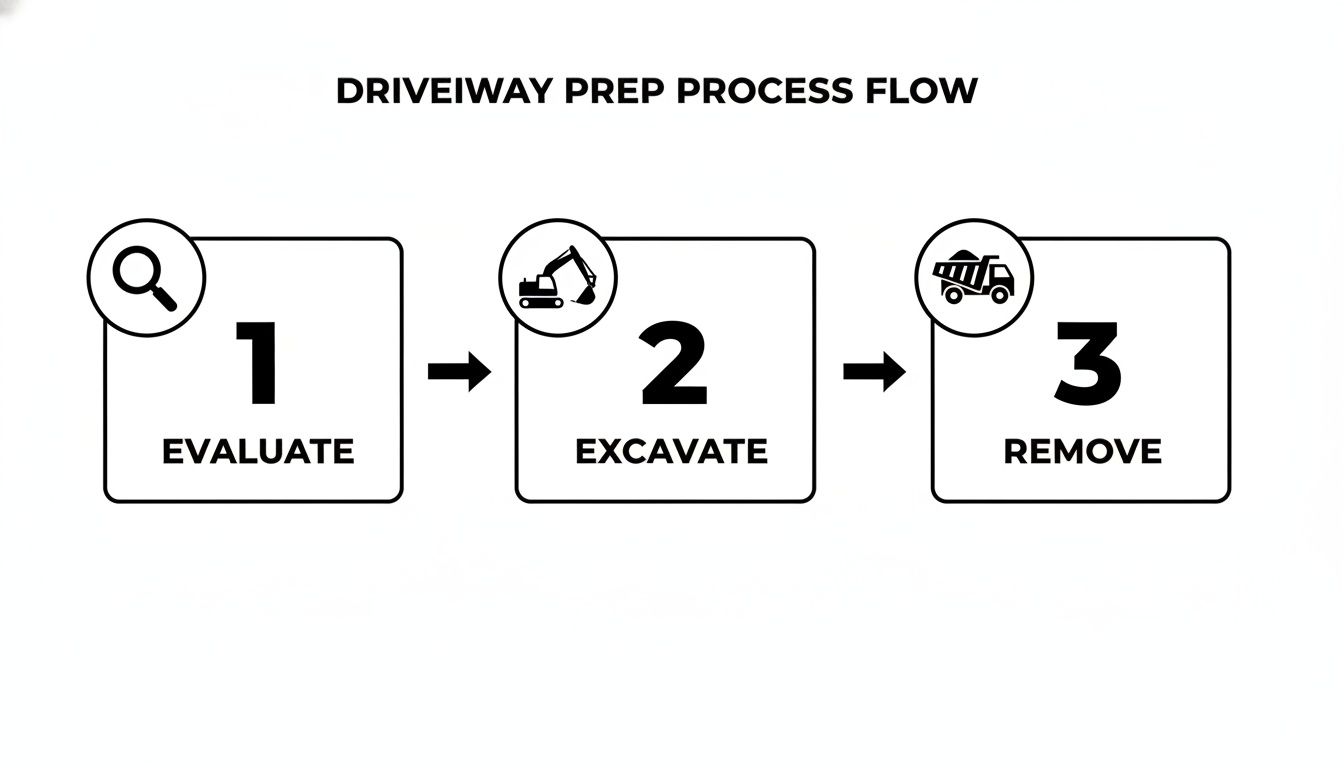
This systematic approach ensures we’ve prepared the perfect canvas before we bring in a single piece of stone.
The Non-Negotiable Step: Compacting The Subgrade
With the native soil graded, we start compaction. This is a non-negotiable step. It’s the process of using heavy equipment to remove air pockets and densify the earth, creating a solid surface that won't shift or settle later.
Building on uncompacted soil is like building a house on a sponge. It just won't hold up.
Our goal is to hit at least 95% of the soil's maximum Proctor density. That’s a technical construction standard, but what it means for you is simple: we’re scientifically verifying that the ground is as solid as it can possibly get. If you want to dive deeper into the science, you can learn more about the importance of proper soil compaction in our guide.
The fact is, proper subgrade preparation is everything. Industry data shows that up to 60% of all concrete failures come from a poorly prepared subgrade. For anyone in Pennsylvania, Maryland, Delaware, or New Jersey—where we see over 50 freeze-thaw cycles a year in some areas—this step is absolutely vital for any foundation builds.
Selecting The Right Base Material And Thickness
Once the subgrade is rock-solid, we can build the sub-base. This is an engineered layer of crushed stone spread evenly over the compacted earth. Its main purpose is to provide fantastic drainage and distribute weight.
The type and thickness of the gravel base are never a guess. We specify them to fight the unique challenges of our local climate, creating a crucial buffer against frost heave and making sure water has a place to go. As your local gravel shed foundation contractors, we get this right every time.
For most residential projects, a compacted gravel base of 4 to 6 inches is the standard. This depth gives you the structural support and drainage needed to protect the concrete slab for decades. If you have an RV or need a heavy-duty concrete foundation for a garage, we’ll often increase that to 8 inches or more for extra peace of mind.
The stone we use is just as important. In our area, we have a few excellent choices that provide the stability and drainage a long-lasting foundation needs.
Driveway Base Material Comparison for PA MD DE and NJ
The table below breaks down the common materials we see and use. You'll notice we lean heavily on angular, crushed stone because its interlocking properties create the most stable and porous base for the harsh freeze-thaw cycles in our region.
| Material Type | Drainage Capability | Compaction Level | Best Use Case |
|---|---|---|---|
| 2A/2B Modified Stone | Excellent | High | Our preferred base for foundations due to interlocking stones. |
| Crushed Concrete (RC-6) | Good | High | A sustainable and strong option, great for most projects. |
| Pea Gravel/River Rock | Fair | Low | Avoid for foundations; round stones shift under load. |
| Sand or Stone Dust | Poor | Medium | Never use as a primary base; it holds water and offers no support. |
Ultimately, the choice of crushed limestone or recycled concrete gives us that stable, interlocking layer that allows water to drain away freely. It prevents moisture from getting trapped under your slab, where it can freeze, expand, and crack it from below. It's this careful, methodical process that lets us build a base for a storage shed, a gazebo foundation, or a driveway that will actually last over 30 years, not just a few seasons.
Framing The Driveway For Strength And Drainage
With the sub-base fully prepared and compacted, the project advances to constructing the frame. This stage is critical for any concrete project, as these concrete forms will contain the wet concrete and establish the final shape and dimensions.
These forms are essentially temporary walls that ensure the finished slab has perfectly straight lines and clean edges. At Firm Foundations, we utilize high-quality lumber for our forms, securely staked to withstand the immense pressure exerted by wet concrete. The use of crooked or weak forms is unacceptable, as it leads to a flawed final product. We take pride in our craftsmanship because we know you take pride in your home.
The framing process also serves as the final check for proper drainage. We set the tops of the forms to a precise slope, which dictates the final surface height and guarantees water will flow away from your home and garage foundation.
Building The Steel Skeleton For Reinforcement
Homeowners in Pennsylvania and surrounding states often ask if reinforcement is genuinely required. The answer is unequivocally yes. While concrete possesses immense compressive strength, it has very little tensile strength, which is the ability to resist pulling forces. Reinforcement provides this necessary strength.
This internal steel skeleton holds the slab together, distributing heavy loads over a much wider area. Critically, for our region's freeze-thaw cycles, it is an essential defense against cracks caused by seasonal ground movement.
At Firm Foundations, we consider steel reinforcement a standard part of every project. It's a relatively small portion of the overall cost but provides a massive return on investment by preventing costly structural cracks down the road. It’s a key part of our promise to deliver quality.
The specific type of steel reinforcement is chosen based on the project’s demands:
- Welded Wire Mesh: This grid of steel wires is highly effective at controlling shrinkage cracks as the concrete cures. It is an excellent standard for most residential applications like a shed foundation.
- Steel Rebar: For projects that will support heavier vehicles like RVs or require robust garage footings and foundations, we employ rebar—thick steel rods arranged in a grid pattern. Rebar offers superior structural integrity.
The reinforcement is always elevated on supports known as "chairs" to position it in the middle of the slab's thickness. This placement is crucial for its performance. This level of detail distinguishes a professionally built cement foundation for a garage from a standard installation.
Engineering Proper Slope And Drainage
The importance of proper drainage cannot be overstated, as water is the primary adversary of any concrete slab. If water is permitted to pool on the surface or saturate the ground underneath, it will inevitably cause spalling, cracking, and heaving.
During the forming stage, we establish the final slope with absolute precision. The industry minimum, and our standard at Firm Foundations, is a slope of ¼ inch per foot. This gradient is sufficient to move water efficiently away from the structure and into a designated drainage area.
Ultimately, this step is about protecting your home. A slab that slopes toward your house directs water straight to your house foundation, which can result in leaks, mold, and significant structural issues. As your local driveway contractors near me, we see it as our duty to protect your entire property.
Correctly installing the forms, reinforcement, and slope is the final preparation step before the pour. It ensures the concrete will be placed into a durable, stable, and perfectly engineered mold, setting the stage for a flawless surface built to last.
Pouring Finishing And The Curing Process
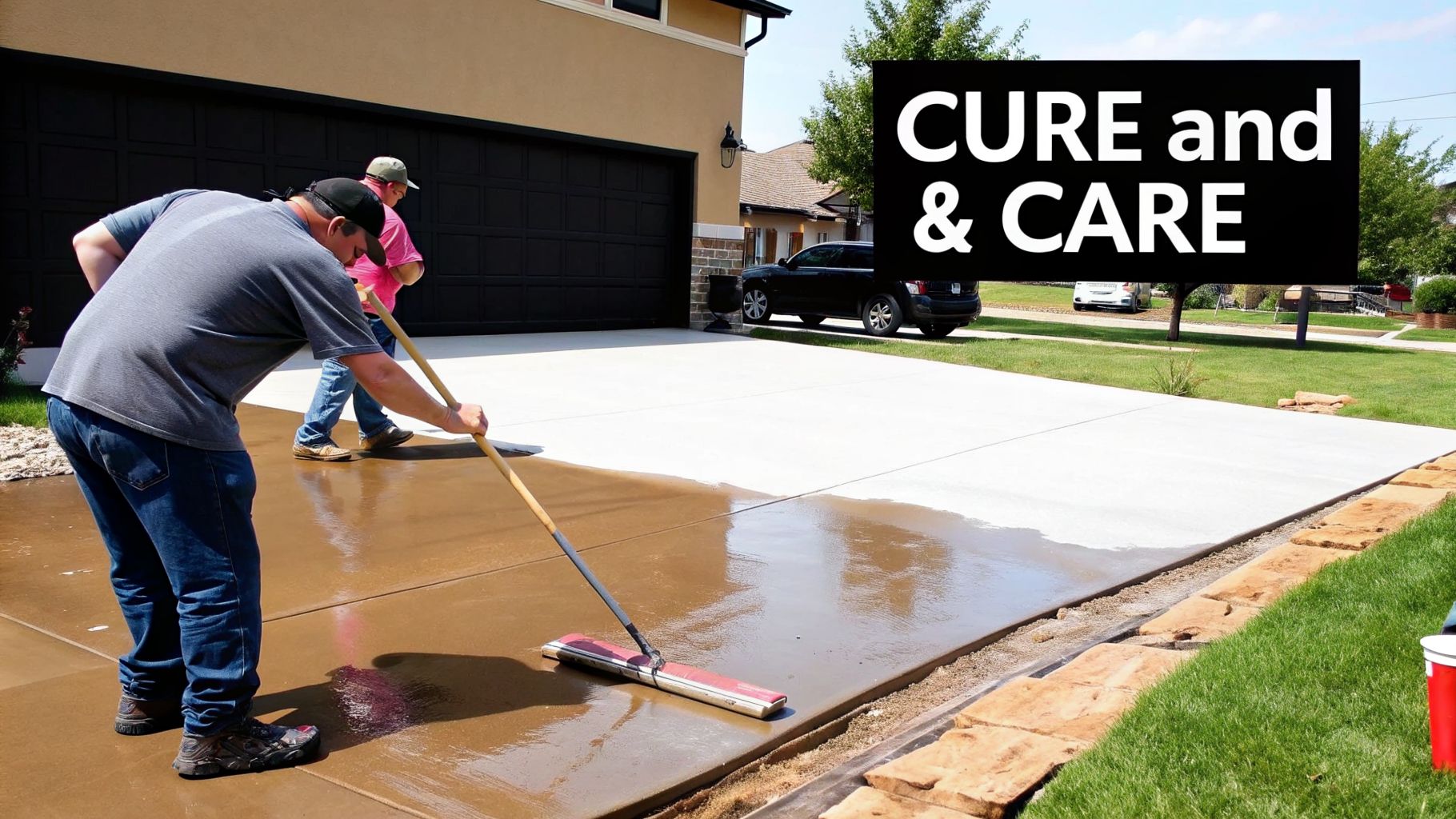
The day the ready-mix truck pulls up is the moment all that careful preparation comes together. This is where skill, timing, and experience converge. It's the most dynamic part of the job, and our Firm Foundations crew handles it with a practiced, steady hand, ensuring our customers feel confident and reassured.
We start by strategically placing the concrete, ensuring it's distributed evenly throughout the forms. Our team works fast to spread it out, making sure every corner is filled and the slab meets the exact thickness we engineered.
Creating A Flawless, Functional Surface
As soon as the concrete is placed, we start the leveling process, known in the trade as screeding. Using a long, straight screed board, we work it across the top of the forms in a sawing motion. This removes excess concrete and establishes the final, flat surface with the precise slope for drainage.
Next, we move to bull floats. These wide, flat tools are on long handles, letting us smooth the surface even further. This step is crucial—it pushes the heavier aggregate down and brings a layer of cement paste, or "cream," to the top, which is what we need for a durable, clean finish.
For driveways and outdoor slabs in our region, a broom finish isn't just an option; it's the professional standard. After the concrete is floated and troweled perfectly smooth, we drag a specialized broom across the surface. This creates fine grooves that provide essential traction in wet or icy weather—a critical safety feature for homes in Pennsylvania, Maryland, Delaware, and New Jersey.
The Right Concrete Mix Makes All The Difference
Not all concrete is the same. The strength and longevity of your new foundation hinge on the quality of the mix. Concrete strength is measured in pounds per square inch (PSI), and for a project that will last, using the right mix is non-negotiable.
We always specify a concrete mix with a compressive strength of at least 4000 PSI. This is the industry standard for any exterior concrete that has to handle vehicle weight or structural loads and the harsh freeze-thaw cycles common to our area. Trying to save a few dollars with a lower-strength mix is a recipe for a shortened lifespan.
Pouring the concrete is a one-shot operation. There are no do-overs. That's why we partner with reputable local ready-mix suppliers who deliver a consistent, high-quality product every single time, ensuring your foundation has the strength it needs from day one. This is part of our commitment to our community.
Why The Curing Process Is So Important
Once the finishing touches are complete, the most critical and often misunderstood phase begins: curing. People think concrete simply "dries," but it actually undergoes a chemical reaction called hydration. For this reaction to happen correctly, the concrete needs to retain moisture to build its internal structure and gain strength.
Proper curing is all about controlling the rate of moisture loss. If concrete loses water too fast, especially in the first few days, it can't reach its full design strength. This leaves it weak and prone to cracking. We make sure this doesn't happen by applying a liquid membrane curing compound, which acts as a seal to lock in moisture.
Following proper curing timelines is something we can't stress enough. You should keep vehicles off a new driveway for 7 days and wait 28 days before the concrete is considered fully cured. Adhering to this simple rule can prevent up to 70% of early damage issues. While the surface might feel hard in a day or two, the real strength is still developing internally. You can get more details on this crucial waiting period from these expert findings on Angi.com.
Here is a simple timeline to help protect your investment:
- First 48 Hours: Stay off completely. This is when the surface is most fragile.
- After 48 Hours: It's generally safe for light foot traffic.
- After 7 Days: Passenger cars and light SUVs can use a new driveway. The concrete has reached about 75% of its final strength.
- After 28 Days: The concrete has hit its full design strength. It's now ready for heavier loads like work trucks or an RV.
Common Questions From Our Pennsylvania Neighbors
Clients throughout our Pennsylvania, Maryland, Delaware, and New Jersey service areas frequently ask insightful questions about their projects. To provide clarity and instill confidence in your decision, we've compiled answers to the most common inquiries. At Firm Foundations, our commitment is to transparency and quality, ensuring you are well-informed and comfortable every step of the way.
What Is the Professional Cost for Foundations in 2026?
While each project has unique needs, the cost for professional concrete driveway preparation or shed foundation installation in our service area typically ranges from $8 to $18 per square foot. This pricing generally includes everything from excavation and the engineered gravel base to reinforcement and the final concrete pour.
The final investment depends on variables like site accessibility, the total square footage, and the specified thickness of the slab. Firm Foundations provides a detailed, transparent quote, so you have a clear understanding of where your investment is going. This ensures the construction of a durable, long-lasting project, which can save you thousands in future repairs and give you lasting peace of mind.
Can a New Concrete Slab Be Poured Over an Existing One?
We strongly advise against this practice. Different materials and old, cracked concrete exhibit different thermal expansion rates, a discrepancy that will invariably lead to premature cracking and failure of the new slab.
The correct and only methodology we employ is the complete removal of the old surface and its underlying base.
Pouring new concrete over an unstable foundation is a definitive recipe for failure. As your trusted local contractor, we always start from the ground up with a new, stable subgrade and a gravel base engineered specifically for a long-lasting concrete slab.
Why Are Control Joints Necessary in New Concrete?
It is a principle of materials science that concrete shrinks as it cures, and this shrinkage inherently causes cracking. Control joints are strategically planned and precisely cut "weak points" in the new slab.
These joints are designed to direct the inevitable cracking into a straight, predetermined line, rather than allowing it to occur randomly across the surface. This is a critical technique utilized by professional concrete contractors to manage the natural behavior of concrete and preserve the beauty and integrity of your project for years. For ongoing maintenance, homeowners can find valuable information on topics like removing grease stains from concrete in specialized guides.
Ready to work with a team that prioritizes quality, integrity, and our community? The experts at Firm Foundations are here to answer all your questions and provide a complimentary, no-obligation quote for your new driveway, shed foundation, or other concrete projects. Give us a call or visit us online at https://shedpads.com to request your quote today.