
Compaction Equipment Types Explained for Solid Foundations
You've leveled the site, spread the gravel, and set out plans for a shed, garage, gazebo, or driveway. Then the base starts to sink near one edge, water collects beside the structure, or a new slab develops movement. In many cases, the problem began before the concrete was poured. The soil or gravel wasn't compacted with the right compaction equipment type for the material, access, and project size.
Firm Foundations helps homeowners and contractors across Pennsylvania, Maryland, Delaware, and New Jersey prepare durable bases for sheds, garages, houses, gazebos, horse barns, playsets, hot tubs, shipping containers, driveways, and patios. Whether you're searching for shed foundations contractors near me, garage foundation contractors near me, or concrete foundations for a larger project, understanding the equipment behind proper site preparation will help you ask better questions and compare quotes with confidence.
Why Compaction Matters Before You Build in Pennsylvania and Beyond
A homeowner may call after noticing that a shed pad no longer looks level. One corner has settled, the door drags, and rainwater sits along the low side. The shed itself may be sound, but the loose or poorly prepared base beneath it has shifted under the load.
That same issue can appear beneath a gazebo foundation, a 10×10 storage shed, a driveway, or a garage slab. Loose fill contains open spaces between particles. As weight, water, and seasonal ground movement act on the area, those particles can rearrange. The result may be settlement, soft spots, uneven support, or water that drains toward the structure instead of away from it.
Pennsylvania and neighboring states also bring frost-related concerns. For permanent foundations such as poured slabs or concrete piers, footings generally need to extend below the local frost line. Frost-depth requirements vary by climate, from roughly 12 inches in warm coastal or southern areas to 30 to 36 inches across parts of the mid-Atlantic and central states, and 48 to 60 inches in much of the Upper Midwest and Northeast, as summarized by regional shed foundation guidance. Local requirements still control, so your contractor should confirm the applicable rules for your property.
Compaction is part of structural preparation
The goal isn't to make gravel look flat. Crews need to create a firm, consistent surface that can support the planned foundation and shed, garage, or other structure. Equipment selection should also account for operating forces and machine capacity. A useful reference on related load considerations is this guide to hydraulic component load limits.
Soil testing can clarify whether the existing ground, imported fill, or mixed material needs special treatment. Before construction, homeowners can review soil testing for foundations as part of the planning process.
The right decision isn't “rent the biggest roller.” A large roller may not fit beside a wall or inside a narrow footing trench. A small plate may vibrate granular gravel effectively but struggle with cohesive clay. Good preparation matches the machine to the ground and the space, then builds the base in controlled layers.
How Compaction Works and Why Equipment Families Differ
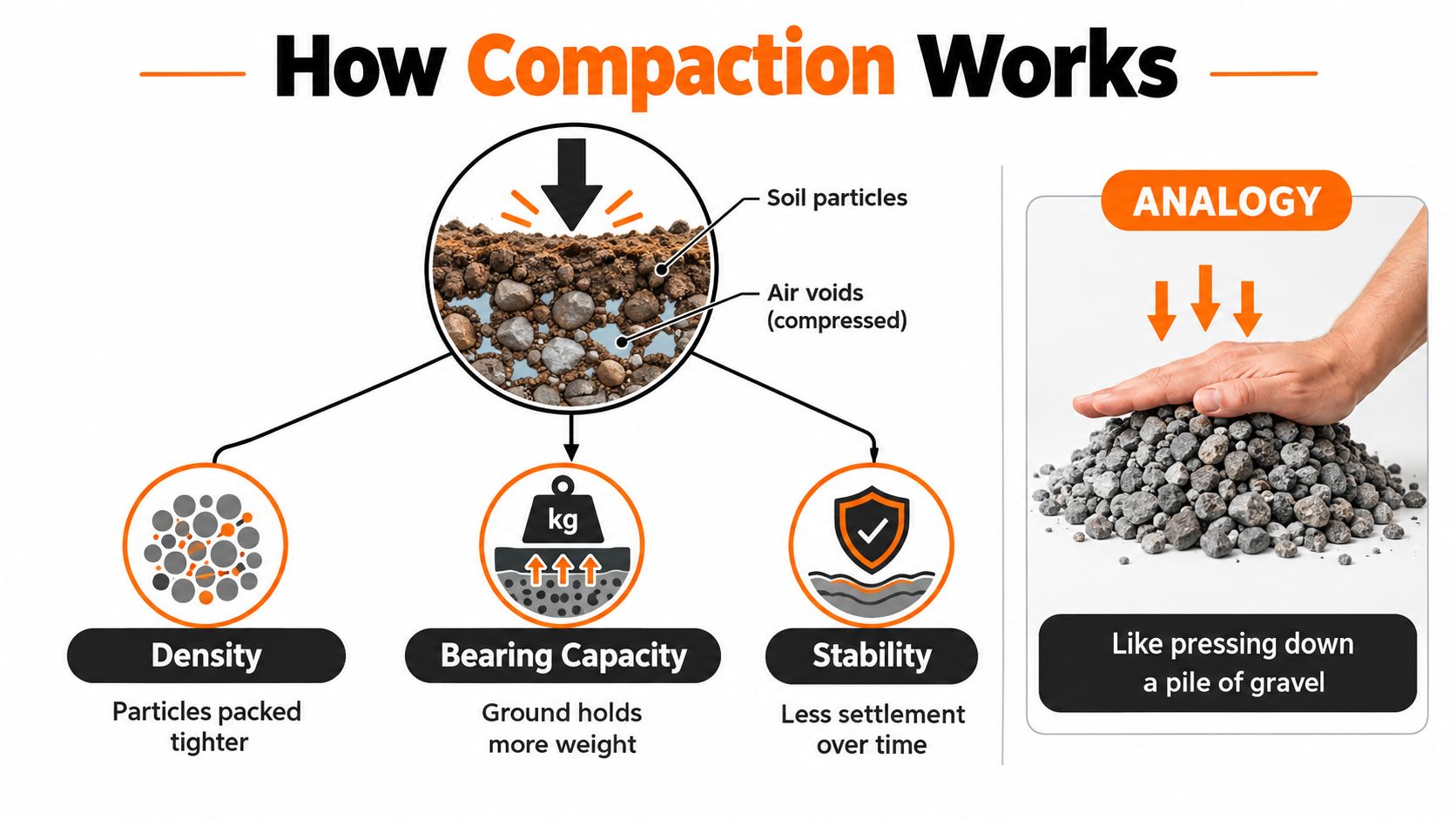
Compaction makes soil or aggregate denser by reducing the air spaces between particles. Think about a loose pile of gravel. The pieces touch in scattered places, but many gaps remain. Pressing and vibrating the pile encourages the particles to settle into a tighter arrangement, creating a more stable layer beneath a foundation.
That change affects three practical outcomes:
- Density: Particles pack more tightly.
- Bearing capacity: The ground can support more weight.
- Stability: The finished surface is less likely to settle unevenly over time.
Three ways machines deliver force
Compactors use a combination of static pressure, vibration, impact, and kneading. Static pressure comes from weight pressing down. Vibration helps granular materials move and settle. Impact delivers repeated vertical blows, which can work well in cohesive soils and narrow trenches. Kneading action works the material from different directions, helping break up clods and reduce voids in clayey fill.
The material determines which force is useful. Sand and gravel usually respond well to vibration because their particles can move into a tighter arrangement. Clay and other cohesive soils hold together in clumps, so vertical impact or kneading may work better than vibration alone.
Why modern equipment comes in families
Compaction equipment evolved from early steam-driven road rollers to modern vibratory machines. Historical industry sources describe steam rollers as tandem and three-wheeled rollers, while single-drum self-propelled vibratory compactors reached the market in force in the mid-1960s, followed soon after by tandem vibratory compactors. By the mid-1960s, self-propelled plate compactors had also become obsolete as vibratory drum compactors gained acceptance, a shift documented in this history of mechanized compaction equipment.
That history explains the families used today:
- Rammers and tampers work in confined areas and often suit cohesive soil.
- Plate compactors handle smaller surfaces and granular base.
- Rollers cover broad areas efficiently.
The industry still separates equipment into smooth wheeled, sheepsfoot, pneumatic, vibratory, rammer, and vibratory plate categories. Market coverage from soil compaction machine research reflects that broad equipment mix across road building, site preparation, trench work, and foundations.
Handheld and Walk Behind Compaction Equipment Types for Tight Spaces
Small foundation work often creates the hardest access problems. A crew may need to compact gravel beside an existing wall, work inside a garage footing trench, or prepare a narrow strip around a gazebo footing. Handheld and walk-behind machines provide control where a ride-on roller would be too wide, too heavy, or unsafe.
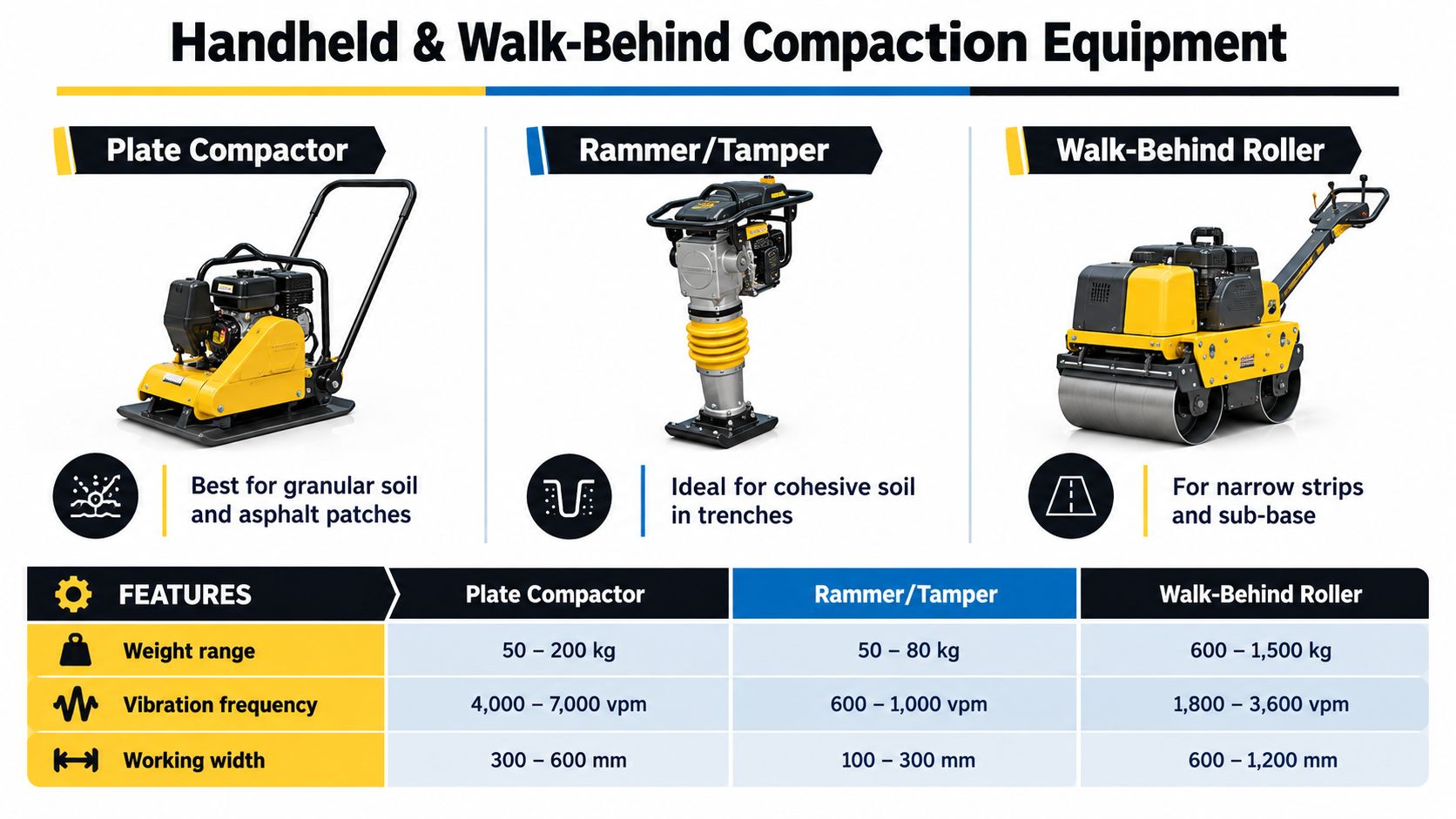
A tamping rammer, sometimes called a jumping jack, uses a narrow foot and repeated vertical impact. It's a strong choice for cohesive soil, clay-rich backfill, and trench-adjacent work. The narrow footprint lets an operator compact close to footings, walls, and utility lines, although the machine can be noisy and tiring to control over a broad open area.
A vibratory plate compactor uses a flat steel plate that moves rapidly against the surface. It's commonly used for sand, gravel, and aggregate bases beneath a shed, patio, walkway, or small driveway. Reversible plates move forward and backward, giving the operator better control where a larger area or somewhat thicker base needs repeated coverage.
A walk-behind roller brings drum-style pressure and vibration to narrow strips, small paving areas, and sub-base work. It generally covers more efficiently than a plate but still fits where a ride-on machine may not. A trench roller, often operated remotely, can compact narrow backfill while keeping the operator away from unstable edges. Padfoot versions suit cohesive soil, while smooth-drum configurations may suit sandy material.
The layer matters as much as the machine
Technical guidance places many small vibratory plate compactors in approximately 50 to 150 kg classes, with operating vibration rates around 400 to 10,000 vibrations per minute. For granular material, guidance commonly describes compacted layer thicknesses of roughly 75 to 110 mm, with 4 to 6 passes often used for optimum densification, as outlined in the forest road engineering manual's compaction guidance.
| Equipment Type | Best Soil Match | Typical Application |
|---|---|---|
| Plate compactor | Sand, gravel, aggregate | Shed foundation gravel base, patio, walkway |
| Rammer or tamper | Clay, cohesive backfill | Trenches, footing edges, confined fill |
| Walk-behind roller | Narrow granular or paved areas | Sub-base strips, small driveway work, asphalt patches |
The main tradeoff is access versus production. A rammer reaches tight corners but works slowly across a wide pad. A plate is efficient on granular material but isn't the right answer for every clay fill. A walk-behind roller covers more surface while preserving maneuverability.
Rollers for Larger Pads Driveways and Garage Foundations
Open sites change the equipment decision. A large shed pad, garage foundation area, driveway, or building subgrade gives a roller room to work, so coverage and consistent passes become more important than the narrow access of a handheld machine.
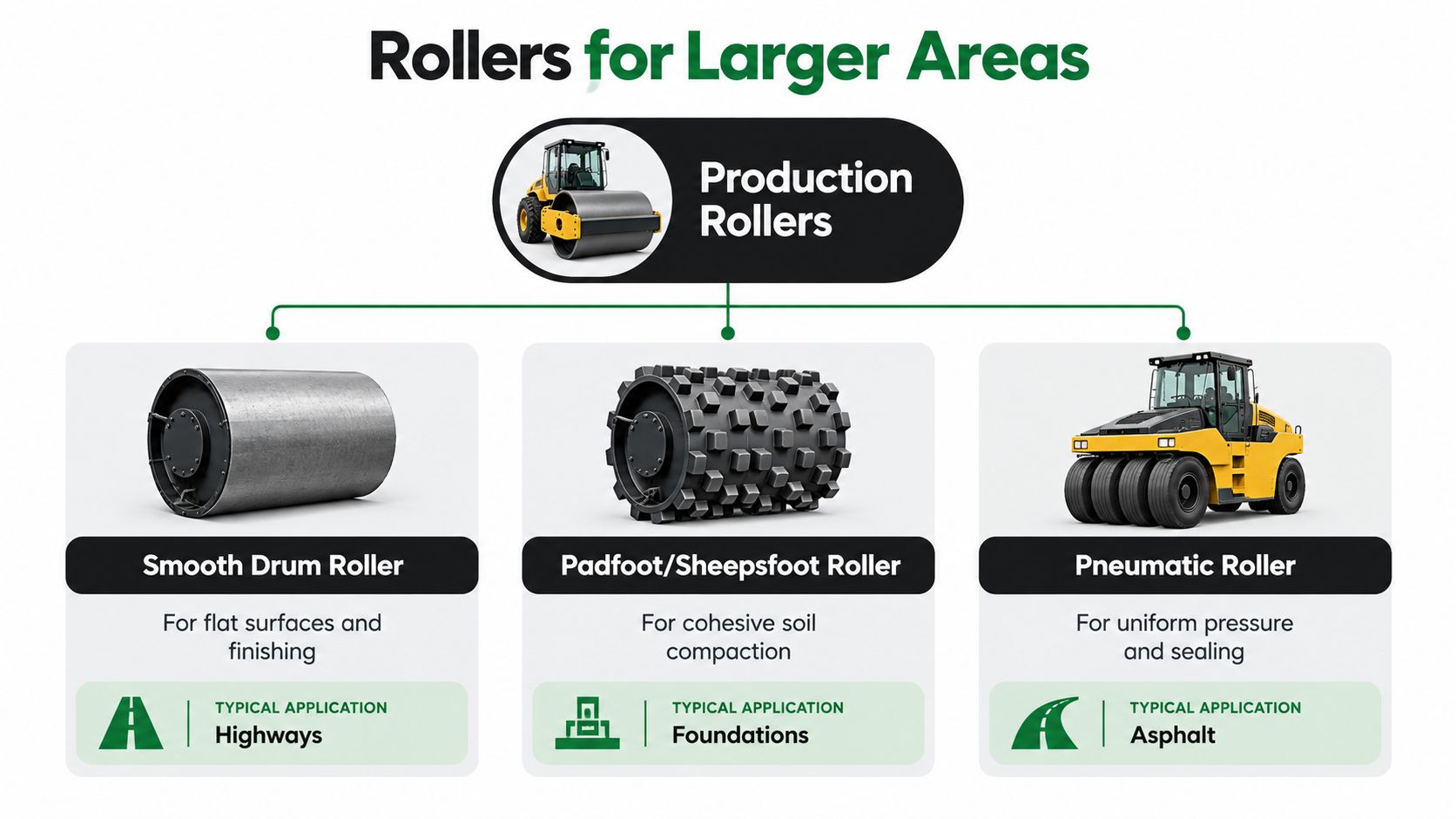
A smooth drum roller applies weight through a smooth steel drum. It suits granular base layers, flat surfaces, and finishing work. A vibratory version adds oscillation to the drum, helping particles settle more tightly. Smooth drums are also common in asphalt compaction, where a uniform finish matters.
A padfoot or sheepsfoot roller uses raised projections on the drum. Those pads penetrate and knead cohesive soil, making this equipment more appropriate for clay, silt, and earthwork fills than a smooth drum. The machine works the material rather than sealing its surface.
A pneumatic roller uses rubber tires to apply distributed pressure and kneading. It can help provide uniform coverage and surface sealing, especially during asphalt or finish work. Because tire contact changes with the material and machine setup, operators need to follow the project's compaction requirements rather than treating pneumatic rollers as a universal solution.
Selecting a roller by surface and finish
A tandem vibratory roller has drums at the front and rear, making it useful where even coverage and a smooth finish are priorities. Tandem rollers are commonly associated with roads, asphalt, and broad granular surfaces. A single-drum roller, by contrast, can combine a front drum with rear tires and may be configured with a smooth drum or padfoot drum depending on the soil.
The wrong roller can create a misleading surface. A smooth drum may close the top of a clay lift while leaving weaker material below. Excessive vibration on loose granular fill can also disturb the layer instead of improving it. Operators need to control moisture, lift thickness, speed, and passes together.
| Roller Type | Main Action | Suitable Work |
|---|---|---|
| Smooth drum | Pressure and vibration | Granular base, flat surfaces, finish work |
| Padfoot or sheepsfoot | Penetration and kneading | Clay, silt, cohesive earthwork |
| Pneumatic | Tire pressure and kneading | Asphalt, sealing, uniform pressure |
| Tandem vibratory | Drum weight and vibration | Driveways, paving, broad granular areas |
For a residential garage or driveway, the largest available roller isn't automatically the most appropriate. The machine must fit the pad, the fill, the access route, and the required finish.
How to Match Compaction Equipment to Soil and Project Size
A useful decision starts with two questions: What material are you compacting, and how much room does the machine have to work? Those questions are more reliable than choosing by horsepower, rental cost, or appearance.
Granular fill, such as clean sand and gravel, generally responds to vibration. A vibratory plate works well for a small shed foundation gravel base, while a smooth drum roller covers a larger garage pad or driveway more efficiently. Cohesive material, such as clay, tends to respond better to impact or kneading. That points toward a rammer for a trench edge or a padfoot roller for an open earthwork area.
Mixed fill needs closer judgment. A material may contain gravel, fines, and clay rather than behaving like a clean textbook soil. Moisture matters too. Material that is too wet can smear or pump under equipment, while material that is too dry may resist proper densification. The crew should evaluate the material in place and adjust the process rather than relying on a machine label.
A practical sequence for small foundation pads
For a small shed or gazebo base, the work often follows a deliberate sequence:
- Prepare the subgrade. Remove vegetation, organic material, soft spots, and unsuitable debris before placing aggregate.
- Build controlled lifts. Spread the gravel or fill in manageable layers instead of placing one deep loose mass.
- Treat the edges first. Use a rammer where the pad meets walls, trenches, posts, or footing lines.
- Compact the main area. Use a vibratory plate for granular fill, or a suitable roller where the pad is open and large.
- Check the surface. Look for movement, rutting, low areas, and drainage paths before the foundation is installed.
For a 4×8 shed with foundation, a small storage shed, or a base for a storage shed, access may matter more than total area. A 10×10 storage shed pad may still have tight setbacks, gates, or landscaping that make a walk-behind plate more practical than a ride-on roller.
For garage slabs and driveways, the open area may justify a walk-behind roller or ride-on equipment. The relevant soil compaction guidance for concrete slabs can help homeowners understand why the base preparation deserves as much attention as the concrete finish.
Lift thickness and passes control the result
Engineering guidance commonly places field lift thicknesses around 150 to 300 mm for common equipment, while finer-grained materials require thinner lifts and more passes. A material-based table lists clay at 100 to 150 mm with 4 to 6 passes, while gravel can be placed at 200 to 300 mm with 3 to 5 passes, according to FHWA compaction guidance.
Those figures aren't a substitute for project specifications. They show why a larger machine can't compensate for an overly thick lift. A properly selected plate, rammer, or roller must reach the material throughout the layer, not just make the surface appear firm.
Compaction Specs to Request for Shed Garage and Driveway Foundations
When you request a quote, ask for more than “gravel base” or “prepare the ground.” A clear proposal should identify the foundation type, excavation limits, aggregate base, drainage plan, and compaction approach. That lets you compare a gravel shed foundation with a concrete foundation for a garage on the same practical terms.
For a shed foundation, guidance commonly calls for a compacted gravel base at least 4 to 6 inches deep on a level, well-drained site. The base should extend appropriately beyond the structure and remain stable around shed foundation blocks or other support components.
For a residential slab-on-grade, the summarized 2024 International Residential Code requirements include a minimum slab thickness of 3.5 inches, a 6-mil polyethylene vapor retarder, and placement over at least 4 inches of clean aggregate or approved compacted fill free from vegetation and organic material, as described in this IRC 2024 slab-on-grade summary. Local code officials and the project designer determine which provisions apply.
Garage floors need drainage and footing planning
For garages, the same code summary identifies a floor requirement to use non-combustible material and slope the floor at least 1/8 inch per foot toward the main vehicle entrance or a floor drain. That slope should be planned during forming and base preparation, not improvised after the concrete arrives.
Ask whether the quote includes:
- Excavation and subgrade work: Clarify what unsuitable soil or organic material will be removed.
- Aggregate specification: Confirm the type, thickness, and placement of the gravel or clean aggregate.
- Compaction process: Ask which equipment will be used and how the crew will handle edges, lifts, and soft areas.
- Drainage control: Confirm finished elevations, surface slope, and water flow away from the structure.
- Footing depth: For garage footings and foundations, verify how local frost-depth requirements affect excavation.
- Concrete details: Compare slab thickness, reinforcement, forms, joints, and finishing rather than comparing price alone.
ASTM D698 provides a laboratory benchmark for soil compaction characteristics. The test measures the relationship between molding water content and dry unit weight using a 4-inch or 6-inch mold and a 5.50-pound-force rammer dropped from 12.0 inches, with defined compaction energy of 12,400 foot-pounds-force per cubic foot, or 600 kilonewton-metres per cubic metre, as specified by ASTM D698. Homeowners don't usually perform this test themselves, but asking how field results will be evaluated can make a technical quote easier to understand.
Some local concrete code examples call for a 4-inch minimum concrete thickness over a 4-inch compacted, uniformly graded, well-drained aggregate base. Those examples also connect garage floor performance to well-compacted earth or aggregate and drainage toward the entrance or a floor drain, as shown in ASTM's referenced compaction material.
Renting Versus Hiring a Pro and Your Next Steps With Firm Foundations
Renting a plate compactor can make sense for a very small, accessible gravel project when you understand the soil, lift thickness, passes, slope, and safe operation. The rental itself doesn't determine whether the finished base is sound. Poor machine selection, missed edges, inconsistent passes, and hidden soft soil can leave problems below a foundation that looks finished from above.
Hiring a professional becomes more valuable when the site needs excavation, imported fill, drainage correction, frost-depth footings, concrete forms, or work beside an existing structure. Garage footings and foundations, house foundation preparation, and larger driveway bases involve more than operating a machine. They require coordination between grading, compaction, forming, reinforcement, concrete placement, and final elevations.
Firm Foundations is a licensed and insured foundation and excavation contractor serving Pennsylvania, Maryland, Delaware, and New Jersey. The company provides site preparation, gravel pads, concrete foundations, excavation, forming, pouring, and finishing for sheds, garages, houses, gazebos, barns, driveways, patios, and other structures. Its process starts with selecting the appropriate foundation type, preparing a transparent free quote, and completing the work to the planned specifications.
A good contractor should explain why a plate, rammer, walk-behind roller, or larger roller fits your site. You should also receive a clear answer about drainage, access, unsuitable soil, and what happens if the crew finds a soft area during excavation.
If you're comparing shed foundations near me, gravel shed foundation contractors near me, excavation near me, or driveway contractors near me, focus on the preparation details behind the finished surface. A properly compacted base supports the foundation you can see and reduces the risk of paying for repairs later.
Firm Foundations prepares compacted gravel pads and concrete foundations for sheds, garages, gazebos, houses, driveways, and other structures across Pennsylvania, Maryland, Delaware, and New Jersey. Visit Firm Foundations to request a transparent quote and discuss the soil, access, drainage, and compaction equipment your project needs.