
Gravel Base for Asphalt Driveway: A Homeowner’s Guide
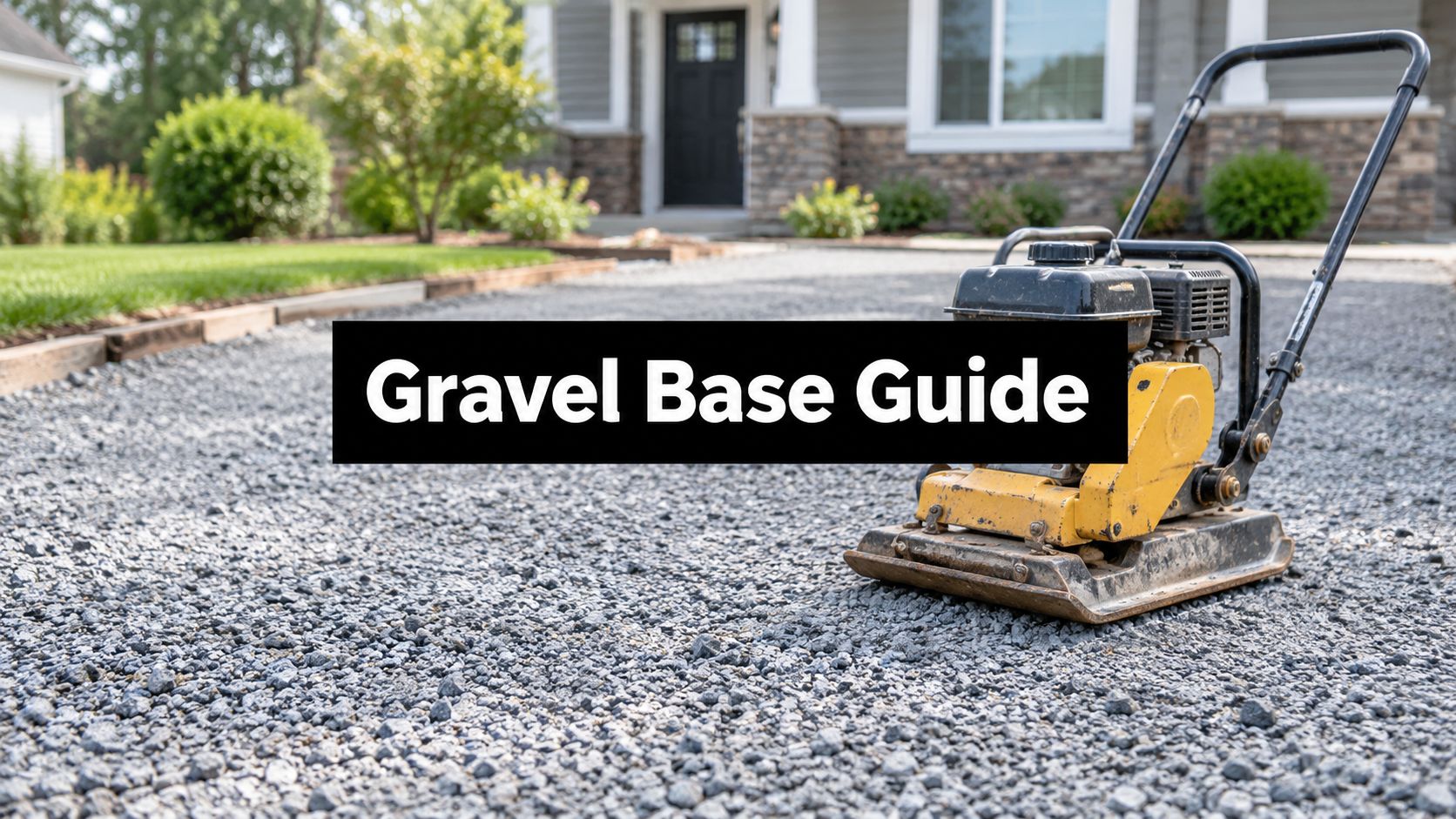
A new asphalt driveway can look perfect when the crew leaves, yet early cracking, soft edges, or tire ruts may appear after the first wet season. Homeowners in Pennsylvania, Maryland, Delaware, and New Jersey often assume the asphalt mix was the problem. On residential job sites, the hidden issue is more often the gravel base for the asphalt driveway, especially when the soil, drainage, lift thickness, and compaction sequence weren't handled together.
The surface is only the part you see. A dependable driveway starts with excavation and continues through a properly shaped subgrade, suitable aggregate, controlled moisture, and a drainage plan that keeps water away from the pavement structure. Whether you're looking for driveway contractors near me, excavation near me, or a contractor who can prepare a stable base before paving, the decisions below determine whether the finished drive remains firm and serviceable.
Why Driveways Fail Before the Asphalt Wears Out
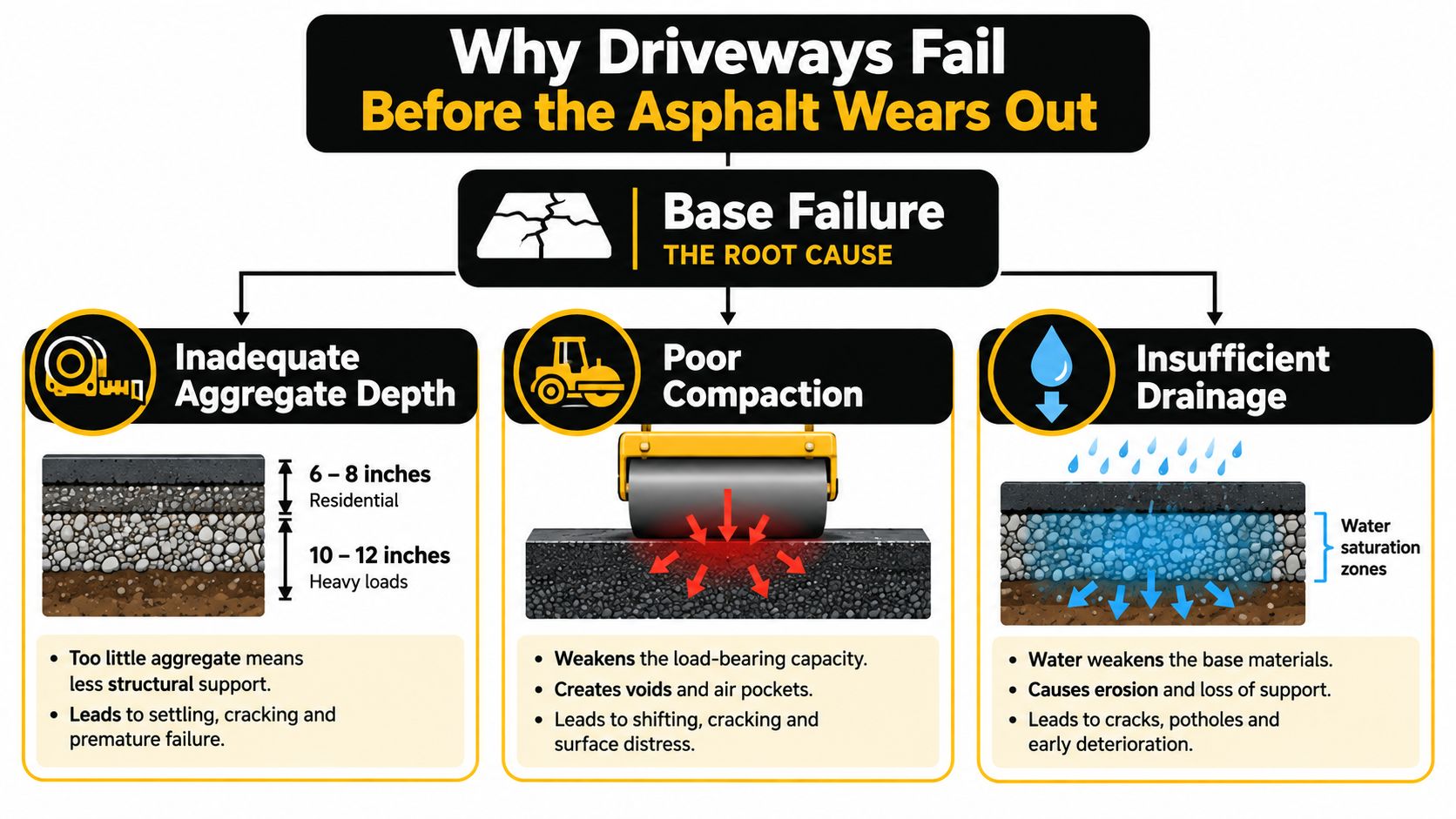
A homeowner may see the first warning at the end of a two-car driveway, where an alligator crack follows the tire path used every morning. The asphalt can still look dark and fairly new. That pattern usually points below the surface. If the supporting layers move, settle, or remain saturated, the asphalt will reflect that movement.
Asphalt is the wearing surface, not the layer that provides all the structural support. Maintenance and replacement are eventually normal, but early cracking, rutting, and settlement usually indicate movement, saturation, inadequate depth, or settlement in the unbound layers. Residential guidance commonly places 2 to 3 inches of compacted asphalt over a 4 to 6 inch compacted gravel base. Heavier-use drives often need 6 to 8 inches of base and 3 to 4 inches of asphalt, as summarized in the Illinois Asphalt Pavement Association driveway guidance.
The pavement stack beneath your tires
A driveway is a layered structure. Asphalt placed over loose or poorly compacted stone may look finished at first, but each layer still has a separate job.
- Native subgrade: This is the existing soil after removing topsoil, roots, and other organic material. The crew must make it uniform, shape it for drainage, and compact it before placing stone. A soft pocket will continue moving beneath additional asphalt.
- Granular subbase: Coarser crushed stone can bridge weak areas and provide a drainage route. On poor soil, it may be needed below the main aggregate base rather than mixed into it.
- Aggregate base course: Graded crushed stone or crusher run creates the working platform and spreads vehicle loads. Place it in lifts the equipment can compact, not as one deep dump that leaves the lower material loose.
- Asphalt surface: Hot-mix pavement protects the structure from traffic and weather. A typical residential surface is 2 to 3 inches compacted.
The sequence matters as much as the material. After excavation, the crew should proof-roll or otherwise check the subgrade, correct soft areas, and establish the required grade before stone arrives. Aggregate placed on a wet, pumping subgrade can trap the problem below the base.
Moisture during compaction also matters. Stone needs enough moisture for particles to knit together under the roller, but saturated material will move instead of densifying. Crews should place manageable lifts, condition the material when needed, and compact each lift before adding the next. A thick layer that feels firm at the top can remain loose underneath.
What determines whether the base performs
Depth is only one part of the decision. Aggregate must suit the soil, the lifts must match the available equipment, and the finished base must shed water toward planned outlets instead of sending it into the pavement edges.
On wet clay, fill, or soil that pumps under equipment, geotextile may belong beneath the stone. Its job is separation and reinforcement, helping keep the aggregate from disappearing into the subgrade. It is not a substitute for excavation, drainage, or compaction. On stable, dry native soil, fabric may add cost without solving a real site problem.
A practical design rule treats 1 inch of asphalt pavement as roughly equivalent to 3 inches of aggregate base for structural comparison. A 6 inch gravel base can therefore contribute roughly the support effect of 2 inches of asphalt thickness, but the materials are not interchangeable. The base spreads wheel loads, limits deformation, and helps the driveway tolerate repeated traffic and freeze-thaw cycles.
Field observation: Smooth asphalt can conceal a weak base until water, wheel loads, and seasonal movement expose the preparation beneath it.
How Much Gravel You Actually Need
A truckload can look generous and still leave a driveway short on structural stone. Base depth must be measured after compaction, not from the loose pile placed on the subgrade. For a residential driveway on reasonably stable loam or sandy soil, start with 4 to 6 inches of compacted aggregate base. The Asphalt Professionals Association installation guidance identifies 4 inches as an absolute minimum and places typical residential work in the 4 to 6 inch range.
The field sequence matters as much as the final depth. Place the aggregate in lifts that the available roller or plate compactor can densify throughout, then check the elevation before placing the next lift. A thick lift may feel firm at the surface while remaining loose below. Material should be damp enough to compact and knit together, while saturated stone or soil can move under equipment instead of becoming dense.
Heavier use changes the design. Driveways carrying work trucks, trailers, or other concentrated loads commonly move toward 6 to 8 inches of compacted base, consistent with residential heavy-use guidance from the Illinois Asphalt Pavement Association. Weak clay, a high water table, or persistent frost conditions may require more thickness, excavation, separation, underdrains, or several of these measures. Extra stone cannot correct a wet subgrade by itself.
| Site Condition | Compacted Base Depth | Notes |
|---|---|---|
| Stable residential soil and passenger-car use | 4 to 6 inches | Place graded crushed aggregate in compacted lifts and verify the subgrade first. |
| Heavy pickups, trailers, or work vehicles | 6 to 8 inches | Control lift thickness and give added attention to edges and drainage. |
| Weak, wet, or frost-sensitive soil | Thicker than a standard residential base may be needed | Evaluate excavation, geotextile separation, underdrains, or a granular subbase. |
For a 1,000 square foot driveway with a 6 inch compacted base, the volume is about 500 cubic feet, or roughly 18.5 cubic yards before accounting for delivered condition. Converting that volume to tons requires the supplier's actual density, moisture, and gradation. The finished order may also need allowance for subbase, grading, and undercut areas.
Measure the excavation, then verify the stone after compaction. Ordering only enough to cover the visible footprint leaves no room for soft spots or corrections. Saving structural depth often shifts the cost into settlement, regrading, and paving repairs later.
Choosing the Right Aggregate for the Job
Aggregate choice should follow the soil and drainage plan, not just the lowest delivered price. Three materials are common on residential work in the Mid-Atlantic, although local quarry names and gradations vary.
Clean crushed stone, such as #57 or #67, has open voids that allow water to move quickly. Its angular faces interlock, but it doesn't contain enough fines to compact into a tightly sealed surface by itself. Contractors may use it as a drainage-oriented layer or where a free-draining structure is needed.
Crusher run, also called a graded aggregate base, combines larger angular stone with smaller particles and fines. That blend fills voids and compacts into a dense working platform. It generally drains more slowly than clean stone, which can be helpful for stability but requires careful attention to surface water and trapped moisture.
Recycled concrete aggregate, or RCA, can perform similarly to suitable virgin aggregate when it is clean, properly processed, and free of unwanted debris. Availability varies by area, and the source should be screened for consistent gradation. A cheaper delivered load isn't a bargain if it contains excessive fines or inconsistent material.
| Aggregate | Compaction | Drainage | Best For |
|---|---|---|---|
| Clean crushed stone, such as #57 or #67 | Locks through angular contact but remains relatively open | Fast | Drainage layers, edge zones, and sites where water movement is important |
| Crusher run or graded base | Compacts into a dense, stable platform | Moderate to limited compared with clean stone | Main residential base course when drainage is properly designed |
| Clean recycled concrete aggregate | Compacts well when properly processed | Depends on gradation and fines | Suitable base work where a reliable local source is available |
| Round bank-run gravel | Rolls and shifts rather than locking | Can drain, but lacks structural stability under traffic | Avoid beneath asphalt unless a qualified design specifically accounts for it |
Round bank-run gravel is the material that causes the most confusion. It may look substantial in a stockpile, but smooth particles roll under load and don't create the stable, angular framework needed below asphalt. Match the material to the subgrade, water conditions, and compaction equipment instead of accepting whichever aggregate the supplier can deliver first.
Compaction the Way Contractors Do It
A driveway base can look finished and still fail under traffic if the crew buries soft soil or leaves the lower stone loose. Good work starts below the aggregate. Strip unsuitable material, shape the subgrade, and proof-roll it or test it for yielding areas. If the soil flexes under equipment, more stone only hides the problem temporarily.
Lift thickness controls how much compaction reaches the bottom of the layer. Clean crushed stone is commonly placed in 4 to 6 inch loose lifts. Crusher run is often spread in 3 to 4 inch lifts, allowing the roller to influence the full depth. The right lift depends on the aggregate, moisture, and available equipment. The Anvil Field asphalt driveway installation guide recommends placing material in lifts the equipment can densify, then compacting near the material's suitable moisture condition before adding the next layer.
A practical sequence on site
- Prepare and inspect the subgrade. Remove organics, cut out soft pockets, and establish the planned grade before base material arrives.
- Separate unstable soil when necessary. If clay or silt pumps into the stone, place an appropriate geotextile before spreading aggregate.
- Spread the first lift evenly. Do not dump a deep pile and grade it into place. The compactor needs access to the entire layer.
- Condition the moisture. Material that is too dry can bridge over voids. Excess water can make the base shove or pump under the machine.
- Roll systematically. Use a vibratory plate in confined areas and a suitable roller across the main drive. Wider or heavily used aprons may need heavier equipment and additional checks.
- Check elevation and density. Fix low spots before placing the next lift or asphalt. Waiting until rutting appears makes the correction more expensive.
Industry guidance commonly targets a dense, uniform gravel base. Larger projects may verify compaction with a nuclear gauge or sand cone. Residential crews more often combine equipment response, proof-rolling, and experienced inspection, while still watching for movement, pumping, or uneven settlement.
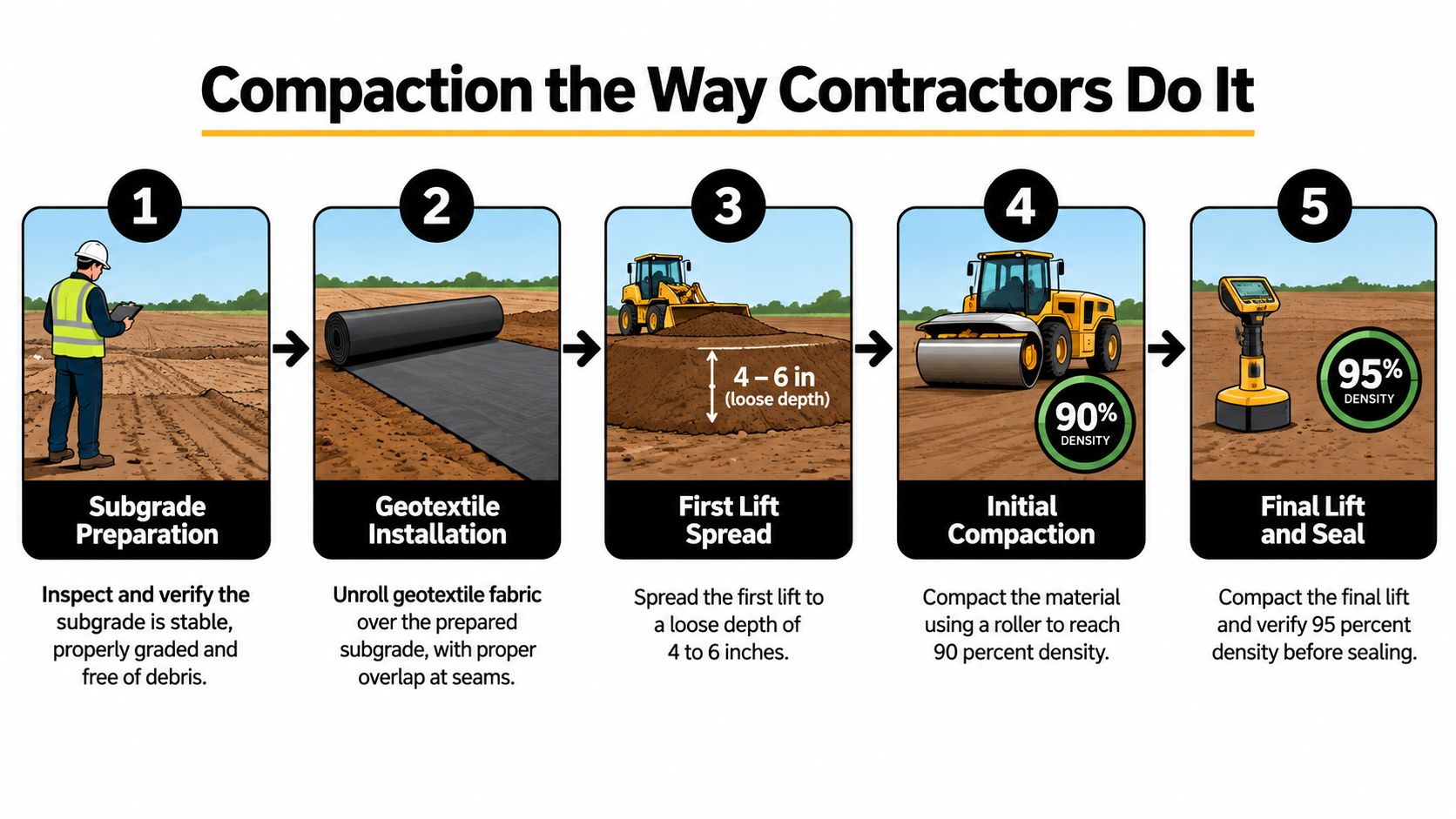
A roller cannot correct an oversized lift. The surface may form a hard crust while the lower stone remains loose. That hidden void can become a rut or depression as vehicles and water work through the driveway.
For a closer look at machines suited to different materials and working areas, review this guide to compaction equipment types.
Drainage, Fabric, and Edge Details
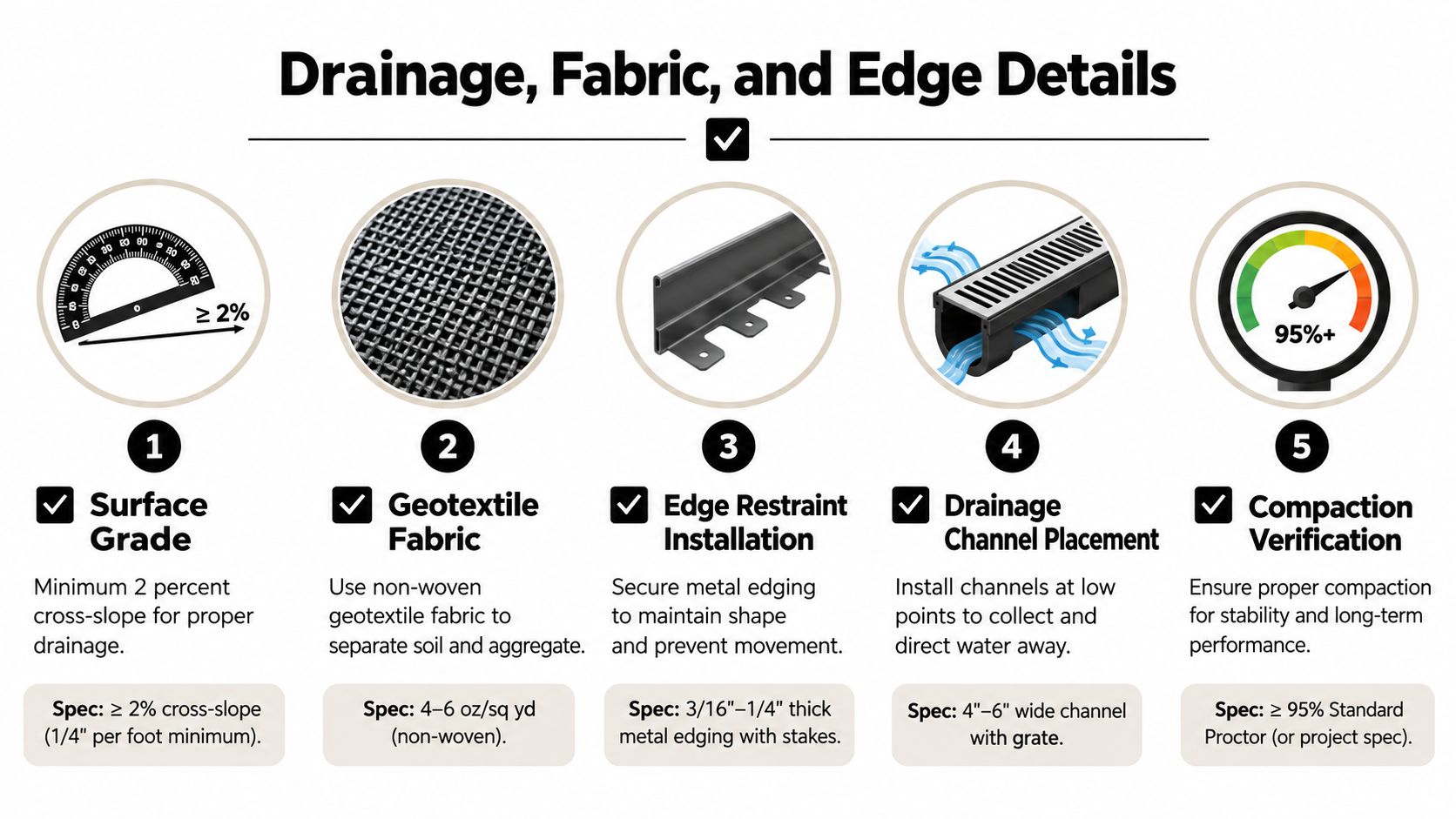
A driveway drainage plan has three connected parts: water must leave the surface, stay out of the base, and avoid undermining the edges. Historical pavement guidance has long emphasized drainage and subbase quality, including a minimum driveway slope of 2 percent for rapid surface-water removal. The same benchmark is discussed in this historical driveway base and slope reference.
A 2 percent cross-slope is roughly a quarter inch per foot. It doesn't mean the driveway should feel steep. It means the finished surface has enough fall to move water toward a planned discharge area instead of allowing puddles to sit along the asphalt edge or in wheel paths.
When geotextile earns its place
Geotextile isn't needed under every driveway. On firm, well-draining soil, a properly prepared aggregate section may perform without fabric. On wet clay or fine silt, a non-woven geotextile can separate the soil from the stone and reduce fines migration. Without separation, traffic can pump soil upward into the aggregate, turning a free-draining layer into a mud-filled, less stable mass.
Fabric also helps the crew maintain the designed stone thickness when the subgrade is marginal. It won't repair a saturated site by itself. If water has nowhere to go, the project may need underdrains, a daylight outlet, or a revised grade.
Protecting the edges
Extend the compacted gravel base 6 to 12 inches beyond the asphalt edge where site conditions and layout allow. That additional support helps the edge resist tire loads and reduces unraveling at the shoulder. A narrow asphalt strip with no lateral support is vulnerable, particularly where vehicles regularly turn near the edge.
Route downspouts, sump discharge, and gutter flow away from the driveway footprint. Concentrated water at one edge can undermine a well-compacted base, while a channel drain may be appropriate where the drive intercepts hillside runoff. The connected approach is outlined in these gravel driveway drainage solutions.
Common Failure Modes and How to Avoid Them
Most driveway callbacks don't begin with a defective asphalt surface. They begin with a preparation decision that was skipped, rushed, or hidden beneath the finished pavement.
A base that is visibly thinner than the site requires may settle under concentrated traffic. Over-thick lifts create a different problem. The surface can appear compacted while the lower portion retains voids because the roller never reached the full depth. After wet weather or a freeze-thaw cycle, the loose material shifts and the asphalt above it reflects the movement.
Clay sites create another recurring failure. Without separation, fine soil migrates into the aggregate under traffic and water. The stone loses its open structure, the subgrade becomes saturated, and the driveway can develop pumping, rutting, or cracking.
| Failure Mode | Visible Symptom | Typical Repair Cost |
|---|---|---|
| Base is too thin for the soil or traffic | Settlement, wheel-path cracking, or low areas | Cost varies with the affected area, excavation depth, and repaving required |
| Lifts are too thick | Rutting or depressions after traffic and wet weather | Usually requires removal of unstable material and reconstruction |
| Geotextile is skipped over pumping clay | Muddy edges, pumping, and recurring soft spots | May require undercutting, fabric installation, new stone, and drainage work |
| Edges lack lateral support | Crumbling shoulders and widening cracks | Often involves edge rebuilding and correction of water entry |
| Drainage is ignored | Ponding, saturated base, frost movement, or erosion | Repair depends on whether the fix requires grading, a channel, or an underdrain |
The repair bill isn't limited to the asphalt visible from the street. If the base has failed, a surface patch only covers the symptom. The reliable repair removes unstable material, corrects the water path, rebuilds the aggregate section in controlled lifts, and then replaces the pavement.
A driveway contractor should be able to explain what happens below the asphalt, not only quote the thickness of the surface mix.
Ask where the subgrade changes, how the crew will handle soft soil, what material will be used, and how the finished grade will discharge water. Those answers reveal more about the proposed driveway than a generic depth chart.
Building It Right the First Time
A driveway can look ready for asphalt and still be headed for failure. The base controls how the finished pavement handles traffic, water, and frost. Weak subgrade, trapped moisture, or lifts placed too thick for the roller can leave a smooth surface over unstable work.
Start with excavation and a subgrade check. Remove topsoil and organic material, locate soft pockets, and proof-roll the exposed soil. If the roller reveals pumping or deflection, undercut that area rather than burying it under more stone. On marginal clay or silt, place geotextile before the aggregate when separation and support are needed. Spread the base in workable lifts, adjust moisture before compaction, and choose total thickness for the soil and expected traffic.
What a useful scope should identify
A quote should show how the crew will build the driveway, not only describe the asphalt. Look for clear notes about:
- Excavation: Which unsuitable soil will be removed, and how will wet or unstable areas be handled?
- Material: Does the proposal name graded crushed aggregate, clean stone, or another specified product?
- Lift thickness: Will each layer be thin enough for the planned roller to compact through its full depth?
- Moisture: Will the crew add water to dry material or allow wet aggregate and subgrade to drain before rolling?
- Compaction: Will every lift be compacted and checked before the next one is placed?
- Drainage: Where will runoff, downspouts, and subsurface water discharge?
- Edges: Will the base extend beyond the asphalt or receive another form of lateral support?
- Access: Can rollers, water equipment, and delivery trucks reach the work without damaging adjoining surfaces?
The property determines the final detail. A driveway near Honey Brook Township may have different soil and grade problems from one elsewhere in Pennsylvania, Maryland, Delaware, or New Jersey. A contractor who tests the ground before equipment arrives can tell whether the job needs supplemental stone, geotextile, or excavation and reconstruction.
For homeowners coordinating material deliveries and trailer access, the ANTS Trailers 2026 landscape guide offers useful context on hauling and site access. Trucks need room to place aggregate without rutting the subgrade or driving across prepared stone.
These preparation standards also apply to shed foundation contractors near me, gravel shed foundation contractors near me, garage foundation contractors near me, concrete foundations, garage footings and foundations, and a concrete foundation for a garage. A shed foundation gravel base, gazebo foundation, barn shed pad, or house foundation still depends on soil preparation and drainage suited to the structure.
Schedule a site walkthrough before equipment is dispatched. The contractor can assess soil, slope, access, existing gravel, and discharge points, then set a base structure that fits the property.
Firm Foundations provides excavation, grading, gravel base preparation, and concrete foundation services across Pennsylvania, Maryland, Delaware, and New Jersey. Visit Firm Foundations to request a free quote and schedule a walkthrough focused on the soil, drainage, and base your project needs.