
Slump Test Procedures for PA & MD Concrete Foundations

A concrete truck pulling up to a shed pad or garage foundation changes the feel of the whole day. The forms are set, the crew is ready, and now the mix in that drum has to do its part. If the concrete is too stiff, it won't finish well around corners and rebar. If it's too loose, it can settle poorly and leave you with a weak surface before the job even cures.
That's why slump test procedures matter on real projects in Pennsylvania, Maryland, Delaware, and New Jersey. A proper slump check tells you whether the mix is workable enough to place, but still consistent enough to build on. For shed foundations, garage footings, gazebo pads, and other residential foundation builds, that first quality check protects the investment long before the slab hardens.
Why Your Concrete Mix Matters for Foundations in Pennsylvania
A truck can arrive right on time and still bring the wrong feel of concrete for the job. On a shed pad in Lancaster County or a garage pour in Honey Brook Township, the mix has to move into forms, support reinforcement, and finish cleanly without turning soupy. That's where a slump check becomes the first sign that the day is going to go right.
A good concrete foundation doesn't start with the finish trowel. It starts with a mix that can be placed without fighting the crew. For a base for storage shed, concrete foundations, or garage footings and foundations, the mix has to match the structure, the formwork, and the site conditions. If the batch isn't workable, you end up forcing placement, and forced placement is where corners get ugly and durability gets lost.
Practical rule: the slump test isn't about passing time on site, it's about catching a bad batch before it becomes a bad foundation.
That's why experienced crews treat the test as a quality gate, not a formality. On a shed foundation or cement foundations for garage, the goal is simple, a mix that flows enough to fill the form, but not so much that it separates or spreads unpredictably. A clean result helps protect the edges, the anchor points, and the long-term shape of the slab.
For homeowners comparing shed foundations near me, garage foundation contractors near me, or gravel shed foundation contractors near me, this is the hidden difference between a pad that just looks finished and one that stays dependable. For a project like a 10×10 storage shed or a 4×8 shed with foundation, that first check helps make sure the concrete is right before any real placement starts. If you're trying to understand why the mix matters so much for a garage floor, this garage floor concrete guide is a helpful companion read.
Gathering Your Slump Test Equipment
A proper slump test doesn't happen with a random bucket and a guess. The cone, rod, and base are built for one thing, giving you a repeatable field check that means the same thing every time. That consistency matters on concrete foundations where a false reading can lead you to accept a mix that doesn't belong in the forms.
The core tools
The slump cone is the heart of the setup. It's the standard shape that holds the fresh concrete before you lift it away and measure how far the mix settles. A tamping rod with a rounded end is just as important, because the rounded tip helps distribute force without cutting into the sample or packing one spot too hard.
You also need a rigid base plate or other flat, non-absorbent surface. If the base flexes or sinks, the cone can shift and the reading gets unreliable. A measuring tape or ruler finishes the kit, because the slump is only useful if you can measure it from the center of the displaced concrete with confidence.
Field insight: a sloppy setup can make a good mix look bad, and a bad mix look acceptable. That's why the equipment matters as much as the reading.
For anyone pouring a shed foundation kit alternative with real concrete instead of blocks, or planning garage foundation work around concrete forms, the tool list is a professional checkpoint. If the crew has the right cone, rod, and clean base, they're already avoiding one of the most common jobsite errors.
The same applies whether the project is a barn shed, a gazebo foundation, or a full house foundation addition. Good equipment doesn't make the concrete better, but it does make the test honest. That's the whole point.
Performing the Concrete Slump Test Correctly
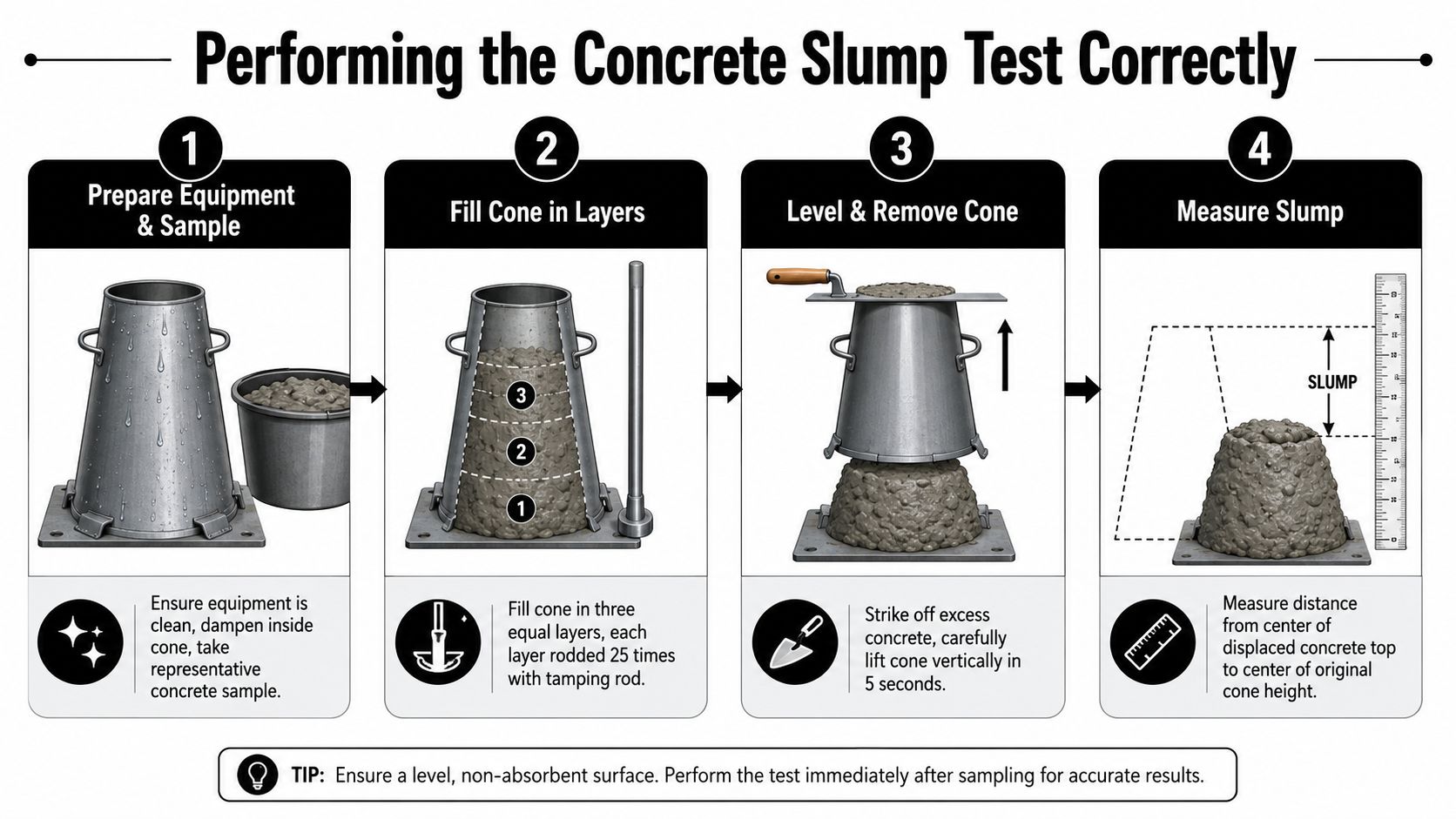
A slump test only helps if the crew treats it like a controlled field check. The sample has to be handled the same way every time, because a rushed pour or a sloppy test can hide problems that show up later as weak corners, hairline cracking, or poor support under a garage foundation or shed foundation. For a residential foundation, the point is not to get a number on paper, it is to know whether the mix will place and finish the way it should.
Under ASTM C143/C143M, the cone is filled in three equal-volume layers, each layer is tamped 25 times with a 5/8-inch, 16 mm rod, the top is struck off, and then the cone is lifted straight up in 5 ± 2 seconds. The slump is recorded to the nearest 1/4 inch, 5 mm as the vertical difference between the cone height and the displaced center of the slumped concrete. That procedure gives you a fair reading when the pour has to carry a concrete foundation for garage or support a long-lasting shed foundation. ASTM C143 slump guidance
Start with a representative sample
The reading starts before the cone is ever filled. A good sample comes from two or more regular intervals throughout mixer or truck discharge, not from the first material out of the chute. That matters on a jobsite because the first batch can look wetter than the rest, and the tail end can be stiffer, which gives you a false picture of the actual mix going into the forms. Representative slump sampling guidance
Freshness matters just as much. Field guidance says slump, air, and temperature tests should begin within 5 minutes of sampling, and the slump test itself must be completed within 2.5 minutes. That keeps the result tied to the batch as delivered, not to the time spent waiting around while the crew gets set.
Fill, rod, and lift with control
Set the cone on a firm base first. Then place the concrete in layers, not all at once, so each lift can be rodded evenly and the mass stays consistent from top to bottom. The rod should pass through the layer below, because that ties the sample together instead of leaving loose pockets that can make the cone settle unevenly.
Once the cone is full, strike off the top flush. Lift the cone straight up, without twisting, tilting, or dragging it across the base. A controlled vertical lift in 5 ± 2 seconds keeps the sample from being disturbed by the test itself, which is what you want if the reading is going to mean anything on a foundation job. Controlled lift and valid test method
The shape left behind should stay clear and uniform at the center. If it shears or collapses, the result is telling you the mix or the procedure needs a second look. That is a practical checkpoint on residential work, especially before you commit concrete to forms that need to stay true. For a closer look at how this field check fits into the broader quality process, see concrete strength testing details.
Interpreting Slump Results for Your Shed or Garage Foundation
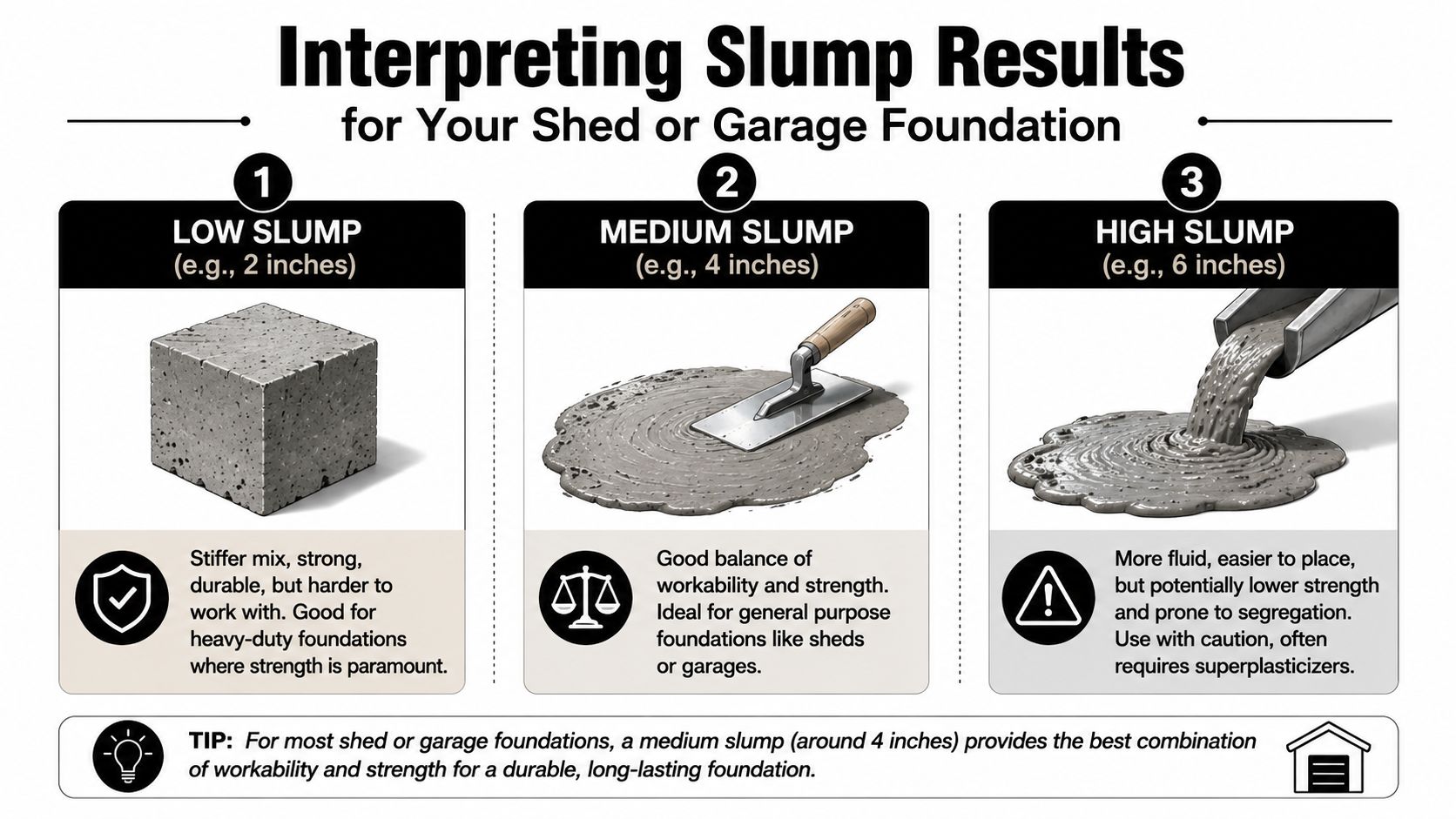
A slump number only matters if you understand what it's telling you about the mix. A clean reading shows how workable the concrete is at that moment, which is exactly what you need when you're placing garage footings and foundations or a base for storage shed. The result doesn't just describe the mix, it tells you how confidently the crew can place it into the forms.
What the shape says
A true slump is the one you want to see. It settles evenly and keeps a stable shape, which is the sign of a valid test. A shear slump slides sideways and usually points to poor cohesion or a problem with the procedure. A collapse slump spreads too far and tells you the mix, or the test, failed the check.
That's why the center of the slumped concrete matters more than a casual glance from the side. The standard field benchmark is simple, a clean, uniform shape indicates a valid result, while collapse or shear means you need to question the batch or the test method. That distinction matters on a garage foundation where the crew needs stable placement around forms and reinforcement.
Matching slump to the job
Different residential jobs call for different degrees of workability. A stiffer mix can be a good fit when strength and shape retention matter most. A more workable mix can help when concrete has to move through tighter forms, more rebar, or a more complicated layout such as a gazebo foundation or a house foundation detail.
A slump reading that looks convenient on paper can still be wrong for the project if it doesn't match the placement needs of the formwork.
For homeowners searching shed foundations contractors near me or garage foundation contractors near me, the practical question is whether the mix can be placed cleanly without creating weak edges or honeycombing. For a shed foundation blocks comparison, or a shed foundation gravel base alternative, the same idea holds, the material has to fit the job, not just the invoice. A concrete foundation for garage needs enough workability to place well, but not so much that it turns loose in the forms.
If a crew is installing a barn shed, a 10×10 storage shed, or a garage concrete foundation, the slump result helps them decide whether the load is ready to use or needs closer review. That's why experienced contractors don't treat slump as a box to tick. They treat it as a decision point.
Common Slump Test Mistakes and Pro Tips
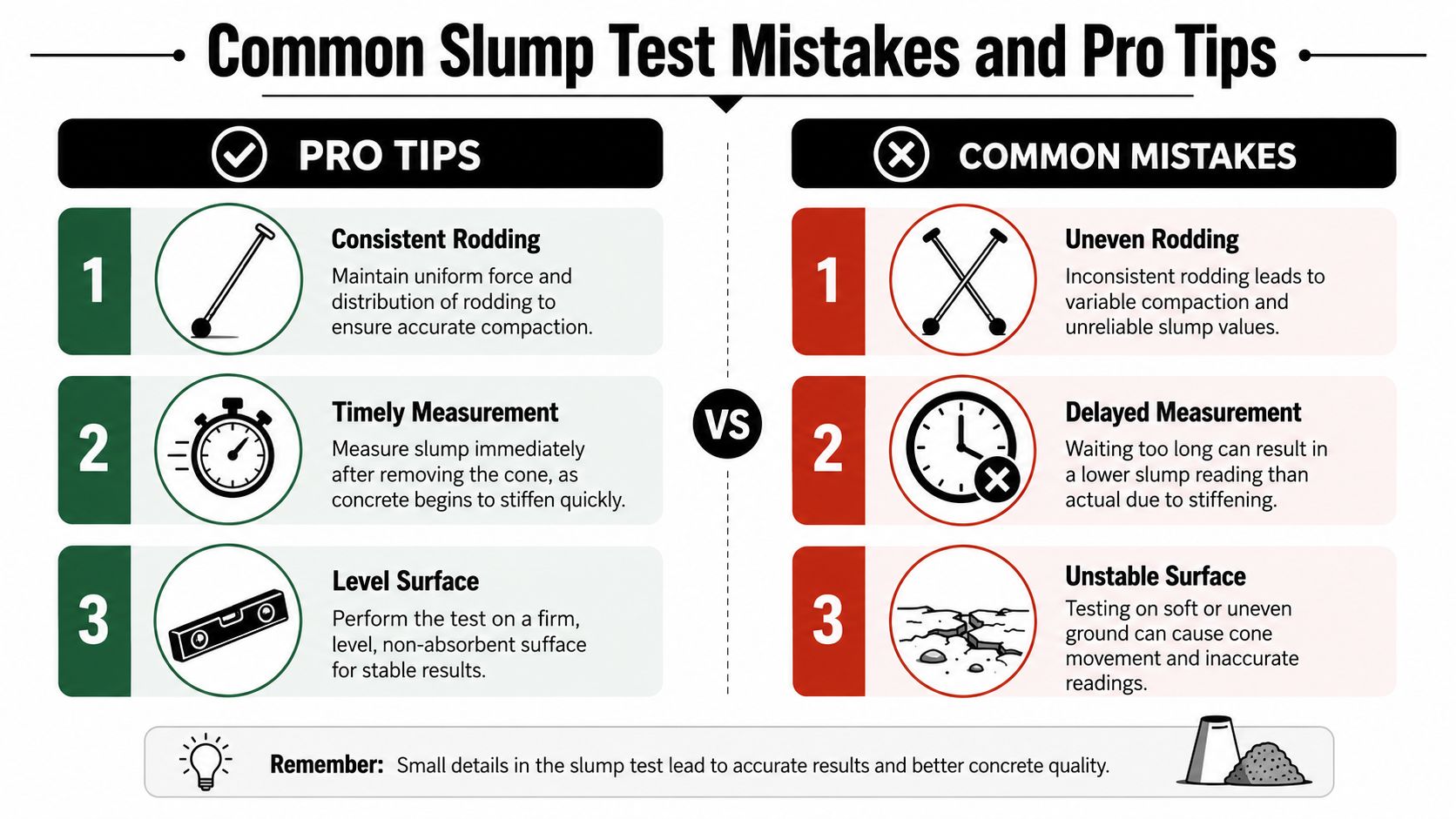
A bad slump reading usually starts with field habits, not with the concrete itself. A sample taken from only one part of the truck, a cone that shifts as it comes off, or a delay while someone hunts for a tape measure can change the result enough to send a pour in the wrong direction. On a garage foundation or shed foundation, that kind of mistake can mean concrete that is too loose at the corners, too stiff to place cleanly, or inconsistent from one section of the form to the next.
What experienced crews protect against
Timing is the first thing to control. Slump, air, and temperature checks need to start within 5 minutes of sampling, and the slump test itself has to finish within 2.5 minutes. That matters on hot days especially, because workability can change fast in the truck or on site. Field timing and temperature guidance
Sampling from the wrong part of discharge causes another common problem. The better practice is to take the sample at two or more regular intervals throughout mixer or truck discharge so the reading reflects the whole batch, not just one uneven stretch. That helps keep a crew from accepting concrete that looks fine at the chute but behaves differently once it is in the forms. Representative discharge sampling
Control during the lift matters just as much. If the cone twists, tilts, or moves as it comes off the sample, the reading can be wrong even when the mix is fine. The base also has to stay firm and level, because a soft or uneven surface lets the cone move and changes the result.
What to do instead
- Keep rodding consistent: Even, distributed strokes help the sample compact the same way every time.
- Measure immediately: Do not let the concrete sit while someone grabs a ruler or talks through the next step.
- Set the cone on a stable base: A level, non-absorbent surface protects the reading from movement.
- Watch the shape, not just the number: A clean, centered slump tells you more than a rushed measurement ever will.
Those habits sound small, but they prevent the field errors that can compromise shed foundations near me, gravel shed foundation contractors near me, and driveway contractors near me projects alike. Concrete work rewards crews who control the details, because a foundation only gets one first pour.
If you're planning a shed foundation, garage footing, gazebo foundation, or another residential concrete project in Pennsylvania, Maryland, Delaware, or New Jersey, contact Firm Foundations for a free quote and talk through the right foundation for your site. A solid result starts with the right mix, the right test, and a crew that knows how to build it right the first time.