
Asphalt vs Concrete Driveway: A PA & MD Homeowner’s Guide
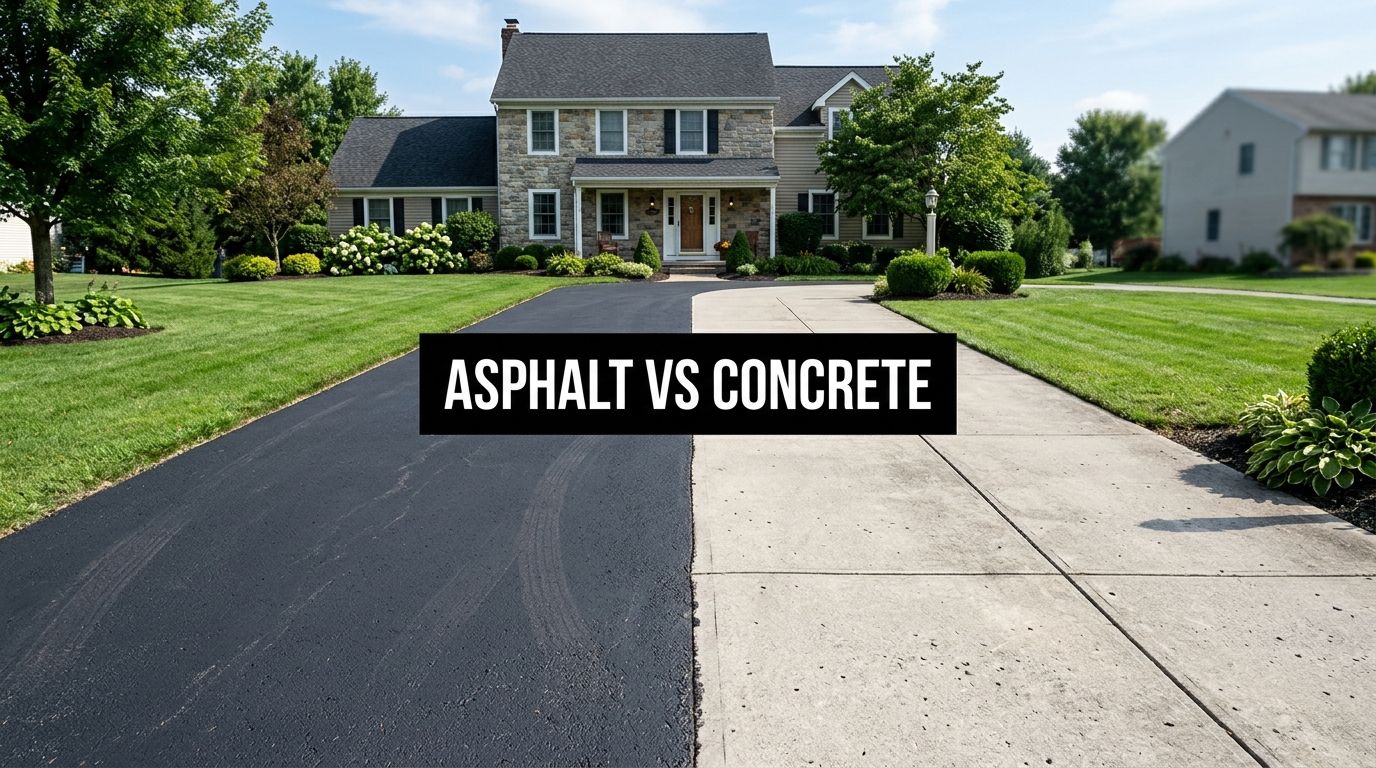
A lot of homeowners in Pennsylvania and Maryland start in the same spot. They walk out to a cracked, uneven driveway or a muddy area where a new garage is going, and the first question is simple: should this be asphalt or concrete?
That choice affects more than the look of the front of your property. It affects drainage, winter performance, maintenance, how well the surface handles heavy vehicles, and how often you'll have to think about repairs. Around here, that matters. Freeze-thaw cycles, summer heat, runoff, and clay-heavy or shifting soils can punish a poorly built driveway fast.
The often-missed aspect is the part underneath. In an asphalt vs concrete driveway decision, the surface matters, but the excavation, gravel base, compaction, and drainage layout matter just as much. Sometimes more. A driveway can look great on day one and still fail early if the base wasn't shaped and compacted correctly.
Choosing Your New Driveway A Decision for Decades
A new driveway usually shows up as part of a bigger property decision. Maybe you're replacing an old surface that's breaking apart near the garage. Maybe you're building a new home in Pennsylvania, adding a workshop in Maryland, or trying to create a clean, durable approach to a barn shed, detached garage, or parking area.
Most homeowners start with cost. That's normal. Asphalt usually looks like the easy answer because the initial number is lower. Concrete usually looks like the bigger commitment because the install price is higher. But that first number doesn't tell you how the driveway will behave after a few winters, how often it'll need attention, or whether the base under it was built to survive our region.
Here's the practical version of the asphalt vs concrete driveway question. If the driveway leads to a standard family home with passenger vehicles, both can work. If it serves a garage with heavier trucks, a camper, equipment, or repeated turning traffic, the conversation changes. If the lot holds water, slopes poorly, or has weak subgrade, the conversation changes again.
Local reality: In PA and MD, a driveway rarely fails because the homeowner picked the “wrong color.” It fails because water sat where it shouldn't, the base moved, or the excavation was rushed.
That same groundwork is what makes so many related projects succeed too. Homeowners searching for shed foundations contractors near me, gravel shed foundation contractors near me, garage foundation contractors near me, or driveway contractors near me are often dealing with the same core issue. They need a stable, well-drained base that won't settle, rut, or hold water.
A driveway is a surface. It's also a foundation system. That's why this decision should be made like one.
| Factor | Asphalt | Concrete |
|---|---|---|
| Upfront cost | Lower initial cost | Higher initial cost |
| Lifespan | Shorter overall lifespan | Longer overall lifespan |
| Maintenance | More frequent sealing and repair | Less frequent routine maintenance |
| Heavy load performance | Good with proper base, but more vulnerable to deformation | Stronger under heavy vehicles |
| Appearance | Clean, traditional black surface | More design flexibility and brighter finish |
| Base prep sensitivity | Very sensitive to drainage and crown accuracy | Still needs proper prep, but can tolerate minor imperfections better |
Upfront Costs vs Long Term Investment
A lot of homeowners in Pennsylvania and Maryland start in the same place. The quote for asphalt looks easier to live with, especially if the driveway is part of a bigger project and money is already going toward a garage, foundation, shed pad, or grading work. That first number matters. It just should not be the only number you use.
What the install usually costs
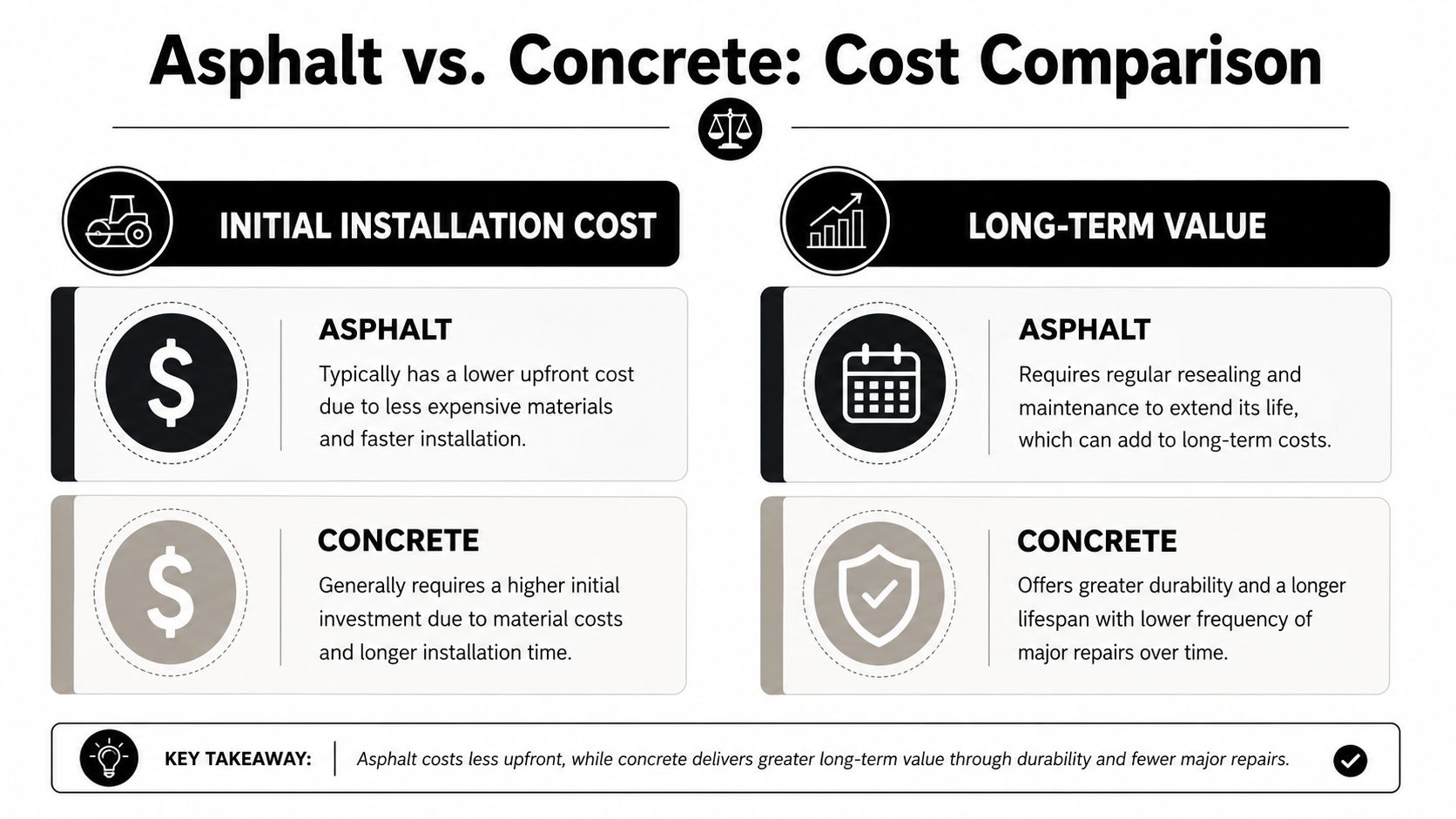
For initial installation, asphalt driveways typically cost $7 to $15 per square foot, while concrete runs $8 to $20 per square foot according to Bart's Asphalt cost comparison. On a 600-square-foot driveway, that puts asphalt at $4,200 to $9,000 and concrete at $4,800 to $12,000.
That cost gap is significant. It explains why asphalt is often the first option homeowners ask about.
What I tell people is simple. If the lower price comes from using asphalt over a properly excavated and compacted stone base, that can be a sound budget decision. If the lower price comes from shaving the base, reducing excavation, or skipping drainage corrections, it usually turns into an expensive driveway later. In our freeze thaw climate, the base decides whether either surface holds up.
What the driveway costs over time
The long-term picture changes once maintenance and repair cycles enter the conversation. Over 30 years, the same source puts a 600-square-foot concrete driveway at $6,500 to $8,000, while asphalt reaches $8,000 to $10,000 because it typically needs more ongoing maintenance.
That does not mean concrete is always the better buy. It means the cheaper proposal needs a closer look.
A well-built asphalt driveway with proper depth, solid edges, and a dry, stable base can serve a home well. A cheaply installed asphalt driveway over weak preparation is where homeowners get burned. They save on day one, then pay for rutting, edge breakdown, low spots, patching, and early replacement years sooner than expected.
A practical way to look at it:
- If cash flow is tight right now, asphalt can make sense, especially on a longer driveway where total square footage drives the budget.
- If you expect to stay in the home for many years, concrete often makes better financial sense because routine upkeep is usually lighter.
- If the driveway is part of a larger site package, such as cement foundations for garage, garage footings and foundations, or other hardscape and grading work, compare the total property investment, not just the surface material.
A lower bid can reflect a lower material cost. It can also reflect less excavation, a thinner stone base, or poor drainage planning. Those shortcuts matter more in PA and MD than many homeowners realize.
Homeowners who want another planning reference can compare layout, finish options, and construction details in Task Masters Inc.'s driveway guide.
Cost decisions that usually hold up best
For a long rural lane, a side parking area, or a straightforward pad serving a 10×10 storage shed or barn shed, asphalt may be the better fit if the base is built correctly and the maintenance plan is realistic. For a front-facing driveway, a property with heavier vehicles, or a driveway expected to stay put for decades with less routine attention, concrete often earns the higher upfront cost.
Price the whole assembly. Surface, excavation, gravel base, compaction, drainage, and expected maintenance all belong in the same conversation. That is how you get the cost right.
Durability and Performance in Our Climate
A February thaw in Pennsylvania or Maryland can turn a driveway problem into a structural problem fast. Water slips through surface cracks or weak edges, drops into the base, freezes again at night, and starts lifting sections that looked fine a week earlier.
Heavy loads and structural strength
Surface material matters. Base preparation matters more.
If the excavation is shallow, the stone base is thin, or compaction is rushed, both asphalt and concrete will fail early in our climate. Asphalt usually shows those mistakes sooner. You see rutting where vehicles turn, edge breakdown where tires drift off the side, and low spots that keep water sitting on the surface. Concrete can hide a base problem longer, but once the slab starts cracking from movement underneath, repairs are rarely small.
For driveways that carry pickup trucks, delivery vans, trailers, or parked vehicles that sit in the same spot every day, concrete has the structural edge. The Michigan concrete and asphalt comparison states that a 5-inch concrete slab has the same load capacity as an 8-inch asphalt pavement.
That difference shows up most clearly at garage approaches, parking pads, and turning areas. Those are the spots where weak support underneath gets exposed.
Lifespan in freeze-thaw country
The same source reports that concrete pavement has an average life expectancy of 27.5 years before repairs are needed, compared with 15.5 years for asphalt. In PA and MD, I would treat those numbers as a best-case range tied to solid site work, not a promise from the surface alone.
That is the part many homeowners never get told. A lower asphalt price often comes with less excavation, less stone, weaker compaction, or poor drainage planning. On paper, it still looks like asphalt versus concrete. In the ground, it is really a properly built driveway versus a shortcut.
Concrete usually holds up longer in freeze-thaw conditions because it carries weight better and resists deformation under repeated traffic. Asphalt can still perform well here, especially on longer driveways where cost matters, but only if the gravel pad is deep enough, the subgrade is stable, and runoff has somewhere to go. If water stays trapped under either surface, winter will expose it.
Field judgment: In this region, the base decides how long the driveway lasts. The surface only reflects how well that hidden work was done.
Summer heat and day-to-day use
Heat changes the day-to-day experience too. According to Ciriello Contracting's driveway comparison, concrete surfaces stay approximately 10 degrees cooler than asphalt.
That can matter around garage entries, walkways, play areas, and detached workspaces that get full sun. Asphalt absorbs more heat and can soften slightly during hotter stretches, especially where vehicles turn in place or sit with heavier loads. Concrete stays cooler and holds its shape better under that kind of use.
For homeowners choosing between the two, the practical question is simple. Do you want the lower upfront price, knowing the base has to be built correctly or the savings disappear early? Or do you want the stronger long-term surface, with a higher initial cost but better resistance to weight, heat, and freeze-thaw movement? In either case, the driveway lasts or fails from the ground up.
The Reality of Driveway Maintenance and Repairs
A driveway usually starts looking "high maintenance" long before the surface itself is worn out. In Pennsylvania and Maryland, the primary trouble often starts underneath. Water gets into a weak base, winter freezes it, and the surface begins to crack, dip, or break apart. That pattern shows up on both asphalt and concrete jobs, but it shows up faster on cheaper asphalt installs where excavation was shallow and the stone base was never built to carry the load.
What routine upkeep really looks like
Asphalt needs more regular attention. Concrete usually asks for less routine care, but repairs are often more expensive and more visible once something goes wrong.
According to Maisano Bros. on asphalt and concrete driveway repairs, asphalt repair costs are often 3 to 5 times lower per square foot than concrete. The same source states that asphalt crack repairs run $1 to $3 per linear foot, while concrete repairs can cost $3 to $25 per square foot depending on severity.
That cost gap matters, but so does repair style. Small asphalt cracks and surface wear can often be handled without tearing out large sections. Concrete is different. Once a slab settles, scales, or cracks badly, the clean repair is often partial replacement, and the patch may still show.
A practical maintenance schedule
For homeowners, the pattern is usually straightforward:
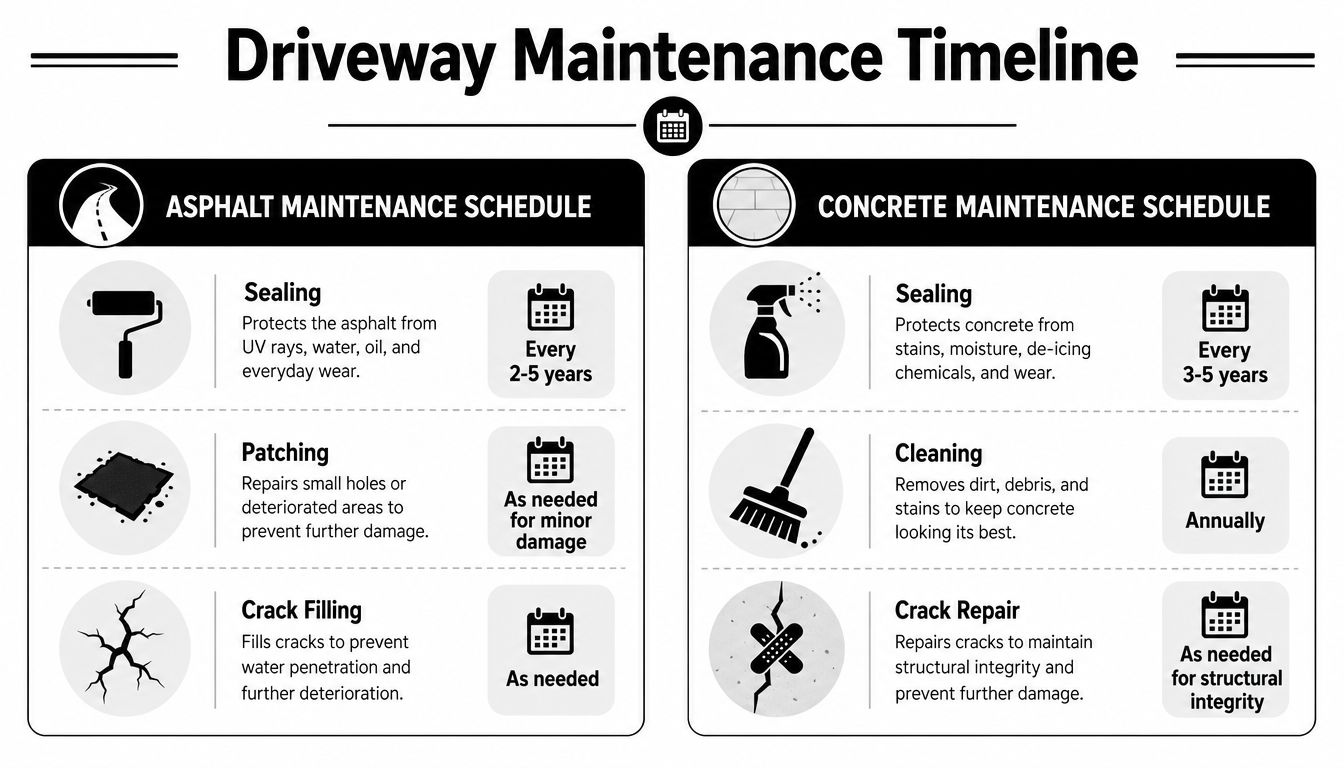
- Asphalt surfaces need regular checks for cracks, edge breakdown, low spots, and places where water stands after rain.
- Sealcoating helps protect asphalt from water intrusion and surface wear, but it does not fix movement caused by a poor base.
- Concrete surfaces benefit from cleaning, joint and crack monitoring, and sealing where conditions call for it.
- Drainage checks matter for both materials. If roof runoff crosses the driveway or pools along the edge, problems start earlier and repairs rarely stay small.
Another cost reference from Bart's Asphalt gives a more detailed budgeting picture. It describes recurring sealing and later resurfacing for asphalt, along with lower-cost spot repairs in many cases. Concrete usually needs less frequent attention, but major slab repairs can get expensive fast.
Good drainage lowers the repair bill for either surface. Homeowners dealing with runoff near the garage, apron, or driveway edges should look at foundation drainage design for managing water around hard surfaces, because drainage mistakes often show up first as driveway cracking and edge failure.
What homeowners often get wrong
The common mistake with asphalt is treating the lower upfront price as the full story. Asphalt can be a smart buy, but only when the base is excavated properly, the stone is compacted in lifts, and water has a path away from the driveway. Without that groundwork, you end up paying for cracks, raveling, patching, and early resurfacing far sooner than expected.
Concrete gets misread too. Some homeowners assume it is close to maintenance-free. It is not. It still needs control joints to do their job, runoff managed, and early cracks watched before settlement spreads.
Small asphalt repairs are usually easier to budget for. Major concrete repairs are less frequent, but they can turn into replacement work quickly.
If you want the lower-cost surface and do not mind periodic upkeep, asphalt can make sense. If you want fewer maintenance events and are comfortable with a higher repair cost if something goes wrong, concrete is often the better fit. In both cases, long-term performance depends less on the top layer than on the base holding it up.
Aesthetics Drainage and Curb Appeal
The driveway is one of the largest visible surfaces on most residential lots. People notice it immediately. So do buyers, guests, and anyone looking at the front of the home as a whole.
Surface appearance and design choices
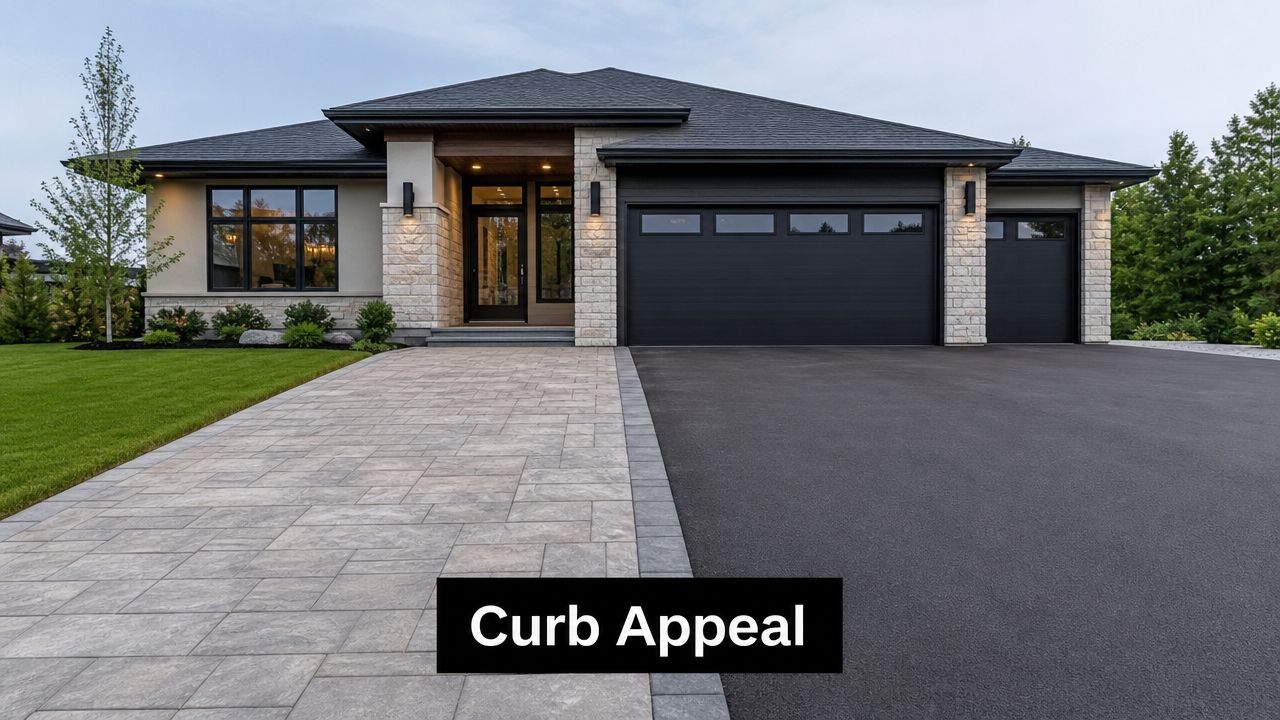
Asphalt gives you a uniform, traditional black finish. It's clean, practical, and usually fits rural properties, long lanes, and straightforward residential layouts well. Concrete gives you a brighter surface and more design flexibility. It also tends to pair naturally with patios, walkways, garage aprons, and other hardscape elements.
That matters if your property already includes site features like a gazebo foundation, shed foundation, or matching concrete work around a detached garage. A driveway doesn't need to stand alone. It should fit the larger design of the property.
For homeowners exploring decorative direction beyond plain broom-finished slabs, ideas from outdoor paver design examples can be useful for visual inspiration, especially when planning borders, transitions, or mixed-material entries.
Drainage decides whether the driveway stays attractive
Good curb appeal doesn't last if water pools at the apron, runs under the edges, or freezes across low spots in winter.
The biggest hidden issue with asphalt is base preparation. The base prep guidance in this video reference notes that the primary failure point for asphalt driveways is poor base preparation and that asphalt needs a perfectly crowned and compacted base for proper drainage. The same source explains that concrete's rigidity can bridge minor imperfections more effectively, which makes excavation accuracy especially important for asphalt in freeze-thaw regions like Pennsylvania.
That's why the foundation under the driveway is inseparable from the finished appearance. If you want the surface to stay smooth and the edges to stay intact, the sub-base has to shed water correctly. Homeowners planning a driveway alongside a shed pad, garage approach, or broader sitework package should understand how foundation drainage design influences long-term surface performance.
A driveway that holds water won't stay attractive for long. Drainage flaws eventually become surface flaws.
Looks matter. Drainage decides how long those looks last.
Which Driveway Is Right for Your Property
A lot of homeowners decide based on the surface they like best. In PA and MD, the better starting point is how the driveway will be used and how well the base can be built underneath it.
That matters most with asphalt. I have seen plenty of asphalt driveways sold as the budget option, then fail early because the excavation was shallow, the stone base was thin, or the water had nowhere to go. On a properly prepared base, asphalt can be a solid choice. On a weak base, it becomes the cheaper driveway twice.
Best fit for common property types
For a standard suburban home with normal daily traffic, both asphalt and concrete can work. Asphalt usually makes sense for homeowners who want a lower upfront price and are willing to seal and patch it over time. Concrete usually makes sense for homeowners who plan to stay put, want less routine upkeep, and care more about long-term shape and edge stability.
For a detached garage, workshop, or any area that sees heavier trucks, trailers, or repeated turning, concrete often holds up better. The rigid surface resists rutting, and it pairs well with related flatwork or structural site work. If the driveway ties into a slab, apron, or other permanent improvements, it helps to review concrete driveway construction details before finalizing the layout.
Rural properties are a different call. A long lane can make asphalt attractive from a cost standpoint, but only if the base is excavated deep enough, compacted correctly, and supported at the edges. Otherwise, the surface starts breaking down where tires track, water sits, and shoulders give way.
How the property itself should guide the choice
Pick concrete if the driveway has steep sections, frequent heavy loads, or a high-value appearance goal near the front entry. It also makes sense where homeowners want cleaner edges, a brighter surface, or decorative options that tie into walkways and hardscape. If you are comparing finishes, borders, or mixed-material layouts, outdoor pavers Melbourne offers useful design examples.
Pick asphalt if the driveway is larger, the budget is tighter, and the site can be graded to move water cleanly off the surface. It is often the practical answer for long residential runs, but only when the foundation work is done right.
A simple way to decide
- Choose asphalt if you need to control upfront cost, traffic is moderate, and you are comfortable with periodic maintenance.
- Choose concrete if you want stronger long-term performance under heavier use and less routine upkeep.
- Choose based on the full site plan if the driveway connects to a garage, shed pad, retaining work, drainage corrections, or other excavation on the property.
That last point gets missed all the time. The driveway should not be designed in isolation. Grade, runoff, subgrade condition, and how the driveway meets the garage or outbuildings will do more to determine service life than the sales pitch for either surface.
Lay the Groundwork for Success with Firm Foundations
By the time most homeowners make the asphalt vs concrete driveway choice, they're focused on the top surface. That's understandable. It's what you see every day. But the surface can only perform as well as the work below it.
The checklist that protects the investment
Before choosing the material, make sure these questions are answered:
- How will water leave the driveway? If runoff has nowhere to go, the driveway will struggle no matter what it's made from.
- How strong is the subgrade? Soft or inconsistent soil needs to be addressed before the top surface goes down.
- What vehicles will use it? A family sedan and a loaded trailer don't ask the same thing from a driveway.
- How much maintenance are you comfortable with? Some homeowners don't mind recurring upkeep. Others want the lowest possible involvement.
- Is the driveway part of a larger project? If the site also needs a garage slab, shed base, patio, or excavation package, the whole layout should be planned together.
Why groundwork decides the outcome
A properly built driveway starts with excavation depth, compacted stone, grading, and drainage control. That's true whether the top is asphalt or concrete. If you want a good overview of what that build quality should include, concrete driveway construction details are worth reviewing before you approve any proposal.
Bottom line: Homeowners usually regret poor prep long before they regret choosing the more durable surface.
For properties in Pennsylvania, Maryland, Delaware, and New Jersey, that groundwork is what separates a driveway that lasts from one that starts giving trouble early. The right material helps. The right base is what makes it hold up.
Frequently Asked Questions
Does asphalt or concrete work better with a heated driveway system
Both can be used with heated systems when the project is designed correctly. The important part is planning the tubing or heating layout, slab or pavement build-up, and drainage before installation starts. Retrofitting after the fact is far more disruptive than building it in from the beginning.
Which option is better if I'm also building a shed or garage
If the driveway ties into a garage slab or another hard surface, many homeowners prefer concrete for consistency and durability. If the project includes a shed foundation kit, a 4×8 shed with foundation, or a gravel-based outbuilding pad separate from the main parking area, asphalt can still make sense for the driveway if the grade and base are done right.
Is one material more environmentally friendly
There isn't a simple winner for every property. Material choice is only one part of the environmental picture. Longevity, repair frequency, drainage control, runoff management, and how much replacement work the driveway will need over time all matter.
Will installation damage my yard or landscaping
Any driveway installation affects the surrounding area because crews need room for excavation, stone placement, forming, grading, and machine access. Good planning limits the disruption. The best time to protect landscaping is before the project starts, not after equipment arrives.
What should I ask a contractor before signing
Ask who is handling excavation, how the base will be compacted, how drainage will be directed, what thickness is planned, and what the driveway is being designed to support. If a contractor talks mostly about the finish and very little about the base, keep asking questions.
Can asphalt still be a good choice in Pennsylvania or Maryland
Yes, absolutely. It just has less room for error. On many properties, asphalt performs well and makes financial sense. But in freeze-thaw areas, weak grading and poor compaction show up quickly, so the quality of the site prep matters even more.
If you're comparing driveway options, planning a garage slab, or looking for shed foundations contractors near me, gravel shed foundation contractors near me, or concrete foundations in Pennsylvania, Maryland, Delaware, or New Jersey, Firm Foundations can help you start with the part that matters most: the ground beneath it. Reach out for a free quote and get a driveway, shed pad, or garage foundation built with the drainage, excavation, and structural prep it needs to last.