
Concrete Driveway Construction Details: A PA & MD Guide
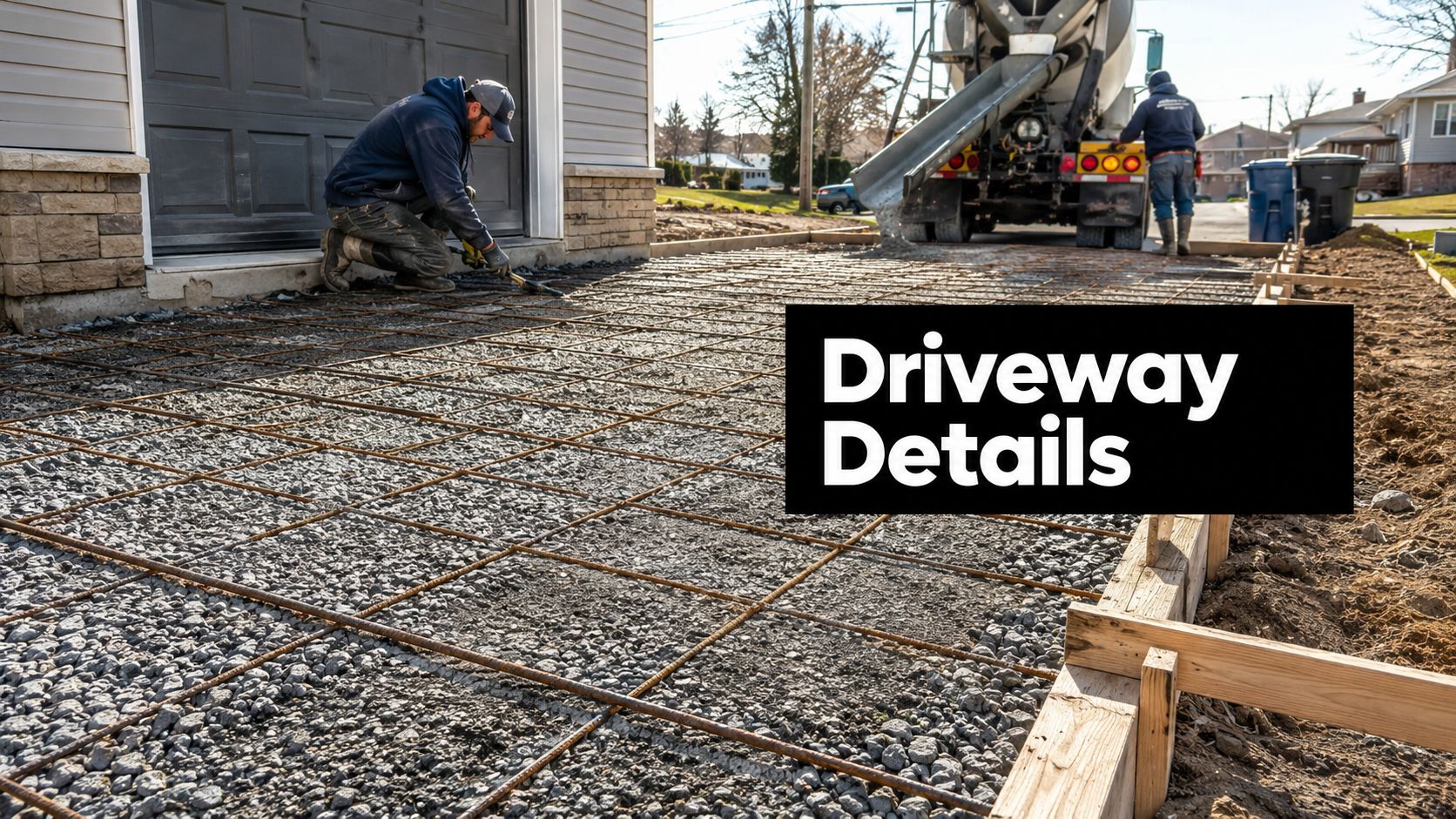
You're probably looking at a driveway in your neighborhood right now that tells the whole story. It looked great the year it was poured. A few winters later, the middle settled, the apron cracked, and the edges started breaking off where tires roll over them every day. That's the part most homeowners want to avoid when they start searching for driveway contractors near me or concrete contractors in Pennsylvania, Maryland, Delaware, or New Jersey.
A driveway should feel like an upgrade, not a gamble. If you're planning a new slab for daily parking, tying a driveway into a garage project, or coordinating it with other work like concrete foundations, a gazebo foundation, or even a base for storage shed placement, the details matter more than the sales pitch. The best concrete driveway construction details are usually the ones you never see after the job is finished.
Your Guide to a Driveway That Lasts a Lifetime
A lot of homeowners start in the same place. They need a new driveway, they know concrete can look clean and durable, and they've also seen enough failed jobs around Honey Brook Township and nearby communities to know a nice finish on day one doesn't mean much by year five.
The pattern is familiar across PA, MD, DE, and NJ. A slab gets poured too quickly. The grade isn't corrected. Water sits where it shouldn't. The edges are thin. Then the first stretch of hard winter weather exposes every shortcut.
What homeowners usually notice first
The first warning signs aren't always dramatic. Often it starts with one of these:
- A low spot near the garage: Water hangs there after rain and tracks into the building.
- Hairline cracking that keeps growing: The crack widens through winter and becomes a trip point.
- Broken edges by the lawn: Tires climb the side and the concrete begins to chip away.
- Surface scaling: The top starts to roughen and lose that tight, finished look.
Those symptoms often send people searching not only for driveway companies near me, but also for garage foundation contractors near me, excavation near me, or shed foundations contractors near me. That makes sense. The root issue is usually the same. The structure above ground only performs as well as what supports it below.
A driveway that lasts doesn't happen because the concrete truck showed up on time. It lasts because the planning, excavation, support layers, reinforcement, finishing, and drainage all worked together.
Why local conditions change everything
Concrete work in the Mid-Atlantic isn't one-size-fits-all. Soil can vary a lot from one property to the next. Some sites hold water. Some have soft topsoil that should never stay under a slab. Some have grades that push runoff back toward the house if they aren't corrected before forms go in.
That's why smart homeowners look past the surface and ask better questions. Not just what the driveway will look like, but how it will be built. The same practical thinking applies whether you're pricing a shed foundation, garage footings and foundations, cement foundations for garage use, or a simple car pad in southeastern Pennsylvania, northern Maryland, Delaware, or South Jersey.
A well-built driveway should add curb appeal, carry daily loads confidently, and hold its shape through seasonal swings. That kind of result comes from disciplined construction, not wishful thinking.
Site Assessment and Project Planning in PA MD DE and NJ
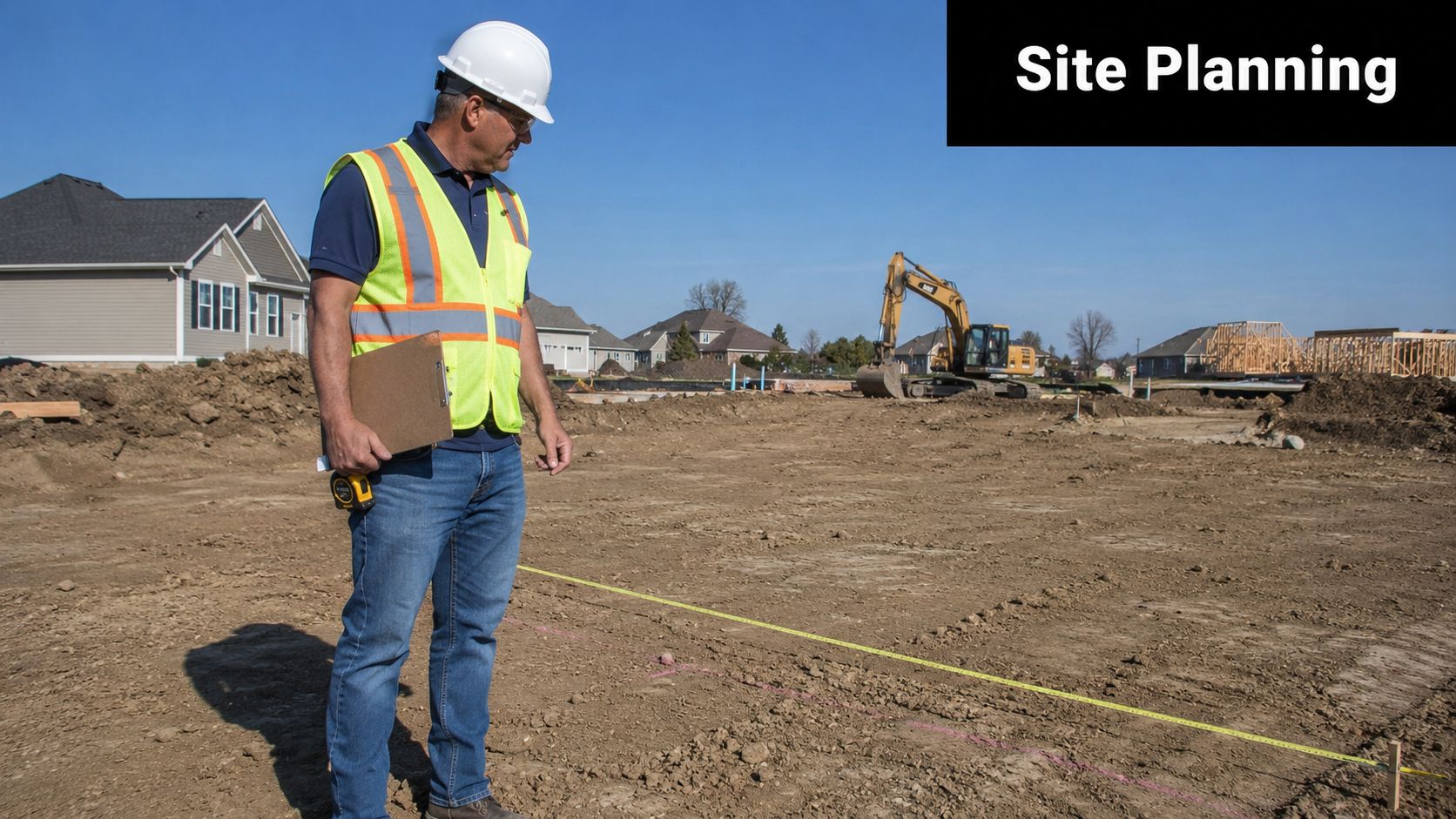
Good driveway work starts before excavation. A contractor should be reading the site long before anyone sets concrete forms or orders a mix. On properties across Pennsylvania, Maryland, Delaware, and New Jersey, the driveway layout has to respond to the actual ground, not just the shape drawn on a proposal.
What a real site assessment should cover
The first walk of the property should answer practical questions.
| Item checked | Why it matters |
|---|---|
| Existing grade | Determines whether water moves away from the slab or back toward the home |
| Soil condition | Helps identify soft areas, organics, and unstable sections that need correction |
| Access | Affects equipment choice, truck staging, and how the crew will place concrete |
| Tie-ins | Matters where the driveway meets a garage floor, sidewalk, road apron, or retaining edge |
| Intended use | A family sedan pad is different from a driveway that sees trailers or service vehicles |
On some lots, the main concern is drainage. On others, it's elevation and how the driveway meets the garage threshold. If the slab is too high, water can run toward the building. If it's too low, you end up with an awkward dip that collects runoff and stresses the concrete at the entrance.
Planning for life, not just for the pour
A durable driveway should fit how the property functions. That sounds basic, but it's where many jobs go wrong. The homeowner may need turning space, room at the apron, a widened section near the garage, or enough bearing area for heavier loads.
That same thinking applies to related searches homeowners make every day, including shed foundations near me, gravel shed foundation contractors near me, shed foundation, garage footings and foundations, and concrete foundation for garage work. A driveway isn't isolated from the rest of the site. If you're adding a 10×10 storage shed, a barn shed, or planning future foundation builds, the grading and circulation should make sense together.
Field note: The best layout on paper can still fail if nobody studies how water already moves across the property.
A helpful planning tool is overhead imagery. Homeowners who want a clearer visual explanation of layout, access, and grading can see how contractors use actionable data from construction drone imaging to understand site conditions from a wider angle. It's a practical way to spot runoff paths, slope transitions, and staging challenges that aren't obvious from the driveway alone.
Local approvals and coordination
Permitting can also shape the project. Some municipalities care about apron details, stormwater flow, or the distance from the street. Others may require clearances from property lines or utility areas. A professional plan accounts for those conditions early, before equipment is mobilized and before homeowners get surprised by revisions.
For homeowners, this stage should feel calm and organized. The driveway footprint, thickness approach, drainage path, and tie-ins should all be discussed in plain language. The same disciplined planning used for a house foundation, shed foundation gravel base, or gazebo foundation should show up here too. If the early conversations are vague, the finished work usually is too.
Preparing the Subgrade and Subbase for Local Conditions
If a driveway fails early, the problem is often under the slab, not in the slab. That's the hard truth many homeowners don't hear until after the cracks show up. In Mid-Atlantic climates, where moisture shifts and winter freezing put stress on the ground, the subgrade and subbase carry a huge share of the job.
What sits below the concrete
The subgrade is the native soil after stripping off unsuitable material and shaping the site to the right elevation. The subbase is the structural gravel layer placed above that prepared soil. Together, they create the platform the concrete depends on every day.
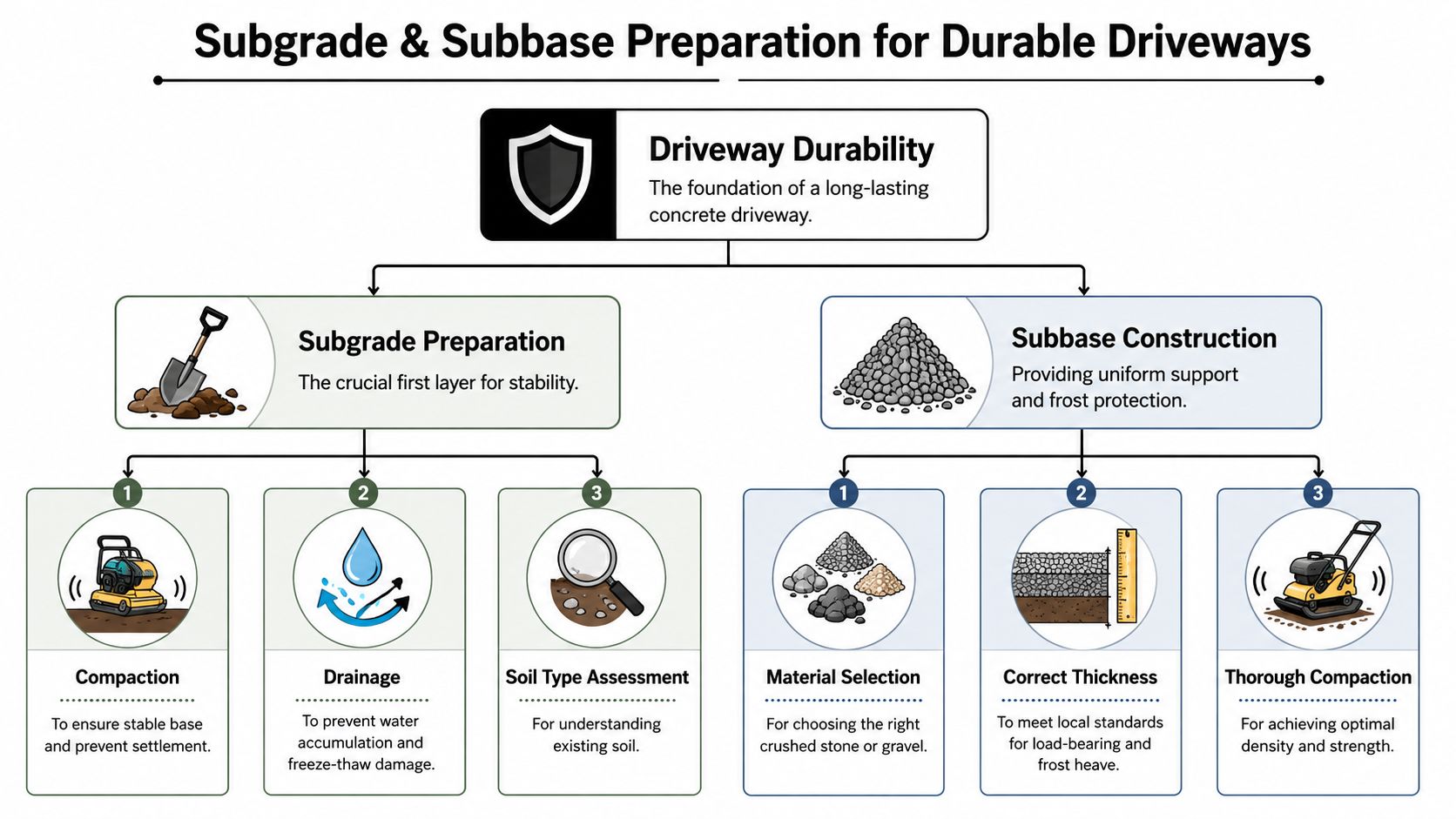
A strong driveway doesn't begin with gray concrete. It begins with excavation, proofing the exposed ground, correcting weak spots, and compacting each layer so the slab receives even support. If one section of the driveway rests on stable material and another sits over soft fill or wet clay, the concrete will telegraph that difference over time.
Why this stage matters most in PA MD DE and NJ
This region sees freeze-thaw cycling, wet periods, and a lot of properties with heavy or variable soils. Those conditions punish poor preparation. Water enters the soil, the ground moves, and the slab responds. That's why pouring over dirt is a bad practice, even if the surface looks neat when the truck pulls away.
Industry studies show that over 80% of premature concrete driveway failures, such as major cracking and settlement, are caused by inadequate subgrade preparation or a non-existent subbase, not the concrete itself (American Concrete Institute reference).
That's the number homeowners should remember when comparing bids. If one estimate is much lower, there's a good chance the savings are coming from excavation depth, gravel quantity, compaction time, or all three.
What proper preparation looks like
A reliable process usually includes several separate operations, not one quick pass with equipment.
- Stripping unsuitable material: Topsoil, roots, soft spots, and organic material have to come out because they decay and settle.
- Shaping the subgrade: The exposed soil needs to be graded evenly so the slab thickness stays consistent.
- Building the gravel layer: Structural stone or gravel is placed to create support and improve drainage behavior under the slab.
- Compacting in a disciplined way: The crew should compact intentionally, not just drive over the area and call it good.
Homeowners who want a closer look at why this matters can review this guide on soil compaction for concrete slab performance. It explains the core issue clearly. Concrete can't bridge bad ground forever.
Practical rule: If the ground underneath moves differently from one area to another, the driveway won't stay uniform, no matter how good the finish looked on pour day.
This is also where experience with other pads helps. Contractors who routinely build a shed foundation gravel base, prepare a base for storage shed use, or handle excavation for garage slabs understand how support layers behave over time. The same principles apply to driveways. The visible concrete gets the attention, but the hidden groundwork decides whether the driveway stays level and serviceable.
Choosing the Right Concrete Mix and Reinforcement
Once the base work is right, the focus shifts to the slab itself. For the slab, material choices separate a durable driveway from one that only looks good for a short while. Homeowners often hear broad terms like “standard concrete” or “wire in it,” but those phrases don't tell you enough.
A driveway carries vehicle loads, deals with sun, rain, deicing exposure, and winter cycles, and has to stay stable at the same time. That takes the right mix, solid reinforcement, and careful form setup.
Concrete mix matters more than most people think
Not all concrete is the same in practice. For exterior flatwork in this region, many experienced contractors prefer a 4000 PSI mix because it offers a stronger starting point for residential driveway service. The target isn't just strength on paper. It's a mix that performs well outside, finishes properly, and suits local weather demands.
A lower-grade approach may save money on the front end, but that's not usually where homeowners want savings. A driveway gets used every day. It's not decorative concrete sitting untouched in a sheltered corner of the property.
When discussing a proposal, ask direct questions about the mix being ordered. A professional concrete contractor should be comfortable discussing what's being placed and why it fits the job. If the answer is vague, that's worth noticing.
Reinforcement choices are not all equal
Reinforcement helps the slab hold together when it experiences stress. Homeowners will often hear about two common options: welded wire mesh and steel rebar.
Here's the practical difference:
| Reinforcement type | What it does well | Where it falls short |
|---|---|---|
| Welded wire mesh | Basic crack control | Often ends up low in the slab and offers less structural benefit |
| #4 rebar grid | Better tensile support and slab integrity | Requires more planning, tying, and proper placement |
For driveways, a grid of #4 rebar is a stronger choice when the goal is long-term performance. It helps the slab act more like a system instead of a thin sheet trying to fend for itself. That becomes especially important where soils are variable, edges carry repeated traffic, or the driveway serves a garage entrance where concentrated loads show up over the same lines again and again.
Rebar only helps if the crew places it where it belongs within the slab. Steel lying on the bottom is not doing the same job as steel held in working position during the pour.
Formwork controls thickness and shape
Concrete forms aren't just temporary lumber around the perimeter. They establish the driveway's line, elevation, slope, and thickness. If the formwork is sloppy, the finished slab will be too.
For standard residential use, a minimum of 4 inches is the baseline many homeowners expect for driveway slab thickness. That thickness has to be real, not assumed. The forms should be set carefully so the slab maintains consistent depth, especially at edges and transitions.
A good form setup does several things at once:
- Keeps the slab dimensions true: Straight runs stay straight, curves stay smooth, and apron transitions look intentional.
- Protects thickness control: Thin sections become weak sections, especially near edges and low spots.
- Supports correct slope: Form elevation helps establish drainage before concrete ever arrives.
This same attention to shape and bearing applies whether a crew is building a driveway, concrete foundation for garage use, cement foundations for garage projects, or one of the many foundation builds homeowners search for, including a 4×8 shed with foundation support or a shed foundation kit upgrade that needs a proper slab nearby.
Material discipline is what homeowners are hiring
A polished sales pitch doesn't strengthen a driveway. Material discipline does. The contractor should know what mix belongs on the site, what reinforcement belongs in the slab, and how the concrete forms need to be set so the slab ends up the right thickness with clean edges and proper pitch.
This is one of the clearest differences between experienced concrete contractors and crews that treat every flatwork job the same. A driveway has its own demands. It connects to the road, it supports repeated loading, and it takes weather exposure head-on. The right mix and reinforcement package should reflect that reality from the start.
The Art of Pouring Finishing and Curing Concrete
Installation day is where planning turns into craftsmanship. Homeowners usually notice the pace first. A good concrete crew moves with urgency, but not with panic. Every step has a sequence, and each person has a job because fresh concrete doesn't wait.
What a well-run pour looks like
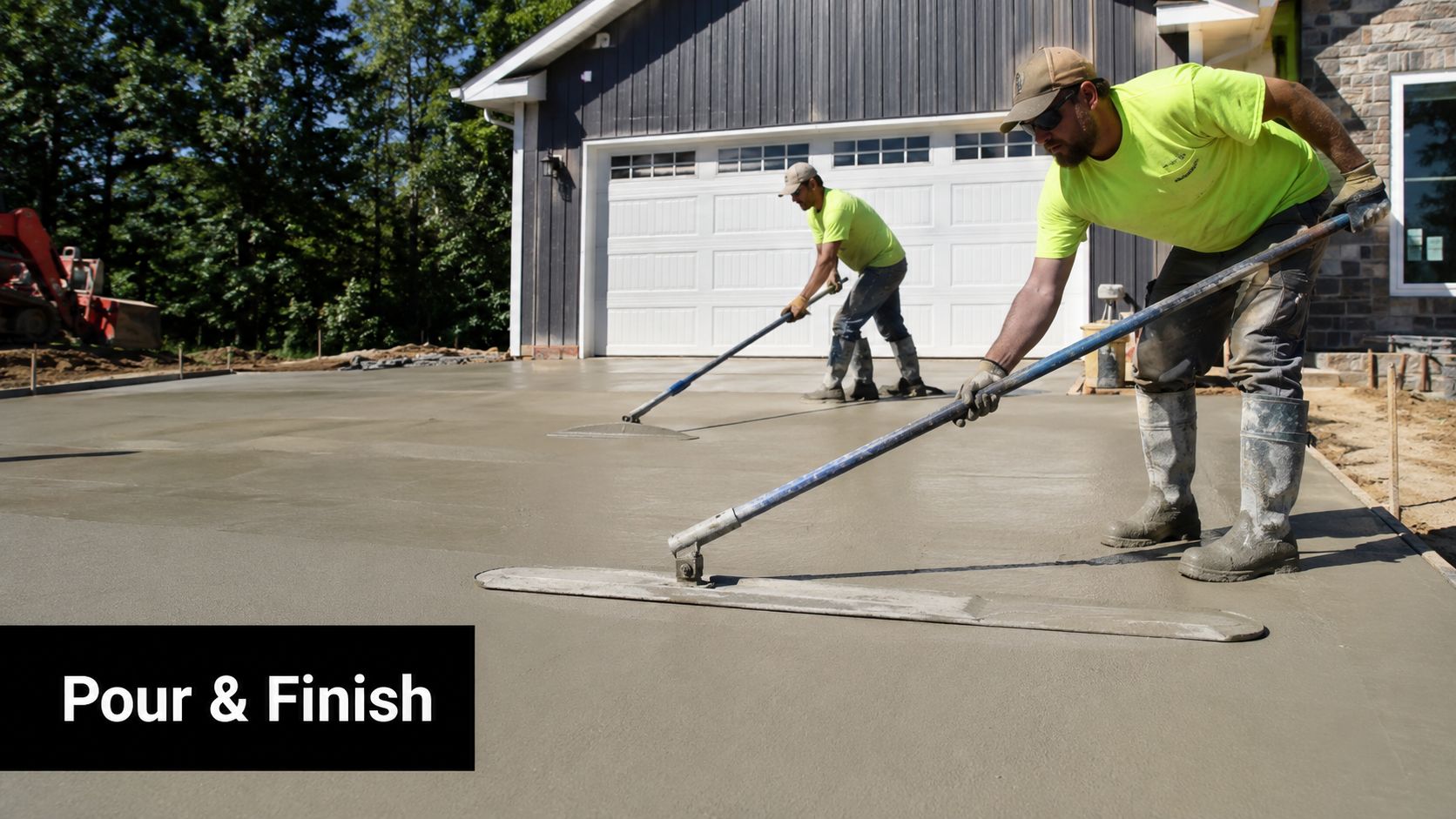
The truck arrives, the concrete is placed into the forms, and the crew works it into position so the slab fills evenly without leaving hollow spots or weak areas. Then comes screeding. That's the stage where the surface is struck off to the planned elevation.
After screeding, the slab is floated. A bull float helps settle the surface, embed larger aggregate slightly below the top, and prepare the concrete for final finishing. Timing matters here. Crews who rush the surface can trap problems into the slab. Crews who wait too long fight the concrete instead of shaping it.
The final texture for most residential driveways in this region should be practical, not slick. A broom finish gives the surface traction in rain, frost, and winter conditions common in Pennsylvania and Delaware. It also gives the driveway a clean, uniform appearance without turning it into a decorative project that sacrifices usability.
Why finishing skill changes the result
Finishing isn't just making wet concrete look smooth. It takes judgment. The installer has to read the moisture at the surface, know when to float again, and know when the slab is ready for its final texture.
That's why two driveways can use similar materials and still finish very differently. One looks tight and consistent. The other shows chatter marks, rough transitions, or surface issues that tell you the crew worked it at the wrong time.
A good finish crew doesn't fight the concrete. They watch it, wait when needed, and work it when the slab is ready.
A lot of homeowners also underestimate curing. Concrete doesn't get strong because it “dried out.” It gains strength through a chemical process, and that process needs proper moisture management. Applying a curing compound helps slow surface moisture loss so the slab can develop more evenly and avoid preventable surface distress.
For homeowners wondering about practical timing after installation, this guide on how long a concrete slab takes to cure gives a useful overview in plain language.
A short visual can also help if you want to see how placement and finishing come together on site.
Why patience after the pour matters
The slab may look finished by the end of the day, but it's not ready for full use. That waiting period protects the surface and the strength the concrete is still developing. Rushing vehicles onto a new driveway too early is one of the easiest ways to harm a job that was otherwise done correctly.
This same curing discipline matters on patios and on any concrete foundation for garage work. The visible placement gets attention, but the quiet period afterward is part of the build. Homeowners who understand that usually get better long-term results because they treat the curing window as part of construction, not as downtime.
Essential Details Joints Drainage and Edge Conditions
The driveway failures people blame on “bad concrete” often come from small details that were skipped or handled carelessly. These aren't cosmetic touches. They are the parts that help the slab manage movement, shed water, and hold up at its most vulnerable points.
Joints are planned protection
Concrete shrinks as it cures. That means cracking pressure has to go somewhere. Control joints give that pressure a planned location so the slab is more likely to crack in a straight, predictable line instead of across the field of the driveway.
Where the driveway meets another structure, the slab also needs room to move independently. That's where expansion joints matter, especially at interfaces with a garage footing and foundation, sidewalks, or other rigid concrete sections. Without a separation detail, movement transfers stress directly into the tie-in area.
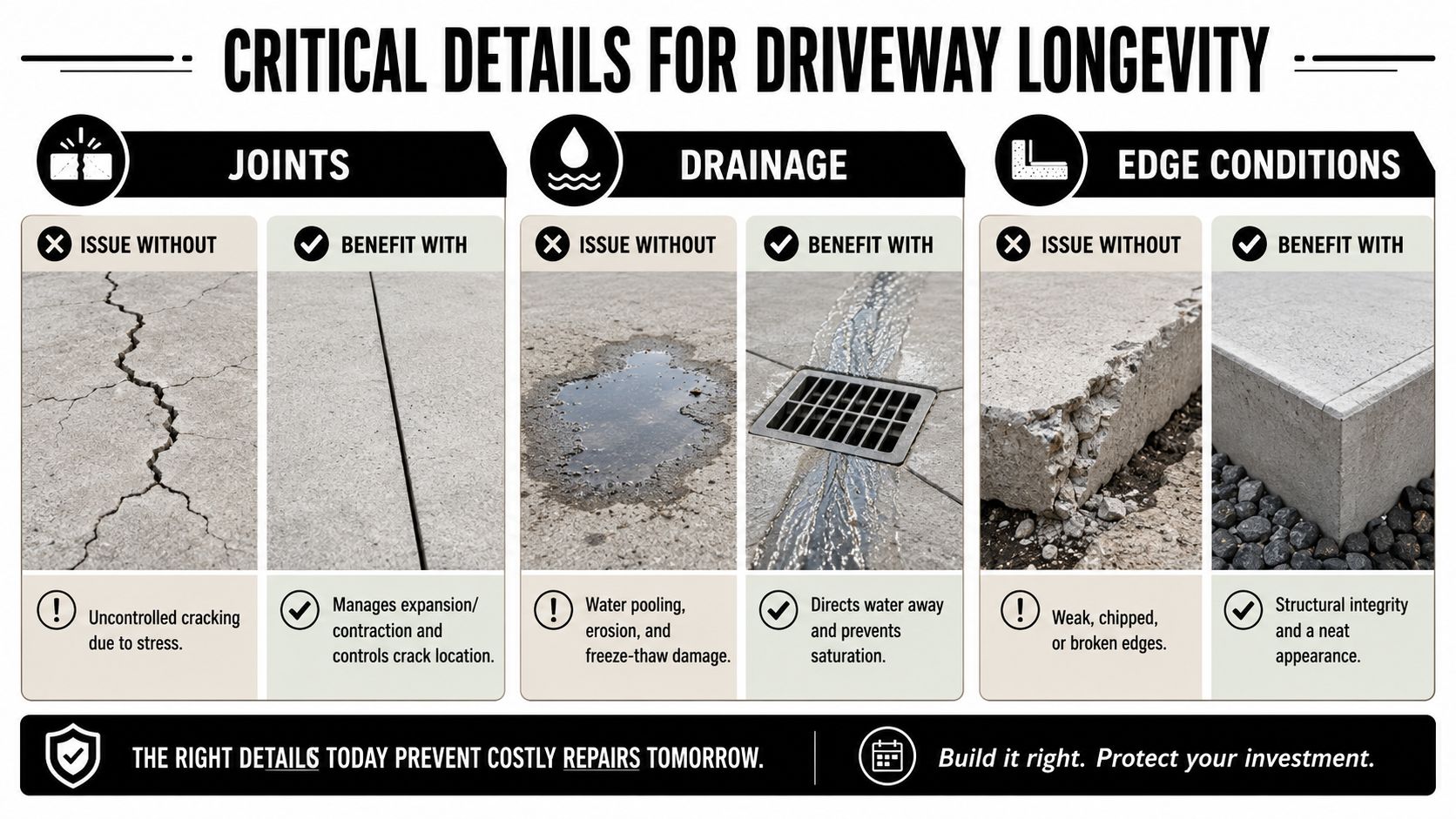
Homeowners sometimes view joints as visual interruptions. That's understandable until they see what happens without them. Random cracking doesn't just look worse. It usually creates a repair problem that never fully disappears.
Drainage is not an upgrade item
A driveway should direct water away from the house and off the slab in a controlled way. If water ponds on the surface, runs back toward the garage, or saturates the edges, the driveway is being asked to fight conditions it should have been designed to avoid.
Proper slope earns its keep. A driveway doesn't need dramatic pitch, but it does need intentional pitch. On Mid-Atlantic properties, drainage mistakes often show up first in winter. Water collects, temperatures drop, and the slab sees repeated stress in the same low spots.
Here's the practical comparison:
- Without proper drainage: Water pools, edges stay soft, freeze-thaw stress increases, and nearby foundation areas are exposed to unnecessary moisture.
- With proper drainage: Water leaves the slab efficiently, the surface stays more usable, and the surrounding soils are less likely to weaken the support system.
Small drainage errors become expensive foundation and driveway problems because water keeps exploiting the same weakness every season.
Edge conditions take daily abuse
The edges of a driveway are where tire pressure, lawn equipment, and unsupported concrete often meet. If those edges are weak, too thin, or left without enough support beside the slab, they begin to chip and break. Once the edge starts going, the driveway tends to age fast visually and structurally.
A strong driveway edge depends on consistent slab depth, good formwork, and stable support beyond the finished line. This matters even more where cars routinely turn at the same spot or where the driveway side isn't held by a curb, wall, or adjacent pavement.
These are the details that separate a short-lived driveway from one that still looks orderly years later. Homeowners often compare estimates based on square footage alone, but joints, drainage, and edge support are where the long-term value really shows up.
Your Action Plan for a Perfect Driveway
A durable driveway is never the result of one lucky decision. It comes from a chain of correct decisions made in the right order. The layout has to fit the property. The excavation has to remove what shouldn't stay. The subgrade and gravel support have to be stable. The concrete mix, reinforcement, formwork, finish, curing, joints, drainage, and edges all have to work together.
That's why concrete driveway construction details matter so much in Pennsylvania, Maryland, Delaware, and New Jersey. This region gives driveways plenty to deal with. Wet periods, winter weather, changing soils, and repeated vehicle traffic expose weak workmanship fast. A homeowner can't judge quality by surface appearance alone on the day of the pour.
What to ask before you hire anyone
Use a practical checklist when you compare proposals.
- Ask about the ground work: What will be removed, how will soft spots be handled, and what support layer goes under the slab?
- Ask about slab build details: What concrete mix is being used, what reinforcement is included, and how is thickness controlled?
- Ask about water management: Where will runoff go, and how is the driveway pitched away from the home?
- Ask about finishing and aftercare: What surface texture is planned, and what curing steps are part of the job?
How this connects to other foundation projects
Homeowners searching for shed foundations near me, garage foundation contractors near me, gravel shed foundation contractors near me, or even a shed foundation kit solution often benefit from thinking about the whole property at once. The same standards that produce reliable concrete foundations, a shed foundation gravel base, or a concrete foundation for garage use also produce better driveways. Stable ground, clear drainage, accurate forming, and material discipline carry across all of it.
If you're planning a new driveway in Honey Brook Township or elsewhere in PA, MD, DE, or NJ, don't settle for a proposal that skips the hard questions. The right contractor should be able to explain the build clearly, answer specifics without hedging, and show that longevity is part of the plan from the first cut to the final cure.
If you want a driveway, garage slab, shed pad, or other foundation build handled with attention to drainage, compaction, and long-term performance, Firm Foundations is a trusted choice for homeowners across Pennsylvania, Maryland, Delaware, and New Jersey. Reach out for a free, no-obligation quote and get clear guidance from a team that builds concrete and gravel foundations to last.