
Expert Foundation Drainage Design in PA, MD, DE & NJ
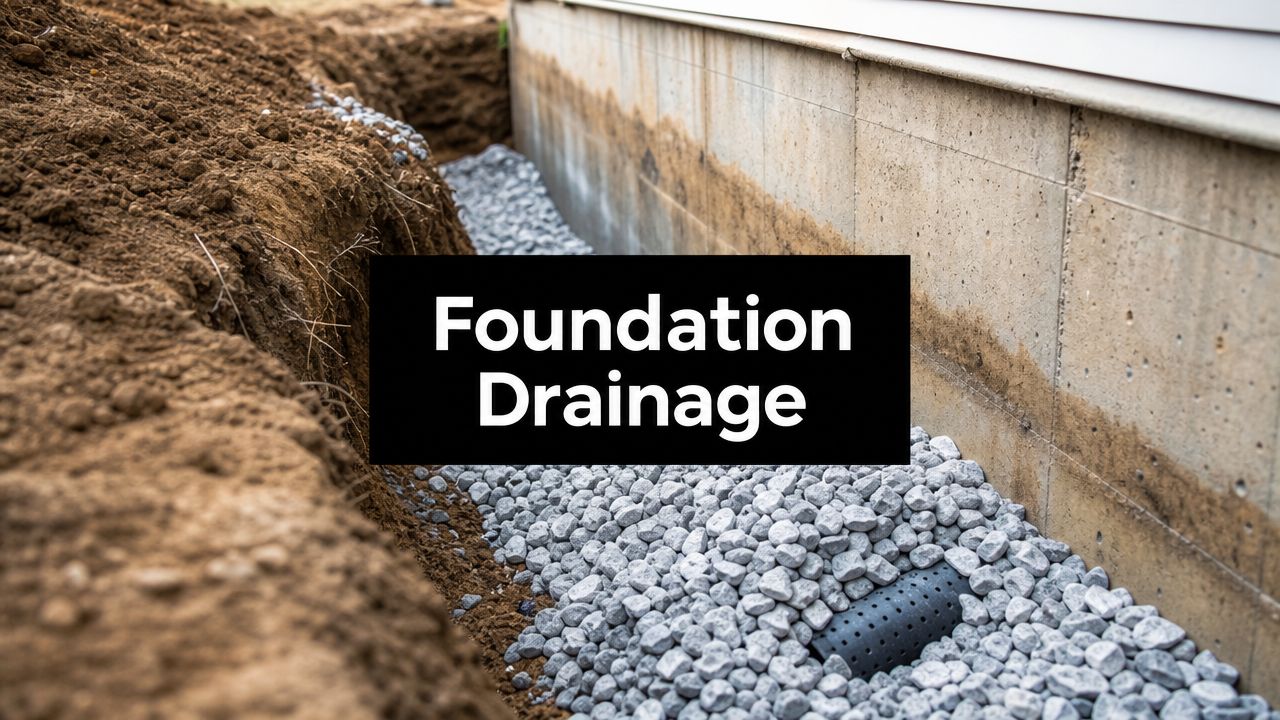
Water problems around a foundation usually start small. A puddle sits beside a new shed after a hard rain. The corner of a garage slab stays damp longer than the rest of the yard. The basement smells musty, even when you can't see standing water.
In Pennsylvania, Maryland, Delaware, and New Jersey, that pattern is common because the weather changes fast and the ground conditions change from one property to the next. A site that looks dry in summer can act very differently during a long wet stretch, a freeze-thaw cycle, or a storm that pushes runoff toward the house instead of away from it.
Good foundation drainage design solves that problem before it turns into wall pressure, settlement, erosion, or interior moisture. It matters for a full house foundation, but it also matters for a shed foundation, gazebo foundation, garage footings and foundations, and the base for a storage shed. If the water management is wrong, even a well-built concrete slab or gravel pad can end up working against the site instead of with it.
Protecting Your Investment from Water Damage
A foundation doesn't fail all at once. Water usually gives warning signs first. Soil washes away at one edge. Mulch keeps floating into the same low spot. A basement wall stays cool and damp. A detached garage shows hairline cracking that keeps drawing your attention because you know something underneath is moving.
That's why drainage should never be treated like an extra. It's part of the foundation itself. If you're planning concrete foundations, cement foundations for garage projects, or a base for storage shed workup in PA, MD, DE, or NJ, the first question isn't only what to pour. It's where the water will go on the worst day of the year.
What homeowners usually notice first
Clients typically call after they've seen one of these issues:
- Pooling near the structure that lingers after the rest of the yard dries out
- Damp interior air in a basement or crawl-adjacent area
- Soft ground at the edge of a shed pad, patio, or garage apron
- Staining or splashing marks low on foundation walls
- Cracks that keep reappearing after patching
Those signs don't always mean major structural damage is already present. They do mean the site is asking for a better drainage plan.
Practical rule: If water regularly sits beside a structure, the grading, collection, or discharge path needs attention. Waiting rarely makes that cheaper or simpler.
Homeowners dealing with active seepage often need immediate triage as well as a long-term fix. If you're already cleaning up after an event, this expert guidance for flooded basements gives practical next steps for safety and damage control while you sort out the root cause.
Why the ground below matters so much
The most important part of any foundation project is the material you don't see after the job is finished. The subgrade, the excavation depth, the backfill, the stone, the slope away from the structure, and the drainage route all work together. If one part is wrong, the finished slab or pad may still look good on day one.
For homeowners comparing a gravel pad to a slab, insulation and moisture behavior can also be part of the bigger planning picture. This guide to concrete slab insulation options is helpful when you're deciding how your foundation assembly should perform over time.
When drainage is planned early, the foundation lasts longer, the site stays cleaner, and maintenance gets easier. That's true whether you're searching for shed foundations near me, garage foundation contractors near me, or a contractor to handle excavation before a larger build.
Assessing Your Property's Drainage Needs
Before choosing pipe, stone, or trench layout, walk the site. Don't do it only on a sunny afternoon. Look at it after rain if you can. The property will tell you where the trouble is if you pay attention to the low spots, the runoff paths, and the soil that stays dark and wet.
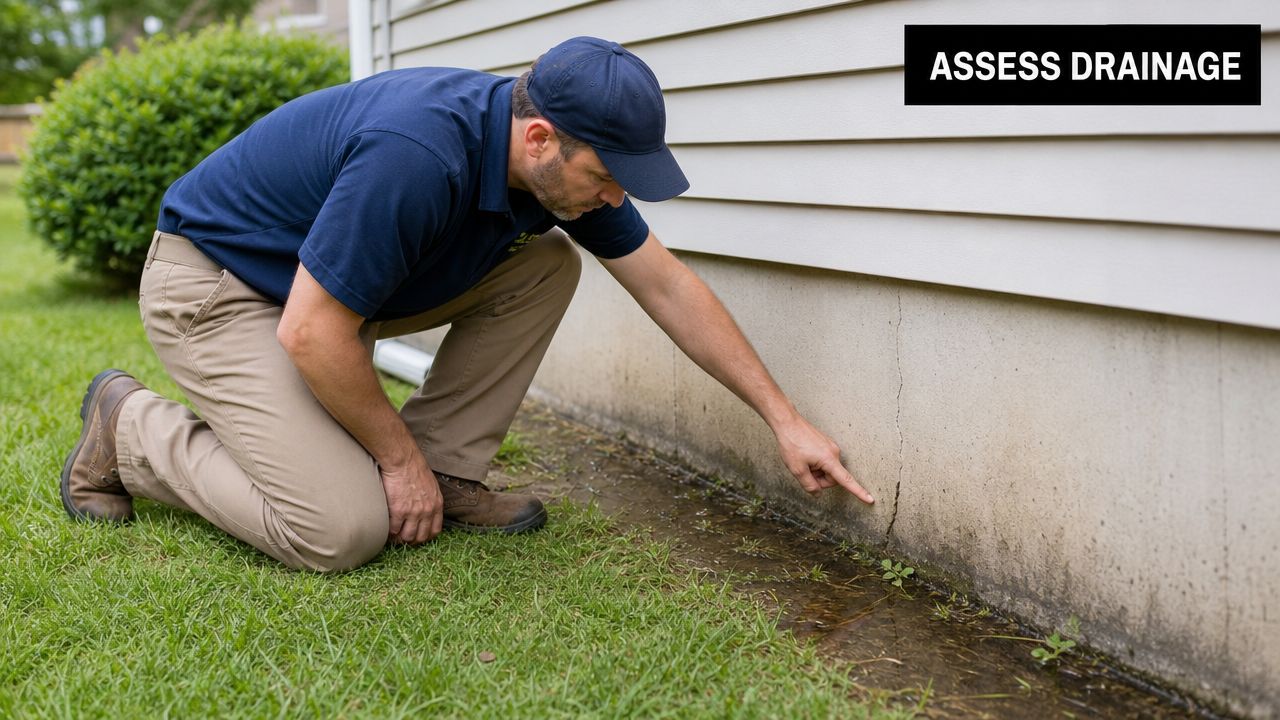
A lot of Mid-Atlantic properties have mixed conditions. One side of the house may drain reasonably well, while the backyard holds water because of clay-heavy soil or a neighboring grade that pushes runoff onto the lot. That's why a real drainage assessment isn't guesswork. It's a field check.
Walk the site like a contractor
Start at the high points and work down toward the structure. Then reverse it and stand at the foundation looking outward.
Use this checklist:
- Look for low pockets where grass is thin, mulch migrates, or water visibly ponds.
- Check the grade at the perimeter around the house, garage, barn shed, or shed foundation.
- Watch the downspouts during rain and note where that water lands.
- Study nearby hard surfaces like driveways, patios, and walkways that may steer water toward the building.
- Notice off-site flow from a neighboring yard, field edge, or uphill tree line.
If you're preparing a new pad or slab, this guide on site preparation for a concrete slab is a good companion because drainage problems often begin before the concrete truck ever arrives.
Surface water and groundwater are different problems
Surface water is the runoff you can usually see. It comes off roofs, driveways, bare soil, and sloped lawns. It tends to move quickly during storms, then settle in low areas if the grade is wrong.
Groundwater is different. It shows up as persistent dampness, seasonal seepage, or pressure against below-grade walls. Homeowners often describe it as “the basement gets wet even when I don't see much water outside.” That usually means the solution needs to address more than surface grading alone.
When a yard sheds water toward the house, grading may solve most of the issue. When moisture comes up from below or pushes through a wall, the drainage design has to intercept it lower in the system.
Soil changes the answer
Soil type matters more than most homeowners expect. Heavier soils hold water longer and drain slower. Looser soils pass water more freely but can shift or wash if they aren't stabilized correctly. In this region, it's common to see one property with firm, workable material and the next one with wet, sticky subsoil that needs a different approach.
A simple homeowner test is to dig a small hole in a problem area and check how the soil behaves. If it smears and clumps heavily when wet, drainage moves slowly. If water disappears fast but the soil sloughs off, erosion control becomes part of the design.
What to bring into a contractor conversation
A useful site visit starts with observations, not assumptions. Have these details ready:
| Site detail | Why it matters |
|---|---|
| Where water stands | Helps identify collection points and failed grade |
| When the problem shows up | Distinguishes constant moisture from storm runoff |
| Which structure is affected | A house foundation, shed pad, or garage slab can need different solutions |
| Any recent changes | New patios, driveways, or landscaping often alter runoff paths |
That information makes it easier to build the right plan for a house foundation, concrete foundation for garage, or smaller outbuilding pad without overspending on the wrong fix.
Choosing the Right Drainage Strategy for Your Foundation
There isn't one drainage system that fits every property. The right setup depends on whether the water is arriving from above, building below grade, or concentrating in one trouble spot because the site funnels it there. On many projects, the best answer is a combination of grading, collection, and discharge.
A useful benchmark comes from industry guidance on site and foundation drainage. It recommends keeping both rough and final grade sloped away from the building by at least 2%, then using clear gravel backfill and a perforated perimeter drain. The same guidance also warns that connecting downspouts directly to footing drains is a common pitfall because it can overload the system during storms (BCBEC drainage guidance).
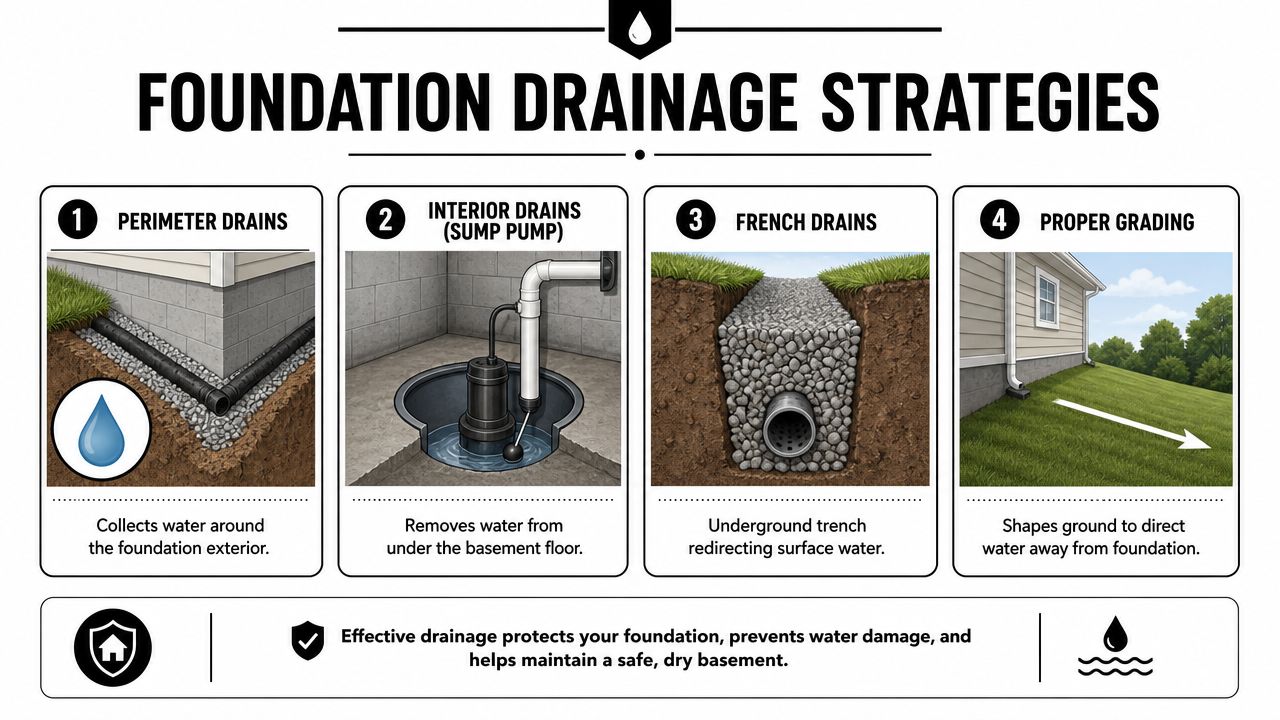
Comparing the main options
| Strategy | Best use | Relative cost | Maintenance |
|---|---|---|---|
| Perimeter drain | Water at the exterior foundation edge | Higher than grading alone | Moderate |
| Interior drain with sump pump | Water under or beside basement floor | Moderate to higher | Ongoing pump checks |
| French drain | Yard runoff or localized soggy areas | Moderate | Periodic outlet inspection |
| Proper grading | First-line control for surface runoff | Lower | Low if preserved |
The “relative cost” here is broad because labor, access, excavation depth, discharge path, and restoration can shift the price significantly from one site to another. The point is fit, not just budget.
Perimeter drains for foundation protection
A perimeter drain belongs near the foundation where water needs to be intercepted before it sits against the wall area. This is the system most homeowners think of when they hear “footing drain.” It's especially important on structures with below-grade space or where exterior backfill tends to stay wet.
For a new home, garage, or deeper concrete foundation, this is often the most durable way to manage subsurface water. For an existing structure, access and excavation conditions determine whether it's practical.
French drains for site problems away from the footing
French drains work well when the primary issue is a yard that carries water toward the structure. They can collect and redirect water before it reaches the foundation. That makes them useful for lots with a hill above the house, recurring soggy bands along a fence line, or runoff that cuts across a future gazebo foundation or base for storage shed.
A French drain isn't a cure-all. If the foundation itself is already under hydrostatic pressure, surface interception alone may not solve the deeper issue.
Here's a quick visual overview of the systems homeowners ask about most often.
Interior drains and sump pumps
Interior drain systems collect water from beneath or along the basement floor area and move it to a sump pit for discharge. They're often chosen when exterior excavation is limited by access, hardscape, additions, or neighboring structures.
They can be effective, but they're not a substitute for good exterior water management. If roof runoff and surface grading are wrong, the pump may end up handling water that should never have reached the foundation in the first place.
The best sump setup is the one that has less to do because the exterior drainage is already working.
Grading and gutter control
Sometimes the simplest fix has the biggest effect. If the soil around the structure pitches inward, no drain pipe will save the site for long. Surface grade has to move water away first.
Gutters matter too because roof water lands fast and in concentrated volume. Homeowners improving roof drainage can benefit from reading about installing seamless gutters in PA, especially when repeated overflow or poor discharge is feeding the same wet corner of the foundation.
For many projects in PA, MD, DE, and NJ, the strongest drainage design uses a layered approach:
- Grade the soil correctly
- Manage roof water separately
- Install the right drain at the right depth
- Send discharge to a safe outlet
That combination protects everything from garage footings and foundations to a 10×10 storage shed pad.
Installation Basics and Local Code Considerations
Drainage systems fail when crews rush the parts nobody sees. A trench that's too shallow, stone that carries fines, pipe set without a reliable fall, or fabric omitted to save time can all shorten the life of the system. On a foundation job, those aren't small misses. They're the job.
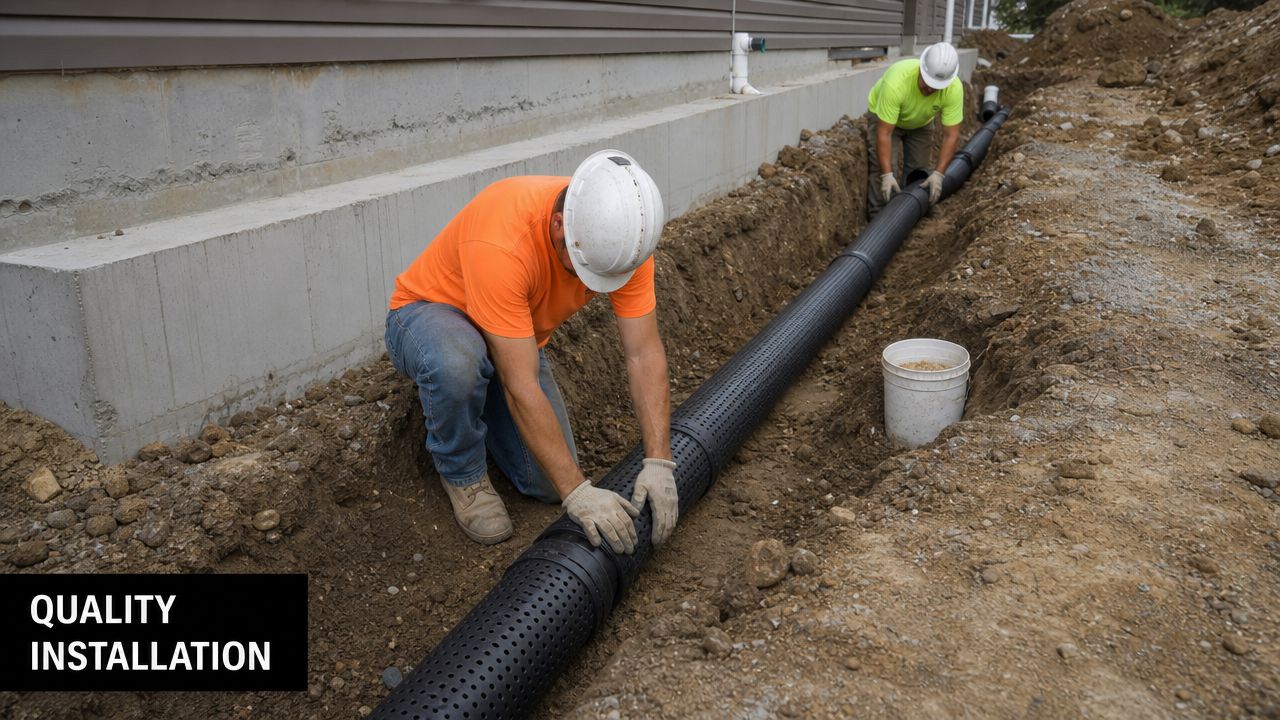
What a solid installation includes
Good installation starts with excavation that exposes the work area cleanly and allows the installer to control depth and slope. The trench bottom should be stable, not soft and churned up. Pipe performs best when it sits on a prepared base instead of random loose spoil.
The basic assembly usually includes a perforated pipe, clean crushed stone or clear gravel, and a filter layer that helps keep sediment from filling the system. The outlet path matters just as much as the trench itself. If water has nowhere dependable to go, the drain becomes storage instead of conveyance.
The code detail that really matters
For below-grade foundations, placement is critical. The International Residential Code Section R405.1 requires drainage around foundations that retain earth and enclose below-grade space, and it specifies that the drainage system's top must be at or below the top of the footing (IRC drainage requirement summary).
That detail matters because water needs to be intercepted low enough to prevent pressure from building against the wall. Putting a drain above the footing sounds close enough to some people, but it changes how the system performs. Water can still collect lower than the pipe and remain where you don't want it.
Material choices that hold up
The right materials aren't flashy, but they separate a lasting installation from a callback.
- Clean stone keeps open space around the pipe so water can move.
- Filter fabric helps stop surrounding soil from clogging the stone bed.
- Rigid perforated pipe usually maintains line and slope better than flimsy alternatives in demanding trench conditions.
- Compacted surrounding areas reduce settlement that can change water paths at the surface.
An experienced crew also plans for restoration. If the grade beside the wall isn't rebuilt carefully after the drain goes in, the site can end up sending water back toward the structure.
A drain pipe can be perfectly installed and still underperform if the final surface grade is wrong.
Regional concerns in PA, MD, DE, and NJ
This region asks more from foundations than many homeowners realize. Freeze-thaw movement, mixed soil profiles, wooded lots, older properties with layered additions, and tight suburban access all change the installation approach. A trench for a house foundation isn't the same as a drainage build around a detached garage, shipping container base, or large gravel pad.
Frost concerns matter because movement near the foundation edge can disturb both grade and drainage pathways over time. That's one reason experienced excavation crews pay close attention to depth, compaction, and where runoff will move after winter weather works on the site.
If you want a broader visual reference on trench-style water control, this expert guide on yard drainage is a useful companion for understanding how collection and redirection systems are put together.
Where homeowners get into trouble with DIY installs
DIY work usually goes sideways in a few predictable places:
- The trench doesn't maintain a consistent fall, so water sits instead of moving.
- The installer uses the wrong backfill, often with too much fine material.
- The outlet is an afterthought, which leaves the system with no reliable discharge.
- The final grading gets neglected, undoing the work near the foundation line.
That's why foundation drainage design is more than “putting a pipe in the ground.” On foundation builds, gravel shed foundation contractors near me searches, and larger excavation near me projects, the drainage details are often what decide how long the job performs.
Common Drainage Pitfalls and How to Avoid Them
Most drainage failures aren't caused by one dramatic mistake. They come from small shortcuts that stack up until the system clogs, backs up, or never works as intended. These are the field issues that show up again and again on residential properties.
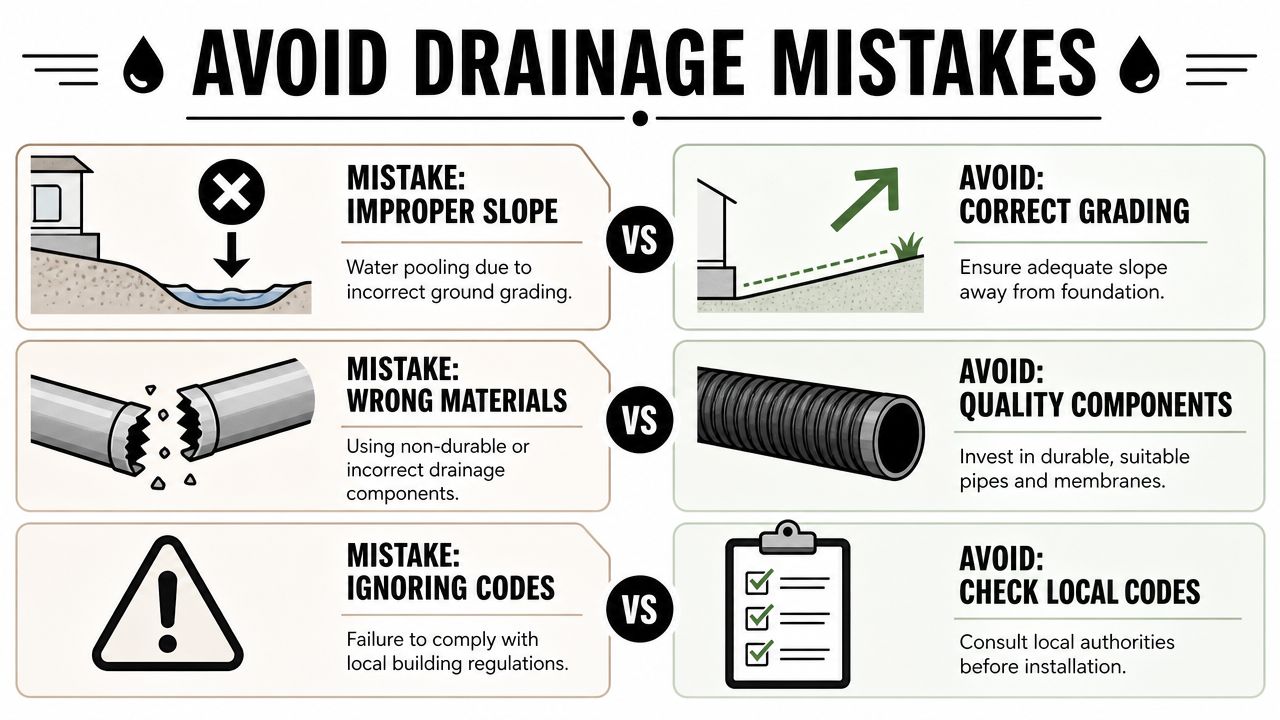
The mistakes that cost homeowners later
Wrong gravel choice
Stone with too much fine material can choke the drainage path. The fix is using clean, free-draining aggregate that keeps open space around the pipe.Poor pipe slope
A drain line that bellies or flattens out can hold water instead of carrying it away. This usually comes from rough trench prep or careless installation.Missing filter fabric
Soil migration is slow but relentless. Without separation, sediment works into the stone and reduces performance over time.Downspouts tied into footing drains
This is one of the most common bad ideas on residential sites. Roof water arrives fast during storms, and that surge can overwhelm a system that should be protecting the foundation, not acting as the main roof drainage line.Final grade pitched the wrong way
Homeowners sometimes fix the subsurface system and forget the finish work. If the soil settles back toward the wall, water returns right to the same trouble area.
Better habits that prevent callbacks
A dependable drainage plan usually follows a simple logic. Keep surface water moving away. Intercept subsurface water where needed. Protect the pipe and stone from sediment. Make sure discharge is separate and reliable.
Good drainage is quiet. You don't think about it because water leaves the area without leaving signs behind.
For homeowners reviewing bids, ask plain questions. What stone will be used? How will the trench be protected from fines? Where will the water discharge? How will the grade be restored? Clear answers usually signal careful work.
If you're comparing concrete contractors, driveway contractors near me, or teams handling both excavation and foundations, that kind of detail matters more than polished sales language.
Start Your Project with a Solid Foundation
Water control isn't a finishing touch. It's part of the structure. Whether you're planning a shed foundation gravel base, a reinforced slab for a garage, a gazebo foundation, or a larger house foundation project, drainage should be designed into the work from the beginning.
That approach protects more than concrete. It protects doors from racking, pads from edge washout, basement areas from moisture problems, and yards from turning into repeat repair projects. It also makes the site easier to live with. Less mud. Less standing water. Fewer surprises after a storm.
In the Mid-Atlantic, local conditions matter. A drainage plan that works on one lot may not fit the next lot a few miles away. Soil behavior, grade, roof runoff, neighboring elevations, access for excavation, and code requirements all shape the right answer. That's why careful planning pays off on everything from a 4×8 shed with foundation up to a full detached garage slab.
If you're pricing out shed foundations contractors near me, garage foundation contractors near me, or looking for a contractor who understands drainage as well as excavation and concrete, don't settle for a one-size-fits-all answer. A well-built foundation starts with water management that makes sense for your property.
If you want a foundation and drainage plan built for real site conditions in Pennsylvania, Maryland, Delaware, or New Jersey, Firm Foundations can help. The team handles gravel pads, concrete slabs, excavation, and drainage-focused site prep for sheds, garages, houses, patios, barns, and more. Reach out for a free quote and get clear guidance on the right base, the right drainage approach, and the right way to protect your investment for the long haul.