
Geotextile Fabric Installation for Shed & Garage Pads


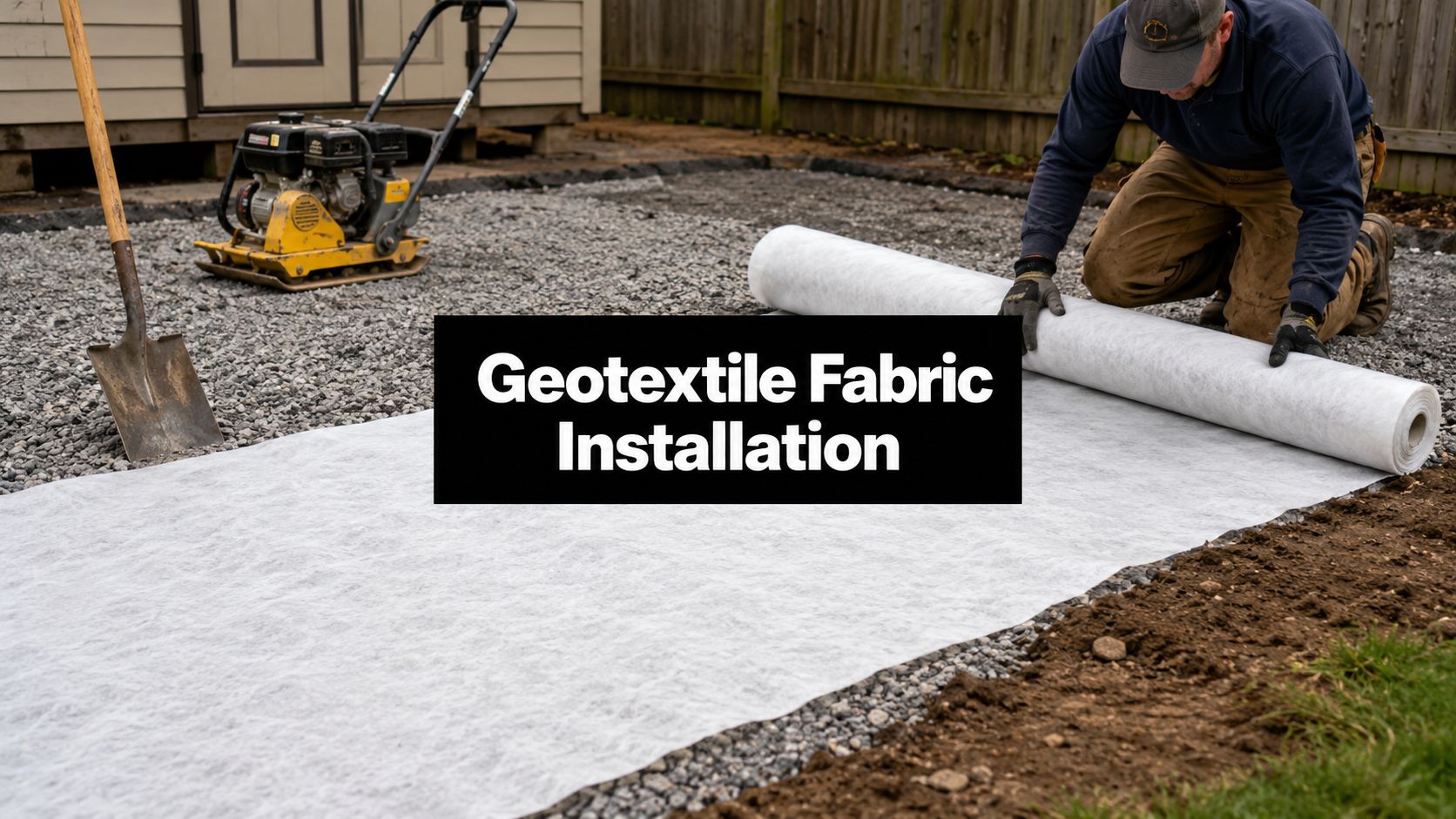
You've picked the shed. Maybe the garage plan is finally moving forward. Maybe you're pricing out a gazebo foundation or trying to figure out the best base for storage shed use on ground that never seems to stay dry for long. That's usually the point where the excitement meets the key question. What's going under it, and will it still be solid a few years from now?
In Pennsylvania and Maryland, that concern is justified. A pad can look clean and level on day one and still fail early if the layers underneath weren't installed correctly. Homeowners searching for shed foundations near me, garage foundation contractors near me, or gravel shed foundation contractors near me are often trying to avoid the same problems: settling corners, muddy edges, gravel disappearing into soil, and weeds pushing up through what was supposed to be a finished base.
A lot of those failures start below the stone. That's where geotextile fabric installation matters. It isn't the flashy part of a project, but it's one of the most important parts if you want a shed foundation, gazebo foundation, or concrete foundation for garage use to stay stable and drain the way it should.
The Unseen Hero of Your Shed Foundation
A homeowner will often focus on the visible parts first. The compacted stone. The concrete forms. The clean finished edges. The pad height. Those things matter, but they only perform well if the ground beneath them stays separated from the base material above.
That's the job of geotextile fabric. Under a shed foundation gravel base or a garage pad, it acts like a separator between native soil and the aggregate layer. Without that separation, the stone starts mixing with the soil beneath it. Once that happens, the base loses structure, drainage gets worse, and the whole pad becomes more vulnerable to movement.
What homeowners usually notice first
Callers don't call about fabric. They call because something else is going wrong.
- A corner starts sinking: The shed door sticks, or the floor feels off.
- The gravel base looks muddy: Stone has worked down into soft subgrade and soil has migrated upward.
- Weeds show up through the base: The underlayment either wasn't right for the job or wasn't overlapped correctly.
- Water sits around the perimeter: The pad may be level, but the system below it isn't managing separation and drainage well.
Those aren't cosmetic problems. They're foundation problems.
Why this layer matters so much
For a base for storage shed or a larger garage foundation, the fabric protects the investment you're making in the excavation, stone, compaction, and final structure. It helps the gravel do the work it's supposed to do instead of disappearing into the ground over time.
Practical rule: If the soil and stone are allowed to mix, the pad starts losing performance long before the homeowner realizes what caused it.
That's why this layer belongs in serious foundation builds, whether the project is a small 4×8 shed with foundation planning, a 10×10 storage shed, a barn shed, or a reinforced slab for a garage. For gravel pads, it's often the difference between a base that stays tight and one that slowly turns into a maintenance project.
Gravel pads and concrete pads both benefit
Homeowners sometimes assume geotextile fabric only belongs under a gravel shed foundation. In reality, it also supports many site-prep situations tied to concrete foundations, cement foundations for garage projects, and broader foundation builds where stable subgrade conditions matter.
The fabric doesn't replace proper excavation or compaction. It supports them. When it's installed correctly, the layers above it stay cleaner, more stable, and more predictable. When it's skipped or handled poorly, the failure may take time to show up, but it usually shows up.
Choosing the Right Geotextile for Your Foundation Project
Not every fabric sold for landscaping belongs under a structural pad. That's one of the biggest points of confusion for homeowners. A roll labeled for weed control might be fine in a flower bed, but that doesn't mean it's suitable under a shed foundation, driveway approach, or garage pad.
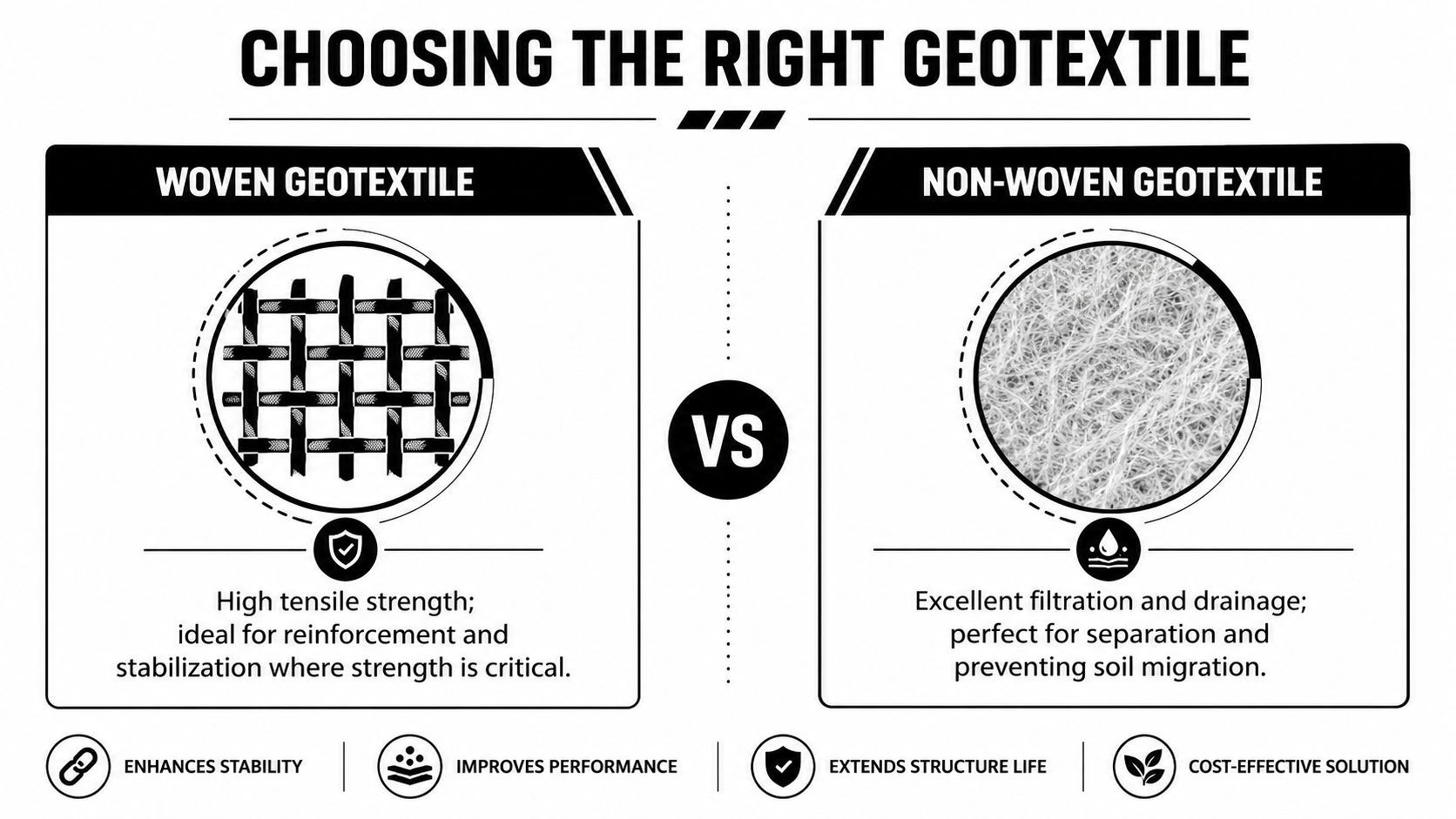
The two categories people hear about most are woven and non-woven geotextile. They don't do the same job equally well.
Woven for stabilization and separation
Woven geotextile is generally the better fit under gravel-based shed pads, garage pads, and other projects where separation and load support matter most. It's built for strength. When native soil wants to pump upward and the gravel wants to press downward, woven fabric helps keep those layers apart.
For a homeowner planning a shed foundation gravel base, a gazebo foundation, or a pad for a barn shed, this is usually the material that makes the most sense when the main goal is keeping the base intact.
Non-woven for filtration and drainage
Non-woven geotextile has a different role. It's often the better choice where water movement and filtration are the priority, such as behind retaining walls or in drainage systems. It has a felt-like structure that supports water passage while helping control soil migration.
That distinction matters. If you're building a driveway base or storage shed pad in Delaware and the issue is load-bearing separation, woven may be the better call. If the project is more about drainage management, non-woven often has the edge.
A lot of geotextile problems don't start with installation. They start with choosing a material that was never meant for the load or moisture conditions on that site.
Woven vs Non-Woven Geotextile Fabric
| Feature | Woven Geotextile | Non-Woven Geotextile |
|---|---|---|
| Primary role | Separation and stabilization | Filtration and drainage |
| Typical texture | Interlaced, mesh-like | Felt-like, fibrous |
| Best fit for shed and garage pads | Usually yes | Sometimes, depending on drainage design |
| Common residential use | Gravel pads, driveways, load-bearing base work | French drains, retaining wall backfill, filtration zones |
The overlap detail most people miss
Material choice and installation go together. Even the right fabric can fail if the seams and overlaps are treated casually. One detail that gets overlooked in generic advice is overlap width on weak ground. Expert guidance notes that weak subgrades require 12–18 inches with generous overlaps to prevent gaps, which helps avoid weed infiltration and gravel mixing according to guidance on geotextile overlap under pavers.
That matters for more than pavers. The same principle applies under a shed or garage pad. Weak soil punishes shortcuts.
If you're still deciding what the ground can support, it helps to understand soil bearing capacity for shed pad planning. That's often the difference between picking fabric confidently and guessing.
Preparing Your Site Like a Pro
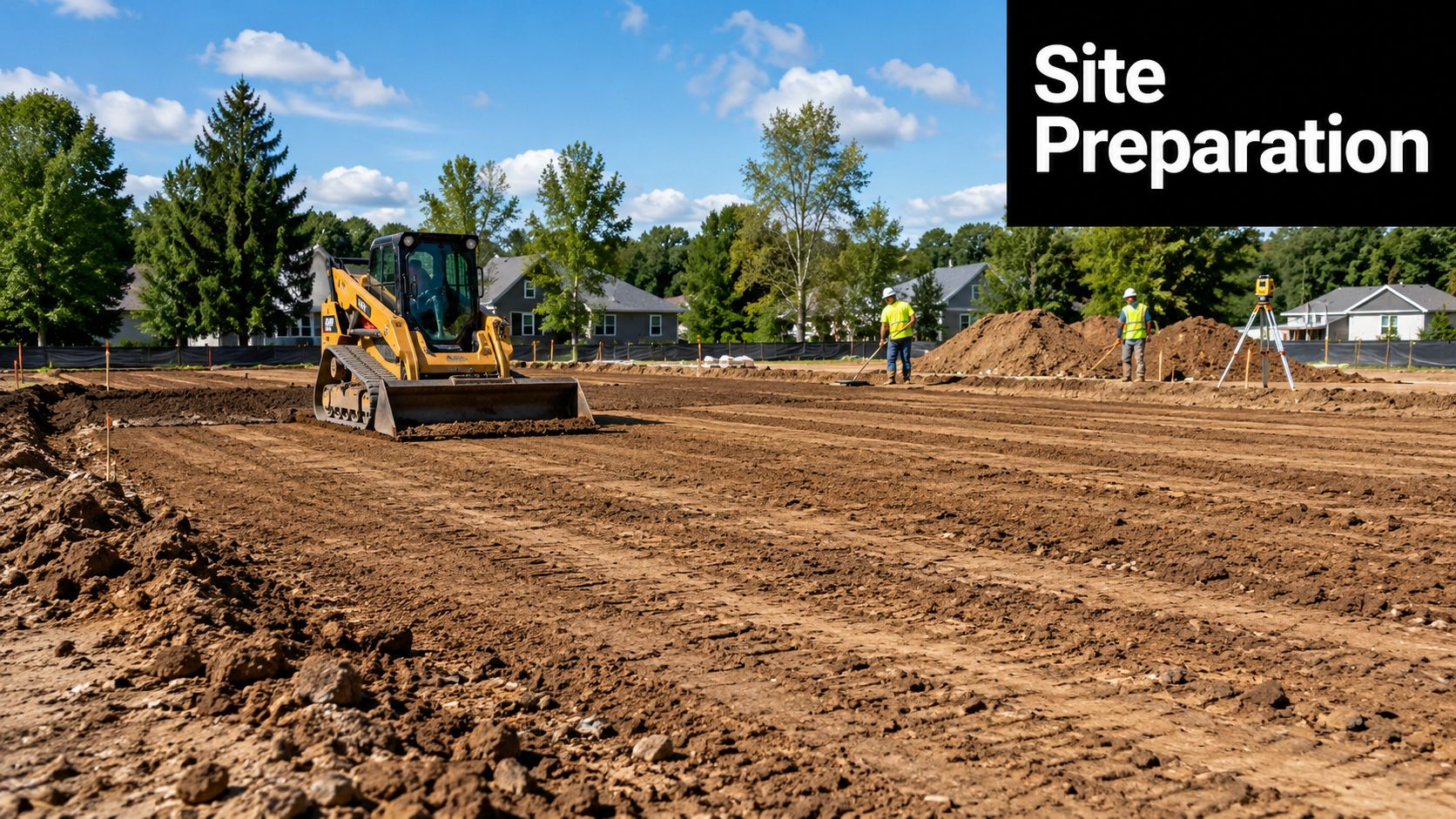
Good geotextile fabric installation starts before the roll ever touches the ground. If the site is soft, uneven, full of organics, or poorly graded, the fabric can't fix that by itself. It supports a proper base. It doesn't replace one.
For homeowners searching excavation near me or trying to build a shed foundation on sloped or uneven ground in Pennsylvania, the prep work is usually where the project is won or lost.
Strip out what doesn't belong
Roots, topsoil, sod, buried organic matter, loose fill, and soft pockets all need to go. A shed pad placed over organic material may look fine at first, but those materials break down and shift. That movement transfers straight into the foundation system.
The cleaner the subgrade, the more reliable everything above it becomes.
Grade for drainage before you think about fabric
A lot of homeowners assume the gravel will solve drainage by itself. It won't if the site still traps water. The subgrade needs shape. Water should move away from the structure, not toward the middle of the pad or against one edge.
For uneven sites, this is where equipment and experience make a difference. A skid steer, compact equipment, and a trained operator can cut high spots, fill low areas correctly, and keep the finished pad from becoming a basin. If you're dealing with a sloped yard, this guide on how to level uneven ground for a shed pad is a useful starting point.
Compact the subgrade so the fabric has something firm to sit on
Fabric performs best when it's laid onto a prepared surface, not a churned-up mess. Compaction reduces movement under the separator layer and helps the aggregate spread evenly when installation begins.
Here's the basic professional sequence:
- Clear the footprint completely: Remove vegetation and unstable material.
- Cut and shape the grade: Establish a clean, drainable subgrade.
- Proof the area visually and physically: Soft zones need correction before fabric goes down.
- Compact the surface: Give the geotextile a stable platform.
The smoothness of the subgrade affects everything that follows. Wrinkles, voids, and soft spots usually start below the fabric, not above it.
Safety and planning matter on active sites
Even for a residential shed foundation, site work involves machinery, changing ground conditions, and crew coordination. Homeowners who like to understand how contractors think about hazard planning may find this overview of the difference between JSA and SWMS helpful. It's a good reminder that successful excavation isn't just about moving dirt. It's about sequencing work so the site stays controlled.
This prep process is the same whether the job is a gravel pad in Honey Brook Township, a concrete foundation for garage use in Maryland, or a broader house foundation and site package. The fabric layer only works well when the ground below it is ready.
Geotextile Layout and Seaming Best Practices
Laying geotextile looks simple until you see what goes wrong when it's rushed. Folded fabric, short overlaps, torn edges, and poorly handled seams don't always fail immediately. They fail later, after the gravel is in place and the structure is loaded.
That's why layout work needs precision. The fabric should be placed as a continuous working layer, not tossed down like ground cover fabric.
Start from firm ground and keep the sheet flat
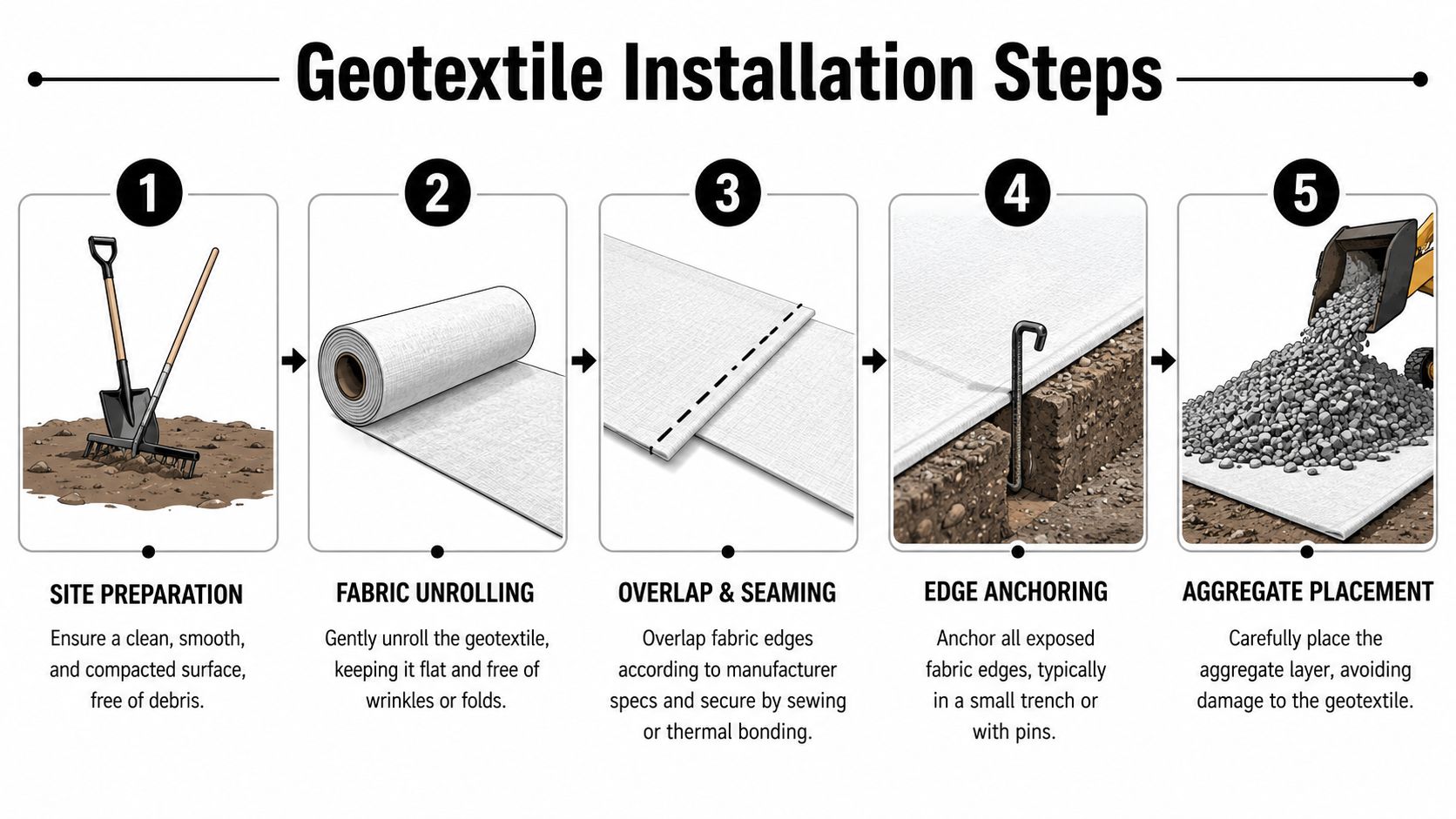
Professional guidance recommends rolling the fabric out from a point that gives equipment access and starts on firm soil at the perimeter, creating an anchor point before the fabric moves onto softer sections. The same guidance also says not to drag the fabric across the subgrade, and it sets the recommended overlap between adjacent panels at 1.5 to 3 feet depending on subgrade strength, with weaker subgrades needing the larger overlap. It also states that aggregate over the geotextile should be spread in lifts of no less than 6 inches, with the first lift thick enough to limit rutting to less than 4 inches according to geotextile separation and stabilization installation guidelines.
Those details matter because they prevent the fabric from shifting, tearing, and opening gaps during construction.
Seams are where shortcuts show up fast
On higher-load applications, seams need more than a casual overlap. For high-load geotextile fabric installations, seams must be overlapped by 30–60 cm (1.0–2.0 ft) and secured with methods like stitching or heat bonding so the seam withstands 80% of the fabric's tensile strength, according to this high-load seam guidance.
For a shed pad, that doesn't mean every homeowner needs industrial seam equipment. It does mean the seam can't be treated like an afterthought if the fabric is carrying real separation responsibility over weak or variable soils.
What a proper layout avoids
A clean geotextile layout protects the performance of the entire foundation system.
- Wrinkles create voids: The stone above won't bear evenly.
- Short overlaps open under stress: Soil and aggregate begin to mix.
- Dragging the fabric damages it early: Small tears become failure points once loaded.
- Poor patching leaves weak spots: The finished pad may settle unpredictably.
If a section gets damaged during installation, expose it and patch it properly. Covering torn fabric with stone doesn't fix the problem. It hides it.
For homeowners comparing shed foundation kit options, gravel pads, and full garage footings and foundations, this is one of the clearest differences between a pad that lasts and one that is merely completed.
Anchoring the Fabric and Placing Your Gravel Base
Once the fabric is down, the next risk is disturbing it while placing stone. This often leads to plenty of promising DIY projects going sideways. The fabric may be aligned correctly, but careless aggregate placement shifts it, punctures it, or folds it underneath the load.
The fix is controlled placement, not speed.
Anchor edges so the sheet stays where you put it
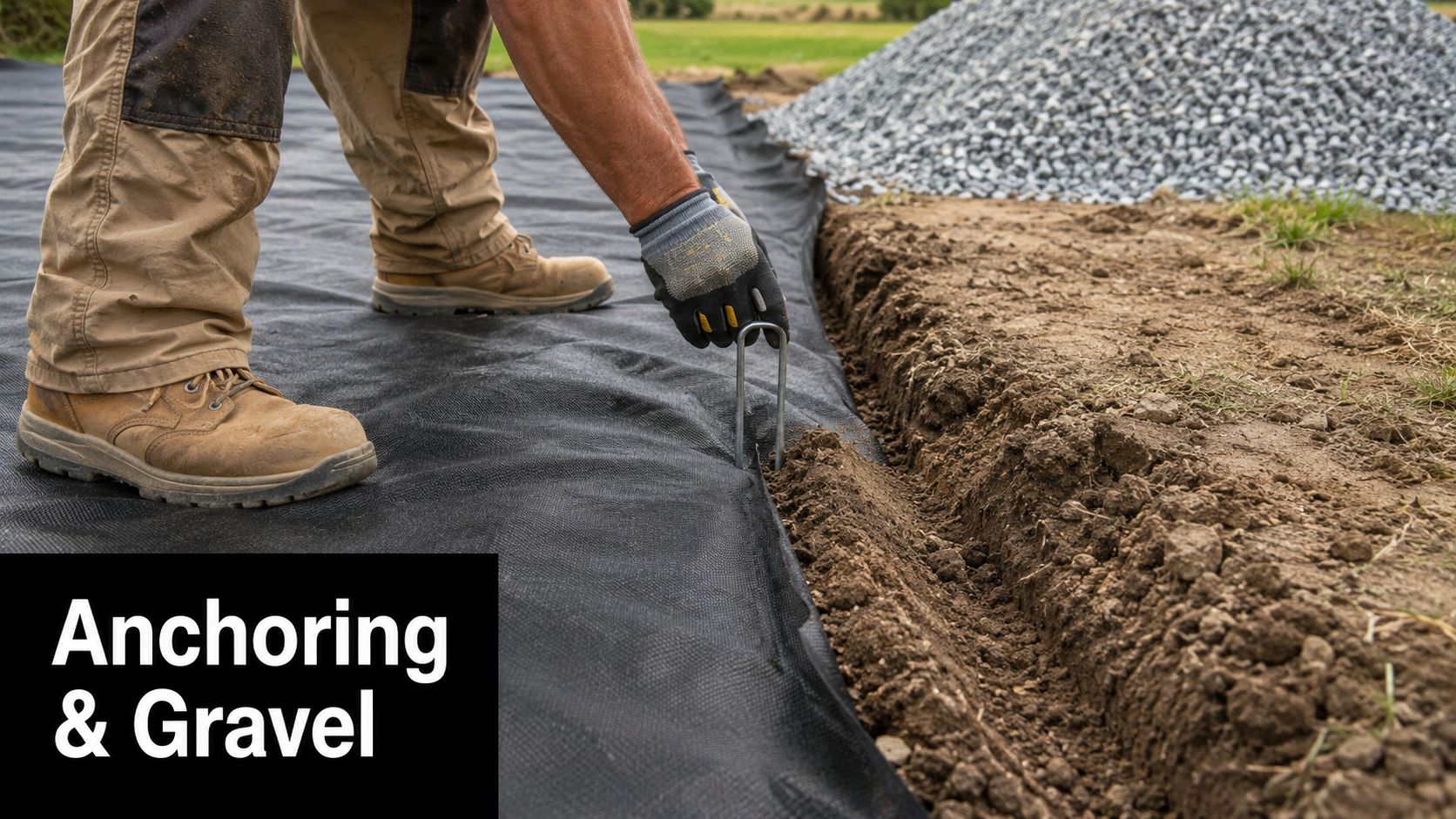
Exposed edges need to be held in place before the aggregate arrives. Depending on the project, that may mean pins, temporary fastening, or setting the edge into a small trench so the sheet can't crawl as stone is pushed across it.
If the edges float, the whole layer can move. That movement usually doesn't stop at the perimeter. It telegraphs inward and disturbs overlap zones too.
Build the gravel layer in controlled lifts
This is one of the most important practical details in geotextile fabric installation. When placing fill material, it must be distributed loosely in lifts of 8–12 inches, and vehicles are prohibited from driving directly on the geotextile to prevent tearing and displacement, according to geotextile fill placement guidance.
That's not just a spec on paper. It directly affects whether the separator layer survives the installation process.
What works on the jobsite
For a gravel shed foundation, the first layer of stone should protect the fabric, not attack it. Good crews place aggregate so the material rolls or spreads onto the fabric rather than dropping aggressively in a way that bunches the sheet.
A few field-tested habits matter:
- Start with enough cover: The first lift needs to shield the fabric from point loads.
- Spread, don't spin: Sudden tire movement or aggressive turns stress the layer below.
- Work forward carefully: Push material in a controlled direction instead of whipping over exposed fabric.
- Watch for bunching: If the fabric starts to fold, stop and correct it before continuing.
Why the first lift decides the outcome
The first gravel lift is the most vulnerable moment in the build. After that, the stone begins acting as a protective working layer. Before that, every bucket placement and equipment movement can damage the system.
A geotextile layer that stays flat under the first lift usually performs well. A layer that gets displaced early rarely improves as the job continues.
This is true whether you're building a simple shed foundation blocks alternative, a larger gravel base for a shipping container, or preparing for concrete forms on a garage slab. The first lift sets the platform for everything above it.
Common Mistakes and When to Call a Foundation Contractor
The most common failure isn't using geotextile fabric. It's using the wrong product or installing the right one carelessly. Homeowners often buy a light-duty fabric, lay it over soft ground, toss stone on top, and assume they've built a structural base. They haven't.
Another frequent mistake is poor overlap discipline. If seams are too short or not kept tight during placement, the separation layer opens up where it matters most. The gravel starts mixing with the subgrade, and the pad slowly loses integrity.
The mistakes that cost the most later
Some installation errors stay hidden until the structure is already in place.
- Cheap garden fabric instead of true geotextile: It tears too easily and doesn't hold up under load.
- Weak subgrade left untreated: Fabric can support a system, but it can't rescue a bad base by itself.
- Fabric damaged during stone placement: The problem gets buried, not solved.
- Wrong equipment on top of the installed layer: Engineers specifically warn against lightweight rubber-tire equipment on installed geotextile because it can cause folding and compromise the separation layer, leading to premature failure, as noted in this engineering caution on rubber-tire equipment over geotextile.
That last point surprises a lot of people. Smaller equipment doesn't automatically mean safer equipment.
When hiring a pro makes more sense
DIY can work on some small, straightforward pads with good soil and easy access. It becomes much riskier when the site is soft, sloped, wet, heavily loaded, or intended to last for decades without rework.
Professional installation usually makes sense when:
- The project is large: A garage pad or broader concrete foundation demands tighter tolerances.
- Soils are poor or inconsistent: Weak ground punishes mistakes below the surface.
- You need garage footings and foundations: The consequences of movement are much more serious than they are for a small playset.
- Access and grading are difficult: Equipment handling and sequencing become part of the structural outcome.
There's also a value question. The installation cost for geotextile fabrics typically ranges from $1 to $3 per square yard including materials and labor, while advanced materials can reach $10 per square yard or more, according to EPA guidance summarizing Maryland SHA and RSMeans data. On a real project, that cost is often small compared with the price of redoing a failed pad, replacing contaminated stone, or correcting settlement after the shed or garage is already built.
For homeowners who like seeing how better crews stay organized from estimate to field scheduling, it's worth understanding how teams use software for construction field operations to keep material, labor, and job sequencing aligned. Good foundation work depends on planning as much as it does on equipment.
If you're in Pennsylvania, Maryland, Delaware, or New Jersey and want a shed pad, gravel base, concrete slab, or garage foundation built to last, Firm Foundations is a licensed and insured contractor that specializes in durable site prep, gravel pads, and concrete foundations. If you're searching for shed foundations contractors near me, gravel shed foundation contractors near me, concrete contractors, driveway contractors near me, or garage foundation contractors near me, reach out for a free, no-obligation quote and get the project started on solid ground.