
Two Car Garage for Sale: A Homeowner’s Guide for 2026
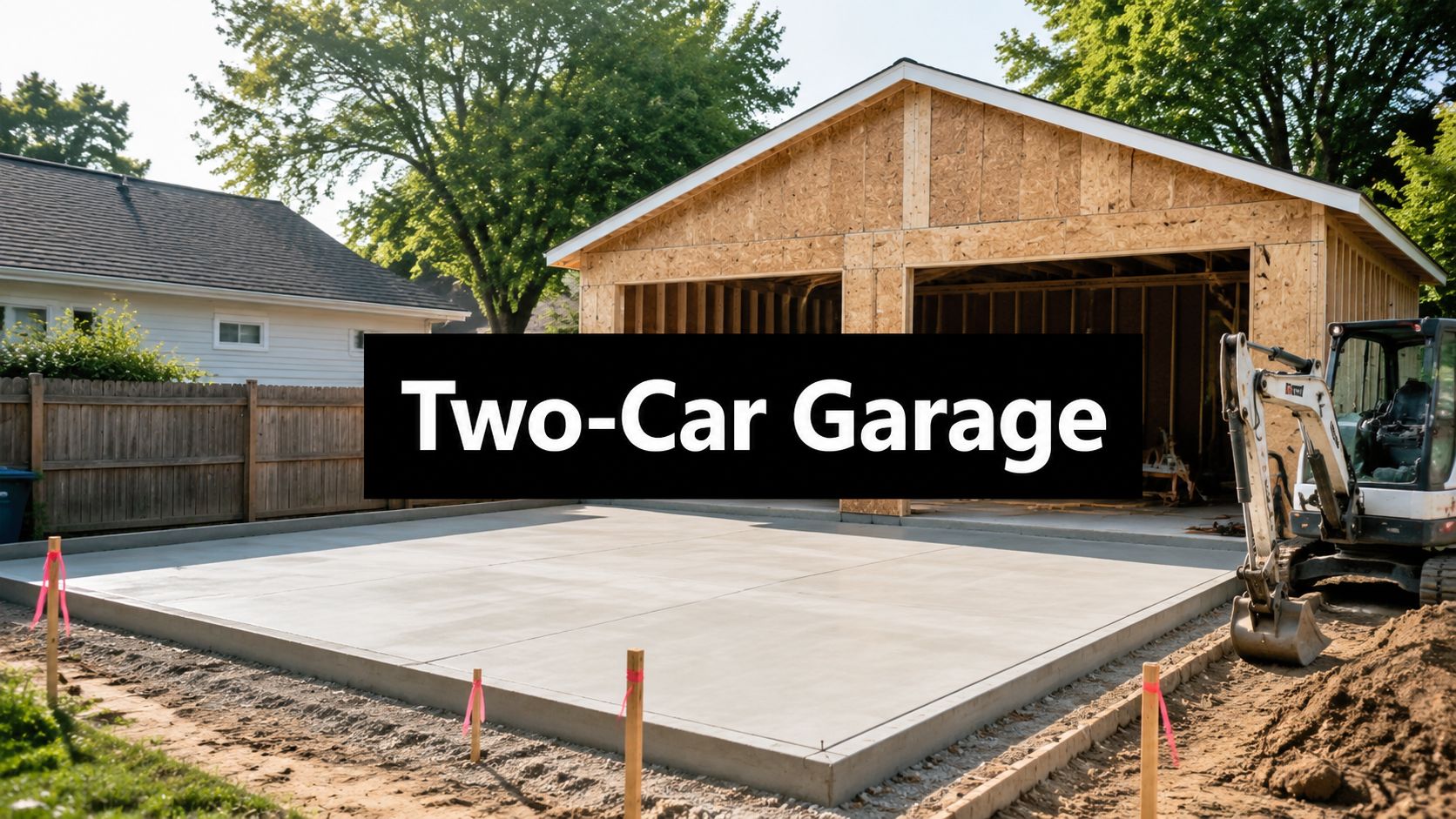
Your driveway is full, the lawn equipment has migrated into the basement, and every time it rains you wish at least one vehicle had a proper place to go. That's usually when people start searching for a two car garage for sale. They think they're shopping for a building, but the true decision starts before the garage ever arrives.
A two-car garage can be a smart property upgrade, not just a convenience purchase. Buyers paid a 31% premium for properties with a garage, equal to about $115,000 more than similar homes without one, and homes with garages sold about 15% faster, averaging 9 fewer days on market according to this garage premium report. Those numbers help explain why homeowners across Pennsylvania, Maryland, Delaware, and New Jersey keep coming back to the same question. Not whether they need more usable space, but how to build it correctly the first time.
The mistake I see most often is simple. A homeowner picks a garage style, agrees on the structure price, and only later learns the site isn't ready for it. That's where garage projects get expensive. Sloped yards, soft soil, drainage issues, and undersized pads turn a straightforward install into a correction job.
If you're still early in the process, it helps to sort zoning, access, and layout questions before you commit. For that planning stage, code research for architectural projects is a useful resource because it helps frame the feasibility side that many garage listings skip over.
Your Guide to Adding a Two-Car Garage in [City, State]
A homeowner in the Mid-Atlantic usually starts with a practical problem, not a design dream. One car sits outside year-round. Bikes and tools fill the corners of the existing shed. Holiday storage ends up in the attic. A two-car garage fixes several issues at once, but only if the project is planned around the site, not just the structure.
What a garage solves for daily life
A good two-car garage gives you protected parking, better storage, and breathing room inside the house. It can also make day-to-day use of the property cleaner and safer. You're not carrying groceries through rain, squeezing around snow-covered vehicles, or stacking fuel cans next to boxes in the basement.
In this region, the garage also needs to work with local ground conditions. Clay-heavy soils, seasonal freeze-thaw movement, and drainage patterns all affect how the foundation should be built. Those aren't details to figure out after delivery day.
A garage is only as good as the base under it. If the slab or pad is wrong, the rest of the project never performs the way it should.
Why the project should be treated as an investment
A lot of homeowners hesitate because they compare the garage price to other home upgrades. That's understandable. But a garage isn't just cosmetic square footage. It adds function that buyers immediately understand.
The strongest value case is usually in homes where parking and storage are already tight. In neighborhoods where people expect covered parking, a two-car setup feels like the right fit for the property instead of an extra feature.
What usually goes wrong first
The common failure points aren't glamorous. They're excavation depth, drainage slope, poor compaction, and foundations that don't match the building footprint. Retailers often sell the shell. Homeowners still need the garage footings and foundations, excavation, grading, and access plan that make installation possible.
That's why local searches like garage foundation contractors near me, concrete foundations, and cement foundations for garage matter so much. The foundation work decides whether the doors stay aligned, whether water runs away from the building, and whether the floor stays serviceable over time.
Selecting the Right Garage Size and Design
Choosing the garage itself is often the initial focus, and that makes sense. Size, door layout, roof shape, and wall height all affect how the building will feel once it's in use. The important part is being honest about what has to fit inside it.
Start with the vehicles, not the brochure
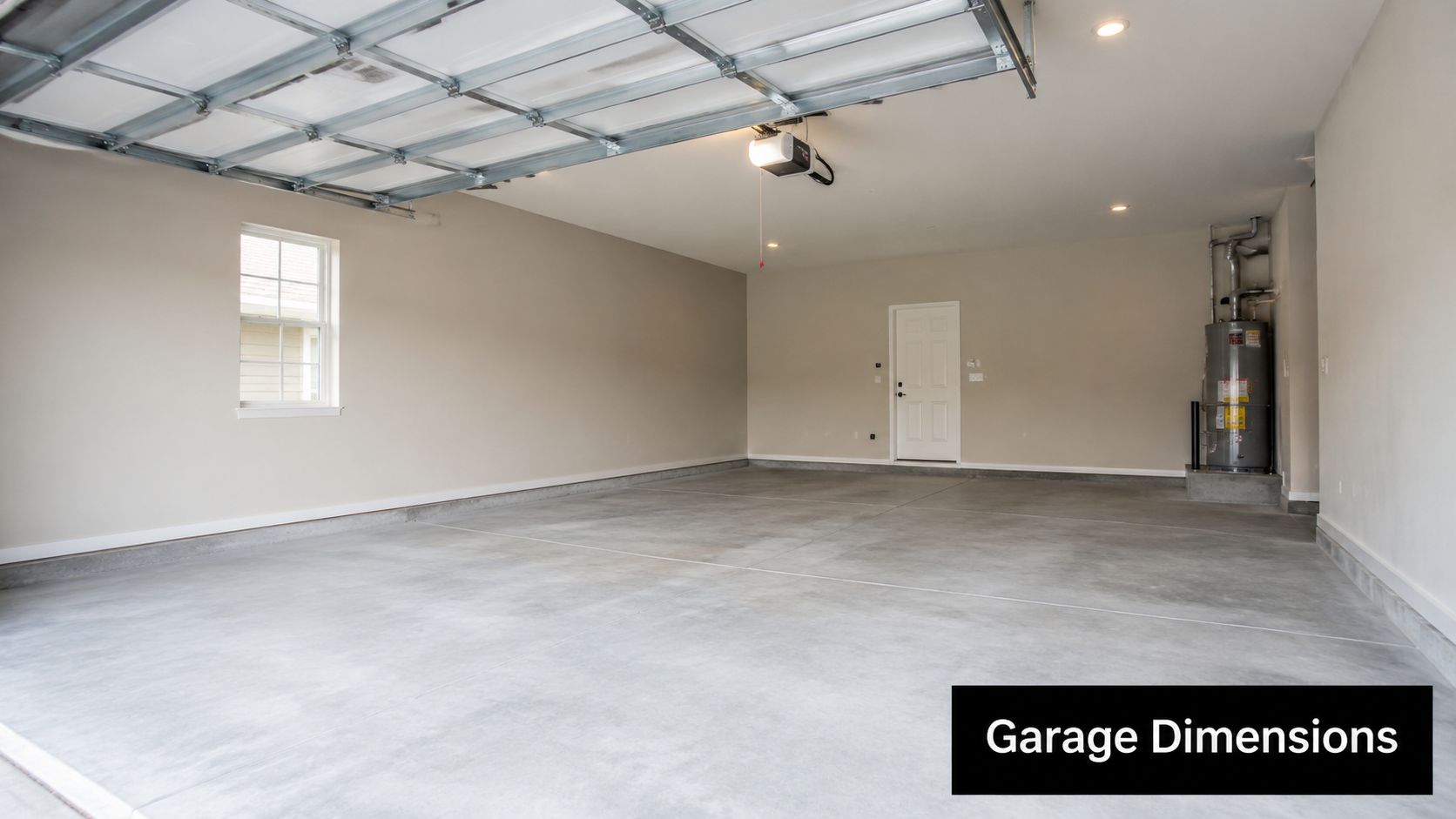
Many homeowners assume a basic two-car garage will fit any two vehicles. Sometimes it does. Sometimes it turns into a daily parking puzzle. The verified buying guidance is straightforward. Garage width commonly falls in the 20 to 24 foot range, depth commonly falls in the 20 to 24 foot range, and planning should account for vehicle dimensions plus working room around them. The same guidance notes that 20×20 units have only a 65% success rate for two sedans due to tight maneuvering, while 24×24 with 6-inch reinforced concrete yields a 94% long-term satisfaction rate across major markets in PA, MD, DE, and NJ.
If you want room for modern SUVs, bikes, a mower, shelving, or a workbench, tighter layouts usually disappoint. That's why a lot of homeowners end up comparing common options using a practical sizing reference like this guide to two-car garage dimensions.
Why the two-car standard still matters
Even with larger garages becoming more common, the two-car layout remains the benchmark most buyers recognize. While 24% of new home buyers prefer a three-car garage, 51% explicitly want a two-car garage, and two-car garages appear in 72 to 81% of new homes in the 1,600 to 2,399 square foot range, based on industry reporting that cites Census Bureau and NAHB data.
That matters because resale isn't just about square footage. It's about whether the garage feels normal and useful for the house. A two-car layout usually does.
Design choices that affect function
Door width and wall height deserve more attention than they get. The verified guidance warns that buyers who choose 8-foot ceilings for lifted trucks often run into fit problems, and 24×30 garages with 12-foot heights and 3/12 roof pitches have a 95% success rate for storing SUVs and lawnmowers. That's not just a convenience issue. It affects whether the building can serve future needs.
Consider these early:
- Door clearance: Roof racks, taller SUVs, and utility trailers need more than a basic opening in some cases.
- Roof pitch: A 3/12 roof pitch is a common benchmark in the verified guidance and often aligns well with standard garage use.
- Future electrical use: If you expect to add an electric vehicle later, planning conduit and panel capacity now is easier than opening finished work later. If that's on your radar, it helps to review what a proper home EV charger installation involves before finalizing the garage layout.
Don't size a garage for the cars you had five years ago. Size it for the vehicles, storage, and access you'll actually need.
Concrete Slab vs Gravel Pad Foundations
This is the choice that decides how the rest of the project behaves. Both foundation types can work. Neither is automatically right for every site. The right answer depends on the garage style, the load, the drainage conditions, and how permanent you want the installation to be.
Where concrete makes sense
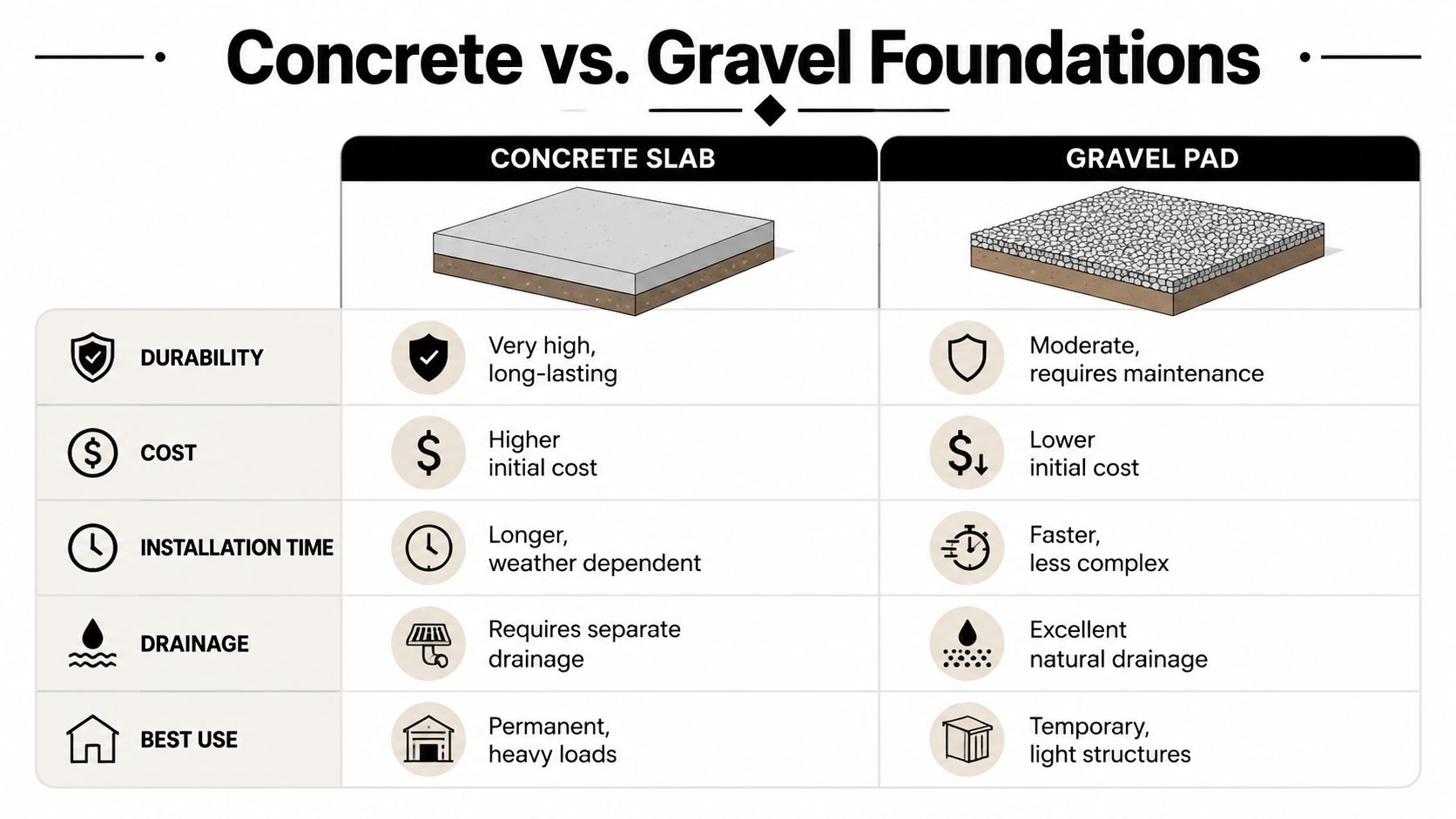
A reinforced slab is usually the better fit when you want a permanent garage floor, heavier use, easier cleaning, and better support for cars, equipment, and storage systems. It's the typical choice for site-built garages and for homeowners who want a finished feel from day one.
Cost is the clearest trade-off. Concrete foundations for two-car garages typically average between $5 and $10 per square foot, while gravel shed foundations average about $1.50 to $3 per square foot, according to FBi Buildings' garage cost guidance. In some local markets, that gap gets wider once excavation, reinforcement, and drainage work are included.
Where gravel earns its place
A professionally installed gravel pad works well for many prefab and modular garages, especially when the manufacturer approves that base. Gravel usually installs faster, costs less up front, and handles drainage naturally when it's built correctly with proper grading and compaction.
But “gravel” doesn't mean dumping stone on the ground. The pad has to be excavated, leveled, compacted, and built to the structure's exact dimensions. If the base is soft or the edge support is weak, the building shifts and doors stop behaving the way they should.
Side-by-side comparison
| Feature | Concrete Slab Foundation | Gravel Pad Foundation |
|---|---|---|
| Best fit | Permanent garages, heavier vehicle loads, finished floor use | Many prefab garages, cost-conscious installs, drainage-priority sites |
| Up-front cost | Higher | Lower |
| Drainage behavior | Needs proper grading and runoff planning | Naturally drains well when installed correctly |
| Installation | More weather-sensitive and labor-intensive | Faster in many cases |
| Long-term feel | Solid floor surface for parking and storage | Strong structural base, but not a finished interior floor |
The detail that gets missed
Anchoring and edge detailing matter with either system. If the garage includes posts, brackets, or hold-down hardware, connection points need to match the base material and loading requirements. For homeowners who want to understand the hardware side better, this overview of hardware for anchoring posts securely is a practical companion to the foundation discussion.
Practical rule: Choose concrete when you want the foundation to be the finished floor. Choose gravel when the garage design allows it and drainage, budget, or delivery method make it the smarter base.
A lot of searches for gravel shed foundation contractors near me, shed foundations near me, shed foundation gravel base, and base for storage shed come from homeowners who really need a garage answer, not a shed answer. The principles overlap, but garage loads and access patterns are usually less forgiving.
Estimating Realistic Costs and Timelines
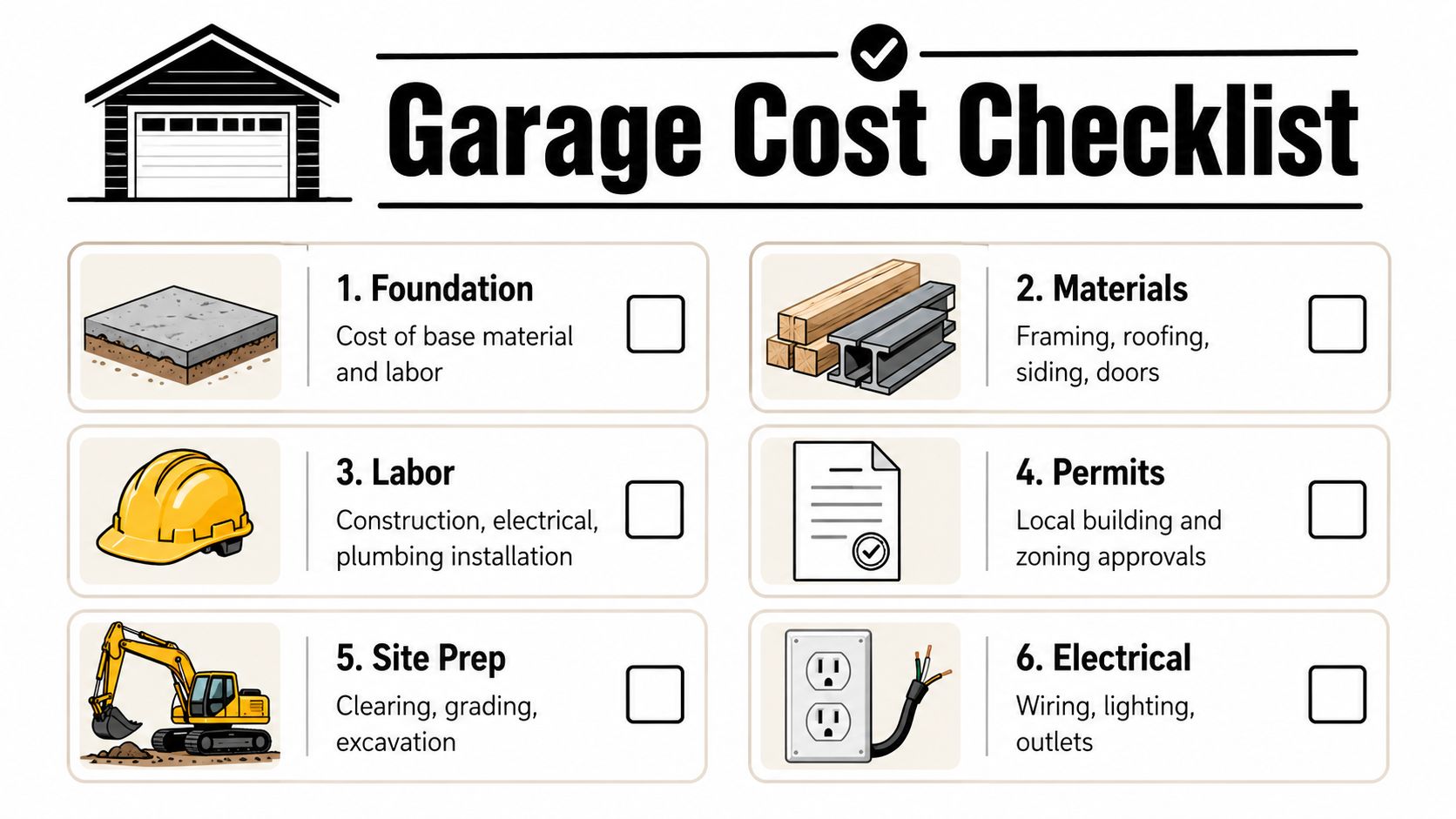
Sticker shock usually starts when a homeowner compares the structure price to the full installed price. A garage listing may look manageable at first glance, then the full scope appears. Excavation, grading, stone, forms, reinforcement, concrete, permits, and electrical planning all have to be accounted for.
The foundation cost that often gets left out
In the Mid-Atlantic region, a reinforced concrete garage slab can range from $12 to $25 per square foot, adding $6,000 to $12,500 to the total project, and that's often omitted from early garage quotes. For homeowners comparing options, this breakdown of concrete slab pricing for a garage helps put the slab into the full project picture.
That's why local buyers searching concrete contractors, garage footings and foundations, or cement foundations for garage often feel like every quote is telling a different story. Some prices include excavation and grading. Some don't. Some include reinforcement. Some assume a simple site that almost never exists in real life.
What your budget should include
A realistic garage budget usually has these pieces:
- Site prep and excavation: Clearing the footprint, cutting high areas, and handling spoils if the site isn't level.
- Foundation work: Gravel pad or concrete slab, plus compaction, forms, and drainage planning.
- Garage structure: The building package itself.
- Permit-related costs: Local zoning or building approvals vary by township and county.
- Electrical planning: Lighting, outlets, opener circuits, and possible future charging equipment.
- Access issues: Tight backyards, soft lawns, and steep approaches can change labor and equipment needs.
This video is a helpful visual overview of the budgeting side of garage construction.
What a normal timeline looks like
Garage projects rarely move in one uninterrupted straight line. Weather, permit timing, and supplier lead times affect the sequence. The foundation portion itself may move quickly once the site is ready, but planning and coordination usually take longer than homeowners expect.
A normal process often looks like this:
Site review and quote
The contractor checks access, slope, drainage, and footprint.Layout and permitting
Setback questions, township requirements, and structure dimensions get confirmed.Excavation and base prep
The site is stripped, graded, and prepared for gravel or concrete work.Foundation installation
Concrete requires forming, reinforcement, pour, and finishing. Gravel requires layered placement and compaction.Garage delivery or build
The structure goes on a prepared base instead of a guessed one.
The fastest garage project is the one that doesn't need to be corrected after delivery.
Finding Your Garage Foundation Contractor Near Me
When homeowners search garage foundation contractors near me or shed foundations contractors near me, they're usually trying to avoid one thing. Hiring someone who can pour concrete, but can't solve site conditions. Garage foundations fail from bad preparation more often than from the concrete itself.
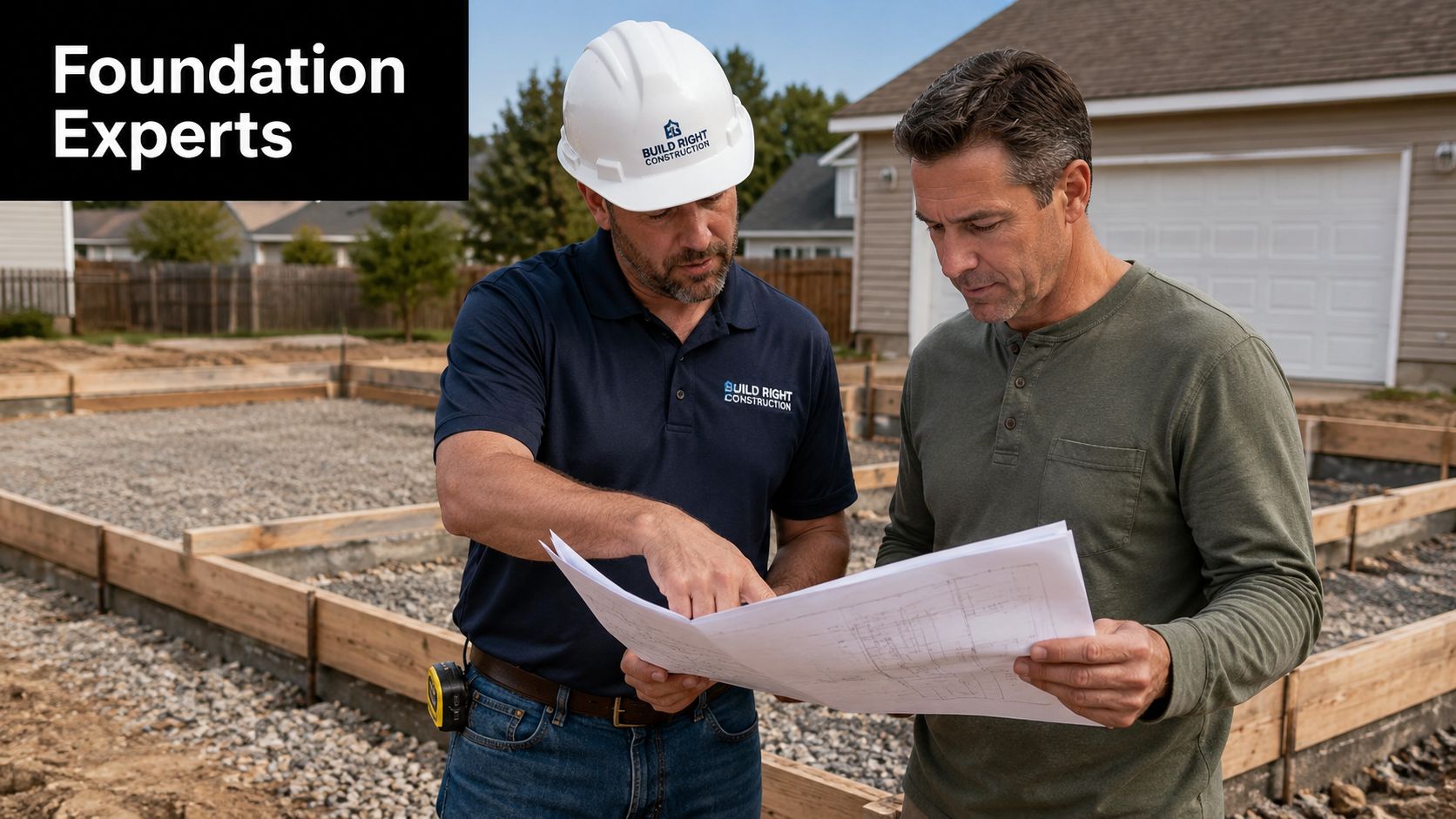
What a qualified contractor should handle
A real foundation contractor should do more than measure and pour. They should understand subgrade prep, drainage path, compaction, formwork, access planning, and how the base needs to match the structure being installed.
That's especially important with modular and prefab garages. Trusted shed builders including Stoltzfus Structures and Sheds Unlimited recommend durable gravel pads and long-lasting concrete foundations, often requiring foundations that exactly match double-wide 24-foot modular garage configurations to support the structural load. If the foundation is off, even by enough to affect bearing or alignment, the installation crew inherits a problem they didn't create.
Questions worth asking before you hire
Ask direct questions. A good contractor won't dodge them.
How do you handle drainage on sloped sites
Water has to move away from the garage, not toward it.Will the base match the building footprint exactly
For some floorless structures, the pad must be equal to or just slightly smaller than the building footprint so water doesn't sit under the edges. That sizing detail is highlighted in this guidance on garage foundation footprint and drainage fit.Do you handle excavation as well as foundation work
If the answer is no, you may end up coordinating two trades that blame each other later.Have you built pads for garages, gazebos, sheds, and similar structures in this region
Soil and drainage habits in PA, MD, DE, and NJ aren't all the same. Local experience matters.
What usually separates a durable job from a short-lived one
The biggest difference is attention to the boring parts. Subgrade compaction. Edge support. Slope. Clean stone. Proper forms. Reinforcement where needed. Those details don't sell the garage in a brochure, but they decide whether the slab cracks badly, whether the building racks, and whether the apron area stays usable.
Homeowners also benefit from contractors who work across related scopes, not just one niche. The same company that handles excavation near me, driveway contractors near me, concrete forms, gazebo foundation, and house foundation work often sees the whole site more clearly than a crew focused only on the pour.
A straight-looking slab on day one doesn't prove much. The real test is whether the garage still operates cleanly after seasons of rain, heat, and freeze-thaw cycles.
Common Mistakes and Maintenance Tips for Your New Garage
Most expensive garage problems can be traced back to early shortcuts. Not dramatic mistakes. Just small decisions that seemed harmless at the time.
Mistakes that cost homeowners later
These are the ones I'd avoid every time:
Buying the structure before checking the site
That's how homeowners end up with access problems, drainage problems, or a building that doesn't fit setbacks.Choosing a foundation by price alone
Gravel and concrete both have their place. The wrong one for the site or structure creates avoidable trouble.Ignoring actual use
A garage for two sedans is different from a garage for SUVs, a mower, shelving, and a workbench.Skipping local permit questions
Setbacks, easements, and township requirements can delay a project fast.
The foundation is not the place to cut corners. Homeowners can upgrade shelving, lighting, and doors later. Rebuilding a failed base is the expensive part.
Simple maintenance that protects the investment
Once the garage is built, basic upkeep goes a long way.
- Keep water moving away: Watch the grade around the slab or pad, especially after heavy rain.
- Check door behavior: If doors start binding or rubbing, don't ignore it. Movement often shows up there first.
- Maintain edge areas: Don't let soil or mulch build up against siding or slab edges.
- Inspect cracks and settlement early: Small changes are easier to assess before they turn into larger structural issues.
- Keep the interior dry: Good seals, ventilation, and drainage help preserve both the garage and what you store inside.
A successful two-car garage project isn't just about finding a two car garage for sale. It's about matching the right building to the right base, on the right site, with realistic expectations from the start. Homeowners in Pennsylvania, Maryland, Delaware, and New Jersey usually don't need more sales talk. They need clear answers, sound prep, and work that holds up.
If you're planning a garage, shed, gazebo, or other concrete foundation project in Pennsylvania, Maryland, Delaware, or New Jersey, Firm Foundations can help you start with the part that matters most. Their team handles excavation, gravel pads, and concrete foundations with transparent quotes and practical guidance, so you know what the full project really involves before work begins.