
Your Guide to Concrete Slab for Garage Costs in PA, MD, DE, & NJ
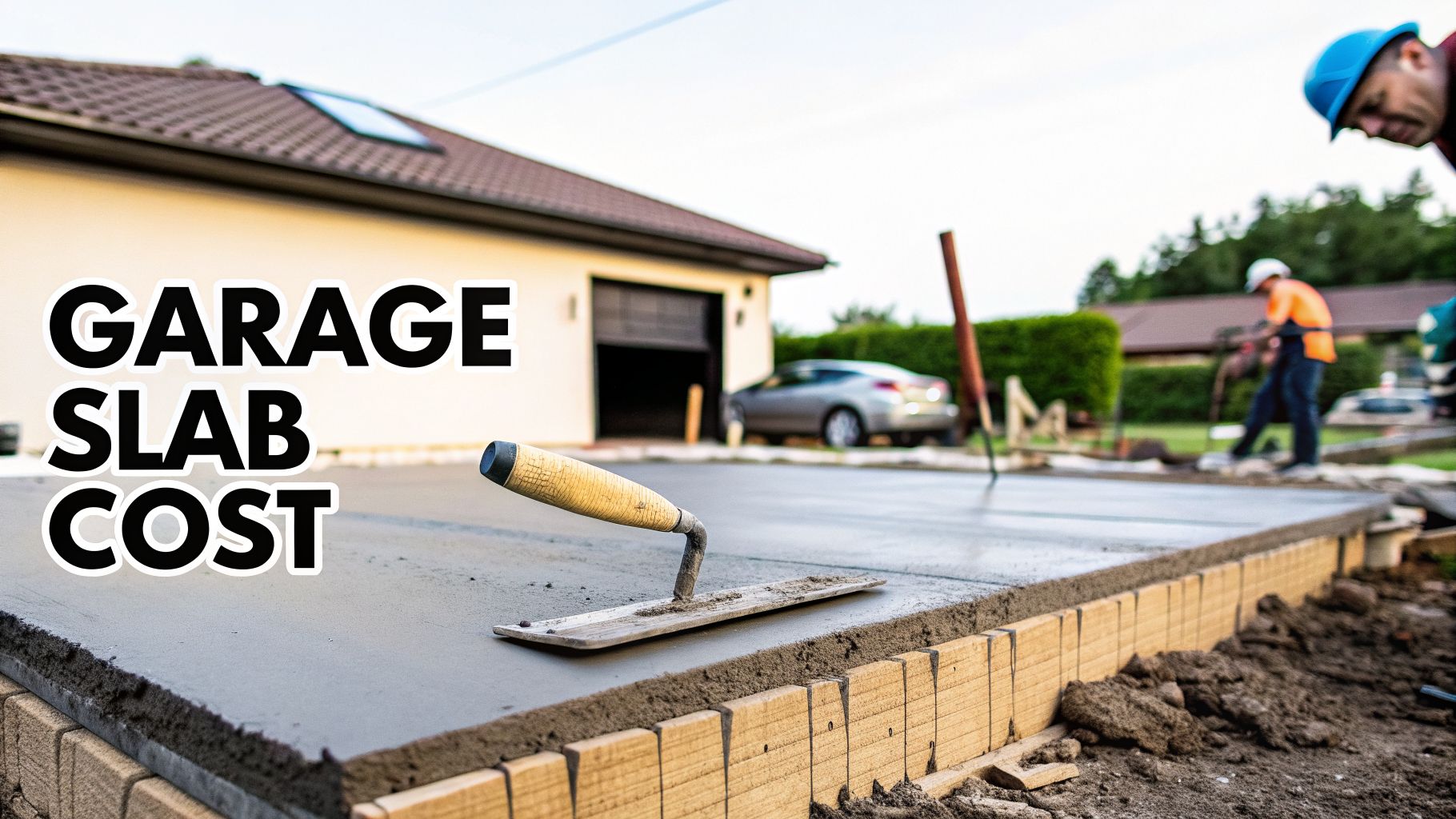
When you're planning a new garage, the foundation is the first major step, and understanding the cost is crucial. For a concrete slab for a garage, you can generally expect the price to fall between $6 to $12 per square foot. For a typical two-car garage in our local service areas, this puts the total between $2,400 and $6,900, depending on your property's specific needs and the final size.
Your Local Guide to Garage Concrete Slab Costs in PA, MD, DE, and NJ
One of the first questions we hear from homeowners in our community is, "What's the real cost going to be?" At Firm Foundations, we believe in providing clear, direct answers to help you budget for a high-quality garage foundation that will stand the test of time. As your trusted local garage foundation contractors near me, we want you to feel confident in your investment.
Since 2011, we've proudly served communities across Pennsylvania, Maryland, Delaware, and New Jersey. Our experience gives us a deep understanding of the local factors that influence a project's final price tag. Our goal is to give you a realistic financial picture from day one, so you know exactly what to expect when working with a trusted construction company right here in your area.
Understanding Regional Price Variations
While national averages are a decent starting point, local conditions really determine the final concrete slab for garage cost. In our service areas, from Honey Brook Township, PA, to neighboring states, a few key factors can shift the price.
- Soil Conditions: The type of ground on your property is critical. If we encounter rocky or unstable soil, it often requires more involved excavation near me, which adds to labor and equipment time. We assess this upfront to provide an accurate quote.
- Site Accessibility: A property that’s tough to access with our standard equipment can present a challenge. In these cases, we may need to use a concrete pump to get the material where it needs to go, which can add $800 to $1,800 to the project budget.
- Seasonal Factors: Pouring concrete during the cold winter months requires extra care to ensure the slab cures correctly. This involves using insulated blankets and special concrete admixtures, which are necessary for structural integrity but do increase the cost.
Based on projections, a standard 4-inch residential concrete slab for a garage floor is priced nationally from $6 to $12 per square foot. For homeowners here in PA, MD, DE, and NJ, costs can be 10-20% higher due to the local variables we just covered. You can explore more about these nationwide trends at costflowai.com to see how our region compares.
Our Approach: At Firm Foundations, we believe a strong project starts with transparent pricing. We are committed to delivering exceptional craftsmanship that provides a durable, reliable base for your new garage, ensuring you get the best value for your home.
To give you a better sense of what to expect, we’ve put together a table with some at-a-glance estimates for common garage slab sizes. This is a great starting point for your budget planning, whether you're building a simple one-car garage or a larger workshop.
Estimated Garage Concrete Slab Costs (PA, MD, DE, NJ)
This table provides at-a-glance cost estimates for common garage slab sizes, including total price ranges for a standard 4-inch reinforced slab.
| Garage Size (Feet) | Square Footage | Estimated Total Cost Range |
|---|---|---|
| 12' x 20' (1-Car) | 240 sq. ft. | $1,680 – $3,120 |
| 20' x 20' (2-Car) | 400 sq. ft. | $2,800 – $5,200 |
| 24' x 24' (2.5-Car) | 576 sq. ft. | $4,032 – $7,488 |
| 24' x 36' (3-Car) | 864 sq. ft. | $6,048 – $11,232 |
| 30' x 40' (Large Garage/Workshop) | 1200 sq. ft. | $8,400 – $15,600 |
Keep in mind that these are estimates. The final price will depend on the unique factors of your property, which we’ll assess during our on-site visit to provide a precise, no-obligation quote.
What's Actually In Your Garage Foundation Quote?
Getting a quote for a big project can feel overwhelming. We believe in total transparency, so we want to walk you through exactly what goes into the concrete slab for garage cost so you can see the value behind every line item. Think of it as a blueprint for your estimate.
When you understand your quote, you remove all the guesswork. There are no surprise charges or hidden fees waiting for you down the line. You’ll know precisely what you’re paying for, from the first scoop of dirt removed to the final, smooth surface of your new garage floor. This clarity is a fundamental part of how we build trust with homeowners across Pennsylvania, Maryland, Delaware, and New Jersey.
This chart gives you a bird's-eye view of how a garage slab quote is built, showing the standard components and the factors that can add to the cost.

As you can see, a standard slab has a pretty straightforward cost breakdown. But things like extensive site prep or needing special equipment can adjust the final price. Let's dig into what these items really mean for your project.
Site Preparation and Excavation
Long before the first drop of concrete is poured, the real work begins with preparing the ground. Honestly, this is the single most important part of the job. Getting the site prep right is what prevents headaches like cracking and settling years from now.
Our quotes always include:
- Grading the Site: We start by clearing and leveling the ground where the garage will sit. This creates a flat, solid base and, just as importantly, ensures water drains away from your new foundation.
- Excavation: Our crew digs down to the specific depth required for your garage footings and foundations. This depth isn’t a guess—it’s determined by local building codes and the soil conditions on your property, and we follow it to the letter.
- Gravel Base: Next, we lay and compact a sub-base of gravel, usually several inches thick. This layer is crucial for drainage, preventing ground moisture from wicking up and damaging the slab from below.
High-Quality Materials
The strength of your garage foundation comes down to the quality of the materials we use. We don’t compromise here—it's just not worth it. Your quote will account for everything needed to build a tough cement foundation for your garage.
A foundation is only as strong as what it's made of. For a structure that needs to support thousands of pounds, using commercial-grade materials isn't a luxury—it's a necessity for safety and longevity.
These materials typically include:
- Concrete Forms: A solid wooden framework is built to hold the wet concrete. This is what guarantees your slab has perfectly straight edges and the exact dimensions from the plan.
- Steel Reinforcement (Rebar): While concrete is incredibly strong under compression (pushing down), it needs help with tension (pulling apart). We install a grid of steel rebar or wire mesh to give the slab the tensile strength to resist cracking from the weight of vehicles or temperature swings.
- Ready-Mix Concrete: We only use professionally mixed concrete, usually rated at 4,000 PSI for garage applications. This ensures a consistent, high-strength product that you just can't get from mixing bags by hand on-site.
Skilled Labor and Finishing
A big part of your quote is the cost of our experienced crew. Their skill is what turns a pile of lumber, steel, and gravel into a flawless foundation. From surveying the site to making the final pass with a trowel, our team handles every detail with professional care.
As your local garage foundation contractors, our labor costs cover the whole process:
- Forming and Rebar Installation: The careful, precise work of setting up the forms and tying the steel grid.
- Pouring and Spreading: Expertly managing the concrete pour to eliminate air pockets and ensure the slab is perfectly even.
- Finishing: This is the art of creating the final surface. A smooth trowel finish is standard and ideal for a garage floor, but we can also do a broom finish if you want extra traction.
By breaking down every step, we make sure you have a crystal-clear picture of your investment. This is how we build trust—and how we build foundations that stand strong for decades.
Key Factors That Influence Your Final Concrete Slab Cost

When you ask for a quote on a new garage foundation, the number you get back is about a lot more than just the square footage. Think of it less like buying a product off the shelf and more like a custom project; the final plan is designed specifically for your property’s unique landscape and your intended use. This is exactly why your concrete slab for garage cost might look different from your neighbor's, even for the same size garage.
At Firm Foundations, we believe in explaining the "why" behind the price. A professional quote from our team isn’t just a number—it’s a comprehensive plan based on several critical variables that ensure your foundation is built right and built to last. Let's break down what really shapes the final cost of your project.
Slab Thickness and Reinforcement
Right after the slab’s dimensions, the most significant factor driving the cost is its thickness. A standard garage slab is usually 4 inches thick. For most people parking sedans, SUVs, and light trucks, this is perfectly fine.
But what if you plan to store something heavier, like an RV, a large boat, or a commercial work van? In those cases, we will almost always recommend upgrading to a thicker, 6-inch slab.
That extra two inches is critical for spreading out the heavy load and preventing the concrete from cracking under pressure. For these heavy-duty jobs, we also beef up the internal reinforcement, typically using a tighter grid of steel rebar. A thicker pour with more steel is what gives a cement foundation for a garage the backbone it needs for serious use.
If you want to dig deeper into this, you can learn more in our detailed article about the right concrete thickness for your garage slab. Getting the thickness right from the start is one of the smartest investments you can make for your garage's longevity.
Why Thickness Matters: Bumping a slab from 4 inches to 6 inches can increase the cost by as much as 35%. But for garages that will bear heavy loads or face the harsh freeze-thaw cycles we see in Pennsylvania, it's non-negotiable.
Local Soil Conditions
The ground underneath your future garage has a huge say in the construction process and, by extension, the final cost. In a perfect world, the soil is stable, drains well, and is easy to dig. On many properties here in PA, MD, DE, and NJ, however, we often run into a few challenges.
Here are some of the most common soil-related issues that can influence your quote:
- Rocky Ground: If your property is hiding large rocks or shallow bedrock, our excavation work gets more involved. We may have to bring in heavier equipment to break up and haul away the rock, which adds to the labor and equipment costs.
- Clay or Poorly-Draining Soil: Heavy clay soil is notorious for holding water. This can cause the ground to swell and heave during freeze-thaw cycles, putting your slab at risk. To prevent this, we often have to dig deeper and bring in more engineered gravel to create a stable, well-draining base for your storage shed or garage.
- Steep Slopes: Building on a hill means we have to do significant grading work. This might even require a stepped foundation or retaining walls to create a perfectly level and secure pad. That extra earth-moving is a major factor in the final price.
As your local garage foundation contractors near me, we always start with a thorough site inspection. This lets us spot these potential issues upfront so your quote is as accurate and transparent as possible.
Site Accessibility and Logistics
Finally, how easily we can get our crew and equipment to your build site directly impacts the cost. If we can pull a large concrete truck right up to the prepared area, the process is smooth and efficient. Things get more complex when we’re dealing with tight access, fences, or established landscaping we need to protect.
If the concrete truck can’t get close enough to the forms, we'll need to use a concrete pump. This specialized machine can send concrete across long distances or into tricky spots, but it comes with a separate rental fee. Likewise, if limited access means all the gravel and concrete have to be moved with smaller machines or by wheelbarrow, the extra labor will be factored into the quote.
We make it a point to walk through all these logistics with you beforehand, so there are absolutely no surprises on installation day.
Why Your Garage Foundation Is Not the Place to Cut Corners
When planning a new garage, it's easy to focus on the final structure. However, it's a major mistake to view the foundation as just a preliminary step and approach the concrete slab for garage cost with a "lowest price wins" mindset. Your garage foundation is the bedrock of the entire build, and compromising on its quality is a surefire way to invite expensive problems down the road.
The principle is simple: a structure is only as sound as its foundation. This holds true for your garage, barn shed, or any other building. This concrete base must reliably support thousands of pounds—not just the weight of the structure, but also heavy vehicles and equipment. Cutting corners here is like building on unstable ground; it may seem fine at first, but structural issues are almost inevitable.
The High Cost of a Poorly Built Foundation
Opting for a contractor based only on the lowest bid, without a thorough review of their process, can lead to serious, long-term problems. We have seen this happen time and again across Pennsylvania and Maryland. An improperly installed cement foundation for a garage will eventually fail, requiring repairs that cost far more than doing it right the first time.
Common risks of a poor-quality foundation include:
- Cracking and Spalling: Inadequate reinforcement or poor base preparation will cause the concrete to crack under vehicle loads. Over time, these cracks worsen and lead to spalling, where the concrete surface chips and breaks apart.
- Sinking and Settling: If the ground isn't properly excavated and compacted, the slab can settle unevenly. This puts immense stress on the garage frame, causing doors to stick and walls to crack.
- Water Damage and Heaving: A slab poured without a proper gravel base for drainage is highly vulnerable to moisture. In the cold winters of PA, MD, DE, and NJ, this water can freeze, expand, and cause the slab to heave and buckle.
Considering measures for long-term durability is essential. Investing in proper drainage and other solutions like preventing foundation flooding may increase the initial project cost but provides significant savings by avoiding future repairs.
At Firm Foundations, we see your garage foundation as an investment in your property's safety and longevity. Our careful, proven process is designed to protect that investment, ensuring your slab performs perfectly for decades.
Our Commitment to Quality and Longevity
We have built our reputation since 2011 by never compromising on the fundamentals of a great foundation. As the trusted garage foundation contractors near me for so many homeowners, our focus is on delivering long-term value, not short-term savings. We always use the correct materials, thickness, and reinforcement for every project.
Our process ensures your concrete foundation is engineered to handle vehicle loads, seasonal climate changes, and daily use. From ensuring precise garage footings and foundations to using high-strength concrete, each step is part of our commitment to building a slab that lasts. This is why homeowners who want the job done right the first time choose Firm Foundations.
The Firm Foundations Process for a Flawless Garage Slab

Knowing the concrete slab for garage cost is important, but seeing how it all comes together is what provides real peace of mind. We want you to understand exactly what to expect when you partner with us. At Firm Foundations, we’ve developed a clear, step-by-step process that we’ve been refining since 2011.
This isn't just a checklist; it's our proven method for delivering a high-quality foundation every single time. From our first chat to the final walkthrough, you’ll be in the loop. Whether you're in Honey Brook Township, PA, or anywhere in the Maryland, Delaware, and New Jersey area, here’s how we turn a patch of dirt into a durable garage slab.
Your Initial Consultation and Site Assessment
A solid plan starts with a good conversation. The first step is always a detailed site visit where we listen to your goals for your new garage. It's about more than just taking measurements—we’re making sure our plan fits your vision perfectly.
During this assessment, our crew gets to work sizing up the job site:
- Evaluate the Terrain: We’ll walk your property, looking closely at slopes, drainage patterns, and any potential obstacles.
- Check Accessibility: We figure out the best and least disruptive way to get our equipment and materials to the build site.
- Discuss Your Needs: We’ll ask what you plan to park or store in the garage. This helps us recommend the right concrete foundation thickness and reinforcement for the job.
This on-site evaluation is what allows us to give you a truly accurate, local quote, with no hidden costs or surprises down the road.
Precise Forming and Reinforcement
Once the plan is set, our team gets hands-on with the prep work. This stage is all about precision, as we build the "mold" that will define the exact shape and size of your new slab.
First, we construct a sturdy frame using wooden concrete forms. For tasks like this, which demand power and precision for drilling into tough materials, professionals often use reliable corded hammer drills to secure forms and fixtures.
With the perimeter set, we lay down a grid of steel rebar or wire mesh. This steel skeleton is the key to your slab's long-term strength, giving it the muscle to support heavy vehicles and withstand the freeze-thaw cycles common in our region. As your local garage foundation contractors near me, this is a step we never compromise on.
A foundation’s strength comes from its internal structure. The steel reinforcement we install is the backbone of your slab, working silently to distribute weight and prevent structural failure for decades to come.
The Expert Concrete Pour and Finish
This is the day your garage foundation becomes a reality. A concrete truck from one of our trusted local suppliers arrives with a professionally mixed batch of high-strength concrete—usually a 4,000 PSI mix for garage slabs. Using ready-mix concrete is critical for ensuring consistent quality and durability.
Our crew then pours the concrete, carefully working it into every corner of the forms to eliminate any air pockets. We use a long, straight tool called a screed to level the surface, creating a perfectly flat plane. The final touch is the finishing process, where we use power and hand trowels to create a dense, smooth surface that's easy to clean and built to last. It’s this methodical approach that ensures your cement foundation for a garage is not only strong but looks professionally finished.
Get Your Free Garage Foundation Quote Today
When you're ready to move forward with your garage project, getting an accurate estimate for the concrete slab for garage cost is the most important first step. At Firm Foundations, we make the process straightforward and pressure-free. Our focus is on providing you with honest, expert advice to ensure your project is done right from the start.
As the trusted garage foundation contractors near me for homeowners throughout Pennsylvania, Maryland, Delaware, and New Jersey, our reputation is built on superior craftsmanship and transparent pricing. We have been constructing durable cement foundations for garages, shed foundations, and driveways since 2011. Our process is designed to give you complete confidence, from the initial consultation to the final inspection.
Our commitment is to provide a detailed, no-obligation quote that clearly explains every part of your project. We want you to feel as confident in our work as we are.
Our team of local experts is ready to answer your questions and help you plan your build with all the information you need. When you're ready for a foundation that's engineered to last, we invite you to request your free, no-obligation quote from our team.
Frequently Asked Questions About Garage Foundations
Proper planning for a new garage involves getting clear answers to your questions. At Firm Foundations, we address the most common inquiries from our clients across Pennsylvania, Maryland, Delaware, and New Jersey to ensure every project is built on a solid understanding of the process.
How Long Does It Take to Install a Concrete Garage Slab?
The on-site installation of a standard residential garage foundation is an efficient process. The work, from initial excavation to the final trowel finish, is typically completed within 2 to 4 days.
Beyond the physical installation, the concrete requires a specific curing period to achieve its full strength.
- Initial Cure: The slab can generally be walked on carefully after 24 to 48 hours.
- Partial Cure: Within 7 days, the concrete gains substantial strength, though it is not yet ready for heavy loads.
- Full Cure: The slab achieves its full structural strength after approximately 28 days, at which point it is safe for vehicles.
We provide a detailed project-specific timeline so you are fully informed of the construction and curing schedule.
Do I Need a Permit for a Garage Foundation in PA or MD?
In nearly all cases, the answer is yes. Municipalities throughout Pennsylvania, Maryland, Delaware, and New Jersey require building permits for new structures, which includes the concrete foundations that support them. This process ensures the project complies with all local safety, zoning, and building codes.
As experienced local garage foundation contractors near me, we have in-depth knowledge of the permitting requirements within the communities we serve. Our team can guide you through this process to ensure full compliance, preventing potential fines or legal issues.
A building permit is not just a piece of paper; it's a critical step that protects your investment and certifies that your garage is constructed according to professional safety standards.
What Is the Difference Between a Garage Slab and a Shed Foundation?
While both serve as a stable base, the main differences between a garage slab and a shed foundation are their thickness and reinforcement. A garage slab must be engineered to support the significant weight of vehicles, which requires a much more robust design.
- Garage Slab: These are typically 4 to 6 inches thick and include heavy reinforcement with a steel rebar grid or thick wire mesh to handle thousands of pounds of dynamic vehicle load.
- Shed Foundation: These are often built on a compacted shed foundation gravel base. While larger sheds may get a thinner, lightly reinforced slab, a simple gravel pad is often enough for smaller structures like a 10×10 storage shed.
Can You Pour a Concrete Slab in the Winter?
Yes, pouring a cement foundation for a garage during winter is possible, but it requires specialized procedures. Cold temperatures can prevent the concrete from curing correctly, which can compromise its final strength and durability.
To handle this, we use specific cold-weather concreting methods. These include using insulated blankets to cover the new slab and protect it from freezing, as well as adding special admixtures to the concrete mix to help it cure properly in low temperatures. These necessary steps may result in a minor adjustment to the final concrete slab for garage cost, which will be clearly detailed in your project quote.
Ready to build a foundation that lasts a lifetime? The experts at Firm Foundations are here to help. Contact us today to get your free, no-obligation quote and start your project with confidence. Get Your Free Quote Today!