
Your 2026 Guide to Two Car Garage Size in PA

Planning a new garage is a major decision for your Honey Brook home, and getting the size right is something you'll appreciate for decades. A garage that’s too small can lead to daily frustrations like dinged car doors and a constant lack of storage. While the absolute minimum two car garage size is 20×20 feet, our experience as local foundation contractors shows that a 24×24 foot layout is a much more practical and future-proof standard for today's vehicles and lifestyles.
As the go-to garage foundation contractors serving Pennsylvania, Maryland, and the surrounding communities, our team at Firm Foundations is dedicated to ensuring your project starts on solid ground—with a plan that truly fits your family's needs. Let us help you build with confidence.
Your Guide to Choosing the Right Two Car Garage Size
Finalizing your garage's dimensions is one of the most important steps in your construction project. This decision directly impacts your home’s long-term functionality and even its property value. It's best to view your garage as more than just a parking spot; think of it as a potential workshop, a storage hub, or a functional extension of your home.
Getting the size right from the beginning means you won't have to do the daily dance of squeezing past vehicles or constantly wishing you had a bit more room for the lawnmower. Having prepared countless sites and poured the cement foundations for garages of all sizes across Honey Brook, PA, and our neighboring communities, our team at Firm Foundations is here to help you plan with confidence.
Comparing Common Garage Dimensions
To get a clearer picture, it helps to compare the most common options homeowners choose. Each size offers a different balance of vehicle space, storage capacity, and workshop potential. From basic vehicle protection to a full-blown multi-use workspace, there's a dimension that fits the job.
The table below provides a quick comparison of the most common two-car garage sizes to help you visualize what might work best for you.
Quick Guide to Common Two Car Garage Dimensions
Compare minimum, average, and recommended garage sizes to see which best fits your vehicles, storage needs, and lifestyle.
| Garage Size (Width x Depth) | Total Square Feet | Best For | Pros | Cons |
|---|---|---|---|---|
| 20’x20’ | 400 sq. ft. | Two compact cars; minimal storage needs. | Most budget-friendly; smallest footprint. | Extremely tight fit; no room for storage or a workbench. |
| 22’x22’ | 484 sq. ft. | Two sedans or small SUVs. | More room to open doors; space for some wall shelving. | Still cramped for larger vehicles like trucks or full-size SUVs. |
| 24’x24’ | 576 sq. ft. | Two mid-size SUVs or one truck and one car. | Ample room to walk around; space for a workbench & storage. | Requires more yard space and a larger budget than smaller sizes. |
| 24’x30’ | 720 sq. ft. | Two large vehicles plus a dedicated workshop. | Maximum flexibility for storage, projects, and equipment. | Significant investment; requires a large, suitable plot of land. |
As you can see, what works for one homeowner might not work for another. The key is to match the dimensions to your specific vehicles and how you plan to use the space.
When considering these options, it’s crucial to think about your future needs. Do you plan on getting a larger vehicle in a few years? Do you hope to build out a workshop for your hobbies? Answering these questions now is the key to a successful project.
For a deeper dive into planning, check out our detailed guide on how to properly size your 2-car garage. From preparing the gravel pad to pouring the final concrete slab, our team ensures every detail of your foundation is ready for the build ahead.
How Garages Grew and Why Bigger Is Often Better
Have you ever tried squeezing a new truck or SUV into an older garage built in the 70s? It’s a tight fit, and it’s a problem we see all the time with homeowners in our community. It's not just your imagination; vehicles have gotten a lot bigger, and understanding this trend is critical when you’re planning a new garage.
In the early days of the automobile, a two-car garage was often a small 18×20 foot structure, just about 360 square feet. Today, that size is almost unheard of. While a 20×20 foot garage is technically the minimum for two cars, it's far from practical. The modern standard now leans toward 22×22 feet (484 sq ft), 24×24 feet (576 sq ft), or even a spacious 24×30 feet (720 sq ft) to accommodate not just the vehicles, but how we use the space around them. You can find more details on how garage dimensions have evolved to meet modern vehicle sizes if you're interested.
This evolution is a direct result of changes in both our vehicles and our lifestyles. The popularity of larger trucks and SUVs, especially in areas like Pennsylvania and Maryland, has turned larger garage dimensions from a luxury into a genuine necessity.
The Rise of the Multi-Functional Garage
A generation ago, a garage was just a box to keep the car out of the weather. Homeowners today have much higher expectations. A modern garage is now a hybrid space, a workhorse that needs to handle a lot more than just parking.
Think about all the roles you need your garage to fill:
- A Workshop: Providing enough room for woodworking, car maintenance, and other hands-on projects.
- Storage Central: Housing everything from lawn equipment and holiday boxes to bikes and sports gear.
- A Home Gym: Creating space for workout equipment without feeling cramped.
- Mudroom Extension: Serving as a drop-zone for muddy boots and outdoor gear to keep the house clean.
This need for versatility is what’s driving the demand for bigger footprints. Building a garage that is "just big enough" for your current cars is a recipe for frustration down the road.
A common mistake we see is homeowners building a garage based on their current car, only to upgrade to a larger truck or SUV a few years later. Planning for a 24×24 foot or larger garage from the start is future-proofing your investment.
Planning for Today's Larger Vehicles
Vehicle dimensions have increased dramatically. A Ford Model T was just over 11 feet long, but a new Ford F-150 can easily exceed 20 feet in length. This change alone has made thousands of older garages obsolete for many drivers in our community.
At Firm Foundations, we specialize in building garage footings and foundations that are sized for the future. We know that a two car garage size isn’t just about parking two cars—it’s about creating a functional, comfortable, and valuable extension of your home.
By looking at how garages have evolved, you can avoid the costly mistake of building a space that’s outdated the day it’s finished. Instead, you can invest in a foundation that supports your needs for years to come. Whether you're in Honey Brook, PA, or northern Maryland, we are the garage foundation contractors ready to lay the groundwork for your perfect space.
Calculating Your Ideal Garage Dimensions
Moving past the basic size categories is where your garage plan really starts coming to life. Figuring out the right dimensions isn't just about measuring your cars—it’s about designing a space that truly works for you and your family. This is the stage where we get down to the practical details that determine the final two car garage size.
As your local construction partner, Firm Foundations is here to help you get your project planned out, starting with a solid foundation built to last. We are the garage foundation contractors homeowners across Honey Brook, PA, and the surrounding areas rely on for dependable site prep and concrete work.
Start With Your Vehicles
First and foremost, a garage is for your vehicles, so that’s the best place to start. The type of cars, trucks, or SUVs you drive is the single biggest factor when deciding on the necessary width and depth.
- Sedans and Compact Cars: If you own a couple of smaller sedans, you can often get by with a narrower design, such as a 22-foot wide garage.
- SUVs and Trucks: For bigger vehicles like SUVs, minivans, or pickups, a width of at least 24 feet is essential. This gives you enough room to open your doors fully without worrying about dings and dents.
It’s smart to think about not just what you drive now, but what you might own in a few years. It's a common mistake to build a garage that feels perfect today but becomes cramped down the road.
Don't forget to look up! If you have a lifted truck or use a roof-mounted cargo box, your ceiling and garage door height need to accommodate it. An 8-foot door is pretty standard, but upgrading to a 9-foot or 10-foot door gives you a lot more flexibility.
This decision guide helps simplify the choice by connecting your vehicle type to our recommended garage sizes.
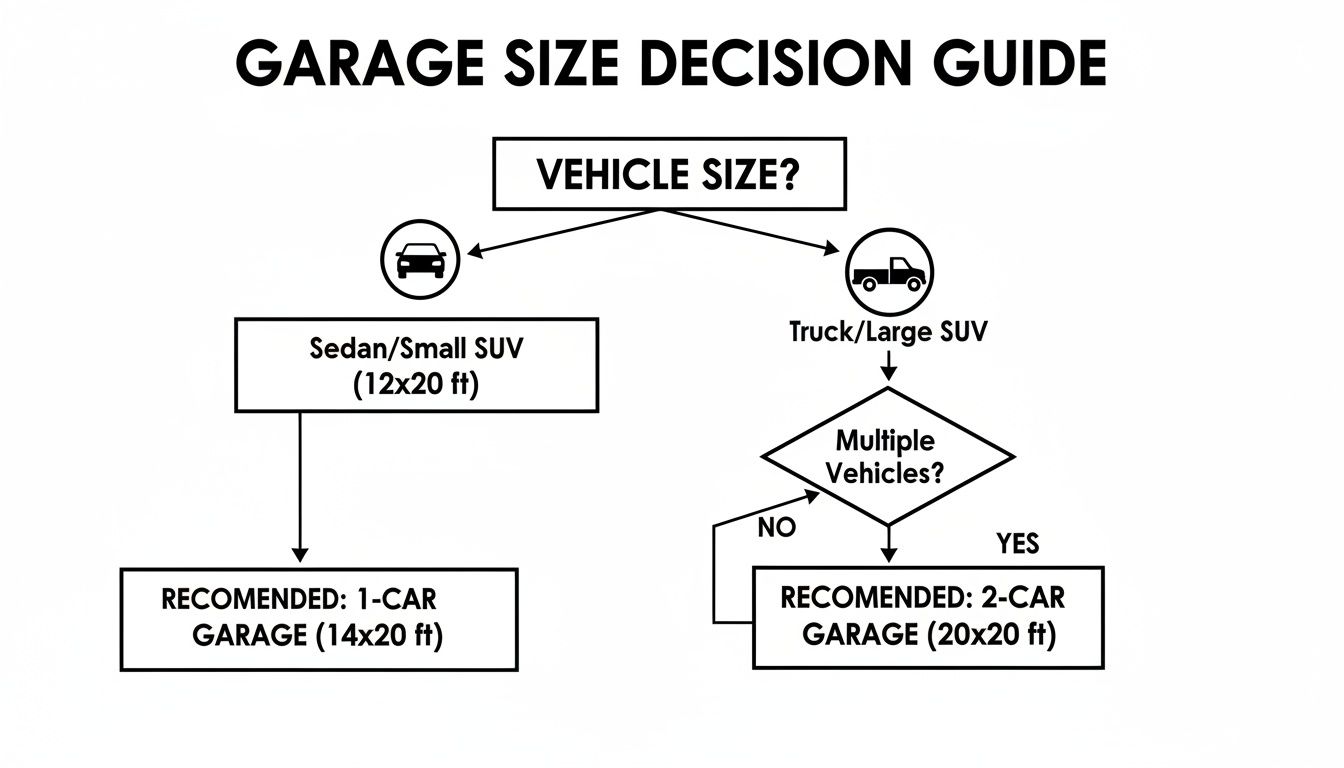
The flowchart makes it clear: while a compact garage might suit two sedans just fine, you really need a larger footprint to comfortably use it with trucks and SUVs.
One Double Door or Two Singles?
Another big decision is how you want your doors configured. This choice affects everything from daily convenience to the garage's structural design and even your heating bill.
One Double Door (Usually 16 feet wide):
- Pros: Gives you a lot more wiggle room for parking, making it easier to pull in at an angle or center one car. It's also typically the more budget-friendly option.
- Cons: A real headache if the opener breaks—both of your cars will be stuck. A single large door also lets a massive amount of cold air rush in during the winter.
Two Single Doors (Usually 8, 9, or 10 feet wide):
- Pros: They offer much better insulation and a built-in backup plan; if one opener fails, the other door still works. Plus, many people simply prefer the balanced, symmetrical look.
- Cons: That center post between the doors eats up valuable maneuvering space inside. This setup is also generally more expensive.
Plan for More Than Just Parking
Let's be honest, a garage is almost never just for parking cars. The best, most useful garages are designed from day one to handle storage and other activities. This "extra" space is what turns a simple carport into a hardworking extension of your home.
The move toward bigger garages is a well-known trend. In fact, in the U.S., over 60% of single-family homes built since 1980 have at least a two-car garage, and the average size has grown to 24×24 feet, or 576 square feet. That's a huge jump from the 20×20-foot standard of older homes. We see this firsthand in Pennsylvania and Maryland, where SUVs and trucks are king. You can discover more insights about these garage size trends and what they say about our modern needs.
To make sure your new garage is truly functional, just remember the 3-foot rule. You'll want to plan for at least 3 feet of clear walking space around your vehicles. This gives you enough room to open doors, unload groceries, and get to your storage shelves without having to squeeze by. If you’re planning a workshop or dedicated storage zone, try to carve out an area that's at least 5-8 feet deep at the front or side of the garage.
Why a Strong Foundation Is Your Garage's Best Asset
It’s easy to get caught up in picking the perfect two car garage size and layout, but the real long-term success of your project rests on something you'll rarely see: the foundation. Think of it as the unsung hero of the entire build. As one of the go-to garage foundation contractors in Pennsylvania and Maryland, we’ve seen firsthand that a top-notch foundation isn’t a luxury—it’s an absolute necessity.
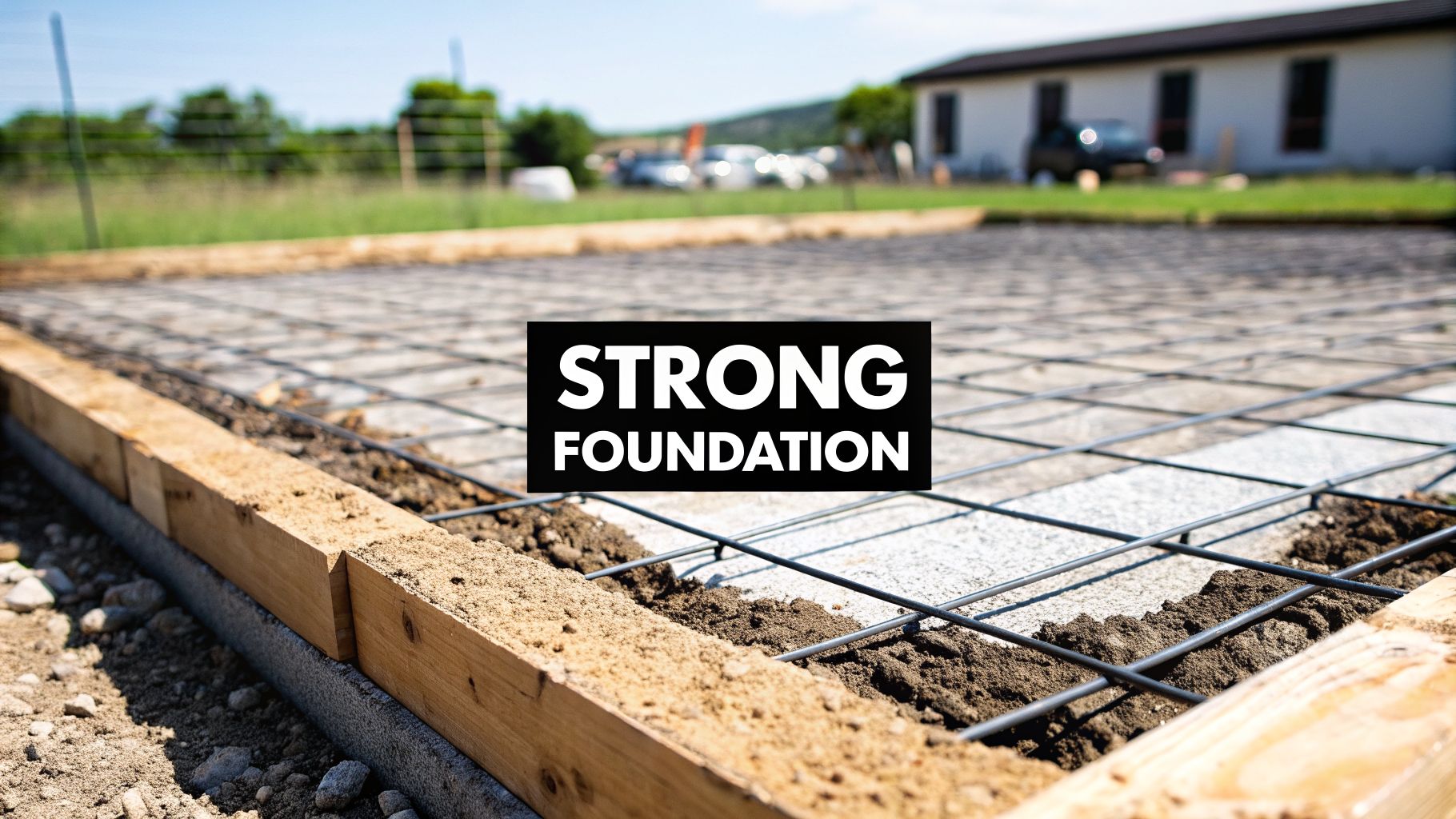
At its core, a garage slab has one critical job: to provide a stable, perfectly level surface that can handle thousands of pounds without cracking, sinking, or shifting over time. It’s the silent guardian that supports your vehicles, heavy tool chests, and whatever else you store, all while fighting the brutal freeze-thaw cycles we get every winter in our region.
The Anatomy of a Durable Concrete Foundation
Building a foundation that lasts isn't about just pouring a patch of concrete and calling it a day. It's a science. Every single component has a specific role in creating a slab that will stand strong for decades.
It all starts with proper site preparation. We begin by excavating the area and then laying a compacted base. This isn’t just any dirt; it's a precisely graded shed foundation gravel base that sets the stage for everything else.
A compacted gravel base acts like a shield for your concrete. It promotes excellent drainage, preventing water from pooling underneath and causing heaving during winter frosts. It also distributes the load evenly, which is the first line of defense against cracks.
This meticulously prepared base gives your cement foundations for the garage a uniform, stable platform to rest on, which is key to minimizing stress and maximizing its lifespan.
Concrete Thickness and Reinforcement
With the base set, the next step is the concrete itself. The right thickness and reinforcement are what give the slab its muscle. For most garages that will house standard cars and SUVs, a 4-inch thick slab of high-strength concrete does the job beautifully.
But that’s just the starting point. If you’ve got a heavy-duty work truck, an RV, or you're planning to install a vehicle lift, we always recommend bumping that up to 5 or 6 inches. That extra depth makes a huge difference in the slab's load-bearing capacity. You can dive deeper into this topic in our guide to the right concrete thickness for your garage slab.
Reinforcement is the slab's internal skeleton. We embed a grid of steel rebar inside the concrete forms before we pour. This rebar is what holds the slab together, helping it resist the pulling forces that cause cracks. It’s like the steel beams in a skyscraper—it provides essential, hidden strength. For any major build, a proper house foundation or garage slab requires expert engineering to ensure stability.
For our projects in PA, MD, DE, and NJ, we adhere to a strict set of specifications to guarantee a foundation that won't fail. Here’s a quick look at our standard components and why each one is so important.
Foundation Specifications for a Durable Garage Slab
| Component | Firm Foundations' Standard | Why It's Critical |
|---|---|---|
| Gravel Base | 4-6 inches of compacted ¾” clean stone | Creates a stable, frost-resistant base that drains water away from the slab, preventing heaving and cracking. |
| Concrete Thickness | 4 inches minimum (up to 6" for heavy loads) | Provides the necessary compressive strength to support vehicles and heavy equipment without failing. |
| Reinforcement | ½” (#4) rebar grid | Acts as an internal skeleton, resisting tensile forces and preventing cracks from spreading. |
| Concrete Strength | 4000 PSI mix | A durable, high-strength mix designed to withstand the region's weather and heavy, repeated use. |
| Anchoring | ½” anchor bolts embedded in the concrete | Securely fastens the garage walls to the foundation, creating a single, solid structure that resists shifting and uplift. |
Following these standards isn't just about meeting code; it's about building something that will perform flawlessly for the life of your garage.
Why Professional Installation Matters
Creating robust garage footings and foundations is a job that demands precision. One mistake during installation can lead to a domino effect of expensive problems, from major cracks to uneven sinking that can wreck the garage structure itself.
Here’s why trusting an experienced crew of concrete contractors makes all the difference:
- Proper Grading: We guarantee the site and the final slab are perfectly sloped to channel water far away from your garage.
- Correct Concrete Mix: We use the right concrete recipe specifically designed for the local weather conditions in PA, MD, DE, and NJ.
- Expert Finishing: The final troweling creates a smooth, dense surface that's easy to clean and built for years of hard use.
As a local company based in Honey Brook, PA, we’ve built our reputation on getting these details exactly right. Your garage is a big investment—it deserves a foundation that’s just as strong and dependable.
Real-World Garage Sizes for Your Lifestyle
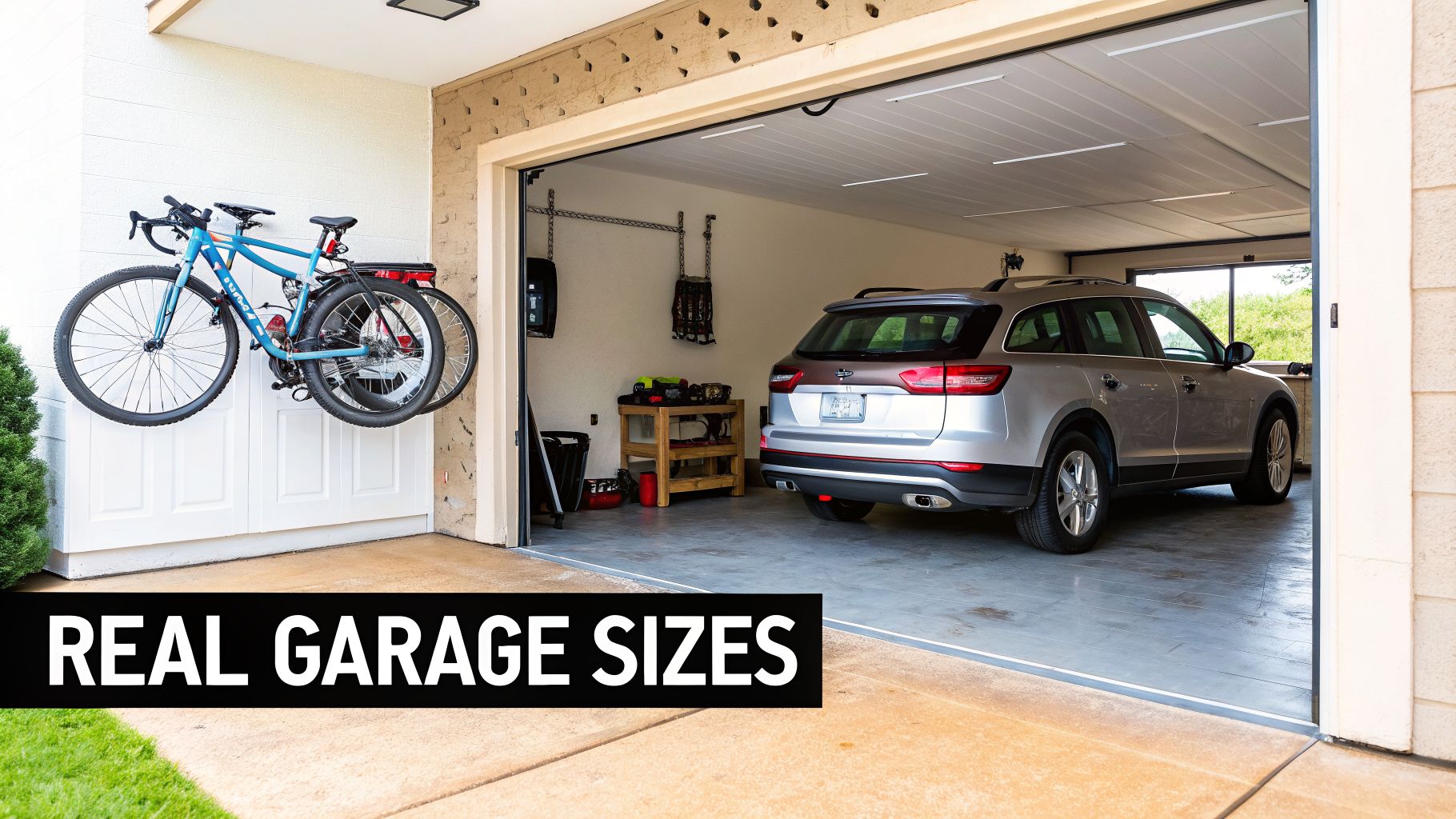
Theory is one thing, but seeing how a specific two car garage size actually functions in the real world is what truly matters. It's one thing to look at blueprints, but another to see how a layout works for a family's daily routine.
This is where our experience as the top shed foundations contractors near me comes in. By matching your needs to one of these common scenarios, you can land on the dimensions that will serve you best for years. We’ve poured the cement foundations for garages in all these configurations for your neighbors from Honey Brook, PA, to northern Maryland.
For the Daily Commuter: A 22×24 Garage
Many homeowners simply need a safe, convenient place to park their two mid-size sedans or small SUVs each night. The main goal is straightforward: protect the vehicles from the weather and have enough room to get in and out without squeezing past a door.
- Recommended Size: 22' W x 24' D
- Why It Works: A 22-foot width gives you just enough clearance to open car doors without worrying about dings. The 24-foot depth leaves a few feet of valuable space at the front for wall-mounted shelves or a small cabinet for car care supplies.
For this purpose, a massive garage is often overkill. A 22’x24’ space delivers the perfect balance of function and efficiency, fitting neatly on a typical suburban lot without eating up your entire backyard.
For the Active Family: A 24×28 Garage
Then you have the active family. They might have a large SUV and a second car, but their garage also doubles as a hub for bikes, kayaks, sports gear, and lawn equipment. For them, the garage is the staging area for every weekend adventure.
A 24'x28' garage offers the perfect blend of vehicle space and storage. That extra four feet of depth compared to a standard 24'x24' is a game-changer, creating a dedicated zone for gear without making the parking area feel cramped.
With this layout, you can easily establish an 8-foot-wide storage and activity zone at the back of the garage. This still leaves a comfortable 24'x20' area for parking, so you can navigate around both vehicles without any trouble. It’s an ideal solution for families whose garage needs to be as versatile as they are.
This shift toward larger garages reflects modern vehicle trends. In the 1960s, a 20×20 foot (400 sq. ft.) garage could handle about 80% of cars on the road. Today, 24×24 feet (576 sq. ft.) is the new standard, built to accommodate nearly 95% of modern vehicles, including wider EVs. With SUVs making up half of U.S. sales, that 24-foot depth is critical for fitting today's longer trucks and family vehicles.
For the Weekend Hobbyist: A 24×32 Garage
Finally, there’s the weekend hobbyist. For this owner, the garage is more than just parking—it’s a sanctuary. They need space for two vehicles plus a dedicated workshop for woodworking, car maintenance, or other hands-on projects. This requires a significant and well-planned footprint.
If your plans include turning part of your garage into a personal workshop or retreat, it’s helpful to understand the process of how to build a man cave.
For this use case, we recommend a generous 24' W x 32' D garage. This size allows you to park two vehicles without compromise and still have an entire 10-foot-deep workshop area at the back. It’s more than enough room for a heavy-duty workbench, tool chests, and larger equipment, transforming your garage into a truly multifunctional space.
As your local garage foundation contractors, we make sure the concrete slab is engineered to handle the extra weight and activity of a workshop.
Start Your Garage Project with Firm Foundations
You now have a clear understanding of how to select the right two car garage size and why a quality foundation is the most essential component of your entire project. The final step is partnering with a trusted expert to bring your vision to life. This is where Firm Foundations comes in.
We dispatch licensed, insured, and experienced crews to every job site. Our service area extends across communities in Pennsylvania, Maryland, Delaware, and New Jersey, and our reputation is built on reliability and superior craftsmanship.
Your Trusted Local Foundation Partner
Homeowners and professional builders in our community choose us for a simple reason: we deliver on our promises. We are the preferred foundation partner for premier builders like Stoltzfus Structures because they know our concrete foundations are engineered for durability. Our work provides the solid, dependable base their customers need to build a high-quality garage.
This trust is reaffirmed with each project, whether it's a base for a storage shed, a strong house foundation, or the garage footings and foundations for your new home in Honey Brook, PA.
Choosing a foundation contractor is as important as choosing the garage itself. Your entire investment rests on the quality of the groundwork. At Firm Foundations, we don’t cut corners—we build for longevity.
Our process is designed to be clear and stress-free. We believe starting a new project should be exciting, not overwhelming. We handle the technical details so you can focus on the rewarding final result.
Here’s How to Get Started with Us
Starting your garage project with our team is a simple and straightforward process. We've refined our approach to ensure you get exactly what you need, with no surprises.
- Request a Free Quote: The first step is to contact our friendly team. We’ll listen to your needs and discuss your project in detail, including your chosen garage size and any unique site requirements.
- Receive a Clear Plan: We will then provide you with a clear, comprehensive proposal. This document outlines the complete scope of work, from excavation near me to pouring the cement foundations for your garage.
- We Handle the Hard Work: Once you approve the plan, our expert crew gets to work. We manage the entire site preparation and foundation process, ensuring your foundation is perfectly level, correctly reinforced, and ready for your garage.
Let us handle the excavation and concrete work with the precision your project deserves. You can look forward to a new garage built on a foundation of strength and integrity. Contact Firm Foundations today for your free, no-obligation quote and start your project with confidence.
Your Garage Foundation Questions, Answered
Planning a new garage comes with a lot of questions, especially when it comes to the foundation. As local contractors, we hear many of the same questions from homeowners across PA, MD, and our service areas. Here are straightforward answers from our experienced team.
What Is the Smallest Two Car Garage You Recommend?
People often ask about the absolute minimum, which is technically a 20×20 foot garage. But in our experience, we almost never recommend going that small. You’ll find it’s a constant battle just to open your car doors without hitting a wall or your other vehicle.
For a space that’s actually comfortable for daily use, a 22×22 foot garage is a much better starting point. If you want what we consider the "gold standard" for today's larger vehicles, we recommend a 24×24 feet garage. That gives you great clearance and even leaves you with a bit of room for storage.
Do I Need a Permit for a Garage Foundation in PA or MD?
Yes, almost without exception. Building a new garage in Pennsylvania or Maryland will require a building permit from your local township. This isn't just red tape; it’s a process designed to ensure your new structure is safe and meets all current zoning and construction codes.
As part of our service, Firm Foundations provides the detailed foundation plans your builder needs to get that permit application approved. We handle the technical drawings for the garage footings and foundations so you can move forward with confidence.
Securing a permit before you start isn’t just a formality. It’s what protects your investment and prevents potential fines down the road. It ensures that every part of your project, especially the crucial concrete foundation for the garage, is built to last.
How Thick Should a Concrete Garage Floor Be?
For a standard residential garage that will house cars, SUVs, and light trucks, we pour a 4-inch thick slab using a 4000 PSI concrete mix. This specification is more than strong enough for everyday vehicle traffic and general storage needs.
However, if your plans include parking heavy-duty work trucks, an RV, or installing a car lift, you need to think bigger. We strongly recommend upgrading to a 5 or 6-inch thick slab for those jobs. This thicker cement foundation for your garage is also reinforced with a rebar grid to handle the much higher weight and prevent cracking over time.
Is a Gravel Base Really Necessary Under the Concrete?
Absolutely. A professionally installed, compacted gravel base isn't just a good idea—it's a non-negotiable part of a durable garage foundation or shed foundation. It’s every bit as critical as the concrete that goes on top of it.
This layer of engineered stone creates a stable, even platform for the concrete, which stops it from sinking or settling. More importantly, it provides proper drainage, moving water away from the slab. In a region with freeze-thaw cycles like ours in PA and MD, that drainage is your single best defense against the heaving and cracking that can destroy concrete.
Ready to lay the groundwork for your perfect garage? The experts at Firm Foundations are here to help. Request your free, no-obligation quote today!