
Garage Floor Paint: Is It Best for Your Home in 2026?


A lot of homeowners stand in the garage at the same moment in the project. The floor is dusty, stained, cracked, or freshly poured, and the question seems simple. Should you paint it?
In Pennsylvania, Maryland, Delaware, and New Jersey, that question comes up all the time because a garage floor takes abuse fast. Hot tires, lawn equipment, road salt, dropped tools, oil spots, and winter moisture don't care what the label on the can says. A floor can look decent on day one and start failing much sooner than expected if the slab underneath wasn't right to begin with.
That's the part most garage floor paint articles skip. They focus on the top layer. Concrete contractors see the whole assembly. The coating matters, but the condition of the concrete slab matters more. If the slab was poorly finished, holds moisture, has contamination in the surface, or already has hidden sealers on it, even a more expensive system can disappoint.
Is Garage Floor Paint the Right Choice for Your Home
A typical homeowner isn't shopping for garage floor paint because they love paint. They're trying to solve a problem. The garage looks worn out. Dust keeps tracking into the house. The floor stains easily. A new garage slab feels too plain to leave unfinished.
That's why paint stays popular. It's accessible, familiar, and it feels like a weekend fix. It also sits in a bigger market where homeowners are clearly paying attention to garage flooring upgrades. One market projection estimates the global garage flooring market at USD 25.54 billion by 2033, growing at a 5.5% CAGR, and says epoxy flooring is expected to account for 32.8% of revenue in 2026, which points to strong buyer interest in more durable systems than simple paint (Coherent Market Insights garage flooring market report).
What homeowners usually want
Customers calling about a garage floor are really asking for one of these outcomes:
- A cleaner-looking space that doesn't feel like unfinished construction
- Less dust and easier cleanup after weather, tools, and vehicle traffic
- A finish that won't peel quickly under normal garage use
- A smart budget decision that won't need to be redone too soon
Those are reasonable goals. The problem is that homeowners often compare products before they evaluate the concrete.
A garage floor finish only performs as well as the slab allows.
A floor with old oil spots, weak surface paste, or moisture issues won't suddenly become sound because a coating was rolled over it.
The better question to ask first
Before choosing paint, epoxy, or another system, ask this: Is my slab ready for any coating at all?
That's the question that saves money. It's also the same logic people use in other flooring projects. If you've looked at painted wood floors before, the Savera Wood Floor Refinishing guide is a useful reminder that appearance and durability are never just about color. Surface condition and prep drive the result.
For homeowners planning a new garage, new outbuilding, or concrete foundations in the Mid-Atlantic, that's where slab quality becomes the key decision. A strong finish starts with a properly built floor.
What Garage Floor Paint Really Is
The term garage floor paint gets used loosely. In stores and online listings, products with very different chemistry get grouped together as if they perform the same. They don't.
At the basic end, you have latex or acrylic paint. It adds color and gives the floor a more finished appearance, but it's still a thin paint film. Then you have resinous systems like epoxy. Those are coatings, not just decorative paint, and they behave differently once applied.
Paint versus coating
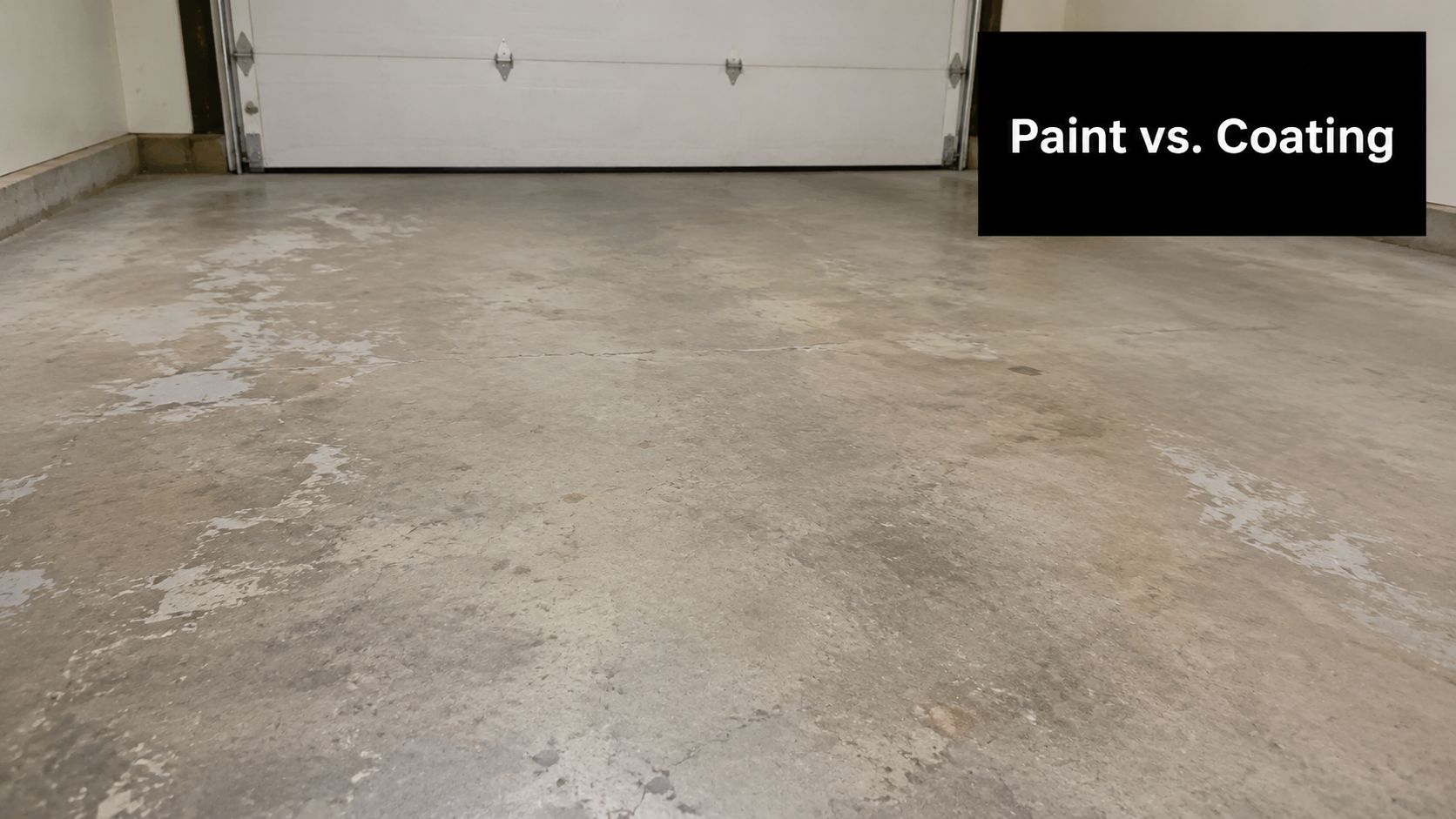
A simple way to think about it is this. Wall paint changes how a surface looks. A coating changes how a surface looks and how it wears.
A true coating builds more body on the slab. It's meant to bond, resist impact better, and hold up longer under traffic. Paint is easier to recognize because it feels familiar. Coatings require more attention to mixing, surface prep, application rate, and curing conditions.
Why thickness matters
Durability in resinous flooring is tied closely to film thickness and system design. Sherwin-Williams classifies resinous floors this way: coatings are about 4 to 30 mils, slurries are 30 to 250 mils, and mortars are 125+ mils. That's one reason many products sold as garage floor paint end up on the thin end of the category. The same guidance notes that a correctly designed epoxy floor can last 10 years or greater in its intended traffic environment (Sherwin-Williams epoxy flooring systems overview).
Thin products aren't automatically bad. They're just limited.
- Thin paint-style finishes are easier to apply and cheaper to try
- Medium-build systems offer more protection against wear
- Heavy-duty systems are designed for more abuse, but they ask more of the slab and installer
Practical rule: If the label makes a floor sound indestructible but says almost nothing about slab prep, be careful.
What that means for a homeowner
If your goal is cosmetic improvement on a light-use floor, paint may be enough. If your garage sees vehicles daily, tools dragged across the floor, snow melt, oil drips, and seasonal temperature swings, you should think in terms of a coating system, not just a paint color.
That distinction matters because the homeowner often isn't buying a can. They're buying an expected level of performance. Those are not the same thing.
Comparing Your Garage Floor Coating Options
Once you understand the terminology, the next step is practical. What should go on your garage floor?
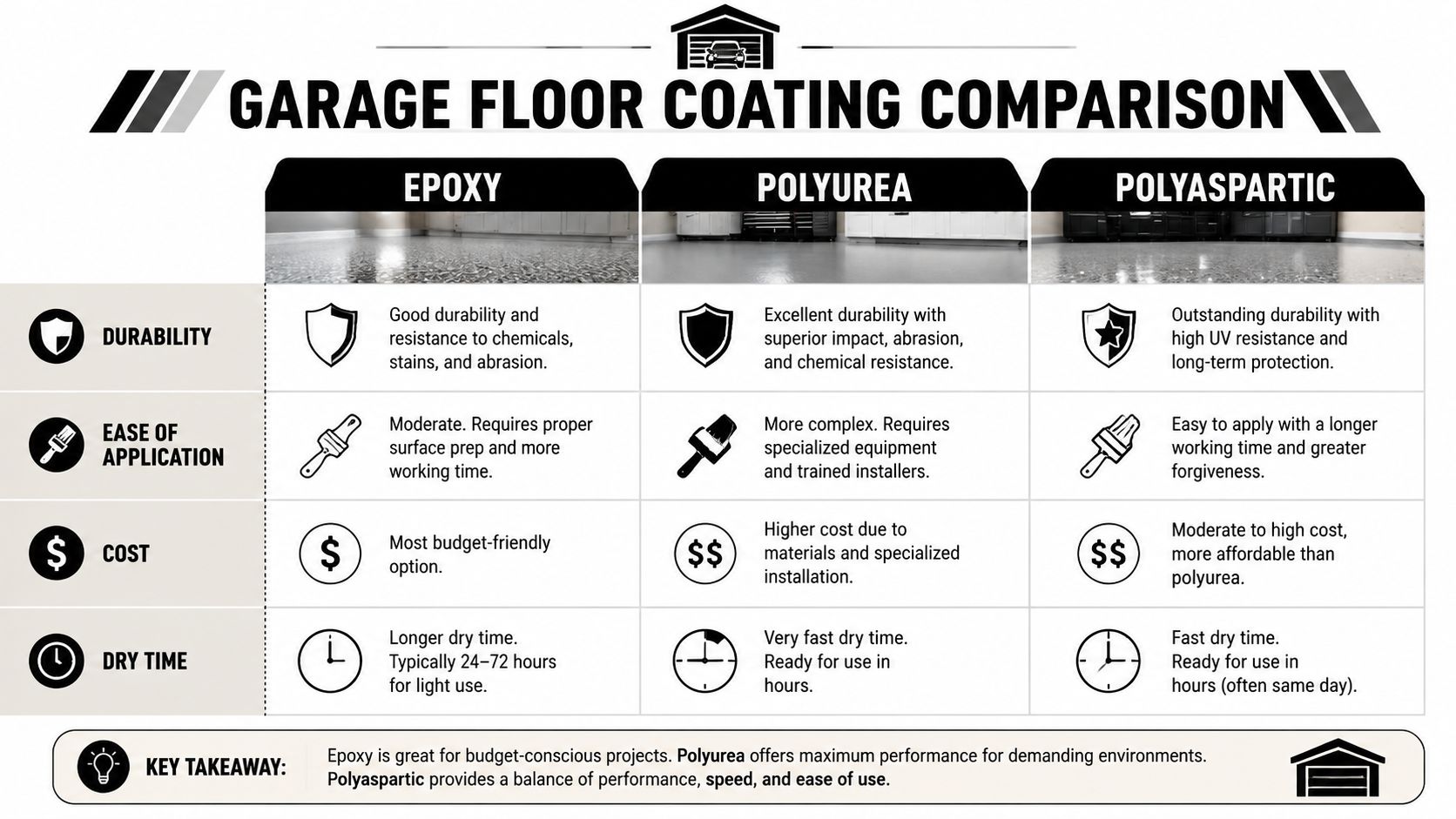
Homeowners usually compare four categories. Basic latex or acrylic paint. Epoxy-fortified paint. True 2-part epoxy systems. Fast-curing polyurea or polyaspartic coatings. Each one fits a different budget and a different tolerance for risk.
The quick read on each option
Latex or acrylic paint is the budget entry point. It improves appearance, but it's the least durable choice for a working garage floor.
1-part epoxy paint sounds stronger than standard paint, and it can be, but it still behaves more like paint than a full resin system.
2-part epoxy coatings are where performance usually becomes more serious. They require more prep and more discipline during installation.
Polyurea or polyaspartic systems appeal to homeowners who want faster return to service, but speed doesn't solve slab problems.
Garage floor finish comparison
| Coating Type | Avg. Cost (per sq. ft.) | Longevity | Key Benefit | Main Drawback |
|---|---|---|---|---|
| Latex or Acrylic Paint | Qualitatively lower-cost | About 2 years | Lowest barrier to entry | Short service life and frequent touch-ups |
| 1-Part Epoxy Paint | Qualitatively mid-range | About 3 to 4 years | Easier than full epoxy system | Still limited compared with thicker systems |
| 2-Part Epoxy Coating | A 400- to 500-square-foot two-car garage often ranges from $1,200 to $6,000 | Qualitatively longer-lasting | Better build and durability | More prep-sensitive and slower cure |
| Polyurea or Polyaspartic | Qualitatively premium | Qualitatively durable when installed well | Faster return to use | Narrower margin for application mistakes |
The hard numbers above come from one industry source that says latex acrylic garage floor paint may last about 2 years, may need touch-ups every 6 to 12 months, and that an epoxy-based paint alternative may last about 3 to 4 years. The same source says epoxy pricing often ranges from $750 to $3,000 for a 250-square-foot one-car garage and $1,200 to $6,000 for a 400- to 500-square-foot two-car garage (GarageFlooringLLC comparison of paint and epoxy).
How to choose without overbuying
For most homeowners, the right answer comes down to use case.
- Choose basic paint if appearance matters more than lifespan, and you understand it's a short-term finish.
- Choose an epoxy-type system if the garage is a daily-use space and you want better resistance to normal abuse.
- Choose fast-curing systems carefully if downtime matters, but only after the slab is evaluated and prepped correctly.
Some homeowners also want to compare installation methods and finish types before committing. A separate garage floor coating overview can help sort through broad product categories and use cases.
What people often miss
The common buying mistake isn't choosing the wrong product family. It's assuming durability comes from chemistry alone.
Fast cure is attractive. Long-term success still depends on slab condition, prep quality, and whether the product is installed at the right spread rate.
That's especially important when planning a concrete foundation for garage use. If you're building new, the finish you choose later is easier to get right when the slab is poured, finished, and cured with future coatings in mind.
Why Your Concrete Slabs Condition Is Critical
A garage floor can look solid and still be a bad candidate for paint.
That's the biggest disconnect in this category. Homeowners see a floor that's “clean enough” and assume the next step is application. In reality, many coating failures start before the coating bucket is even opened.
Clean-looking concrete can still fail
One installer guide puts it plainly: adhesion problems are commonly tied to moisture, alkalinity, old sealers, and oil stains, and a floor that looks clean can still hold hidden curing compounds or sealers that block bonding (GarageFlooringLLC epoxy questions guide).
That matches what concrete contractors run into on real jobs. The slab might have:
- Old contamination from years of oil, tire residue, or lawn equipment
- A sealed surface from the original pour that was never removed
- Moisture movement through the slab that pushes against the coating
- Weak top surface material that powders or breaks bond under stress
None of those conditions show up clearly from a quick sweep and a shop vacuum.
Why slab quality matters more than the can label
Garage footings and foundations and cement foundations for garage projects matter. A well-installed slab starts with proper subgrade prep, drainage planning, finishing practices, and curing habits. Those choices affect whether the surface becomes a strong base for a future coating or a constant source of peeling and blistering.
If you're comparing concrete finishes more broadly, even outside garage work, this guide for Dallas-Fort Worth patios is a good reminder that finish decisions only work when the underlying slab is right for the application.
A slab with structural cracks or recurring moisture problems may need more than coating prep. In some cases, owners should first look at broader concrete performance issues such as movement, drainage, and cracking. A practical reference on how to help prevent slab cracking is useful when the floor problem starts below the surface.
If the slab is wrong, paint won't fix it. It will only hide it for a while.
New concrete isn't automatically ready
Fresh concrete creates its own misunderstandings. Homeowners assume new means ready. It doesn't.
A newly poured garage slab can still have finishing issues, surface density problems, curing residue, or moisture conditions that make a coating risky. That's why the conversation should start with slab readiness, not just color choice.
Surface Prep The Secret to a Lasting Finish
A garage floor paint job usually looks fine on day one. The failures show up later, after hot tires, winter salt, a few oil drips, and one humid stretch of weather. When paint peels, the can is not always the problem. In my experience, the slab and the prep are usually where the job was won or lost.
Good prep starts with an honest read of the concrete. Paint needs clean, dry, sound concrete with enough surface profile to grip. If the floor still has grease in the pores, curing residue on the surface, or weak paste at the top of the slab, the coating sits too high and lets go early. Manufacturers and installers make the same point in guides like this ArmorGarage surface preparation guide. The concrete should be mechanically profiled through methods like diamond grinding or shot blasting, which allows the coating to penetrate and bond instead of sitting on top.
What proper prep usually includes
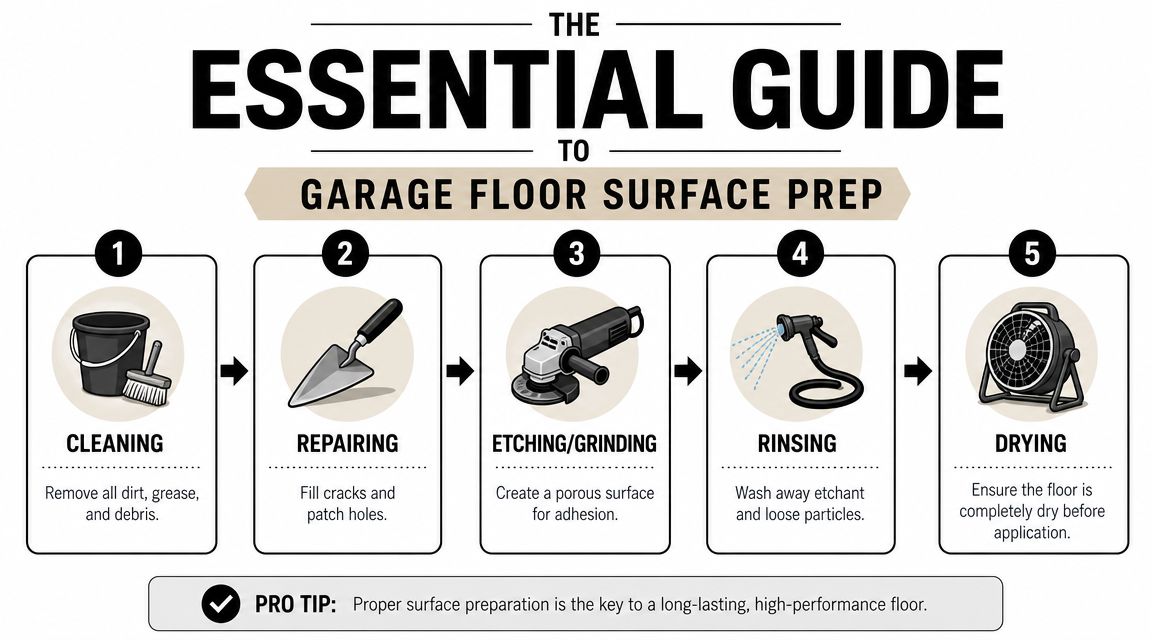
A solid prep sequence has several parts, and each one solves a different problem.
Deep cleaning
Oil, road film, tire residue, and old spills have to come out of the concrete, not just off the surface. If contamination stays in the slab, bond strength drops fast.Repairs
Cracks, pop-outs, pitting, and spalled edges should be patched before coating. Paint does not hide bad concrete for long. It usually highlights it.Mechanical profiling
This is the step many homeowners skip because it adds labor, dust control, and equipment cost. It also makes the biggest difference. Grinding or shot blasting opens the surface and gives the coating a profile it can hold onto.Dust removal and drying
Fine dust, rinse residue, and trapped moisture can all interfere with adhesion. The floor has to be clean and dry right before application, not just clean the day before.
For a visual walkthrough of the process, this installation video is useful:
Where DIY jobs usually go wrong
The first mistake is treating prep like cleaning. Sweeping, degreasing, and acid etching may make the slab look ready, but appearance is not the same as profile.
The second mistake is assuming a newer slab needs less prep. I have seen new garage floors with tight, overfinished surfaces that reject coatings because the top layer was too dense or too smooth. I have also seen older slabs hold paint well after proper grinding and moisture checks. Age matters less than condition.
Another common miss is underestimating moisture. A floor can look dry and still push vapor through the slab. Once that happens, peeling often starts at the weakest bonded spots and spreads.
Even outside garage flooring, the same rule applies. These professional container painting tips are useful because they reinforce a simple point. Coatings last longer when the surface is prepared for the product instead of rushed to meet the schedule.
Surface prep determines whether garage floor paint lasts a season or actually earns a few good years.
One practical note for new builds
On a new garage slab, prep starts long before paint day. Placement, finishing, curing, and protection during construction all affect how well a coating will bond later. That is the part homeowners often miss. They shop for the top layer, but the slab underneath decides how forgiving that top layer will be.
If the concrete was installed well, prep is more straightforward. If the slab has weak surface paste, poor drainage around the garage, or moisture coming up from below, surface prep turns into damage control. That is why the foundation work matters so much in the first place.
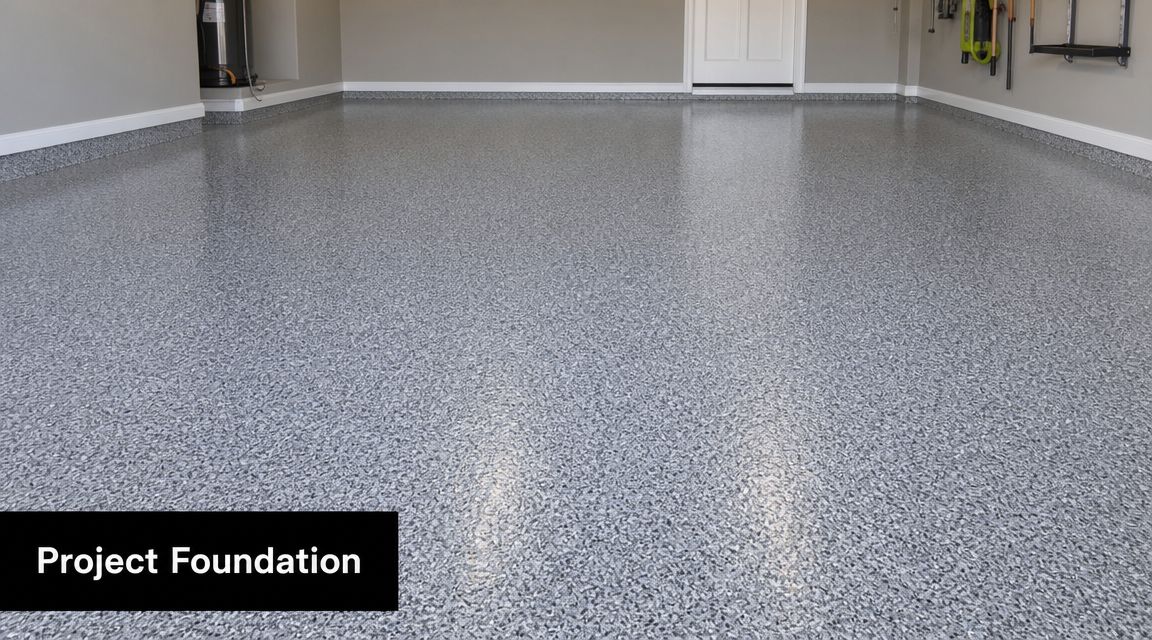
Your Next Step A Perfect Foundation for Your Project
If your garage floor is lightly used and you mainly want a cleaner look, garage floor paint can be a reasonable short-term choice. There's nothing wrong with choosing the budget option when your expectations match the product.
If your floor has moisture issues, old stains, weak concrete, hidden sealers, or visible distress, paint usually isn't the solution. It's a layer over a problem. In that situation, the smarter investment is to look at the slab itself.
Think beyond the finish
Homeowners in Pennsylvania, Maryland, Delaware, and New Jersey often start by asking what coating they should buy. A better starting point is simpler.
- Is the slab dry enough?
- Is the surface strong and properly prepared?
- Were the garage foundation and slab installed with drainage and longevity in mind?
- Will this floor support the finish you want, or reject it?
Those answers matter more than brochure language.
What works long term
The garage floors that hold up well usually have three things in common. Sound concrete. Proper prep. A finish that matches the way the space is used.
That's true whether you're evaluating an old floor, planning a new garage foundation, installing a concrete pad, or tying the garage project into a new driveway or adjacent slab work. The top layer gets the attention, but the base is what carries the result.
For homeowners with a tired floor, the next step isn't always to buy a coating kit. Sometimes it's to get an honest read on whether the slab is ready for anything at all.
If you're planning a new garage slab, replacing a failing floor, or want a straight answer about whether your existing concrete can support a coating, contact Firm Foundations for a free quote. The company builds concrete foundations, garage slabs, pads, driveways, and excavation-based site prep across Pennsylvania, Maryland, Delaware, and New Jersey, with the focus where it belongs. On the concrete underneath the finish.