
Concrete Housekeeping Pads: A PA & NJ Contractor’s Guide
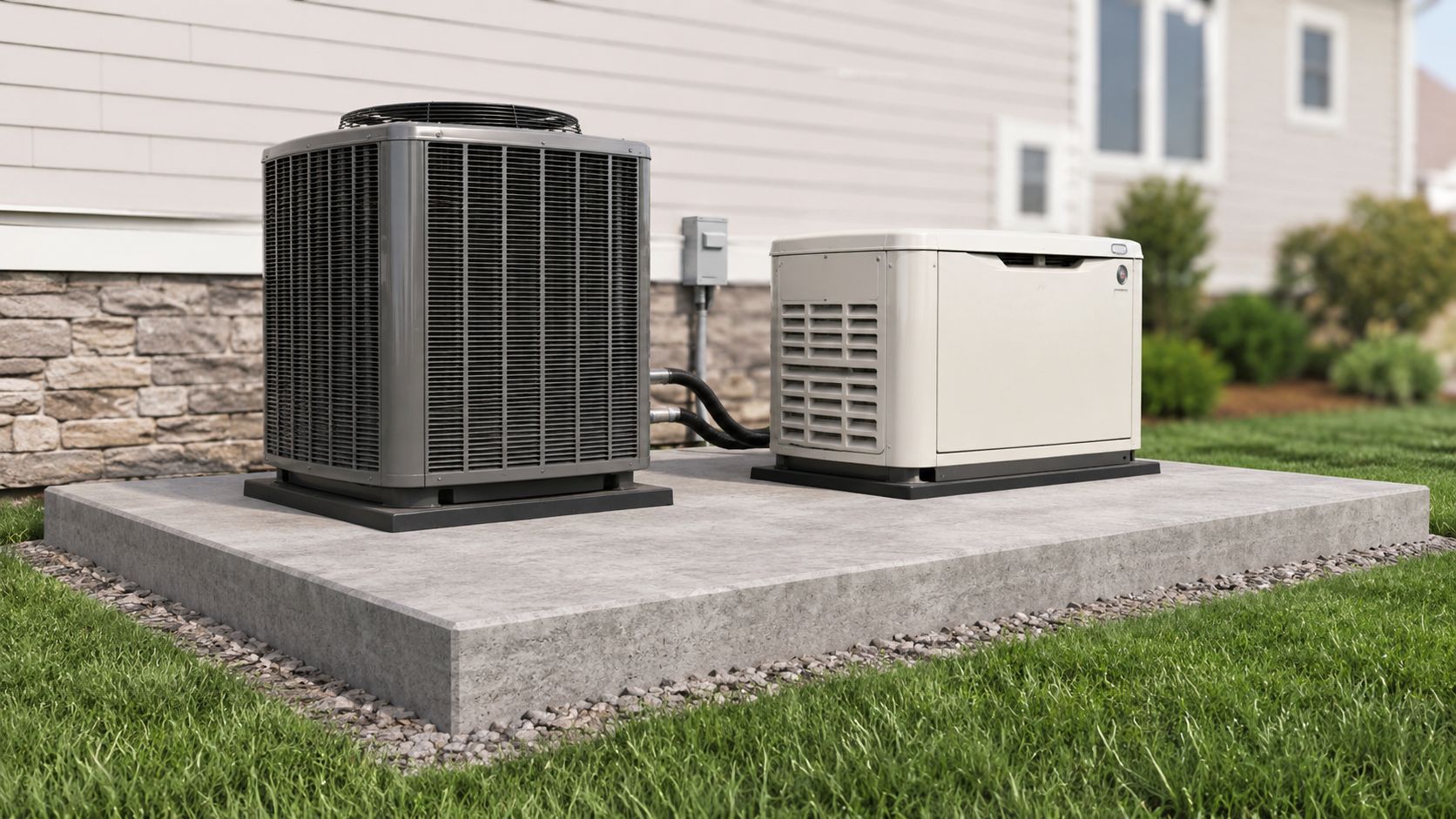
You buy a generator because you don't want to lose power in a winter storm. You replace an aging AC unit because you want the house comfortable again. You install a hot tub because you finally want the backyard to feel finished. Then the same question comes up every time. What is that equipment going to sit on?
A lot of property owners in Pennsylvania, Maryland, Delaware, and New Jersey are surprised by how often the answer is not gravel, not patio pavers, and not “just a little slab.” Heavy equipment needs a stable, level, durable base that can handle weight, weather, vibration, and water. That's where concrete housekeeping pads come in.
In this region, that matters even more. Freeze and thaw cycles, wet springs, humid summers, and storm runoff all work against poorly built pads. A professional installation protects the equipment, helps the surrounding area stay cleaner and safer, and adds long-term value to the property because the work is done as part of the site, not as a temporary afterthought.
Your Guide to Equipment Foundations in PA, MD, DE, and NJ
A homeowner in Honey Brook Township buys a backup generator after one too many outages. A small business owner in South Jersey upgrades to a more efficient rooftop or ground-level HVAC system. Both have made a smart investment. Both also reach the same point fast. The equipment manufacturer has requirements, the installer wants a level base, and nobody wants that new unit sitting in mud, grass, or on a pad that cracks the first hard season.
That's usually when people start searching for concrete foundations, garage foundation contractors near me, or even shed foundations near me, because they know they need someone who understands more than just pouring concrete. Equipment pads have to perform.
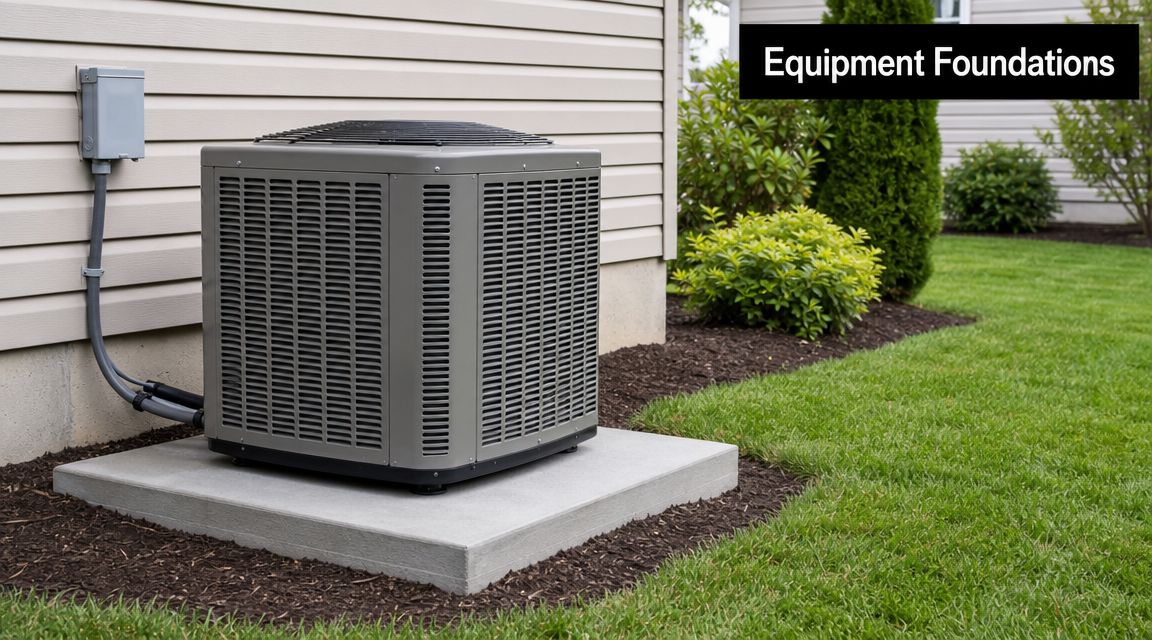
Why the base matters
When a unit sits on unprepared ground, the problems usually start small. One corner settles. Rainwater pools around the equipment. Vibration loosens connections. Service techs have a harder time leveling or anchoring the unit correctly. Over time, small movement becomes misalignment, drainage trouble, edge cracking, or premature wear.
A properly built housekeeping pad gives the equipment a dedicated foundation that stays where it belongs. It also creates separation from soil, mulch, and splash-back, which is a big advantage in the Mid-Atlantic climate.
Practical rule: Expensive equipment deserves a foundation designed for equipment, not a leftover slab detail from another project.
What property owners usually need
For homeowners, that often means support for:
- Generators that need a stable, raised base near the home
- AC condensers and heat pumps that shouldn't sit in wet ground
- Hot tubs and spas that put constant load on one area
- Pool equipment that benefits from a clean, level service surface
For commercial properties, the list expands to pumps, compressors, utility equipment, dumpster pads, and other installations where a plain exterior slab isn't enough.
Across PA, MD, DE, and NJ, the right approach is the same. Match the foundation to the equipment, the site conditions, and the long-term use of the space. That's the difference between a pad that exists and one that effectively protects your investment.
What Exactly Is a Concrete Housekeeping Pad
A concrete housekeeping pad is a dedicated equipment foundation. It is not the same thing as a patio, walkway, or random square of concrete poured because there happened to be extra mix on site. Its job is specific. It supports equipment, keeps it level, helps isolate it from surrounding moisture and debris, and creates a proper surface for anchoring and service.
The easiest way to think about it is this. A housekeeping pad is the equipment's platform, much like an engine mount supports machinery in a vehicle. The unit may be the expensive part you see, but the base underneath affects how well it performs.
What it does that a simple slab doesn't
A basic slab can hold foot traffic. A housekeeping pad has a different purpose. It needs to handle concentrated loads, stay stable under vibration, and maintain a clean edge and elevation around the equipment.
That difference becomes even more important indoors or near occupied spaces. Research on floating floors found that adding a housekeeping pad can affect sound transmission, with the strongest effect occurring between 500 Hz and 1 kHz. The same research noted that professional design needs to consider the full floor system, not just the pad by itself, to avoid unwanted noise transfer in buildings (acoustic evaluation of floating floors with housekeeping pads).
What homeowners and owners often miss
Many people assume the pad is only there to “keep it off the dirt.” That's part of it, but not the whole story. The pad also helps with:
- Level support so the equipment starts out properly installed
- Anchorage where the unit needs to be secured
- Protection from water and debris that can shorten service life
- Cleaner service access for technicians
- Reduced movement from vibration over time
A housekeeping pad isn't decorative concrete. It's a working structural detail.
What it is not
It isn't a substitute for every kind of foundation. It isn't always the answer for a full shed foundation, a gazebo foundation, or a large cement foundation for garage work where footings and slab design follow a different set of structural demands. It also isn't something to size by guesswork.
That's why a professional will first ask what's going on the pad, how much it weighs, how it operates, and what the ground conditions look like. Those answers determine whether a standard exterior slab approach is enough or whether the project needs a more deliberate equipment foundation.
Common Uses for Concrete Equipment Pads
The range of uses is wider than commonly expected. Around PA, MD, DE, and NJ, concrete housekeeping pads show up in both residential yards and commercial service areas because they solve a simple problem well. Heavy or sensitive equipment needs a dependable place to sit.
Around the home
The most common residential requests usually involve mechanical equipment.
A new AC condenser needs a level spot beside the house. A backup generator needs a base that stays stable through wet weather and seasonal ground movement. Pool pumps and heaters need a cleaner, drier platform than bare soil or stone alone. Hot tubs need support that won't shift once the tub is filled and in use.
For some projects, homeowners who first search for a base for storage shed or shed foundation realize the same site issues apply to equipment. If the yard has drainage problems, soft ground, or slope, the base has to be built intentionally.
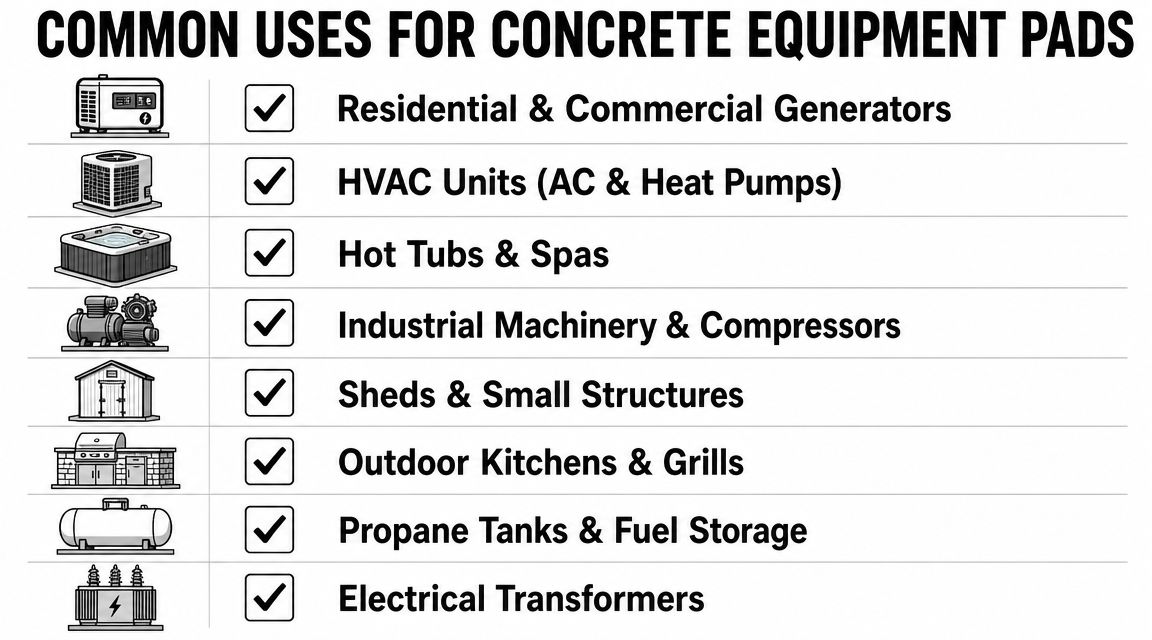
For commercial and light industrial properties
Small business owners tend to need pads for a different set of reasons. The equipment is often heavier, service access matters more, and downtime is more expensive.
Common examples include:
- HVAC equipment serving offices, shops, or mixed-use buildings
- Standby generators for continuity during outages
- Pumps and mechanical units in service rooms or exterior yards
- Propane or utility-adjacent equipment where a durable base helps with alignment and maintenance
- Compressors and similar machinery that benefit from a rigid, level platform
Why the use case changes the build
A hot tub pad and a generator pad may both look like rectangles from the driveway, but they aren't the same project. One may need more attention to distributed water load. The other may need more attention to anchorage, clearances, and vibration. A commercial mechanical pad may also need cleaner detailing around edges and adjacent surfaces because of daily service traffic.
That's why trying to reuse a one-size-fits-all slab detail usually causes trouble. The right pad should fit the equipment, the space, and the way the owner will use the area. In many cases, that same thinking carries over to nearby work such as concrete foundation for garage projects, garage footings and foundations, or site prep tied to excavation near me searches. The base has to match the purpose.
Recommended Dimensions and Reinforcement
A housekeeping pad has to do more than hold equipment off the ground. It has to stay level, resist cracking around anchors, shed water, and keep doing that through freeze-thaw cycles in PA, MD, DE, and NJ. That is the difference between a proper equipment foundation and a quick slab poured to match the footprint.
What standard specifications actually mean on site
Professional specifications often call for housekeeping pads to extend at least 2 inches beyond the steel or cast base and to be no less than 6 inches thick, with edges chamfered 2 to 4 inches at 45 degrees and the grout contact surface coated with a thin epoxy layer not exceeding 5 mils (municipal equipment foundation specification).
Those details solve real problems. The extra perimeter protects edges from breaking when equipment is serviced. Thickness helps the pad carry concentrated loads without flexing at anchor points. Chamfered edges hold up better when snow shovels, hand trucks, and service traffic hit the corners. In our region, where moisture and winter weather work on every exposed slab, those details add years to the pad.
Concrete strength and reinforcement
Concrete strength and steel should match the equipment, not guesswork. Industry guidance commonly places housekeeping pad concrete in the 2500 to 3000 psi range, and some equipment foundations use heavier reinforcement such as #6 rebar on 12-inch centers, as noted earlier in the article.
That does not mean every pad needs the same steel schedule. A small residential condenser pad, a standby generator pad, and a commercial pump base all load the concrete differently. Some need more mass for vibration control. Some need better crack control around anchors. Some need both.
A pad that is undersized may still look fine on pour day.
Problems show up later. Anchors loosen. Corners break off. Equipment falls out of level. Vibration transfers into the building or stresses connected lines. Once that starts, the repair usually costs more than building the pad correctly the first time.
Typical housekeeping pad specifications
| Equipment Type | Recommended Thickness | Concrete Strength (PSI) | Reinforcement |
|---|---|---|---|
| Light residential equipment | Sized to the unit, service clearance, and soil conditions | Common design guides place housekeeping pads in the 2500 to 3000 psi range | Reinforcement based on load and crack-control needs |
| Generator installations | Often 6 inches or more where weight, anchorage, and vibration are factors | Often specified within the 2500 to 3000 psi range depending on design | Reinforcement may increase substantially based on equipment weight and anchor layout |
| Equipment bases with grout and anchorage needs | Often at least 6 inches thick and extending 2 inches beyond the base | Follow project specification | Steel matched to structural load, anchors, and service conditions |
Why DIY dimensions often fail
The common mistakes are predictable. Pads get poured too thin. Reinforcement ends up too low in the slab or gets skipped altogether. The footprint is tight to the equipment, so the edges chip. Water drains toward the pad instead of away from it, then winter freezing opens the cracks wider.
This guide on how to prevent a concrete slab from cracking does a good job explaining how subgrade prep, reinforcement, curing, and drainage work together. The same principles apply here, but equipment pads carry a higher penalty for mistakes because they also affect machinery performance and service life.
Owners budgeting a full site project sometimes compare slab work with nearby grade and retaining needs. If the yard has elevation changes, a resource on retaining wall sleepers cost can help frame that part of the budget. Grade control matters because water moving off a slope will find the pad, the joints, and the base if the site is not planned as one system.
At Firm Foundations, we size housekeeping pads around the equipment, the soil, and the local weather exposure. That approach gives homeowners and small business owners a pad that protects the equipment sitting on it and supports property value over the long run.
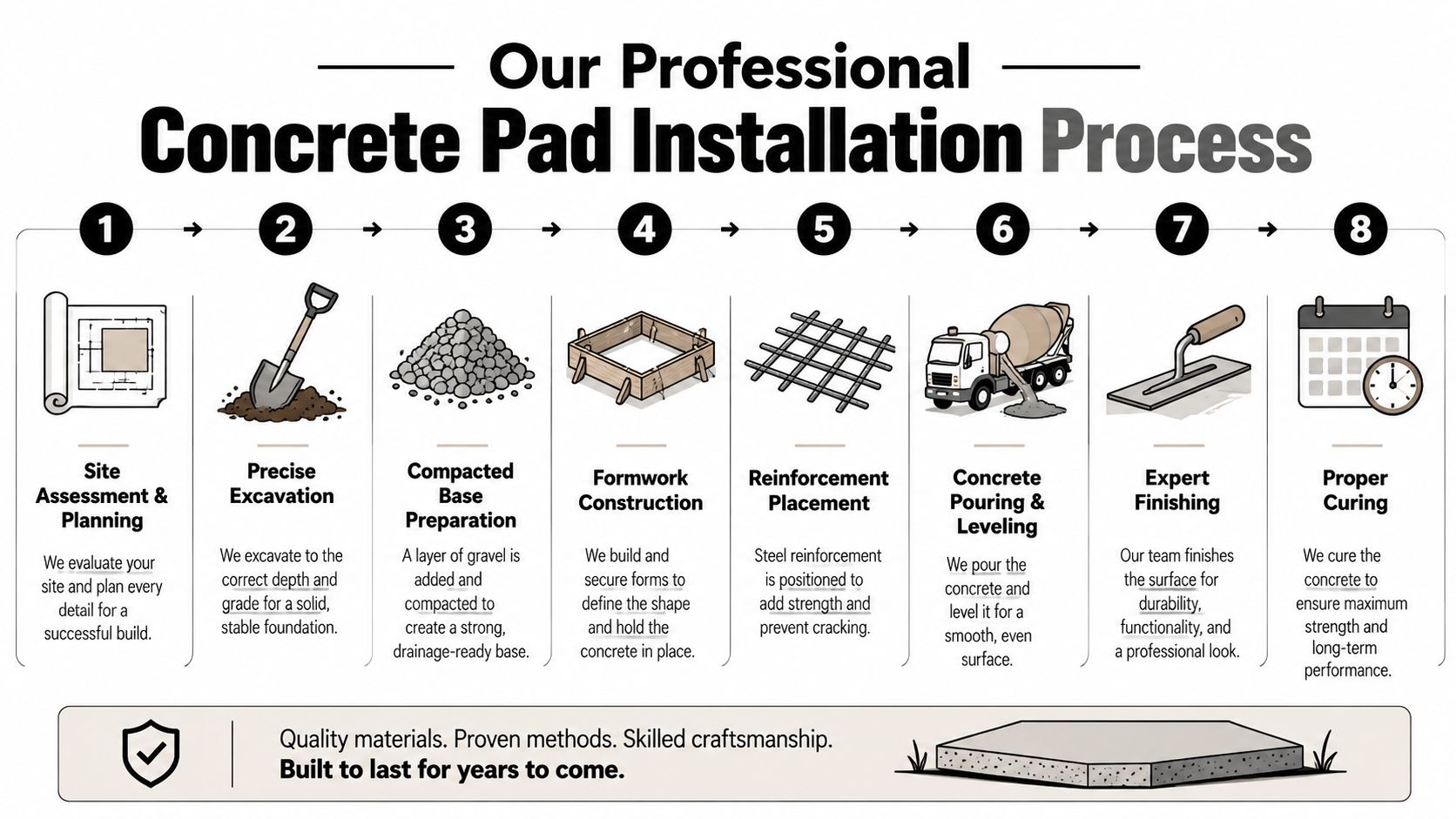
Our Professional Concrete Pad Installation Process
A good-looking pour can still fail if the work underneath was sloppy. The process matters long before concrete arrives on site.
It starts with the ground
Every durable pad begins with site assessment. The crew has to know where water moves, how stable the soil is, what nearby structures or utilities matter, and how the equipment will be installed and serviced later.
Then comes excavation and base preparation. This is the step many DIY jobs rush, and it's the reason many pads settle. The goal is a stable sub-base that supports the slab evenly, not just a hole filled quickly and flattened.
Forming and reinforcement
Once the base is ready, the dimensions are laid out and forms are built to hold the slab exactly where it belongs. This stage sets the final footprint, edge detail, and elevation. If the forms are wrong, the finished pad will be wrong.
Reinforcement is placed according to the project requirements. For some installations, that may mean heavier steel and stricter layout because the equipment load or anchorage demands it.
A lot of owners appreciate seeing the process before work starts. This overview of concrete pad installation gives a straightforward picture of the sequence and why each step matters.
Pour, finish, and cure
The pour itself is only part of the job. The slab has to be placed, consolidated, and finished to the right surface condition for the equipment. It also has to be level where level matters and sloped appropriately where drainage matters. Those are not contradictory goals when the work is planned correctly.
After placement, curing makes the difference between a pad that gains strength properly and one that dries too fast and becomes more vulnerable to surface problems. Weather, sun, and wind all affect that stage.
Here's a look at the process in motion:
Why process control matters for the owner
From the customer side, the value is predictability. You want to know the pad will be where the equipment installer expects it, at the right elevation, with proper access and drainage around it. That doesn't happen by luck.
On estimating and planning, some contractors and project managers use tools such as Exayard estimating software for concrete contractors to organize quantities, labor, and scope. The software isn't the work itself, of course, but it reflects something customers should look for in any contractor: a methodical approach instead of rough guesswork.
For homeowners and property managers in this region, Firm Foundations handles site prep, forming, pouring, and finishing for foundation and pad projects across PA, MD, DE, and NJ. The practical value is having one crew responsible for the full sequence, not a patchwork of steps left to chance.
DIY Pad vs Hiring Firm Foundations
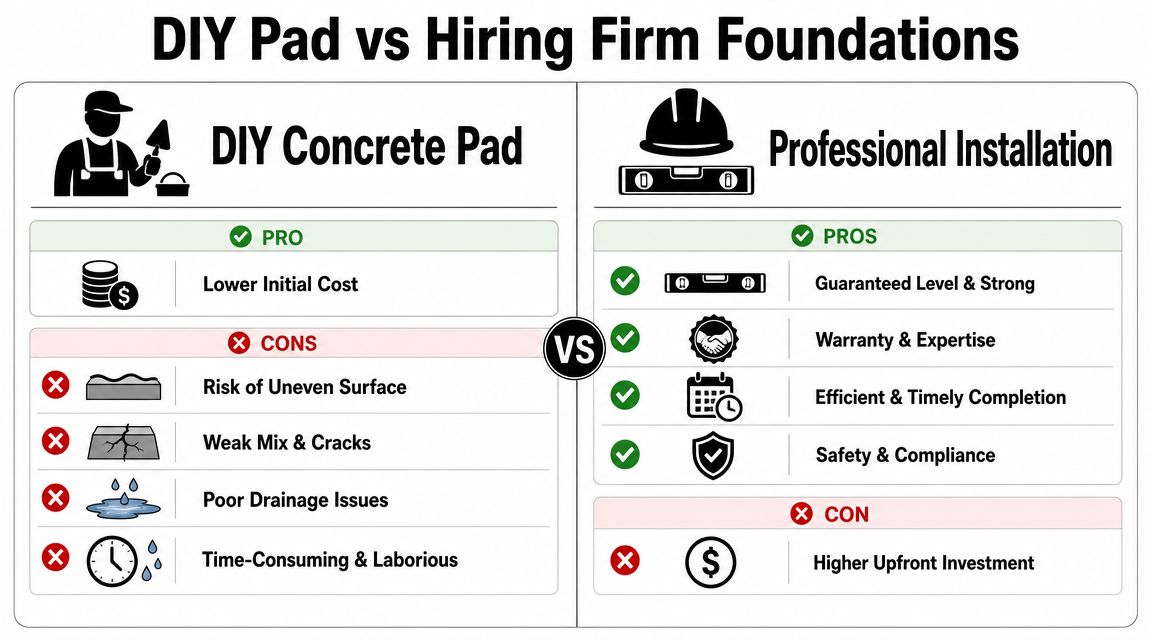
DIY concrete is appealing for one reason. It looks simple from the outside. Mark a square, mix some bags, smooth it off, and save money. For a decorative stepping stone, that may be fine. For equipment support, it often goes sideways.
Where DIY usually gets into trouble
The first issue is level. Equipment pads have very little tolerance for a sloppy base. Even small unevenness can affect installation, anchoring, water runoff, or vibration.
The second issue is support under the slab. People focus on the top surface because that's what they see. The true performance starts below it, with excavation, compaction, edge stability, and drainage.
Then there's the concrete itself. If the pad is undersized, poorly reinforced, or finished without regard to the equipment it will carry, the problem may not show up on day one. It shows up later when a corner settles, an edge breaks, or service technicians point to the pad as the reason the equipment is shifting.
When DIY can make sense, and when it doesn't
If someone wants to understand the basics of base prep and leveling for a lightweight backyard project, a practical DIY shed foundation guide can be a helpful starting point. It gives a good sense of how much layout and prep go into even a modest structure.
That said, equipment pads are where many owners are better off bringing in a contractor. The cost of getting the pad wrong often extends beyond the concrete itself. It can affect the equipment, the installer's work, the drainage around the house or building, and the appearance of the property.
The cheapest pad on pour day can become the most expensive pad once it starts moving, cracking, or holding water around expensive equipment.
Why professional installation has long-term value
Hiring a contractor is about more than avoiding the mess. You're paying for the judgment that keeps common mistakes from being built into the slab.
That includes:
- Correct sizing for the actual equipment and use
- Better site prep so the pad stays stable through seasonal weather
- Cleaner finish and edges that hold up better over time
- Drainage awareness so water moves away instead of pooling
- A stronger result for property value because the installation looks intentional and permanent
That's especially important in PA, MD, DE, and NJ, where weather and soil conditions can expose shortcuts fast. A well-built pad won't make the weather easier, but it gives your equipment a foundation that's built for it.
Frequently Asked Questions About Concrete Pads
A few questions come up on almost every call. Here are the short answers property owners usually need before moving forward.
| Question | Answer |
|---|---|
| Do all generators and AC units need a concrete pad? | Not every piece of equipment uses the exact same foundation detail, but many benefit from a stable, level, durable base. The right choice depends on the equipment, site conditions, and installation requirements. |
| Is a housekeeping pad the same as a patio slab? | No. A housekeeping pad is built as an equipment support element. It has a different job than a slab meant mainly for foot traffic or outdoor living space. |
| Can a pad be installed on sloped ground? | Yes, but the slope has to be addressed in the site prep and grading. That's often where professional excavation and base preparation make the biggest difference. |
| Are these only for commercial properties? | No. Homeowners use them for generators, HVAC units, hot tubs, and pool equipment. Commercial properties often need them for heavier or more service-sensitive equipment. |
| How do I know what size pad I need? | Start with the equipment make, model, base dimensions, and installation requirements. A contractor can then match the pad layout and site prep to the real load and conditions. |
| Do concrete housekeeping pads help property value? | They can, because they support expensive equipment properly and make the installation look permanent, clean, and well planned. |
| What if I'm already comparing shed or garage foundation options? | That's common. The same property owners looking for shed foundations contractors near me, gravel shed foundation contractors near me, or cement foundations for garage work often need an equipment pad as part of the larger site plan. |
If you need a concrete housekeeping pad in Pennsylvania, Maryland, Delaware, or New Jersey, Firm Foundations can help you sort out the right size, site prep, and installation approach for your equipment and property. Request a quote, ask questions, and get the base built correctly before your new equipment goes in.