
Garage Floor Grinding: PA, MD, DE, NJ Experts
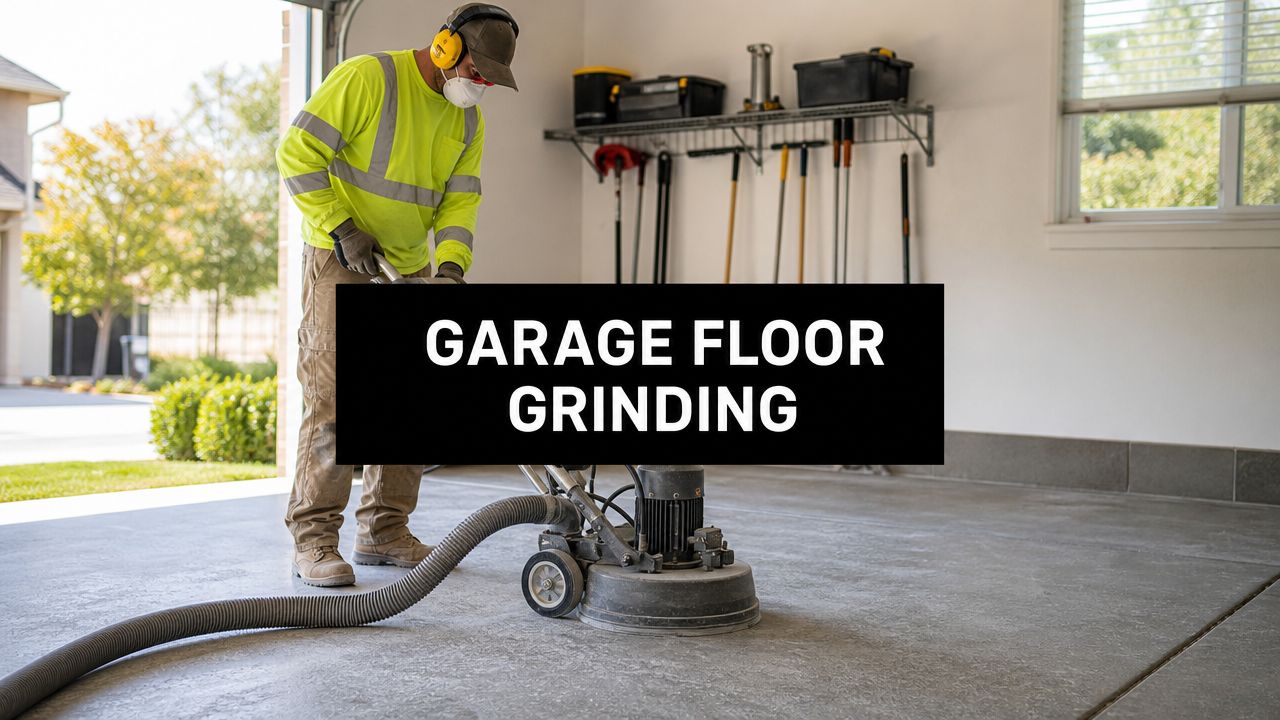
A lot of homeowners start looking into garage floor grinding after they've had enough of the same ugly problems. The floor stays dusty no matter how often it's swept. Old paint peels in patches. Oil stains never really come out. A DIY coating looked good for a while, then started lifting where the tires sit. In some garages, the slab even feels rough or uneven enough that the whole space looks unfinished.
That frustration is real, especially when the garage is doing more than holding cars. It might be a workshop, home gym, storage area, or the main entry into the house. When the concrete surface is failing, the entire space feels dirty and neglected.
The important part is this. Grinding can be the right solution, but it isn't the right answer for every slab. A good contractor should diagnose the problem first, then recommend the fix. That matters whether you're trying to remove a failed coating, prep for epoxy, correct minor surface issues, or figure out why your garage floor keeps wearing out.
Your Trusted Garage Floor Experts in PA, MD, DE, and NJ
A common call goes like this. A homeowner has a garage floor that “just needs epoxy.” When we look closer, the underlying issue isn't the coating choice. It's the surface underneath it.
Sometimes the slab has a chalky top layer that never bonded well in the first place. Sometimes old paint, glue, or sealer is still sitting on the surface. Sometimes there are chips at the front edge, cracks around control joints, or high spots that will show right through any new finish. Homeowners usually notice the symptom first. Peeling, dusting, staining, tire lift. The cause is often poor surface preparation.
That's where garage floor grinding comes in. Done correctly, it gives the slab a clean, mechanically prepared surface so the next step has a real chance to last. Done poorly, it leaves swirl marks, uneven texture, edge damage, and a garage full of dust.
Practical rule: If someone recommends a coating before they inspect the concrete itself, they're guessing.
Firm Foundations serves homeowners and property owners across Pennsylvania, Maryland, Delaware, and New Jersey with concrete and sitework services built around long-term performance. That includes the kind of work that demands real slab knowledge, from concrete foundations and garage footings and foundations to shed pads, driveway prep, excavation, and surface correction on existing concrete.
Why slab experience matters
Garage grinding isn't isolated from the rest of concrete work. It ties directly into how a slab was poured, how it drains, how it cracked, and what's happening at the surface. A crew that also handles concrete foundation for garage projects, cement foundations for garage work, and site prep can usually spot the difference between a surface issue and a slab issue faster than someone who only sells coatings.
For homeowners searching for garage foundation contractors near me, concrete contractors, or even driveway contractors near me, that overlap matters. You want one clear answer to a basic question. Is this floor a good candidate for grinding, or does it need repair, leveling, or more involved concrete work first?
What homeowners can expect
A solid garage floor plan usually starts with three decisions:
- Surface problem or structural problem: Dusting, coating failure, and glue removal point toward surface prep. Movement, heaving, and broader flatness issues may point elsewhere.
- Prep only or full system: Some floors need grinding so another installer can apply epoxy or sealer. Others need the same contractor to handle the entire system.
- DIY risk or professional control: In an enclosed garage, the dust and cleanup side of grinding changes the decision fast.
If your garage floor in PA, MD, DE, or NJ looks worn out, the next step shouldn't be a sales pitch. It should be a diagnosis.
What Is Garage Floor Grinding?
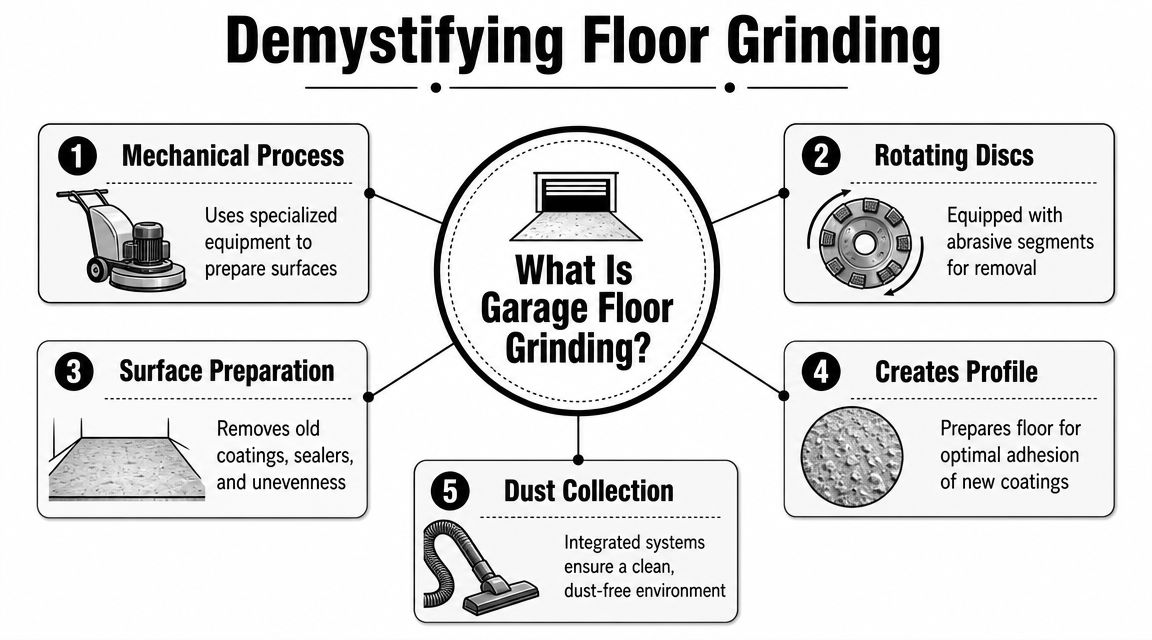
Garage floor grinding is a mechanical surface-preparation process. A machine with rotating diamond abrasives removes the top layer of concrete just enough to clean it, open it up, and create the texture needed for the next step.
The simplest way to think about it is sanding wood before painting. You're not trying to destroy the material. You're preparing it so the finish can bond properly and look right.
Industry guidance describes garage floor grinding as a surface-profile control step. Its purpose is to create a mechanically roughened profile so coatings can bond reliably, while removing laitance, old paint, and other contaminants from the top layer, as explained in this overview of garage floor grinding and coating adhesion.
What grinding actually removes
A proper grinding pass can address several common garage-floor problems at once:
- Failed coatings: Old epoxy, paint, or sealer that's peeling or flaking
- Surface contamination: Glue, residue, and weak top layers that interfere with adhesion
- Minor surface defects: Small imperfections that need to be smoothed before a new finish
- Preparation for new finishes: A textured slab for epoxy, sealer, or another coating system
Homeowners looking at equipment options often don't realize how much the machine matters. A wider, purpose-built grinder behaves very differently from a handheld tool. If you want to see the kind of equipment used for slab prep, this page on a garage floor grinder gives a useful reference point.
What grinding does not fix
Grinding has limits, and a lot of bad advice begins at this point.
It does not repair structural cracks by itself. It does not correct deeper low spots just because the surface gets shaved down. It does not guarantee a coating will last if moisture, poor repairs, or contamination are still present.
Grinding is prep work. If the slab needs repair first, the machine doesn't solve that for you.
That's why a contractor should inspect chips, cracks, and any visible movement before deciding how aggressive the grind should be, or whether grinding is even the right service at all.
Grinding vs Polishing vs Shot-Blasting
Homeowners often hear three terms grouped together. Grinding, polishing, and shot-blasting. They aren't interchangeable.
Grinding is usually the preparation step for a garage floor. Polishing is a finishing process that refines concrete into the final exposed surface. Shot-blasting is a heavier, more aggressive prep method that's often used where a rougher profile is needed.
Choosing the right concrete surface treatment
| Method | Primary Purpose | Final Surface | Best For |
|---|---|---|---|
| Grinding | Surface preparation and profile control | Clean, opened, mechanically roughened surface | Garages getting epoxy, sealer, or coating removal |
| Polishing | Decorative finishing of the concrete itself | Smooth, refined, more reflective concrete | Interior slabs where the concrete is the finished floor |
| Shot-blasting | Aggressive mechanical preparation | Rougher texture with strong mechanical profile | Heavier-duty prep where coatings need a more aggressive anchor |
Where homeowners get confused
A lot of people say they want a “polished garage floor” when they want a coated garage floor that looks clean and finished. Those are different outcomes.
If you're applying epoxy or another topical finish, the slab usually needs grinding so the coating has the right profile to grab onto. Polishing goes in the other direction. It uses progressively finer abrasives to make the concrete itself smoother and more finished, not more receptive to a film coating.
Shot-blasting has its place, but it's not usually the first recommendation for a typical residential garage unless the floor condition or coating requirements justify it. It can be more aggressive than the job really needs.
Which one fits a typical residential garage
For most garages, the decision tree is pretty simple:
- You want to remove old coating and prep for a new one: grinding is usually the right conversation.
- You want bare concrete as the finished look: polishing may be worth discussing.
- You have a tougher industrial-style prep requirement: shot-blasting may enter the picture.
The better contractor won't force one method onto every slab. They'll look at the floor, the condition of the surface, and the finish you want at the end.
If the final product is a coating, the prep method matters more than the color chart.
That same mindset applies in related concrete work. Homeowners searching for garage footings and foundations, house foundation work, or a base for storage shed often think first about the visible finish. Long-term performance usually comes from the prep and the substrate, not from whatever gets applied last.
The Firm Foundations Grinding Process From Start to Finish
The process should feel organized from the first visit. If it doesn't, that usually shows up in the final floor.
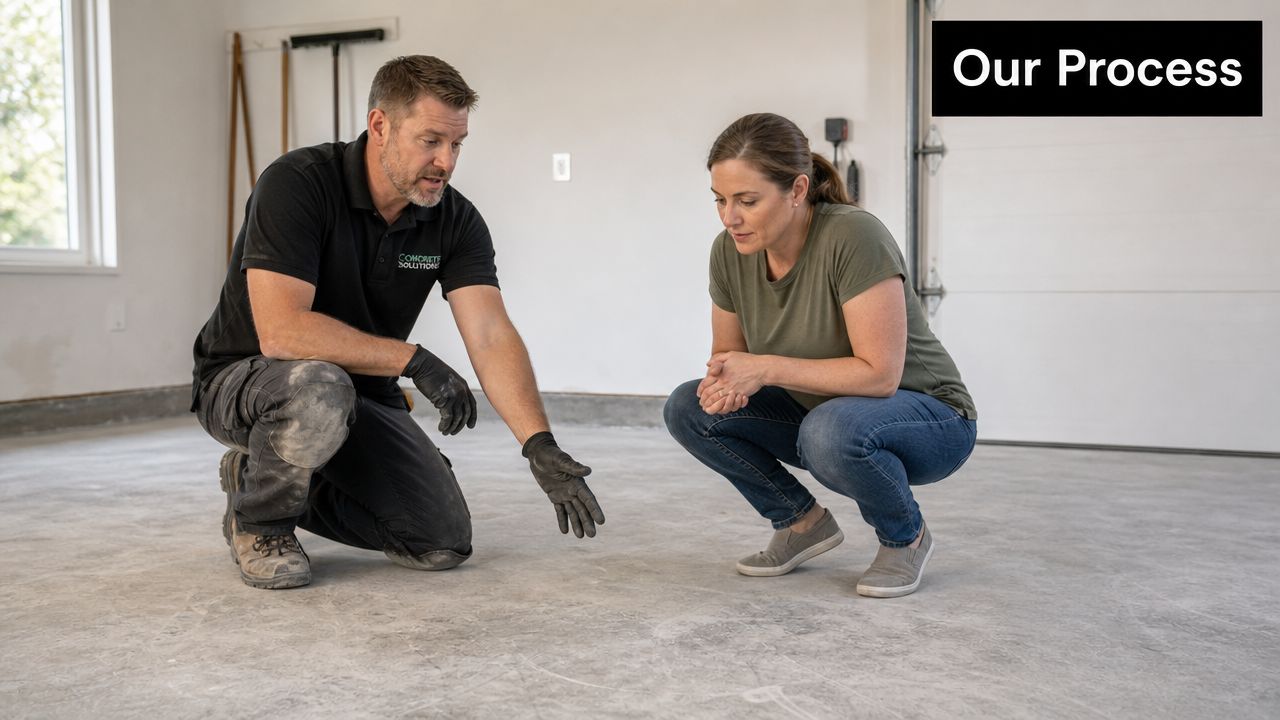
A typical project starts with an on-site evaluation. The floor gets checked for old coatings, contamination, cracks, chips, weak surface paste, and any signs that the slab has a bigger problem than surface wear. That part matters just as much as the actual grinding. A floor that needs repair should be treated differently from one that only needs prep.
Step one is diagnosis
The first real question isn't what machine to use. It's whether grinding alone matches the problem.
Common findings include old paint near the garage door, glue from previous flooring, tire wear where coatings failed, and edge damage around expansion joints. Some floors only need prep. Others need crack repair or patching before any machine work starts.
The grinding setup
Equipment choice changes both the speed of the work and the quality of the finish. Professional floor grinders can use 10-horsepower, 480-volt three-phase motors with three 8.7-inch discs running at 300 to 1,400 rpm, while residential jobs often call for machines in the 18 to 22 inch range on 220V single-phase power, which fits garage access and residential electrical realities better, according to this guide on floor grinder sizing and power requirements.
That's why a walk-behind planetary grinder usually performs better than small handheld tools on a full garage. It covers more evenly, cuts flatter, and controls the surface profile better.
For homeowners comparing next steps after prep, a garage floor sealer is one common finish path once the slab is properly prepared.
Dust control and edge work
Grinding a garage isn't just open-floor work. The perimeter, corners, and door edges need attention too. That usually means a combination of larger planetary equipment for the field and hand tools for tighter areas.
The process should also include dust collection attached at the source, not just a shop vacuum brought in afterward. That keeps the work area more controlled and avoids the layer of fine dust that tends to settle on every shelf, tool, and stored item in the garage.
This walkthrough gives a visual sense of how professional floor prep is staged and performed on concrete surfaces:
What a good finish looks like before coating
A properly ground garage floor should look consistent, clean, and intentionally prepared. It may not look decorative yet, because that's not the point of this stage. The surface should be open, even, and ready for repair materials, primer, sealer, or coating.
If a contractor leaves gouges, misses edges, or treats crack repair like an afterthought, that shows up later. Usually right through the final finish.
Understanding Costs and Why Safety Comes First
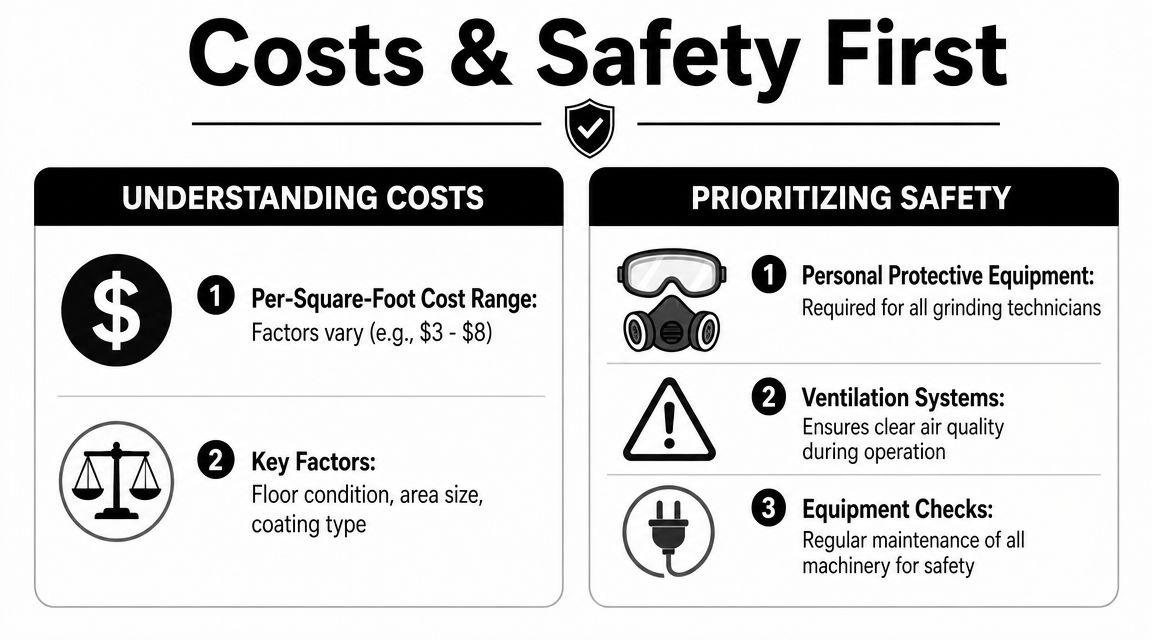
Cost matters, but homeowners usually make the wrong comparison. They compare the price of professional grinding to the rental cost of a machine. A more appropriate comparison is professional diagnosis, proper prep, dust control, cleanup, and finish readiness versus taking on the risk of doing all of that yourself.
The historical roots of modern grinding come from concrete pavement work. The Federal Highway Administration notes that typical concrete pavement may be ground up to three times without compromising fatigue life, and reports diamond grinding costs averaging about $2.00 to $8.00 per square meter, rising as high as $12 per square meter in harder aggregate conditions, in this FHWA bulletin on diamond grinding as a concrete restoration method. That guidance applies to highways, not garages, but it shows how established grinding is as a precise restoration process rather than a rough demolition tactic.
What changes the cost of a garage job
Garage grinding prices vary because floors vary. The main cost drivers are usually:
- Current floor condition: Thick coating residue, paint buildup, and weak surface material take more work than a clean slab.
- Repairs required: Cracks, chips, and patching needs can change the scope fast.
- Desired end use: Prep for a thin sealer isn't always the same as prep for a coating system.
- Access and logistics: Garages full of storage, tight working space, and occupied homes affect labor and containment.
A straightforward slab is one thing. A garage with failed DIY coatings, edge deterioration, and contamination from years of vehicle use is another.
The DIY problem most people underestimate
The biggest issue isn't just finish quality. It's dust.
One comparison discussed in a video on DIY concrete grinding reported about 10 hours of labor for a 500 sq. ft. floor by hand versus about 7 minutes for a 25 ft. sample area with larger equipment, and the same discussion highlights OSHA's position that respirable crystalline silica from concrete work is a serious hazard requiring controls such as wet methods or dust collection, as shown in this video on garage grinding dust and silica risk.
That dust is fine enough to travel well beyond the garage. Once dry grinding starts without proper containment, it can move through doorways, settle on stored items, and spread into living areas.
The dust problem doesn't end when the machine stops. It ends when the dust was captured correctly in the first place.
Safety is part of job quality
A contractor who takes safety seriously usually runs a cleaner, more disciplined project overall. That means equipment checks, containment planning, PPE, and dust collection are treated as normal parts of the work, not optional add-ons. For homeowners who want broader context on jobsite practices, this guide on essential safety for building firms is a useful overview.
If you're weighing DIY against hiring out, the decision usually clarifies for these reasons. Garage floor grinding inside an enclosed residential space isn't just a labor question. It's an exposure and cleanup question too.
Questions to Ask Your Concrete Contractor
Before you hire anyone for garage floor grinding, ask direct questions and listen for direct answers. A reputable contractor won't get defensive. They'll explain their process clearly.
The questions that matter most
Ask these before you sign anything:
- Are you licensed and insured? You should hear a clear yes, not a vague answer.
- What dust-control system do you use? “We'll sweep up after” isn't a dust-control plan.
- How do you handle cracks, chips, and weak spots? Surface prep and repair should be discussed together.
- How do you decide whether grinding is the right fix? This is the question many homeowners forget to ask.
- Is prep included in the quote? That matters whether the project is garage resurfacing, a new slab tie-in, or related foundation builds.
A critical point many contractors skip is diagnosis. Grinding is used to remove coatings and minor imperfections, but flatness problems often require separate steps like marking high and low spots and using leveling compounds first, as outlined in this guide to how concrete grinders are used and when they aren't enough.
What a good answer sounds like
A trustworthy contractor should be comfortable saying, “Grinding alone won't solve that.”
That's the answer you want if the slab has broader flatness issues, failed repairs, or damage that will telegraph through the finish. The right contractor manages scope transparently. Homeowners can think about it the same way commercial property teams think about managing contractors effectively and safely. Clear expectations, documented process, and visible safety standards are signs of a crew that takes the work seriously.
Good contractors don't sell a machine pass. They solve the floor problem in front of them.
If you're comparing bids in Pennsylvania, Maryland, Delaware, or New Jersey, ask those questions first. The answers will usually tell you who's preparing the slab correctly and who's just trying to get to the coating stage faster.
If your garage floor is stained, peeling, dusty, or not ready for a lasting finish, Firm Foundations can help you figure out the right next step. We serve homeowners across PA, MD, DE, and NJ with concrete, excavation, and slab-focused services built around proper diagnosis, clean preparation, and durable results. Request a quote and get a clear assessment before you commit to the wrong fix.