
Expert Concrete Pad Repair: Fix Your Slab in PA & MD
You walk out to the garage, patio, or shed site and notice something new. A crack runs across the slab. One corner looks lower than it did last season. The edge is starting to chip, and every rain seems to leave water sitting in the same spot.
Most homeowners in Pennsylvania, Maryland, Delaware, and New Jersey have the same first question. Is this a cosmetic issue, or is the pad failing?
The good news is that not every crack means major replacement. Concrete moves, weather changes, and slabs on grade take abuse from moisture, freeze-thaw cycles, traffic, and the soil below them. The part many DIY guides miss is the most important part of all. Sometimes the concrete is only showing you a problem that starts underneath it.
Is That Crack in Your Concrete Pad a Serious Problem
A homeowner might first notice a jagged line in the garage floor while sweeping. Another sees a shed pad corner sinking just enough that the doors no longer close cleanly. Someone else spots the patio edge crumbling after winter. Those situations feel urgent, but they don't all point to the same repair.
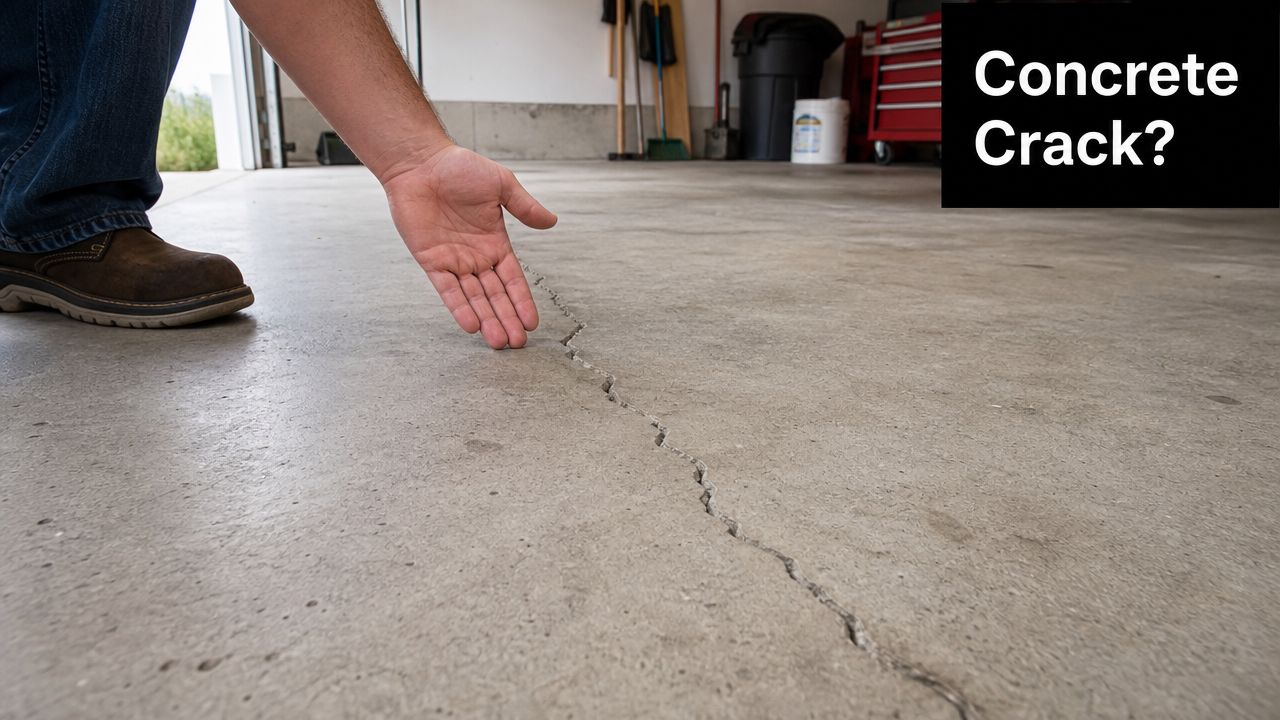
The first thing to understand is simple. A crack is a symptom, not a diagnosis. Some cracks are shallow and mostly cosmetic. Others show that the slab has lost support, taken on water, or started moving because the base wasn't built or drained properly.
What usually causes pad damage
A concrete pad can crack or settle for a few common reasons:
- Ground movement: Soil can shift, wash out, or settle unevenly under the slab.
- Water issues: Runoff, poor grading, and downspout discharge can soften the base and create voids.
- Freeze-thaw exposure: Water gets into weak spots, freezes, expands, and breaks the surface apart.
- Installation problems: Thin spots, weak edges, poor subgrade prep, or rushed finishing can shorten slab life.
One of the most overlooked questions in concrete pad repair is whether the slab should be repaired at all before the support underneath it is addressed. Guidance summarized in this overview of concrete repair issues and solutions emphasizes that water control and a stable subgrade are critical because erosion and soil movement can keep damaging the slab even after surface repairs.
Practical rule: If the same area keeps cracking or sinking, stop focusing only on the concrete. Look at drainage, runoff, and what the slab is resting on.
That root-cause mindset matters whether you're dealing with a shed foundation, a gazebo foundation, a base for storage shed placement, or a larger slab like a garage floor. A pad can look like it needs patching when the appropriate solution is reworking the grade, rebuilding the base, or correcting how water moves across the site.
If you want a broader outside perspective on recurring slab disputes and defect patterns, this NSW guide for concrete building issues is a useful reference. It reinforces a point contractors see all the time. Surface defects are often easier to spot than the conditions causing them.
How to Diagnose Your Concrete Pad Problems
Before you decide on patching, lifting, or replacement, look at the type of damage. The shape, depth, and location of the defect tell you a lot about what the slab is doing.
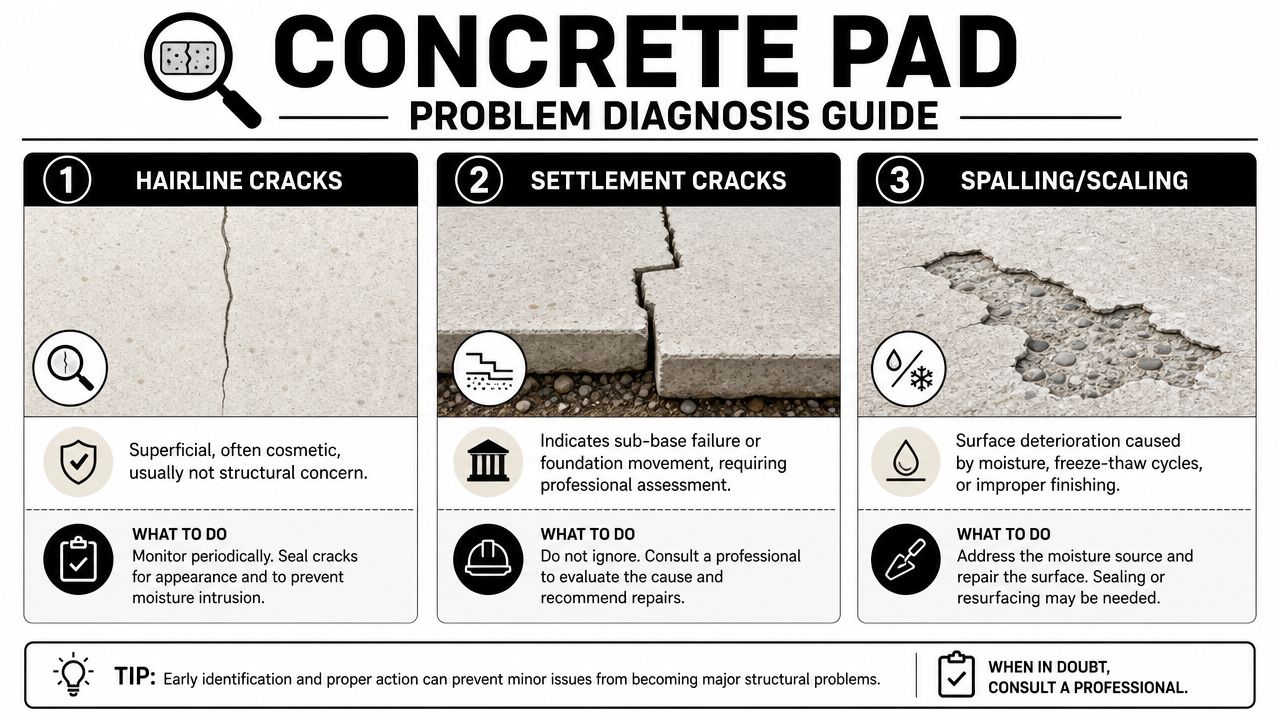
Hairline cracks versus movement cracks
A thin hairline crack that stays flat on both sides is often less concerning than a crack with vertical displacement. The difference in elevation matters more than the crack itself.
Here are the patterns to pay attention to:
- Hairline cracks: Usually shallow and often related to shrinkage or minor surface stress.
- Uniform flat cracks: Worth watching, especially if they begin to widen or collect water.
- Cracks with one side higher: This points to movement, heaving, or settlement.
- V-shaped cracks: If the crack is wider at the top than below, it can suggest surface stress or opening movement.
- Stepped or wandering cracks near corners: Often worth a closer professional look, especially on load-bearing pads.
For structural cracks, the repair has to match the failure mode. Guidance from the Dam Safety concrete repair techniques reference notes that epoxy injection is used when a crack needs structural restoration and a monolithic bond. The same guidance warns that if the cause of cracking isn't corrected first, the crack is likely to return.
A surface patch over an active movement crack usually looks good before it fails.
Surface damage versus full-depth damage
Not every failing slab starts with a dramatic crack. Some begin with the top wearing away.
Look for these signs:
| Problem type | What it looks like | What it often means |
|---|---|---|
| Hairline surface cracking | Thin lines with little depth | Often cosmetic, but monitor for change |
| Spalling or scaling | Flaking, pitting, rough top surface | Moisture exposure, freeze-thaw stress, or weak surface layer |
| Edge breakup | Corners or sides crumbling | Weak edge support, impact, or water infiltration |
| Local sinking | One section lower than the rest | Void below slab or sub-base failure |
If you want a homeowner-focused guide on prevention, this article on how to prevent a concrete slab from cracking helps explain why prep and drainage matter so much before concrete is ever poured.
A quick walk-around checklist
Walk the pad and check these points:
- Stand back first: Does the slab look level from a distance?
- Check water behavior: After rain, where does water sit or run?
- Look at nearby grade: Is soil sloped toward the slab?
- Inspect edges: Breaking edges often reveal support problems early.
- Note nearby structures: If it's supporting a garage, hot tub, container, or shed, movement matters more.
For homeowners searching for concrete contractors, garage foundation contractors near me, or shed foundations near me, this is usually the point where a trained inspection saves money. The repair choice only works if the diagnosis is right.
DIY Concrete Repair What You Can and Cant Fix Yourself
Some concrete pad repair jobs are reasonable for a careful homeowner. Others aren't. The line is usually not about confidence. It's about whether the defect is cosmetic or tied to movement, support loss, or structural load.
What you can usually handle
If the slab is still level and solid, and the damage is minor, a DIY repair may make sense. Small surface chips, shallow spalls, or non-structural cracks can often be cleaned up and sealed.
A reliable patch workflow follows the same fundamentals used in better trade guidance. The Lowe's concrete repair guide recommends removing all unsound concrete, cleaning away dust and debris, pre-wetting the area to a saturated-surface-dry condition, using a bonding agent, placing the repair material, then finishing and protecting it with slow, moist curing.
A practical DIY sequence looks like this:
- Remove weak material: Use a hammer and chisel or grinder to get rid of loose concrete.
- Clean thoroughly: Dust kills bond. Vacuum, brush, and rinse as needed.
- Pre-wet the patch area: Damp concrete won't pull moisture out of the repair mix too fast.
- Apply bonding agent: Follow the product directions closely.
- Place and finish the patch: Match the slab surface as well as you can.
- Cure it slowly: Don't let the patch dry out too fast.
What usually goes wrong in DIY work
The biggest DIY mistake isn't choosing the wrong patch mix. It's bonding new material to dirty, weak, or moving concrete.
Another common problem is patching over a wet area without fixing the water source. If downspouts, poor slope, or runoff are feeding the same spot, the patch won't last long. Homeowners also tend to underestimate curing. A repair that looks hard after a short time still needs protection from rapid drying.
Field advice: If the slab is moving, lifting, or rocking underfoot, patch material won't solve the real issue.
What you should not try yourself
Leave these repairs to professionals:
- Structural cracks: Especially cracks with height difference, repeated reopening, or signs of movement.
- Sunken slabs: Lifting a settled pad correctly requires the right method and diagnosis.
- Wide-spread deterioration: If large sections are failing, isolated patching becomes a short-term cosmetic fix.
- Pads carrying real load: A concrete foundation for garage, hot tub slab, barn slab, or container base needs to be assessed for performance, not just appearance.
DIY repair is best for minor defects on stable concrete. If the slab supports a 10×10 storage shed, a barn shed, a gazebo, or garage use, and the surface problem may trace back to the base, that's where professional concrete pad repair becomes the safer call.
Professional Repair Methods and Lasting Results
When homeowners start calling around for concrete contractors near me or garage foundation contractors near me, they often get quotes with methods listed but not fully explained. The method matters because each one solves a different problem.
Which repair method fits which failure
Some repairs are about bond. Some are about appearance. Some are about restoring support under the slab.
Here is a plain-language comparison:
| Repair Method | Best For | How It Works | Consideration |
|---|---|---|---|
| Crack filling or sealing | Minor non-structural cracks | Fills the opening to reduce water entry | Doesn't correct movement |
| Epoxy injection | Structural crack repair | Bonds crack faces to restore monolithic behavior | Only works if underlying cause is corrected |
| Resurfacing | Worn or scaled surfaces | Adds a new top layer over prepared concrete | Base slab still needs to be sound |
| Slab lifting or leveling | Sunken but salvageable pads | Raises slab by filling voids below | Won't help if slab is badly broken |
| Partial-depth patching | Local surface damage | Removes weak spots and rebuilds affected area | Limited to sound surrounding concrete |
| Full-depth section repair | Severely damaged sections | Removes and replaces the distressed part of the slab | More invasive, but often more durable |
What the price range usually tells you
Concrete pad repair costs vary with the method and severity. According to this concrete repair cost guide, small crack fixes can run $100 to $1,000, while more involved leveling or resurfacing commonly lands around $500 to $6,000+. The same guide cites driveway repair as a useful slab-on-grade benchmark, with 2026 repair costs averaging about $1,802, a typical range of roughly $829 to $2,830, simple crack filling at $0.50 to $3 per linear foot, and full replacement at $6 to $14 per square foot.
That spread is why two slabs that both "have cracks" can get very different quotes. One may need a localized repair. The other may need lifting, base correction, and surface restoration.
What professional work does better
Professional repair isn't just stronger because of the material. It's stronger because of the sequence and judgment behind it.
For example:
- Crack injection is chosen when the crack itself needs structural restoration.
- Resurfacing makes sense when the slab is sound but ugly, pitted, or weathered.
- Slab lifting addresses settlement by dealing with support loss below.
- Full-depth repair is the right move when a section has deteriorated beyond patching.
For homeowners comparing cement foundations for garage, garage footings and foundations, or repairs to an older slab, this is where a detailed site review matters. A low quote that ignores drainage or subgrade issues can turn into a repeat repair.
Repair works best when the contractor can explain not only how they will fix the slab, but why that method matches the way the slab failed.
Should You Repair or Replace Your Concrete Pad
The hardest question isn't whether concrete can be repaired. It usually can. The key question is whether repair is still the smart investment.
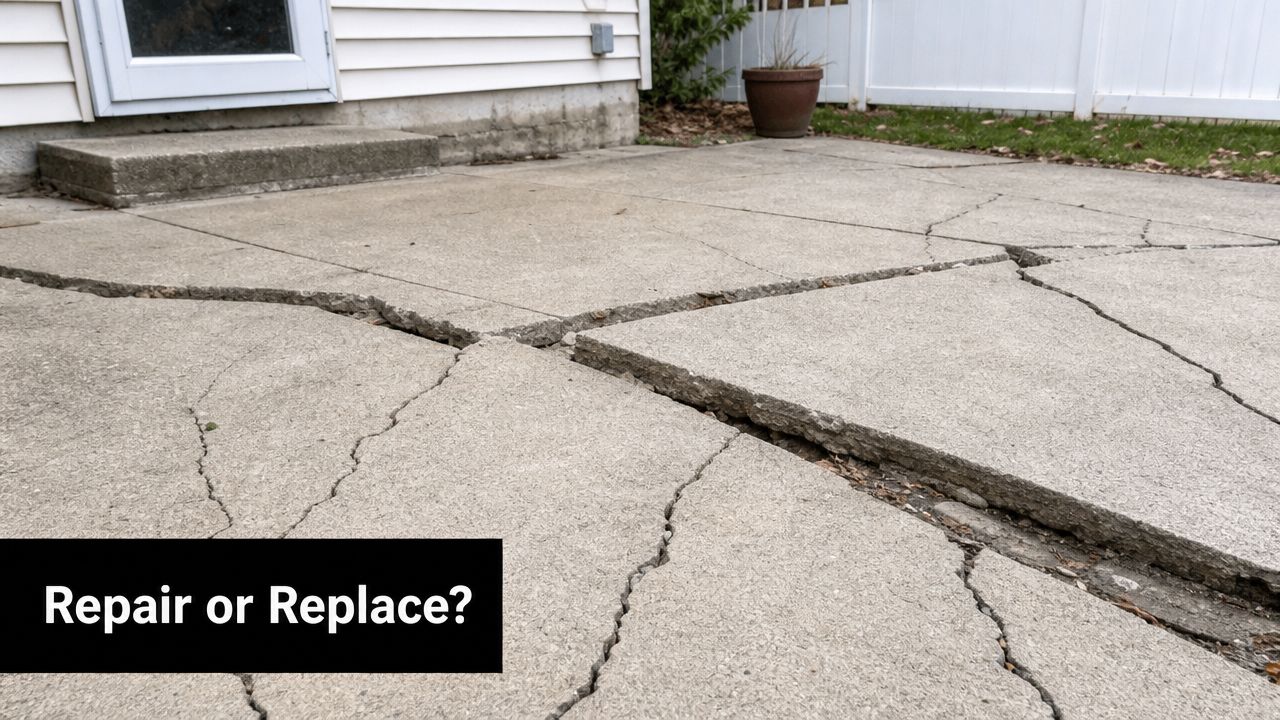
A repair makes sense when the slab is sound, the damage is limited, and the support conditions can be trusted. Replacement makes more sense when the slab keeps moving, the base is failing, or the pad has to carry reliable load for years without callbacks.
When repair is the better move
Repair is often the better option when:
- The slab is still structurally sound: The problem is limited to isolated cracks, small chips, or minor settlement.
- The use is lighter duty: A walkway or patio may tolerate localized repair better than a loaded garage slab.
- The base issue is small and correctable: Drainage adjustments or local support restoration may save the slab.
- You want to preserve an otherwise good pad: Especially if the defect is concentrated in one area.
When replacement is the smarter investment
For load-bearing pads, one question matters more than anything else. Will the repaired slab reliably meet load and moisture requirements for the next 10 to 20 years, as discussed in this repair versus replacement discussion for concrete slabs? That same guidance notes that deep cracking, large potholes, or severe sinking can push a slab past the point where repair makes sense.
That comes up often with:
- Garage slabs
- Hot tub pads
- Shipping container bases
- Barn slabs
- Shed pads that support heavier prefab structures
If a slab has repeated settlement, major cracking, moisture issues, and a weak base, replacement gives you the chance to fix the whole system. That means excavation, grading, compaction, drainage planning, forms, reinforcement where appropriate, and a slab built for the actual use.
If you're weighing that option, this page on concrete pad installation is a helpful reference for what goes into a properly built new slab.
Here's a useful visual on how replacement decisions are approached in practice:
Don't ignore the base beneath the pad
Homeowners often search for gravel shed foundation contractors near me, shed foundation gravel base, or excavation near me only after a concrete slab has already started failing. In many cases, that's the right instinct. The long-term value is often below the slab, not on top of it.
The same logic shows up in larger rebuild work too. While it's a different project type, this overview of Brisbane knock down rebuilds is a good reminder that when the underlying structure no longer supports the goal, rebuilding can be more practical than layering repairs onto a compromised base.
For a house foundation, foundation builds, or any serious pad carrying weight, replacement isn't overkill when the support system is the problem. It's often the cleanest path to a durable result.
Get a Reliable Foundation from Your Local Experts
Good concrete pad repair starts with a simple question. Is the slab damaged, or is the site failing underneath it?
That distinction changes everything. A cosmetic crack may need a straightforward repair. A settled slab may need drainage correction, excavation, subbase work, and either lifting or replacement. If the slab supports a shed, garage, gazebo, patio, driveway, horse barn, or storage structure, the costliest mistake is treating the visible defect while ignoring the cause.
What lasting work looks like
Concrete repair is a mature, technical field. The Federal Highway Administration's guidance on full-depth repair shows that proper work follows a sequence: survey the area, saw and remove damaged concrete, prepare the subbase, place and finish the repair, and cure it correctly. The same FHWA reference notes that the U.S. spends about $18 to $21 billion per year on the repair and rehabilitation of concrete structures, which shows how established and engineered this work really is in practice. You can review that process in the FHWA full-depth concrete repair guidance.
That should reassure homeowners. Durable results don't come from guesswork. They come from diagnosis, preparation, and matching the repair to the actual failure.
What to do next if your pad is cracking or sinking
If you're in Pennsylvania, Maryland, Delaware, or New Jersey and you're noticing slab movement, edge breakup, cracking, or drainage trouble, act before the defect spreads.
Use this short decision guide:
- Monitor small stable cracks: Especially if there's no sinking or height change.
- Call for an assessment if the slab has settled: Movement usually means support loss below.
- Take load seriously: Pads under garages, containers, hot tubs, and larger sheds need more than a cosmetic fix.
- Ask about site prep: Drainage, grading, and subbase condition should always be part of the conversation.
The homeowners who get the best outcome usually ask the right question early. Not "How do I patch this?" but "Why did this happen, and what will keep it from happening again?"
If you need a quote for concrete pad repair, a new shed pad, a gravel base, a garage slab, excavation, or a full concrete foundation in Pennsylvania, Maryland, Delaware, or New Jersey, contact Firm Foundations. As a licensed and insured local contractor, they build and repair foundations with attention to drainage, subgrade stability, and long-term performance, so you get a solution that fits the structure and the site, not just a surface-level fix.