
Garage Floor Vapor Barrier: Prevent Moisture Damage
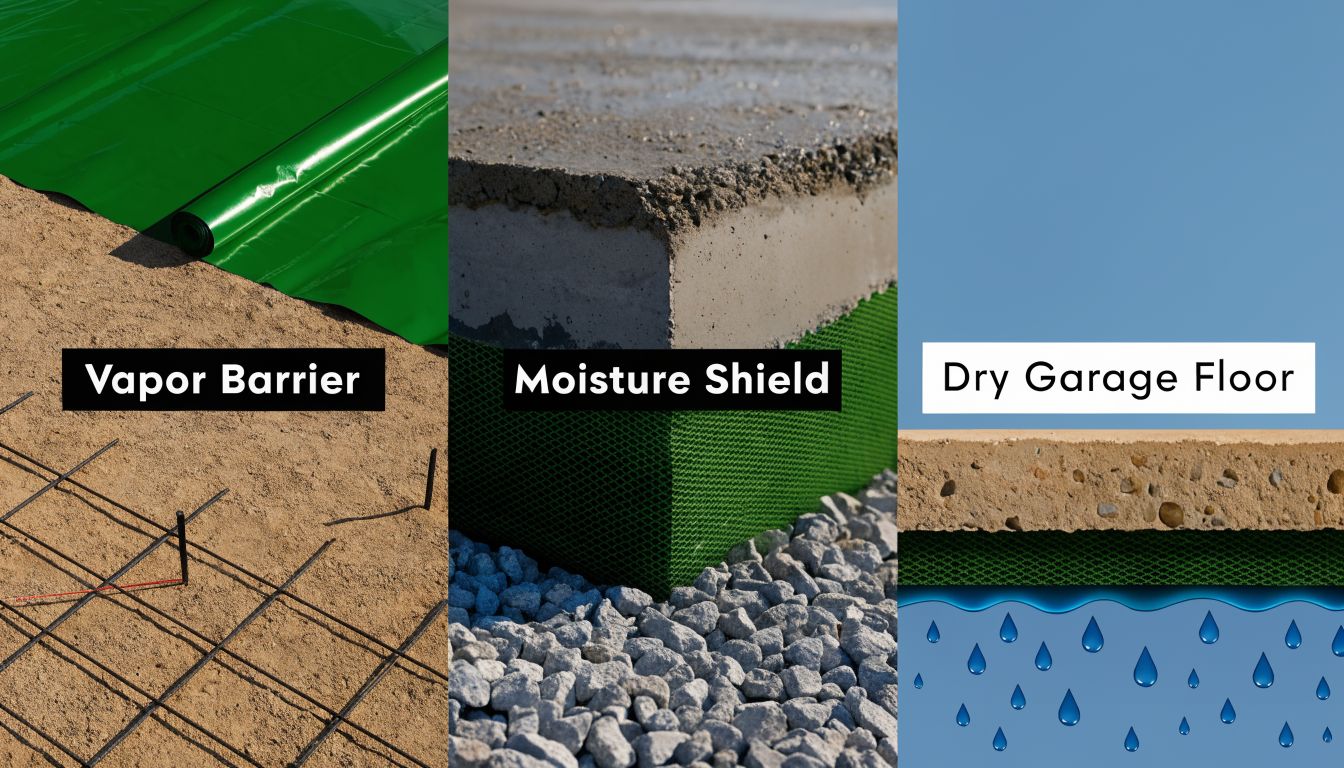
You’re probably thinking about the visible parts of the project right now. The garage doors, the siding, the roofline, the storage layout, maybe even whether you’ll coat the floor later. That’s normal. But the part that decides whether that garage stays dry and dependable is the slab assembly underneath it.
In Pennsylvania, Maryland, Delaware, and New Jersey, moisture is rarely a theoretical issue. It shows up as a damp smell, white residue on concrete, peeling paint, failed epoxy, rust on stored tools, and cardboard boxes that never seem fully dry. A garage can look solid from day one and still have a moisture problem built into it if the slab was poured without the right protection below.
That’s why the garage floor vapor barrier matters so much. If you’re planning a new garage, workshop, barn shed, or even a concrete foundation for garage storage, this is one of the details worth settling before the truck ever arrives.
Protecting Your Investment in a New Garage
A new garage usually starts with good intentions. You want a clean place for vehicles, a workshop that isn’t cramped, or a dry spot for seasonal storage. Homeowners in places like Honey Brook Township and throughout the Mid-Atlantic also want a building that feels finished, not a structure that turns musty after the first stretch of wet weather.
The trouble is that moisture problems often start below the slab, where nobody sees them during construction. Concrete looks dense, but it doesn’t stop ground vapor by itself. If damp soil sits below the slab, that moisture can move upward over time and affect what sits on the floor and what gets installed over it.
What homeowners notice first
The first signs are usually small:
- Stored items feel damp: Metal tools flash-rust, boxes soften, and anything left on the floor picks up moisture.
- Floor coatings don’t last: A garage that seemed ready for epoxy starts bubbling or peeling later.
- The space never feels fully dry: Even with the doors closed, the air can feel heavy.
That risk is higher in PA, MD, DE, and NJ, where humidity, rainfall, groundwater conditions, and freeze-thaw cycles all work against slab performance. If you’re searching for garage foundation contractors near me, concrete foundations, or cement foundations for garage, you want more than a flat slab. You want a slab system that handles local conditions from the start.
Practical rule: The best time to solve slab moisture is before the pour. After the concrete cures, every fix gets harder and more expensive.
For garages, shed foundation projects, gazebo foundation work, and larger foundation builds, the smartest approach is simple. Build the base for drainage, then install the right vapor protection before concrete goes down. That one choice has a direct effect on how the slab performs for years.
What Is a Garage Floor Vapor Barrier
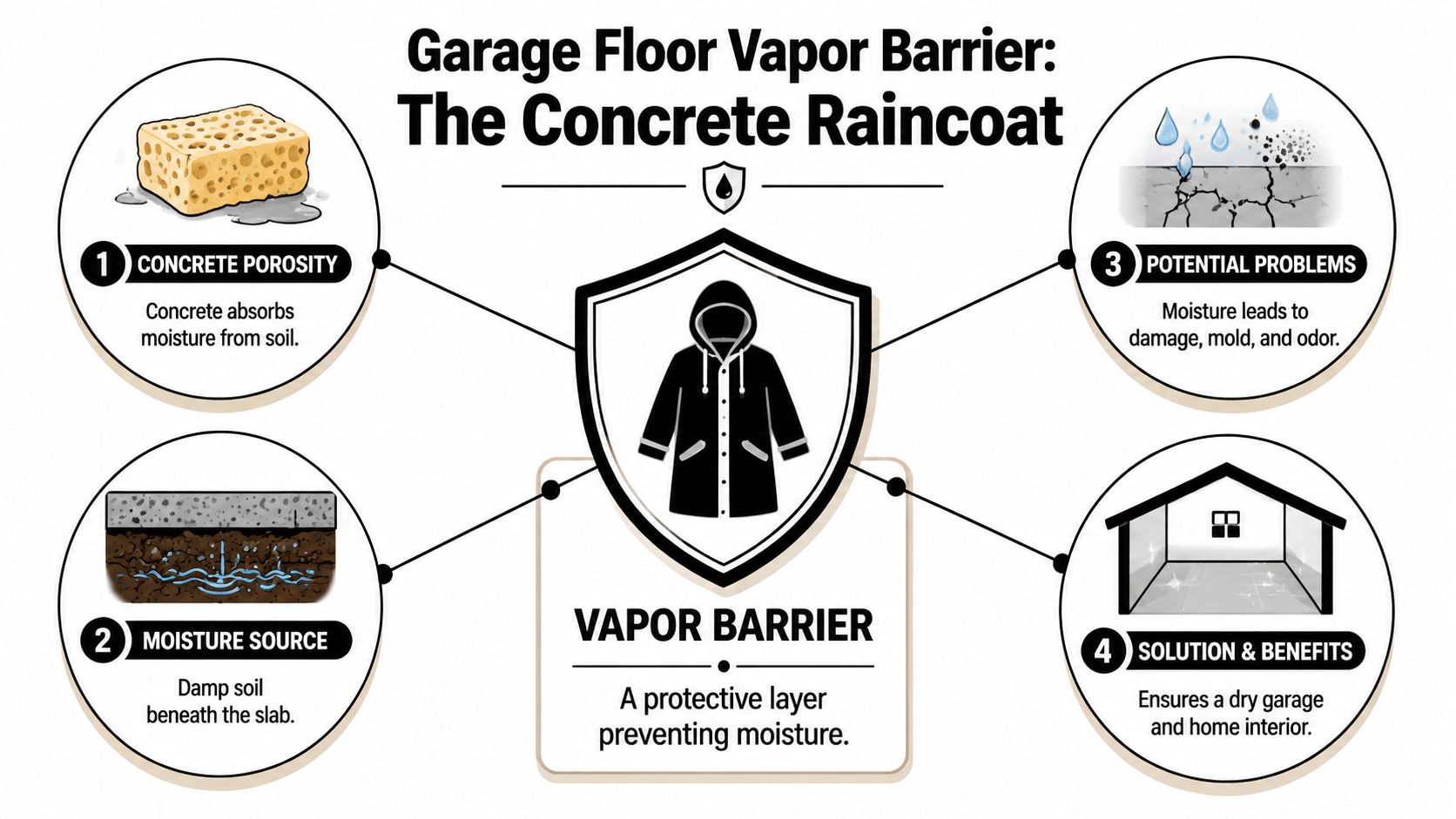
A garage floor vapor barrier is the membrane placed directly under the concrete slab to limit moisture vapor coming up from the soil. In plain jobsite terms, it separates a dry slab from damp ground. That matters a lot in PA, MD, DE, and NJ, where humid summers, wet seasons, and freeze-thaw cycles keep soil moisture in play for much of the year.
Concrete is porous. It will transmit moisture over time, even when the surface looks clean and dry. In a garage, that moisture shows up later as peeling coatings, damp storage, rust on tools, and a floor that never seems to stay fully dry.
Vapor barrier vs vapor retarder
Homeowners hear both terms on estimates and inspection reports, and the terms often get mixed together. The practical difference is simple. A vapor retarder slows moisture. A vapor barrier allows much less vapor to pass through.
That distinction matters most when the garage is expected to do more than hold a car. If the slab may get epoxy later, support a workshop, or store cardboard, lumber, and seasonal items, lower vapor transmission gives you more margin for error over the long haul. Meeting the minimum code for an unheated garage is one standard. Building for Mid-Atlantic conditions is another.
In this region, I treat that as a real trade-off, not a technicality. Code exceptions for some garages can lead homeowners to skip under-slab protection entirely. The slab still sits over damp ground, and the climate does not care whether the garage is heated.
Why the barrier belongs under the slab
A proper under-slab barrier helps control problems that are expensive to chase after the pour:
- Floor finish failures: Moisture pressure can ruin epoxy, paint, and adhesive-backed products.
- Musty garage conditions: A slab that keeps pulling vapor upward can add to that heavy, damp feel.
- Damage to stored items: Boxes, wood, and metal tools all hold up better in a drier space.
- Surface residue and discoloration: Moisture movement can leave mineral deposits and uneven appearance over time.
A sealer on top of the slab can help with surface wear and cleanup, but it does not replace under-slab protection. Homeowners planning coatings should understand the difference between a membrane below the concrete and a concrete slab sealer for the finished surface.
For a basic detached garage, some builders still follow the minimum and move on. I do not recommend that approach in the Mid-Atlantic if the goal is long-term performance. Once the concrete is down, you do not get a second chance to install the layer that should have been under it.
Vapor Barrier Materials and Specifications
Material choice decides whether the slab gets real protection or just a layer that looks good on the plan. I see homeowners get told, “It’s all plastic under concrete,” and that shortcut usually leads to the wrong product.
For a garage slab in PA, MD, DE, or NJ, I care about three specs first. Thickness, puncture resistance, and permeance. If the sheet gets torn during placement or lets too much vapor pass, the rest of the assembly loses value fast.
What changes from 6-mil to 15-mil
The jump from 6-mil to 10-mil or 15-mil is not just about a thicker roll. It is about surviving the work before the concrete is even placed. Foot traffic, stone base, wire mesh, rebar chairs, and turning a buggy across the slab area can damage light poly much more easily than an engineered barrier.
That matters in Mid-Atlantic garage work because the long-term risk is not theoretical. Humid summers, wet subgrades, and winter freeze-thaw cycles put more stress on the slab system than homeowners expect. A sheet that barely meets a minimum standard for one job does not give the same margin for error on a garage that may later get epoxy, tile, or stored contents that do not handle moisture well.
For that reason, I treat ASTM E1745 Class A as a better target than basic poly for many garage slabs in this region. A 15-mil product such as Stego Wrap lists a water vapor permeance of 0.0086 perms, puncture resistance of 2,266 grams, tensile strength of 70.6 lbf/in, and vapor transmission reduction of over 99% compared with standard 6-mil poly, according to Stego’s 15-mil vapor barrier specifications.
Vapor Barrier Material Comparison
| Material Spec (Thickness) | Permeance Rating | Puncture Resistance | Best For |
|---|---|---|---|
| 6-mil poly | Higher permeance than engineered barriers | Lower resistance to jobsite damage | Bare-minimum installs where future coatings and moisture control are not major concerns |
| 10-mil engineered barrier | Lower permeance than basic poly | Better durability during placement | Garage slabs where the owner wants better protection without stepping up to the heaviest sheet |
| 15-mil Class A barrier | Very low permeance | High puncture resistance | Garages with epoxy plans, stored tools or materials, and sites with heavier moisture exposure |
What a low perm rating really means
Low perm ratings matter most after the slab is finished and in service. Less vapor gets through from the ground below. That gives coatings, adhesives, stored items, and the slab surface itself a better chance to stay in good shape over time.
A surface treatment still has its place, but it does a different job. Homeowners comparing below-slab protection to a finished-surface product should read about concrete slab sealer options for the top of the slab separately, because a sealer does not replace the membrane under the concrete.
One more field point. The best material on paper can still fail if seams are not taped, penetrations are left open, or the crew punches holes through it and keeps pouring. Good specs help. Careful installation is what makes those specs worth paying for.
PA MD DE & NJ Code and Climate Rules
A garage slab in this region can look fine at final inspection and still become a moisture problem a few years later. I see that happen when an owner is told an unheated garage is exempt, so the crew skips the under-slab vapor retarder or installs the thinnest sheet they can get away with.
The code issue is straightforward. The 2012 International Residential Code R506.2.3 calls for a 6-mil vapor retarder below residential concrete slabs, with an exception that can apply to unheated accessory structures such as garages. That exception may satisfy the inspector in some cases. It does not change the conditions under the slab in Pennsylvania, Maryland, Delaware, and New Jersey.

Why the exception is risky in the Mid-Atlantic
Our local climate is hard on garage slabs. Summers are humid. Storm cycles leave the soil wet for long stretches. Winter brings freeze-thaw movement, and snow-covered vehicles add more water at the surface after the slab is already dealing with moisture from below.
That combination is why minimum code and good building practice are not always the same thing here. A detached garage may be unheated on paper, but owners still park inside, store tools, keep cardboard boxes on the floor, and later decide they want a coating. Once that garage starts functioning like real usable space, skipping below-slab moisture protection becomes a gamble.
I would rather see a slab built for the site than built only for the inspection sticker.
Code minimum versus a slab built to last
In this region, the trade-off usually comes down to upfront cost versus future options.
- Code minimum: May allow no vapor retarder under some unheated garage slabs, or a basic thin membrane where required.
- Better practice: Uses a heavier under-slab barrier that is less likely to tear during placement and does a better job limiting ground moisture over time.
- Best fit for many Mid-Atlantic garages: Build as if the space will see wet cars, seasonal humidity, and a possible floor coating later.
That last point matters. Homeowners rarely regret installing a better barrier before the pour. They do regret finding out later that the floor sweats, stored items pick up moisture, or a coating will not perform well because vapor is pushing through the slab.
Local soil and drainage conditions also affect the decision. A garage on a well-drained site is different from one near a high water table, at the bottom of a slope, or on fill that stays damp after storms. Good contractors look at the whole pad, not just the concrete thickness. Proper grading and base prep are part of the same moisture-control plan, which is why the site preparation for a concrete slab deserves as much attention as the membrane itself.
Passing code has its place. Building for Mid-Atlantic conditions gives the slab a better chance to stay dry, stable, and useful for the long haul.
Proper Vapor Barrier Installation Under Concrete
A premium membrane won’t save a bad install. Under-slab vapor protection works only when the crew treats it like part of the foundation system, not an accessory thrown down right before the pour.
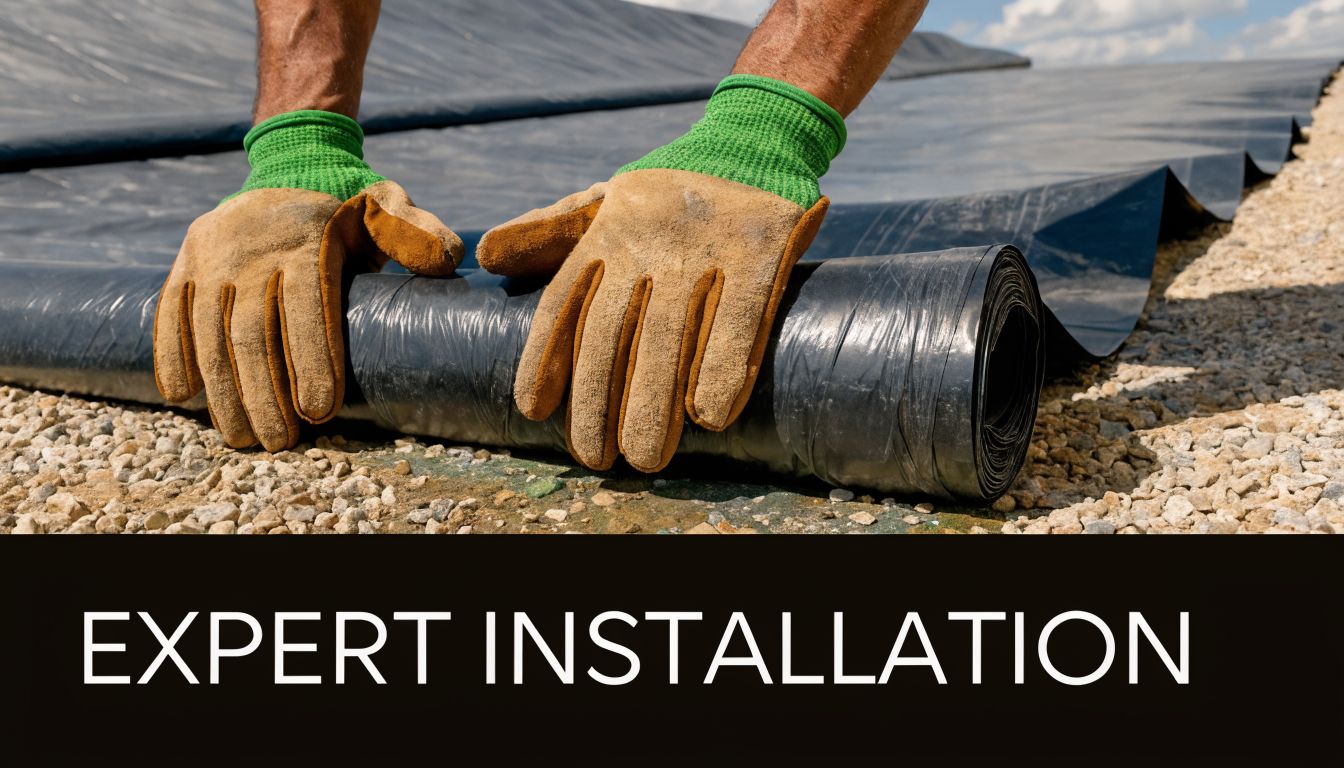
The starting point is the base. The subgrade needs to be shaped correctly, compacted, and topped with a stable gravel layer that supports drainage and gives the slab a consistent platform. If you’re comparing project scopes, this overview of site preparation for concrete slab work shows why the prep phase matters as much as the pour.
What correct installation looks like
The membrane gets rolled out over the prepared base before reinforcement and concrete placement. Seams need to be overlapped and sealed so the system acts like one continuous layer, not a patchwork.
For products in this class, overlaps are commonly handled in the 6 to 12 inch range with tape, and the older IRC language referenced earlier requires joints lapped at least 6 inches for the residential slab application it governs. The key is continuity. Any break in the barrier creates a path for vapor.
The crew also needs to protect the material while they work. Punctures usually happen at the most ordinary moments. Dragging tools, setting steel, moving forms, or careless foot traffic.
Details that separate a durable install from a weak one
- Seams must stay sealed: Loose overlap without the right tape is not enough.
- Penetrations need attention: Pipes and conduit can’t be left as rough cut holes.
- Damage has to be repaired before the pour: Once concrete is down, that opportunity is gone.
- Concrete should go directly over the barrier when the assembly is designed for direct contact: Adding loose material above it can work against the moisture-control goal.
This short video gives a helpful visual on under-slab prep and placement details:
Field advice: If a crew treats the vapor barrier like packaging instead of a system component, expect problems later.
Homeowners searching for concrete contractors, excavation near me, or garage foundation contractors near me should ask one simple question: how do you handle seams, penetrations, and puncture repair before the pour? A solid answer tells you a lot.
Troubleshooting Moisture in Existing Garage Floors
If your garage is already built and the floor paint is peeling, the epoxy is blistering, or the slab always feels damp, the issue may be moisture moving through the concrete from below. At that stage, you’re no longer choosing an under-slab barrier. You’re diagnosing a slab that has already cured without enough moisture control.
The right fix starts with testing, not guessing. Contractors should verify the slab’s moisture condition before recommending another coating. One common benchmark is in-situ relative humidity testing under ASTM F2170, especially when the garage is going to receive a resinous finish.
When a topical moisture barrier makes sense
For an existing slab with high moisture, a 100% solids 2-part epoxy MVB can be an effective repair path. According to the DRYTEK Moisture Vapor Barrier product data, it can reduce MVER from 25 lbs to less than 3 lbs, help prevent 95% of moisture-induced coating failures, cure in 4 to 6 hours, and tolerate 100% relative humidity after proper surface preparation.
That kind of system isn’t paint. The slab usually needs to be mechanically ground first so the epoxy bonds to clean, properly profiled concrete. Once it cures, it creates a new moisture-control layer on top of the slab and gives the finish coat a more stable surface.
What this can and can’t do
A topical MVB is a strong solution for the right slab, but it’s still a repair strategy.
- It can help salvage an existing garage floor without removing the slab.
- It can support a new coating system when moisture has caused past failures.
- It can’t undo poor drainage outside the building if water management around the garage is still wrong.
If an old garage floor keeps rejecting coatings, the slab is usually telling you something. Listen to the moisture condition before buying another finish.
For homeowners with an older garage, this is often the line between a lasting fix and another round of peeling.
Get Your Garage Foundation Right with Firm Foundations
A garage slab only works as well as the system under it. That includes excavation, grading, the gravel base, drainage planning, the vapor barrier selection, and the way the crew installs every seam before concrete is poured. Miss one part, and the floor may still look good on day one while problems build underneath.
That matters even more if you plan to coat the floor later. A topical epoxy moisture vapor barrier can be very effective, but it has trade-offs. According to this garage floor moisture and UV performance analysis, epoxy MVBs can show yellowing within 12 to 18 months in the first few feet of a garage exposed to sunlight, while newer polyaspartic systems offer 2x UV resistance. The same source notes that adding 2 to 4 inches of permeable aggregate under slabs can cut MVER by 70%, which is one reason sub-base design still matters even when coatings enter the conversation later.

Why the full foundation plan matters
Homeowners often focus on the slab price and miss the sitework decisions that affect long-term performance. Grading, drainage paths, and base preparation all influence how much moisture pressure the slab sees over time. If you want a broader look at how site shaping affects project cost before foundation work begins, this TruTec grading and paving cost breakdown is a useful planning reference.
For new work, the best path is still the simplest one. Build the slab right the first time with a proper base and under-slab protection. That approach usually makes more sense than relying on coatings alone to solve avoidable moisture issues after the garage is already finished.
If you’re looking for shed foundations near me, gravel shed foundation contractors near me, garage foundation contractors near me, or reliable help with garage footings and foundations in PA, MD, DE, or NJ, the details covered above are what separate a temporary fix from a long-lasting slab.
If you’re planning a garage, shed, gazebo, barn shed, driveway, or other concrete foundation project in Pennsylvania, Maryland, Delaware, or New Jersey, Firm Foundations can help you get the base, drainage, and slab assembly right from the start. Reach out for a free, transparent quote and get a foundation built for the way Mid-Atlantic sites perform.