
Garage Floor Squeegee: A Pro Guide for PA & MD Homes
If you live in Pennsylvania, Maryland, Delaware, or New Jersey, you've probably opened the garage door after rain or a winter drive and found the same mess waiting for you. Melted snow, road grit, muddy tire tracks, and a shallow sheet of water sitting on the slab. Many homeowners see a cleaning chore.
A contractor sees a drainage test.
Water that lingers on a garage slab doesn't just make the floor dirty and slippery. It keeps moisture in contact with the concrete, settles into low spots, and works its way into the surface over time. For homeowners in the Mid-Atlantic, improper water removal from concrete can lead to up to 30% faster deterioration from frequent freeze-thaw cycles, according to this market analysis on floor squeegee use and concrete care.
That's why a garage floor squeegee matters more than people think. It's one of the simplest tools you can keep in the garage, but it plays a direct role in protecting the concrete slab, the finish on the floor, and the long-term durability of the foundation work underneath.
Why Your Garage Floor Needs More Than Just a Mop
A mop works fine in a laundry room. It's the wrong tool for a garage.
Garage floors collect heavier debris, more standing water, and more abrasive grime than most interior surfaces. A mop tends to spread dirty water around, especially when the floor has a broom finish, a slight slope, or the rough texture common on a newer concrete slab. A squeegee moves that water where you want it to go. Out the door, toward the drain, and away from the edges that matter most.
Concrete problems usually start small
Most slab damage doesn't announce itself with a dramatic crack overnight. It starts with routine exposure. Water sits along the perimeter. Mud and salt hold moisture against the surface. A low corner stays damp longer than the rest of the floor. Then winter arrives and that trapped moisture starts stressing the concrete.
Practical rule: If water is still sitting on your garage floor after the obvious puddles should've drained, the slab is telling you something.
That matters whether you're dealing with a brand-new garage, an older detached structure, or a new cement foundation for garage use that you want to keep in good condition for years.
Why a squeegee beats waiting for the floor to dry
Air-drying sounds harmless, but it leaves too much to chance. In a Mid-Atlantic climate, garages often stay cool, shaded, and slow to dry. That means moisture hangs around longer, especially near walls and garage footings.
A good garage floor squeegee helps with several practical jobs:
- Water removal: Pulls melted snow, wash water, and rain runoff off the slab quickly.
- Debris control: Moves sand, leaves, and grit before they grind into the surface.
- Post-project cleanup: Helps after pressure washing, vehicle leaks, or storm-related water intrusion.
- Foundation protection: Keeps water from repeatedly pooling along the slab edge.
If you've been searching for garage foundation contractors near me, concrete foundations, or garage footings and foundations in PA, MD, DE, or NJ, this is part of the bigger picture. Good construction starts with grading, compaction, forming, and drainage. Good ownership continues with simple habits that protect that work.
The hidden value of a dry slab
A dry garage floor is easier to walk on, easier to clean, and easier to inspect. You spot leaks sooner. You notice stains before they set. You catch drainage issues before they become repair issues.
That's a small tool doing a serious job.
How to Choose the Right Squeegee for Your Concrete Slab
Not every garage floor squeegee works well on every slab. The best choice depends on the surface texture, the amount of water you're moving, and whether the concrete is bare, sealed, or coated.
Start with the blade material
Most homeowners make the wrong choice at this stage. They buy whatever looks sturdy at the hardware store, then wonder why it leaves water behind.
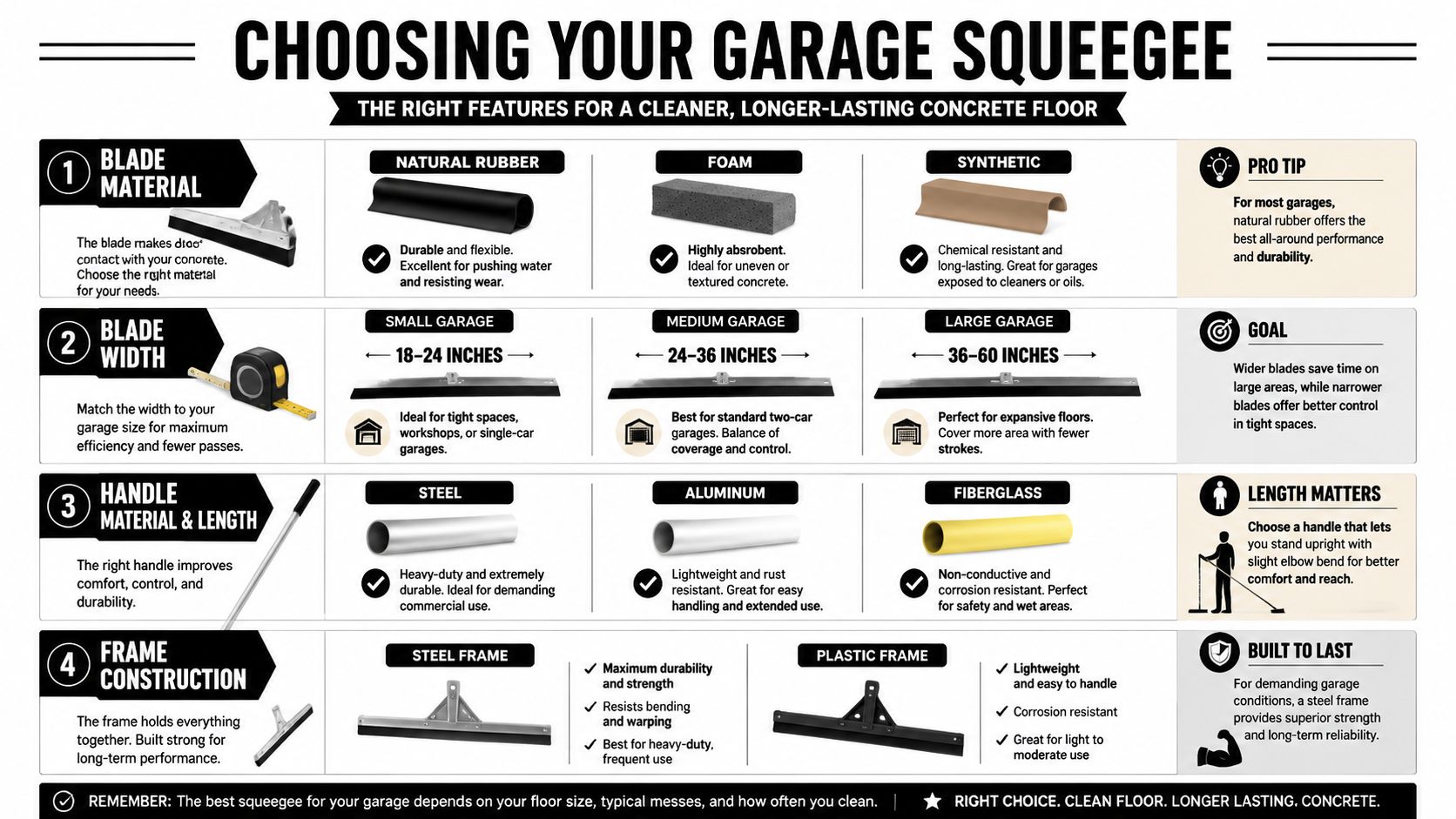
On textured or slightly uneven surfaces common with new concrete pads, foam blades demonstrate 95% water removal efficiency compared to 80% for standard rubber blades, according to the garage-surface compatibility note tied to this referenced video resource. That matters on broom-finished slabs, recently poured pads, and utility structures where the floor isn't polished smooth.
Use this rule of thumb:
| Surface type | Better blade choice | Why it works |
|---|---|---|
| New broom-finished concrete | Foam | Conforms better to texture and minor surface variation |
| Slightly uneven garage slab | Foam | Reaches shallow dips and crevices better |
| Smooth sealed concrete | Rubber or synthetic rubber | Gives a cleaner pass on flatter surfaces |
| Chemical-prone work area | Synthetic or chemical-resistant blade | Holds up better around oils and shop use |
If you're comparing slab types for a future build, this guide on the best concrete for a garage floor helps connect floor finish choices with long-term maintenance.
A new garage slab and an old painted floor don't behave the same way. Your squeegee shouldn't be the same either.
Match the width to the garage
A blade that's too narrow wastes effort. One that's too wide can chatter across the surface, especially if the slab has a pitch or minor irregularities.
For most home garages, an 18 to 24 inch model is the practical starting point. It's wide enough to clear water efficiently but still easy to control around tires, posts, stored tools, or the back wall. Medium and larger garages can handle a wider head if the floor is relatively open.
What matters most is control. A manageable squeegee that stays in full contact with the floor will outperform an oversized one that skips at the edges.
Don't ignore the handle and frame
The blade gets all the attention, but the frame and handle decide how the tool feels after a few minutes of real use.
Look for:
- A rigid frame: Flimsy plastic twists under pressure and leaves uneven passes.
- A comfortable handle length: You should be able to pull water without stooping.
- A secure connection point: Loose threaded handles make the tool feel sloppy fast.
- A corrosion-resistant build: Garages stay damp. Cheap metal parts don't age well.
If you want a broader look at durable warehouse sanitation and maintenance gear, it's useful to review the kind of commercial-grade equipment built for wet floors and heavier cleanup conditions. The same buying logic applies at home. Better materials usually mean smoother use and longer service life.
What works and what usually disappoints
The cheap combo broom-squeegee tools are convenient, but they often compromise both functions. The broom side doesn't sweep well, and the rubber edge doesn't sit flat enough to pull water cleanly. For a rough garage slab, that usually means multiple passes and leftover streaks.
A dedicated garage floor squeegee is the better buy if your goal is getting the slab dry.
The Professional Technique for Removing Water and Debris
Owning the right tool helps, but technique is what gets the floor dry instead of just less wet.
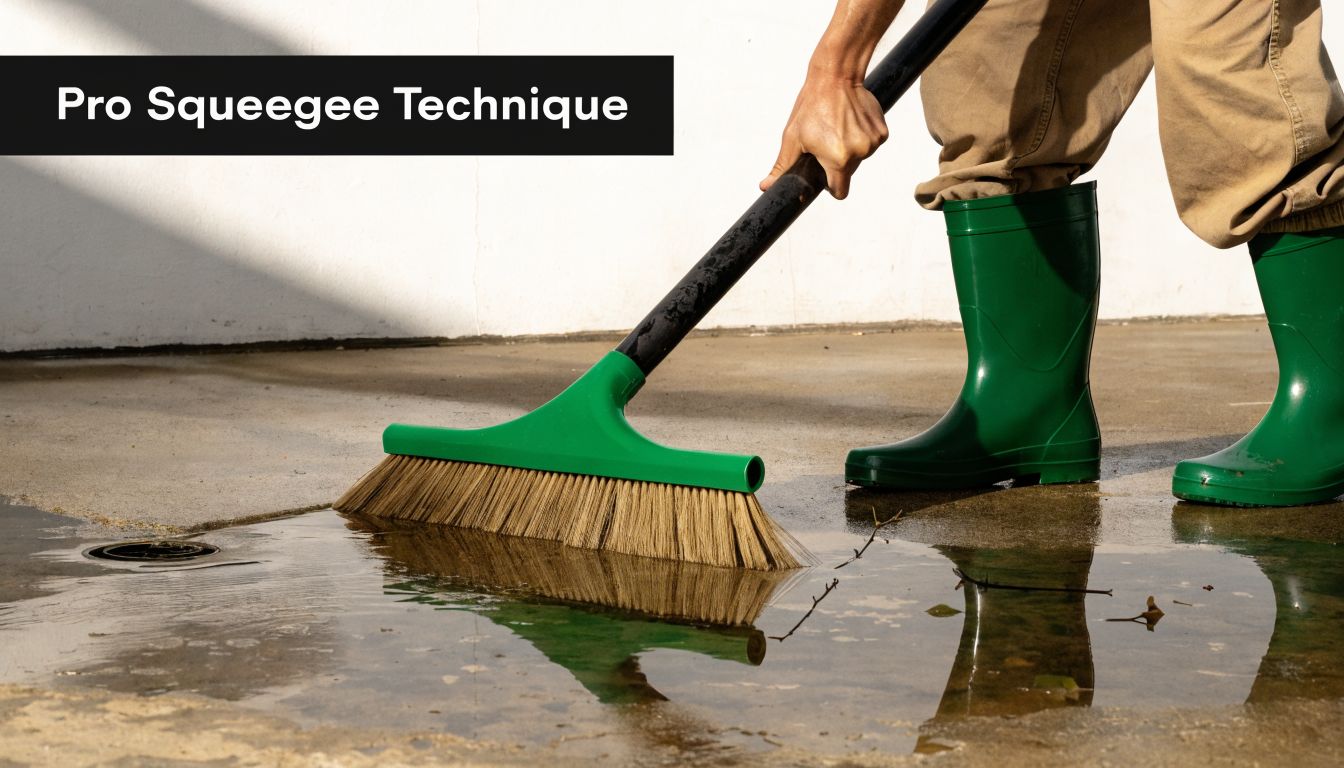
The biggest mistake homeowners make is pushing water randomly across the slab. That turns cleanup into a back-and-forth workout and usually leaves a damp film behind. A better approach is controlled, directional movement.
Use the blade angle correctly
For coating work, the verified epoxy application method calls for using a squeegee at a 45° angle as part of a controlled spread process, as noted in this professional notched squeegee reference. While cleaning a garage floor isn't the same as applying epoxy, that same angled contact principle helps with water control on concrete.
Keep the blade slightly angled instead of square to the direction of travel. That lets the water gather and roll ahead of the blade rather than slipping under it.
A simple method that works on most garage slabs
Use this sequence:
- Dry clear first. Sweep or shovel out leaves, gravel, and heavy debris before you touch standing water. Grit under the blade interrupts contact.
- Start at the high side. Most garages are built to direct water outward. Work with that slope, not against it.
- Pull more than you push. Pulling gives better control and helps you keep the blade flat.
- Overlap each pass. A slight overlap prevents thin wet strips between strokes.
- Finish the edges last. Perimeter cleanup matters because water likes to linger where slab meets wall.
Protect the slab perimeter
The center of the floor usually dries first. The trouble spots are around the edges, in front of the garage door, beside stored items, and anywhere the slab has settled slightly or was finished with a bit more texture.
Pull water away from walls and corners first if you notice repeated dampness there. That's where hidden moisture problems often start.
If you're cleaning after washing the floor or after a storm blew water inside, take an extra pass along the base of the walls and the inside corners. Don't leave a narrow ribbon of water behind just because the middle looks dry.
A quick visual walkthrough helps if you prefer to see floor-clearing motion in action:
What to do on rougher slabs and utility pads
A garage attached to the house isn't the only place this matters. The same technique applies to a shed foundation, a base for storage shed projects, a small workshop pad, or a utility slab beside a 10×10 storage shed.
On rougher concrete:
- Take shorter passes: Long strokes can skip over shallow dips.
- Use lighter pressure at first: Let the blade conform to the texture.
- Change direction if needed: Some broom finishes track better one way than the other.
This is the same mindset good concrete contractors use on site. Don't force the tool. Read the surface and work with it.
Using a Squeegee to Protect Your Garage Foundation
Water management is part of foundation care. That's true whether you're looking after a detached garage, a workshop slab, or a larger concrete pad tied into other site work.
A lot of homeowners think slab damage only comes from bad concrete. Poor maintenance plays a role too. If water repeatedly sits on the same parts of the floor, it can increase surface wear, expose weak drainage patterns, and keep stress concentrated in the same areas.
Why standing water is harder on concrete than it looks
Concrete is durable, but it isn't invincible. It performs best when water moves off the slab the way the site was intended to handle it. When that doesn't happen, moisture can linger in low spots, around control joints, and near the slab edge.
Properly squeegeeing a garage floor to prevent water pooling can reduce the risk of concrete cracking from hydrostatic pressure by up to 25%, especially in regions like Pennsylvania that experience over 40 freeze-thaw cycles annually, according to this historical and practical squeegee reference.
That's a strong argument for a simple habit. Remove the water while it's still on the surface, and you reduce one source of long-term stress on the slab.
What repeated pooling usually tells you
If you need the squeegee in the exact same spot every time it rains, don't ignore that pattern. It can point to:
- Minor surface low spots: Common on older slabs or heavily used garage floors.
- Drainage issues at the door: Water may be entering faster than it exits.
- Improper exterior grading: Runoff might be moving toward the garage.
- Settlement or movement: If the puddling pattern changed, the slab may need evaluation.
A homeowner can manage surface water. A recurring drainage problem deserves a closer look. If you've already noticed signs of movement, this overview of the consequences of foundation cracks gives a useful high-level explanation of why small warning signs shouldn't sit too long.
A squeegee handles the symptom on the floor. If the same symptom keeps returning, check the slope, the grading, and the slab itself.
Simple maintenance versus a bigger site problem
Use the squeegee after storms, after washing vehicles inside, and after winter runoff from tires. That's smart routine maintenance. But if water consistently returns to the same location, maintenance alone won't solve it.
At that point, think bigger than cleanup. The issue may involve the slab pitch, adjacent concrete, surrounding soil, or a drainage path that was never corrected. Homeowners researching excavation near me, garage foundation contractors near me, or ways to stop slab damage are usually already at that point.
If you want a practical companion read, this article on how to prevent a concrete slab from cracking ties together drainage, surface care, and the kind of site conditions that matter long term.
Your Next Step for a Lasting Foundation
A garage floor squeegee won't replace good site prep, proper forming, or quality concrete work. It does help protect all of it after the job is done.
Keep the tool simple and dependable. Rinse the blade after use, especially if you're moving road salt, grit, or oily residue. Check the edge for wear. Store it so the blade stays straight instead of bent or crushed against the floor. A well-kept squeegee works better and makes it more likely you'll use it when the garage gets wet.
A small maintenance habit that supports bigger investments
This is the part many homeowners miss. Foundation durability doesn't depend on one big decision alone. It comes from a series of good ones. Proper excavation. Correct base prep. Thoughtful drainage. A well-finished slab. Then consistent care after the build.
If your garage floor is coated or you're thinking about one, the Newline Painting garage floor guide offers a helpful look at how floor systems change cleaning and maintenance habits. The same principle applies either way. Water shouldn't sit on the slab any longer than necessary.
For homeowners in Honey Brook Township and throughout Pennsylvania, Maryland, Delaware, and New Jersey, that matters whether you need a new garage slab, a gravel shed foundation, a gazebo foundation, a house foundation, or help from driveway contractors near me and concrete contractors planning related site work.
A clean garage looks better. A dry garage performs better. And a slab that stays dry has a better chance of lasting the way it should.
If you're planning a new garage, replacing an old slab, or searching for shed foundations contractors near me, garage foundation contractors near me, or durable concrete foundations in Honey Brook Township or nearby areas, Firm Foundations is ready to help. We build gravel pads, garage slabs, shed foundations, driveways, and excavation projects across PA, MD, DE, and NJ with a focus on drainage, structural integrity, and long-term durability. Request a free quote and get a foundation built the right way from the start.