
Garage Floor Kit vs Pro: A PA Contractor’s Guide


You walk into the garage, look down, and see the same thing you've been seeing for years. Tire marks. Oil stains. Dust that never really goes away. Maybe a few hairline cracks. Maybe a bigger crack that keeps catching your eye every time you carry groceries in through the garage.
So you start searching for a garage floor kit. The box at the hardware store looks simple enough. Clean the floor, roll it on, throw some flakes, and by the weekend your garage looks finished.
That idea is appealing because it feels fast and affordable. In some cases, it can improve the look of the floor for a while. But in Pennsylvania, a garage floor coating usually doesn't succeed or fail because of the kit itself. It succeeds or fails because of the concrete slab underneath it.
A floor coating can only bond to the surface it's given. If the slab is holding moisture, too smooth, poorly drained, or already moving from base problems, the coating becomes a cosmetic layer on top of a structural problem. That's why many homeowners end up recoating the same floor instead of solving the reason it keeps peeling, bubbling, or cracking in the first place.
Thinking About a Garage Floor Kit for Your PA Home?
A lot of Pennsylvania homeowners start in the same place. They're not trying to build a showroom. They just want a garage that feels cleaner, looks better, and doesn't leave concrete dust on everything stored inside.
The search usually begins after one annoying moment. You're sweeping and the floor still looks dirty. Snow melt and road grime leave stains behind. A crack that used to seem harmless now looks wider. So a garage floor kit feels like the obvious next step.
That logic makes sense. A kit is easy to find, the packaging is persuasive, and the project sounds manageable. For many homeowners in PA, MD, DE, and NJ, it feels like a smart weekend job instead of a bigger construction project.
A coating fixes appearance. It does not fix a weak slab, trapped moisture, or drainage that keeps feeding problems from below.
What homeowners usually notice first
Individuals typically don't begin by inquiring about slab quality. They start with the visible issues:
- Staining: Oil, salt residue, dirt, and rust marks that won't scrub out
- Dusting: Fine concrete powder that keeps returning after you sweep
- Minor cracking: Surface cracks that make the floor look older than it is
- Rough texture: Pitting, scaling, or worn areas where traffic is heaviest
Those are surface symptoms. Sometimes a coating is a reasonable finish for a sound slab. Sometimes those same symptoms are warnings that the slab needs more than a coating.
The bigger question under the coating
In this region, the primary question isn't just, “Which garage floor kit should I buy?” It's, “Is my slab in good enough shape to hold any coating long term?”
That's the part many garage floor articles skip. They compare epoxy to paint. They talk about gloss, color, and cleanup. They don't spend enough time on subgrade support, moisture movement, curing, and slab preparation.
If the concrete was poured over a weak base, sheds water toward the garage, or never got the right surface prep, the best-looking finish on day one can become a disappointment fast.
Understanding Your Garage Floor Kit Options
When homeowners say “garage floor kit,” they usually mean one of three things. A paint-like coating, a two-part epoxy-style product, or a modular floor covering such as interlocking tiles. Each one solves a different problem, and each one has limitations.
Paint-style kits and thin coatings
The most common entry-level kits behave more like reinforced paint than a true floor system. That matters because film build is part of durability.
Many lower-cost products create thin-film coatings of only 2 to 4 mils, and those behave more like paint than a long-lasting floor system. High-quality floor coatings should achieve an abrasion loss rating of 20 milligrams or less, while many lower-cost DIY products exceed 30 milligrams, which points to faster surface wear, according to the 2026 garage floor coating guide from ArmorGarage.
If you're trying to judge whether a product is substantial or superficial, it helps to understand basic concrete and slab performance first. This guide to best concrete for garage floor gives useful context on what a coating is being asked to sit on.
Two-part epoxy kits
A true two-part kit mixes resin and hardener. That's different from a single-can product because the material cures through a chemical reaction instead of drying.
These kits can give a better finish than paint-style products, but the result still depends on the slab. If the floor is contaminated, too smooth, or damp, a two-part kit won't make up for those conditions. It may still peel from the concrete.
Interlocking garage tiles
Tiles aren't a coating. They cover the slab instead of bonding to it. That can be useful when the floor is ugly and the homeowner wants a cleaner appearance without grinding and coating.
But tiles don't solve the slab either. If moisture is coming through, if the floor is uneven, or if the concrete keeps moving, those issues remain underneath. Tiles are a covering, not a repair.
Practical rule: If a garage floor kit advertisement talks more about color and flakes than slab prep, it's leaving out the part that determines whether the floor lasts.
What to look for before you buy
A homeowner doesn't need to become a coatings chemist. But a few checkpoints help:
- Thickness matters: Very thin products usually wear sooner
- Surface prep matters more: A strong product over weak prep still fails
- Concrete condition is not optional: Cracks, moisture, and weak surface paste need attention first
- Use matters: A storage-only garage and a daily-driver garage are not the same environment
That last point gets overlooked all the time in Pennsylvania. A garage used every day through winter slush and salt demands much more from the slab and the finish above it.
DIY Garage Floor Kits vs Professional Concrete Solutions
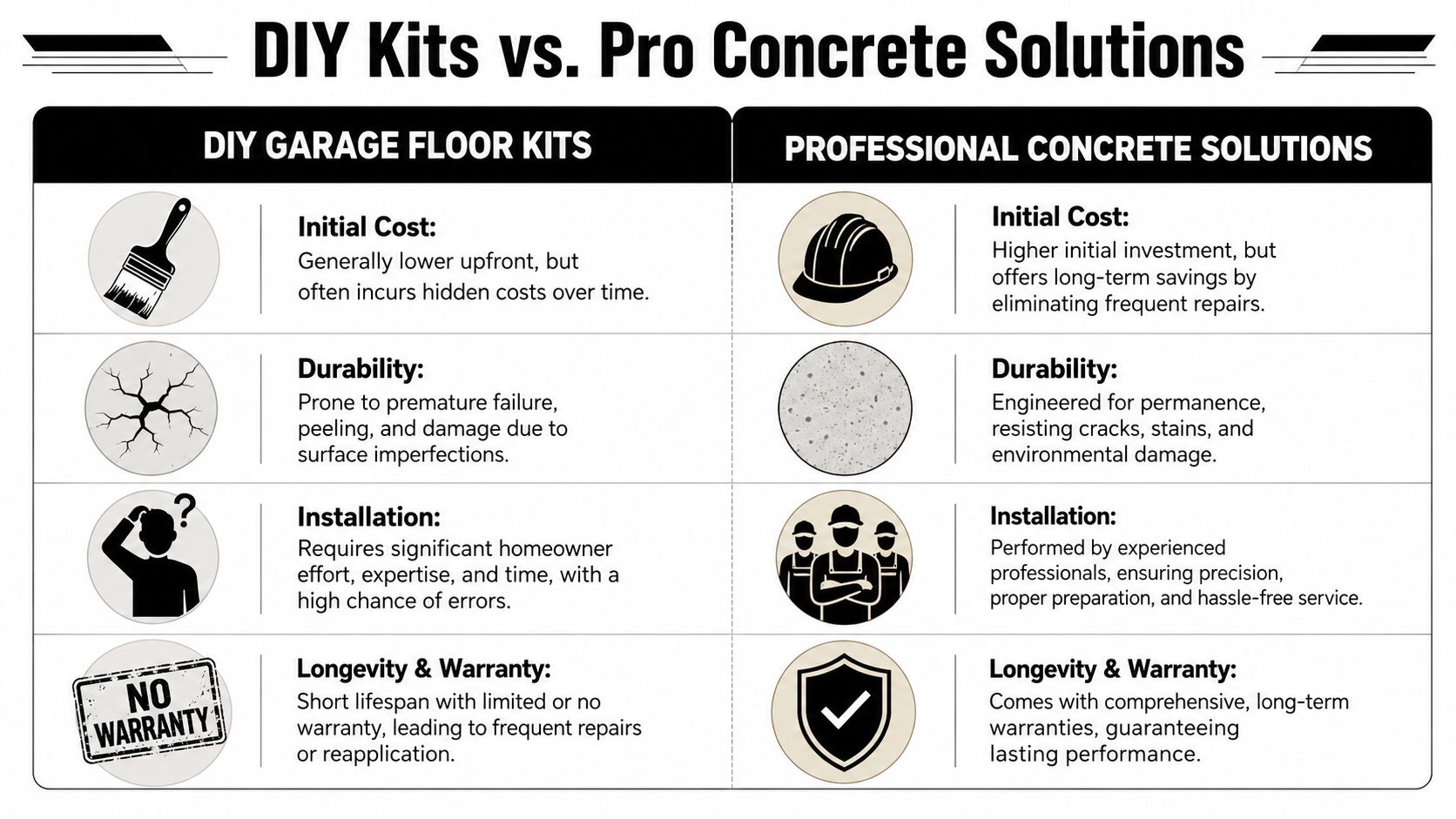
A garage floor kit wins on one thing immediately. Lower upfront cost. That's why so many homeowners try it first.
The problem is that upfront price and long-term value aren't the same thing. A floor that needs repeated touch-ups, recoats, or complete removal becomes expensive in both money and frustration.
Cost now versus cost over time
DIY epoxy kits typically cost $50 to $400 and are associated with a 1 to 5 year lifespan, while professional installation averages $4 to $7 per square foot. Over a 15-year period, a high-performance system can have zero recoat costs, while DIY kits may require 5 recoats totaling over $1,500, based on the cost and lifespan comparison published by Premier Edge Concrete Solutions.
That doesn't mean every homeowner needs the most expensive finish. It means the cheapest path often isn't the least expensive path.
Side-by-side comparison
| Factor | DIY Garage Floor Kit | Professional Solution (Firm Foundations) |
|---|---|---|
| Upfront cost | Lower initial cost | Higher initial investment |
| Lifespan | Commonly shorter service life | Built around long-term slab performance |
| Prep work | Homeowner handles cleaning and prep | Concrete condition and prep handled professionally |
| Moisture risk | Often underestimated | Evaluated as part of the slab decision |
| Appearance over time | More likely to peel, wear, or discolor | Better chance of lasting because the base is addressed |
| Best use case | Cosmetic improvement on a sound slab | New slabs, failing slabs, drainage problems, long-term use |
The part most comparisons miss
Most kit-versus-pro articles focus only on coating materials. That's too narrow. A more appropriate comparison should be between a surface treatment and a concrete solution that starts below the surface.
If the slab is already stable, dry, and properly prepared, a coating may perform well. If the slab has ongoing movement, poor drainage, or surface weakness, a new coating only delays the underlying repair.
That's why homeowners looking for garage foundation contractors near me, concrete foundations, or cement foundations for garage are often closer to the right question than they realize. Sometimes the right investment is not a better box from the store. It's a better slab.
A garage floor only performs as well as the concrete under it. That's true whether you spend a little or a lot on the finish.
Why Garage Floor Kits Fail The Unseen Problems
Most failed garage floors don't fail because the homeowner picked the wrong color or skipped decorative flakes. They fail because the concrete wasn't ready to accept a bonded coating.
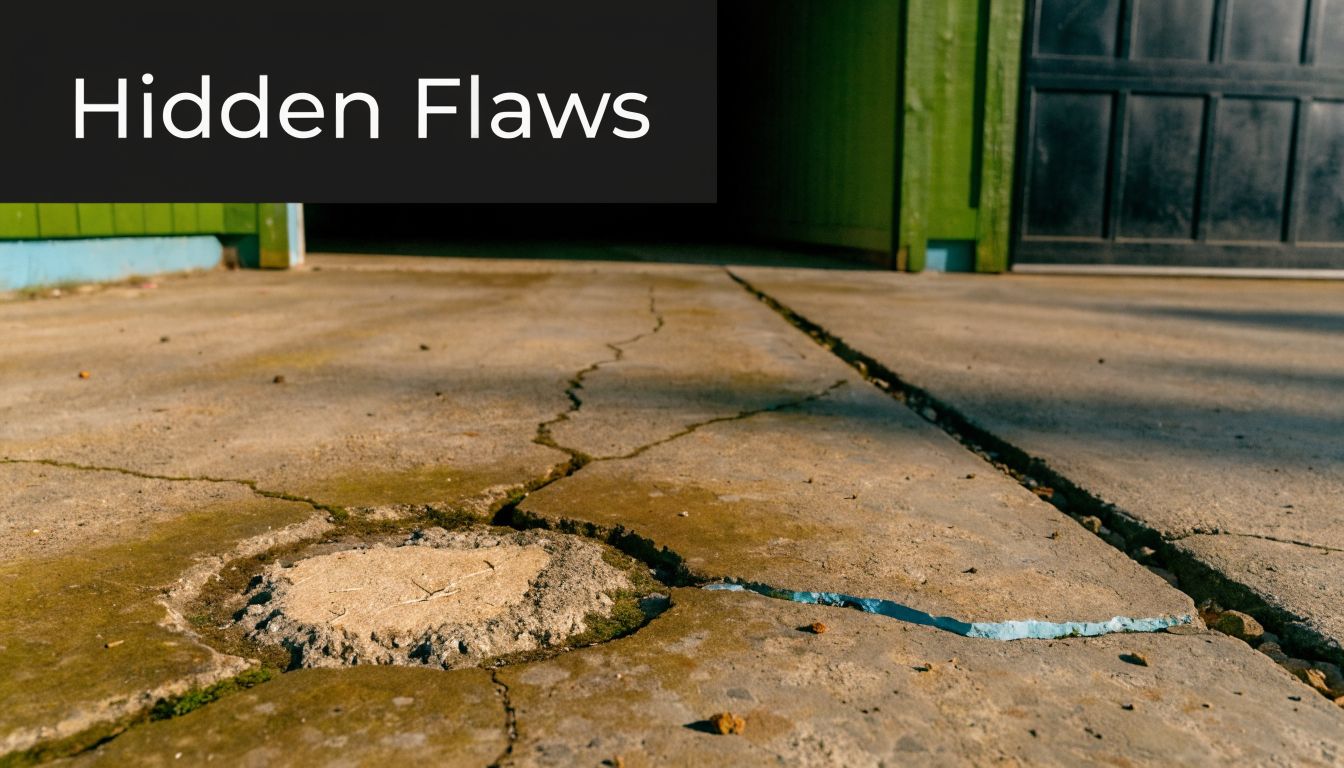
A garage slab can look solid at a glance and still have hidden conditions that ruin adhesion. Moisture is a major one. Surface profile is another. Both are easy to underestimate when a kit makes the project sound simple.
Bond strength starts with the slab
Professional-grade epoxy bonds through a chemical cross-link with the concrete. Proper grinding can increase epoxy penetration depth by 20 to 30 percent, which directly improves bond strength. Without that prep, and on slabs with residual moisture, delamination within 6 to 12 months is common, according to the technical guidance from QuestMark on epoxy garage floor coating adhesion.
That's the key issue. Homeowners often think the coating sits on top of the floor like paint on drywall. It doesn't work that way. A durable system needs the concrete pores opened and the weak surface layer removed so the material can anchor itself.
Common failure points homeowners don't see
- Residual moisture: Water vapor moving up through the slab can break the bond
- Smooth surface paste: Troweled concrete may be too slick for strong adhesion
- Contamination: Oil, old sealers, and embedded dirt interfere with bonding
- Weak top layer: Some slabs have a fragile surface that comes off with the coating
A practical read on slab durability is this article on how to prevent concrete slab from cracking. Cracking and coating failure aren't identical problems, but they often come from the same deeper issues of support, moisture, and construction quality.
New concrete can be the trickiest slab of all
Homeowners are often surprised by this, but a newly poured garage floor isn't automatically ready for a garage floor kit. Fresh concrete still holds moisture. It may also have a very dense, finished top surface that needs profiling.
That's one reason “brand-new garage, brand-new coating” can go wrong. The floor looks perfect, so people rush the finish.
Before deciding on any coating system, it helps to see how pros talk through slab prep and failure points in real time:
If a coating peels up and you can see clean concrete underneath, the problem was usually the bond. If concrete comes up with the coating, the slab surface itself may have been weak.
Local Challenges for Garage Floors in PA MD DE and NJ
Generic garage floor advice usually comes from places that don't deal with a Mid-Atlantic winter. That matters.
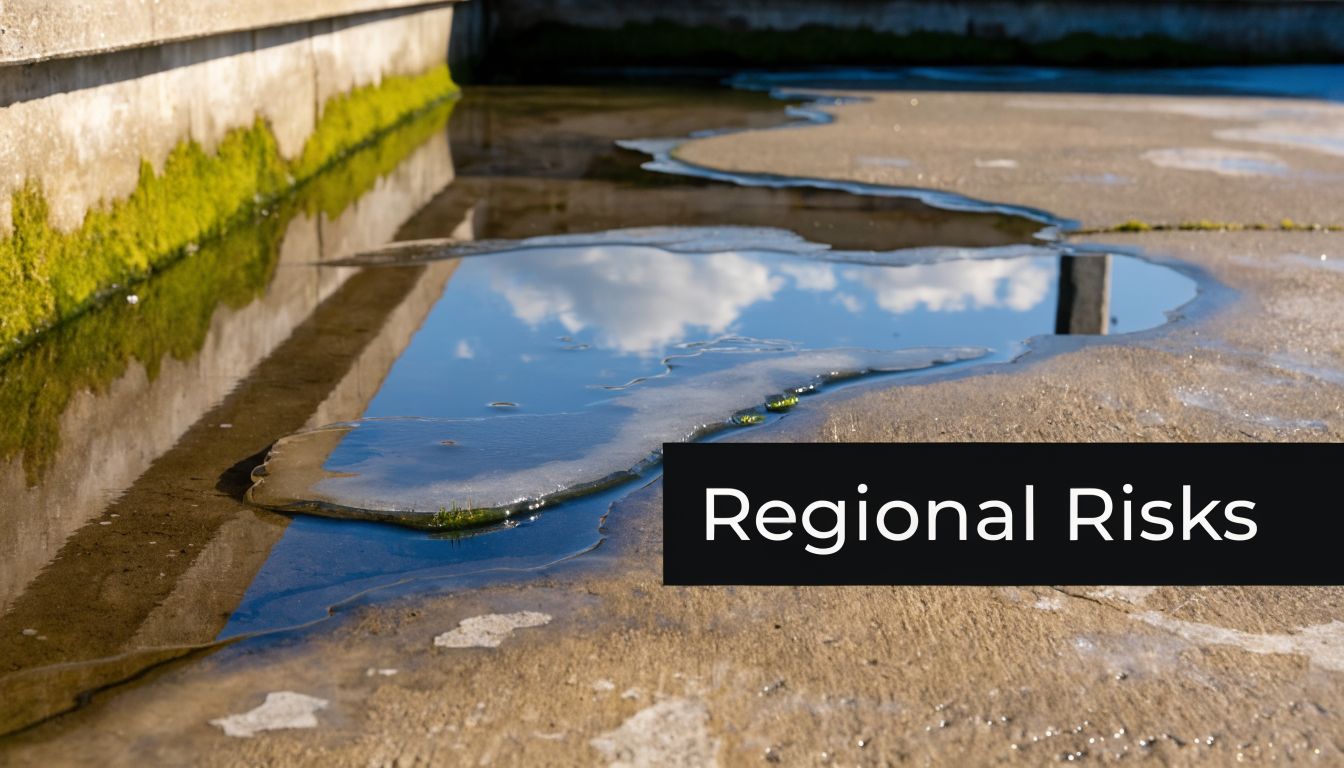
In Pennsylvania, Maryland, Delaware, and New Jersey, garage slabs deal with wet winters, freeze-thaw cycling, road salt, humidity, and runoff problems that put real pressure on both the concrete and the coating.
Why northern garages are harder on coatings
In the Mid-Atlantic, freeze-thaw cycles and road salt intrusion cause 30 to 40 percent of coating failures. Standard DIY epoxies are not designed to resist salt and can peel within a few seasons, while professional hybrid systems are built to last 10 to 15 years in these northern climates, according to the regional coating discussion at Garage Floor Coating Grand Junction.
Those conditions are familiar to anyone in PA. You pull in with slush packed into the wheel wells. Salt brine melts onto the floor. Overnight temperatures drop. Then the cycle repeats for months.
Local slab issues matter too
Climate isn't the only factor. Site drainage, soil movement, and garage elevation all affect what happens at the floor.
A garage built on a poorly supported base may hold moisture longer. A slab near poor grading may take on water from outside. In older properties, homeowners sometimes discover permit or site-history issues while planning repairs or replacements. If that comes up, this guide to PA home professional permit support is a useful resource for understanding what to do next.
What works better in this region
For homeowners in PA, MD, DE, and NJ, the safer mindset is to start with the environment:
- Look at drainage first: Water around the slab becomes water under the coating
- Respect winter exposure: Salt and wet tire traffic are part of the design load here
- Treat sun exposure realistically: Garage doors open, and some floors get direct light
- Build for the slab you have: Not every floor is a candidate for a kit
A garage floor in this region needs more than a pretty finish. It needs a slab and surface system that can handle weather, traffic, and moisture without breaking bond.
The Right Foundation A Permanent Solution
If the goal is a garage floor that still looks and performs well years from now, the focus has to move below the topcoat. The permanent solution starts with site prep, base stability, drainage, and concrete quality.
That applies to more than garages. The same principle matters for a base for storage shed, a gazebo foundation, and any outbuilding slab that needs to stay level and dry.
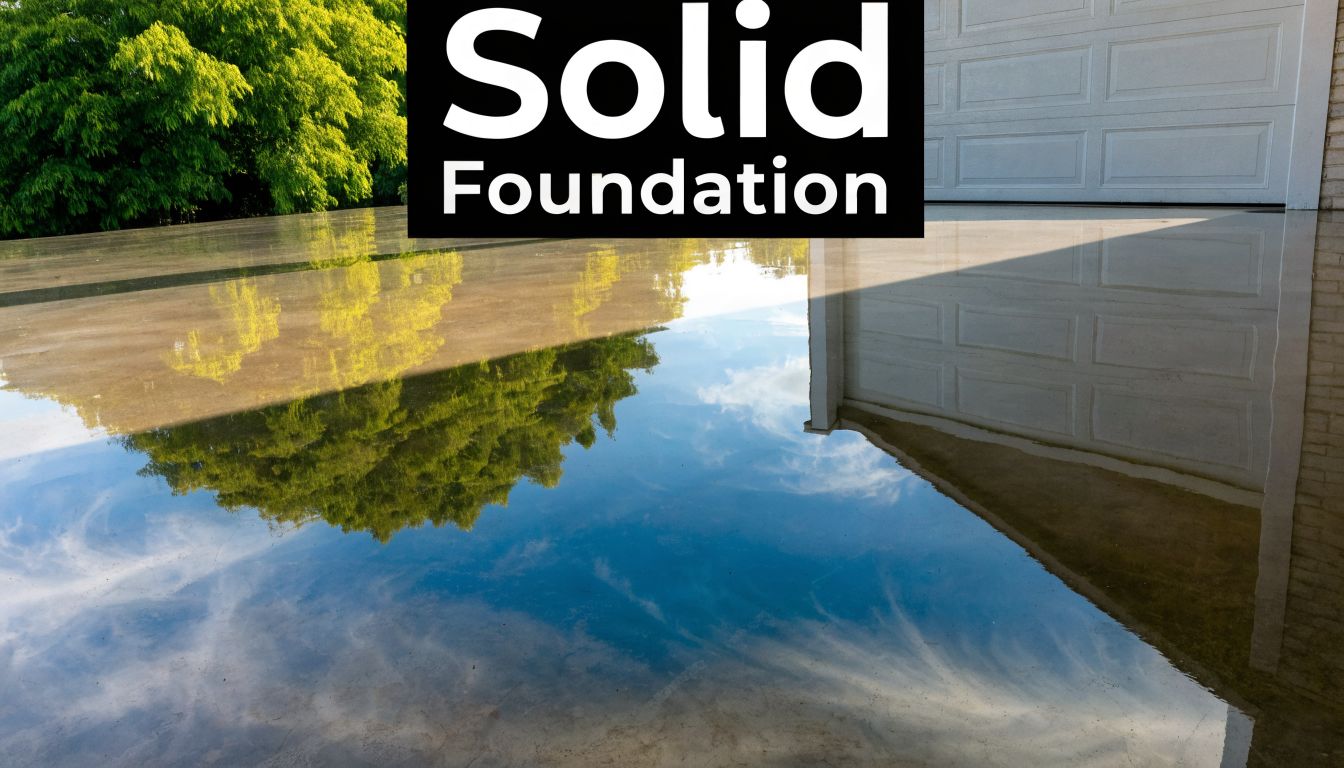
What a coating-ready slab really needs
For new concrete slabs, one critical step is allowing the slab to cure for 28 to 30 days and verifying moisture is below 5% RH before coating. DIY kits often fail because they're applied too soon on improperly prepared new slabs, which need professional diamond grinding to a CSP 2-3 profile for success, as noted in this article on what no one tells you about epoxy kits.
That sequence matters more than brand names on the coating box. If the slab is rushed, too wet, or too smooth, the finish is starting at a disadvantage.
The work happens before the coating
A strong garage slab usually comes from decisions made early:
- Excavation and grading: The site has to move water away from the slab, not toward it
- Base preparation: The gravel base needs to be compacted and stable
- Forming and reinforcement: The slab has to be shaped and supported for its intended use
- Curing and profiling: Concrete needs time before any finish goes on top
Those same standards matter for homeowners searching terms like shed foundations near me, gravel shed foundation contractors near me, garage footings and foundations, and concrete foundation for garage. A foundation isn't just a place to set a building. It controls performance for everything above it.
Better tools help, but they don't replace good construction
Homeowners sometimes ask about the tools involved in prep, especially when they're trying to decide whether to rent equipment or hire the work out. If you're curious about demolition and prep equipment, this breakdown on comparing SDS Plus rotary hammer specs is helpful for understanding what those tools are designed to do.
But even the right tool doesn't solve the core issue by itself. A rotary hammer, grinder, or saw can't compensate for a slab poured over a weak base or a site with poor drainage. Good tools matter. Good slab construction matters more.
Field reality: The best-looking coated garage floors usually come from boring decisions made early. Correct excavation, proper base prep, patient curing, and honest moisture checks.
For homeowners planning a new garage, replacing a failing slab, or adding a barn shed or 10×10 storage shed, that's the lesson worth keeping. The finish is the last step. The foundation is the step that decides whether the finish lasts.
Get a Garage Foundation Built to Last
If you're weighing a garage floor kit for your home in Pennsylvania, the smartest move is to evaluate the slab before you evaluate the coating. That single decision can save you from repeating the same project every few years.
A kit can make sense on the right floor. If the slab is dry, stable, properly prepared, and built well, a coating may perform the way you hope. But if the concrete has moisture issues, drainage problems, weak surface paste, or structural movement, the coating becomes a temporary cover over a lasting problem.
That's why homeowners searching for garage foundation contractors near me, concrete contractors, driveway contractors near me, or help with a shed foundation kit are often asking the right question without realizing it. The long-term answer usually starts with the slab, not the sheen.
If your garage floor is stained, cracking, peeling, or never seems to stay clean, don't just ask which garage floor kit to buy. Ask whether the concrete underneath is ready for one.
If you're planning a garage slab, replacing failing concrete, or need a durable pad for a shed, gazebo, patio, or driveway in Pennsylvania, Maryland, Delaware, or New Jersey, Firm Foundations can help you start with the part that matters most. Reach out for a free quote and get a foundation built for drainage, stability, and long-term performance.