
Patio Concrete Overlay: Enhance Your Outdoor Living
A lot of homeowners reach out when the patio is still usable, but it no longer feels worth using. The slab may be stained, lightly cracked, rough underfoot, or just dated enough that it drags down the whole backyard. In Pennsylvania, Maryland, Delaware, and New Jersey, that frustration usually comes with another concern too. People know the weather here is hard on concrete, so they want to improve the patio without making a short-lived mistake.
A patio concrete overlay can be the right answer when the existing slab is still structurally worth saving. It gives you a fresh surface and a new look without the disruption of full demolition. The key is knowing when an overlay is a smart upgrade and when it's just covering a deeper problem.
That distinction matters in this region. Freeze-thaw weather punishes bad prep, poor drainage, and weak base concrete. A patio that looks like an overlay candidate at first glance may need repair work first, or in some cases full replacement. Homeowners who understand that upfront usually make better long-term decisions.
What is a Patio Concrete Overlay
A patio concrete overlay is a thin, polymer-modified cement layer applied over an existing concrete slab. It isn't paint, and it isn't a surface coating you roll on to hide damage for a season. It's a bonded resurfacing system designed to renew the appearance of concrete and, when the slab underneath is sound, extend the useful life of the patio.
Many homeowners first compare an overlay to tearing everything out and starting over. That's understandable, but those are very different jobs. Full replacement means demolition, hauling debris away, preparing the subgrade again, forming, pouring, finishing, and curing a brand-new slab. An overlay works with the concrete you already have, provided that concrete still deserves to stay in place.
What the material actually does
The overlay bonds to the existing patio and creates a new finished surface. Depending on the product and design goals, that new surface can be smooth, textured, troweled, stamped, or colored. Modern systems have come a long way. According to industry guidance on concrete overlay costs and performance, modern formulations typically offer a lifespan of 10 to 25 years, and the average cost to resurface a concrete patio is $4 per square foot.
That lower entry cost is why overlays have become such a practical option for patios that are tired but not failing.
Practical rule: An overlay is a resurfacing solution, not a structural rescue.
When homeowners usually choose one
A patio concrete overlay makes sense when the slab has surface wear, cosmetic cracking, discoloration, minor scaling, or an outdated finish. It also works well when the homeowner likes the layout and size of the patio but wants the surface to look newer and feel more intentional.
Common reasons people choose an overlay include:
- Appearance problems: The patio looks blotchy, worn, or old compared with the house and landscaping.
- Texture issues: The surface may be rough, patchy, or unpleasant to walk on.
- Budget priorities: The owner wants a major visual improvement without paying for full replacement.
- Less disruption: The goal is to avoid a bigger demolition project if the base slab is still serviceable.
For homeowners comparing contractors and methods, it's also useful to review how other expert concrete and asphalt professionals explain resurfacing options in practical terms. The best guidance usually sounds the same across good tradespeople. Surface renewal works well when the slab is sound and the prep work is taken seriously.
An overlay can make an old patio feel current again. It just has to be treated like a concrete project, not a cosmetic shortcut.
Design Options Finishes Textures and Colors
The biggest surprise for many homeowners is how flexible a patio concrete overlay can look once it's finished. People often assume "overlay" means a plain gray skim coat. In reality, the surface can be shaped and finished to fit the house, the yard, and how the patio gets used.

A simple backyard sitting area may need a clean broomed or lightly textured finish. A larger entertaining space may look better with a decorative pattern that breaks up the slab visually. Around pool areas or outdoor kitchens, homeowners usually care as much about traction and comfort as they do about color.
Popular looks homeowners ask for
Some overlays are meant to disappear into the property and look natural. Others are meant to become the visual focal point of the backyard.
A few common directions include:
- Stamped finishes: These mimic the look of stone, brick, or slate while using the existing slab as the base.
- Spray or knockdown textures: Good for patios and nearby pool areas where slip resistance matters.
- Hand-troweled finishes: These create a more custom, crafted appearance with movement in the surface.
- Color-enhanced systems: These can complement siding, trim, hardscape, or nearby retaining walls.
The finish should fit the setting. A rustic home often looks better with warmer, variegated tones and more texture. A newer build may benefit from a cleaner, more restrained surface.
Texture isn't just about appearance
Texture changes how a patio feels underfoot, how it sheds water, and how it holds up visually over time. Some overlay products are designed to be troweled for smoothness or squeegeed for more texture and profile. According to Allied Outdoor Solutions' guide to concrete overlay options, products such as Pro Bond Ultra can reach 3,500 to 4,000 PSI compressive strength and can be installed in ways that create different slopes and textures. That same guidance notes that in sunny Mid-Atlantic conditions, UV-protective sealers matter because they help protect the finished surface from degradation.
That combination matters on patios. A surface can look great on install day, but if the finish doesn't suit the weather exposure, traffic, and drainage needs, it won't stay attractive.
To help homeowners think beyond the slab itself, a good companion resource is this stylish patio lighting guide. Lighting changes how texture and color read at night, especially on decorative concrete.
For a visual example of how resurfaced patios can be styled, this short video gives useful design inspiration:
A good finish should still look right on a cloudy winter afternoon, not just in bright summer photos.
Choosing a finish that fits the house
The best patio overlays don't look trendy for trend's sake. They look like they belong.
A few practical matching guidelines help:
| Patio situation | Finish direction that often works |
|---|---|
| Traditional home with brick or stone | Stamped or variegated finish with natural-looking texture |
| Modern home with simple lines | Cleaner texture, restrained color, less pattern |
| Busy backyard with kids and pets | More forgiving texture and color variation |
| Outdoor dining or entertaining area | Decorative finish that defines the space visually |
A patio should feel finished, but not forced. When the finish, color, and texture match the property, the overlay looks like an upgrade instead of a patch.
Surface Preparation and Patio Requirements
Most overlay failures start long before the overlay material is mixed. They start with a slab that shouldn't have been resurfaced in the first place, or with prep work that was rushed because the visible surface looked "good enough."
That's why slab condition matters more than color charts or pattern samples. If the patio holds water, moves too much, or has unresolved structural cracking, a new surface won't fix the underlying issue.
The patio has to drain correctly
Drainage is non-negotiable in this region. According to Techo-Bloc's patio and porch overlay installation guidance, the substrate should have a minimum pitch of 1/4 inch per foot so water can move off the patio properly. That matters in PA, MD, DE, and NJ because standing water leads to bigger problems when temperatures swing below freezing.
Water doesn't just sit on a bad patio and look ugly. It finds low spots, works into surface defects, and increases the risk of delamination and freeze-thaw damage. If a slab is flat in the wrong places, or pitched back toward the house, that issue has to be addressed before an overlay goes down.
On-site judgment matters: If water can't leave the patio, the overlay is being asked to survive a drainage problem it didn't create.
What makes a slab a poor candidate
Some patios are past the resurfacing stage. That doesn't mean overlays are bad. It means the slab underneath has stopped being reliable.
Watch for these warning signs:
- Settlement or rocking sections: If parts of the slab have dropped or move under load, resurfacing won't stabilize them.
- Repeated wide cracking: Active cracks usually signal slab movement or base failure.
- Chronic water pooling: Low areas, back-pitch, and drainage traps shorten overlay life.
- Surface contamination: Old sealers, coatings, grease, and embedded dirt can interfere with bond.
- Edge breakdown and spalling tied to deeper damage: Cosmetic patching doesn't fix a weak slab body.
Homeowners who want to understand basic crack types and patching approaches can review these DIY concrete repair tips from UrbanManCaves.com. It's a useful general primer, but it doesn't replace a jobsite evaluation when the slab may have structural issues.
Prep work that actually matters
The prep phase is where good overlay jobs separate from short-lived ones. Surface preparation usually includes cleaning, profiling, removing weak material, and addressing crack areas before the resurfacing system starts.
A sound patio typically needs attention in these areas:
- Surface cleaning so dust, grime, and contaminants don't interfere with bond.
- Mechanical profiling to give the new material a proper surface to grab.
- Crack evaluation to determine whether the cracks are static, cosmetic, or signs of movement.
- Drainage review to confirm the slab sheds water instead of collecting it.
- Height planning so door thresholds, steps, and transitions still work after resurfacing.
If you're comparing resurfacing against a fresh slab, it's worth understanding how slab design affects long-term performance. This guide on how thick a patio concrete slab should be is helpful because thickness and support directly influence whether a patio ages well enough to be resurfaced later.
Honesty saves money here
Not every contractor likes telling a homeowner that an overlay isn't the right fit. It can be an uncomfortable conversation. But it's the right one.
A patio concrete overlay is a smart investment when the slab is stable, properly sloped, and worth preserving. When the slab has unresolved movement, drainage failure, or significant deterioration, resurfacing becomes expensive camouflage. In freeze-thaw climates, camouflage doesn't last.
Cost and Lifespan An Overlay vs Full Replacement
Most homeowners compare these options the same way at first. They want to know what the overlay costs, what replacement costs, and whether the savings are worth it. That's the right starting point, but the smarter comparison is value over time, not just the first invoice.
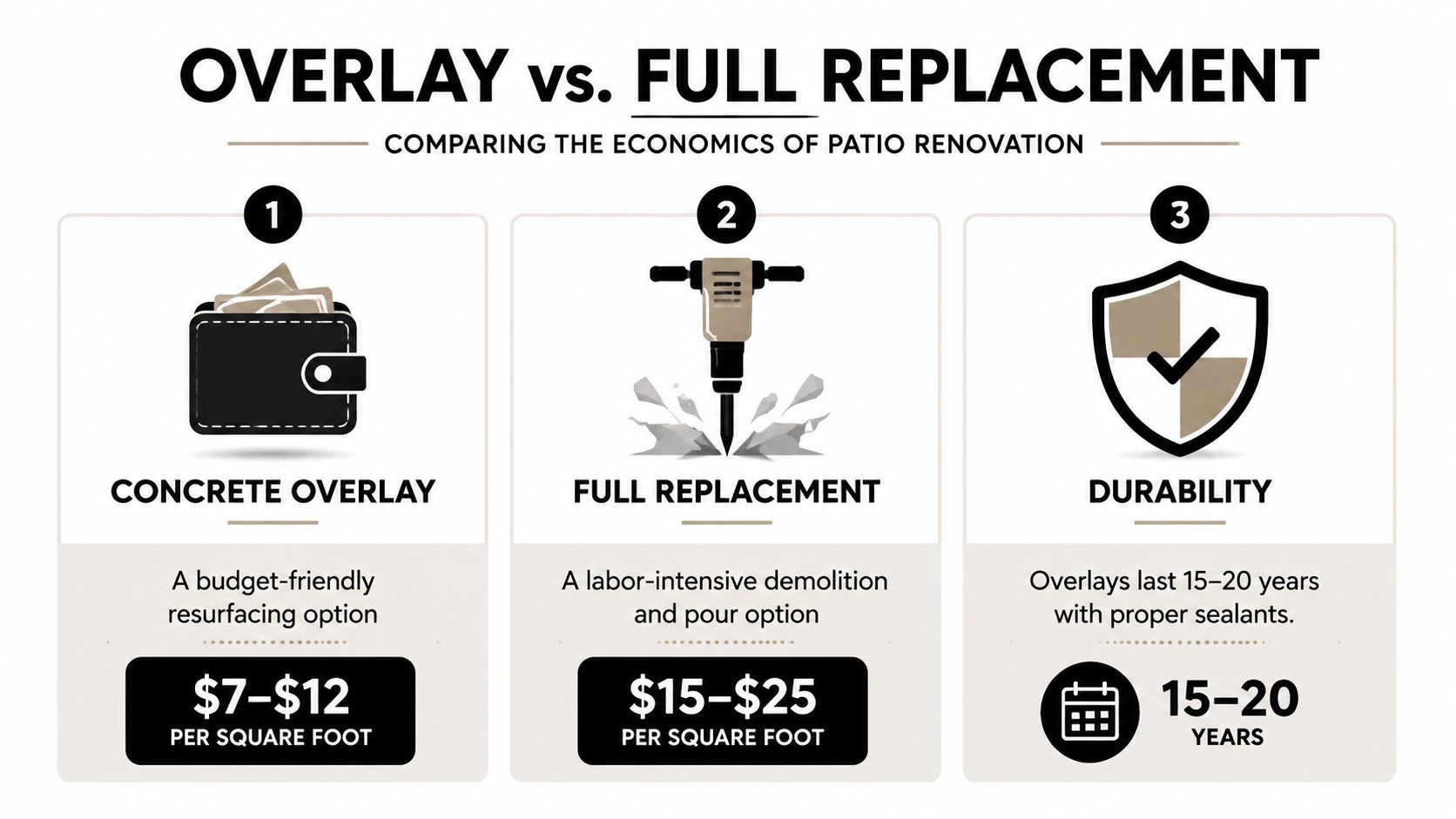
According to Angi's concrete resurfacing cost guide, basic concrete overlays typically cost $3 to $5 per square foot, while decorative stamped or multi-color designs can range from $5 to $20 or more. That same source notes that overlays can deliver an approximate 70% return on investment when the underlying substrate remains structurally sound.
What those numbers mean in real decisions
For many patios, the budget gap between resurfacing and replacement is large enough to matter immediately. But money isn't the only trade-off.
An overlay is usually the better financial move when:
- The slab is sound: You're improving the finish, not trying to save a failing structure.
- The layout still works: There's no need to change the size, shape, or elevation of the patio.
- The goal is visual renewal: You want the patio to look updated without a full rebuild.
- The schedule matters: Resurfacing is typically less disruptive than tear-out and repour.
Replacement becomes easier to justify when drainage is wrong, the base has failed, or the slab condition is poor enough that resurfacing would be money spent on borrowed time.
Lifespan and maintenance
Cost only makes sense when paired with expected service life. As noted earlier in the article, overlay systems can offer a long usable life when installed on a suitable slab and maintained properly. Maintenance is usually centered on cleaning and periodic resealing, not major reconstruction.
That long-view thinking also applies to crack prevention and slab health. Homeowners weighing resurfacing against replacement should understand what causes concrete to fail in the first place. This guide on how to prevent a concrete slab from cracking is a useful reference because many expensive patio problems start below the surface, not on top of it.
A cheap overlay on a bad slab is expensive. A properly installed overlay on a good slab is often the value option.
A simple comparison
| Decision point | Overlay | Full replacement |
|---|---|---|
| Upfront cost | Lower in many cases | Higher due to demolition and rebuild |
| Design refresh | Strong option for cosmetic transformation | Strong option with full redesign freedom |
| Structural correction | Limited | Best option when slab failure exists |
| Disruption | Less invasive | More invasive |
| Best use case | Sound slab with surface problems | Failing slab or major layout issues |
The right answer depends on the concrete you already have. If the patio is structurally dependable, resurfacing often gives homeowners the best balance of cost, appearance, and long-term practicality. If the slab isn't dependable, replacement stops being the expensive option and starts being the necessary one.
The Firm Foundations Installation Process
When a professional crew installs a patio concrete overlay, the job should feel organized from the start. Homeowners shouldn't see guesswork. They should see a sequence.
The process begins with evaluation, not mixing material. The slab has to be checked for bond issues, drainage problems, cracking patterns, surface contamination, and any areas that suggest the patio has deeper structural trouble. If those conditions aren't identified first, the rest of the job is just building on uncertainty.
What happens before the overlay is applied
The first on-site work usually focuses on preparation. That means cleaning the surface thoroughly, removing weak or failing material, and mechanically preparing the slab so the overlay has a proper profile to bond to.
Depending on the slab and the system being used, the crew may also repair localized defects and apply a bonding primer where required. Product instructions matter here. Some overlay systems are more forgiving than others, but none of them perform well when installers skip the prep they depend on.
The application phase
Once the slab is ready, the overlay material is mixed and installed according to the selected finish. Some systems are troweled by hand. Others are squeegeed, sprayed, or textured in stages. The method depends on the desired look and on what the patio needs from a drainage and wear standpoint.
During application, the crew is controlling several things at once:
- Material consistency so the overlay places evenly
- Working time so there aren't visible cold joints
- Surface flatness and slope so water moves correctly
- Finish detail so the texture and appearance stay consistent
A good installation crew pays attention to transitions too. Doorways, steps, edges, and adjoining hardscape all have to make sense after the overlay is in place.
Finishing and protection
After the overlay cures enough for the next stage, the finish is refined and sealed as needed for the system. On decorative patios, sealing isn't just about appearance. It helps protect the surface from wear, moisture intrusion, and weather exposure.
Homeowners should expect clear guidance about cure time, foot traffic, furniture placement, and ongoing maintenance. That part is often overlooked, but it's part of doing the job right. A patio can be installed beautifully and still get damaged if it's put back into service too aggressively or maintained carelessly.
The cleanest-looking jobs usually come from the most disciplined prep and timing, not from the flashiest finish.
A well-run overlay project should leave the homeowner with two things: a patio that looks renewed, and confidence that the crew respected the concrete underneath.
Why Local Expertise Matters in PA MD DE and NJ
Concrete behaves differently when it has to live through Mid-Atlantic winters. That's the point many homeowners miss when they read generic resurfacing advice online. A patio in a mild climate can tolerate mistakes that a patio in Pennsylvania or New Jersey won't forgive.

In this region, water is usually the enemy. It gets into weak spots, sits in low areas, and expands when temperatures drop. If the patio already has unresolved movement or drainage trouble, an overlay won't stop that cycle. It becomes the next layer affected by it.
Freeze-thaw changes the decision
Local judgment matters most in these situations. According to the referenced industry discussion on freeze-thaw performance, in areas with 30 to 50 annual freeze-thaw cycles such as parts of PA and NJ, thin overlays can crack or delaminate within 3 to 7 years if the base slab has unresolved issues, and structural engineers advise that overlays are only viable as a cosmetic finish over a verifiably sound slab. That same warning is especially relevant for homeowners in PA, MD, DE, and NJ because patios here regularly deal with winter exposure, seasonal moisture, and repeated temperature swings.
That doesn't mean overlays are a bad option. It means the slab evaluation has to be honest, and the installation approach has to respect the climate.
What local contractors notice faster
A contractor who works in this region sees the same failure patterns over and over:
- Low spots that hold winter water
- Edges that break down after repeated freezing
- Cracks tied to settlement or poor support
- Patios pitched the wrong way near the house
- Surface repairs that looked fine in summer and failed after winter
That experience matters because patio work connects to bigger concrete and excavation fundamentals. The same people who understand patio drainage usually understand subgrade prep, concrete support, and load behavior on other jobs too. That's why homeowners often look for broader expertise from garage foundation contractors near me, concrete foundations specialists, or teams that build durable shed foundations, gazebo foundation bases, and cement foundations for garage projects. Good patio work comes from the same discipline that produces reliable garage footings and foundations, a stable base for storage shed, and long-lasting slab and excavation work across a property.
Why broad foundation experience helps patio work
Patios may seem simpler than a garage slab or a shed foundation, but the principles overlap. Drainage, support, base integrity, elevation, and finish quality all still matter. Contractors who regularly handle shed foundations near me, gravel shed foundation contractors near me, site grading, and excavation tend to approach patio resurfacing more cautiously because they know what failed slabs look like beneath the surface.
Local expertise isn't just knowing how to apply an overlay. It's knowing when not to.
That kind of judgment protects homeowners. It keeps them from putting a decorative finish over a slab that should be rebuilt. It also helps them move forward confidently when the patio is a good candidate and resurfacing is the smart call.
If you're in Pennsylvania, Maryland, Delaware, or New Jersey and you're weighing resurfacing against replacement, get a quote from a contractor who understands both decorative finishes and the structural side of concrete. That's especially important if you're also comparing related projects like a shed foundation, house foundation, foundation builds, excavation near me, or even driveway contractors near me for the same property. Concrete decisions tend to connect.
If your patio is worn out and you want a straight answer on whether resurfacing or replacement makes more sense, contact Firm Foundations. Their team serves Pennsylvania, Maryland, Delaware, and New Jersey with practical site evaluation, excavation knowledge, and concrete experience built around drainage, structural integrity, and long-term performance. Request a quote and get clear guidance before you spend money on the wrong fix.