
How to Build a Concrete Pad in PA, MD, DE & NJ


If you're planning a new shed, detached garage, gazebo, or barn in Pennsylvania, Maryland, Delaware, or New Jersey, the exciting part usually comes first. You pick the building, choose the size, and start imagining how you'll use it. Then the practical question shows up fast. What is it going to sit on?
That question matters more than most homeowners expect. A building can look great on delivery day and still have trouble after the first wet season or hard winter if the pad underneath it isn't level, compacted, drained, and reinforced the right way. Around Honey Brook Township and across the Mid-Atlantic, that problem usually starts below the surface, not on top of it.
A concrete pad is often the long-term answer because it gives you a clean, durable, low-maintenance base for everything from a 10×10 storage shed to a concrete foundation for a garage. When it's engineered correctly with a compacted granular sub-base and 4,000 PSI concrete, a pad for outbuildings can last 50 to 100 years while resisting rot, pests, fire, and harsh weather, according to Lion Buildings' overview of concrete pad design and benefits. In some applicable structures, concrete's thermal mass can also help reduce heating and cooling costs by 15-25% through better energy performance, as noted in that same concrete pad benefits guide.
Generic online tutorials usually stop at "dig, pour, done." Real jobs don't work that way. If you want a broader look at how excavation and foundation work fit together before getting into slab details, this NSW excavation and foundation guide is a useful companion read.
Your Guide to a Flawless Concrete Pad Foundation
A homeowner orders a prefab shed thinking the hard part is over. Then the installer asks whether the site is ready, whether the base is square, and whether the pad accounts for drainage. That's usually the moment the project shifts from simple to serious.
For a shed foundation, gazebo foundation, or cement foundation for garage use, the pad has to do several jobs at once. It has to carry weight, stay level, shed water, and resist movement through seasonal changes. If any one of those is missed, the structure above starts telling on the foundation below.
Why concrete pads beat temporary shortcuts
Concrete isn't the only option, but it's often the one homeowners stop wishing they had chosen later. Shed foundation blocks and a loose gravel setup can work for some light-duty applications, but they don't offer the same finished floor, anchoring surface, or long-term consistency as a properly built pad.
A well-built pad also makes the building easier to use every day. Doors stay aligned, floors feel solid, and the area around the structure stays cleaner in wet weather.
Practical rule: Build the foundation for the building you want to own in ten years, not the one that only needs to look good on delivery day.
What a good pad needs to do
The best concrete foundations are not just flat rectangles. They are planned for the site they sit on.
That usually means paying attention to:
- Soil behavior. Clay-heavy ground holds water and moves differently than granular soil.
- Drainage path. Water must leave the slab area instead of collecting against it.
- Load type. A hot tub, garage, and barn shed don't stress concrete the same way.
- Regional weather. Freeze-thaw cycles in PA, MD, DE, and NJ punish weak prep work fast.
Homeowners searching for shed foundations near me or garage foundation contractors near me are usually not just buying concrete. They're buying peace of mind that the structure won't twist, settle, or crack because someone rushed the groundwork.
Planning Your Concrete Foundation Project
A successful pad starts before the first string line goes up. The planning stage decides whether the job moves smoothly or becomes a chain of corrections after concrete is already hard.
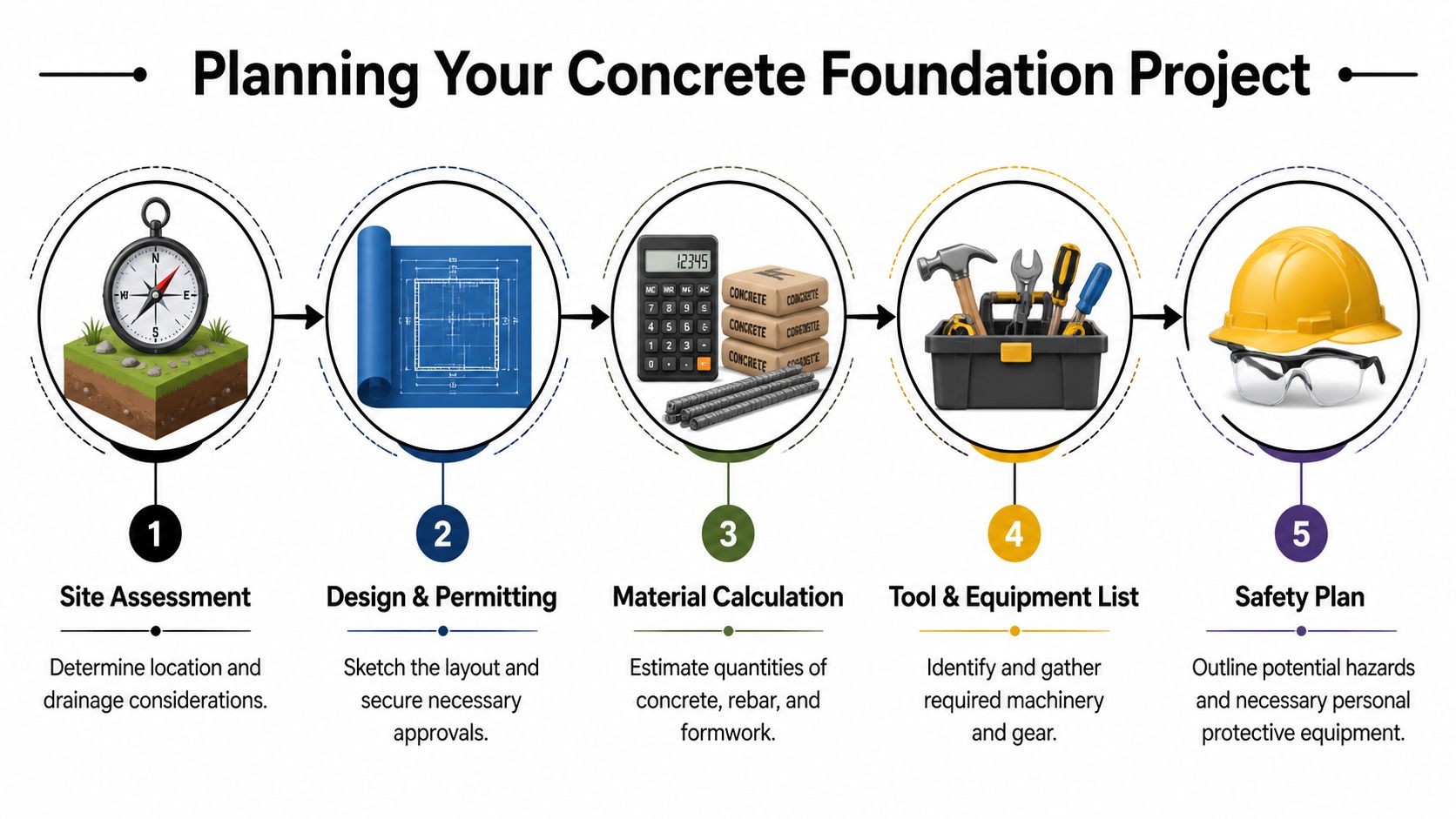
Start with the site, not the structure
Most homeowners begin with the building dimensions. The better approach is to start with the ground where that building will sit.
Walk the area and look at access, slope, drainage patterns, and how close the project is to property lines, fences, trees, and overhead wires. If ready-mix access will be tight or excavation equipment can't reach the pad area cleanly, that changes the plan right away.
Look especially hard at where water already wants to go. If the yard funnels runoff into the exact corner where you want your base for storage shed or garage slab, the slab design has to work with that reality.
Mid-Atlantic soil and frost issues change the job
A lot of national DIY content falls short. The Mid-Atlantic isn't one uniform set of conditions, and the pad details that might hold up in a milder region can fail here.
A major gap in many DIY guides is adapting to regional soil and frost conditions. In PA, MD, DE, and NJ, clay soils often require amended bases to prevent heaving, local codes commonly require footings 36-48 inches deep to stay below the frost line, and a PennDOT report noted 28% of residential slab failures in the region stem from inadequate soil prep, according to Marstella's discussion of building a concrete pad in local conditions.
The slab almost never fails because the top looked wrong on day one. It fails because the soil and drainage below it were misunderstood.
That matters whether you're planning a 4×8 shed with foundation, a backyard patio, or garage footings and foundations for vehicle storage.
Permits, setbacks, and scope
Before excavation starts, confirm whether your township or county requires permits, inspections, engineered drawings, or setback compliance. A small shed foundation gravel base may trigger a different process than a reinforced concrete foundation for garage work area.
Check these items early:
- Property line setbacks. These can affect the allowable location and slab size.
- Structure type. Attached and detached buildings may be treated differently.
- Utility conflicts. Buried electric, gas, water, and septic components can change excavation limits.
- Anchoring requirements. Some prefab structures come with manufacturer specifications that your pad must meet.
Budget and timeline expectations
Homeowners often ask whether concrete is worth the extra upfront cost. In many cases, yes, especially when the structure is permanent or you want a finished, low-maintenance surface.
Typical pad pricing varies by size, access, excavation complexity, reinforcement needs, and how much grading is required before forms ever go in. If you want a market comparison from another region to help frame expectations, this overview of concrete pad costs for Cleveland homeowners is a useful reference point for how site conditions and slab choices affect pricing.
For broader context, pad-style work remains attractive because it reduces excavation compared with deeper foundation systems. Concrete pad foundations commonly fall in the 600mm to 2000mm depth range on soils with adequate shallow bearing capacity, and slab-style systems can save up to 30-50% in labor and material costs compared with alternatives like basements because they use less concrete and require less digging, according to Heaton Manufacturing's pad foundations guide.
What homeowners should decide before work begins
Some decisions are easier to make before anyone starts digging:
| Decision | Why it matters |
|---|---|
| Final use of the building | A workshop, shed, and garage don't need the same reinforcement or edge details. |
| Finished floor expectations | If the slab will stay exposed, finishing quality matters more. |
| Water management plan | Downspouts, grade changes, and runoff paths affect long-term performance. |
| Access for crews and materials | Tight access can change equipment, labor, and sequencing. |
Good planning doesn't make the build flashy. It makes it predictable. That's what you want before committing to a house foundation, pad, or any other foundation builds on your property.
Proper Excavation and Subbase Preparation
Most slab problems begin in the dirt, not in the concrete. If the excavation is shallow in one spot, soft in another, or filled back with loose material, the pad is already compromised before the truck arrives.
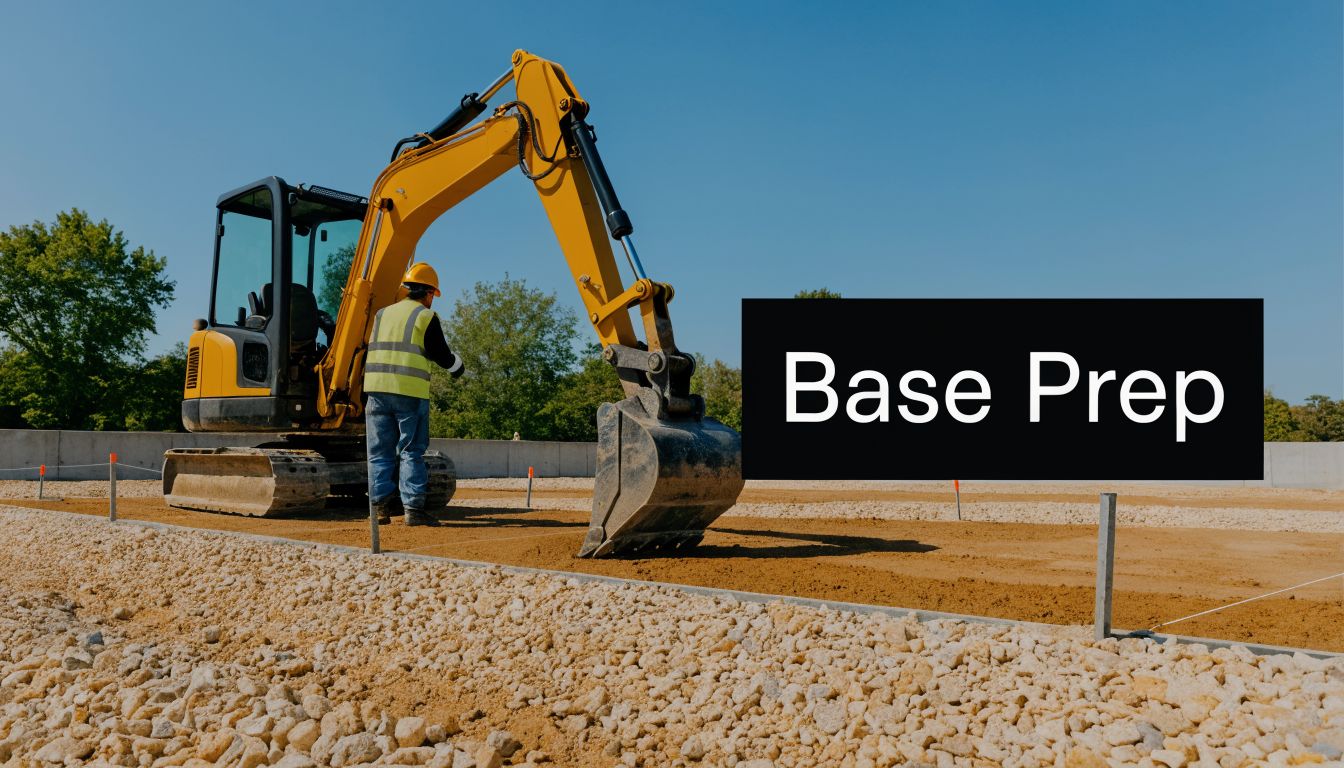
Lay out the pad and make it square
Start by staking the perimeter and running string lines. Don't eyeball it. Check for square using the 3-4-5 method or by comparing diagonal measurements.
For homeowners learning how to build a concrete pad, this is one of the first places mistakes show up. A slab that's slightly out of square can turn into a frustrating install day when a shed, gazebo, or garage kit doesn't sit right on the edges.
Remove the wrong material, not just the visible grass
Excavation isn't just scraping off sod. You need to remove topsoil, roots, organics, and any soft material until you reach stable subgrade.
That usually means excavating 6-8 inches and extending beyond the final slab footprint so you have room to work forms and compact the perimeter correctly, based on the process described in Marshalltown's slab preparation guide. If you're planning a project and want a practical checklist before the concrete stage, this guide to site preparation for a concrete slab is worth reviewing.
Build the base in lifts, not one loose dump
This part gets rushed all the time. It shouldn't.
Precise excavation and base preparation are critical for preventing up to 80% of common slab failures. The standard process involves adding 3-4 inches of compacted 3/4-inch crushed gravel in 2-inch lifts, compacting to 95% Proctor density, and leveling the base to within 1/4 inch across 10 feet, according to Marshalltown's step-by-step slab guidance. That same source notes that poor compaction in clay-heavy soils, common across PA, MD, DE, and NJ, increases settlement risk by 50-70%.
On the ground: If the base feels solid at the surface but pumps, shifts, or scuffs underfoot after compaction, it isn't ready.
A plate compactor does the work here. Dumping stone and raking it flat is not compaction. The gravel should be placed, compacted, checked, and then rechecked.
Keep drainage in the base plan
Water needs a path before concrete covers the area. On many outbuilding pads, the base should slope away from nearby structures so drainage doesn't depend only on the slab finish.
A practical sequence looks like this:
- Mark the full footprint with stakes and string.
- Excavate to clean subgrade, removing unstable material.
- Install crushed gravel in lifts, not all at once.
- Compact each lift thoroughly with a plate compactor.
- Check level and drainage with a long straightedge and string line.
What works and what fails
Some shortcuts seem harmless because the slab still looks fine when it's fresh. The failures show up later.
- What works. Clean excavation, crushed stone, lift-by-lift compaction, and a verified grade.
- What fails. Pouring over topsoil, using mixed fill with organic material, or trusting a hand tamper alone on a larger pad.
- What also fails. Assuming a gravel base that works in one yard will behave the same in a clay-heavy lot across the county.
If you're comparing excavation near me, concrete contractors, or driveway contractors near me, this stage is where experienced crews separate themselves. Anyone can make wet concrete look smooth for a few hours. Fewer crews know how to make the base stay still for years.
Building Forms and Adding Reinforcement
Once the subbase is compacted and graded correctly, the job becomes more precise. Forms control the shape. Reinforcement controls how the slab handles stress after it cures.
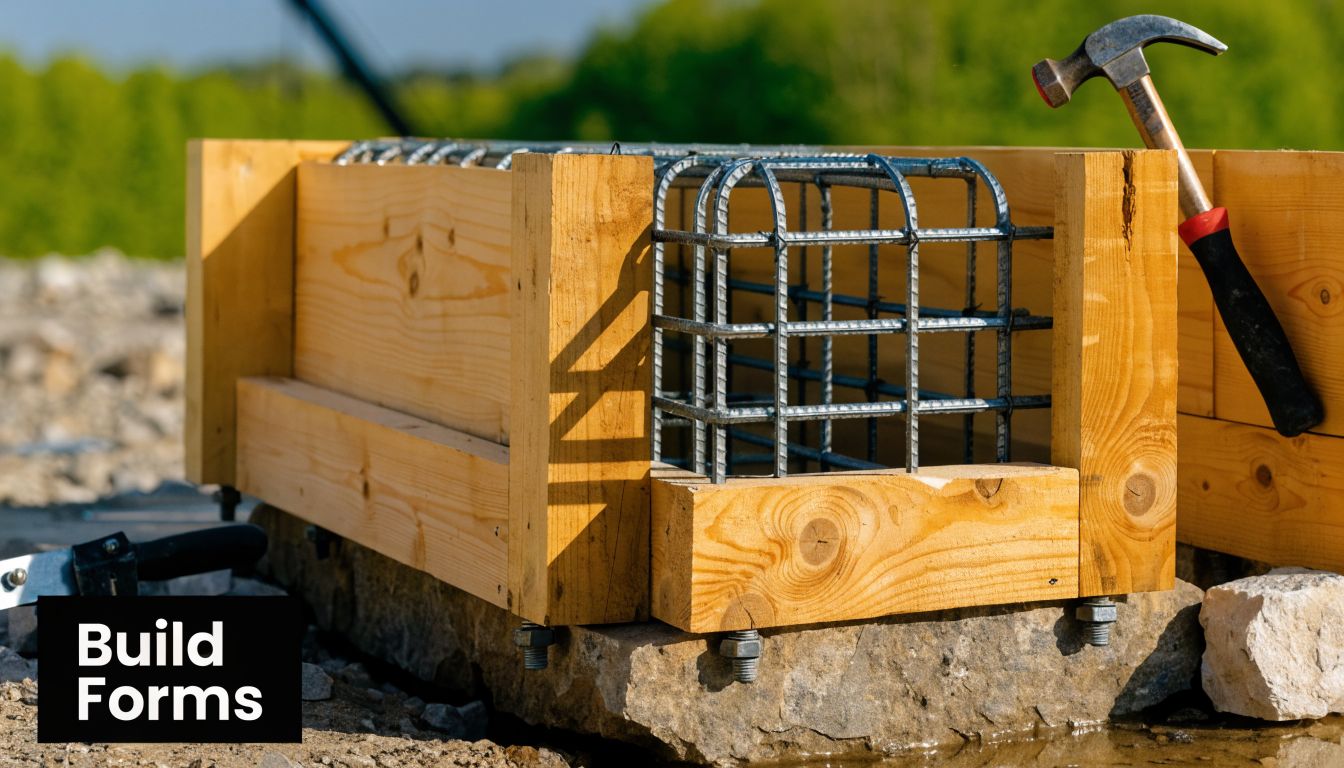
Build forms that stay put
For many residential pads, 2×6 forms are used for a 4-inch slab, with stakes placed every 2-3 feet, based on the forming method outlined in Mister Concrete's slab pouring guide. The forms need to be square, level, and braced well enough that they don't spread or bow once concrete pressure hits them.
Use string lines, a line level, and a long straightedge. Backfill gaps outside the forms where needed so wet concrete doesn't push out weak spots. Clean, stable forms give you crisp slab edges and accurate finished dimensions.
Rebar and mesh are not decoration
Concrete is strong in compression and weak in tension. Reinforcement handles the movement and stress that plain concrete alone doesn't tolerate well.
Proper forming and reinforcement can reduce tensile cracking by 60-75%. That commonly means installing #4 rebar in a grid at 18-24 inch centers, with the steel positioned correctly inside the slab rather than lying at the bottom, according to Mister Concrete's reinforcement details.
Reinforcement only helps when it's in the concrete where it belongs. Steel sitting on the stone base is not doing the same job.
For a light-duty gazebo foundation or some small outbuilding pads, wire mesh may be considered. For heavier uses, especially cement foundations for garage applications, rebar is usually the safer choice because it offers more reliable control under vehicle loads and freeze-thaw stress.
Match the reinforcement to the use
Not every slab needs the same steel layout. The expected load should drive the decision.
| Project type | Reinforcement approach |
|---|---|
| Small utility shed | Light reinforcement may be suitable depending on site and loading |
| Workshop or larger shed | Rebar grid is often the better long-term choice |
| Garage slab | Reinforcement should be treated as standard, not optional |
| Hot tub or container base | Load concentration makes placement and design more critical |
That difference matters in this region. ACI benchmarks cited by Mister Concrete show reinforced slabs in freeze-thaw zones endure over 5,000 cycles compared with 2,000 for unreinforced slabs.
Don't forget joints and embedded items
Control joints, anchor bolts, and any required embeds should be planned before the pour begins. If you're building for a prefab structure, the anchor layout should match the manufacturer's installation specs.
A common mistake is focusing only on the slab field and forgetting the edge conditions. The slab edges take abuse from weather, anchoring, runoff, and traffic. Good formwork and reinforcement protect the slab where many failures start.
For homeowners searching garage foundation contractors near me or shed foundations contractors near me, this is one of the easiest places to underestimate the difference between a quick pour and a durable slab. The pad might look the same from the driveway. It isn't the same once weather and weight start working on it.
Pouring Finishing and Curing Your Concrete
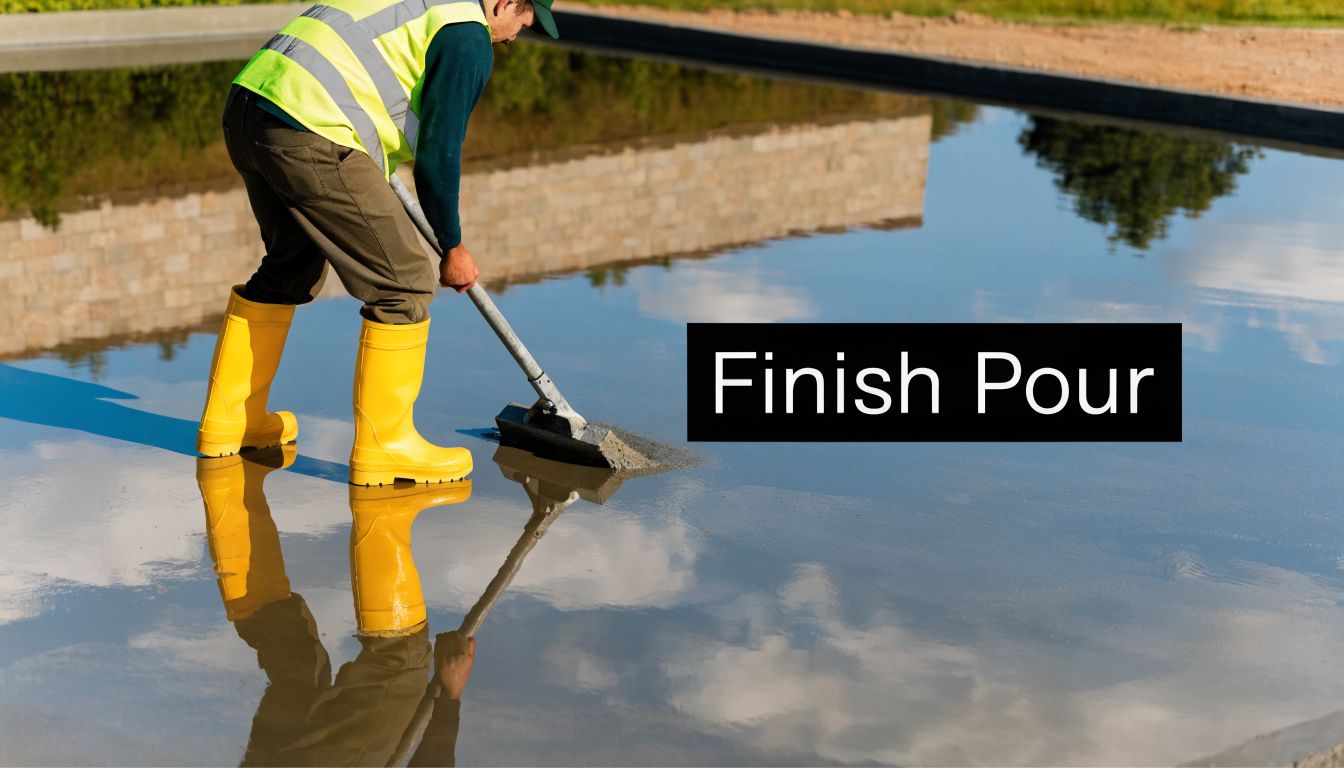
The pour day is where preparation gets tested. Concrete doesn't wait while you correct avoidable mistakes, and the quality of the finished surface depends on how well the crew places, levels, joints, textures, and cures the slab in sequence.
Place the mix evenly and work fast, not sloppy
For long-lasting outbuilding slabs in this region, 4,000 PSI concrete is a common target because it provides the durability needed for weather exposure and regular use, as discussed in Lion Buildings' concrete pad guidance. The concrete should be placed as evenly as possible into the forms so you are not dragging large volumes from one end to the other.
Once the mix is in, the finishing sequence matters. Screed first to strike off excess concrete. Bull float immediately after screeding to flatten ridges and bring paste to the surface. After that, edge and joint at the right time, then apply a broom finish for traction.
Drainage is part of finishing, not an afterthought
In the Mid-Atlantic, one of the most overlooked parts of how to build a concrete pad is surface drainage. A slab that looks level to the eye can still hold water in the wrong spots.
Advanced drainage, such as sloping the pad an extra 2%, or 1/4 inch per foot, can cut surface ponding by 50% compared with the code-minimum 1/8 inch per foot, according to Lowe's concrete pad guidance. That same source notes that in regions like Pennsylvania, where the frost line can reach 42 inches, poor drainage and weak frost protection contribute to a 22% slab failure rate.
A flat-looking slab is not the goal. A slab that sends water away from the structure is the goal.
If you're trying to understand the most common failure points after placement, this guide on how to prevent a concrete slab from cracking gives a practical overview of what to watch.
Finishing sequence that gives the best result
A clean finish depends on timing more than force. The slab tells you when it's ready for the next tool.
- Screed first. Use a straight board to bring the surface to grade.
- Bull float early. This smooths ridges before bleed water disappears.
- Edge the perimeter. Clean edges hold up better and look finished.
- Cut control joints. Jointing helps the slab crack where you intend instead of where it chooses.
- Broom across the travel path. That gives grip for walking, wheeling equipment, and general use.
For a visual look at finishing workflow, this video is a helpful reference.
Curing is where strength is protected
A slab isn't done when the surface hardens enough to walk around it. Curing is what helps concrete develop the strength and durability it was designed for.
The slab should be protected from drying too quickly, especially in sun, wind, or warm conditions. Covering the surface and maintaining proper moisture during the curing period helps reduce early shrinkage stress and improves long-term performance.
The final stages of DIY jobs often see a decline in quality. The slab looked good, so it was treated like it was finished. Good concrete work stays disciplined after the pour, not just during it.
When to Call Your Local Foundation Contractors
A small pad can look manageable on paper. The challenge is that every stage depends on the one before it. If the site drains poorly, the base shifts. If the base shifts, the slab cracks. If the slab isn't square or reinforced correctly, the structure above starts fighting the foundation from the day it is installed.
Homeowners often reach the point where they realize the primary question isn't whether they can pour concrete. It's whether they can handle layout, excavation, compaction, grade control, forming, reinforcement, delivery timing, finishing, and curing without one mistake turning into a permanent problem.
Jobs that usually deserve professional help
Some projects move out of DIY territory quickly.
- Garage slabs. Vehicle loads, edge durability, and anchoring details raise the stakes.
- Clay-heavy or wet sites. These demand better soil judgment and better drainage planning.
- Sloped yards. Grade changes affect excavation depth, fill stability, and runoff control.
- Tight-access properties. Limited equipment access changes how materials get moved and compacted.
- Code-sensitive work. Frost depth, setbacks, and inspection requirements don't leave much room for guessing.
What a contractor solves that a guide can't
A guide can show you the process. It can't test your subgrade, spot weak fill left from an old project, or adjust the pad elevation so water leaves the area instead of trapping itself against a garage door or shed base.
It also can't rescue the clock on pour day. Concrete work is time-sensitive. Once the truck is on site, every delay gets expensive.
Hiring a pro isn't only about labor. It's about judgment under conditions that change from lot to lot.
That matters a lot across Pennsylvania, Maryland, Delaware, and New Jersey, where one property may drain beautifully and the next may hold water over dense clay after a routine rain. Regional experience shows up in decisions that homeowners rarely see directly, like how much to excavate, when to overbuild the base, when to adjust slope, and when a simple pad needs a more serious footing approach.
If you're searching terms like shed foundations contractors near me, gravel shed foundation contractors near me, garage foundation contractors near me, or concrete contractors, you're probably already weighing the cost of professional work against the cost of doing it twice. For many homeowners, the smarter move is getting a clear quote before materials are ordered and schedules are locked in with a building supplier.
That is especially true when your pad has to meet the requirements of prefab builders such as Stoltzfus Structures or Sheds Unlimited. A foundation that is slightly off in size, square, or finish quality can delay the entire installation.
Frequently Asked Questions About Concrete Pads
Do I really need a full concrete pad for a small 10×10 storage shed
Not always. A small 10×10 storage shed can sometimes sit on a properly prepared gravel base if the building is light-duty and the site drains well.
But a concrete pad usually makes more sense if you want a cleaner floor, stronger anchoring, better resistance to rutting around the doorway, and less maintenance over time. If the site is damp, clay-heavy, or prone to seasonal movement, the pad becomes a much safer long-term choice than shed foundation blocks alone.
How do you build a level pad on a sloped yard
You don't force the slope to disappear with a thin layer of stone and hope for the best. A sloped yard often requires more excavation on the high side, careful fill placement and compaction on the low side, and a drainage plan that moves water around the slab instead of trapping it behind it.
That is one reason sloped sites often need a more experienced approach than flat sites. The finished slab may look simple, but the work underneath it is usually not.
What's the difference between a concrete pad and a full house foundation
A concrete pad is typically a slab designed to support an outbuilding, garage, patio structure, hot tub, or similar load at or near grade. A full house foundation is part of a broader structural system and usually involves more engineering, more excavation, and more code requirements than a standard outbuilding pad.
Homeowners sometimes use the terms interchangeably, but they are not the same type of work. If the structure is intended for living space or major occupancy use, the foundation requirements are more involved.
Is gravel ever enough for a shed foundation
Sometimes, yes. A shed foundation gravel base can be a good choice for lighter structures where the site is stable and drainage is strong.
It becomes a weaker option when the soil is soft, the building is larger, or you want a finished floor surface. A lot of frustration comes from using a light-duty base under a structure that should have been on concrete from the start.
How thick should the slab be
Thickness depends on the use, load, reinforcement, and site conditions. A storage shed slab and a concrete foundation for garage use are not automatically designed the same way.
The right answer comes from the actual project, not from a one-size-fits-all rule. That includes the pad dimensions, expected weight, anchor requirements, and whether the slab edges need to handle more stress.
Can a concrete pad be built for more than sheds and garages
Yes. Concrete pads are common for barn shed setups, gazebos, horse barns, shipping containers, hot tubs, patios, driveways, and other outbuildings.
The important part is matching the design to the use. A pad for a playset or gazebo is not laid out the same way as one supporting vehicles or concentrated equipment loads.
How do I know if I should call for excavation help first
If the site has a noticeable slope, poor drainage, soft ground, old fill, or difficult access, start with excavation planning. A lot of homeowners look for excavation near me only after they realize the ground itself is the underlying issue.
That is usually the right instinct. The quality of the finished slab depends on the work below it.
If you're planning a shed pad, garage slab, gazebo foundation, or other concrete foundation in Pennsylvania, Maryland, Delaware, or New Jersey, Firm Foundations can help you get it right from the ground up. As a licensed and insured contractor serving the region since 2011, the team handles excavation, gravel base preparation, concrete forms, reinforced pads, drainage planning, and finished slabs built to spec for homeowners, builders, and property managers. If you'd like a clear, free quote with no surprises, contact Firm Foundations and get a foundation plan that fits your site, structure, and timeline.