
Concrete Foundation Contractors NJ: Your 2026 Guide
A lot of New Jersey homeowners reach the same point at the same time. The shed is ordered, the garage plan is approved in principle, or the new gazebo finally feels close enough to touch. Then the practical question lands hard. What is this structure going to sit on, and who can build that base the right way?
That’s usually where stress replaces excitement. People start searching for concrete foundation contractors NJ, compare wildly different recommendations, and realize fast that not every foundation is built for the same soil, drainage pattern, or structure weight. A base for storage shed use is different from a reinforced slab for a garage. A backyard in North Jersey behaves differently than a wetter coastal lot. If the foundation choice is wrong, the building tells you later through doors that rack, slabs that crack, and water that never seems to leave.
The good news is that a strong start is very achievable when the work is planned around the property instead of forced into a one-size-fits-all solution. New Jersey has a large, active market for this work, with approximately 1,363 concrete contractors statewide according to New Jersey concrete industry data. That gives homeowners options, but it also means choosing carefully matters.
Your Project's Strongest Start Begins with the Right Foundation
Few begin their search by saying, “I need subgrade preparation and drainage control.” They say, “I need a shed foundation near me,” or “I need garage foundation contractors near me before the building crew arrives.” That's the practical reality of this project. The structure is coming, the site isn’t ready, and you want it done once.
In New Jersey, the right answer depends on three things first. The structure itself, the condition of the site, and how water moves across the property. Those factors decide whether a gravel shed foundation, a gazebo foundation, or a concrete foundation for garage use makes the most sense.
A foundation isn’t just a flat surface. It’s the part of the job that decides whether the structure stays level, drains properly, and lasts.
A homeowner putting in a 10×10 storage shed usually needs something different than someone planning cement foundations for garage use. One project may benefit from a well-built gravel pad that sheds water cleanly and supports the shed floor evenly. Another may need excavation, forms, reinforcement, and a finished slab that can handle vehicles, tools, and repeated loading.
What homeowners usually worry about first
The concerns are almost always practical:
- Will it stay level
- Will water collect around it
- Do I need permits
- How long before I can use it
- Am I paying for the right foundation or just the most expensive one
Those are the right questions. Good foundation work answers them before excavation starts, not after the concrete is on the ground.
Where mistakes usually begin
The most expensive problems usually come from rushing the earliest steps. Homeowners often focus on the visible finish and miss the hidden work underneath. If the site isn’t cut correctly, if organic material stays in place, or if drainage is ignored, the structure can move even when the top looks clean on install day.
That’s why experienced contractors talk about grade, compaction, and runoff before they talk about appearance. The slab or pad only performs as well as the preparation under it.
Choosing the Right Foundation for Your New Jersey Property
Not every project needs poured concrete. Not every project should avoid it, either. The best foundation type comes from matching the structure to the site conditions and the expected use.
New Jersey makes this choice more important than many homeowners realize. According to New Jersey soil and foundation guidance, over 40% of the state contains expansive clays or soils with a high plasticity index, and those soils can increase the risk of cracks and uneven settling by 25-30% if the foundation isn’t adapted to those conditions. That’s why a slab that works fine on one lot can perform poorly on another.
Gravel pads for sheds, gazebos, and lighter structures
A shed foundation gravel base is often the best answer for smaller outbuildings when the structure is designed for that type of support. A properly built gravel pad drains well, can be easier to place on challenging sites, and avoids some of the moisture problems that come with trapping water around a flat slab.
For many homeowners searching gravel shed foundation contractors near me, this is the option they want, even if they started by assuming concrete was the default. Gravel works especially well when the goal is a base for storage shed use, a barn shed, a playset area, or some gazebo installations.
What works well with gravel pads:
- Sheds with wood floors that need even support and good drainage
- Gazebos and smaller backyard structures where runoff management matters
- Sites with minor slope where grading and contained stone can create a level base
- Homeowners prioritizing drainage over a fully poured surface
What doesn’t work is a loose pile of stone dumped on topsoil. A real gravel foundation is shaped, compacted, contained, and built to hold grade.
Poured concrete slabs for garages and heavier loads
When the building load increases, the foundation usually needs to as well. A garage slab, workshop floor, or pad intended for repeated vehicle use calls for a different standard than a simple shed base. In those cases, homeowners searching garage footings and foundations, garage foundation contractors near me, or cement foundations for garage are usually right to focus on concrete.
A well-built slab gives you a durable, hard-wearing surface for heavier structures and more demanding use. It also allows for more controlled thickness, reinforcement, and finished elevation where that matters to the building package.
Here’s the trade-off in plain terms.
| Foundation type | Best fit | Main advantage | Main caution |
|---|---|---|---|
| Gravel pad | Sheds, some gazebos, lighter outbuildings | Drainage and practical site adaptability | Must be excavated and compacted correctly |
| Concrete slab | Garages, heavier accessory structures, workspaces | Strong finished surface for higher loads | Less forgiving if drainage and soil prep are wrong |
What NJ soil conditions change
Local experience matters significantly. Clay-loam and other movement-prone soils can expand and contract as moisture changes. On some properties, that means the foundation design needs extra attention to drainage, base preparation, and the type of support under the structure. On coastal or high-water-table lots, the issue often isn’t just movement. It’s persistent moisture.
Practical rule: If water lingers after rain, the foundation decision should start with drainage, not with concrete color, thickness guesses, or online photos.
On stable, well-draining upland ground, a slab-on-grade may make sense for the right structure. On wetter ground, a contractor may recommend a different approach or extra prep to avoid future trouble. The point isn’t that one system is universally better. It’s that the site should lead the decision.
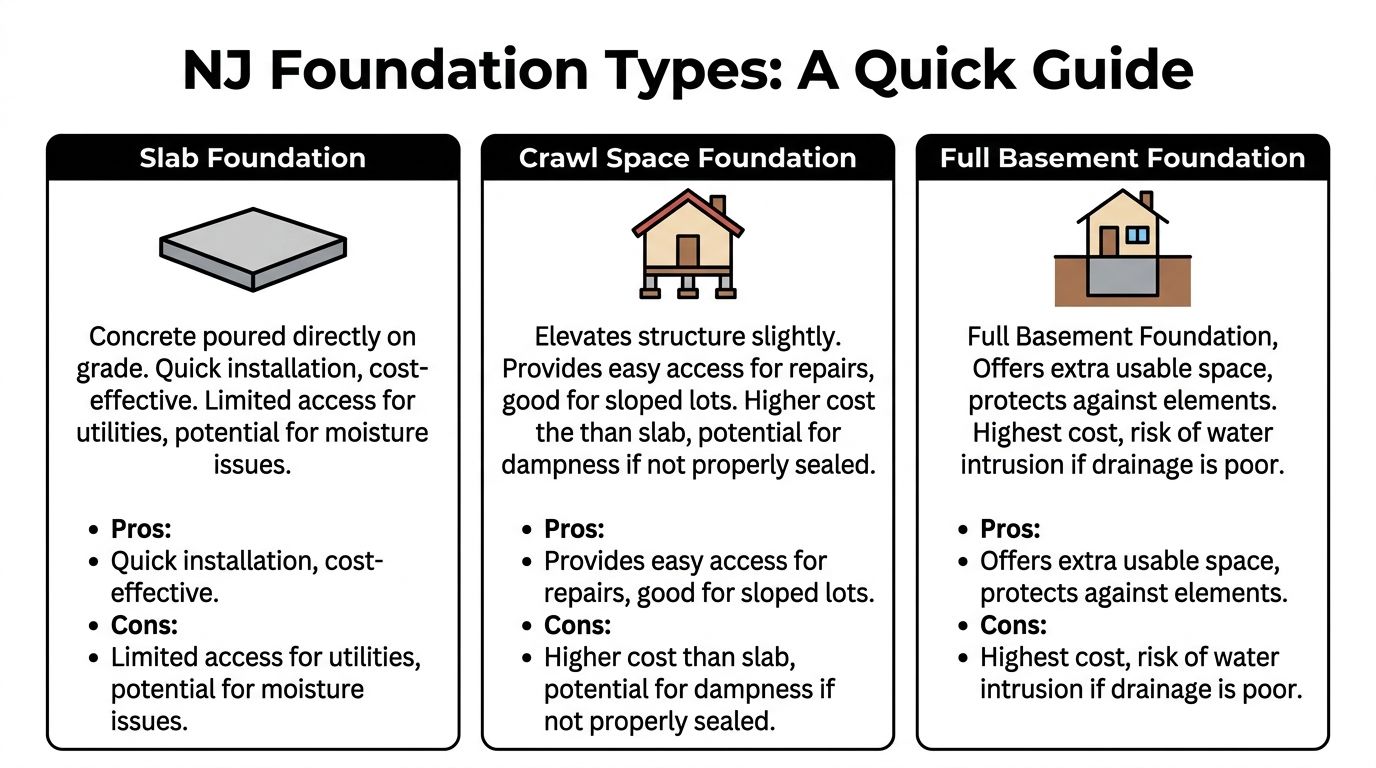
Slab, crawl space, or full basement for larger builds
For larger residential construction, homeowners may also compare slab, crawl space, and full basement foundations. Those choices involve more than outbuilding support. They affect utility access, finished space, elevation, and long-term moisture management.
General trade-offs look like this:
- Slab foundation gives a straightforward footprint and can be efficient where grade and drainage cooperate.
- Crawl space foundation provides access below the structure and can help where slight elevation is useful.
- Full basement foundation adds usable lower-level space but demands careful waterproofing and drainage planning.
For many accessory-structure searches such as shed foundations contractors near me or garage foundation contractors near me, the main comparison is still gravel pad versus slab. But on house foundation or larger foundation builds, the site and building plans widen the conversation.
Matching the foundation to the structure
A few quick examples make this easier:
- A 4×8 shed with foundation needs stability, but not necessarily a poured slab.
- A 10×10 storage shed often performs well on a properly built gravel foundation if the shed manufacturer allows it.
- A detached garage typically needs a stronger, more engineered approach than a storage shed.
- A hot tub pad or shipping container base may need tighter tolerances and a different bearing strategy than a gazebo.
That’s why the best contractor doesn’t start with a sales pitch for one product. They ask what’s being built, where it’s going, how the site drains, and what kind of use the structure will see over time.
How to Find and Vet NJ Concrete Foundation Contractors
A homeowner in coastal New Jersey can hire the right company for a slab and still end up with trouble if that crew builds the job the same way they would on a drier inland lot. High groundwater, frost depth, drainage patterns, and township inspection standards change the work. In parts of the state with heavier clay-loam soils, including areas such as Honey Brook Township, the contractor’s judgment on excavation depth, base prep, and water management matters as much as the concrete itself.
That is why vetting a foundation contractor in New Jersey has to go beyond reviews and price.

Start by checking whether they actually build foundations
A lot of companies advertise concrete work. Fewer handle foundations with the planning and site control the job requires. A driveway crew may do good flatwork and still be the wrong fit for footings, frost protection, drainage correction, and bearing prep.
When you search concrete contractors, excavation near me, or driveway contractors near me, review the company’s site with that distinction in mind. Look for evidence that they regularly install shed pads, garage slabs, footings, stem walls, crawl space foundations, or house foundations in New Jersey. Their project photos should show excavation, forming, reinforcement, gravel base, and finished grading, not only a clean broom finish after the pour.
A useful benchmark is reviewing dedicated service pages like concrete foundation contractor project examples, which show the type of scope and specificity homeowners should expect from any serious contractor.
Check the paperwork before you judge the sales pitch
Good contractors expect questions about credentials. Ask early, before you spend time comparing personalities.
Request:
- New Jersey Home Improvement Contractor registration information
- Proof of general liability insurance
- Proof of workers' compensation coverage
- A written estimate with defined scope
- Recent local references for similar work
Local references matter more than many homeowners realize. A contractor who has completed foundations in your county is more likely to understand how your township inspects, how wet the site stays after rain, and what subgrade problems tend to show up in that area.
If the company hesitates to share documents, gives vague answers about insurance, or says permits are "usually not a big deal," treat that as a warning sign.
Ask questions that reveal field experience
The best vetting conversations sound practical, not polished. An experienced foundation contractor should be able to explain how they handle your site in plain language.
Ask questions like these:
| Ask this | Strong answer sounds like |
|---|---|
| How do you handle soft or organic soil | They explain removal, replacement, grading, and compaction |
| What changes on a wet lot or high-water-table site | They discuss elevation, drainage path, base thickness, and whether the foundation type should change |
| How do you build for frost in New Jersey | They explain footing depth and how they follow local code and plan requirements |
| What if the lot falls out of level | They describe a cut-and-fill or stepped approach, not "we’ll figure it out" |
| Who handles inspections and township communication | They give a clear process and name who is responsible |
I tell homeowners to pay attention to how specific the answers are. A contractor with real experience usually talks about soil, drainage, compaction, and access without needing to be prompted twice.
Compare estimates by scope, not by total
Foundation pricing can vary for legitimate reasons. Access may be tight. Spoils may need to be hauled out. The site may need undercutting because the top layer is soft. A lower quote is not automatically a better quote if it leaves out the work that keeps the slab or footing stable.
Read the estimate like a field checklist. Look for these items clearly spelled out:
- Excavation depth and limits
- Removal of unsuitable soil
- Stone base thickness and compaction
- Forms and reinforcement
- Concrete thickness and PSI
- Spoil haul-off or on-site disposal
- Rough and final grading
- Cleanup
- Who is responsible for permit coordination
Communication habits matter here too. Homeowners often get an early sense of a company from how quickly questions are answered and how clearly revisions are explained. For context on how service businesses are improving response times, this overview of general contractors leveraging AI chatbots is useful. Quick replies do not prove field quality, but poor communication before a job often leads to confusion once excavation starts.
Watch for New Jersey-specific red flags
Some problems are generic. Others show up often on NJ jobs.
Be cautious if a contractor does not ask about drainage on a low lot, acts unconcerned about groundwater near the shore, or gives the same foundation recommendation for every property. The right approach for a simple inland shed pad is not always the right approach for a garage slab near a seasonally wet area or a home addition on heavier soil.
Other red flags include:
- Unusually low pricing without a detailed scope
- Pressure to sign before you have reviewed terms
- Cash-only requests
- No recent photos of similar projects
- Vague answers about reinforcement, base prep, or curing
- No discussion of site access, runoff, or finished elevation
A good contractor should be able to explain how they would build a shed foundation, concrete foundation for garage, or gazebo foundation on your property, not just on an ideal site somewhere else.
A quick visual overview can also help when you’re comparing contractors and scopes:
Decoding Estimates and Navigating NJ Permit Requirements
Homeowners usually expect a price. What surprises them is how much can hide behind that number. A foundation estimate should show what the contractor is building, what prep work is included, and what approvals may be required before any machine arrives.
In New Jersey, permit rules can add time and paperwork faster than people expect. According to New Jersey permit guidance for concrete foundation services, a poured concrete slab larger than 400 sq ft typically requires an engineered plan and a permit, with fees ranging from $200-$500 and approval times of 2-4 weeks depending on the township. That’s a critical detail for garage slabs, larger pads, and homeowners trying to lock in a structure delivery date.
What a solid estimate should include
A good estimate reads like a work plan, not a one-line total. If you’re comparing quotes for shed foundations near me, garage footings and foundations, or concrete forms and slab work, these items should be addressed clearly.
- Site preparation including stripping vegetation, organic material, and unsuitable soil
- Excavation scope describing cut, fill, and grading
- Base material with the type of stone or gravel being used
- Forming and reinforcement if it’s a concrete slab
- Pour and finish details for concrete work
- Cleanup and spoil removal so you know what stays and what leaves
- Permit handling if local approval is required
If excavation is part of the job, it helps to understand what that service involves. Homeowners comparing site work can review residential excavation services for foundation prep to see how grading and preparation fit into the bigger project.
Why one estimate can be lower than another
Two estimates can describe the same slab size and still represent very different jobs. One contractor may include full site prep and drainage correction. Another may assume the site is ready. One may remove unsuitable material. Another may build over it and hope it holds.
That’s why “cheapest” and “best value” are often two different things in foundation work.
If an estimate doesn’t describe the ground under the slab or pad, it’s leaving out the part that most often causes trouble later.
Permit questions to ask before scheduling
New Jersey homeowners should never assume township rules are identical from one municipality to the next. Before setting a delivery date for a garage, prefab shed, or patio project, confirm who is responsible for permit research and submission.
Ask these questions directly:
- Will this project require a permit in my township
- If engineered plans are needed, who obtains them
- Is the estimate written assuming permits are approved
- Does the schedule account for township review time
- Will inspections be required before or after the pour
For larger slabs, permit timing can be the difference between a smooth sequence and a stalled project with equipment or materials waiting on approval.
Gravel versus concrete in estimate planning
Some projects don’t need a full slab, and that matters financially. Homeowners should ask whether a gravel pad is appropriate instead of assuming every structure needs concrete.
The right contractor should be willing to explain the trade-off. A gravel base may be the smarter solution for certain sheds and smaller accessory structures. A poured slab may be necessary for a garage or for a structure with load and anchoring requirements that call for it. The point is to pay for the foundation your building needs, not the one that happens to be easiest for someone else to sell.
What to Expect During Site Prep and Foundation Installation
The visible part of a foundation job starts with equipment showing up. The important part starts earlier, when the contractor decides how the site will be cut, where spoil will go, how grade will be established, and what has to be removed before the first base material is placed.
A lot of failures trace back to prep, not to the final finish. According to guidance on common concrete foundation mistakes, up to 70% of concrete slab failures are linked to a poorly prepared base. The same guidance notes that compacting the subgrade to 95% Proctor density and using a 4-6 inch gravel base are key steps for preventing cracks and uneven settling, especially in New Jersey’s freeze-thaw climate.
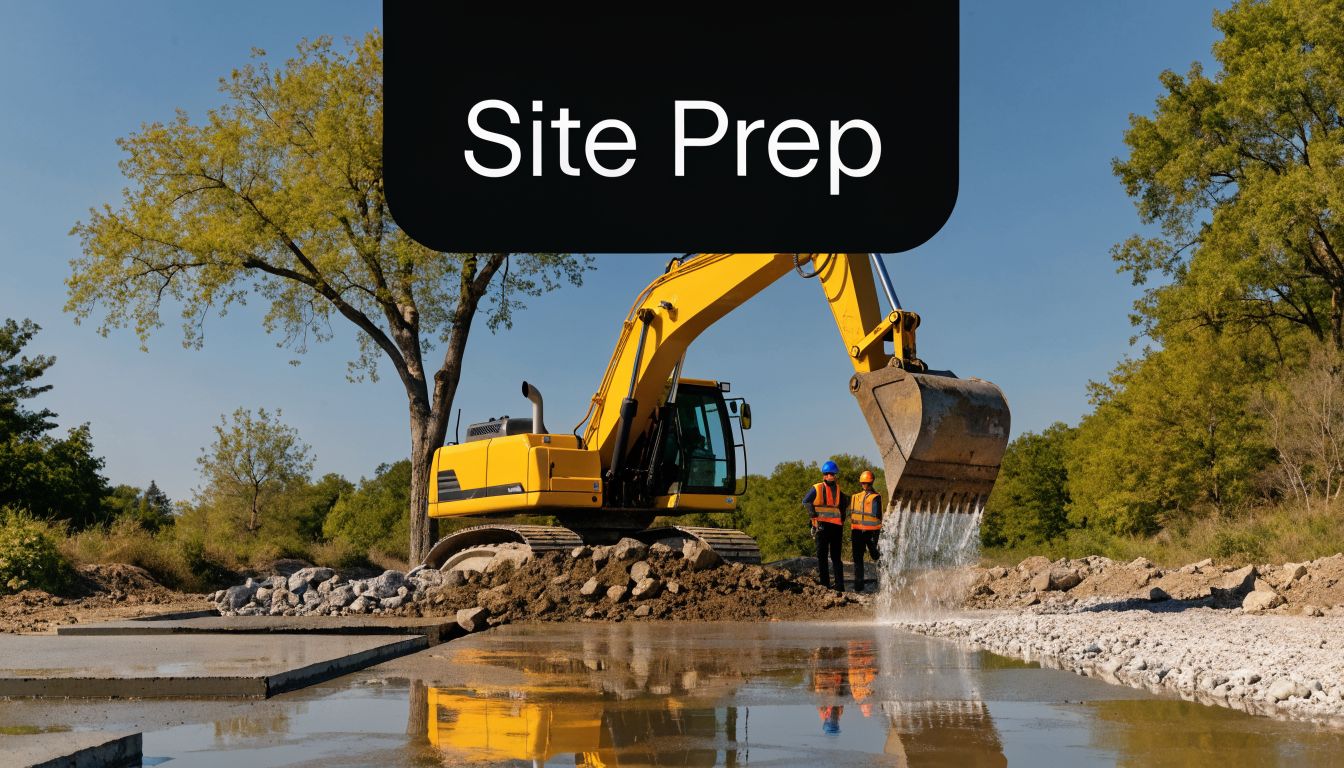
Step one begins with layout and excavation
Before a contractor can build a shed foundation, garage slab, or patio base, the layout has to be established accurately. That means confirming footprint, elevation, setbacks, and access for equipment and material.
Excavation is not just digging until things look flat. The crew removes topsoil, roots, debris, and weak material that should never stay under a pad or slab. On sloped sites, they may cut one side and build the other in a controlled way so the finished foundation sits level and drains correctly.
Step two is subgrade preparation
This phase is where disciplined crews separate themselves. The exposed subgrade has to be stable, properly compacted, and consistent across the whole footprint. Soft pockets can’t be ignored because they’re hidden later.
For homeowners, the practical takeaway is simple. If the contractor spends time compacting, checking, and refining the base, that’s a good sign. Fast isn’t better here.
A well-run crew also keeps safety procedures clear during excavation and concrete work. If you want a simple overview of how jobsite hazard planning is documented, this explanation of Job Safety Analysis (JSA) and Safe Work Method Statement (SWMS) gives helpful context.
Step three is stone base, forms, and reinforcement
After subgrade prep comes the base layer. For concrete work, the base supports drainage and helps create a stable platform for the slab. For gravel pad projects, this phase is the foundation itself taking shape through compacted lifts, correct elevation, and clean edges.
For concrete slabs, crews then install forms and reinforcement. This work has to stay straight, square, and held in place so the slab ends up at the intended dimensions and thickness. Reinforcement that shifts or sits incorrectly doesn’t do its job.
Good concrete work looks calm before the pour. The site is already organized, the forms are braced, and the base is finished before the truck arrives.
Step four is the pour and finish
Pour day moves faster, but it should never feel chaotic. The concrete has to be placed continuously and worked into position without creating weak spots. Finishing follows the intended use of the slab. A garage floor, patio, and utility pad don’t always receive the same finish.
Homeowners often focus on appearance at this point, but placement discipline matters more than cosmetic detail. The crew should be watching edges, level, consolidation, and overall consistency. Extra water added casually on site is a red flag.
Step five is curing and protecting the finished foundation
The slab isn’t ready just because the surface looks hard. Concrete gains strength over time, and curing affects long-term durability. That means the contractor may restrict access, protect the surface, and give clear guidance about when the structure can be installed.
For gravel pads, the final phase is usually edge cleanup, final grading, and checking that water sheds away from the build area.
What the timeline feels like on your property
Every site is different, but most homeowners experience the process in phases rather than as one uninterrupted job:
| Phase | What you notice |
|---|---|
| Mobilization | Equipment arrival, layout confirmation, access planning |
| Excavation and grading | Soil removal, cut/fill work, shape of the site changing |
| Base preparation | Compaction, stone placement, repeated checking of grade |
| Foundation build | Forms, reinforcement, pour, or final gravel shaping |
| Finish and wrap-up | Cleanup, edge work, use instructions, next-step timing |
If you know what each phase is supposed to accomplish, the project feels much less opaque. You can also ask better questions and spot whether the crew is taking the hidden work seriously.
Ensuring Longevity Warranty Care and Your Final Questions
A week after a slab goes in, the concrete usually looks finished and the equipment is gone. That is often when homeowners start asking the questions that matter long term. What does the warranty cover, and what can shorten the life of the foundation after the crew leaves.
In New Jersey, those questions matter because the site keeps working on the foundation long after installation. Coastal properties deal with higher groundwater. Inland lots can have clay-loam soil that holds water and expands. In places with freeze-thaw cycles and mixed soil conditions, a well-built foundation still needs proper drainage and sensible use around it.
A reputable contractor should spell out warranty terms in writing. The document should explain what is covered as workmanship, what relates to site conditions, and what falls outside the contractor’s responsibility if the area is changed later. If the promise sounds broad but the paperwork stays vague, treat that as a warning sign.
How homeowners protect a new foundation
Most problems that show up later come from water, heavy loading, or changes made around the finished slab or pad.
After installation, keep an eye on a few practical items:
- Keep drainage paths open so roof runoff and surface water move away from the foundation
- Avoid piling soil or mulch against slab edges where moisture can sit
- Do not park or drive heavy equipment on areas not built for that load
- Watch how water behaves after landscaping, gutter changes, or a new walkway
- Ask before drilling, anchoring, or modifying the slab for a shed, garage, or addition
Small changes around the perimeter can create big problems later. I have seen good slab work undermined by a downspout that discharged next to one corner for one season too long.
Common questions homeowners ask
How long does concrete need before a shed or garage can be placed on it
Use the contractor’s timeline for that specific slab. Strength builds over time, and the safe install date depends on slab thickness, reinforcement, weather, curing conditions, and the weight of the structure. A delivery schedule should not override the curing plan.
Do I need a permit for a gravel pad
Sometimes. It depends on the township and on the structure that will sit on the pad. In New Jersey, permit rules are local, so it is better to confirm early than assume gravel work is automatically exempt.
Can a foundation be built on a slope
Yes, but the design has to match the site. A sloped lot may require more excavation, grade correction, drainage planning, and in some cases a different foundation type than you would use on a flat yard. The issue is not the slope itself. The issue is whether the plan accounts for it properly.
Is a concrete slab always better than gravel
No. A compacted gravel pad is often the better choice for sheds because it drains well and fits the load. A concrete slab is often the better fit for garages, heavier buildings, and projects that need a fixed floor surface. The right answer depends on use, soil behavior, drainage, and code requirements.
What should I ask before signing a contract
Ask who is handling permits, what excavation and base prep are included, how water will be moved away from the foundation, what the warranty covers, what cleanup includes, and when the structure can be set. Clear answers usually reflect a crew with a clear process.
The final check before you move forward
Before hiring anyone, make sure you can answer these questions plainly:
- Do I know which foundation type fits my structure and site
- Do I understand how water moves across my lot
- Does the estimate clearly describe prep, materials, and scope
- Have local permit requirements been confirmed
- Do I trust the contractor’s process as much as the price
This is the final decision point. Homeowners who slow down here usually avoid the expensive problems, especially on New Jersey properties where soil type, drainage, and township requirements can change from one neighborhood to the next.
If you're looking for a dependable partner for shed pads, garage slabs, excavation, or concrete foundations in New Jersey, Firm Foundations is built for this work. The team serves NJ along with PA, MD, and DE, and specializes in durable gravel pads, long-lasting concrete foundations, and site prep that prioritizes drainage, structural integrity, and clean execution. If you want a clear quote, honest guidance on the right foundation type, and a crew that knows how to build for real site conditions, contact Firm Foundations to get your project started.