
How Big Garage Should You Build? PA & MD Guide
Most homeowners start with the same thought. They know they want a garage, but they don’t know how big garage space they need once real life gets added to the plan.
One vehicle sounds simple until you factor in door swing, shelves, a mower, bikes, a snow blower, holiday storage, or a workbench. A two-car garage sounds generous until one truck replaces a sedan and the space suddenly feels tight every morning.
That’s why garage planning goes wrong so often. People picture parked vehicles. They don’t picture using the garage on a rainy night, carrying groceries, loading tools, walking around bumpers, or trying to add storage after the slab is already poured.
Your Dream Garage Starts With One Question
A garage project usually begins with excitement. Then the practical questions show up fast.
You might be replacing an old detached garage that never worked well. You might be adding a new structure because the basement is full, the driveway is crowded, or your vehicles have outgrown the house. You might also be trying to make room for more than parking, such as a workshop corner or organized storage that finally gets everything out of the house.
Why size matters more than people expect
The biggest mistake is building to the smallest layout that technically fits a vehicle.
A garage can be the right size on paper and still feel frustrating every day. That happens when the design only accounts for the car footprint and ignores how people move through the space. It also happens when the foundation and site plan aren’t matched to local conditions.
A garage that feels oversized when you sketch it often feels normal once you start living with it.
Homeowners across the country have been moving toward larger garages for years. According to U.S. Census data summarized by DASMA, the share of new homes with garages for three or more cars rose from 11 percent in 1992 to 20 percent by 2005. That shift reflects something contractors see in the field all the time. People want room for vehicles, storage, and work space in one structure.
The better way to answer how big garage space should be
Start with three questions:
- What has to fit today: Cars, trucks, motorcycles, tools, bins, lawn equipment.
- What may need to fit later: EV charging, taller vehicles, overhead storage, a lift, hobby space.
- What does the site allow: Lot layout, access, drainage, frost conditions, and local setbacks.
Those three answers usually tell the truth faster than any online template.
A garage is easier to size correctly when you treat it as part parking area, part storage plan, and part foundation project. If one of those pieces gets ignored, the whole build suffers. The footprint may be too small, the approach may be awkward, or the slab may start showing problems that could have been prevented.
A practical mindset from the start
The goal isn’t to build the biggest garage possible.
The goal is to build one that works well for your property, your vehicles, and your daily routine. A well-planned garage feels easy to use from day one. Doors open without hitting walls. Storage has a home. Water drains away. The slab stays stable. Nothing feels like an afterthought.
This marks the true starting point.
Standard Garage Sizes A Practical Starting Point
A garage can look adequate on paper and still feel tight the first week you use it. That usually happens when the footprint is based on bare minimum parking dimensions instead of how people in PA, MD, DE, and NJ use garages now. Larger trucks, EV charging, tall storage racks, and workshop overflow all change what a "standard" size should mean for your property.
Standard sizes are still useful. They give you a starting range before you price the slab, footings, framing, and door openings. The mistake is treating the smallest common size as the safe choice.
One-car garages
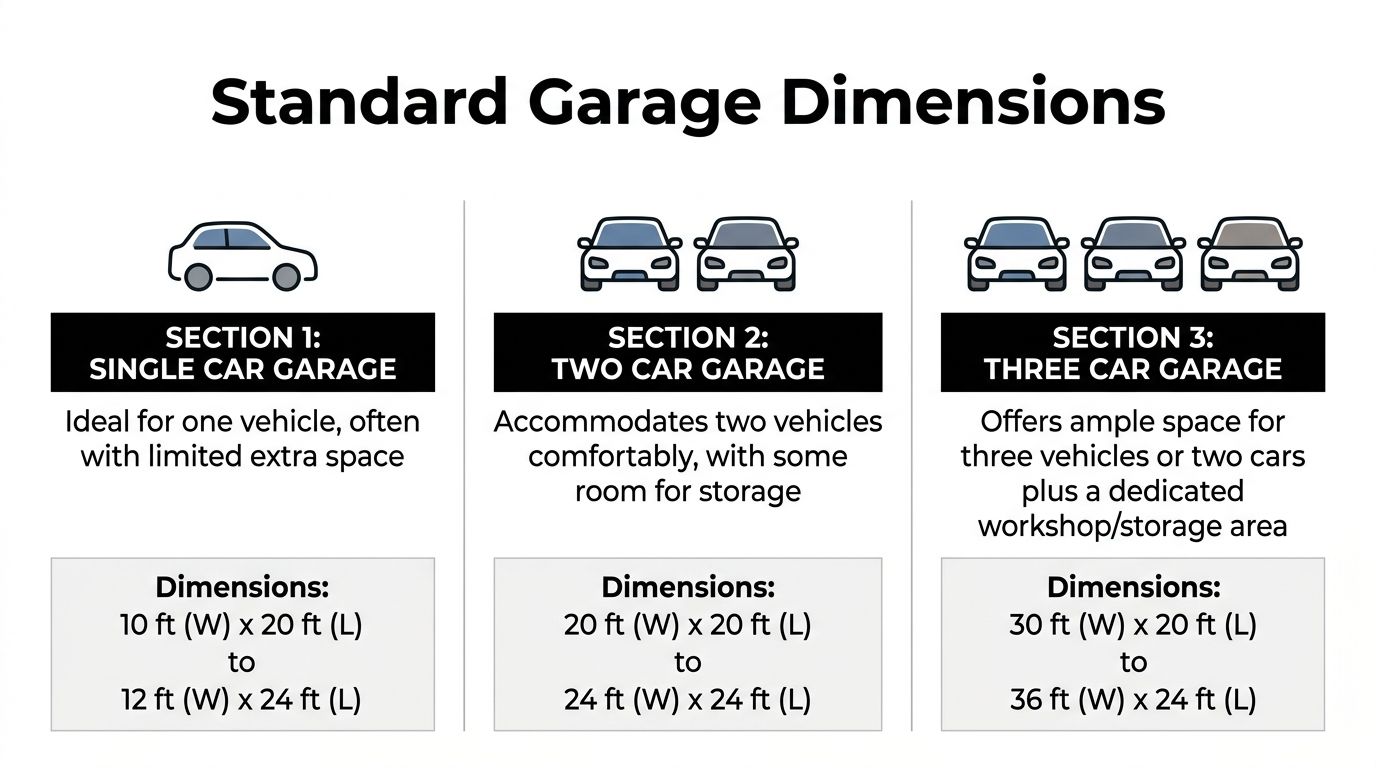
A one-car garage often starts around 12×20 feet. That can park a compact vehicle, but it leaves very little forgiveness once you add shelves, a mower, trash cans, or a side wall bench.
For many homeowners, 14×22 is where a one-car garage starts working better day to day. 16×24 gives you a more comfortable layout if the vehicle is larger or the garage also needs to handle storage. In the Mid-Atlantic, that extra room also helps when winter gear, snow tools, and basement overflow end up in the garage, which happens often.
A practical way to look at single-bay sizing:
- 12×20: Tight parking, little to no side storage
- 14×22: Better door swing and walking space
- 16×24: More realistic for storage, tools, or a small work area
Two-car garages
Two-car garages are where sizing mistakes show up fastest. On paper, 18×20 feet can count as a two-car footprint. In real use, it often parks two vehicles tightly and leaves very little room for stepping out, carrying groceries, or storing much of anything.
Most homeowners are happier at 22×22 or 24×24. That added width and depth gives space between vehicles, room along the walls, and better clearance for modern SUVs and pickups. If one of those vehicles will be electric, planning extra wall space for charging equipment now is easier than trying to force it in later.
For homeowners comparing layouts, this guide to two car garage size options is a useful reference. If you want to test different footprints before settling on a slab dimension, a room size calculator can help you sketch the space and see how quickly a few extra feet improve usability.
Three-car garages and larger layouts
A three-car garage usually starts around 32×22 feet. Larger layouts are common when one bay is expected to do more than park a vehicle. That third bay often becomes the workshop, tool wall, lawn equipment area, or the storage zone people did not account for in the original plan.
That pattern matters during design. If one bay will hold a workbench, motorcycles, freezers, or vertical shelving, size the garage for that use from the start instead of counting it as open vehicle space. I see fewer regrets on projects where the owner admits that early and builds the square footage into the foundation plan.
Standard vs recommended garage dimensions
| Garage Type | Standard Dimensions (W x D) | Recommended Dimensions (W x D) | Best For |
|---|---|---|---|
| One-car | 12×20 | 14×22 or 16×24 | One vehicle with enough room for walking space, light storage, or a bench |
| Two-car | 18×20 | 22×22 or 24×24 | Two vehicles with better clearance and more usable wall space |
| Three-car | 32×22 | Larger layouts based on use | Three vehicles, or two vehicles plus storage or shop space |
What works in the field
The better choice is usually the size that still works after the garage fills up a little. That means accounting for open car doors, wall storage, charger locations, and the fact that many Mid-Atlantic garages carry more household overflow than the original plan intended.
Bigger is not automatically better. A wider or deeper garage adds excavation, concrete, and framing cost, and in this region it can also affect footing depth, drainage planning, and how the slab performs through freeze-thaw cycles. But building too small is expensive in its own way. Once the slab is in and the structure is up, adding missing width is a lot harder than sizing it correctly the first time.
Planning Beyond Parking Your Garage's True Purpose
A lot of garage plans look right on paper and feel tight within a year. A second refrigerator shows up. The kids' bikes move in. Then someone wants a bench, a mower, or a place to charge the next vehicle. If the slab and foundation were sized only for parking, the garage starts losing function fast.
The best way to avoid that is to decide what the garage needs to do on an ordinary Tuesday, not just on move-in day.
Plan the garage by use, not just by car count
I tell homeowners to stop at the driveway and picture the routine. Are you pulling in two daily drivers, storing yard equipment, charging an EV overnight, and keeping a wall free for shelves? In PA, MD, DE, and NJ, that decision affects more than layout. It can change slab size, footing layout, drainage planning, and how well the building handles freeze-thaw conditions over time.
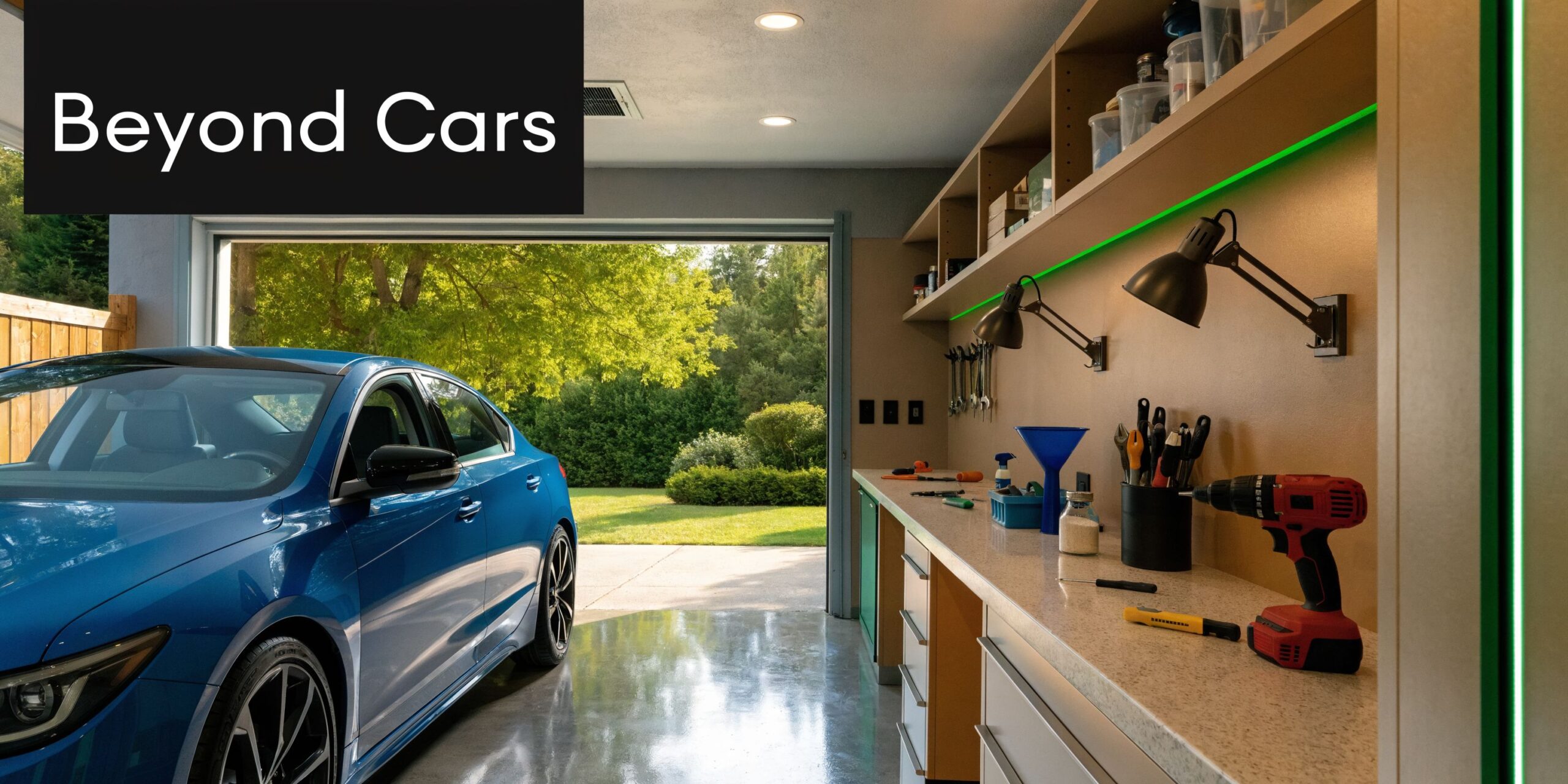
A practical layout usually includes four working areas:
- Parking area: room to park without hugging the wall every time
- Storage area: space for shelves, bins, ladders, and seasonal overflow
- Work area: enough depth for a bench, tools, or repair work
- Utility area: charger location, panel access, entry door, and mechanical clearances
That mix is why a garage that technically fits two vehicles can still feel undersized from day one.
Workshops and storage need dedicated floor space
A bench on the back wall or side wall sounds minor until you account for stool space, tool storage, and room to stand and work safely. The same goes for shelving. Twelve to twenty-four inches of storage depth along a wall changes the usable parking width immediately.
As noted earlier, recommended sizes work better than bare minimums once real storage and shop use enter the plan. A one-car garage in the 14×22 to 16×24 range gives you far better odds of keeping both the vehicle space and the work space usable. For a two-car setup, many families are happier once one bay is treated as shared parking and household storage from the start instead of pretending every inch will stay open.
Vehicle hobbyists need even more room. If you plan to pull an engine, store jacks and stands, or roll equipment around the bay, layout matters as much as square footage. Even a tool choice like an engine hoist leveler affects how much side and front clearance you should leave for safe work.
Plan for EVs, taller vehicles, and vertical storage now
Garage use has changed in the last few years. More homeowners want a charger, a larger SUV or pickup, and storage that goes up the wall instead of across the floor.
Houzz’s garage measurement guide shows the same pattern I see in the field. Newer garages often need more wall space for charging equipment and more height for taller vehicles, lifts, and overhead storage. That is one reason older minimum sizes feel dated so quickly.
In the Mid-Atlantic, planning that extra room early usually costs less than trying to retrofit around a slab that was poured too tight.
A short visual can help you think through modern garage use before finalizing your footprint.
Fit the garage into the whole property plan
The garage footprint should work with the rest of the site, not compete with it. If you may add a walkway, apron extension, shed pad, or gazebo later, leave room now for grading, drainage paths, and access. I have seen good garage structures create water problems because the surrounding hardscape was never considered with the foundation layout.
The strongest plans account for the garage as part of the property system. That means enough room to use it the way you live, and a foundation sized for that use from the beginning.
The Unseen Essentials Clearances and Access
A garage can be the right size and still be awkward to use. That usually comes down to clearance.
Clearance isn’t wasted space. It’s the difference between a garage you enjoy and one you tolerate.
Door swing and walk-around room
The bare minimum that fits a vehicle often ignores how you enter and exit it.
You need room to open doors without tapping drywall, scraping another car, or squeezing sideways with bags in your hand. You also need enough space at the front, rear, and sides to move around the vehicle without feeling trapped.

A few practical questions reveal whether the layout is usable:
- Will both drivers be able to open their doors at the same time?
- Can someone walk past the front of the vehicle without turning sideways?
- Is there room along at least one wall for shelves or tools without pinching the parking lane?
If the answer is no, the design may technically fit, but it won’t function well.
Garage doors and ceiling height
The opening matters just as much as the interior.
A garage door that’s undersized for the vehicle creates a stressful approach every time you park. A low header can also limit future use, especially if you later buy a taller truck or want overhead storage.
Ceiling height deserves more attention than it usually gets. Even without a car lift, overhead racks, open hatchbacks, garage door tracks, lighting, and door openers all compete for space above the vehicle.
Don’t forget the approach outside
Access starts before the tires reach the slab.
A good garage location gives the driver a clean approach, enough turning room, and a driveway alignment that feels natural. Tight turns, steep transitions, or awkward placement can make a well-sized garage harder to use than a smaller one with better access.
This is especially important on rural and semi-rural properties in Pennsylvania, Maryland, Delaware, and New Jersey where driveways often tie into grades, drainage swales, or existing outbuildings. The garage and driveway need to be planned together.
Empty space inside a garage isn’t wasted if it lets you park easily, open doors fully, and move safely around the vehicle.
Building a Foundation That Lasts in PA MD DE and NJ
A garage can look perfectly sized on paper and still become a problem if the slab and footings are wrong for the site. I see that more often than homeowners expect in Pennsylvania, Maryland, Delaware, and New Jersey, where frost depth, wet clay, fill soil, and drainage patterns can change the foundation plan fast.
In this region, the ground is part of the sizing decision.
A two-car garage built for heavier trucks, EVs, a workbench, or tall storage loads the slab differently than a bare-bones parking box. Add freeze-thaw cycles and uneven soil conditions, and a generic national foundation detail stops being good enough.
Mid-Atlantic sites need more than a basic slab
Garage foundations here have to carry weight, resist seasonal movement, and stay dry. That usually means checking local frost depth, confirming bearing soil, and deciding early whether a slab-on-grade is enough or whether the building needs footings and a perimeter wall system.
In colder parts of the region, a common durable approach is a block foundation with footings placed below frost depth, then a slab poured over a compacted stone base. Sheds Unlimited’s concrete pad guide describes one version of that assembly using 8-inch block over footers with a 4-inch slab above a prepared base.

That kind of foundation is built to handle site conditions, not just create a flat floor.
Slab details affect long-term performance
The slab itself needs the right thickness, concrete strength, reinforcement, and base prep for the way the garage will be used. Passenger cars, pickups, EVs, stored equipment, and workshop tools all add demand. Edge cracking and settlement usually start where the slab is undersized, poorly supported, or exposed to water.
As noted earlier from Absolute RV's foundation specifications, garage slabs are commonly built at about 4 inches thick with suitable concrete strength and reinforcement, and perimeter footings are often taken below local frost depth where frost heave is a concern. The exact specification should match the building, soil, and intended use.
That is why foundation work should be set before the building package is ordered, not figured out after excavation starts.
What happens below the concrete matters most
Many slab failures start in the subgrade.
Soft topsoil, buried organic material, loose fill, and poor compaction all create weak spots. A properly compacted gravel or stone base helps support the slab and gives water a path to move away instead of collecting under the concrete. If the site holds water, the grading plan and foundation plan need to work together. Otherwise the slab edge stays wet, the ground moves through the seasons, and cracks show up early.
This matters even more on Mid-Atlantic properties with mixed soil conditions. One corner of the garage may be bearing on firm native ground while another sits over disturbed fill from an old driveway, shed, or grading job.
Larger garages raise the stakes
As the garage gets bigger, foundation mistakes get more expensive to fix. A wider slab has more room for differential settlement. A deeper garage often means more excavation. A workshop bay, storage loft area, or heavier vehicle use can also justify stronger reinforcement, thicker sections in some areas, or a closer look at the footing design.
Cost comparisons only help if they include the whole foundation system. This breakdown of concrete slab for garage cost is useful because it separates excavation, stone base, concrete, and related site work instead of treating the slab like a simple one-day pour.
What I want settled before concrete is scheduled
For a garage foundation in PA, MD, DE, or NJ, these are the items that deserve a clear answer:
- Bearing soil: Remove topsoil, roots, and soft material until the foundation bears on suitable ground.
- Base preparation: Install and compact stone or gravel to support the slab and improve drainage.
- Frost protection: Set footings to the depth required for the municipality and site conditions.
- Concrete specification: Match slab thickness, strength, and reinforcement to the intended use, especially for trucks, EVs, or workshop loads.
- Water management: Grade the site so runoff moves away from the garage instead of pooling along the slab edge.
- Final dimensions: Make sure the slab and foundation layout match the building footprint, door locations, and anchoring requirements.
A garage foundation should be built for the lot you own, the climate you live in, and the way you will use the space. That is the local piece many garage size guides leave out, and it is the part that prevents expensive settling, cracking, and drainage problems later.
Navigating Permits and Local Building Codes
A garage that fits your needs still has to fit your municipality’s rules. That part catches a lot of homeowners off guard.
Local permitting offices don’t only care about the structure itself. They also look at where it sits on the lot, how much surface area it adds, and whether drainage and foundation details meet code.
The checklist that usually matters most
Before excavation starts, confirm these items with your township, borough, county, or city office:
- Setbacks: Your garage has to sit the required distance from property lines, easements, and sometimes existing structures.
- Height limits: Detached garages may have separate height rules from the house.
- Impervious coverage: Added concrete, driveway area, and roof footprint can affect what’s allowed on the lot.
- Use classification: Some jurisdictions treat workshops, storage buildings, and vehicle structures differently.
- Stormwater considerations: Drainage may need to be addressed as part of the permit.
These requirements can directly affect how big garage space you’re allowed to build and where it can go.
Why local code review changes the design
A homeowner might want a larger footprint, but the lot may only support it in one location. That can change the garage door orientation, driveway approach, and foundation design.
Some sites also force decisions between width and depth. Others require the slab elevation to work with surrounding grade so runoff doesn’t move toward the house or a neighboring property.
What inspectors usually care about below the surface
Inspectors often focus on details homeowners never see once the slab is finished:
- excavation depth
- footing layout
- reinforcement
- gravel base preparation
- slab thickness
- drainage and finished grade
That’s why experienced concrete contractors matter. Good paperwork helps, but field execution is what gets approved and holds up over time.
Permits aren’t just red tape. They’re often the moment when site limits and wish-list ideas finally meet reality.
The smoother projects are the ones where the footprint, access, and foundation details are all coordinated before materials arrive.
Your Project Starts with a Firm Foundation
A garage project usually looks simple on paper. Then the site starts answering back.
The footprint has to fit the way you live, but the slab and footings have to fit the ground, the grade, and the frost depth in your area. In Pennsylvania, Maryland, Delaware, and New Jersey, that matters more than many homeowners expect. A layout that works in a generic online guide can still be wrong for Mid-Atlantic soil conditions or winter movement.
Good garage planning ends at the ground, not at the walls.
The best results come from sizing the garage and the foundation together. A wider bay for larger trucks, EV charging space, a workbench, or vertical storage changes loads, door placement, and how people move through the space every day. On some sites, a simple slab works. On others, the garage needs deeper footings, added base preparation, or a different approach to handle frost and drainage without future cracking or movement.
That is why I tell homeowners to make foundation decisions early, before the building package is locked in. If the excavation, stone base, reinforcement, slab thickness, and finished elevation are handled properly, the garage feels right to use and holds up better over time. If those details are rushed, the problems show up later as standing water, slab cracks, sticking doors, and uneven floors.
If you are planning a new garage in PA, MD, DE, or NJ, start with two questions. How much room do you need for the way you will use the space, and what kind of foundation does your site require to support it properly?
For homeowners searching for garage foundation contractors near me, garage footings and foundations, cement foundations for garage, concrete foundations, or excavation near me, the smartest next step is getting the site and slab reviewed before the build is locked in.
Frequently Asked Questions About Garage Construction
What size garage works best for most homeowners?
For one vehicle, a standard garage is often enough for parking, but recommended sizes are usually more comfortable once storage is included. For two vehicles, extra width and depth make daily use much easier. The best size depends on vehicle type, storage plans, and whether the garage will double as a workshop.
Can I build a garage slab without deep footings?
Sometimes, but not every site should use the same approach. In frost-prone areas, deeper footings or a block-wall-and-slab system may be needed to resist seasonal movement. Local soil and code requirements should guide that decision.
What if my site has drainage or slope issues?
That usually means more planning at the excavation stage. Grading, base prep, and slab elevation have to work together so water moves away from the garage instead of toward it.
Should I plan for EV charging now even if I don’t own one yet?
If you think an EV is likely later, it’s smart to reserve wall space, access, and enough overall room now. It’s easier to plan that into the garage than to force it into a tight layout afterward.
If you’re ready to build a garage that’s sized correctly and supported the right way, contact Firm Foundations. The team builds durable garage slabs, gravel pads, shed foundations, gazebo foundation bases, and excavation-ready sites across Pennsylvania, Maryland, Delaware, and New Jersey. Request a free quote and get a foundation plan that fits your property, your garage, and the way you’ll use it.