
Prefab Detached Garages: A PA/MD/DE/NJ Guide
Your house still works. Your storage plan does not.
That is where many prefab detached garage projects begin in Pennsylvania, Maryland, Delaware, and New Jersey. The lawn equipment is taking over one bay. Holiday bins are stacked in corners. The vehicle that used to stay protected now sits outside. A workshop, gym, or clean storage area sounds simple enough, until the practical questions start piling up.
Most homeowners ask the same things first. Will a prefab garage hold up in our climate? What kind of base does it need? Will the township require permits? Can the truck even get it into the backyard? Those are the right questions, especially in the Mid-Atlantic where soil movement, drainage, and local code enforcement can make or break the project.
A prefab garage can be a smart solution because it gives you faster installation and a more controlled build process than a fully site-built garage. But the garage itself is only part of the job. The site, the access path, the drainage, and the foundation decide whether that structure stays level and usable for the long haul.
Your Prefab Garage Project Starts Here
Many individuals start by shopping styles, colors, and door layouts. That makes sense. The garage is the visible part. But the first practical decision is usually the less exciting one. It is whether your property can support the building you want.
In this region, a prefab garage project usually turns on five early checks:
Use and size
Decide whether the structure is mainly for vehicles, storage, a hobby shop, or mixed use. A simple parking garage needs different floor support and interior planning than a workshop with tools, shelving, or future electric.Access for delivery
Prefab detached garages arrive either as sections or as a structure assembled on site from factory-built components. Trees, fences, overhead wires, septic fields, and narrow driveways can all affect what style is realistic.Drainage
Water always wins if the site is wrong. A low spot in the yard may look level enough in dry weather, but a foundation contractor will look for runoff patterns, soft areas, and where water will move after a storm.Code and zoning
Township and borough rules can vary widely. Setbacks, maximum building size, lot coverage, and utility requirements all need a look before the install date is on the calendar.Foundation type
This is the long-term decision. The wrong base can leave you with sticking doors, water problems, and a building that slowly goes out of square.
Tip: Before you order the garage, confirm the foundation requirements with both the garage supplier and your local code office. That avoids the common problem of having a structure ready for delivery but no approved base to set it on.
Homeowners who like seeing how construction companies explain planning and project communication can also learn from resources on construction marketing strategies. Not for garage design itself, but for understanding how reputable contractors present process, expectations, and next steps.
Exploring Your Prefab Garage Options
Prefab does not mean one thing. Homeowners often use the term for any garage that is not framed stick by stick on the property, but there are a few distinct ways these buildings are sold and installed.
What prefab usually means on a residential lot
A prefab detached garage is generally built in a factory, either fully assembled or in sections, then delivered for placement or final assembly. That differs from a traditional stick-built garage, where crews frame, sheath, and finish the structure entirely on site.
That factory setting matters. Materials stay drier. Crews repeat the same assembly steps. The weather causes fewer delays. For many homeowners, that is the main appeal. The visible progress on site moves quickly once the pad or slab is ready.
Common garage styles in PA MD DE and NJ
The style you choose affects more than appearance. It can change headroom, storage potential, and how well the garage fits the house and neighborhood.
| Style | Best fit | What homeowners like |
|---|---|---|
| A-frame garage | Most suburban homes | Familiar roofline, clean appearance, easy match with existing architecture |
| Gambrel or barn shed style | Storage-heavy use | More upper volume for loft storage or a workshop feel |
| Simple box or utility style | Budget-focused setups | Straightforward footprint, practical layout, fewer design extras |
The A-frame is the most common request because it blends in well with homes in established neighborhoods. A gambrel works well when storage matters as much as parking. Some owners never park inside at all. They want a barn shed layout for lawn equipment, seasonal items, and hobby space.
Material choices and real trade-offs
There is no perfect material. There is only the best fit for how you want to use the structure and how much upkeep you want to handle.
- Wood garages offer a traditional appearance and are easy to customize visually. They suit homeowners who want the garage to look closely tied to the house.
- Vinyl-clad garages reduce exterior maintenance and stay popular with owners who want a cleaner, lower-upkeep finish.
- Metal garages are often chosen for affordability and simplicity. The verified market data notes that prefab metal garages can further reduce costs because of cheaper materials and lower labor, especially for budget-conscious homeowners in Pennsylvania, Maryland, Delaware, and New Jersey, as discussed in the comparison of prefab vs custom built garages.
A quick walk-through can help you picture the build style and handling process before ordering:
Uses beyond parking
The best prefab detached garages solve a space problem, not just a car problem.
Some homeowners use them for:
- Vehicle protection for daily drivers, collector cars, motorcycles, or lawn tractors
- Workshop space for woodworking, small-engine repair, or craft work
- Organized storage that frees up the basement and spare bedroom
- Home gym use where noise and equipment stay outside the main house
- Overflow utility space for a mower, snowblower, garden supplies, and tools
That last category is more common than people expect. A detached garage often becomes the practical answer for everyone who searched for a base for storage shed options, then realized they need a larger enclosed structure with better access.
Choosing the Right Foundation for Your Garage in Our Climate
The foundation is the part homeowners notice least on day one and appreciate most a few winters later.
In Pennsylvania, Maryland, Delaware, and New Jersey, freeze-thaw movement changes the whole conversation. A garage that looks perfectly fine when it is delivered can start showing trouble after repeated cold-weather cycles if the base was chosen on price alone.
Why frost heave causes real trouble
When soil freezes and thaws, it moves. That movement is not always uniform. One side of a building may rise or settle more than the other. A detached garage does not need dramatic failure to become frustrating. A little shift can throw doors out of alignment, create water entry points, or leave the structure looking slightly twisted.
The foundation data most relevant to this region is clear. T-shaped foundations are engineered for freeze-thaw climates with footings poured below the local frost line, and local frost depth is typically 3 to 4 feet in Pennsylvania and nearby states according to this summary of garage foundation types. That deep footing and wall system helps isolate the structure from vertical soil movement caused by freezing ground.
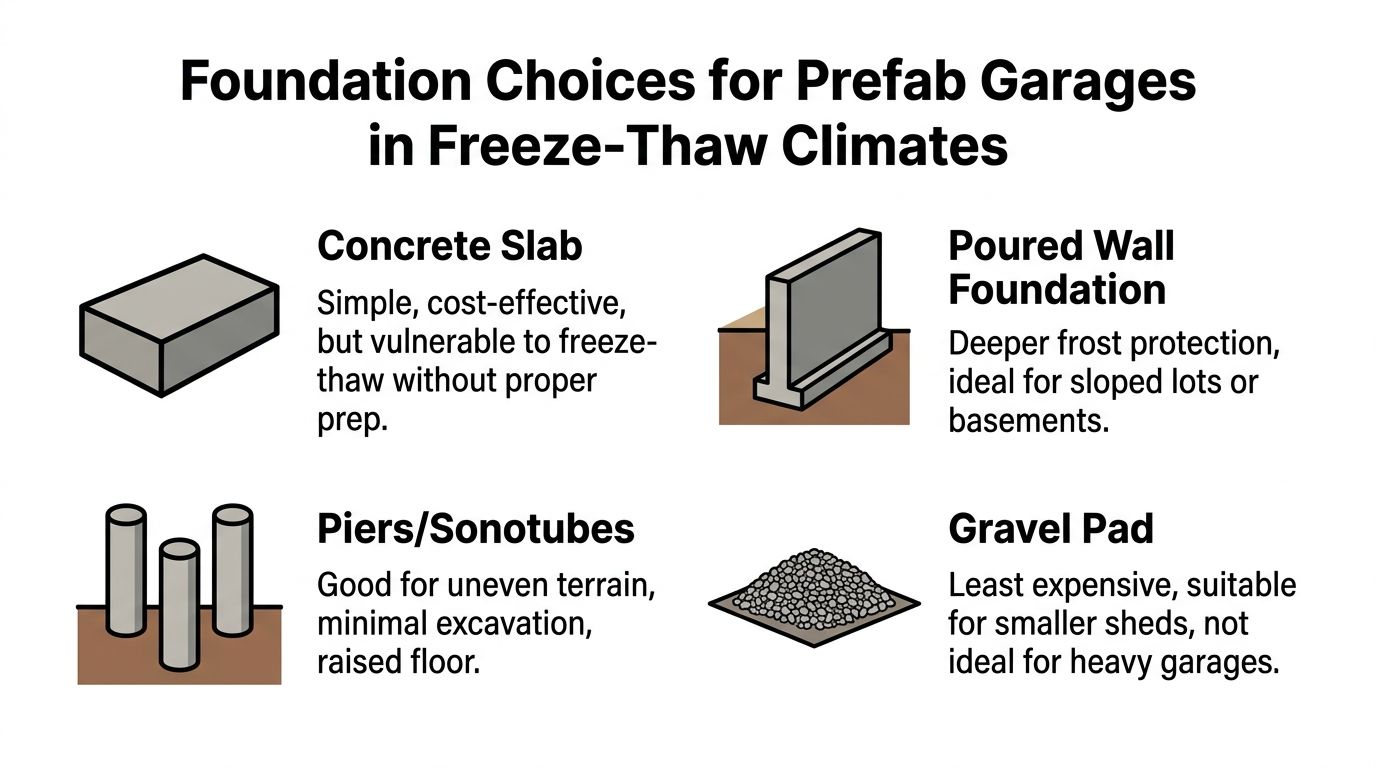
Key takeaway: In a freeze-thaw climate, a permanent garage foundation is not just about holding weight. It is about controlling movement.
Gravel pad versus concrete slab versus deeper frost protection
Homeowners usually compare three broad categories. Each has a place, but not every site or garage should use the cheapest option.
Gravel pad
A properly built gravel pad can work well for many structures, especially when drainage is the top concern and the building type allows for it. The difference is in the word properly.
A basic dump-and-level stone base is not the same thing as a compacted, well-contained pad prepared for long-term support. The background data provided for this article notes a recurring gap in prefab garage advice. Many sellers talk about low-cost setups without adequately addressing settlement risk, drainage, and frost movement in Mid-Atlantic soils. That is exactly where many avoidable problems begin.
A gravel pad is often a strong option when:
- the garage manufacturer approves it
- the site drains well
- the pad is excavated, contained, and compacted correctly
- the intended use does not demand a monolithic concrete floor
A gravel pad is often a poor option when:
- the site stays wet
- clay-heavy soil holds water
- the structure is large and permanent
- local code asks for an engineered or concrete solution
Reinforced concrete slab
A reinforced slab gives you a finished floor and a strong, predictable base. For many homeowners, this is the cleanest setup for parking vehicles, using jacks or toolboxes, or turning the space into a workshop.
The issue is not whether concrete is strong. It is whether the slab design fits the site and climate. A shallow slab placed on poorly prepared ground can still move. A slab that does not account for drainage can still let water become the long-term problem.
Floating slab designs come up often in garage planning. If you want a simple explanation of that approach, this overview of a floating slab foundation is useful. The right slab can perform very well, but it still needs proper subgrade preparation and a realistic view of local frost conditions.
Frost-protected or deeper footing systems
For a permanent detached garage in colder parts of the region, this is often the most conservative approach. The verified foundation data states that T-shaped foundations typically cost $12 to $18 per square foot in Mid-Atlantic applications and are used where frost resistance and long-term stability justify the premium, based on the same garage foundation types reference.
This is the option to discuss seriously when:
- the garage is larger and intended as a permanent building
- the township treats it more like a conventional structure
- the lot has known frost or water issues
- you plan to invest in electric, interior finishes, or long-term use
What works and what usually fails
The failure pattern is familiar. A homeowner buys a good garage and saves money under it. The structure goes on blocks, shallow stone, or a lightly prepared base. The first season looks fine. Then the site starts telling the truth.
Common outcomes include:
- Doors that rack or bind
- Water that runs under the wall line
- Visible settling at corners
- Cracking or edge movement in weak concrete
- Trim and siding gaps caused by the structure moving out of level
What works is less flashy. Correct excavation. Stable base material. Drainage planning. Matching the foundation to the structure and the site, not just to the lowest bid.
A practical decision rule
If the garage is small, the site is dry, and the manufacturer permits it, a well-built gravel pad can be a sensible foundation.
If you want a finished floor, vehicle use, or cleaner interior function, a reinforced slab usually makes more sense.
If the building is permanent and the lot deals with real winter movement, deeper frost-protected construction deserves serious weight in the decision.
Navigating Permits and Building Codes in PA MD DE & NJ
Permits make people uneasy because no one wants to order a garage, schedule site work, and then learn the township has a problem with the location or the base.
The first thing to know is simple. Garage rules are local. State matters, but the actual answers often come from the township, borough, city, or county office reviewing your property.
What usually triggers a permit review
Detached garages often need permits when size, use, height, or placement crosses a local threshold. Some municipalities care most about square footage. Others focus on setbacks, lot coverage, or whether the structure has power.
The safe approach is to ask before you buy. Do not rely on what a neighbor did, what a dealership said, or what a previous owner got away with.
A short call to the local office should cover these questions:
- Setback rules for side, rear, and front property lines
- Maximum structure size allowed on your lot
- Height limits for detached accessory buildings
- Foundation requirements for a prefab garage
- Impervious coverage limits if you are also adding driveway area
- Electrical permit needs if you plan lights, outlets, or a subpanel
Why local code language matters
One town may treat a detached garage under a simple accessory-structure path. Another may want engineered drawings, a specific foundation detail, or stormwater review if the footprint changes runoff patterns.
That matters a lot in this four-state service area because suburban neighborhoods, rural townships, and older established towns often use different enforcement styles. Honey Brook Township, a Pennsylvania borough, and a New Jersey township may all look at the same garage differently.
Tip: Ask the code office what they need in writing. Some homeowners only ask, “Do I need a permit?” Better questions are, “What documents do you need from me?” and “What foundation detail must appear on the application?”
Where homeowners get tripped up
Most permit delays come from one of these issues:
| Issue | Why it slows the project |
|---|---|
| Wrong location on the lot | Setbacks or easements are violated |
| Missing site plan | Reviewer cannot verify placement |
| Vague foundation detail | Inspector wants more structural information |
| Undeclared electric | Separate permit or trade review is needed |
| Access conflicts | Delivery path differs from approved placement |
If you are planning electrical service inside the garage, it also helps to understand what inspectors tend to look for once wiring begins. A practical checklist like this electrical rough-in inspection checklist can help you ask better questions before that phase starts.
A steady way to handle approvals
Homeowners do better when they gather information in this order:
- Choose the approximate garage size and location
- Confirm local zoning and permit expectations
- Verify the required foundation type
- Check access for delivery equipment
- Submit the site plan and any supporting details early
That order prevents the common mistake of falling in love with a garage model before confirming whether the lot can legally and practically support it.
Your Project Budget and Timeline What to Realistically Expect
The biggest budgeting mistake with prefab detached garages is focusing only on the building price.
The garage itself may be affordable, but the total project includes site prep, excavation, foundation work, drainage measures, delivery access, and any finish work you want afterward. A clear budget starts by separating the structure from the ground it sits on.
What the garage itself may cost
Verified market data shows that prefab detached garages typically cost $24 to $43 per square foot, compared with $40 to $70 per square foot for stick-built garages, and that a 24×24 two-car prefab garage averages $19,500, with savings driven largely by 50 to 70 percent lower labor costs and faster installation according to prefab vs custom built garages.
That same verified data also notes that complete prefab units often fall in the $5,000 to $20,000 range, while custom builds commonly run $28,000 to $52,000 or higher, as summarized in the same source above.

What the total project budget includes
Think in cost buckets, not one lump number.
Garage unit
This is the prefabricated structure itself, including the style, siding, doors, and selected upgrades.Delivery and placement
The route to the property, crane or mule access if needed, and final set day all affect this part.Excavation and site prep
Clearing sod, cutting grade, importing stone, and correcting drainage can materially change the project scope.Foundation work
A gravel base, reinforced slab, or deeper footing system all carry different cost levels and labor intensity.Electrical or finishing work
Interior lights, outlets, openers, insulation, and wall finishes are often separate trades and separate line items.
For homeowners comparing slab options, a practical cost overview like this page on concrete slab for garage cost can help frame the foundation portion of the budget.
Key takeaway: A prefab garage can save money on structure and labor, but the site still has to be built correctly. The cheapest garage is not the cheapest project if the ground prep is wrong.
What the timeline usually looks like
Prefab stands out because the visible install happens quickly once the site is ready. Verified data notes that installation can take 4 to 5 hours, versus 2 to 4 weeks for site-built construction, and some prefab options include delivery and assembly in under a day according to the same prefab vs custom built garages reference already cited earlier in this section.
The full project timeline usually feels more like this:
| Phase | What happens |
|---|---|
| Planning | Choose size, layout, and location |
| Permitting | Local review, revisions if needed |
| Site prep | Excavation, grading, drainage work |
| Foundation | Pad, slab, or footing installation |
| Cure or stabilization time | Depends on foundation type |
| Delivery day | Garage arrives and is set or assembled |
| Final add-ons | Electric, doors, shelving, finish details |
The garage may arrive fast. The schedule before that is where good planning pays off.
What helps projects stay on track
A realistic timeline depends on decisions made early. Homeowners who move smoothly usually do three things well:
- They confirm code requirements before ordering
- They choose the foundation based on the site, not just on the quote
- They make sure delivery access is possible from the street to final placement
That is the practical side of prefab. Fast installation is real. Fast preparation is not automatic.
The Firm Foundations Process A Pre-Install Checklist
The best garage installs feel calm because the hard questions got answered before delivery day.
A good pre-install checklist keeps the project from drifting into last-minute surprises. If you are comparing garage foundation contractors near me, concrete foundations, or gravel shed foundation contractors near me, this is the kind of process you want to hear from any serious contractor.
Step one starts with the site, not the brochure
The garage model matters, but the property decides what is workable.
A proper site review looks at:
- grade and drainage
- soil conditions
- access width and overhead clearance
- distance from the road or driveway
- nearby trees, fences, utilities, and septic components
- where water will go after the garage and apron are installed. Many homeowners learn here that the original “perfect spot” is only perfect on paper.
The checklist before excavation begins
Use this list before any machine shows up:
Choose the exact footprint
Mark the planned location with setbacks in mind, not just convenience.Confirm the delivery route
A prefab detached garage needs a real path to the pad or slab. Tight gates and low limbs matter.Get permit clarity
Make sure the municipality has confirmed what they want for the foundation and placement.Decide on utility plans early
If you may want electric later, plan conduit or trenching before the foundation is complete.Pick the base that matches use
Storage-only, vehicle parking, workshop use, and long-term permanence do not all call for the same setup.
What precise foundation prep should include
This stage separates a durable result from a temporary-looking one.
A competent crew should handle:
- Excavation to proper depth so organic material and unstable topsoil are removed
- Base preparation with the right material for the chosen foundation
- Compaction so the support layer is stable
- Grade correction to move water away from the garage area
- Final leveling because prefab structures need accurate, consistent support across the footprint
Tip: If a contractor talks only about “dropping some stone” or “pouring a quick pad,” keep asking questions. Good foundation work sounds methodical because it is.
Coordination with the garage supplier
This part gets overlooked often.
The foundation should match:
- the exact building dimensions
- door orientation
- anchor requirements
- entry height expectations
- the supplier’s delivery and placement method
If the supplier is delivering a finished structure, the pad location and approach path become just as important as the pad dimensions. If the garage arrives in sections, staging room for installers also matters.
What homeowners should expect on install day
Delivery day should be mostly about execution, not problem-solving.
You want:
- a clear, accessible route
- a finished and ready base
- no unresolved permit questions
- a site free of loose debris or obstructions
- everyone working from the same footprint and orientation
That is how the install stays straightforward. The structure arrives. The crew places or assembles it. The doors open the way they should. Water has somewhere to go. The building starts its life level.
A final readiness check
Before you lock in a delivery date, ask yourself:
| Question | Why it matters |
|---|---|
| Is the exact location approved? | Prevents relocation or permit trouble |
| Is the foundation complete and level? | Protects the building from early movement |
| Can the delivery equipment access the site? | Avoids day-of delays |
| Is drainage addressed? | Protects the base and interior |
| Are future add-ons planned now? | Saves rework later |
That checklist applies whether you are planning a concrete foundation for garage use, a shed foundation gravel base, a gazebo foundation, or even a barn shed pad. The project changes. The principle does not. Good groundwork solves more than most homeowners realize.
Frequently Asked Questions About Prefab Garages
Can prefab detached garages handle Mid-Atlantic winters
Yes, if the structure is well built and the foundation matches local conditions. The climate challenge is usually less about the garage shell and more about frost movement, drainage, and whether the base was designed for a permanent building.
Is a gravel base enough for every garage
No. A gravel base can be a good solution on the right site and for the right structure, but not every garage belongs on gravel. Larger or more permanent garages, wet sites, and places with stronger code requirements often justify a slab or a deeper frost-protected foundation.
Do I always need concrete for a detached garage
Not always. Some prefab detached garages can sit successfully on a well-built gravel pad if the manufacturer allows it and local rules permit it. If you want a finished floor, heavier vehicle use, or stronger long-term rigidity, concrete often becomes the better choice.
What causes most garage foundation problems
Three issues show up again and again. Poor drainage. Inadequate excavation and compaction. Choosing a base that ignores frost conditions. The visible symptom may be a crooked door, but a common cause is usually under the building.
How much space should I leave around the garage
Enough for drainage, maintenance, and delivery access. Exact setback distances come from the local code office, but from a practical standpoint, the structure should not be squeezed into a location that makes water control or future repairs difficult.
Can a prefab garage be used as a workshop or gym
Often yes, but make that decision early. Workshop and gym uses affect foundation expectations, floor performance, electrical planning, lighting, and sometimes insulation choices. A garage used only for storage has different needs than one that will hold benches, free weights, or rolling equipment.
What if my lot is sloped or hard to access
That does not automatically rule out prefab. It does mean the project needs a more careful site review. Some lots need grading, others need a different foundation approach, and some need a different delivery method. Access is one of the first things to verify before ordering the structure.
Is a prefab garage only for budget projects
No. Some homeowners choose prefab for price, but many choose it for speed, predictability, and cleaner installation logistics. A lower-cost structure can still be a strong long-term investment when the foundation and site work are done correctly.
Should I call the township or the contractor first
Call the township early for zoning and permit basics, then speak with the contractor once you know the local framework. That combination usually saves the most time. The office tells you what is allowed. The contractor tells you what is workable.
If you are planning a prefab detached garage in Pennsylvania, Maryland, Delaware, or New Jersey, Firm Foundations can help you start with the part that matters most. The team builds durable gravel pads, concrete foundations, and garage footings that match your site, your structure, and our region’s climate. Reach out for a free quote and get a clear plan before delivery day arrives.