
Local Floating Slab Foundations in Pennsylvania: A 2026 Guide
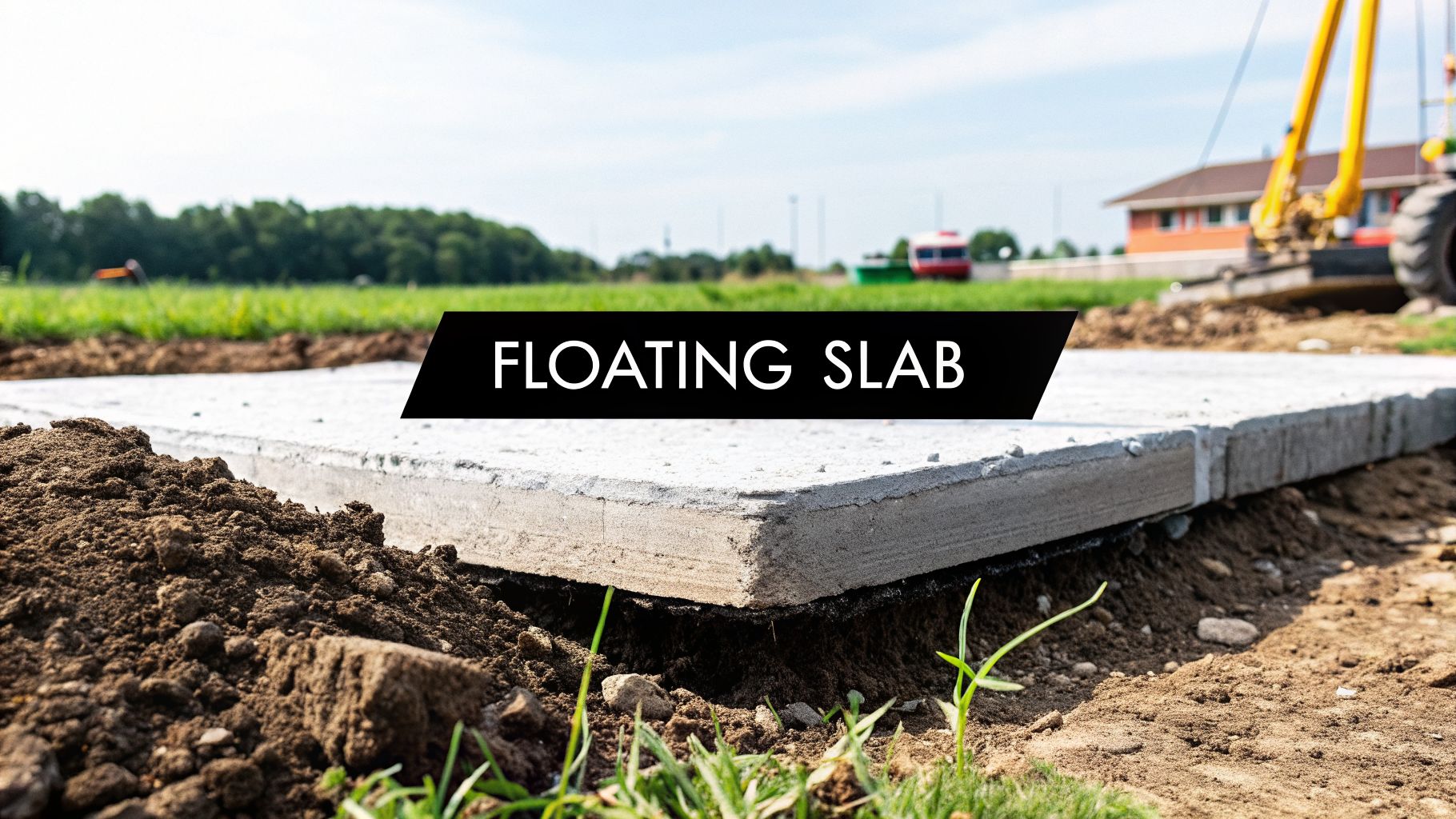
So, what exactly is a floating slab foundation? If you're a homeowner in Pennsylvania planning a new structure, the simplest way to understand it is to picture a sturdy, one-piece concrete raft built specifically for your shed, garage, or gazebo. At Firm Foundations, we engineer this single, reinforced concrete pad to "float" right on top of the soil.
Instead of fighting against the ground's natural seasonal movements, it moves with them as a single, solid unit. This approach is why so many of your neighbors trust us for their foundation builds.
A Quick Guide To Floating Slab Foundations
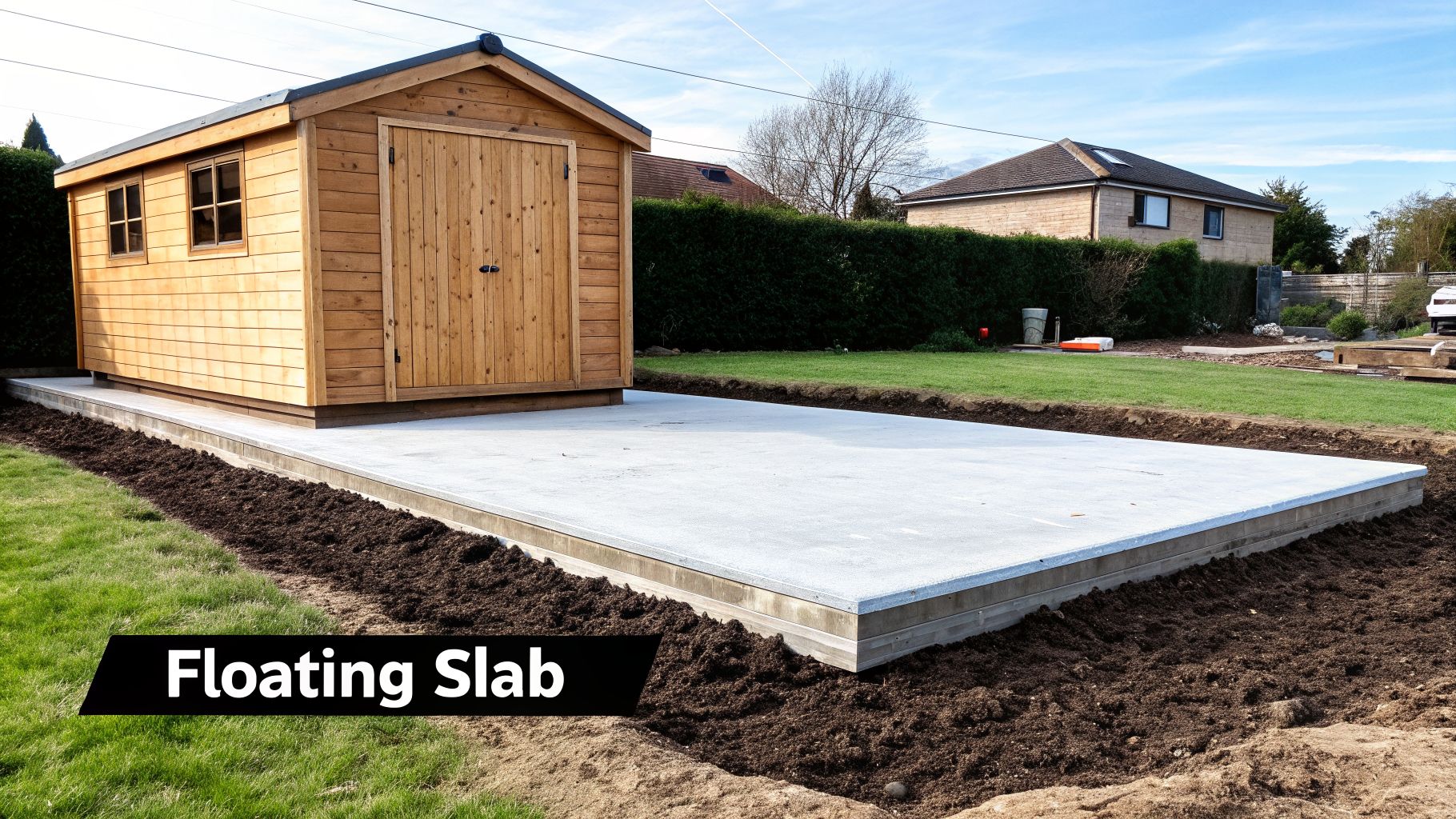
If you’re a homeowner in Pennsylvania, you’ve almost certainly seen a floating slab without even realizing it. They are the preferred base for countless detached structures, from a simple 10×10 storage shed to a complete two-car garage. As your local foundation experts, we want you to feel confident in the solution you choose.
To give you a clearer picture, here is a quick summary of what defines a floating slab.
Floating Slab Foundation At a Glance
| Characteristic | Description |
|---|---|
| Construction | A single, monolithic pour of concrete reinforced with steel rebar or wire mesh. |
| Placement | Poured directly onto a prepared base of gravel, sitting on top of the ground. |
| Depth | Relatively shallow, typically 4 to 6 inches thick with thickened edges. |
| Key Feature | Moves with the ground during freeze-thaw cycles, preventing cracks and heaving. |
| Best For | Detached garages, sheds, workshops, gazebos, and other accessory structures. |
This at-a-glance view shows why this method is so reliable for the types of projects we handle every day at Firm Foundations right here in our community.
The concept itself is fascinating and has deep roots in architectural history. In fact, a "floating raft" foundation was pioneered back in the late 1800s to build skyscrapers on Chicago’s notoriously soft soil. Architects needed a way to distribute the building’s immense weight, and a massive, reinforced slab was the brilliant solution. You can read more about this historical innovation and how it shaped modern construction.
Why Are Floating Slabs So Popular In Our Region?
Floating slabs are particularly well-suited for the challenging soil and climate conditions we see across Pennsylvania. Our region’s constant freeze-thaw cycles cause the ground to expand and contract, putting tremendous pressure on foundations.
A floating slab is the perfect answer to this problem for two main reasons:
- It Moves as a Single Unit: Because the foundation is one solid piece, the entire slab can rise and fall slightly with the ground’s movement. This prevents the structural cracks and damage that can easily compromise other foundation types.
- It Distributes Weight Evenly: The slab spreads the entire weight of your shed or garage over a large surface area. This reduces the pressure on any single point of the underlying soil, ensuring long-term stability.
When you start searching for "shed foundations contractors near me" or "garage foundation contractors near me," you're really looking for a team that understands these local Pennsylvania challenges. At Firm Foundations, we don’t just pour concrete; we engineer a durable solution designed to protect your investment for decades to come.
How a Floating Slab Works for Your Shed or Garage
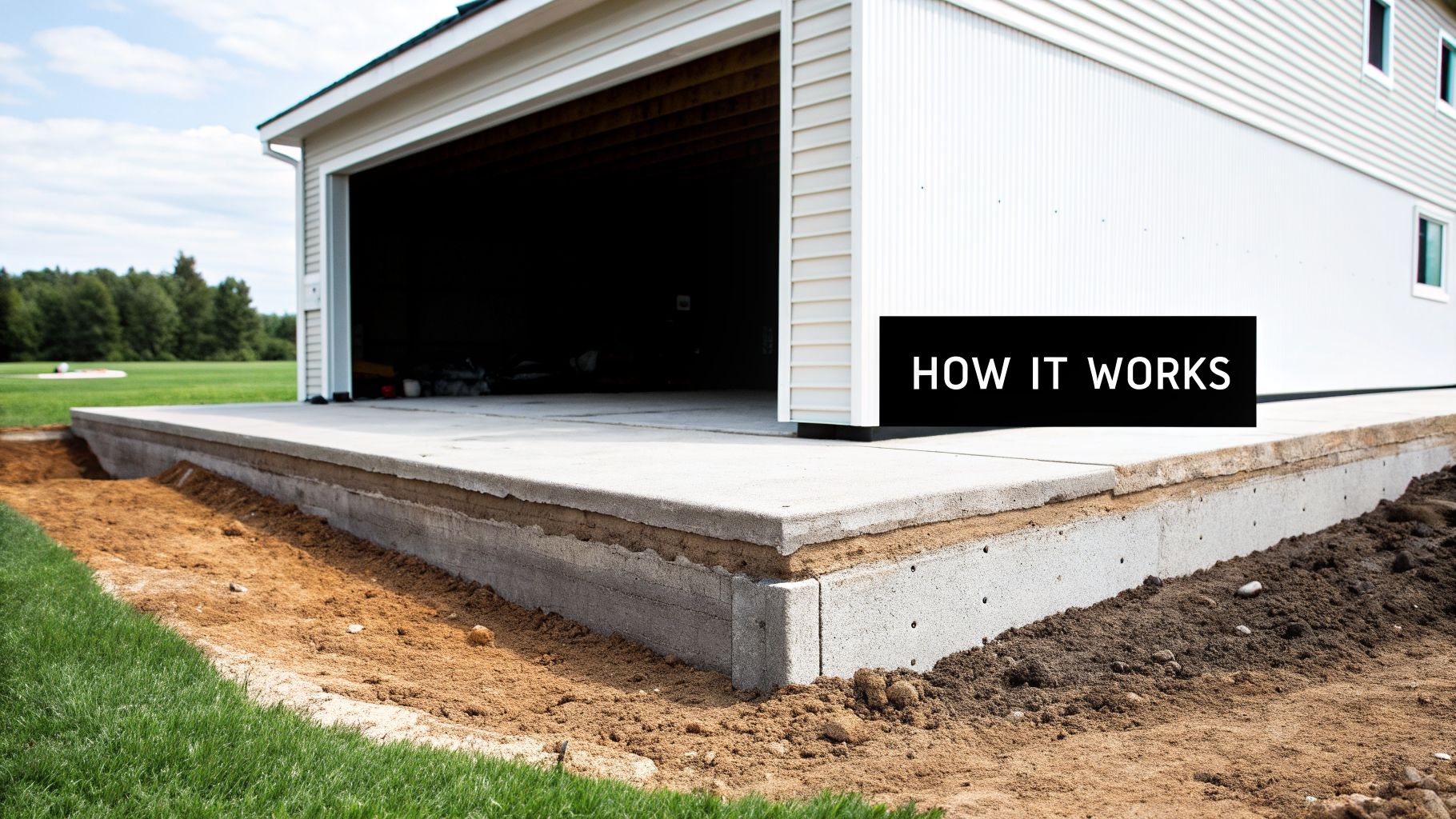
The effectiveness of a floating slab foundation lies in its unified construction. We build them using a monolithic pour, meaning the slab floor and the thickened edges are formed from a single, continuous placement of concrete. This creates one solid, interconnected unit right on your property.
This technique is what creates integrated garage footings and foundations all in one piece. Unlike traditional foundations that require separate, deep footings that fight against the ground, a floating slab is engineered to work with the earth.
The Science Behind the 'Float'
A floating slab’s design is a direct solution to soil movement. Here in Pennsylvania, we deal with significant frost heave and expansive clay soils that cause the ground to shift. These forces can exert immense pressure on traditional foundations, leading to cracks and failure.
A floating slab is different—it moves as a single, cohesive unit with the ground.
Because the slab is a single, rigid piece, it can rise and fall uniformly with the ground's natural shifts. This prevents the uneven pressure that causes other foundations to crack, ensuring your shed foundation or garage pad remains stable and intact for years.
This unified structure is the very reason it’s so durable. For a reliable base for a storage shed or a new garage, this design provides superior stability against the seasonal challenges common in our area.
The Role of the Thickened Edge
A key engineering component of a floating slab is its thickened perimeter, sometimes called a haunch. This is far more than just extra concrete; it’s an integrated footing that provides critical support precisely where it’s needed most: directly under the structure's load-bearing walls.
The thickened edge serves several key functions:
- Load Distribution: It effectively transfers the weight from the walls and roof across the entire slab, preventing stress points.
- Structural Rigidity: It adds immense stiffness to the foundation, which stops the edges from curling or breaking under load.
- Frost Protection: By extending deeper into the ground, it acts as a barrier against frost, minimizing the impact of freeze-thaw cycles.
As experienced garage foundation contractors, we engineer every monolithic slab with a robust thickened edge. It’s this professional detail that makes our cement foundations for garage and shed projects last a lifetime. Once your floating slab foundation is in place, you can focus on the rest of your project. For example, you might want to learn how to insulate a tin shed to improve its comfort and usability year-round.
Weighing the Pros and Cons of a Floating Slab
No foundation is a one-size-fits-all solution, and floating slabs are certainly no exception. At Firm Foundations, we believe in giving Pennsylvania homeowners the complete picture so you can make an informed decision for your project. Let's weigh the advantages against the potential drawbacks.
The Advantages of a Floating Slab
The primary appeal of a floating slab for many homeowners comes down to two things: speed and cost. Because this type of foundation doesn't require deep excavation for footers, the site can be prepped and the concrete poured much more quickly. This efficiency is a huge advantage when you’re eager to get your new gazebo foundation or base for a storage shed built and ready for use.
This speed directly translates to significant cost savings. A floating slab requires less excavation, less labor, and fewer materials than a traditional basement or crawl space, making it an exceptionally budget-friendly option for detached garages, sheds, and other outbuildings where a full foundation isn't necessary.
This focus on efficiency isn't new. The floating slab surged in popularity during the post-World War II housing boom. Builders needed to construct homes for millions of returning veterans quickly and affordably. The monolithic slab, poured in a single go, dramatically cut construction time and costs, cementing its place in modern construction. You can learn more about the history of slab foundations and their impact on residential building.
To put it in perspective, here is a quick look at how these two foundation types stack up.
Floating Slab vs Traditional Foundation A Quick Comparison
| Feature | Floating Slab Foundation | Traditional Foundation (with Footings/Basement) |
|---|---|---|
| Cost | More affordable due to less excavation and materials. | Higher upfront cost due to extensive excavation and labor. |
| Speed | Faster installation, often poured in a single day. | Slower, multi-stage process involving deep footings and walls. |
| Soil Conditions | Ideal for stable or well-prepared ground. | Can be adapted to various soil types but is more complex. |
As you can see, the benefits in terms of time and money are clear, especially for the right kind of project and location.
Potential Drawbacks to Consider
While floating slabs have many benefits, they also come with potential issues that require professional foresight to prevent. One of the most common concerns is future access to plumbing or electrical lines. Since these utilities are embedded directly within the concrete, making repairs can be a major, disruptive job if not planned for correctly from the start.
Another critical factor, especially here in Pennsylvania, is the risk of frost damage. If a floating slab is installed without precise site preparation, proper drainage, and a stable gravel base, it becomes vulnerable to heaving and cracking during our region's harsh freeze-thaw cycles.
This is precisely where hiring experienced foundation contractors like Firm Foundations becomes critical. We turn these potential cons into non-issues by using our deep knowledge of local soil and climate conditions to engineer a foundation that lasts.
Our meticulous site prep and drainage solutions are designed to manage water effectively, protecting your investment from the damaging effects of frost. By addressing these factors from day one, we build a durable and reliable foundation that gives you all the pros without the cons.
Our Step-by-Step Guide to Building Your Foundation
Building a durable concrete foundation for a new shed, garage, or outbuilding is a process that demands precision from start to finish. At Firm Foundations, we provide homeowners across Pennsylvania with a clear, professional process, ensuring you have complete confidence in the final result.
A foundation's strength is a direct reflection of the quality of its construction. Whether the project is a simple pad for a 10×10 storage shed or a heavily reinforced slab for a large barn shed, our commitment to meticulous execution remains the same.
The Initial Site Assessment and Free Quote
Every successful project begins with a thorough site visit and a detailed plan. When you reach out to us, we schedule a professional assessment of your property to understand the specific requirements of your project.
During our visit, we evaluate several key factors:
- Soil Conditions: We identify the soil type to determine the correct preparation and compaction methods needed for a stable base.
- Site Grade: Any slopes or unevenness are measured, as proper leveling is critical for long-term stability and drainage.
- Accessibility: We map out the most efficient and least disruptive path for bringing equipment and materials onto your property.
Following this in-person assessment, we deliver a comprehensive quote. You will receive a detailed breakdown of all costs, ensuring complete transparency before any work begins.
Meticulous Site Preparation and Excavation
Once you approve the plan, our specialists begin the crucial phase of site preparation. The long-term durability of your foundation is established here, long before any concrete is poured. This is a technical process that involves far more than just digging.
First, we clear the designated area of all topsoil, vegetation, and debris. We then carefully grade the site to create a perfectly level surface that directs water away from your future structure. Achieving a stable, well-compacted sub-grade is non-negotiable for a foundation built to last. You can read more about the importance of soil compaction in our guide on the topic.
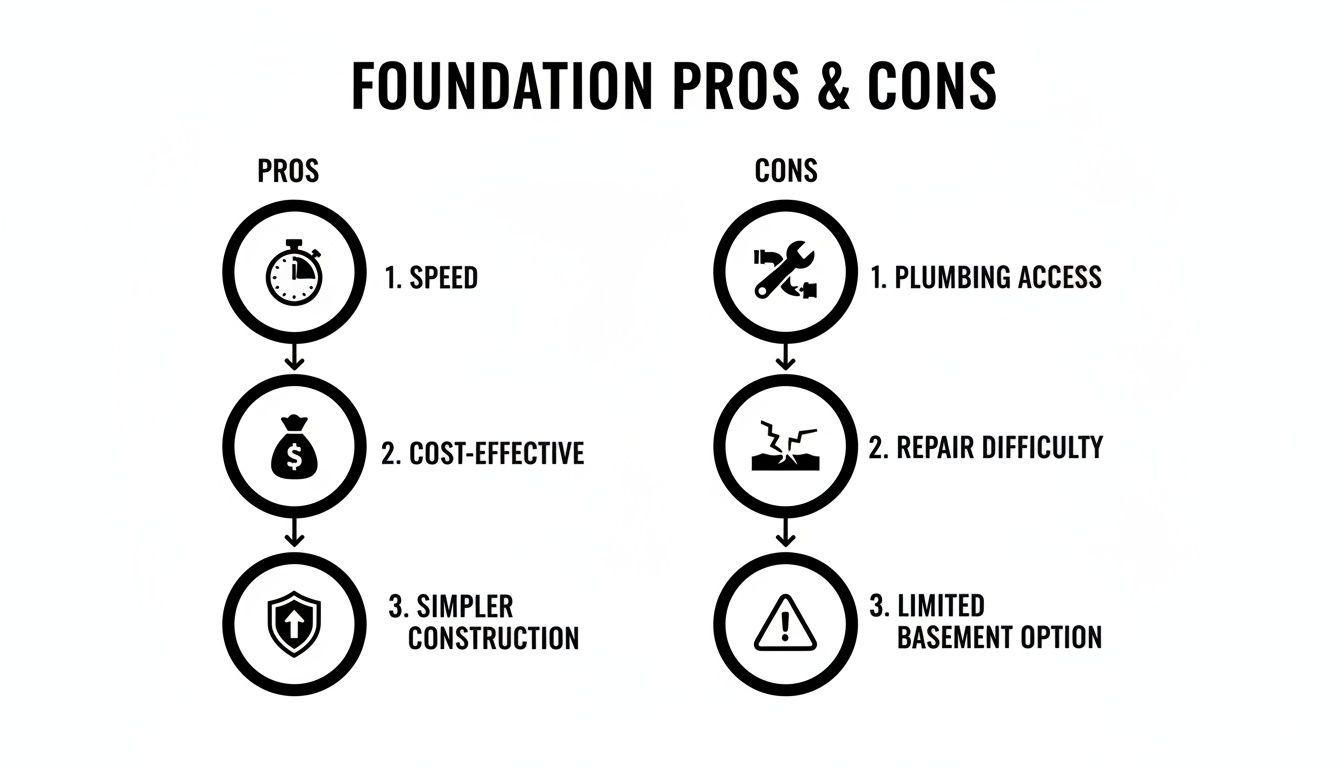
This infographic highlights the primary trade-offs of a floating slab. As shown, the primary benefits are its lower cost and speed of installation, while a key consideration is the more difficult access to any plumbing embedded within the concrete.
Constructing Concrete Forms and Pouring the Slab
With the sub-grade fully prepared, we proceed to construct the concrete forms. These wooden frames serve as a precise mold, defining the exact dimensions and thickness of your foundation. They are built to be incredibly robust to contain the significant pressure of wet concrete.
The accuracy of the formwork is where true craftsmanship becomes evident. Precise forms are essential for ensuring your foundation has perfectly square corners and straight edges, which is critical for the assembly of the structure it will support.
The final step is the concrete pour itself. We use a high-quality concrete mix and pour it efficiently to form a single, solid slab. Our team then expertly finishes the surface, creating a smooth, level plane ready to serve as a reliable base for your project for many years to come.
Is a Floating Slab Right for Your Project?
This is the key question for any homeowner planning a new structure. After weighing all the options, how do you decide if a floating slab is truly the best foundation for your needs? At Firm Foundations, we guide homeowners across Pennsylvania through this decision every single day.
The right answer always comes down to the specifics of your project. A floating slab is often the ideal solution for a new backyard shed or a sturdy gazebo foundation. It’s also an excellent, cost-effective choice for a detached garage or a level pad for a hot tub. These projects get all the benefits of a durable foundation without the cost or complexity of a full basement.
Matching the Foundation to the Project
A floating slab shines in very specific roles. If you’re building a detached, non-living structure like a workshop or storage building, this type of foundation is purpose-built for the job. It provides a solid, stable surface that’s engineered to handle our region’s demanding freeze-thaw cycles.
However, a floating slab isn’t a one-size-fits-all solution. For a primary residence or any building with extensive plumbing running beneath the floor, a traditional foundation with a crawlspace or basement is usually more appropriate. Those designs provide critical access for future utility work and can be engineered for different structural loads.
Why Professional Installation Is Non-Negotiable
Here in Pennsylvania, correctly dealing with the local frost line isn't a task for a weekend warrior. An improperly installed slab that fails to account for soil conditions and proper drainage is a recipe for heaving, cracking, and eventual failure. This is precisely where professional experience becomes invaluable. As expert garage foundation contractors, we ensure every single slab is built on a perfectly prepared and compacted base designed to manage water and withstand seasonal movement.
If you are unsure which foundation is right for you, that's a perfect starting point. Our team is here to provide clarity, not pressure. We believe the best projects start with an honest conversation.
Let Firm Foundations help you make the right choice from the very beginning. Contact us today for a professional site assessment and a free, no-obligation quote to lay the groundwork for a successful project.
Frequently Asked Questions About Floating Slabs
We often receive inquiries from homeowners about floating slab foundations. To provide clarity, we have compiled answers to some of the most common questions we hear from our clients across Pennsylvania.
How Long Does a Floating Slab Foundation Last?
A professionally installed floating slab is engineered for exceptional durability and can easily last 50 years or more. For structures such as sheds and garages, the foundation will often outlive the building it was designed to support.
The key to achieving this longevity, especially in our local climate, is meticulous site preparation. Proper grading for drainage and a stable, compacted gravel base are essential for managing water and mitigating the effects of the freeze-thaw cycles common to our region. We do not simply pour concrete; we build foundations to endure.
Do I Need a Permit for My Shed or Garage Slab?
Permitting requirements are determined by your local municipality and the scale of your project. The rules can vary significantly from one township to another, even within the same county in Pennsylvania.
As a general rule, smaller accessory structures (often under a specific size like 120 or 200 sq. ft.) may be exempt from permitting. However, larger projects, including two-car garages or substantial barn sheds, almost always require a permit.
As your local garage foundation contractors near me, our team handles this process on your behalf. We possess a deep familiarity with the building codes throughout our service areas and will guide you through permitting to ensure your project is fully compliant from the start.
We construct every concrete foundation to meet or exceed local codes. This approach guarantees a smooth, efficient process and eliminates the possibility of future compliance issues for you as the homeowner.
How Much Does a Floating Slab Foundation Cost?
While a precise quote requires a site evaluation, a floating slab is consistently the most cost-effective option for a permanent foundation. It offers significant savings when compared to a traditional foundation with a basement or crawlspace, making it an ideal choice for a base for a storage shed or a new garage.
The final cost is influenced by several factors:
- Size: A pad for a 4×8 shed with foundation will naturally be less than a foundation for a multi-car garage.
- Thickness: The intended use of the structure dictates the required thickness of the concrete.
- Site Prep: The extent of excavation near me and grading needed will affect the total price.
The most effective way to receive an accurate estimate is to schedule a site visit with our team. We provide a transparent, no-obligation quote so you have a complete understanding of the investment required.
Can You Build a Floating Slab on a Sloped Lot?
Yes. Constructing foundations on sloped or uneven terrain is a common requirement for properties in our region and a task our team is well-equipped to manage. The process requires professional excavation and grading, both of which are core competencies at Firm Foundations.
We utilize proven techniques, such as a "cut and fill" method, to engineer a perfectly level and stable base for the foundation. Our experts will assess your property’s unique topography to design the most durable and efficient solution, ensuring your new structure is secure regardless of the landscape.
Ready to establish the groundwork for your new shed, garage, or patio? The team at Firm Foundations has the local expertise to build a durable, long-lasting concrete or gravel foundation designed for Pennsylvania's specific needs. We manage the entire process, from site prep to the final pour.