
Shed Foundations Near Me: Your 2026 Guide to a Perfect Build

Building a shed, garage, or gazebo is an exciting project, but it all starts with a solid foundation. If you're searching for "shed foundations contractors near me" in Pennsylvania, Maryland, Delaware, or New Jersey, you understand that a precise plan is the key to success. A proper material estimate prevents costly overages and frustrating delays, turning your construction goals into a stress-free reality.
Why Smart Material Planning Is Your Project’s Strongest Foundation
Getting your shed material list right is arguably the most critical step for a successful build. We've seen it time and again at Firm Foundations: ordering too little material leads to extra delivery fees and annoying delays, while ordering too much is just a waste of good money. As a trusted local construction company, this guide draws from our years of direct experience serving homeowners like you across Pennsylvania, Maryland, Delaware, and New Jersey.
Our goal is to walk you through the common pitfalls we see, from miscalculating gravel for a pad to underestimating the concrete needed for a durable slab. Think of it as getting advice from a local pro who has seen it all and wants to help you get it right the first time. We are the shed foundations near me experts you can rely on.
The Real Cost of Inaccurate Estimates
A faulty material list doesn't just hit your wallet; it can put the entire project at risk. Imagine your crew is ready, but you run out of concrete halfway through a pour on a hot summer day. Or you find you’re short on gravel after the delivery truck has already gone. These are real scenarios that add stress, time, and unexpected expenses to what should be an exciting home improvement project.
This isn't a small issue. The global garden shed market was valued at an impressive USD 6.2 billion in 2022 and is projected to climb to USD 9.51 billion by 2030. With this kind of growth, efficiency is key. For a common 48×10 foot shed, for example, you have to nail the materials for 480 square feet of foundation. A smart estimate can save 10-20% on costs and ensure your shed is built to last—a standard we’ve upheld at Firm Foundations since 2011. You can explore more on these industry trends to see how planning plays a major role.
At Firm Foundations, we know a strong project starts with a strong plan. A precise material estimate isn't just about numbers; it's about peace of mind and ensuring the final structure—whether it's a small barn shed or a large garage foundation—is built to last.
Your Local Guide to a Perfect Foundation
Whether you're prepping a base for a storage shed, a new gazebo foundation, or durable garage footings and foundations, our objective is to help you plan with accuracy. We have intimate knowledge of the challenges in our service areas, from Pennsylvania's unique soil conditions to the coastal drainage needs in New Jersey, and we want to help you achieve your goals.
Here is how precise planning directly benefits you:
- Avoids Budget Overruns: Buying exactly what you need prevents wasted money on excess materials or extra orders.
- Saves Valuable Time: No more last-minute runs to the home improvement store or waiting on a second delivery.
- Ensures Structural Integrity: The right amount of the right material is the cornerstone of a long-lasting foundation.
- Reduces Project Stress: A solid plan removes the guesswork, letting you focus on the build itself.
This guide is designed to give you the tools and confidence to manage your project effectively, ensuring your new shed, garage, or gazebo has a foundation that will stand the test of time.
Before you can begin estimating materials for your new shed foundation, some critical preliminary work is necessary. This upfront planning is the foundation—both literally and figuratively—upon which a successful project is built, ensuring your final material list is accurate and your project proceeds without costly surprises.
Jumping straight to a calculator without understanding your site-specific conditions and local regulations is a common misstep. Such an oversight can lead to incorrect material orders, permit rejections, or even the need to dismantle and rebuild your work—problems our clients avoid by partnering with a trusted local professional.
Understanding Local Building Codes
First and foremost, you must consider local regulations. In our primary service areas of Pennsylvania, Maryland, Delaware, and New Jersey, building codes can vary significantly between townships. These are not mere suggestions; they are legal requirements that dictate the size, placement, and construction standards of your shed.
Be sure to investigate these key regulatory points with your local municipality:
- Shed Size and Permits: Many jurisdictions have a square footage limit, often 100-200 sq. ft., for structures built without a permit. Anything larger will almost certainly require a formal application and review process.
- Impervious Surface Limits: In areas concerned with stormwater management, towns may restrict the total percentage of your property covered by non-porous surfaces. This includes concrete foundations and, in some cases, even compacted gravel pads.
- Setbacks and Placement: Local codes will specify the required distance your shed must be from property lines, your home, and other structures. You cannot simply place it wherever you see fit.
A phone call to your local municipal office is the most effective way to get accurate information. As your local shed foundations contractors near me, Firm Foundations is well-versed in many of these regional codes and can assist you in navigating these requirements, ensuring your project is compliant from day one.
Conducting a Simple Site Assessment
With the local rules understood, the next step is to evaluate the proposed site. A careful walk-through of the intended location will reveal potential challenges that directly influence your material quantities and labor needs.
Pay close attention to these three factors:
- Slope and Grade: Is the ground perfectly level? Any slope, no matter how slight, will require additional gravel and labor for a "cut and fill" process to create a level base.
- Drainage and Soil Type: Observe if water tends to pool in the area after rainfall. Poor drainage can compromise any foundation over time. This is especially critical in areas with clay-heavy Pennsylvania soils or in the coastal regions of New Jersey. The soil conditions will help determine if a gravel shed foundation or a concrete slab is more appropriate.
- Accessibility: Consider how materials will get to the build site. If a delivery truck cannot get close, you must account for the additional labor and time needed to move gravel, concrete, or other materials from the curb. Our excavation and driveway teams are experts at site prep.
A crucial but often overlooked detail is the frost line. For a typical 8×10 shed, a material estimator might suggest a basic gravel pad. However, in frost-prone states like Pennsylvania, failing to account for frost heave can be a costly mistake. For full compliance and structural safety, industry data highlights the importance of local building codes and proper foundation depth.
Choosing the Right Foundation Type
Perhaps the most significant decision you'll make is selecting the foundation type. The base for your storage shed dictates not only the material list but also the structure's long-term stability and functionality. A gravel pad or a concrete slab are the two primary options, and the right choice depends entirely on your specific needs, shed size, and local conditions.
To help you decide, here’s a quick comparison of the two most common foundation types we build for homeowners in PA, MD, DE, and NJ.
Gravel Pad vs. Concrete Slab at a Glance
| Feature | Gravel Pad Foundation | Concrete Slab Foundation |
|---|---|---|
| Cost | Generally more affordable | Higher initial material and labor costs |
| Installation | Faster and less complex; DIY-friendly | Requires professional expertise; longer cure time |
| Drainage | Excellent; water drains through the stone | Requires proper grading to avoid pooling |
| Best For | Standard storage sheds, playhouses, chicken coops | Garages, workshops, heavy equipment storage |
| Durability | Long-lasting and stable when properly installed | Permanent and extremely durable |
| Permitting | Less likely to require a permit for smaller sheds | More likely to require permits and inspections |
Ultimately, a gravel shed foundation is a cost-effective and highly functional choice for most standard storage sheds, offering superior drainage. A concrete foundation for a garage, however, provides a permanent, smooth, and easy-to-clean floor ideal for heavier applications. We can help you evaluate the pros and cons to determine the best solution for your project and budget.
Calculating Materials for a Gravel Shed Foundation
Ready to get into the numbers? This is your practical guide to estimating all the materials you'll need for a rock-solid gravel shed foundation. We'll skip the confusing jargon and give you the simple formulas and real-world examples you need to plan your project like a seasoned shed foundations contractor.
Let’s use a common scenario: building a foundation for a 10×12 shed in a place like Chester County, PA. A gravel pad is an excellent choice here, known for superior drainage and cost-effectiveness. The first step is figuring out the total area and volume of gravel required. This involves more than just length times width; you must account for the proper depth and a crucial perimeter extension.
Our standard process involves extending the pad dimensions by a minimum of one foot on all sides of the shed. For that 10×12 shed, this means your gravel pad should actually measure 12×14 feet. This larger base for a storage shed creates a stable border, prevents erosion along the edges, and gives you a firm, dry path to walk around your structure.
From Volume to Tons: The Gravel Calculation
With the pad dimensions established (12 ft x 14 ft), you must decide on the depth. For most residential sheds in our region, a depth of 4 to 6 inches of compacted gravel is sufficient. We will use 4 inches (or 0.33 feet) for this calculation.
Here's the formula to determine the volume of gravel in cubic feet:
Pad Length (ft) x Pad Width (ft) x Pad Depth (ft) = Volume (cubic feet)
Using our example: 12 ft x 14 ft x 0.33 ft = 55.44 cubic feet
The next step is converting this volume into the unit your supplier uses: tons. Most #57 crushed stone, a popular choice for a shed foundation gravel base, weighs about 1.5 tons per cubic yard. First, you convert your volume from cubic feet to cubic yards by dividing by 27 (as there are 27 cubic feet in a cubic yard).
- 55.44 cubic feet / 27 = 2.05 cubic yards
- 2.05 cubic yards x 1.5 tons/yard = 3.08 tons
This calculation shows you'll need just over 3 tons of gravel. But this is where professional experience makes a difference.
Insider Tip: Always add a 10-15% waste factor to your material orders. For gravel, this accounts for the volume lost during compaction. For 3.08 tons, a 10% buffer means you should order approximately 3.4 tons. This small increase helps you avoid a costly second delivery charge and project delays.
The infographic below illustrates the key preparation steps that come before estimating materials. As you can see, these initial site checks and foundation choices directly influence your final material needs and prevent unexpected costs.
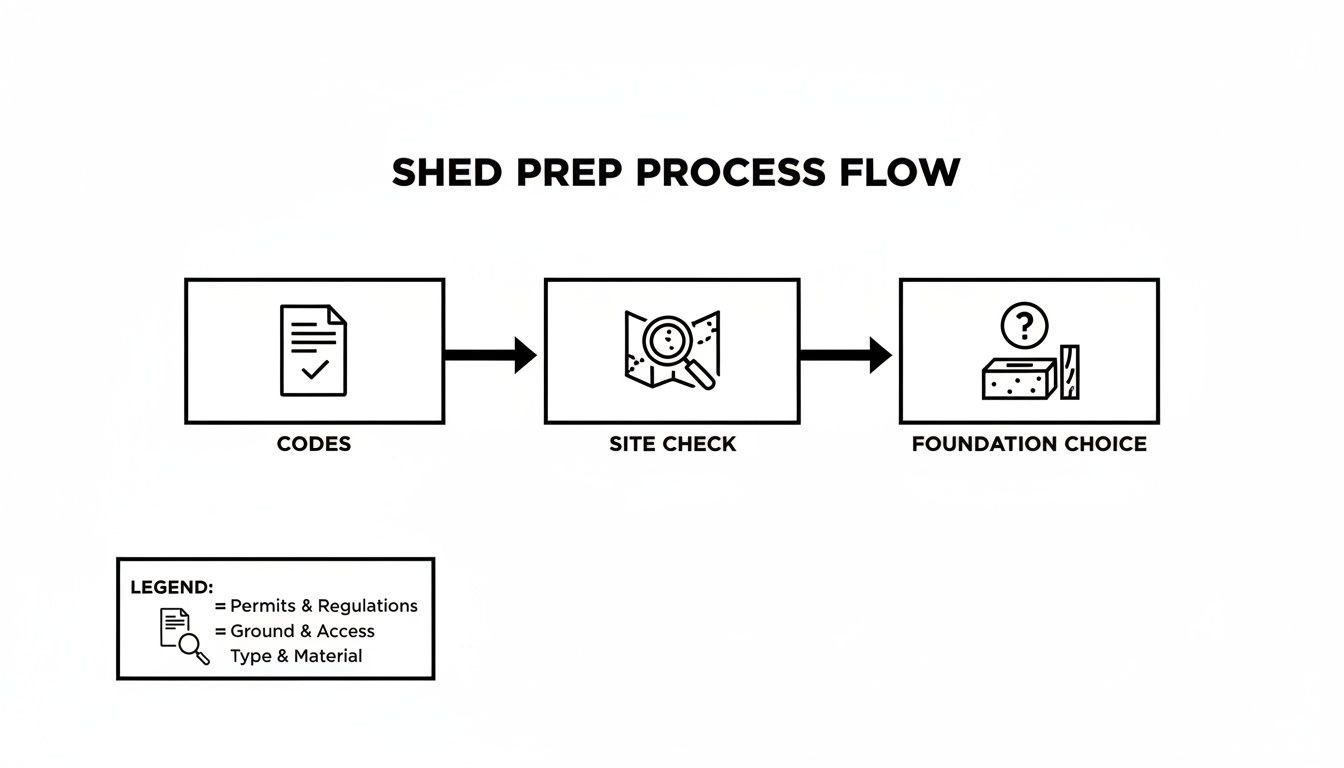
These initial planning stages are interconnected and set the foundation for an accurate material estimate, preventing backtracking and budget overruns down the line.
Estimating the Timber Perimeter and Fabric
A properly constructed gravel foundation requires a sturdy perimeter frame and a high-quality weed barrier. These materials are just as critical as the stone itself.
For the timber frame, pressure-treated 4×6 or 6×6 lumber is the ideal choice. To calculate the lumber needed for our 12×14 pad, you simply find the perimeter:
(12 ft + 14 ft) x 2 = 52 linear feet
You will need to purchase enough boards to cover 52 feet. Because lumber is sold in standard lengths (8, 10, 12, or 16 feet), you should plan your cuts to minimize waste. You will also need long galvanized spikes or pieces of rebar to anchor the frame securely to the ground.
Underneath the gravel, a layer of commercial-grade landscape fabric is essential. It prevents weeds from growing through and stops the stone from mixing into the soil over time. For a 12×14 foot pad, the required area is:
12 ft x 14 ft = 168 square feet
Simply buy a roll of fabric that covers at least 168 square feet, making sure to allow for a slight overlap at any seams. While these calculations provide a solid starting point, you can experiment with different dimensions and see how material needs change with our comprehensive shed material calculator for more detailed planning. As you can see, what begins as a simple 10×10 storage shed project involves several layers of calculation to get right.
Estimating Materials for a Concrete Slab Foundation
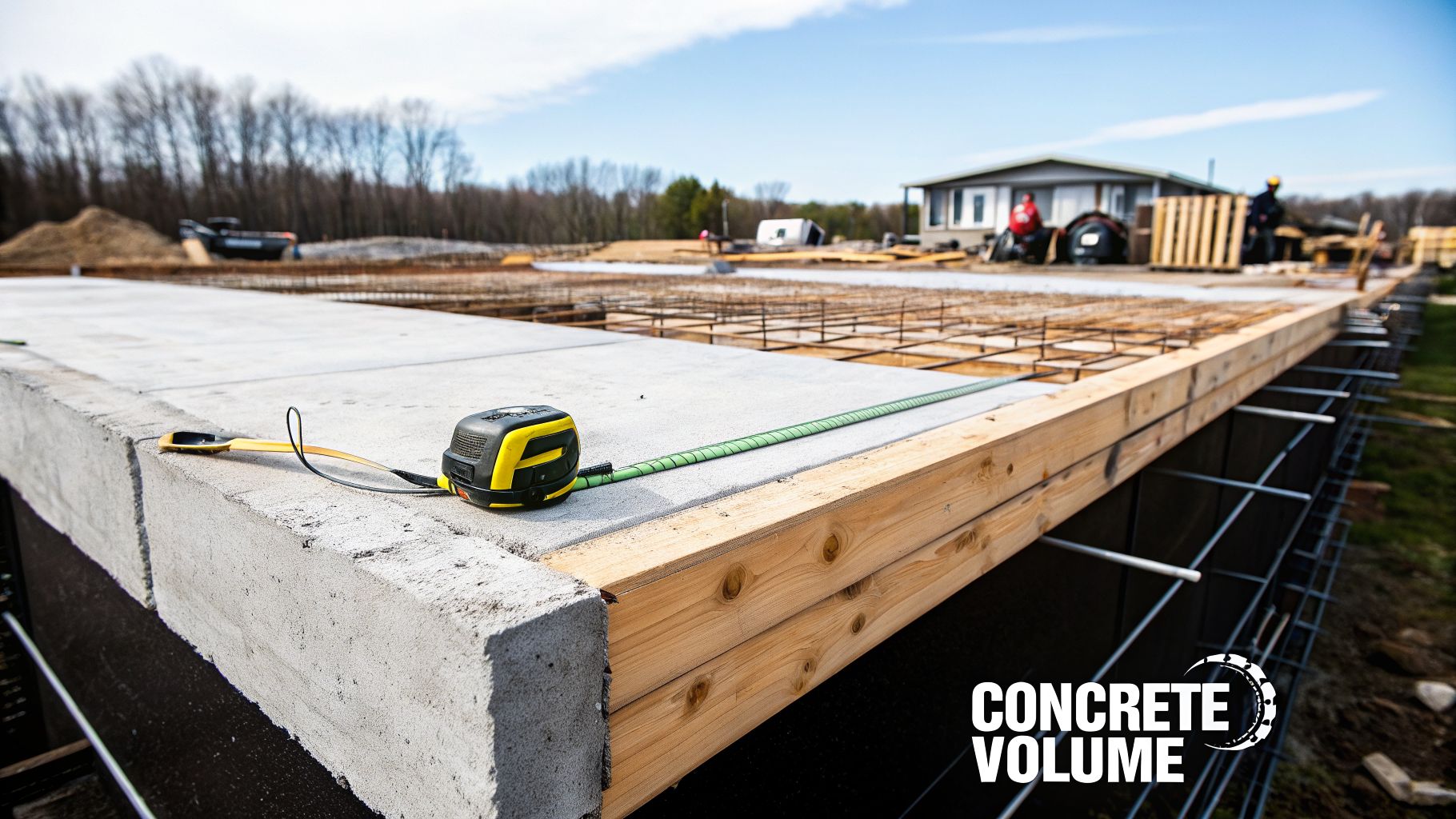
When it comes to ultimate durability, nothing stands up to the elements quite like a solid concrete slab. It creates a permanent, perfectly level base for anything you have in mind, from a simple storage shed to a heavy-duty workshop or a full cement foundation for a garage. As premier garage foundation contractors near me, we specialize in these robust builds.
But here's the thing: a successful concrete project hinges on precision from the very start. Nailing your material estimate isn't just a good idea—it's absolutely essential for keeping your project on track and on budget. We’ll walk through the exact formulas and professional insights you need, covering everything from the concrete itself to the formwork, reinforcement, and the all-important sub-base.
Calculating Your Concrete Needs
First things first: you have to figure out exactly how much concrete to order. Concrete is sold by the cubic yard, so getting this calculation right is your most critical step. The formula itself is simple, based on the length, width, and thickness of your planned slab.
Let's work through a common scenario we see all the time in Pennsylvania and New Jersey: building a 12×20 garage foundation. For an application like this, a 4-inch thick slab is the standard. Your first move is to convert that thickness from inches into feet by dividing by 12.
4 inches / 12 = 0.33 feet
Now, you can plug those numbers into the volume formula:
Length (ft) x Width (ft) x Thickness (ft) = Volume (cubic feet)
20 ft x 12 ft x 0.33 ft = 79.2 cubic feet
With your volume in cubic feet, the final step is converting it to cubic yards. You just need to divide by 27 (the number of cubic feet in a cubic yard).
79.2 cubic feet / 27 = 2.93 cubic yards
So, you need just under 3 cubic yards of concrete. A word of advice from the field: always add a 10% buffer for waste. This accounts for any slight variations in your sub-base grade or spillage during the pour. In this case, you'd round up and order 3.25 cubic yards to be safe.
In the broader construction world, where total US starts recently hit $1.24 trillion annualized, accurate estimating is what separates profitable jobs from losing ones. For a simple 800 sq ft concrete driveway at 4 inches thick, an estimator must calculate exactly 10 yards of concrete. A miscalculation can inflate costs by as much as 18%, a significant risk that our professional quoting process at Firm Foundations eliminates for our clients. You can read more on these construction market trends to see why lean planning is so vital.
Figuring Out Formwork and Reinforcement
Before any concrete arrives, you have to build the mold. This temporary wooden frame, called concrete forms, contains the wet mix and shapes the final slab. At the same time, you need to plan for steel reinforcement, which gives concrete the tensile strength it needs to resist cracking over time.
Formwork Materials:
- Lumber: The perimeter frame is typically built from 2×4 or 2×6 lumber. To figure out how much you need, just calculate the total perimeter of your slab. For our 12×20 example, that’s (12 ft + 20 ft) x 2 = 64 linear feet of lumber.
- Stakes: You’ll need to drive wooden or metal stakes into the ground every 2-3 feet along the outside of the forms. These are non-negotiable for holding the frame securely against the pressure of the wet concrete.
Reinforcement Materials:
This is what gives your house foundation or garage slab its backbone. You have two main options, depending on the project's demands.
- Rebar (Reinforcing Bar): For garage footings and foundations or any slab that will support heavy vehicles or equipment, rebar is the strongest choice. The standard is to lay the bars in a grid pattern with 18-24 inch spacing.
- Welded Wire Mesh: For most standard shed pads, patios, and light-use slabs, a steel wire mesh is perfectly suitable. It comes in large rolls or flat sheets and is excellent for preventing surface-level cracking.
To calculate the amount you need, just find the total area of your slab (12 ft x 20 ft = 240 sq ft) and purchase enough material to cover it.
Don't Forget the Gravel Sub-Base
A concrete slab poured directly on dirt is a recipe for failure. Just like a gravel pad, a concrete foundation requires a solid, compacted gravel sub-base underneath it. This layer serves two critical functions: it provides a stable platform to pour on and, more importantly, it allows for proper drainage. Without it, water can get trapped and freeze, causing the slab to heave and crack.
We recommend a 4-inch layer of compacted crushed stone, such as #57 stone. You can use the same volume calculation we used for the concrete.
20 ft x 12 ft x 0.33 ft = 79.2 cubic feet
Convert that to cubic yards (79.2 / 27 = 2.93 cubic yards), and then to tons. A good rule of thumb is 1.5 tons per cubic yard, which gives you 4.4 tons of gravel needed. This level of site preparation is a core part of what makes our professional concrete shed pads stand the test of time and why discerning homeowners choose us as their driveway contractors near me.
When to DIY vs When to Call in a Pro
After using a material estimator for shed construction and understanding the necessary formulas, the critical decision remains: should this project be undertaken independently or entrusted to a professional? This choice involves a careful balance of cost, time investment, and personal construction aptitude.
While the DIY approach presents an initial appeal through potential labor cost savings, a comprehensive evaluation is necessary. A foundation project extends beyond simply mixing concrete or spreading gravel; it is a physically intensive process demanding meticulous planning and significant manual labor.
The Realities of a DIY Foundation Project
Opting for a DIY foundation places the full responsibility of project management, labor, and troubleshooting on the homeowner. This includes sourcing all materials, coordinating deliveries, and renting and operating heavy machinery such as skid steers or plate compactors.
Several potential challenges should be considered:
- Unforeseen Site Conditions: Discovering large subterranean rocks or utility lines during excavation can cause significant delays and complications for a DIY project.
- Physical Demands: The exertion required to move tons of aggregate or properly finish a concrete slab, especially in adverse weather, is frequently underestimated.
- Consequences of Errors: An improperly leveled base or a poorly prepared concrete mix can severely compromise the structural integrity of your shed. Rectifying such mistakes can ultimately prove more costly than hiring a professional from the outset.
For foundations that present complexities beyond basic construction—such as difficult soil conditions or specific structural engineering needs—it is advisable to consult with professional foundation design services. This is where the distinction between a simple and a complex project becomes most apparent.
The Firm Foundations Alternative: Peace of Mind
Engaging a professional team like Firm Foundations provides a structured and proficient alternative. Instead of managing logistical challenges and performing strenuous labor, clients receive a guaranteed, high-quality result. We are the shed foundations contractors near me that property owners throughout Pennsylvania, Maryland, Delaware, and New Jersey consistently rely on for their foundation builds.
Our methodology is designed to ensure a smooth execution from start to finish. It begins with an expert on-site evaluation to assess the property, confirm project requirements, and identify potential issues before work commences.
With a professional crew, you are not merely purchasing a foundation; you are investing in extensive experience. Our team arrives with the correct equipment, appropriate materials, and the technical skill to manage every phase, from precise excavation to final grading.
Following the initial assessment, you will receive a detailed and transparent quote encompassing all material and labor costs, with no hidden fees. Upon approval, our experienced crew manages the entire installation process. We ensure your gravel shed foundation or concrete slab is perfectly level, offers correct drainage, and is constructed for long-term durability. For homeowners in PA, MD, DE, and NJ, obtaining a free, no-obligation quote from us is the most prudent first step toward a successful project.
Common Questions About Shed Material Estimates
Even with the most detailed plan, questions frequently arise during project planning. We’ve gathered some of the most common inquiries we receive from homeowners across Pennsylvania, Maryland, Delaware, and New Jersey. These are the real-world questions that come up when planning a shed foundation, and our answers are based on years of hands-on experience.
How Much Extra Material Should I Actually Order?
A general guideline for any DIY project is to order 10-15% extra material. This waste factor is critical. For materials like gravel or stone, it accounts for natural compaction. For lumber, it gives you a buffer for the inevitable mis-cuts or warped boards you'll encounter.
This is a significant difference between a DIY estimate and a professional one. When you partner with Firm Foundations, our quote includes the exact amount of material needed for your project. We manage the detailed calculations and logistics, so you avoid the stress of running short or the cost of over-ordering.
Can I Use a Material Estimator for a Shed on a Slope?
Yes, but it adds considerable complexity and requires precise measurements. You must calculate the extra material needed to build up the low side of the property to establish a perfectly level base.
This "cut and fill" process can dramatically increase your gravel or soil requirements. It's one of the most common areas where homeowners miscalculate, leading to significant budget overruns and project delays.
This is a situation where professional expertise is invaluable. As experts in excavation near me, the team at Firm Foundations conducts a thorough on-site evaluation and incorporates exact calculations for sloped properties in our quotes. We guarantee a perfectly level foundation every single time.
What Is the Best Base Material for a Shed in Pennsylvania?
For the regional climate in Pennsylvania and its neighboring states—which involves harsh freeze-thaw cycles and heavy clay soil—we almost always recommend a deep base of compacted #57 crushed stone. This specific gravel provides superior drainage, which is crucial for preventing frost heave and the long-term damage it causes to shed foundations.
We typically install a minimum depth of 4-6 inches, though we may advise a deeper base depending on your site’s specific soil conditions. While a gravel shed foundation is an exceptional choice, a poured concrete slab is also a highly durable option, particularly if the shed will function as a workshop or garage where a solid, smooth floor is beneficial.
Do I Need a Permit for My Shed Foundation?
The answer depends entirely on your local municipality in PA, MD, DE, or NJ. Many jurisdictions have size limitations—for instance, sheds under 120 square feet—that may not require a building permit.
However, these regulations vary widely from one township to the next. Your best course of action is to always confirm with your local code enforcement office before beginning any work. As part of our service, Firm Foundations can advise on the typical requirements in your area, ensuring your project proceeds without regulatory issues.
Ready to bypass the guesswork and have your foundation built correctly by local experts? At Firm Foundations, we manage every detail from precise material estimation to flawless installation. Request your free, no-obligation quote today and lay the groundwork for success.