
How to Concrete a Driveway: Pro Guide for PA, MD, DE, NJ
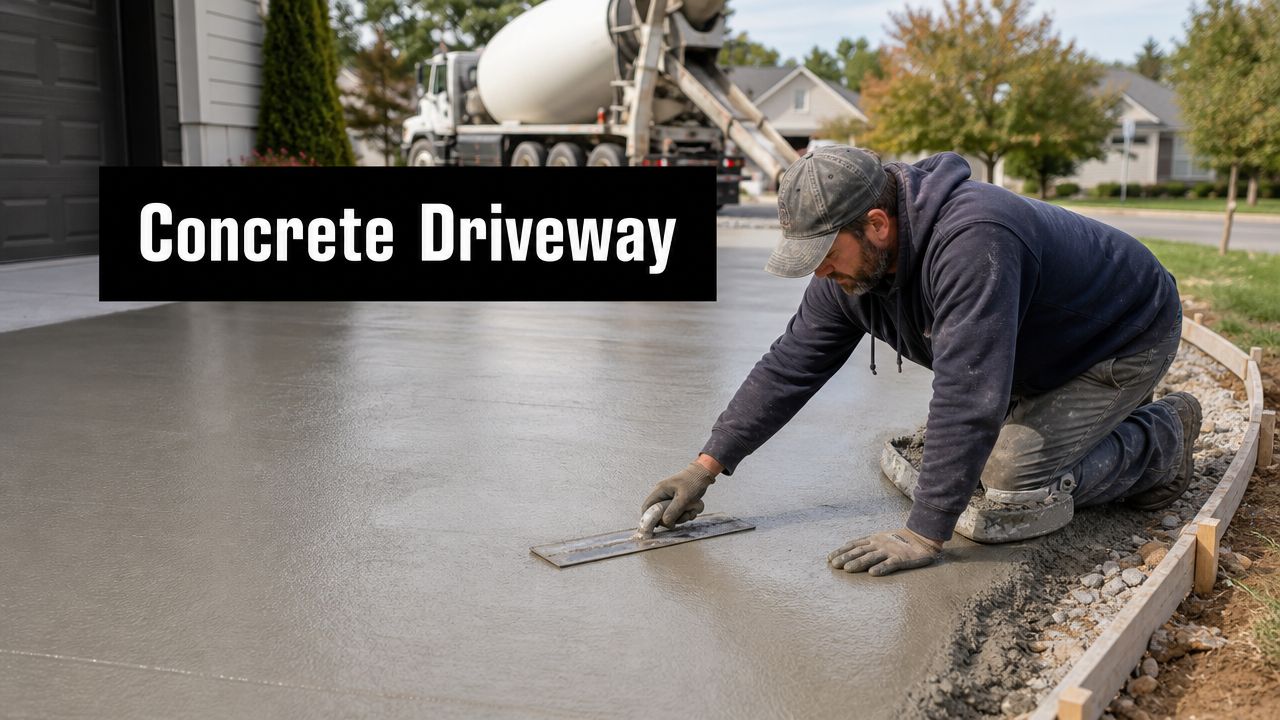
A lot of homeowners start in the same place. The old asphalt is breaking apart, the gravel drive tracks mud into the garage, or a new home build needs a clean, durable entrance that sheds water instead of holding it. The idea seems simple enough. Form it, pour it, smooth it, and let it cure.
That's not how a driveway succeeds in Pennsylvania or Maryland.
If you want to know how to concrete a driveway the right way, start below the surface. In our region, the projects that last usually come from good excavation, proper grade control, and a compacted base. The projects that fail usually fail there too. The concrete on top only performs as well as the ground underneath and the water management around it.
Planning Your Driveway Project Before You Dig
A driveway can look simple on paper. Then you stand at the curb during a hard Pennsylvania rain and realize the job is deciding where that water goes, how the slab meets the garage, and whether the ground underneath can carry the load without settling.
That planning work decides more driveway failures than the concrete mix does.
Before you call for excavation, pin down the driveway's job. A single-car parking pad, a daily two-car driveway, and an apron that sees delivery vans or a work truck should not be laid out the same way. The shape, width, turning space, and finish elevation all need to match how the space is used.
Cost belongs in that first conversation too. Concrete driveway pricing can vary widely based on thickness, reinforcement, finish, access for equipment, and how much grading or drainage correction the site needs. A clean, level lot is usually straightforward. A site with slope changes, soft areas, or runoff heading toward the house takes more labor and more judgment.
Check the site before you settle on a layout
Walk the route from the street to the garage or parking area and study it like water would. Look for low pockets, ruts, downspouts, exposed roots, utility covers, retaining walls, and any point where runoff could collect against the slab or wash under it later. In our area, freeze-thaw damage often starts with water problems that were built into the layout on day one.
A useful site review should cover:
- Vehicle load: Passenger cars need less slab support than heavier pickups, trailers, or service vehicles.
- Approach and turning room: Tight entries force drivers onto the driveway edge, which is where cracking and breakdown often start.
- Elevation tie-ins: The street, garage floor, sidewalk, and any existing apron control the finished height more than homeowners expect.
- Equipment access: If concrete trucks or buggies cannot reach the pour area cleanly, placement gets harder fast.
- Utility marking: Underground utilities need to be located before digging starts.
If you have not mapped water exit points, the project is not ready.
Permits and material choices come before excavation
Townships and counties across Pennsylvania and Maryland often have rules for driveway width, apron work, setbacks, stormwater handling, or permits tied to public-road access. It is much easier to clear those issues before the first machine arrives than to fix them after inspection.
Homeowners also weigh surface options at this stage. If you are still choosing between pavers and concrete for driveways, compare more than appearance. Maintenance, joint movement, snow removal, edge restraint, and long-term repair costs all matter.
Planning also means being honest about the prep work hidden below the slab. This guide to concrete driveway preparation gives a solid overview of what needs to be resolved before forms and concrete trucks ever show up.
Width, thickness, and drainage have to work together
A driveway that is too narrow feels awkward every day. Tires ride the edge, doors open into grass, and backing up becomes harder than it should be. For many residential driveways, contractors commonly plan around enough width for comfortable entry and enough slab thickness to match the expected vehicle load.
Those decisions should never be made apart from drainage. I have seen driveways with decent concrete and acceptable finish work fail early because the slab held water near the garage or pushed runoff toward the house. In the PA, MD, DE, and NJ climate, layout mistakes are expensive because water finds every weak point. Good planning keeps that from being built into the job.
The Groundwork Excavation Grading and Subbase
A driveway usually does not fail because the concrete truck showed up with a bad mix. It fails because water gets under the slab, the base moves, and winter finishes the job. In Pennsylvania and Maryland, that problem starts below the concrete.
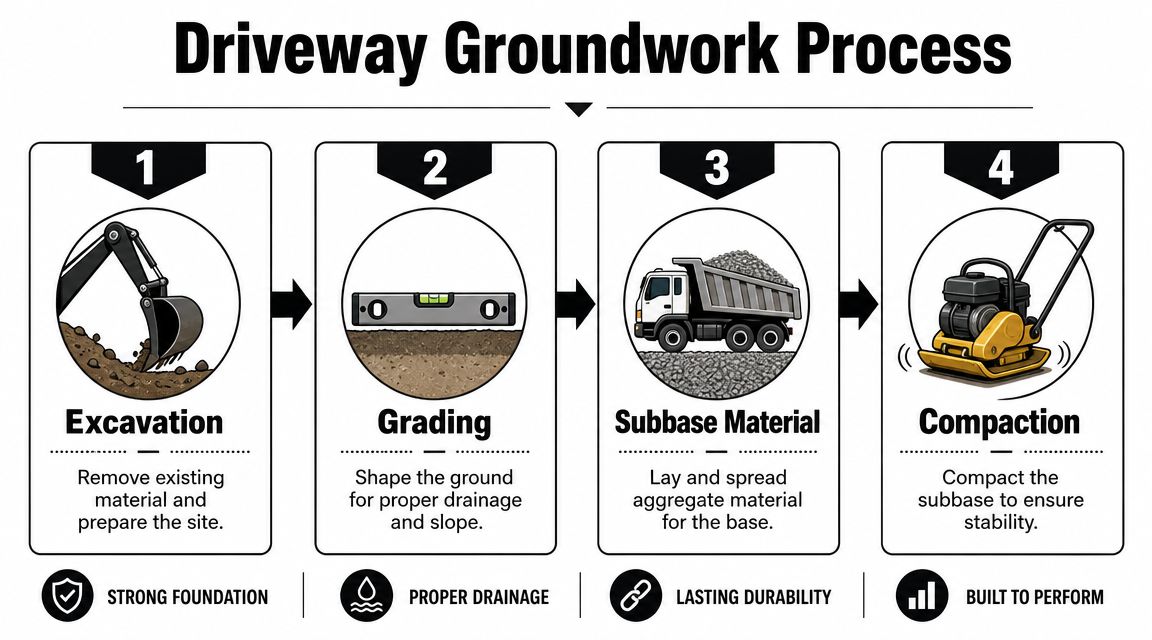
Poor slope sends runoff toward the garage, leaves water along the slab edge, and encourages freeze-thaw movement under the driveway. A contractor walkthrough in this driveway drainage and slope discussion shows how quickly drainage mistakes turn into slab problems. Drainage is not a finish detail. It is part of the structure.
Excavation means removing weak material, not just digging a shape
A good excavation removes topsoil, roots, soft pockets, old loose fill, and anything else that can compress later. The goal is uniform support from one end of the driveway to the other. If one tire path is bearing on firm ground and the next section is sitting on disturbed soil, cracking and settlement usually follow.
Depth depends on the site, soil conditions, and the thickness needed for the slab and base. On many residential jobs, that means excavating enough to fit the planned concrete thickness plus a compacted granular base. The exact depth should match the existing soil, not the number a homeowner hopes will work.
That is one of the first trade-offs on a driveway job. Cutting excavation shallow saves money up front, but it often leaves too little room for stone and too much risk below the slab. Digging deeper costs more in labor, hauling, and stone. It usually buys a longer service life.
Common mistakes at this stage include:
- Leaving soft pockets in place: They compress after the driveway is poured and create unsupported areas.
- Excavating unevenly: The slab may end up with inconsistent base thickness and uneven support.
- Ignoring the surrounding yard grade: Water from the lawn, hill, or downspout area can still feed the driveway base.
- Building over organic material: Roots and topsoil break down and leave voids.
After excavation, shape the subgrade to the drainage plan before any stone goes down. Wet concrete cannot correct a bad subgrade. It only hides it for a while.
A short visual walkthrough helps here:
Grading and compaction require the most skill
Many DIY driveway projects go off course. Stone gets dumped, spread loosely, and called a base. A proper base has to be placed in manageable lifts, shaped to the required pitch, and compacted evenly so the slab is supported across its full width.
Good driveway work starts with grade stakes and elevation checks, not with the truck order.
Compaction is easy to underestimate because it does not look dramatic. It matters anyway. Loose aggregate can look flat and still shift under load, especially near edges and in areas that stay wet. Experienced crews check elevations repeatedly, watch for pumping or soft response under the plate compactor or roller, and correct weak areas before the pour day locks everything in place.
This is the type of expertise homeowners need when looking for local excavation services. Dirt removal is only one small part of the work. The harder part is setting the site so water leaves the slab, does not collect near the house, and does not wash out edge support over time.
Edge support deserves extra attention. A driveway can have decent concrete in the middle and still start breaking at the sides if the bordering soil is low, soft, or easily washed out. I see this often where a driveway meets lawn with no stable shoulder and no thought given to runoff.
What a proper base needs to accomplish
| Base requirement | Why it matters |
|---|---|
| Uniform support | Prevents isolated settlement under wheel paths |
| Correct slope | Moves water away from the slab and nearby structures |
| Dense compaction | Reduces movement under vehicle load |
| Clean aggregate base | Helps drainage and improves slab stability |
Homeowners usually notice the finish first. Contractors notice the groundwork first, because that is where the driveway either earns a long life or starts failing before the first winter is over.
Building the Framework Forms and Reinforcement
A lot of driveway failures start at the edges. The slab may look fine on pour day, but if the forms are out of line, the thickness varies, or the steel ends up buried in the stone instead of the concrete, cracks and broken corners usually show up early. In Pennsylvania and Maryland, freeze-thaw cycles make those small mistakes more expensive.
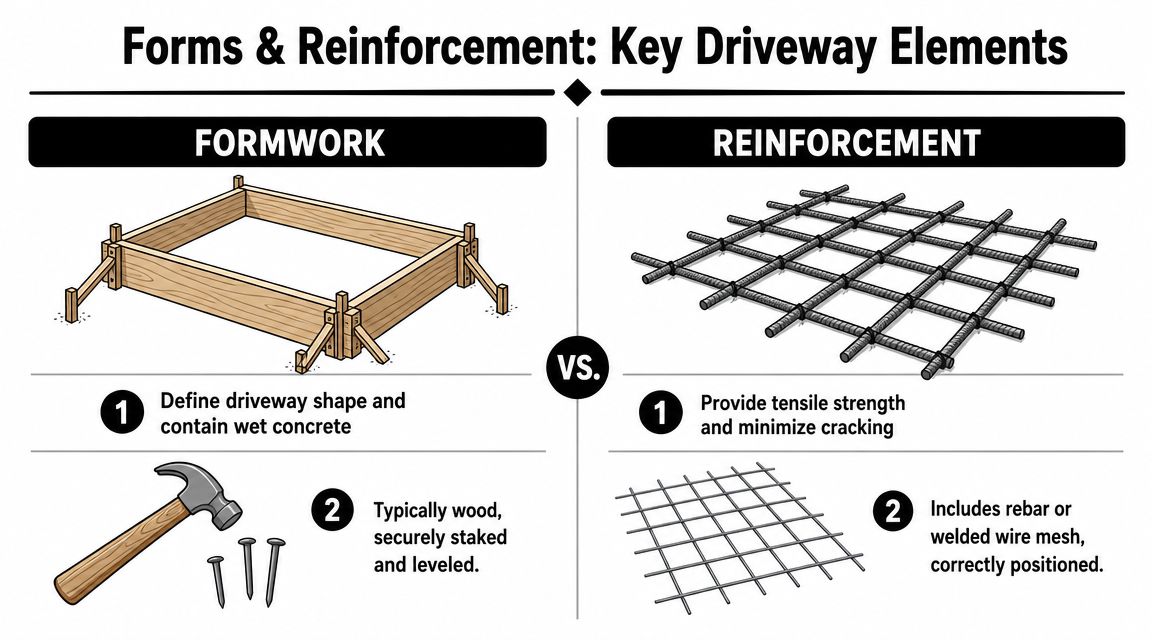
Forms set the driveway's shape, height, and edge quality. They also control whether water leaves the slab the way it should. If a form bows outward or sits a little high at the garage, the finished concrete will keep that mistake for the life of the driveway.
Forms need to stay straight under pressure
Use straight form boards, solid stakes, and enough bracing to keep everything from shifting during the pour. Wet concrete pushes hard, especially on long runs and curves. Check alignment with a string line, confirm elevations with a level, and verify the driveway width in several places instead of measuring only at the ends.
Pay close attention where the driveway meets:
- Garage floors
- Existing sidewalks
- Street aprons
- Door thresholds and steps
Those transition points need to work in real life, not just look neat from the street. A bad tie-in can leave a lip at the sidewalk, send water toward the garage, or create a thin section that breaks under tire traffic. At Firm Foundations, we spend extra time on these connection points because they are where homeowners notice problems first and where repairs are rarely simple.
Reinforcement only helps if it is placed correctly
Homeowners often ask whether rebar, wire mesh, or fiber mesh is the right choice. The practical answer depends on the driveway design and what will use it. A standard passenger-car driveway on well-prepared ground may perform well with welded wire mesh or fiber added to the mix for crack control. Areas that carry heavier vehicles, turn-in stress near the garage, or soil that has a history of movement usually justify steel reinforcement.
The bigger mistake is assuming any reinforcement product can make up for poor support underneath. It cannot. Reinforcement helps control cracking and hold the slab together after cracking starts. It does not fix weak subgrade, thin concrete, or water problems.
Here's the practical comparison:
| Reinforcement option | Where it helps | Where it falls short |
|---|---|---|
| Rebar | Better load support and added strength across weak spots or heavier-use areas | Costs more and has to be tied and held at the right height |
| Wire mesh | Helps limit shrinkage cracking on typical residential slabs | Often ends up flat on the base if it is not pulled into position |
| Fiber mesh | Adds distributed crack control throughout the mix | Does not replace steel where added structural support is needed |
Placement matters as much as material choice. Steel should sit within the slab, not on the stone base. If rebar or mesh is lying at the bottom, it contributes far less than people expect. Chairs, dobies, or careful lifting during placement keep reinforcement where it can perform its function.
One more trade-off matters here. Heavier reinforcement can improve performance, but it also adds labor and demands better coordination on pour day. For a homeowner doing this as a DIY project, that is often where things slip. Forms move, mesh gets stepped down, and thickness varies near edges. That is one reason professional crews treat layout, bracing, and reinforcement setup as part of the drainage and durability plan, not as a quick prep step before the truck arrives.
For lighter residential use, wire mesh may be adequate if the slab thickness, base preparation, and drainage are all right. For heavier vehicles or questionable ground, rebar is usually the safer call. Either way, a driveway lasts longer when the formwork is accurate, the reinforcement stays supported, and the slab is built with local weather and runoff in mind.
The Pour Day Mixing Pouring and Finishing
A driveway pour can start out calm at 8 a.m. and get out of hand by lunch. One late truck, a little extra water in the mix, or a crew that cannot keep up with placement, and the slab starts losing the shape, surface, and drainage control you spent days setting up. In Pennsylvania and Maryland, where freeze-thaw cycles punish weak spots, pour day is not just about getting concrete on the ground. It is about protecting the grade and runoff plan built into the base and forms.
For anything beyond a very small pad, ready-mix is usually the right call. Bagged concrete sounds cheaper until you factor in labor, inconsistent batches, cold joints, and the simple reality that one area can start setting while another is still being mixed. On a driveway, that uneven timing often shows up later as rough finish changes, weak edges, and water sitting where it should have drained.
Place the concrete with grade control in mind
Concrete should be placed close to its final position and spread with as little handling as possible. Dumping a large pile in one spot and dragging it across the forms wastes time and makes it harder to hold thickness and slope. That matters more than many homeowners expect. If the slab ends up thin near the edges or loses the intended pitch, water will find those mistakes fast.
For a typical residential driveway, slab thickness and any thicker sections for heavier vehicles should already be settled before the truck is ordered. Pour day is too late to improvise. I have seen DIY jobs where the center looked fine, but the apron or wheel paths ended up thin because the crew was focused on keeping up rather than checking depth and grade.
The finishing sequence has to match the concrete, not the clock
The basic order stays the same. Strike it off, float it, edge it as needed, cut or plan joints, then broom it when the surface is ready. The hard part is reading the concrete. Temperature, wind, sun, base moisture, and mix consistency all change the timing.
- Screeding brings the slab to the planned height and slope.
- Floating levels ridges and settles the surface without overworking paste and water to the top.
- Edging and joint work clean up the perimeter and help control where cracking happens.
- Broom finishing adds traction for rain, frost, and light snow.
A rushed finish creates real problems. Start too early and the surface can scale, dust, or show washboard marks. Wait too long and the broom drags, the edges chip, and the joints look rough. On a driveway, good finishing is not just about appearance. It affects slip resistance, drainage, and how the surface holds up through winter.
Crew size and timing decide whether the pour stays under control
This is the point where many DIY driveway projects fall apart. Concrete does not pause while you grab another tool or run for help. Someone needs to manage the chute or buggy, someone needs to spread and rake, someone needs to screed, and someone needs to stay ahead on floating and edges. If one part of that chain slows down, the whole slab suffers.
Useful pour-day tools usually include:
- Screed board or straightedge
- Bull float
- Come-alongs and shovels
- Hand floats, edgers, and groovers
- Concrete broom
- Saw and blade ready for joint cutting if you are not tooling joints
Weather can change the whole job. A cool, damp day gives you more working time. A hot, breezy afternoon can skin the surface over much faster than expected, especially on an open site. That is one reason professional crews watch conditions so closely. At Firm Foundations, we treat pour day as the point where all the earlier grading and drainage work either gets preserved or gets compromised.
After finishing, the slab still needs time before it can handle traffic. If you want a plain-language timeline, this guide on how long a concrete slab takes to cure helps explain what happens after the surface looks done.
After the Pour Curing Joints and Long-Term Care
A driveway can look finished at the end of pour day and still be easy to damage. What happens over the next few days has a direct effect on surface strength, crack control, and how well the slab holds up through Pennsylvania and Maryland winters.
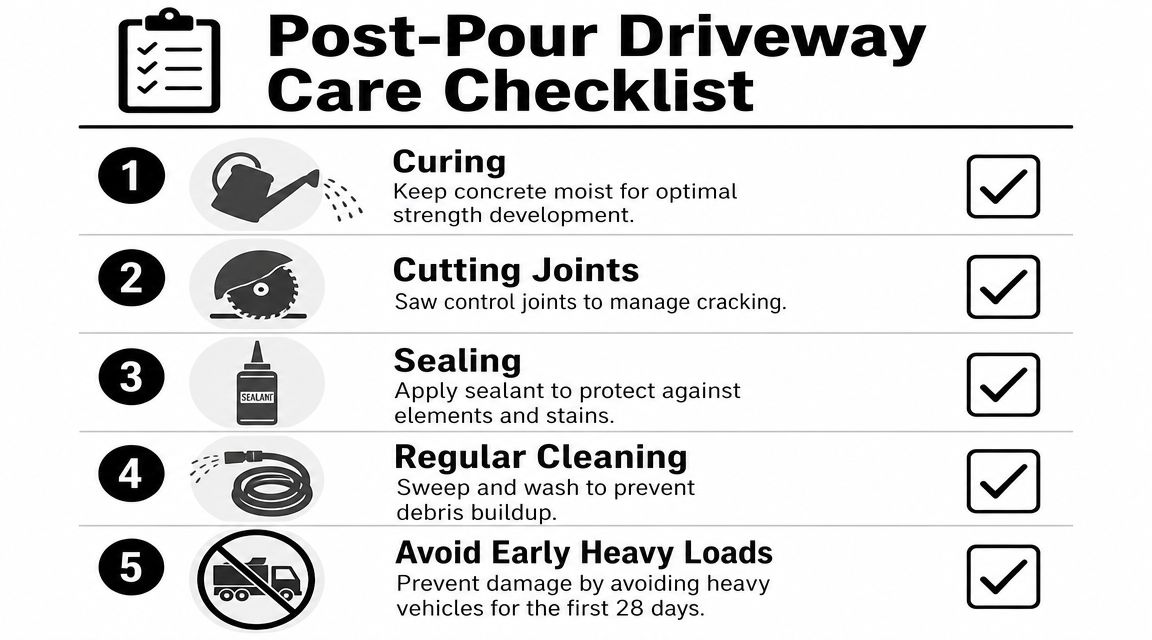
Curing is how concrete gains strength
Concrete does not harden because it "dries out." It gains strength through a chemical reaction that works best when the slab holds moisture and avoids rapid temperature swings. For a residential driveway, that usually means protecting the surface after finishing, keeping traffic off it longer than feels necessary, and avoiding the common mistake of assuming a hard-looking surface is ready for normal use.
In our area, sun, wind, and low humidity can pull moisture out of the top too quickly. That often shows up later as a weak, dusty surface or fine cracking. Good curing helps the slab reach its intended strength over time, with full design strength developing over about 28 days.
If you want a plain-language timeline, this guide on how long a concrete slab takes to cure explains what to expect day by day.
A simple rule helps here. Foot traffic may be fine earlier, but vehicles should wait until the slab has had enough curing time for the mix, weather, and site conditions.
Joints reduce random cracking, but layout matters
Concrete will shrink as it cures. Some cracking is natural. The goal is to guide that movement into planned joints instead of letting it split across the middle of the driveway.
For a typical residential slab, control joints are usually spaced so the panels stay close to square, and they need to be cut deep enough to create a real weak plane in the concrete. If the spacing gets too wide, the panel shapes get irregular, or the saw cuts go in too late, the slab often makes its own crack pattern.
That is one reason site prep matters long after the pour. A well-compacted base and correct drainage do not eliminate cracking, but they reduce the uneven support that turns a normal shrinkage crack into a wider, more visible failure. At Firm Foundations, we pay close attention to this because many driveway problems that show up months later start with base prep and water movement, not the finish itself.
Long-term care that helps the slab last
Homeowners can do a lot of good with basic maintenance:
- Keep water moving off the driveway: After heavy rain, check for ponding near the garage, apron, or edges. Standing water usually points to a drainage or settlement issue that is easier to address early.
- Protect the edges: The edges break down faster if soil washes away alongside the slab or tires keep riding the same unsupported line.
- Go easy on deicers: Harsh winter salts can be rough on young concrete, especially during the first season.
- Clean oil, leaves, and packed dirt off the surface: That makes it easier to spot small issues before they turn into scaling, staining, or drainage trouble.
- Hold off on heavy loads: Dump trailers, delivery trucks, and loaded dumpsters can overstress a residential driveway, especially before the slab has fully matured.
The first winter tells you a lot. If water drains cleanly, the joints are doing their job, and the edges stay supported, the driveway usually performs much better over the long run.
Running a concrete crew also means getting communication and scheduling right, which is true across the trades. For a broader business perspective, these insights for service business success are worth a read.
When to Call a Pro for Your Driveway Project
Most homeowners can understand the process after reading a guide like this. That's different from being equipped to execute it well.
The hard part isn't knowing that forms need to be straight or that concrete needs joints. The hard part is getting the elevations right when the driveway has to hit the garage, the sidewalk, and the street without trapping water. The hard part is compacting the base uniformly across the full footprint. The hard part is having enough hands, enough tools, and enough experience when the truck is on site and the slab is setting.

DIY makes sense sometimes. Driveways are less forgiving.
Small pads are one thing. A full driveway is different because it combines excavation, drainage, forming, reinforcement placement, concrete ordering, finishing, and curing. A mistake in any one of those stages can turn into cracking, settlement, edge failure, drainage complaints, or a rough finish that's obvious every time you pull in.
That's why many homeowners who start by searching for driveway contractors near me, driveway companies near me, concrete contractors, or even garage foundation contractors near me are usually reacting to risk as much as price. They want to avoid paying for the same project twice.
What professional help changes
A professional crew brings a few things that matter immediately:
- Better excavation equipment: Grade control is faster and more accurate.
- A repeatable process: Base prep, form setting, and finishing aren't improvised.
- More reliable labor on pour day: The crew can place and finish the slab in the right window.
- Regional judgment: In PA, MD, DE, and NJ, water management and freeze-thaw durability affect almost every driveway decision.
Firm Foundations is one option for homeowners in Pennsylvania, Maryland, Delaware, and New Jersey who need excavation, concrete foundations, and driveway work tied to proper base preparation and drainage planning. That kind of overlap matters when the driveway also connects to a garage slab, shed foundation, or another site improvement.
The cheapest driveway often becomes the expensive driveway when the base settles or the water has nowhere to go.
Hiring a contractor is also about communication
Homeowners usually notice the quality of communication before they notice the quality of the finish. Clear scheduling, direct answers, and fast response times matter because projects move quickly once weather and crews align. If you're comparing companies, these insights for service business success make a good point about why responsiveness often signals how a contractor handles the entire job.
If you're still deciding whether to tackle the work yourself, use a simple test. If you can confidently handle layout, excavation depth, slope control, compaction, reinforcement placement, truck coordination, finishing timing, and curing protection, you may be a candidate for DIY. If even one of those feels uncertain, calling a pro is the safer move.
If you're planning a new driveway in Pennsylvania, Maryland, Delaware, or New Jersey, Firm Foundations can help you sort out the site conditions, drainage, excavation, and slab approach before the first machine arrives. Request a free quote and get a straightforward plan for a driveway that's built for local soil, weather, and daily use.