
Garage Floor Tiles vs Epoxy: The 2026 Homeowner Guide
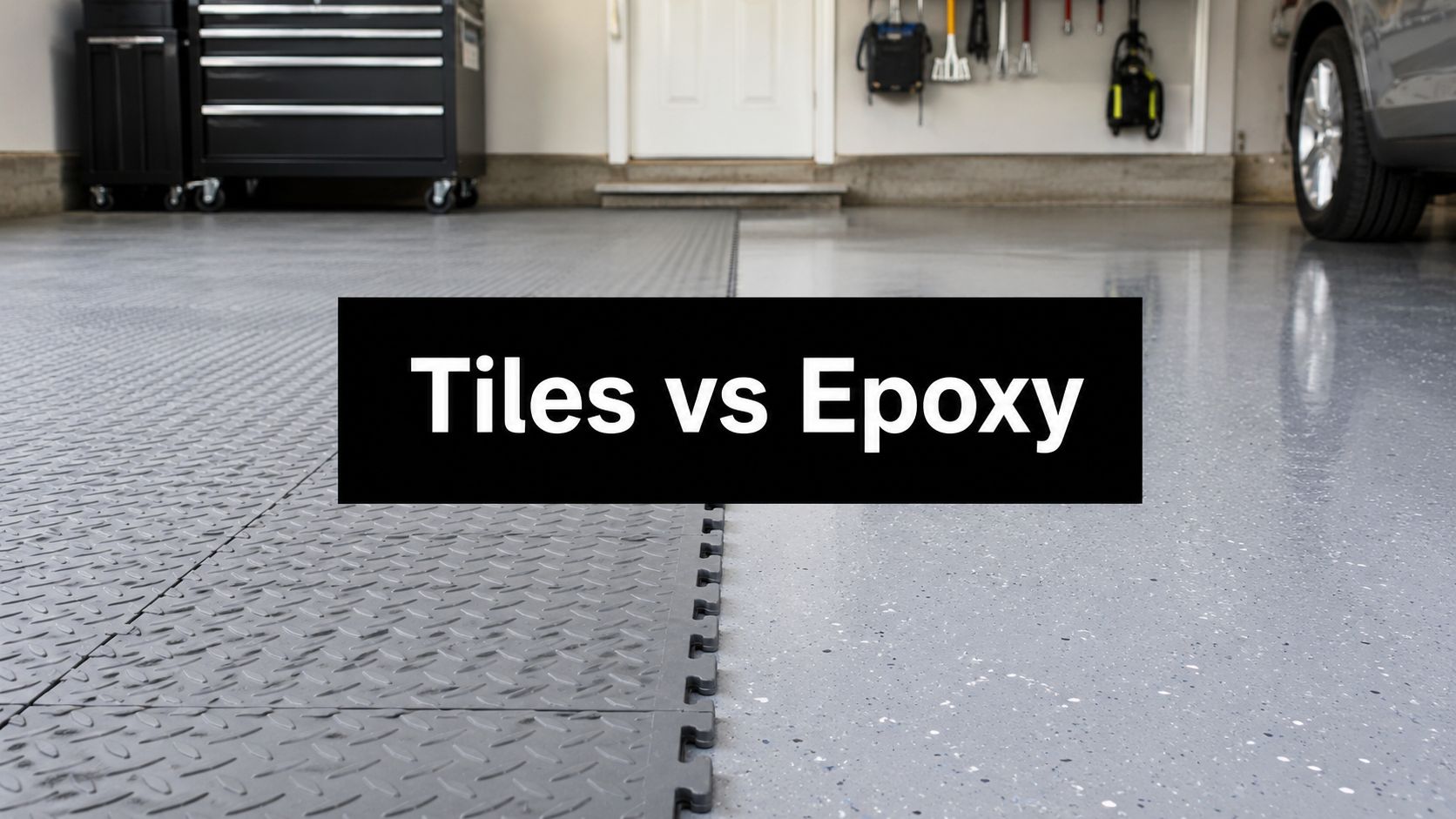
If you're standing in a cold garage in Pennsylvania, New Jersey, Delaware, or Maryland, staring at a stained slab with winter salt on the tires and cracks at the control joints, you're not really choosing between two finishes. You're choosing how much abuse your slab can take, how much moisture is hiding underneath it, and how much future hassle you're willing to live with.
That's why garage floor tiles vs epoxy is never just a looks conversation. The slab underneath decides a lot more than the brochure does, and if the concrete is cracked, damp, or out of level, the wrong floor just covers the problem until it turns into a bigger one. Firm Foundations has spent years prepping and pouring garage slabs across the Mid-Atlantic, and that background matters because a floor system only works as well as the concrete below it.
| Factor | Interlocking Tiles | Epoxy Coating |
|---|---|---|
| Surface feel | Modular, replaceable sections | Seamless coated finish |
| Typical material cost | $2.90–$8.00+ per sq. ft. | $3.00–$12.00+ per sq. ft. |
| 400 sq. ft. material range | About $1,000–$1,800 | About $600–$1,800 |
| Install timing | Usable the same day | 3–7 days before full use |
| Repair style | Swap a damaged tile | Recoat or blend a larger area |
A good starting point is the slab itself. If you want a deeper look at concrete underlayment and slab selection for garage use, this guide on best concrete for garage floor is worth a read before you buy anything. If the concrete is already telling you it needs repair, that's a slab problem first, not a flooring problem.
Why Your Garage Floor Decision Starts With the Slab
A homeowner usually notices the floor when the garage is at its worst, after a storm, after a salty commute, or after another winter has chewed up the concrete. The slab is stained, maybe powdery at the edges, maybe cracked along the cold joint, and now the question is whether tiles or epoxy will make it look better.
That's the wrong first question. The question is what the slab is doing under load, under moisture, and under seasonal temperature swings.
Read the concrete before you read the product label
A floor covering can hide a rough surface for a while, but it can't fix a slab that moves, sweats, or drains poorly. In older garages, especially around PA and NJ, I usually see a mix of hairline cracks, low spots, and moisture issues that show up only when the temperature drops and the garage gets closed up. That's where the choice starts to separate, because tiles tolerate imperfect concrete better, while epoxy demands a cleaner, drier, more stable base.
Practical rule: if the slab is already failing, spend your money on the slab first. Floor coating second.
That's also why local experience matters. Since 2011, Firm Foundations has handled garage slab prep, excavation, and concrete foundation work across Pennsylvania, Maryland, Delaware, and New Jersey, so the company sees the part most flooring ads skip, the base under the finish. Moisture testing, grading, and crack repair aren't glamorous, but they decide whether either flooring choice holds up in a Mid-Atlantic garage.
If you've ever had to deal with a moisture issue elsewhere in the house, the problem is rarely the finish. For a useful parallel on slab-related moisture trouble, Florida slab leak fixes shows how serious hidden water can be when it gets under concrete.
Garage Floor Tiles and Epoxy Side by Side
Garage floor tiles are interlocking polypropylene or PVC pieces that snap together over the slab. Epoxy is a bonded coating that chemically locks to properly prepared concrete and cures into a sealed surface. They solve the same problem in different ways, and the money behaves differently too.
Tiles often make sense when the slab has small flaws and the homeowner wants a floor that can be taken apart later. Epoxy makes more sense when the concrete is sound, the prep is done right, and the goal is a harder-wearing coated surface that stays put for years. In a Mid-Atlantic garage, that difference matters because winter salt, tracked-in slush, and summer humidity punish weak prep fast.
The price story is not as simple as a sticker on the box. Published comparisons in the brief place tiles at $2.90–$8.00+ per square foot for materials, while professional epoxy installation can run $3.00–$12.00+ per square foot depending on prep and system complexity, according to garage floor options over time. The same comparison says initial tile installation can run 20–40% more expensive than epoxy, even though tiles can be driven on immediately and epoxy may need 3–7 days of curing before full use.
For a typical 400-square-foot two-car garage, that source estimates tile materials at about $1,000–$1,800, while epoxy materials run about $600–$1,800 before labor is added for a professional epoxy job. That is why epoxy often wins on raw entry price and tiles often win on speed and serviceability.
Bottom line: if you want the garage back fast, tiles make sense. If you want the cleanest coated finish and you are willing to wait for cure time, epoxy is the sharper-looking option.
A deeper comparison of coating behavior is also useful before you choose. If you are weighing alternatives beyond basic paint, the polyaspartic vs epoxy guide helps explain why prep and coating chemistry matter so much.
Tile vs Epoxy at a Glance for a 400 sq ft Garage
| Factor | Interlocking Tiles | Epoxy Coating |
|---|---|---|
| Material cost | $2.90–$8.00+ per sq. ft. | $3.00–$12.00+ per sq. ft. |
| Typical 400 sq. ft. material range | $1,000–$1,800 | $600–$1,800 |
| Time before use | Same day | 3–7 days |
| Install style | Modular, replaceable | Coated finish |
| Budget profile | Often a higher initial outlay | Often lower upfront materials |
How Each System Is Installed and Prepped
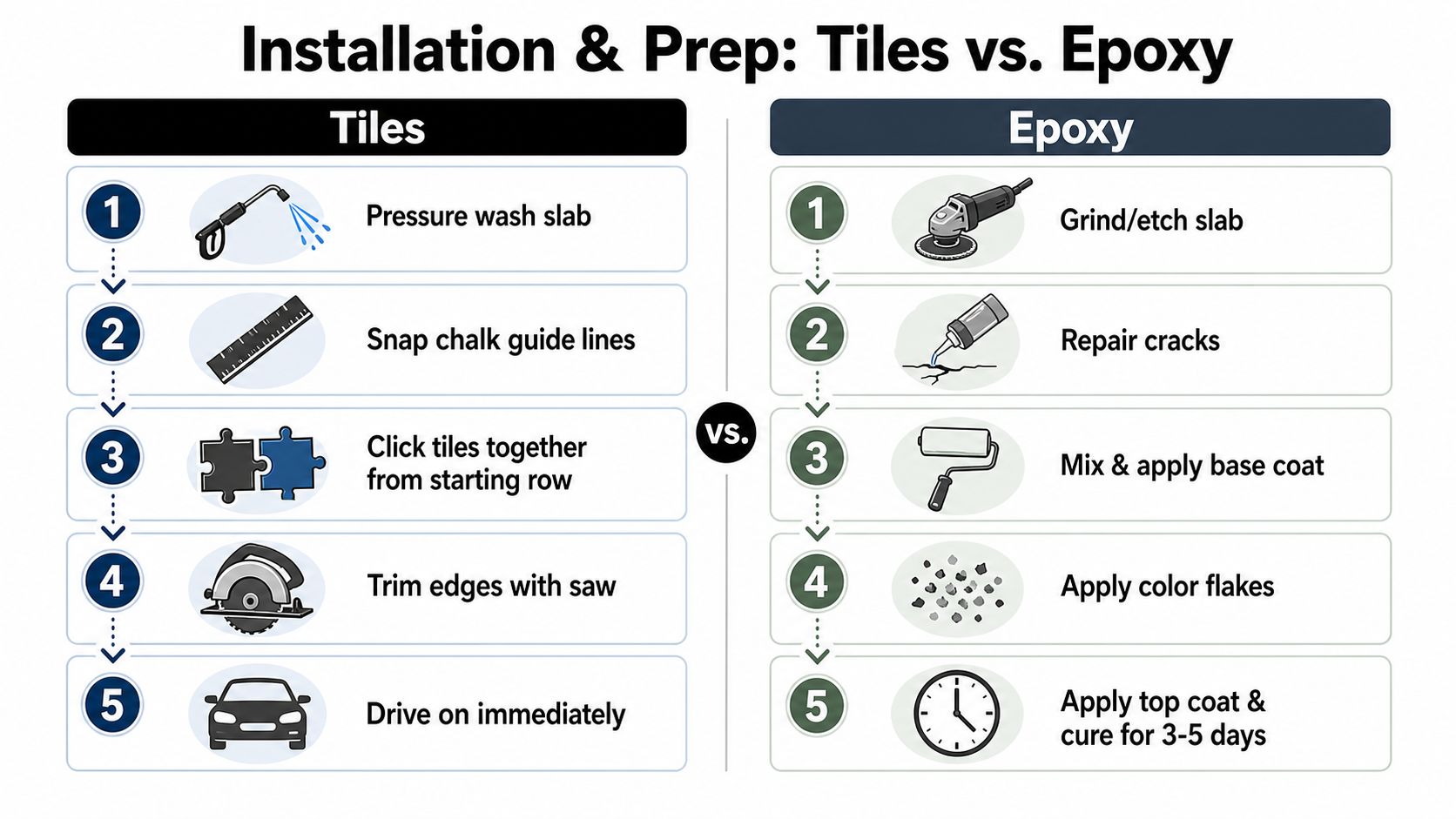
Tiles are simple because the concrete doesn't have to be perfect. You clean the slab, snap a starting row, click the pieces together, trim the edges with a saw, and you're basically done. If the garage is usable, the floor is usable right away.
Epoxy is a different animal. The slab has to be ground or acid etched, cracks need to be repaired, moisture has to be checked, and then the primer, base coat, flakes if used, and top coat all have to go down in the right order. The curing window matters, because the floor can't be treated like a finished surface until the system hardens fully.
Prep is where epoxy either succeeds or fails
Most epoxy failures don't start with the coating. They start with shortcuts in profiling, dust removal, crack repair, or moisture testing. That's why a slab in an older garage, especially one with hairline cracking, vapor issues, or a slight dip in one bay, can make the install turn ugly fast if the prep is rushed.
Good epoxy is a prep job with a coating on top of it.
Bad epoxy is just a shiny failure.
Tiles are more forgiving because they don't need the same chemical bond to the concrete. They still need a flat, clean slab, but the process is closer to a weekend layout job than a multi-day surface conversion. Epoxy is the better finished surface when everything beneath it checks out. Tiles are the easier choice when the slab is imperfect and the homeowner wants a fast result without grinding the whole garage.
Durability Load Rating and Chemical Resistance
The numbers that matter here are not the marketing photos. They are load resistance, impact resistance, and chemical resistance.
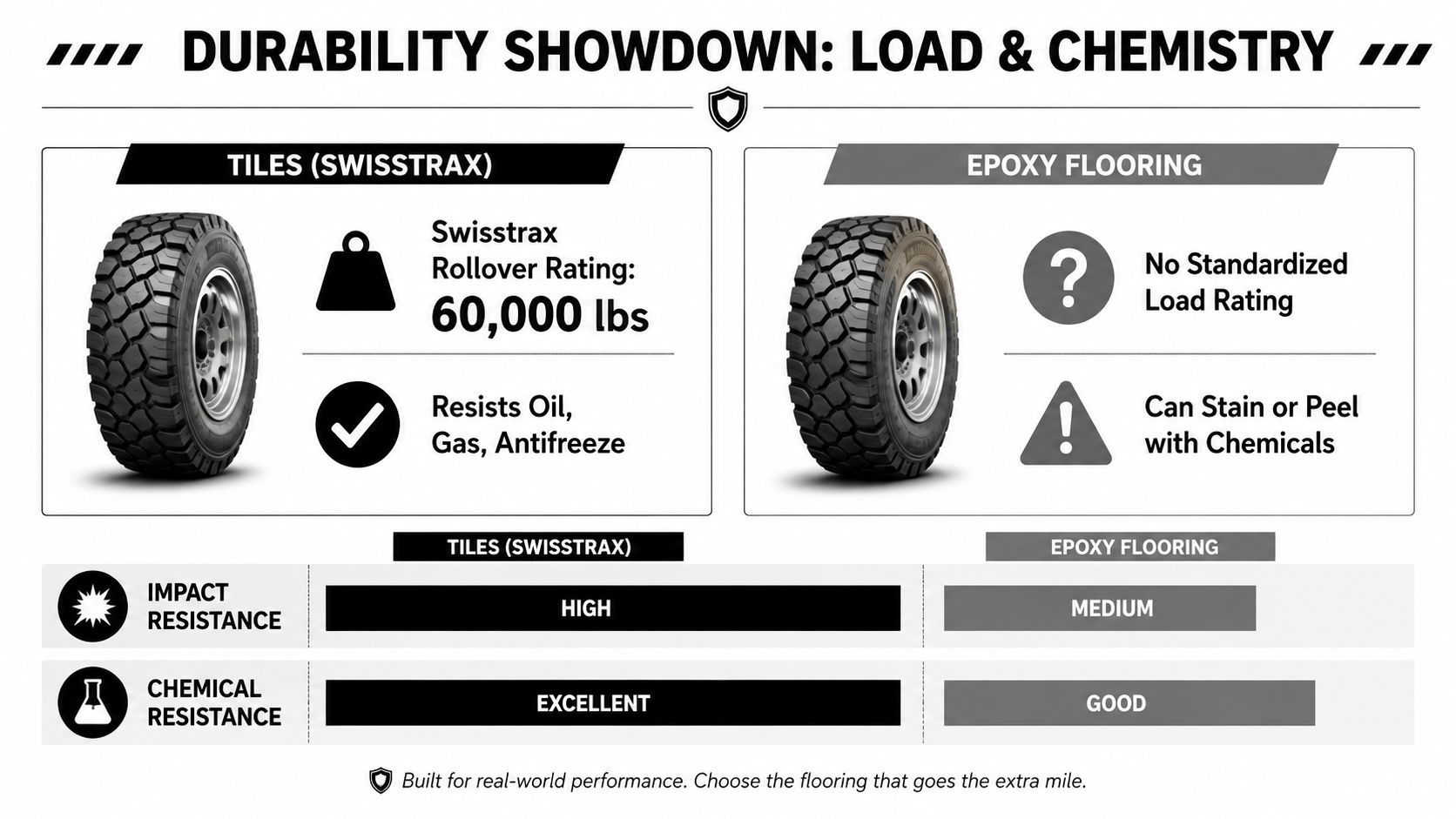
Swisstrax says its interlocking garage tiles are engineered to withstand 60,000 lbs rollover weight (Swisstrax rollover comparison). Epoxy does not get the same tile-style load rating, because its performance depends on the concrete prep and the integrity of the coating itself. That is why I do not talk about these products as if they are the same thing.
Common Causes of Damage in a Garage
Dropped tools, jack stands, oil drips, brake fluid, battery acid, and road salt are the true test. A well-installed epoxy floor gives you a surface that wipes clean more easily and usually stands up better to chemicals, while tiles handle impact better because a damaged section can be replaced without tearing up the whole floor. That repair advantage matters in a garage that sees heavy rolling loads or repeated point impact.
The surface chemistry matters too. If you want a closer look at coating chemistry and how the topcoat changes performance, the 2026 epoxy coating guide is a useful reference point.
My call on durability
If the garage is a workshop with rolling toolboxes, jacks, and constant abuse, tiles take the punishment better because you can isolate the damage. If the garage is mostly for daily-driver parking and cleanup after fluids, epoxy gives you the better surface over time when the slab and prep are right.
That tradeoff is modular replaceability versus coated-surface continuity. Neither one is magic. The better choice is the one that matches how the garage is used and how the slab underneath behaves. If moisture is part of the picture, a proper garage floor vapor barrier check belongs in the conversation before anyone commits to a coating.
The Winter Salt and Moisture Trap Nobody Talks About
Mid-Atlantic garages get hit hard in winter. Salt, slush, and freeze-thaw cycles ride in on tires for months, and that mess does not stay politely on top of the floor.
Some interlocking tile systems are free-draining, which means salty slush can work its way through the gaps and sit on the concrete unless the garage has a floor drain and the floor gets rinsed regularly (Cleveland Epoxy Flooring comparison). That is the part most comparison articles skip. The tile surface may look clean, but the slab below can still take the abuse from brine and trapped humidity.
Understanding the role of a garage floor vapor barrier helps explain why moisture control matters before any floor system goes down.
Epoxy seals, but only if the slab is ready
Epoxy does the opposite. It seals the slab and keeps liquid off the concrete as long as the coating stays intact. If the slab was damp before installation, trapped moisture can still cause bubbling or peeling later. That is why moisture testing matters so much in PA, MD, DE, and NJ garages, where cold weather and wet vehicles make moisture problems more common than people expect.
Firm Foundations deals with that issue before any floor system goes down. The crew tests slab moisture, checks grading, and fixes the concrete base first, because a floor system cannot correct bad drainage.
Winter rule: tiles need aggressive cleaning and a slope to drain. Epoxy needs a dry, tested slab before it ever gets rolled out.
I would rather see a homeowner solve the drainage problem once than keep fighting winter residue every season. If the garage floor cannot shed water, no surface layer will behave well for long.
Maintenance Repairs and Lifecycle Costs Over Time
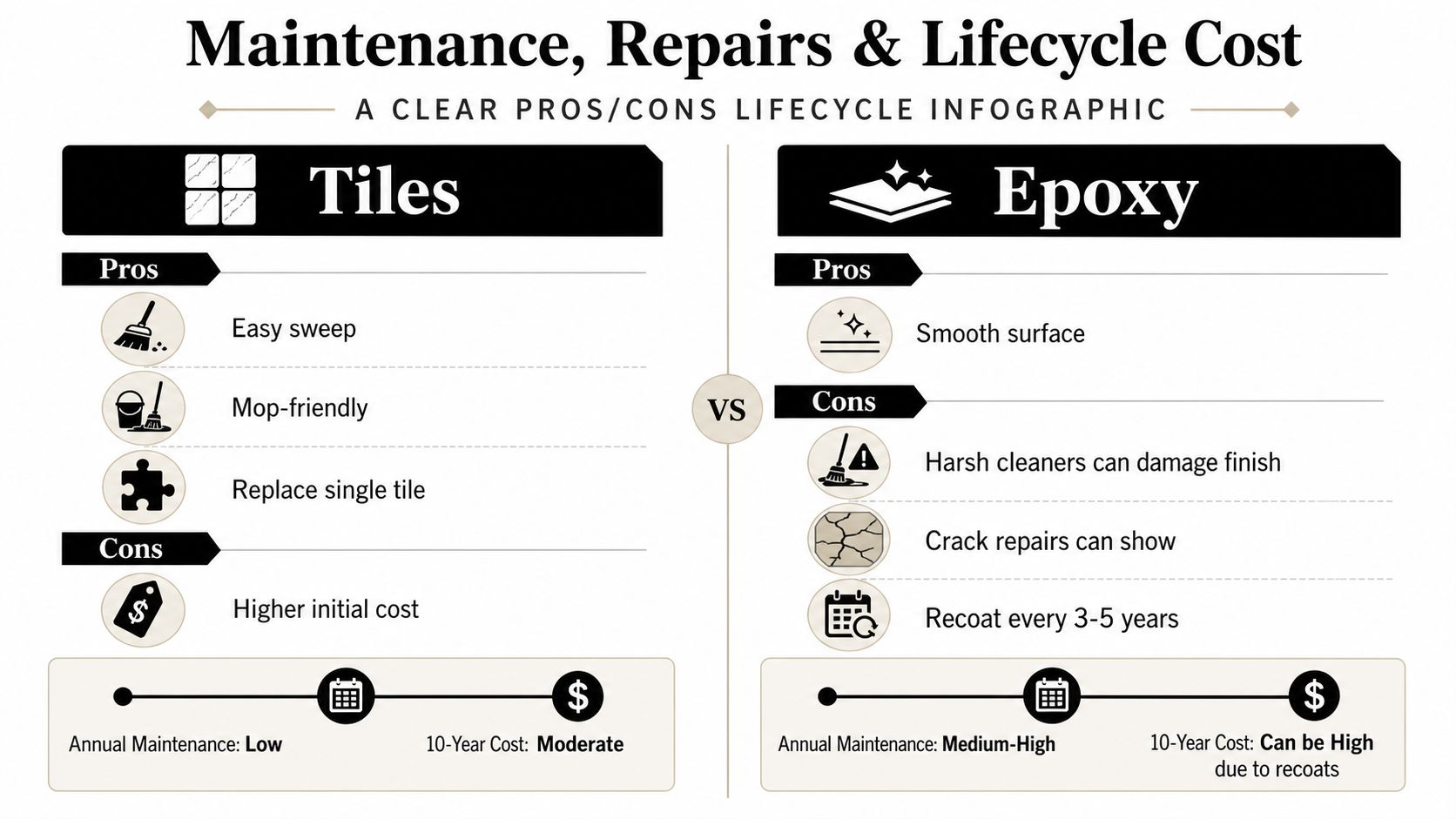
The yearly routine tells you more than the brochure does. Tiles get swept, mopped, and checked for any section that needs to come up for cleaning underneath. If one tile gets damaged, you replace that tile and keep going.
Epoxy is also easy to sweep and mop, but it asks for a little more discipline with cleaners and top-layer care. When a coated section fails, the repair often spreads beyond the visible patch because the new material has to blend into the surrounding floor.
Think in disruption, not just repair cost
The homeowner question isn't, “Which one costs less to install?” It's, “Which one disrupts my life less over ten or fifteen years?” A workshop garage tends to rack up tile swaps from impact, dropped tools, and heavy movement. A daily-driver garage tends to ask more of the epoxy surface through repeated traffic, salt exposure, and cleanup.
My rule of thumb: choose the floor that matches how often you want to touch it again.
Tiles usually win when you want simple, isolated repairs. Epoxy usually wins when you want the cleanest surface and you're willing to live with occasional recoating or blend work if the finish gets tired. Neither one should be judged by day one alone.
Which Floor Wins and When to Call a Pro
If the budget is tight and the slab is decent, tiles are the smarter weekend upgrade. You get the floor back fast, you avoid cure time, and you can swap damaged pieces later without tearing up the whole garage.
If you want a showroom finish and you plan to stay in the house for years, professionally installed epoxy makes more sense. It gives you the uniform look most homeowners want, and it does a better job of presenting the garage like a finished room.
Real-world recommendations by garage type
- Budget homeowner with a sound slab: Choose tiles. You'll spend more up front than a basic coating kit, but you'll avoid the grind, cure, and moisture anxiety that come with epoxy.
- Long-term owner who wants a polished finish: Choose epoxy after proper slab prep. The finish is cleaner, and the garage feels more permanent.
- Workshop with rolling tools and jack stands: Choose tiles. Damage stays local, and a bad section doesn't force a larger refinishing job.
- Daily-driver garage with road salt exposure and a dry slab: Choose epoxy. The surface handles cleanup well if the concrete was moisture-tested first.
If your slab is unlevel, cracked, or has never been checked for moisture, that comes first. In our PA, MD, DE, and NJ service area, the concrete under the floor matters more than the brand on the box, and that's exactly why a proper foundation and slab prep conversation beats a color sample every time.
Frequently Asked Questions From Mid-Atlantic Homeowners
Can epoxy be installed in winter in an unheated garage? It can be, but only if the slab conditions and product requirements line up. Cold concrete slows cure, and a damp slab is a bad candidate no matter how good the coating looks on the shelf.
Can I install interlocking tiles myself? Yes, and that's one of the main reasons people buy them. You still need a clean slab, a layout plan, a saw for trimming edges, and enough patience to get the first row straight.
Do either of these add resale value in Pennsylvania or New Jersey? A clean garage helps perception, but buyers usually respond more to the condition of the slab and the overall finish than to the brand of flooring. An epoxy floor tends to read as more polished, while tiles read as more flexible and serviceable. The stronger resale move is choosing the system that makes the garage look dry, maintained, and structurally sound.
Firm Foundations can help you start with the right base before you choose tiles or epoxy. If your garage slab needs moisture testing, crack repair, grading, or a new concrete foundation, visit Firm Foundations and request a free quote. A floor only lasts when the concrete underneath is ready for it.