
Frost Line Depth Pennsylvania: 2026 Foundation Guide
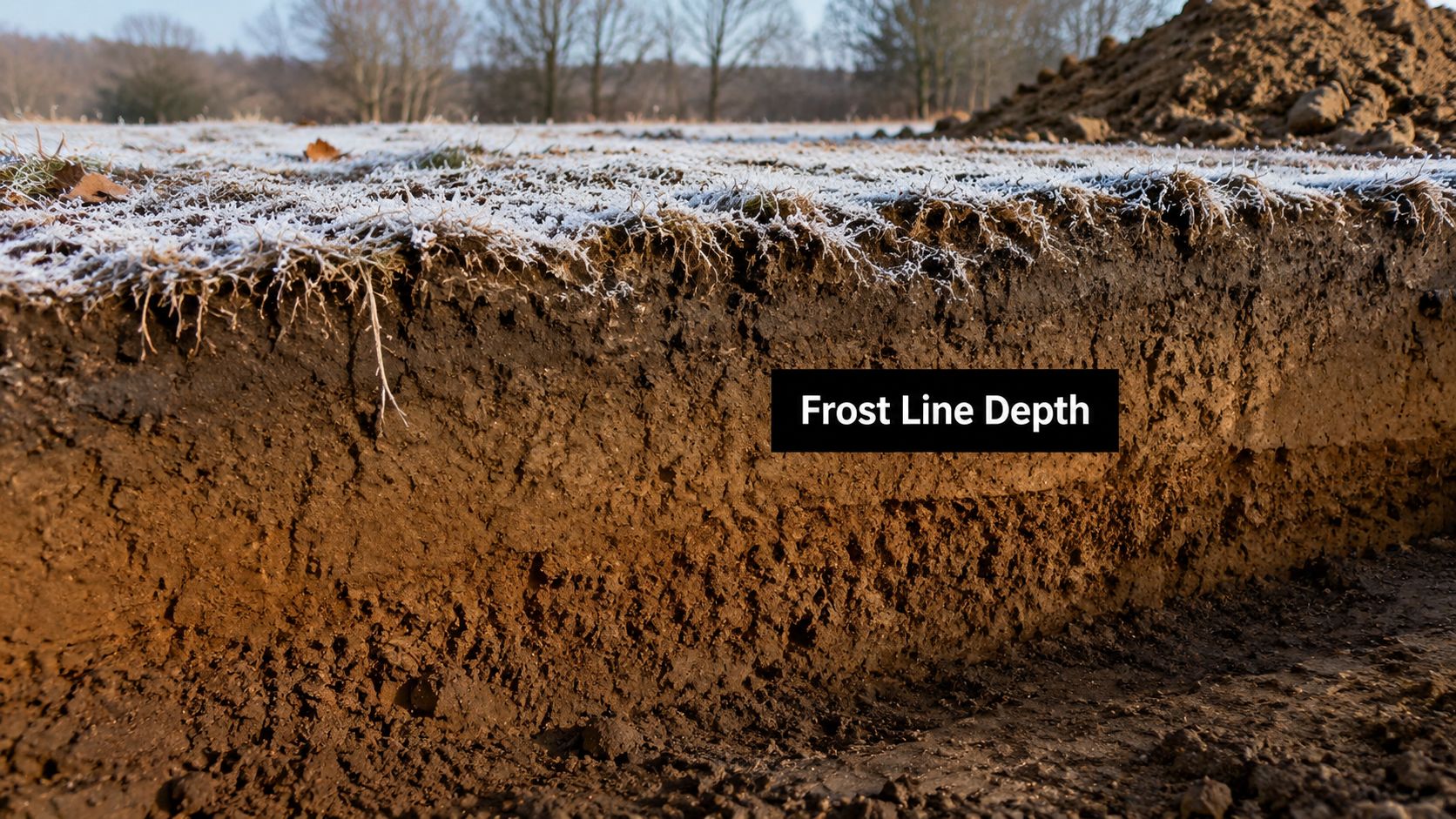
You've picked the shed, sized the garage, or marked out the gazebo. Then the project hits the same wall a lot of Pennsylvania property owners hit. Someone says, “Make sure you're below the frost line,” and suddenly a simple pad or footing job doesn't feel simple anymore.
That concern is justified. If the foundation system doesn't match the site, the structure can move, doors stop closing right, slabs crack, posts lift, and what looked like a straightforward build turns into a repair project. For homeowners searching frost line depth Pennsylvania, the frustrating part is that many pages give one number and move on. That's not how real site work works.
Your PA Foundation Project Starts with the Frost Line
A typical call starts with a homeowner who wants a shed foundation, a detached garage slab, or a base for storage shed delivery. They've already done the fun part. They picked the building style, the size, and the location in the yard. Then the dealer, township, or inspector asks about footing depth, and now they're trying to figure out whether they need a full concrete foundation, a gravel shed foundation, piers, or something else.
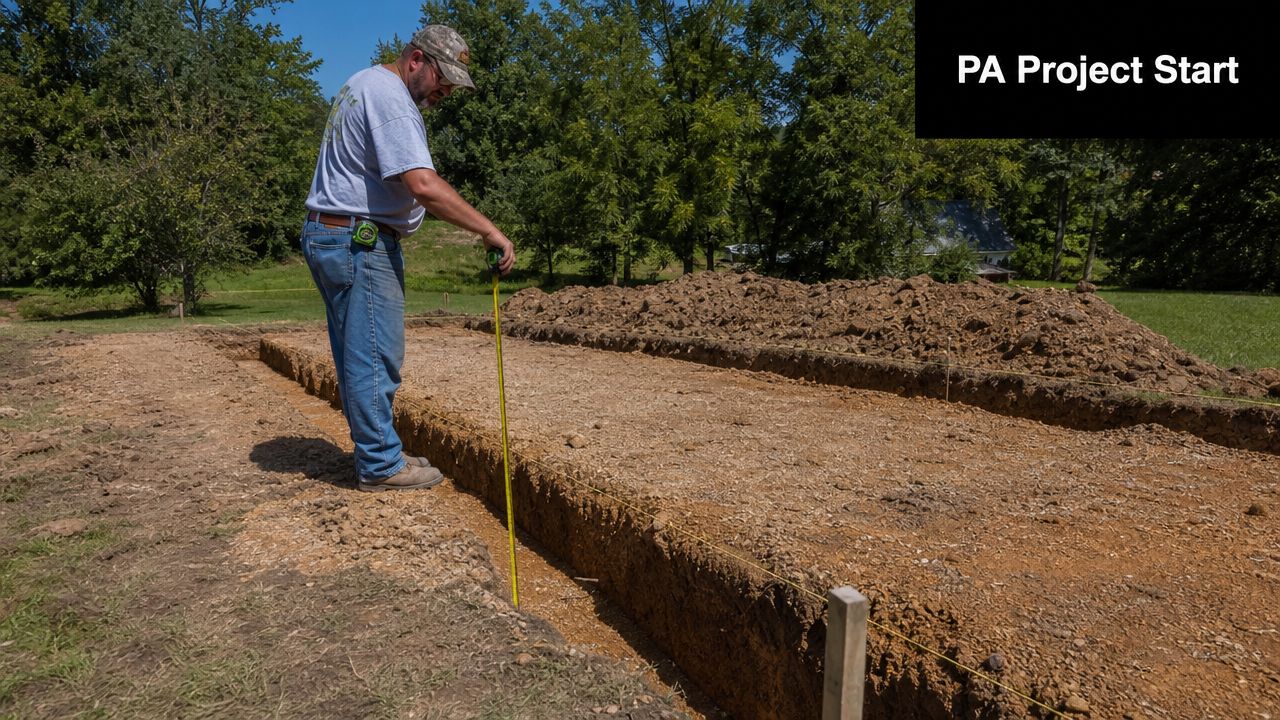
The first thing to clear up is simple. There isn't one universal answer for every project in Pennsylvania. One source notes that many people search for a single statewide number and may see 44 inches mentioned as an average, but official guidance is more location- and condition-dependent, and drainage and soil type matter just as much as depth (Andreas Plumbing on Pennsylvania frost depth context).
Why one number leads people wrong
A concrete foundation for garage use is not judged the same way as a light accessory structure in every situation. A shed on a well-drained stone pad behaves differently from a slab poured on wet, churned-up clay. A heated building behaves differently from an unheated one. A protected site near the house behaves differently from an open field that catches wind and holds water.
That's why the smart question isn't just “What's the Pennsylvania frost line?” The smart question is:
- What are you building
- Where on the property is it going
- How wet is the soil
- Will the structure be heated
- Is deep excavation the best option for this site
Practical rule: If someone answers your foundation question with one number before asking about the structure, soil, drainage, and intended use, they're skipping the part that prevents callbacks.
There's also a big difference between general web advice and actual foundation design choices. If you want a broader look at how engineers think about designing shallow and deep foundations, that framework helps explain why different structures call for different support systems even on the same property.
What homeowners usually need to decide
Most Pennsylvania property owners are choosing between a few practical options:
| Project type | Common foundation direction | Main concern |
|---|---|---|
| Shed or small outbuilding | Engineered gravel pad or piers | Drainage and movement |
| Detached garage | Footings with slab or slab system | Load, vehicle weight, frost protection |
| Gazebo foundation | Piers, footings, or slab | Uplift, level support, water flow |
| Patio or light accessory slab | Site prep and frost strategy | Surface cracking and heave |
If you're searching for shed foundations near me, garage foundation contractors near me, or concrete contractors in Pennsylvania, this is what you need. Not a shortcut answer. You need the right system for your exact build.
What is Frost Heave and Why It Matters in Pennsylvania
Frost heave is ground movement caused when water in the soil freezes and creates upward pressure. The easy way to understand it is a frozen bottle of water. Water takes up more room when it turns to ice. In soil, that expansion can push against footings, slabs, posts, and surface materials.
Pennsylvania gets the kind of winter pattern that makes this a real construction issue. Cold snaps, thaw periods, wet soil, and repeated freeze-thaw cycles put a lot of stress on foundations that weren't prepared correctly. That's why builders who do this work every day pay as much attention to water management as they do to excavation depth.
What actually causes the damage
The frost itself isn't the whole story. The trouble starts when three conditions show up together:
- Moisture in the ground gives freezing conditions something to act on
- Frost-susceptible soil allows movement
- A structure with poor support can't resist that movement cleanly
A shallow footing in wet soil can lift unevenly. One corner moves first. Another stays put. The result might be a crack in a slab, a twisted door frame, or a shed that no longer sits square on its base.
Where people get fooled
Some sites look solid in dry weather and fail after the first winter. That usually happens when the top looks firm, but the base holds water or the excavation disturbed the soil too much before the foundation went in. A lot of failed cement foundations for garage projects and uneven gazebo foundation installs trace back to that problem.
The best-looking slab on pour day can still fail if the subgrade is soft, wet, or poorly drained.
For smaller structures, people also assume “lightweight” means “no problem.” That's not true. A shed doesn't need the same support as a house foundation, but it still needs a stable, well-drained base. If one side of the pad stays wetter than the other, the building can rack and settle out of level.
What works and what doesn't
Here's the practical version from the field.
What works
- Clean drainage stone under the right structures
- Compacted subgrade before stone or concrete goes in
- Positive drainage away from the build area
- Foundation selection matched to use, not guesswork
What doesn't
- Pouring over soft fill
- Assuming a thicker slab fixes bad site prep
- Using random crushed material without drainage planning
- Ignoring roof runoff and slope around the building
National engineering research also helps explain why one statewide frost answer falls short. The Federal Highway Administration classifies frost penetration as shallow at 0 to 0.6 meters (0 to 1.97 feet), medium at 0.6 to 0.9 meters (1.97 to 2.95 feet), and deep at 0.9 meters (2.95 feet) or more, which is useful because footing and excavation choices are made by comparing local expectations with code minimums rather than relying on a single statewide constant (FHWA frost penetration bands).
That's why experienced excavation near me crews spend time reading the site before they dig. Frost heave is a soil-and-water problem first. The foundation only survives if the site prep respects that.
Pennsylvania Frost Depths A Region by Region Guide
Ask three Pennsylvania property owners about frost depth and you'll often get three different answers. That's because the state doesn't behave like one climate zone. Conditions in the southern part of the state aren't the same as conditions farther north or in higher, colder areas.
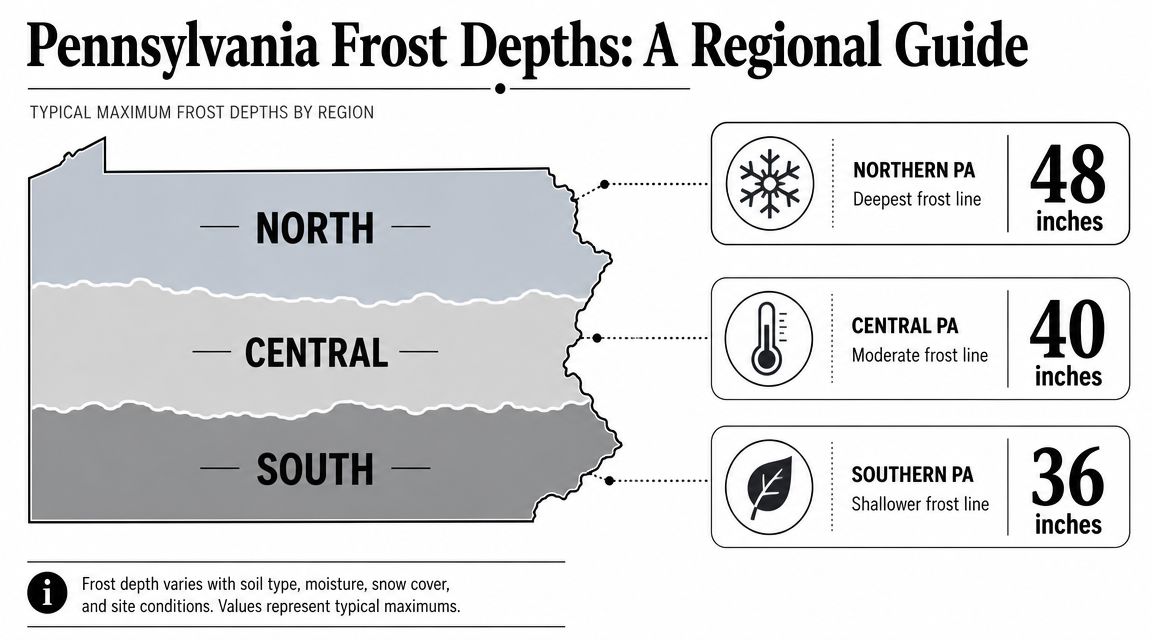
For planning purposes, homeowners often think in broad regional terms. The infographic above reflects a simplified regional pattern people commonly use in the field: Northern PA at 48 inches, Central PA at 40 inches, and Southern PA at 36 inches. That's useful as a starting point, not a substitute for local code review and site-specific judgment.
How regional patterns affect real projects
A detached garage in southern Pennsylvania may call for a different excavation plan than the same garage in the northern tier. The same is true for a barn shed, 10×10 storage shed, or shipping container base. Colder regions generally push builders toward deeper traditional footing strategies unless another engineered frost-protection method makes better sense.
Here's a simple planning view:
| Pennsylvania area | Typical planning expectation | Practical effect |
|---|---|---|
| Southern counties | Shallower frost concerns than colder regions | May reduce excavation compared with colder areas |
| Central Pennsylvania | Moderate frost exposure | Often calls for careful balancing of depth and drainage |
| Northern and colder western areas | Deeper frost concerns | Greater need for robust frost strategy |
Why region alone still isn't enough
Regional guidance gets you in the ballpark. It doesn't finalize the job. Two sites in the same county can need different approaches because of slope, exposure, wet ground, fill material, and the kind of structure you're supporting.
A gravel pad for a prefab shed may be the right answer on one lot and the wrong answer on another. A slab for a detached garage might perform well on a dry, prepared site but struggle where runoff from a hill keeps feeding water under the build area.
If the site stays wet after a storm, solve that before arguing over another few inches of excavation.
The contractor's view of local variation
Experienced local crews distinguish themselves from generic advice pages. They know that garage footings and foundations in one township can run into very different field conditions than a nearby project, even when both owners searched the same term online. They also know that proper layout, stripping topsoil, controlling runoff, and compacting subgrade are part of the frost answer.
Those looking for garage foundation contractors near me, gravel shed foundation contractors near me, or driveway contractors near me are often in need of someone who can evaluate the entire build envelope:
- The structure load
- The drainage path
- The soil condition after excavation
- The best foundation type for the budget
The map gets you started. The site decides the build.
Meeting Code for Garage and Shed Foundations
Code isn't paperwork for its own sake. It's the minimum standard for a foundation that has a realistic chance of lasting. For garage footings and foundations, detached outbuildings, and concrete work tied to inspections, local municipal requirements are the final word.
That matters because accessory structures often fall into gray areas for homeowners. People assume a detached garage, shed, or gazebo is “just a small building.” Inspectors don't look at it that way if the loads, anchoring, or frost exposure require a more deliberate foundation system.
Why structure type changes the answer
A heated building can behave differently from an unheated one because the conditions around the foundation aren't identical. A garage that stays cold all winter shouldn't be treated like conditioned interior space. A light shed delivered onto a prepared pad also isn't the same as a site-built garage with framed walls, vehicle loads, and anchored slab edges.
Pennsylvania guidance for manufactured housing shows how nuanced these rules can get. The Pennsylvania Housing Research Center guide ties foundation depth to a state map and states that foundations should be built at least as deep as the values shown there. It also notes that skirting can reduce required depth by 12 inches for portions of the foundation located 6 feet or more inward from the skirting, but a minimum depth of 18 inches still has to be maintained for adequate soil bearing capacity (Pennsylvania Housing Research Center frost depth guide).
That example isn't a shortcut rule for every shed or garage. It shows something more important. The rules can be conditional. They can change by structure type and by where on the foundation system you're measuring.
What code compliance protects you from
A code-based approach reduces a lot of common failure points:
- Underbuilt footings that move after the first hard winter
- Poor permit assumptions that delay delivery or inspections
- Improvised slab edges that weren't designed for frost exposure
- Wrong foundation choice for the intended use of the structure
Common homeowner mistakes
Some of the most expensive errors start with good intentions.
One is using a house-style answer for a shed. Another is treating a detached garage like a floating patio slab. A third is assuming the shed dealer's generic recommendation automatically satisfies local requirements. It might. It might not.
Code takeaway: A foundation that passes casual visual inspection can still fail an actual permit review or inspection if the footing depth, bearing, or drainage details don't match the project.
If your project needs permits, inspections, or engineered review, code compliance needs to be built into the plan from the start. It's a lot cheaper to align the design before excavation than to redo concrete after a stop-work notice or failed inspection.
Smarter Solutions Frost Protected Foundations and Gravel Pads
“Just dig deeper” is sometimes the right answer. It's not always the best one.
For many accessory structures in Pennsylvania, the better conversation is about which frost strategy fits the structure, soil, and budget. That's where frost-protected shallow foundations, engineered gravel pads, and insulated systems become useful. They don't ignore frost. They manage it differently.
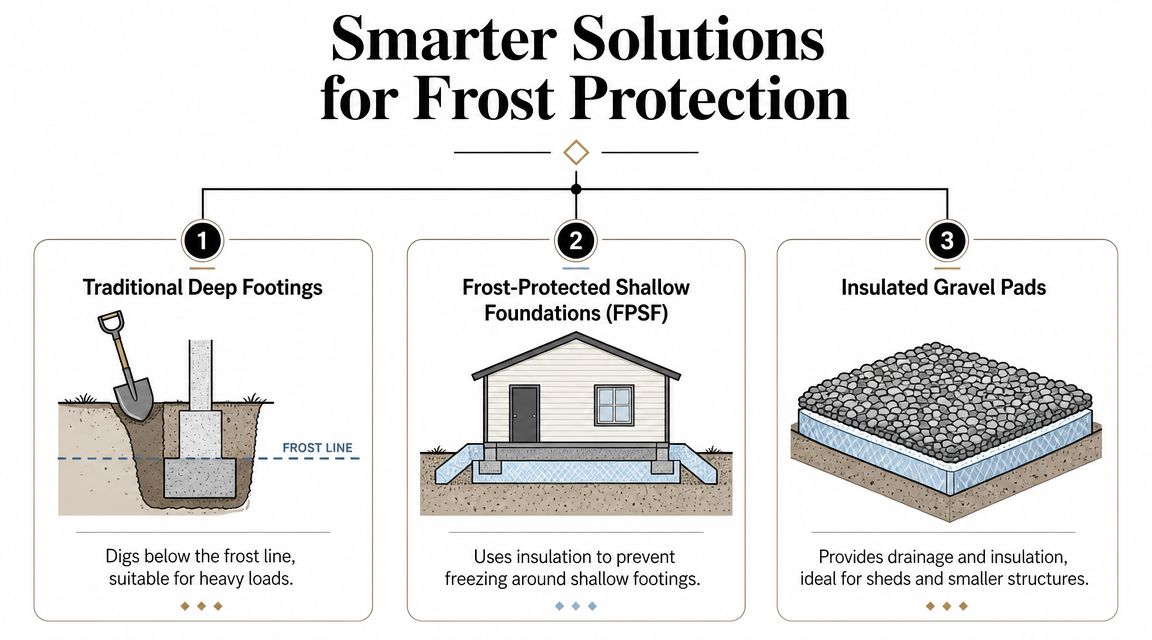
Engineering guidance notes that rigid perimeter insulation and granular fill can be used to reduce frost heave risk instead of relying only on deep excavation. This frost-protected shallow foundation approach is a viable alternative to traditional deep footings, especially for garages and sheds where budget and site conditions drive the decision (overview of frost-protected shallow foundations).
Traditional deep footings
This is the familiar method. Excavate below expected frost influence, form and pour the footing, then build from there.
It's a strong choice for heavier structures, higher loads, and projects where local requirements clearly point to conventional footings. It's also familiar to inspectors and straightforward to explain on permitted builds.
The tradeoff is labor and excavation. On some sites, going deeper means more spoil removal, more form work, and more disturbance to the yard.
Frost-protected shallow foundations
A frost-protected shallow foundation uses insulation placement and controlled site conditions to limit freezing around the footing area. Instead of winning the fight by depth alone, it changes the thermal and moisture conditions that cause heave.
This can make sense for certain concrete foundations, detached garages, and accessory structures where deep digging is difficult or costly. If you want a practical look at slab-edge insulation details, this guide to concrete slab insulation options helps show how insulation fits into the overall system.
Engineered gravel pads
For many shed projects, a properly installed gravel shed foundation is the most cost-effective answer. Not loose stone dumped on grass. A real pad with stripped topsoil, a stable sub-base, clean compacted aggregate, correct elevation, and drainage planned around the perimeter.
That kind of pad solves a major part of the frost problem by moving water away from the building base and reducing saturation where freezing would otherwise create movement. It's often the right fit for prefab sheds, smaller outbuildings, and some light-use structures where a full concrete footing system would be overbuilt.
A gravel pad doesn't work because gravel is magic. It works when the pad is thick enough, compacted correctly, elevated properly, and allowed to drain.
Which option fits which project
Here's the simplest side-by-side view:
| Foundation option | Best fit | Main advantage | Main limitation |
|---|---|---|---|
| Deep footings | Heavy garages, higher loads, code-driven builds | Familiar and robust | More digging and site disruption |
| FPSF | Select garages and accessory structures | Less excavation in the right conditions | Needs proper design and detailing |
| Gravel pad | Sheds and lighter outbuildings | Strong drainage and lower complexity | Not right for every structure |
What usually wastes money
Overspending often comes from using a house-scale solution for a shed, or using a shed-scale solution for a garage. Both mistakes happen all the time.
A small prefab building doesn't always need a deep concrete system. On the other hand, a detached garage that will carry vehicles and anchored framing usually shouldn't be treated like a basic storage shed base. The right answer comes from matching foundation type to actual use, not building the biggest thing by default.
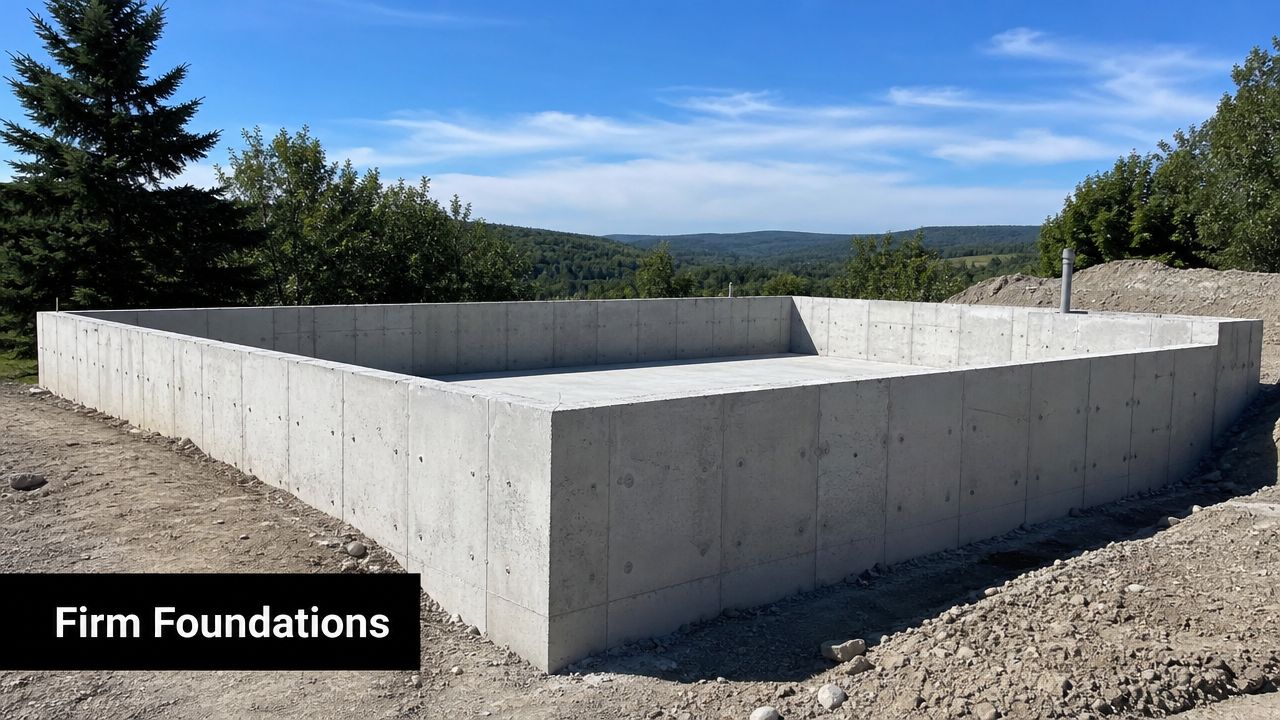
Lay the Right Groundwork with Firm Foundations
A definitive answer to frost line depth Pennsylvania isn't a single number. It's a decision about site conditions, structure type, drainage, soil behavior, and the foundation system that gives you the best long-term result.
That's why good foundation work starts before the first bucket of dirt comes out. You need the right layout. You need proper excavation. You need support that matches the structure. And you need a base that won't turn into a water trap after the first freeze-thaw cycle.
The foundation is only as good as the ground under it
A lot of problems blamed on “bad concrete” are really subgrade problems. If the soil isn't stable and compacted correctly, even a well-finished slab can move. If you want a practical explanation of why that matters, this overview of soil compaction and why it affects foundations is worth reading.
What to keep in mind before you build
Before you schedule delivery or excavation, make sure you've answered these practical questions:
- What will the structure be used for. Storage shed, vehicle garage, gazebo, hot tub base, or something heavier.
- How does water move across the site. A dry-looking area in summer may hold runoff in winter.
- Does the township require a specific footing approach. That answer can change the whole plan.
- Would a gravel pad, slab, or deeper footing system be the better investment. Cheapest up front and best value over time aren't always the same.
The best projects get these answers early. That prevents redesigns, delays, and expensive fixes after the building is already on site.
If you need shed foundation contractors near me, garage foundation contractors near me, concrete foundations, or an engineered base for storage shed use in Pennsylvania and nearby service areas, the smartest move is getting the site evaluated before materials or buildings arrive.
If you're planning a shed pad, detached garage, gazebo foundation, concrete slab, or excavation project, Firm Foundations can help you choose the right solution for your site in Pennsylvania, Maryland, Delaware, or New Jersey. The team builds gravel pads, concrete foundations, and footing systems that prioritize drainage, stability, and long-term performance. Reach out for a free quote and get clear guidance before you dig.